



SNL does Girls
I love Girls, I love Saturday Night Live, I love Tina Fey, so this was pretty much perfect for me:
An Albanian girl named Blerta moves to Brooklyn and offers sage advice to Hannah, Marnie, Jessa and Shoshanna.

This site is made possible by member support. 💞
Big thanks to Arcustech for hosting the site and offering amazing tech support.
When you buy through links on kottke.org, I may earn an affiliate commission. Thanks for supporting the site!
kottke.org. home of fine hypertext products since 1998.
Beloved by 86.47% of the web.
I love Girls, I love Saturday Night Live, I love Tina Fey, so this was pretty much perfect for me:
An Albanian girl named Blerta moves to Brooklyn and offers sage advice to Hannah, Marnie, Jessa and Shoshanna.
Light (aka electromagnetic radiation) is responsible for most of what we know about the universe. By measuring photons of various frequencies in different ways — “the careful collection of ancient light” — we’ve painted a picture of our endless living space. But light isn’t perfect. It can bend, scatter, and be blocked. Changes in gravity are more difficult to detect, but new instruments may allow scientists to construct a different map of the universe and its beginnings.
LIGO works by shooting laser beams down two perpendicular arms and measuring the difference in length between them-a strategy known as laser interferometry. If a sufficiently large gravitational wave comes by, it will change the relative length of the arms, pushing and pulling them back and forth. In essence, LIGO is a celestial earpiece, a giant microphone that listens for the faint symphony of the hidden cosmos.
Like many exotic physical phenomena, gravitational waves originated as theoretical concepts, the products of equations, not sensory experience. Albert Einstein was the first to realize that his general theory of relativity predicted the existence of gravitational waves. He understood that some objects are so massive and so fast moving that they wrench the fabric of spacetime itself, sending tiny swells across it.
How tiny? So tiny that Einstein thought they would never be observed. But in 1974 two astronomers, Russell Hulse and Joseph Taylor, inferred their existence with an ingenious experiment, a close study of an astronomical object called a binary pulsar [see “Gravitational Waves from an Orbiting Pulsar,” by J. M. Weisberg et al.; Scientific American, October 1981]. Pulsars are the spinning, flashing cores of long-exploded stars. They spin and flash with astonishing regularity, a quality that endears them to astronomers, who use them as cosmic clocks. In a binary pulsar system, a pulsar and another object (in this case, an ultradense neutron star) orbit each other. Hulse and Taylor realized that if Einstein had relativity right, the spiraling pair would produce gravitational waves that would drain orbital energy from the system, tightening the orbit and speeding it up. The two astronomers plotted out the pulsar’s probable path and then watched it for years to see if the tightening orbit showed up in the data. The tightening not only showed up, it matched Hulse and Taylor’s predictions perfectly, falling so cleanly on the graph and vindicating Einstein so utterly that in 1993 the two were awarded the Nobel Prize in Physics.
Disney and JJ Abrams are rebooting the Star Wars franchise. This two-minute video outlines four simple rules that could make Star Wars great again.
The rules are:
1. The setting is the frontier.
2. The future is old.
3. The Force is mysterious.
4. Star Wars isn’t cute.
Jay Porter recently wrote a series of posts about his experience running a restaurant that abolished tipping. Here’s part one:
This is a summary of the experiences I had in our no-tipping lab, and in my next few posts I’ll dig a little deeper into each of them. Then I’ll finish this series by talking about what I’ve learned this year from a couple new friends who are researchers from the University of Guelph, and who have brought me in contact with some deeper thoughts about the tipping issue, from the social justice side. After seeing what they and their colleagues have uncovered, I’ve become convinced that thoughtful cultures who value civil rights will make tipping not just optional but illegal; and that this could actually happen sooner rather than later, when courts assess the reality of the situation.
If you want the Cliff Notes version, Porter wrote a shorter piece for Slate.
When we switched from tipping to a service charge, our food improved, probably because our cooks were being paid more and didn’t feel taken for granted. In turn, business improved, and within a couple of months, our server team was making more money than it had under the tipped system. The quality of our service also improved. In my observation, however, that wasn’t mainly because the servers were making more money (although that helped, too). Instead, our service improved principally because eliminating tips makes it easier to provide good service.
For his Full Turn project, Benjamin Muzzin mounted two screens back-to-back on a rotating platform and spun them fast, creating the illusion of a holographish 3D image.

And scene! No Kottke.org guest editor takeover would be complete without a birthday card by frequent Kottke.org illustrator, Chris Piascik.
The craziest thing about this thing we put together is that it wasn’t until the last minute that we knew for sure it was your 40th birthday. But we figured even if you were turning 39, we were going for it anyway. Thanks for the good times, and for leaving your back door open. We hope you and everyone who reads Kottke.org liked the party we threw.
Aaron, Adam, Ainsley, Anil, Choire, Chris, David, Greg, Joel, Sarah, and Tim!
The Kottke post I probably think about most often is 2009’s “One-handed computing with the iPhone.” It just has all these perfectly rounded sentences in it, like this one:
A portable networked computing and gaming device that can be easily operated with one hand can be used in a surprising variety of situations.
Try to take the adjectives and adverbs out of that sentence. (Strunk and White say to “write with nouns and verbs, not adjectives and adverbs.” Strunk and White are often surprisingly stupid.)
But try adding any more adjectives or adverbs. Try adding in or taking away any of the clauses. Try writing a better sentence that describes the same thing. (This is also known as Mohammed’s “produce a better surah” Test.) Try to misunderstand what the sentence means. I’m a professional writer. So is Jason. I appreciate this stuff.
There’s also a lot of structural and emotional variety in this post. The author gets mad. He makes jokes. But mostly, he observes. He studies. He empathizes.
People carry things. Coffee, shopping bags, books, bags, babies, small dogs, hot dogs, water bottles, coats, etc. It’s nice to be able to not put all that crap down just to quickly Google for the closest public restroom (aka Starbucks).
It is very occasionally necessary to use the iPhone while driving. No, not for checking your stock portfolio, you asshole. For directions. Glance quickly and keep your thoughts on the road ahead.
My wife spends about five hours a day breastfeeding our daughter and has only one hand available for non-feeding activities. That hand is frequently occupied by her iPhone; it helps her keep abreast (hey’o!) of current events, stay connected with pals through Twitter & email, track feeding/sleeping/diaper changing times, keep notes (she plans meals and grocery “shops” at 3am), and alert her layabout husband via SMS to come and get the damned baby already.
I liked “layabout husband” so much when I read it, I started referring to Jason as “noted layabout Jason Kottke.” At a certain point, I forgot where the phrase came from.
But read that last paragraph again. You can’t read that description of Meg and not think of it every time you’re doing any of the things she does in that sentence: every time you have to have to carry a bag and use your phone, every time you have to open a door and use your phone, every time you don’t have to use your phone while walking down the street but you do it anyways, because you can, and the fact that you can now means that you have to.
I think about it every time I cover a new gadget and companies start touting its hands-free features; how it’s added a new voice interface; how its new keyboard algorithm makes it easier to correct for typos. People didn’t really use to market that sort of thing. But companies started to notice that these were the features their customers liked best.
I also thought about it when I read these tweets Meg wrote, just yesterday and this morning, about how the newer iPhone’s longer screen borks its one-handed functionality.
New iPhone (was on 4S): holding w left hand, pinky supporting bottom-right corner, my thumb can’t reach diagonal to top right buttons…
— Meg Hourihan (@megnut) September 26, 2013
It’s unstable to reach across, so I can’t use phone one handed anymore. This is a huge physically change/fail for me. :(
— Meg Hourihan (@megnut) September 26, 2013
From here on out its front faces until my thumb grows or I get a man-hand transplant.
— Meg Hourihan (@megnut) September 26, 2013
Ugh “front faces”?! No. Frowny faces.
— Meg Hourihan (@megnut) September 26, 2013
How I used the 4S https://t.co/wJk5WI2aEf
— Meg Hourihan (@megnut) September 26, 2013
After 6 hrs, guess iOS7 & iPhone 5 designed mostly by 20-something males. Phone too long for (my) female hand, text too small for 40yo eyes!
— Meg Hourihan (@megnut) September 26, 2013
I have enormous man-hands, and I still think that the trend toward enormous screen sizes on smartphones stinks. Not only is it harder to use a phone with one hand, it’s harder to fit a phone in a pants pocket, and a long, thin phone is more likely to tip over and get knocked off a table or shelf.
Markets are gonna market, and specs are gonna spec, but it often feels like companies are forgetting that computers are for people, first. And people have bodies, those bodies have limitations, and all of us have limitations in specific situations.
We’re all disabled sometimes. If I turn off the lights in your room, you can’t see. If I fill the room with enough noise, you can’t hear. If your hands are full, you can’t use them to do anything else.
But as Sara Hendren writes, “all technology is assistive technology.” When it’s working right, technology helps people of every ability overcome these limitations. It doesn’t throw us back into the world of assumptions that expects us all to be fully capable all of the time.
That’s not what good technology does. That’s not what good design does. That’s what assholes do.
I think often about Jason’s post on one-handed computing because I’m in the story. He wrote it for his wife, and he wrote it for me. I’d badly broken my right arm in an accident, snapping my radius in half and shooting it out of my body. Emergency room doctors stabilized my arm, then surgeons took the fibula from my left leg and used it to create a graft to replace my missing arm bone.
I’d broken my right leg, too, and sustained a concussion. With both legs unstable, I was stuck in a bed most days, and even when I could start putting weight on my left leg again, I couldn’t climb in or out of bed to get into a wheelchair without help. I’m over six feet tall and I weigh about 300 pounds, so most nurses and orderlies were out of luck helping me. I couldn’t type. I couldn’t use the bathroom. I had hallucinations from the pain medicine. I was extremely fucked up.
Another victim of the accident was my Blackberry, my first-ever smartphone, which I bought just before I finally got my PhD. (I revealed this once in a 2010 post for Wired. Commenters called for my head, saying anyone whose first smartphone was bought in 2009 had no business writing for a gadget blog. “I’m sorry,” I told them. “I spent my twenties learning things, not buying things.”)
After I was discharged from the hospital, I spent money I didn’t have to get an iPhone 3G, which was my phone for the next three years. It was mailed to me at the rehab institute where I learned how to walk again. And it changed everything for me. Even with my left hand, I could tweet, send emails, browse the web. I could even read books again — even print books weren’t as easy as the iPhone.
And then I read Jason’s post about one-handed computing. And I thought and thought and thought.
I started blogging again. I even started my own community blog about the future of reading. The next year, that led to some articles for Alexis Madrigal at The Atlantic.
I was back home by then. My injuries had cost me my postdoctoral fellowship and a second crack at the academic job market. But I was able to audition for and win an entry-level job writing for Wired the same week that I did my first stint guest-hosting for Kottke.
And I swore to myself that I would never forget: technology is for people.
Anyways, the accident that broke my arm in half was four years ago today.
It was on Jason’s birthday. He was 36 then; I was 29. His son was two, almost exactly the same age as my son, his brand new baby daughter less than a week old.
It was all so very long ago. It was the beginning of the rest of my life.
If you ask me why Jason Kottke is important to me, it’s because in 2005, he found my little Blogspot blog when it only had a couple dozen readers and started linking to it. It’s because his idea of “Liberal Arts 2.0” led to a book I made with friends, some of whom went off to make extraordinary things of their own. (We offered to let Jason write the forward; characteristically, he declined.)
Then Jason became my friend. Every so often, he gives me the keys to this place he’s built — home to the best audience on the internet — and lets me write about things I care about. And because of all of that, I got a second chance — me, with all of my flaws and frailties, my misdeeds and mistakes.
But really Jason is important to me because Jason is always writing about how technology is for human beings. He doesn’t bang gavels and rattle sabres and shout “TECHNOLOGY IS FOR HUMAN BEINGS!” That’s partly because Jason is not a gavel-banging, sabre-rattling sort of person. But it’s mostly because it wouldn’t occur to him to talk about it in any other way. It’s so obvious.
The thing that tech companies forget — that journalists forget, that Wall Street never knew, that commenters who root for tech companies like sports fans for their teams could never formulate — that technology is for people — is obvious to Jason. Technology is for us. All of us. People who carry things.
People. Us. These stupid, stubborn, spectacular machines made of meat and electricity, friends and laughter, genes and dreams.
Happy birthday, Jason. Here’s to the next forty years of Kottke.org.
It’s maybe the least Kottke-like Kottke post imaginable, but “How to unshrink a wool sweater” still holds up for me after more than a dozen years. It’s a personal anecdote with no links, deeply focused on domestic service journalism instead of the liberal arts or technology or society. But it kinda, sorta changed the course of my career and my life.
Jason had noticed my site linking to his before, but we actually emailed about the sweater post and I was totally geeked out that he replied to me. It cemented the idea that I could participate in this medium, even though I was years behind the experts and pioneers like him. And from that point, it was a short journey to making all of the friends I’ve made online, and discovering so much more about what we could do online.
So while there are the planes-on-treadmills and girls-on-bikes are the crowdpleasers for other Kottke fans, on Jason’s birthday I wanted to point out a post that’s simple, useful, memorable, personal, and effortlessly combines midwestern earnestness with big city pragmatism. In other words, exactly what I’ve come to expect from my friend Jason.
If — among a certain and increasingly geriatric set of bloggers — you say the words, “a little girl was riding her bike,” the response you’ll get will be some combination of wistful nostalgia and the belligerent pride of the old-school. Back in the day, man, when people edited their sites by hand.
Memes have always dropped out of the Web, with the regularity and frequency of fertilizer from a well-fed horse. Witness your Dancing Babies, your Mahirs, your Hamster Dances. But the little girl thing — and only the most obtuse definition of “thing” does it justice — was the first time I’d seen something just… go. By itself. From and among people I knew, and counted (a bit desperately) as peers. Viewed today, it’s infinitely small, undocumented by even the obsessive completists who obsessively complete documentation, but among the tight-knit community of early bloggers (modulo rivalries and jealousies and pettiness; it was still the Internet), it seemed like something new.
From this distance, a billion Web-years later, it’s difficult to fully explain, except in the most rote way possible: Almost a decade and a half ago, a bunch of bloggers copied a post from kottke.org (and megnut.com), spreading it from site to site to site, for no reason whatsoever, except that nobody had bothered before. What started as the smallest conspiratorial joke possible quickly took on a life of its own, moving out of the house and getting drunk and causing trouble. Looking back, this random bit of Command-C, Command-V presaged reblogs and questions of attribution; the coordination of metadata to establish narrative; anonymous, poker-faced net.art; even the public pointlessness of telling the world about your lunch. It was people in a small community in a new medium pushing against the sides of the womb, seeing if there was a way out into a larger world.
That’s an awful lot of half-assed deep-think for a single paragraph about a little girl riding a bike, but this long-lost bit of serendipity is exactly the sort of thing that Jason Kottke has been doing with the Web almost every day, year in and year out and year in and year out and year in and year out: experimenting, playing, refining, honing, perfecting. Jason was the first person I knew to suffer a cease and desist; the first to run a comment thread out to a thousand entires; the first to ask his audience to support him financially.
Blogging has changed a hell of a lot over these past thirteen years — only the most wild-eyed optimists and glower-faced doom-sayers were anywhere close to being right about how things would turn out — but one rock-steady constant has been the work Jason Kottke has done. Early bloggers, dressed in animal skins and flung forward in time, would be dizzy with the technologies and economics of Internet publishing today. But they’d eventually find their footing, load up kottke.org, and discover some small improvement, some new touch, some tiny experiment, another little girl riding another bike, improving blogging and the Web along with it. Still.
My favorite of Jason’s posts are the ones that are wrong. I love the spirited debate, looking at the @messages directed to him, and I especially love the “Post Updates” feature and its self-documenting “wha?” Kottke.org is not about viral videos or amazing facts (although it has those, too), it’s about Jason saying: “Look at this cool thing,” and starting a conversation around it. Jason has worked for almost fifteen years as programmer, editor, designer and of course blogger of the site with sharing at its core.
I’ve always loved how he thinks and talks about the way the site works:
Stellar is the natural extension of Jason’s work. The site is an enthusiasm engine, allowing you to see the best of the Internet through the eyes of friends and trusted strangers. It’s one of the Top Five pieces of software of all time.1 Jason’s fine hypertext products buy us time by filtering out the crap. If you want something good to read or look at or retweet, Stellar won’t let you down. And it’s made Kottke.org better too.
Last night I swung by Jason’s neighborhood place to raise a glass in Jason’s honor. Meg generously offered me a few glasses more and soon I was telling strangers to buy the Stellar fun pass. Some people are angry drunks, I tell strangers about Stellar. But I do want to take this (sober!) moment to encourage you to buy the stellar fun pass, it helps Jason do what Jason does best - he does it better than anyone else, and it makes all of us better at internet.
Jason was way ahead of his time with his Micropatronage project, which has been a huge influence on how I work and think about the web ever since. I also love How Cranberries are Harvested, NFL maps, God Fave the Queen,
Hilarious bad lip reading of NFL players, Megway, the old domain “yoink.org,” kottke.org/random, and kottke.org posts tagged kottke.org. I love kottke.org.
Happy Birthday, Jason!
1. I am tweaking this list in my head almost weekly, but Stellar is always on it.
When one is forced to compare one’s genitals to a nightshade to a paramedic during the course of bedroom activities gone wrong, that medical intervention can actually be the precursor to romantic morning-after breakfasts. Today’s a great day to take another look at this post, which reminds us the power of love, collegiate sweatpants, and the power of using Margaret Thatcher as a sexual aid.
Kottke loves maps. My favorite of last few years is “Local vs Tourists,” but so, so many are fantastic & so is the fact that Kottke loves maps. So there’s that to get out of the way: I would be a rabid Kottke fan just for the maps.
But he also loves, among others, Eggers and Tufte and Morris (if you missed this, go back and read the series) and generally keeps his smart-o-meter well-calibrated and active. There’s also design and sports and computing and po — well, no, not politics, but that’s just not his thing. Jason can sometimes be snarky (this take-down was epic), but he never throws elbows and what’s politics about if not elbows?
I sometimes ask myself, “What don’t I get introduced to by Kottke anymore?” A lot, I suppose (I thought I was introduced to parkour by him, but checked and his first post on the sport was a link to a piece in The New Yorker by Alec Wilkinson, which I would have read) — but what does it say that even if he didn’t introduce me to something, it feels like he did? That is the secret ingredient of Kottke — which will not, must not, ever be distilled or revealed. It certainly can’t be imitated, as those of us posting today learned as one-or-another-time guest-bloggers here on Kottke.org.
And now Jason is 40. Can’t believe how far back on the Wayback Machine I went to write this post, but hope it continues to go Wayforward: Happy Birthday, Jason!
Because I like and respect Jason Kottke, I’m taking this opportunity to express a contrary viewpoint on a documentary he reviewed not two days ago, Rodney Ascher’s “Room 237”.
Before I forget, happy birthday, Jason.
Now, what I suspect has happened here is that both he and our friend John Gruber, whose tweet spurred Jason’s post, sort of missed the point. Which is that the film’s ambition was not to cast light on the conspiracy theories around their beloved Kubrick film (“The Shining”, in case you’re coming to this late), it was not to document further context around the film or to disclose any of its master filmmaker’s process or intentions, but rather to paint an artful picture—a media collage if you will-of obsession, and mania.
But “Room 237” isn’t about “The Shining” or about Kubrick, it’s about a small assortment of unrelated film scholars(?) who have selected “The Shining” as their thing. It’s about the degree of their obsessions, the intricacies of their fixations.
Or rather, it’s not about the people, it’s about the infatuation. Watching the film, you’ll notice fairly quickly that the filmmakers have made the unique and brilliant choice to never show the theorists’ faces on-camera. All we know of them is their voices and their theories. This was at once a respectful and calculated choice. Respectful in that it protects the interviewees from some of the involuntary judgments we the audience will tend to make when given the benefit of someone’s physical appearance. And calculated in that presenting the subjects in audio only frees the viewer from the distraction of a fully fleshed-out human connection. Sure, we can extrapolate character and make judgments based on vocal tone and demographic (not to mention the content of the speech). But the main focus is on the visualizations themselves, which are nightmarishly brilliant.
What we have in the supporting media is a mashup of Kubrickian archive, bizarro warpy analog synth music, some digital wizardy, and old dollar-bin stock footage, all coming together to form a spooky dream fort — a haunted factory built of unfamiliar nostalgia.
You know that psychological effect that has no name, when you used to find an old VHS tape in the back of the cabinet, one that your family would use to record TV shows a decade before, and you’d play it, only to find that the commercials were still intact? Remember that creepy, kind of gross but comfortable remembrance? That’s what “Room 237” has in spades.
I have a unique (or at least memorable) story of my first viewing of “The Shining”. Short version: impacted largely by the medium through which I viewed it, the movie scared the living piss out of me. But I’m willing to put a stake in the ground and say that as scary as “The Shining” is to me, “Room 237” is even scarier. Not because I believe any of the conspiracy theories to be true, but because our minds are capable of manufacturing them.
A lot of us come from small towns and remote places and find ourselves in big cities, maybe to live in ways we couldn’t or shouldn’t imagine. Once upon a time there was a horse, free and proud. He lived in Russia. Then when he was old enough to want more than his simple life he poked his head up and found he had admirers, people who liked listening to him. You are who your last dozen tweets say you are, he knew. Some of those admirers wanted to pay for his thoughts. He had an invitation from a sponsor who paid him to move to New York City.
First horse had a bad apartment then he had a big apartment. Horse went to work for his sponsor. He liked it here, but it was scary. Living in a big city, you get to hear other people’s conversations all the time. Inane, or robotic, or cool, or sad. A lot of people in NYC live alone, and all they have to keep them company sometimes are their pets.
Horse wondered if he was a pet.
One night horse’s sponsor came over and slit horse’s throat. It turns out horse had been sponsored by a necromancer. The necromancer put horse’s head on himself and wore it to horse’s job and punched horse’s time cards. Everyone had to work. The necromancer worked at a company that gets the joke and participates meaningfully in an actual conversation with a full awareness of the context. He liked it there! Somehow no one really noticed that he was living as horse.
It was hard being two things though. Was he man or horse? He had to lie to everyone, he thought. He had planned to use the tools of public relations and press management to make horse more important—the most famous, the most beautiful. And also to make some money from horse.
Every night he’d come home and the headless body of horse was rotting in the guest room. Horse was half a black puddle by now. The necromancer had tried so hard to be like horse, but something had gone wrong. We can’t have nice things on the internet.
The one piece of advice Jason had for me when I started guest editing was don’t write about politics. kottke.org is usually a pretty apolitical site and politics coming from a guest editor would be especially weird so that made sense. But I think Jason and kottke.org were at their best and most relevant in December 2012 deep in national politics.
In the wake of the Newtown school shooting, Jason spent the next week adding context and perspective to what was a very untethered national conversation.
His informative, thoughtful posts on gun culture, talking to children about violence, and the media’s role in shaping these events were a rallying point for a lot of people looking to make sense of what was going on and have a productive dialogue.
It’s been 10 months since Newtown and, nationally, we still haven’t stopped the flow of guns in general or even into schools specifically. But maybe the pragmatic empathy kottke.org and others have may be one way of stopping further tragedy.
“I just started talking to him … and let him know what was going on with me and that it would be OK,” the clerk, Antoinette Tuff, told Atlanta’s Channel 2 Action News during a lengthy sit-down interview. Tuff described Hill as “a young man that was ready to kill anybody that he could.”
School staff have regular run-throughs of scenarios like this one and Tuff was one of three staff members who were specifically trained to handle shooters. In fact, “the training is so often and extensive,” a district spokesman told reporters, that Tuff “thought it was a drill” at first. “Let me tell you something, babe, I’ve never been so scared in all the days of my life.”
The documentary Room 237 doesn’t sound like it’s about any of the things I like about Stanley Kubrick’s films, especially The Shining. But Stephen King reminds us that he doesn’t like The Shining either, and for better reasons than novelists usually give when talking about movies based on their books:
Shelley Duvall as Wendy is really one of the most misogynistic characters ever put on film, she’s basically just there to scream and be stupid and that’s not the woman that I wrote about.
Wendy’s best moments in the film are when she’s not that thing, but yeah, she’s mostly that thing.
But at the same time King is bothered by one of the things that is actually super-distinctive and weirdly compelling about Kubrick, fucked up as that dude clearly was:
I’m not a cold guy. I think one of the things people relate to in my books is this warmth, there’s a reaching out and saying to the reader, “I want you to be a part of this.” With Kubrick’s The Shining I felt that it was very cold, very “We’re looking at these people, but they’re like ants in an anthill, aren’t they doing interesting things, these little insects.”
So wait, why is Stephen King talking about The Shining? Because he has a sequel to the book, just out today, called Doctor Sleep. It’s about Daniel Torrance, the little boy from the novel. It follows him through his childhood, and now he’s all grown up.
Haunted by the inhabitants of the Overlook Hotel where he spent one horrific childhood year, Dan has been drifting for decades, desperate to shed his father’s legacy of despair, alcoholism, and violence. Finally, he settles in a New Hampshire town, an AA community that sustains him, and a job at a nursing home where his remnant “shining” power provides the crucial final comfort to the dying. Aided by a prescient cat, he becomes “Doctor Sleep.”
“Aided by a prescient cat”! Oh, whoever at Studio Ghibli becomes the anointed heir of Hayao Miyazaki, please give us a warm, weird, spooky film version of this. This book trailer isn’t doing it for me.
King’s BBC interview is better. Besides Kubrick’s movie, he talks about how The Shining was in retrospect a way for him to autobiographically work through his own drinking problems and resentment for literary fiction.
Friday morning is as good a time as any to revisit what I consider one of the quintessential Kottke.org post(s), The case of the plane and conveyor belt. Essentially, will an airplane take off on a treadmill. Prompted by a question on The Straight Dope, the post, now over 7 years old, has everything you need for a Kottke.org post: airplanes, physics, a waffle, and careful consideration of the facts. The question was addressed again a few days later to definitively and succinctly put the argument to rest.
Now that I’ve closed the comments on the question of the airplane and the conveyor belt, I’m still getting emails calling me an idiot for thinking that the plane will take off. Having believed that after first hearing the question and formulating several reasons reinforcing my belief, I can sympathize with that POV, but that doesn’t change the fact that I was initially wrong and that if you believe the plane won’t take off, you’re wrong too.
A 2008 liveblog of an episode of Mythbusters, further cemented the following notion:

For what it’s worth commenters almost everywhere continue to disagree. For more opinions, see here, here, here, here.
An amateur astronomer discovered asteroid J002E3 orbiting the Earth in 2002. By observing how the object was moving and measuring its spectrum, it was determined that the asteroid was man-made and probably the third stage of Apollo 12’s Saturn V rocket.
In early September 2002, spectral and photometric observations of J002E3 were made at IRTF and Mt. Biglow in an effort to determine whether the object was an asteroid or a human-made. Early observations yielded a possible spin-rate and orientation. Additional spectral observations were completed in May 2003 at the Air Force Maui Optical Supercomputing (AMOS) site. Through the modeling of common spacecraft materials, the observations of J002E3 show a strong correlation of absorption features to a combination of human-made materials including white paint, black paint, and aluminum. Absorption features in the near IR show a strong correlation with paint containing a titanium-oxide semiconductor. Using the material model and the orbital information, it was concluded that J002E3 is a human-made object from an Apollo rocket upperstage, most likely Apollo 12.
Here’s a cool animation showing how the Earth’s gravity temporarily captured J002E3.
In the 1980s, Charles Ehret developed an antidote to jet lag called The Argonne Anti-Jet-Lag-Diet.
After experimenting on protozoa, rats, and his eight children, Ehret recommended that the international traveler, in the several days before his flight, alternate days of feasting with days of very light eating. Come the flight, the traveler would nibble sparsely until eating a big breakfast at about 7:30 a.m. in his new time zone — no matter that it was still 1:30 a.m. in the old time zone or that the airline wasn’t serving breakfast until 10:00 a.m. His reward would be little or no jet lag.
The diet was adopted by US government agencies and other groups as well as Ronald Reagan, but it difficult to stick to. Recently, researchers in Boston have devised a simpler anti-jet lag remedy:
The international traveler, they counsel, can avoid jet lag by simply not eating for twelve to sixteen hours before breakfast time in the new time zone-at which point, as in Ehret’s diet, he should break his fast. Since most of us go twelve to sixteen hours between dinner and breakfast anyway, the abstention is a small hardship.
According to the Harvard team, the fast works because our bodies have, in addition to our circadian clock, a second clock that might be thought of as a food clock or, perhaps better, a master clock. When food is scarce, this master clock suspends the circadian clock and commands the body to sleep much less than normally. Only after the body starts eating again does the master clock switch the circadian clock back on.
Totally trying this the next time I have to travel, although the Advil PM/melatonin combination my doctor suggested worked really well for me on my trip to New Zealand. (via @genmon)
I loved every little bit of this letter that producer Steve Albini sent to Nirvana before the recording of In Utero, the band’s final studio album. In it, Albini clearly and succinctly lays out his philosophy about recording music and has specific suggestions for working with Nirvana. But the last few paragraphs, about his payment, are awesome. I’ve reproduced the selection here in full:
#5: Dough. I explained this to Kurt but I thought I’d better reiterate it here. I do not want and will not take a royalty on any record I record. No points. Period. I think paying a royalty to a producer or engineer is ethically indefensible. The band write the songs. The band play the music. It’s the band’s fans who buy the records. The band is responsible for whether it’s a great record or a horrible record. Royalties belong to the band.
I would like to be paid like a plumber: I do the job and you pay me what it’s worth. The record company will expect me to ask for a point or a point and a half. If we assume three million sales, that works out to 400,000 dollars or so. There’s no fucking way I would ever take that much money. I wouldn’t be able to sleep.
I have to be comfortable with the amount of money you pay me, but it’s your money, and I insist you be comfortable with it as well. Kurt suggested paying me a chunk which I would consider full payment, and then if you really thought I deserved more, paying me another chunk after you’d had a chance to live with the album for a while. That would be fine, but probably more organizational trouble than it’s worth.
Whatever. I trust you guys to be fair to me and I know you must be familiar with what a regular industry goon would want. I will let you make the final decision about what I’m going to be paid. How much you choose to pay me will not effect my enthusiasm for the record.
Some people in my position would expect an increase in business after being associated with your band. I, however, already have more work that I can handle, and frankly, the kind of people such superficialities will attract are not people I want to work with. Please don’t consider that an issue.
(via @akuban)
This piece by Jacqui Cheng about her experience watching kids from inner city Chicago navigate social media is interesting thoughout, but the way they use account deletion to turn Facebook into something a bit more like Snapchat is super-clever and savvy.
For example, did you know that many teens “delete” their Facebook accounts altogether every time the rest of us would just log out? They’re taking advantage of the fact that Facebook actually keeps much of your account information on its servers when you decide to “leave” the service, allowing them to stay under the radar from nosy friend, parent, or public searches while they’re not online. Their photos disappear and their status updates go on the down-low-at least until the next time they log back in by re-activating their accounts.
How long before we see a social networking app where your info is only visible when you’re actively online? And maybe you can pay to increase your visibility beyond those bounds?
Coinbox Hero and Cookie Clicker both break the idea of the video game down into the bare essentials: perform an action to get points, use points to power up, repeat. They’re games that show you how games work. (See also Cow Clicker.)
In Cookie Clicker, you click to make cookies until you have enough cookies to hire a cursor to click for you and eventually you get enough points to buy cookie mines, time machines, and antimatter condensers capable of generating millions of cookies a second. There doesn’t seem to be a goal per se…presumably you can keep upgrading until you’re generating trillions of cookies a minute. It’s like Bitcoin except with cookies.
In Coinbox Hero, you start similarly, jumping into a Super Mario-esque coinbox to get coins to buy workers to collect more coins for you. Unlike Cookie Clicker, there’s a clear objective: earn 1,000,000 points to buy a device that will destroy the coinbox.
I found both of these games very satisfying to play, which suggests that a significant amount of my enjoyment of games derives not from the gameplay but from the amassing wealth and power, which, man, I guess I have something to talk to my therapist about this week. (via waxy)
John Gruber’s tweet last night reminded me I’d never written up a review for Room 237, the documentary about Stanley Kubrick’s The Shining. Gruber writes:
Broke down and watched “Room 237”. It was bad. Really bad. Boring bad. Crazy people.
Just watch “The Shining” again instead.
I agree. I watched it earlier this year and disliked the film so much, I didn’t even finish it, which is rare for me. As I hinted at on Twitter, I’m exposed to enough anti-vaccine, anti-evolution, anti-anthropogenic climate change, anti-science, and religious fundamentalist “theories” in my day-to-day reading that are genuinely harmful to humanity that an examination of how the minds of conspiracy theory crackpots take the smallest little details and weave them into fantastical stories that make no sense is not how I want to spend my time.
As if to underscore my dislike of the film, the following arrived in my inbox shortly after I watched it.
To: Jason Kottke <[email protected]>
Prospective Story: Re: Stanley Kubrick’s “The Shining”i’m not good at salesmanship so i’ll get right to the point. i’ve solved the mystery of room 237 in stanley kubrick’s ‘the shining’ i’m shopping this information to various media sources. here’s the deal:
*** the price is $13,000.00
*** i’m aware of the documentaries, the scholarly analyses and the terrabytes of web space dedicated to the topic
*** nobody has gottten it right
*** i guarantee satisfaction
*** there’s no risk. either you think the solution to the greatest cinematic mystery of all time is worth 13k or you don’t. all i require beforehand is a conditional agreement protecting me from ip theft
*** i remain anonymous. once the transaction is complete the information is yours. i don’t care who receives credit or what you do with it
it’s been over 30 years. this information should be public. YOU can be the first.
i look forward to your response
Putting on my tin foil hat for a minute, DONT YOU SHEEPLE UNDERSTAND WHAT THIS MEANS? That someone is watching what I’m watching! How did this person know I had just watched Room 237?! I bet it’s the NSA! Or something! They are watching for people with large audiences to plant lies about Kubrick to deflect attention away from the faked Moon landing! For some reason! THIS IS THE PROOF WEVE BEEN WAITING FOR!??
Yep: “Really bad. Boring bad. Crazy people.”
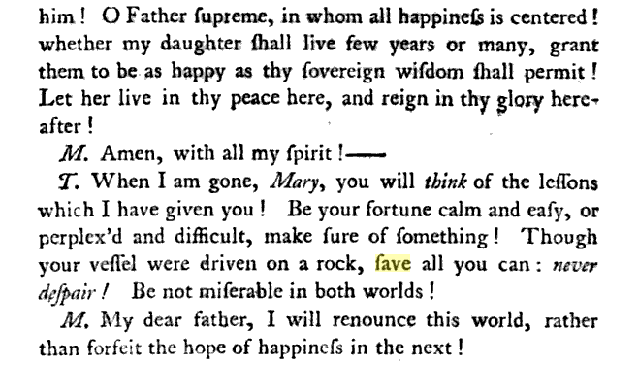
While researching the etymology of the word “fave”, a noun that’s in the process of being verbed,1 I noticed that, according to Google’s ngram viewer, the word was much more popular in the 1600-1700s than it is now.
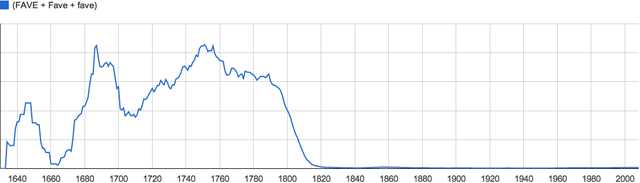
A bit of investigation reveals that Google’s book-scanning software is at fault; it can’t recognize the long s commonly used in books prior to the 1800s. So each time it encounters “save” with a long s, it sees “fave”:
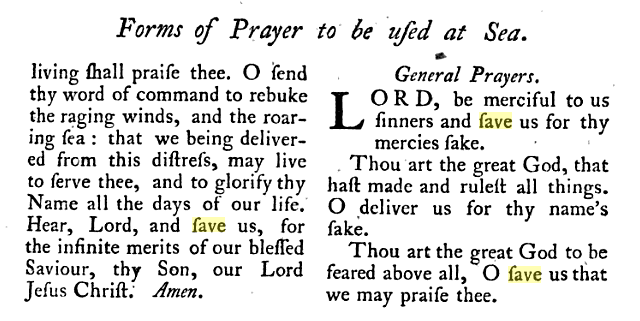
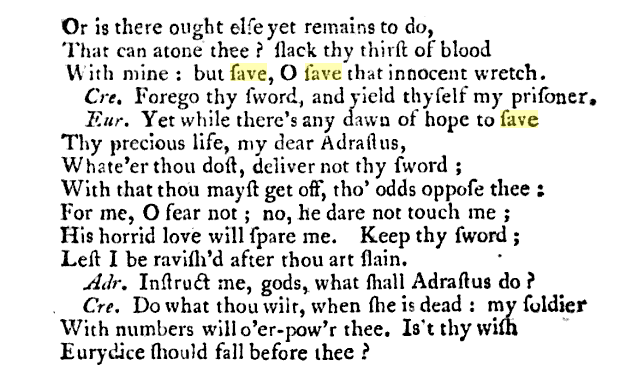
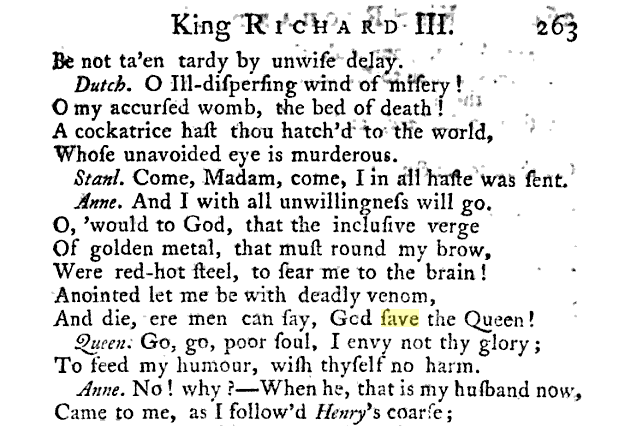
“Fave” (n., adj.) is slang for “favorite”, a usage that started in the US in the 1920s, as in “Teddy Roosevelt was totally my fave President”. Recently, “fave” (v.) has come to mean liking or marking an item as a favorite on social media services like Twitter, Flickr, Facebook, Tumblr, Stellar, etc. (IMPORTANT: It’s “fave”, not “fav”. Let’s get this one right, people.)↩
A team of web dev hot shots recently convened at CERN to build an emulator of the CERN line-mode browser, the first browser that made the WWW accessible to a wide number of people.
The line-mode browser, launched in 1993, was the first readily accessible browser for what we now know as the world wide web. It was not, however, the world’s first web browser. The very first web browser was called WorldWideWeb and was created by Tim Berners-Lee in 1990.
But WorldWideWeb only worked on the NeXT operating system. WorldWideWeb was a great piece of software, but it was important that the web should be accessible to many kinds of computers, not just NeXT machines.
That’s where the line-mode browser came in. It was the first web browser with a cross-platform codebase so it could be installed on many different kinds of computers. It was a relatively simple piece of software with a very basic interface, but in the early days of the web, it was instrumental in demonstrating the power of this new medium.
The text says the line-mode browser launched in 1993 but it was actually 1991 (and first stable release in early 1992). My first browser was NCSA Mosaic so it was a treat to use this for a few minutes this morning. (via @craigmod)
The Other F Word is a 2011 documentary about how punk rockers and other countercultural figures made the transition from anti-authoritarianism to parenthood. Features members from Devo, NOFX, Black Flag, Rancid, and also pro skater Tony Hawk. Here’s the trailer:
To be sure, watching foul-mouthed, colorfully inked musicians attempt to fit themselves into Ward Cleaver’s smoking jacket provides for some consistently hilarious situational comedy, but the film’s deeper delving into a whole generation of artists clumsily making amends for their own absentee parents could strike a resonant note with anyone (punk or not) who’s stumbled headfirst into family life.
Available to rent/buy on iTunes and on Amazon.
(via @claytoncubitt)
It probably doesn’t come as much of a surprise that the NFL is a highly profitable business. But it might come as a shock that the league enjoys nonprofit status. From Gregg Easterbrook: How the NFL Fleeces Taxpayers.
Taxpayers fund the stadiums, antitrust law doesn’t apply to broadcast deals, the league enjoys nonprofit status, and Commissioner Roger Goodell makes $30 million a year. It’s time to stop the public giveaways to America’s richest sports league — and to the feudal lords who own its teams.
Zoo is a short documentary film by Bert Haanstra filmed at a zoo in Amsterdam. It is lovely.
Haanstra cleverly makes the human animal more a part of the film than the rest of the animals. Haanstra also made the Oscar-winning Glas. (via the kid should see this)
Another excellent link from Quora’s weekly newsletter: What is the best sacrifice in the history of chess? A game played in 1934 featured the sacrifice of the queen & both rooks and was over so quickly (14 moves) that it’s referred to as The Peruvian Immortal. I found it easier to follow the game by watching it:
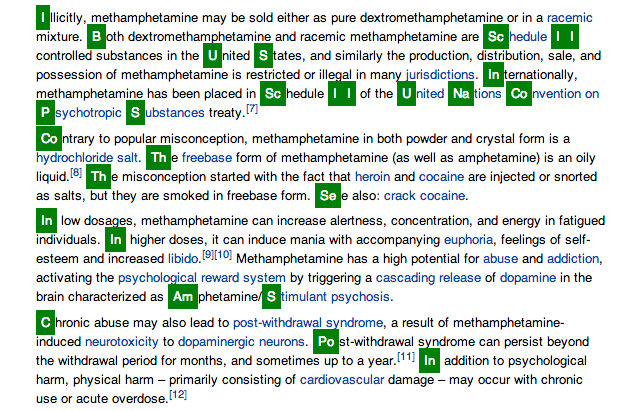
After I wondered why no one had a made a Breaking Bad bookmarklet that highlights element symbols on web pages in the style of Breaking Bad’s opening titles sequence, Adam Prescott did just that.
Jake Dobkin has been doing a series of posts on Gothamist called Ask a Native New Yorker and in the latest installment, he tackles the gentrification of New York City.
All New Yorkers are gentrifiers. Say you’re of Jewish extraction: your forebears gentrified some Irish right out of L.E.S. around the turn of the century. Or maybe you’re Irish, and your ancestors were responsible for gentrifying the marginal land around the Collect Pond in Five Points. Or maybe your family goes all the way back to New Amsterdam and Peter Minuit, the original gentrifier, who gentrified the poor Native Americans right off Manhattan island. No New Yorker, no matter how long their tenure, has the right to point fingers and say to anyone else “the problem started when you arrived here.”
I had no idea that’s how rubber bands worked. Once again, Feynman takes something that seems pretty simple and makes it both simpler and vividly complex.
(via @stevenstrogatz)
Black Perl is a poem written in valid Perl 3 code:
BEFOREHAND: close door, each window & exit; wait until time.

    open spellbook, study, read (scan, select, tell us);

write it, print the hex while each watches,

    reverse its length, write again;

    kill spiders, pop them, chop, split, kill them.

        unlink arms, shift, wait & listen (listening, wait),

sort the flock (then, warn the "goats" & kill the "sheep");

    kill them, dump qualms, shift moralities,

    values aside, each one;

        die sheep! die to reverse the system

        you accept (reject, respect);

next step,

    kill the next sacrifice, each sacrifice,

    wait, redo ritual until "all the spirits are pleased";

    do it ("as they say").

do it(*everyone***must***participate***in***forbidden**s*e*x*).

return last victim; package body;

    exit crypt (time, times & "half a time") & close it,

    select (quickly) & warn your next victim;

AFTERWORDS: tell nobody.

    wait, wait until time;

    wait until next year, next decade;

        sleep, sleep, die yourself,

        die at last

# Larry Wall
It’s not Shakespeare, but it’s not bad for executable code.
I was poking around on YouTube for “how to” videos (one of my favorite video genres) the other day when I hit a small jackpot: a bunch of How Do They…? videos from the National Film Board of Canada. A favorite shows how chain link fences are made:
You can view all the videos at the NFB site as well. NFB produced one of my favorite “how to” videos ever: how to build an igloo.
The Motley Fool collected 20 snippets of business wisdom uttered by Amazon CEO Jeff Bezos over the years.
All businesses need to be young forever. If your customer base ages with you, you’re Woolworth’s.
Totes agree with this, which is why I use words like “totes”. (Obvs.)
The Art of the Title chats with the excellent Jessica Hische about the lettering and type design she did for Wes Anderson’s Moonrise Kingdom.
To me, that was really fun because if you think about New England in the ’60s… it’s not like most places would be staying on top of the most current trends in type, using typefaces that were released that very year. So, using something from the ’40s made sense to me. If you think about a small, conservative New England town, lord knows all the printers and designers in town are probably still using type from years ago. I think when people think about historical type references, they often don’t think about that. You should be reaching from that time period to 15 - 20 years earlier and then you’ll be getting stuff that’s quote-unquote “current.”
And she’s releasing the typeface commercially so everyone can use it! Yay!
Older kids generally succeed better in sports, but holding kids back in school seems to have the opposite effect when it comes to academic achievement.
The researchers discovered that relatively more mature students didn’t have an academic edge; instead, when they looked at their progress at the end of kindergarten, and, later, when they reached middle school, they were worse off in multiple respects. Not only did they score significantly lower on achievement tests — both in kindergarten and middle school — they were also more likely to have been kept back a year by the time they reached middle school, and were less likely to take college-entrance exams. The less mature students, on the other hand, experienced positive effects from being in a relatively more mature environment: in striving to catch up with their peers, they ended up surpassing them.
I was the second youngest kid in my class growing up; only our valedictorian was younger. Meg was young too. And both our kids are among the youngest in the class…we didn’t redshirt them because they seemed ready for the grades they’re in. As the article states, the differences are starker now than they were…some kids in their groups are more than a year older than they are and most are several months older. NYC preschools have trouble finding a wide range of ages for each class because so many people are holding their kids back to gain a supposed competitive edge against their peers…fall kindergarten classes are full of 6-year-olds but few just-turned-fives. It’s crazy…but so much of New York is competitive like this, why wouldn’t kids’ preschool education be the same?
I love this theory from Jon Negroni that all of the Pixar movies take place in the same universe and are all connected.
Centuries later, the animals from Brave that have been experimented on by the witch have interbred, creating a large-scale population of animals slowly gaining personification and intelligence on their own.
There are two progressions: the progression of the animals and the progression of artificial intelligence. The events of the following movies set up a power struggle between humans, animals, and machines.
The stage for all-out war in regards to animals is set by Ratatouille, Finding Nemo, and Up, in that order. Notice I left out A Bug’s Life, but I’ll explain why later.
For the reading-averse, there’s a condensed timeline version. (via slate)
Update: And for the very reading-averse, here’s a video explanation:
This group on Flickr shows just how fantastically designed Japanese manhole covers are. Here are some of my favorites:




This is powerful and amazing (and upsetting): Project Unbreakable is a photography project that features images of sexual assault survivors holding signs showing what others (attackers, family members, cops, etc.) said to them about the assaults.

It’s difficult to pick the yuckiest bottom-of-the-barrel sludge here, but the comments from the police officers really get my dander up.
“If you were my daughter I would have killed you.” - Lady police officer while being interrogated
“If you don’t tell us how many people you’ve slept with, the ADA won’t even consider your case.” - Interviewing Dectective
“This is why we have underage drinking laws! THIS IS YOUR FAULT! If you hadn’t been drinking this wouldn’t have happened to you!” - St. Petersburg police when I tried to press charges
Sickening, sickening. The police are supposed to protect the vulnerable, not persecute them. (via @rebeccablood)
After chatting with personal finance expert Helaine Olen, Harold Pollack wrote down all the personal finance advice you’ll ever need on a 4x6 index card:
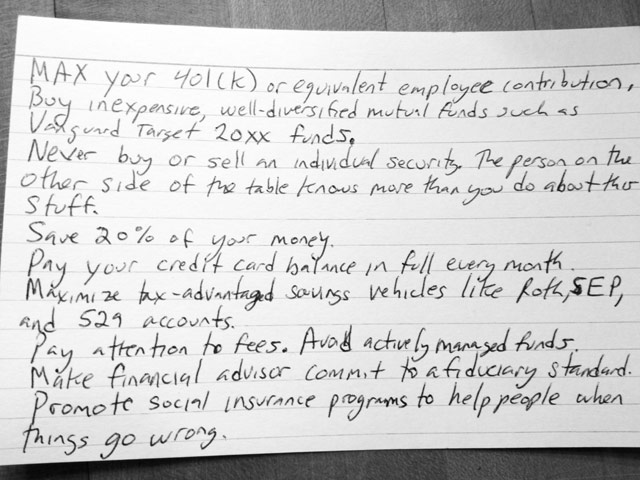
Unless you’re an insider or get particularly lucky, you’re just not going to beat this. (via ezra klein)
Looks like someone lost their drone in the West Village:

Pretty sure that drones falling from the skies in heavily populated metropolitan areas is going to lead to banning.
Ernest Hemingway liked a good burger and had a specific recipe he wanted his staff to use when preparing meals. Using his instructions, Cheryl Lu-Lien Tan recently recreated the Hemingway burger.
Fingers deep, I kneaded. Fighting the urge to be careless and quick, I kept the pace rhythmic, slow. Each squeeze, I hoped, would gently ease the flavors — knobby bits of garlic, finely chopped capers, smatterings of dry spices — into the marbled mound before me.
I had made burgers before, countless times on countless evenings. This one was different; I wasn’t making just any burger — I was attempting to recreate Hemingway’s hamburger. And it had to be just right.
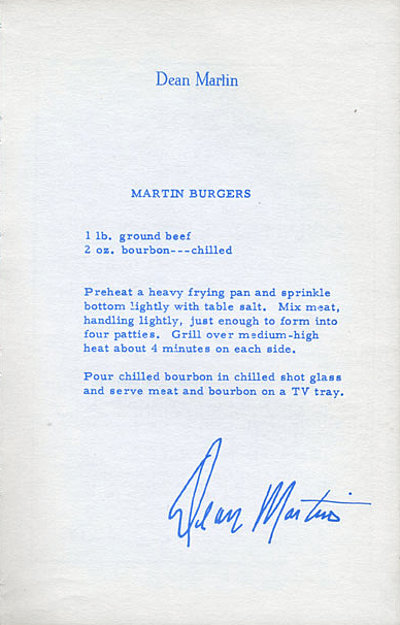
Surprisingly, with 11 different ingredients, Hemingway’s burger is not as stripped down as his prose. For a more minimalist burger, you have to turn to Dean Martin:
Frank Sinatra’s is perhaps even easier:
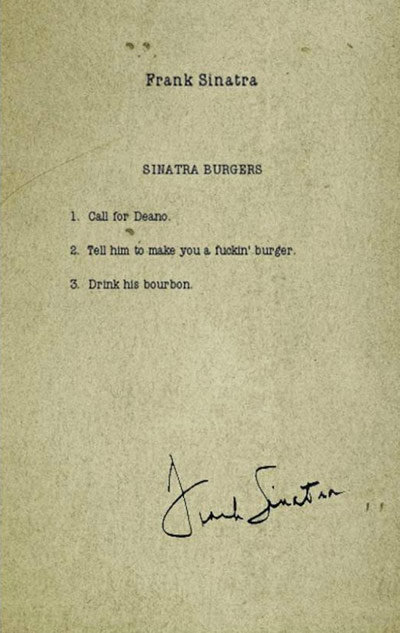
One thing is for sure: none of these gentlemen would cotton to the idea of the ramen burger, homemade or no. (via open culture)
How risky is it to even wade a few inches into the gun rights debate? Just ask Starbucks CEO Howard Schultz. Today, he announced the company’s policy that seeks to keep guns out of its cafes. Sort of.
Under the change, baristas and other store employees will not ask customers who come in with guns in holsters, say, to leave or confront them in any way, Mr. Schultz said. No signs explaining the policy will be posted in Starbucks stores, either.
According to Schultz: “We are going to serve them as we would serve anyone else.” In other words, it’s still a good idea to think twice before asking for another shot with your Frappuccino.
A Texas man was getting drunk without drinking alcohol and his doctors think they figured out why: brewer’s yeast in his in gut was brewing beer and making the man intoxicated.
The patient had an infection with Saccharomyces cerevisiae, Cordell says. So when he ate or drank a bunch of starch — a bagel, pasta or even a soda — the yeast fermented the sugars into ethanol, and he would get drunk. Essentially, he was brewing beer in his own gut. Cordell and McCarthy reported the case of “auto-brewery syndrome” a few months ago in the International Journal of Clinical Medicine.
Some clever entrepreneur will undoubtedly turn this syndrome into a product…the market opportunity for a pill that allows you to get drunk on spaghetti *and* be the owner/operator of your own microbrewery is too large to ignore. (via ★interesting)
Former NY Times restaurant critic Frank Bruni writes about the joys of being a regular at your neighborhood restaurant.
What you have with a restaurant that you visit once or twice is a transaction. What you have with a restaurant that you visit over and over is a relationship.
My wife and I eat out at least once a week and we used to travel all over the city to try all sorts of different places, just-opened hot spots and old favorites alike. It was great. But now we mostly go to a bar/restaurant1 around the corner from where we live and that’s even better. Bruni covers the experience pretty well, but I just wanted to share a couple of seemingly small aspects of being a regular:
1. Our local is popular and always crowded, especially during the dreaded 7-10pm hours and double especially Thu-Sat nights. But even when I go in by myself at a peak time, when the bar’s jam-packed, there’s always a seat for me. It might take a bit, but something opens up and they slot me in, even if I’m only stopping in for a drink and they could seat a two-top for dinner at the bar. (A regular in the hand is worth two in the rush.)
2. This is a totally minor thing but I love it: more than once, I’ve come in early in the evening, had a drink, left without paying to go run an errand or meet someone somewhere else, and then come back later for another drink or dinner and then settle my bill. It’s like having a house account without the house account.
3. Another nice thing about being a regular at a place that values regulars is that you meet the other regulars. This summer I was often left to my own devices for dinner and a couple times a week, I ended up at my local. And almost without exception, I ended up having dinner with someone I’d previously met at the bar. Routinely turning a solo dining experience into dinner with a friend is an amazing accomplishment for a restaurant.
Something I read in one of food writer Jeffrey Steingarten’s books has always stuck with me. He said there are certain restaurants he frequents that he never writes about critically. Those places are just for him and he would never recommend them to his readers. Having written for so long here on kottke.org, there are certain things I hold back, that are just for me. Having a public opinion on absolutely everything you love is no way to live.
So, no, I’m not going to tell you what restaurant I’m talking about. It’s beside the point anyway…Bruni’s not trying to persuade you to try Barbuto or Charlie Bird, it’s about you finding your own local.↩
What does it feel like to soar majestically like an bird? Maybe something like this video, shot with a camera strapped to the back of an eagle flying near Chamonix in France.
See also first-person footage of a peregrine falcon diving and killing a duck in mid-air. (via @gavinpurcell)
Artist JK Keller took an episode of the Simpsons, ran the entire thing through some audio and video filters, and somehow it retains the full character of the show while also seeming like, as Keller puts it, “a frenetic mess of sight and sound”.
After ripping all the frames, I used software to turn the ripped images into vectors. Then I processed the files through Illustrator using the default Alignment & Distribution tools (23 different combinations). With the audio, I used a similar process, making a spectrogram image of the audio from each cut in the episode. Then I applied a variety of processes to the image to mimic the alignment/distribution used.
When Shaquille O’Neal entered the NBA in 1992 after starring at LSU, people had already begun naming their children after him. 20-something years later, some of those kids are starting to play college basketball themselves. Ken Pomeroy is tracking the Shaq babies as they show up in their schools’ line-ups and offers a look at the future of children named after NBA stars.
We can never know those reasons for sure, but we can say that since 1997, Kobe has been the name of choice for parents opting to name their children after basketball players. (Lebron has yet to crack the top 1000.) From this we can be confident we’ll see the first-ever college basketball player named Kobe sometime in the 2016 to 2018 seasons. And while the supply of Shaqs will peter out right quick, Kobe’s name will be appearing on college basketball rosters well into the 2030’s. Kobe Bryant may have skipped college, but Kobe will be playing college basketball for many, many, many years to come.
(via http://marginalrevolution.com/)
In the parlance of NYC graffiti enthusiasts, going “all city” means getting your stuff known all over the five boroughs. Now a group of designers are challenging each other to go “all RGB”, to make images that contain all of the 16.7 million colors that make up the RGB spectrum once each. This entry is amazing because it still looks like an actual photograph when you zoom out (many others do not):

You can find many more entries on allRGB.com or make your own using this code on GitHub. (via digg)
Socials & More