kottke.org posts about education
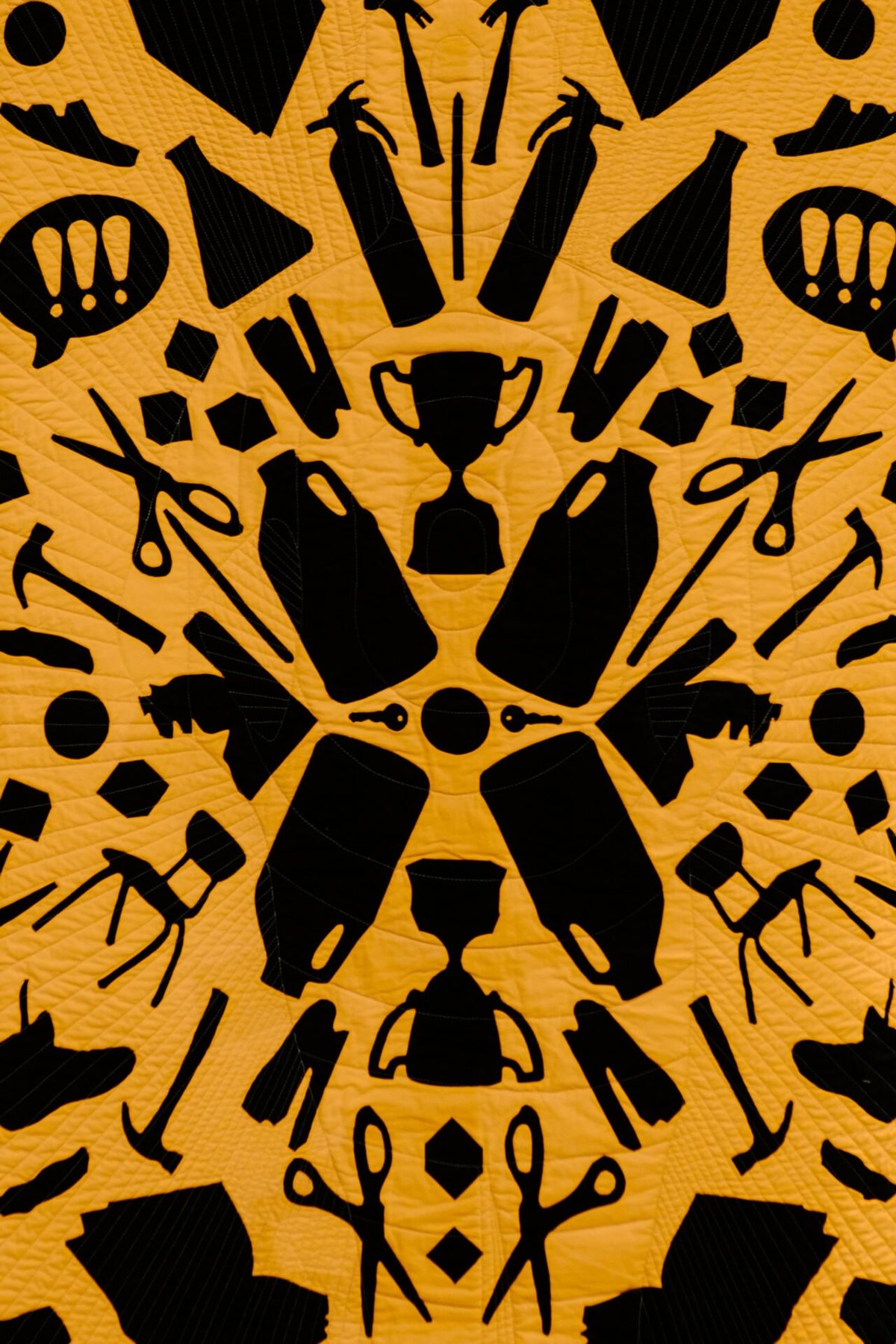
In 2024, schoolteacher Ginny Robinson won the Best in Show award at a quilting convention for her quilt called What We Will Use as Weapons: A List of School Supplies.
This is a protest quilt. It was made by an artist whose day job puts her on the front lines of one of the most grotesque realities in America today. She is a teacher.
What We Will Use as Weapons: A List of School Supplies is the title for this provocative work of art that features school supplies hurling toward the center on the front and an assault rifle on the back. This long, narrow quilt is the actual size and shape of a door. An outline of a human is stitched through the layers. On the front, the person is meant to represent a shooter, and on the reverse side, a teacher.
Robinson’s quilt is now part of the collection at the International Quilt Museum.
In 1966, Huey Newton & Bobby Seale formed the Black Panther Party and wrote a 10-point manifesto of what the group stood for and what they wanted. Here’s the full text of the plan.
4. We Want Decent Housing Fit For The Shelter of Human Beings.
We believe that if the White Landlords will not give decent housing to our Black community, then the housing and the land should be made into cooperatives so that our community, with government aid, can build and make decent housing for its people.
5. We Want Education for Our People That Exposes The True Nature Of This Decadent American Society. We Want Education That Teaches Us Our True History And Our Role in the Present-Day Society.
We believe in an educational system that will give to our people a knowledge of self. If a man does not have knowledge of himself and his position in society and the world then he has little chance to relate to anything else.
Students and faculty from Columbia University recently held a “25-hour speak-out” in support of academic freedom. Some of the remarks made during the speak-out are published at Rise Up, Columbia: part 1, part 2.
Turkuler Isiksel, political science professor:
Like other scholars in my discipline, political science, I think a lot about how in recent decades, elections have come to be used for authoritarian ends.
Many countries that hold regular elections, where leaders come to power through a competitive struggle for the people’s vote, are nevertheless authoritarian. But how can that be? Aren’t elections the same thing as democracy?
Well, elections in authoritarian regimes are a kind of window-dressing: authoritarian incumbents win elections because they ensure that they cannot lose: by restricting media freedom, manipulating information, intimidating civil society leaders, jailing dissidents, banning opposition parties, outlawing rallies and demonstrations. Once in power, they typically try to conquer 5 key social institutions:
- The press
- The bureaucracy
- The military
- The judiciary
- Universities
Why these institutions?
First, because they answer to a different authority than whoever happens to be in political power. Their activities are guided not by whoever happens to be in power, but by its own professional ethic.
- journalism is guided by a commitment to informing the public,
- the bureaucracy is guided by an ethic of professionalism and public service,
- the military is guided by respect for the chain of command and political neutrality,
- the judiciary is guided by the ethic of impartially applying the law, and
- universities like ours are guided by the search for truth.
In scholarly inquiry, disciplinary standards have priority over other metrics (profits, power, glory, public opinion). Political non-interference is a precondition for our scholarly and teaching mission.
In short, the third law of thermodynamics does not change because the commander-in-chief doesn’t like it. So these institutions present an obstacle to political and social control.
James Schamus, film & media studies professor:
I’ve been asked to speak briefly today as part of a specifically Jewish cohort of Columbia faculty. And the request as always surfaces in me two contradictory immediate reactions. The first reaction is simple: Who cares what Jews think? A genocide is a genocide is a genocide; ethno-state fascism is ethno-state fascism. The false and dangerous conflation of criticism of Israel and Zionism with antisemitism as a cover for Israel’s crimes and the fascist repression of our universities here in the states is obvious now to all: Jews have no privileged perspective from which to add to those obvious facts.
My second reaction is also simple: This genocide in Gaza is being enacted in my name, supposedly on my behalf; the destruction of American universities is being enacted in my name, supposedly on my behalf. So I am indeed called to speak out, to fight back, and to work to create alternative forms of community and identity to counter the false claim that Israel’s depredations and Trump’s destruction of my university are somehow in my interest.
(thx, joe)

Randall Munroe notes that the typical path to getting a Ph.D. at an American college or university has changed somewhat in the past few months. In the alt-text for the image, he notes: “Rümeysa Öztürk was grabbed off the street in my town one month ago.”
Öztürk is still being held without evidence and a federal judge recently ruled that she must be returned to Vermont while her detainment is being challenged.
Harvard is refusing to comply with Trump’s demands related to his regime’s racist, xenophobic political agenda, including a threat to cut $9 billion in research funding. From the AP:
Harvard President Alan Garber, in a letter to the Harvard community Monday, said the demands violated the university’s First Amendment rights and “exceeds the statutory limits of the government’s authority under Title VI,” which prohibits discrimination against students based on their race, color or national origin.
“No government — regardless of which party is in power — should dictate what private universities can teach, whom they can admit and hire, and which areas of study and inquiry they can pursue,” Garber wrote, adding that the university had taken extensive reforms to address antisemitism.
“These ends will not be achieved by assertions of power, unmoored from the law, to control teaching and learning at Harvard and to dictate how we operate,” he wrote. “The work of addressing our shortcomings, fulfilling our commitments, and embodying our values is ours to define and undertake as a community.”
You can read Garber’s letter and the letter Harvard received from the Trump regime.
I recently attended a virtual talk and Q&A with Timothy Snyder and when he was asked about Columbia and other schools capitulating to Trump’s demands and what needs to happen in order to stop it, he replied something along the lines of: “Some big school is gonna have to stick their neck out and take the hit. Say ‘no’ unequivocally to Trump and get their funding pulled. Lead by example and others will follow. Solidarity is the only way out of this.” Good on Harvard1 for helping to lead the way on this…hopefully more schools will find their backbone after this.
I have one kid entering college this fall and one a few years away, so I’ve been thinking (with fury and sadness) about the effect that Trump’s authoritarian regime is having on American colleges and universities. They’re pulling funding from schools; schools are cancelling programs, freezing hiring, and cutting back on admissions; and NIH and NSF funding is being curtailed and withdrawn. College students are being snatched off the streets by ICE & DHS and schools either can’t or won’t do anything to stop it. If these actions persist, US colleges & universities could look quite different in a year or two.
In a piece called The End of College Life, Ian Bogost calls the potential effect of these changes a “calamity” and says “the damage to our educational system could be worse than the public comprehends”.
Any one of the Trump administration’s attacks on research universities, let alone all of them together, could upend the college experience for millions of Americans. What’s at stake is far from trivial: Forget the frisbees on the quad; think of what it means to go to college in this country. Think of the middle-class ideal that has persisted for most of a century: earning a degree and starting a career, yes, but also moving away from home, testing limits, joining new communities, becoming an adult.
This might all be changing for fancy private schools and giant public universities alike. If you, or your son, or your daughter, are in college now, or are planning to enroll in the years ahead, you should be worried.
I am curious to hear from parents of high school and college students, from college faculty & administrators, and from students themselves: how have the actions of the Trump regime changed your thinking about college? What plans are you making or changing? Let me know in the comments. (If you don’t have a membership but would like to leave a comment, just email me your thoughts and I’ll post it for you.)
Food historian Max Miller stumbled upon the original recipe for 1980s/90s school cafeteria pizza (you know, with the iconic rectangular slices) and decided to whip up a batch (with “pourable dough”).
Tastes just like it. You can like — all of those herbs are exactly the same as they were. I think maybe it tastes a little fresher than I remember, like the flavors are a little heightened…but that’s that’s them. This is the pizza…
While the pizza was baking, Miller talked about the history of school lunches (following up on his video about school lunches during the Depression) — it’s a story that features J. Edgar Hoover and The Black Panthers.
You can find the pizza recipe on Miller’s website or in the original 1988 USDA publication Quantity Recipes for School Food Service courtesy of the Internet Archive. The pourable dough recipe is on page B-15 and the cheese pizza recipe is on D-30. (via @ernie.tedium.co)
Gareth Fearn writing for the London Review of Books about the student protests on US campuses: Liberalism without Accountability.
This is a toxic combination: universities reliant on investment portfolios in a system where mega-profits are made by companies that threaten and destroy human life, influenced by an increasingly radicalised class of billionaires, teaching students whose degrees won’t earn them enough to pay off their loans, managed by supine administrators threatened by (or willingly collaborating with) a reactionary right, who have decided that young people’s minds are being turned against capitalism not by their own lived experience of austerity and racialised police violence but by ‘woke Marxist professors’. This situation has now met with a live-streamed genocide which is supported, and brazenly lied about, by political leaders and commentators who claim to stand for truth and justice. Students, like much of the public, cannot square the reality of what they see with the world as constructed by politicians and the media.
Under such circumstances, pitching tents, raising placards and demanding divestment are really quite mild-mannered responses. That they have been met, in many US universities, with militarised policing reflects the fragility of liberalism — in the face of the growing hegemony of the conservative right as well as its own inability to offer a future even to Ivy League college students, let alone the less privileged.
This is a quote I like that’s attributed to Alvin Toffler from his 1970 book, Future Shock:
The illiterate of the twenty-first century will not be those who cannot read and write, but those who cannot learn, unlearn, and relearn.
It turns out that’s not a direct quote — it’s been cobbled together from two separate passages in the book:
By instructing students how to learn, unlearn and relearn, a powerful new dimension can be added to education.
and:
Psychologist Herbert Gerjuoy of the Human Resources Research Organization phrases it simply: “The new education must teach the individual how to classify and reclassify information, how to evaluate its veracity, how to change categories when necessary, how to move from the concrete to the abstract and back, how to look at problems from a new direction — how to teach himself. Tomorrow’s illiterate will not be the man who can’t read; he will be the man who has not learned how to learn.”
Somewhere along the line, someone combined Gerjuoy’s observation with Toffler’s phrasing to create, IMHO, a more insightful quote about the flexibility their future (and our present) requires.
For more misattributed quote debunking, see also “I Hate to Write, but I Love Having Written” and Where the Rich Use Public Transportation…
For the past 13 years, former Secretary of Labor Robert Reich has taught a class called Wealth & Poverty at UC Berkeley. He retired from teaching this year and has uploaded his lectures from the course to YouTube.
Welcome to my final UC Berkeley course on Wealth and Poverty. Drawing on my 40+ years in politics, including my time as secretary of labor, I offer a deeper look at why inequalities of income and wealth have widened significantly since the late 1970s in the United States, and why this poses dangerous risks to our society.
This course also offers insights into the political and public-policy debates that have arisen in light of this inequality, as well as possible means of reversing it.
Here’s the first lecture, What’s Happened to Income & Wealth:
Reich has also published an abbreviated syllabus for each of the classes; links can be found in his course introduction (here’s class #1).
A high school here in Vermont is located (temporarily) in an abandoned Macy’s department store. A crew from the BBC recently made a short video tour, where you can see books on shelves designed to display fine china, an absence of windows, escalators, a lack of floor-to-ceiling walls, and fashion branding that remains on the walls.
Alexandra Lange wrote about the school in 2021 for Curbed.
The genre may be nearly dead, yet the building remains. And for economic, ecological, and social reasons, those buildings should be reused. “It’s amazing to think that we are standing in what used to be a department store; that we’re greeting people where we used to buy winter coats; reading books where they once sold fine china; taking phone calls in converted changing rooms; and learning science in the old suit racks,” Burlington’s school superintendent, Tom Flanagan, said at the ceremony. A school in a department store doesn’t have to be a sad story. In fact, this should just be the beginning, both for the students and for a country once addicted to big boxes.
Vermont indie newspaper Seven Days published a writeup, video tour, and photo slideshow of the school when it opened two years ago.
For Black History Month, Masterclass is offering an entire class on Black History, Black Freedom, and Black Love for free.
From critical race theory to the 1619 Project, Black intellectuals are reshaping conversations on race in America. Now seven of those preeminent voices share their insight on the reckoning with race in America in three parts: past, present, and future. Gain a foundational understanding of the history of white supremacy and discover a path forward through the limitless capacity and resilience of Black love.
The class includes several hours of videos about “the history you weren’t taught in school” from an absolutely incredible lineup of instructors: Angela Davis, Kimberlé Williams Crenshaw, Nikole Hannah-Jones, Jelani Cobb, Sherrilyn Ifill, John McWhorter, and Cornel West. This is a fantastic resource. (thx, neil)
Dan Sinker writes for The Atlantic about how navigating Covid risks, politically motivated bullshit, and America’s failing infrastructure has broken parents during the pandemic: Parents Are Not Okay.
Instead it was a year in limbo: school on stuttering Zoom, school in person and then back home again for quarantine, school all the time and none of the time. No part of it was good, for kids or parents, but most parts of it were safe, and somehow, impossibly, we made it through a full year. It was hell, but we did it. We did it.
Time collapsed and it was summer again, and, briefly, things looked better. We began to dream of normalcy, of trips and jobs and school. But 2021’s hot vax summer only truly delivered on the hot part, as vaccination rates slowed and the Delta variant cut through some states with the brutal efficiency of the wildfires that decimated others. It happened in a flash: It was good, then it was bad, then we were right back in the same nightmare we’d been living in for 18 months.
And suddenly now it’s back to school while cases are rising, back to school while masks are a battleground, back to school while everyone under 12 is still unvaccinated. Parents are living a repeat of the worst year of their lives-except this time, no matter what, kids are going back.
Almost every parent I know is struggling with exactly this: trying to keep their kids (and family and friends) safe from Covid-19 while balancing the social & emotional wellbeing of everyone concerned and not getting a lot of help from their governments or communities. Remote school is no longer an option, few infrastructure upgrades have been made to improve ventilation in schools, no vaccine mandates for teachers or staff, parents fighting administrators about vaccine & mask mandates, and everyone is trying to do complex risk calculations about sending their can’t-yet-be-vaccinated kids into buildings with other kids whose parents, you suspect, are not vaccinated and aren’t taking any precautions in states where Delta is endemic. All while trying to work and remain sane somehow? And most of the parents I know have resources — they have steady income & savings, live in safe communities, and have friends & family to fall back on when times get tough. Those who don’t? I truly do not know how they are doing any of this without incurring significant, long-term trauma for parents and kids. We, inasmuch as we’re still a “we” in America, are failing them all.
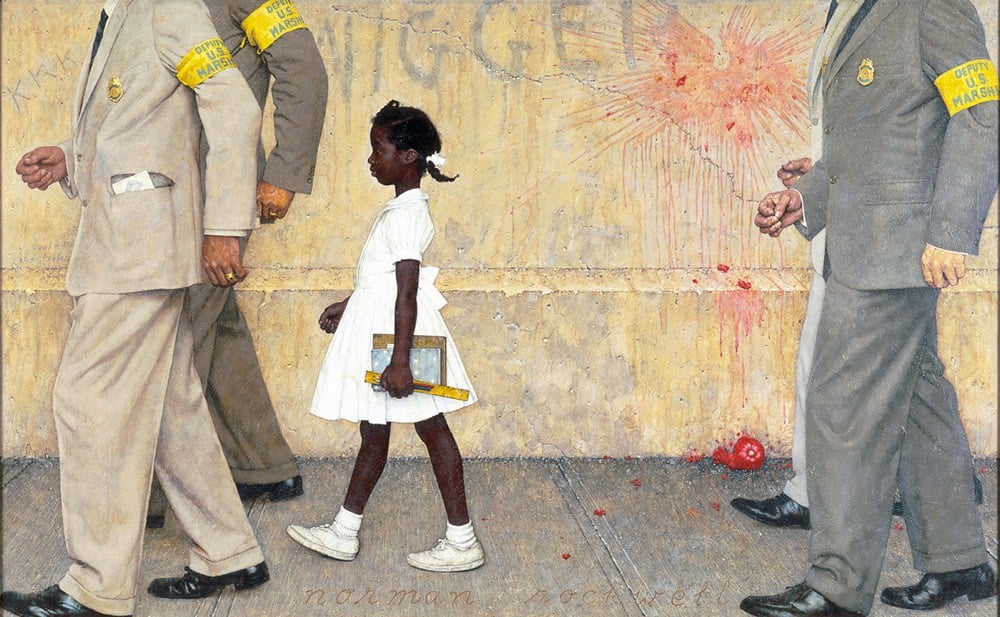
In 1960, six-year-old Ruby Bridges became the first Black student at the newly desegregated William Frantz Elementary School in New Orleans. Escorted to her first day of school by federal marshals, she was immortalized by Normal Rockwell in a 1964 painting called The Problem We All Live With. Bridges has a new book out today called This Is Your Time.
Written as a letter from civil rights activist and icon Ruby Bridges to the reader, This Is Your Time is both a recounting of Ruby’s experience as a child who had no choice but to be escorted to class by federal marshals when she was chosen as one of the first black students to integrate New Orleans’ all-white public school system and an appeal to generations to come to effect change.
In a segment on NPR’s Weekend Edition, Bridges shared some of her story from the book.
The first day that I arrived with federal marshals, they rushed me inside of the building. And 500 kids walked out of school that first day and they never returned.
[Making friends] did not come easy because I heard kids, there were days when I would go into this coat closet to hang up my coat and I could hear kids laughing and talking, but I never saw them. Later on, I came to realize that they were being hidden from me in another classroom.
And that was because there were some white parents who actually crossed that picket line and brought their kids to school. But the principal who was part of the opposition, she would hide them. And even though I was complaining — or at least mentioning it to Mrs. Henry, she would never say anything to me, but she was actually going to the principal and saying, if you don’t allow those kids to come together, because the law has now changed, then I’m going to report you to the superintendent. And so I think after months of that, we were allowed to come together.
Bridges is only 66 years old today — this was all not so long ago.
Update: Sad news: Ruby’s mother, Lucille Bridges, died yesterday at the age of 86.
Her daughter went on to become an icon of the Civil Rights Movement, memorialized in Norman Rockwell’s famous painting “The Problem We All Live With” which depicts a tiny Ruby in a white dress carrying her notebooks and a ruler surrounded by much taller U.S. Marshals. But Ruby Bridges once credited her parents as the forces behind her history-making achievement.
“My parents are the real heroes,” the U.S. Marshals Service once quoted her as saying during a ceremony at an art gallery showing the painting. “They (sent me to that public school) because they felt it was the right thing to do.”
MIT’s biology department is offering a new online class this fall called COVID-19, SARS-CoV-2 and the Pandemic. The class will be led by Richard Young and Facundo Batista and will include guest lectures by several leading authorities on Covid-19, coronaviruses, epidemiology, and immune systems like Anthony Fauci, Michael Mina, and Akiko Iwasaki. Here’s the course description and syllabus.
Lectures by leading experts on the fundamentals of coronavirus and host cell biology, immunology, epidemiology, clinical disease, and vaccine and therapeutic development.

The first class is today, Sept 1st, at 11:30am ET and meets on Tuesday through December 8. Lectures are via live video but will be archived if you miss a class. There’s no homework or outside reading (it’s just the lectures), no pre-requisites needed, and it’s a 1-credit pass/fail exploratory course, so despite the source and subject matter, it should be fairly accessible. I’m taking the course and will let you know how it goes! (thx, meg)
Update: Here’s an archive of the first lecture by Bruce Walker of the Ragon Institute.
In the United States, amid high numbers of Covid-19 infections and thousands of weekly deaths, no national plan for testing & tracing, little support for working parents, and individual states and school districts left to their own devices to figure this all out for themselves, schools around the country are trying to “open” for the 2020-2021 school year. At McSweeney’s, Kara Baskin imagines Your School District’s Reopening Survey. Here’s what a hybrid learning model will look like:
This model will combine the key elements of in-person instruction (see above) with remote learning, which we hopefully perfected this spring. Your child will be divided into a cohort (A, B, AB, BC, CC, XVY, MCXLVII, and Depeche Mode) based on careful consideration of his or her learning style, social-emotional needs, friendships, and an algorithm our intern designed this summer. You will need a reliable Internet connection, a work schedule that follows no concrete pattern, a forgiving supervisor, independent wealth, or a Xanax prescription. Please contact our school nurse for the latter.
I sent this link to a friend who is currently evaluating several options for her child’s schooling that range from poor to dangerous, and she replied, “This may be too on the nose to be funny.”
Kristen McConnell writing for The Atlantic: I’m a Nurse in New York. Teachers Should Do Their Jobs, Just Like I Did.
So I can understand that teachers are nervous about returning to school. But they should take a cue from their fellow essential workers and do their job. Even people who think there’s a fundamental difference between a nurse and a teacher in a pandemic must realize that there isn’t one between a grocery-store worker and a teacher, in terms of obligation. People who work at grocery stores in no way signed up to expose themselves to disease, but we expected them to go to work, and they did. If they had not, society would have collapsed. What do teachers think will happen if working parents cannot send their children to school? Life as we know it simply will not go on.
Oh yes, that is a totally awesome thing our brave grocery store workers did for us out of a sense of obligation and not because their choice was between risking their health and losing their job in a country with a terrible social safety net. But let’s leave that to one side for a second.
I think many more people would support (and indeed rapturously welcome) kids going back to school if a) there were many fewer cases of Covid-19 in the US, b) if the federal and state governments were doing more testing, tracing, and isolation & support of those who test positive, c) if there was more support for parents, and especially low-income folks, with other options around education and childcare (more on that below), and d) if the mask issue wasn’t so contentious in some parts of the country. Oh and don’t forget that even before any of this happened, teachers regularly used their own money and held online fundraisers to buy necessary school supplies for their classrooms.
Blaming teachers for not wanting to go back to work because their country and communities can’t or won’t do the hard work of making it safe is ridiculous. It’s not fair to ask them to do their part when others with greater responsibility to act are not. Someone has been watching too many war movies where soldiers dying due to the negligence, incompetence, or bad intentions of their superiors is played off as patriotic service & bravery instead of murder.
And this…this is just flat out false:
(And parents who want their children to stay home have that option, whether through homeschooling or continued remote learning.)
Rich people with reliable internet access and extra computers lying around have that option, and it’s a terrible option if those parents work (especially if they’re single parents). A huge chunk of America does not.1 If, by some miracle, the federal government started paying people to stay home from work to help their kids with school, gave everyone a laptop stipend (as well as enough money so that kids have access to meals that they might usually get through school programs), and ensured internet access to those who don’t have it, that statement would be closer to the truth. As long as we’re waving magic wands, I would like a chocolate pony and a peanut butter unicorn.
I would have been far more sympathetic to McConnell’s case had she made a convincing argument that school is so essential to children that it’s worth the risk to them, their teachers, and their families, that schools and governments are doing the right things to ensure the safety of their students and staff, and that Covid-19 is coming under control in the United States. But she did not.
Update: Sarah Jones rebuts McConnell’s argument for New York magazine: Teachers Aren’t Sacrificial Lambs. No Essential Worker Is.
The idea that remote work and home education don’t qualify as doing one’s part for society is so pernicious that it nearly distracts from McConnell’s core argument, which is both simple and widespread: If work is essential, it must also be sacrificial. That argument is worth examining, not least because it’s likely to reappear as parents cope with another semester at home. McConnell has taken a view expressed most commonly in the pandemic policies of certain large corporations and extended it to teachers. The same thread is visible both in Amazon’s failure to get enough masks to workers and to ensure social-distancing in warehouses and in the insistence that teachers should head back into classrooms, whatever the risk.
I also had a bunch of mail in my inbox this morning, both from teachers and healthcare professionals, poking holes in this poorly argued piece. The Atlantic’s coverage of the pandemic has been outstanding, but this article was just not very good — a rare misfire. (via @zidaya)
I Am a Scientist is an effort to introduce children to scientists outside of the narrow stereotypes that our culture typically offers (old, male, white, nerdy). They’re doing this through “scientist-of-the-month toolkits” that tell stories about contemporary working scientists who embody an “incredible range of personalities, interests, backgrounds, and pursuits”. From a blog post about the program:
Science has been the driving force in the modernization of the world as we know it, yet science as an industry has failed to adequately diversify with the times. While the new digital age offers opportunities to expand interest in and appeal of STEM careers, many barriers still hinder equitable access for all students. Conversations of famous scientists often draw answers such as “Albert Einstein” and “Bill Nye the Science Guy”. While accurate references of scientific leaders, the lack of diversity in the public image of scientists can contribute to the lack of diversity in STEM fields.
Introducing the “I Am A Scientist” initiative, which provides opportunities for students, specifically those in Junior High School and High School, to interact with the science and stories of today’s scientists-breaking down barriers like race, gender, and personal interests.
The program’s collection of classroom toolkits provide real-life stories of modern scientists, classroom resources, posters, career resources, and more. The initiative aims to help students engage with scientists that may look, act, or think like them, and are making great strides in remarkable fields that are often left out of career planning discussions. With featured scientists that range from multidimensional graduate students to globally recognized innovators at the top of their field, “I Am A Scientist” tunes into the power that comes from discovering a wide range of role models.
From Alex Vitale, author of The End of Policing, a list of 10 Ways To Reduce Our Reliance On Policing And Make Our Communities Safer For Everyone, which includes proposals like having mental health and social workers to respond to crises, have crime labs operate independently of law enforcement, and replacing cops in schools with counselors & safety coaches.
For children growing up during the era of mass incarceration, seeing armed officers in their schools is commonplace. Federal grants have supported more and more cops in schools. Federal programs like the Community Oriented Policing Services (“COPS”) have provided millions of dollars to hire and train local police, including police in schools.
Police officers do not have specialized training in adolescent or childhood development. They are not mental health experts, social workers with licensed degrees, psychologists, or school counselors. They are not educators. To be clear, school resource officers are career law enforcement officers, with arresting authority, and a license to carry a weapon. Police officers patrol school hallways just like they do city streets. More than one and a half million students attend schools with an SRO, but no counselor.
There are better, safer, and cheaper alternatives. In 2016, Intermediate School District 287, a school west of the Twin Cities with a high concentration of students with special needs and mental health needs that can result in behavior issues, replaced their school resource officers with Student Safety Coaches. The Student Safety Coaches specialize in mental health, restorative justice, de-escalation, and building positive relationships with their students. Arrests decreased by 80 percent in the pilot school after implementation of the program.
The common, and commonsense, thread through all of these proposals is to replace armed, untrained responders who make difficult situations less safe with people & organizations that are specifically trained to help people in distress or crisis.
See also Police Abolition: The Growing Movement to Defund the Police.
In this video for NPR, Gene Demby summarizes the history of housing segregation in America and how it’s a factor for current differences in health (poorer), wealth (much less), education (underfunded), and policing (much more aggressive) for Black communities in US cities.
If you look at the way housing segregation works in America, you can see how things ended up this way. Once you see it, you won’t be able to unsee it.
When you’re talking about housing policy in America, Kimberly Jones’ Monopoly analogy starts to sound a lot less metaphorical and more literal: if Black people cannot buy houses or can only buy houses on certain streets, they will not be able to build wealth like others can.
For more on housing segregation, check out historian Richard Rothstein’s The Color of Law: A Forgotten History of How Our Government Segregated America. From a 2017 interview with Rothstein:
The federal government pursued two important policies in the mid-20th century that segregated metropolitan areas. One was the first civilian public housing program which frequently demolished integrated neighborhoods in order to create segregated public housing.
The second program that the federal government pursued was to subsidize the development of suburbs on a condition that they be only sold to white families and that the homes in those suburbs had deeds that prohibited resale to African-Americans. These two policies worked together to segregate metropolitan areas in ways that they otherwise would never have been segregated.
Rothstein talked about the book with Ta-Nehisi Coates during a conversation at Politics and Prose Bookstore.
Update: This is excellent: you can explore the maps created by the federal government’s Home Owners’ Loan Corporation at Mapping Inequality by the University of Richmond’s Digital Scholarship Lab.
These grades were a tool for redlining: making it difficult or impossible for people in certain areas to access mortgage financing and thus become homeowners. Redlining directed both public and private capital to native-born white families and away from African American and immigrant families. As homeownership was arguably the most significant means of intergenerational wealth building in the United States in the twentieth century, these redlining practices from eight decades ago had long-term effects in creating wealth inequalities that we still see today.
(via @masonadams)
Calling it one of their most requested videos, PBS’s Frontline has uploaded to YouTube their 1985 program on schoolteacher Jane Elliott’s powerful lesson in discrimination. The video shows how, in the wake of Martin Luther King Jr.’s assassination, Elliott divided her third-grade class into those with blue eyes and those with non-blue eyes and then instructed the non-blue-eyed group to treat the blue-eyed group as inferior. The resulting behavior is fascinating, upsetting, and illuminating.
Elliott went on to become a noted antiracism activist and has done blue eyes/brown eyes workshops with groups of adults and teens. And she goes hard at them — see this video and this video for instance.
I’m trying to get the people who participate in this exercise the opportunity to find out how it feels like to be something other than white in this society. ‘Alright people, I’m Jane Elliott and I’m your resident bitch for the day and make no mistake about that, that is exactly what this is about.’ I do this in a mean, nasty way because racism, sexism, ageism, homophobia, ethnocentrism are mean and nasty.
I would also highly recommend watching this brief clip of a talk by Elliott. In less than a minute, she deftly skewers the idea that racial discrimination doesn’t exist in America and calls out White Americans’ complicity in allowing it to persist.
I want every white person in this room who would be happy to be treated as this society in general treats our black citizens — if you as a white person would be happy to receive the same treatment that our black citizens do in this society, please stand.
[Nobody stands.]
You didn’t understand the directions. If you white folks want to be treated the way blacks are in this society, stand. Nobody’s standing here. That says very plainly that you know what’s happening, you know you don’t want it for you. I want to know why you’re so willing to accept it or to allow it to happen for others.
Freedom for some is not freedom.
Update: Alisha Haridasani Gupta recently interviewed Elliott for the NY Times. In it, she reveals that she doesn’t do her workshops anymore because people are increasingly close-minded.
I’ve been doing the exercise with adults for about 35 years. But in the last few years, I’ve only been doing speeches about it because we now live in a situation where people turn off immediately if they think they’re going to learn something counter to their beliefs, and I don’t want to be threatened with death anymore. I’m tired of receiving death threats.
In the Before Times, Netflix let teachers stream their programming in the classroom. With schools not in sessions due to the Covid-19 pandemic, Netflix has decided to put some of their educational programming on YouTube for free (full playlist here). For instance, they’ve put all 8 episodes of David Attenborough’s nature series Our Planet online in their entirety. Here’s the first episode:
The Our Planet website also has tons of educational information for schools and kids.
13th is a feature-length documentary by Ava DuVernay about how racial inequality in America drives our high incarceration rates:
13th is currently rated 97% on Rotten Tomatoes and NY Times reviewer Manohla Dargis called it “powerful, infuriating and at times overwhelming”. Here’s a discussion guide.
Eight full episodes of the first season of Abstract: The Art of Design are also available on YouTube (discussion guide). Here’s the episode featuring illustrator Christoph Niemann:
Several episodes of Vox’s series Explained are included, like this one on the racial wealth gap:
Also included are The White Helmets & Period. End of Sentence. (which each won an Oscar for Best Documentary Short Subject) as well as Knock Down The House, the documentary on the 2018 Congressional campaigns of four women (including Alexandria Ocasio-Cortez). See the full list of included shows and the full playlist on YouTube.
The James Dyson Foundation has designed a set of 44 challenges related to science & engineering specifically for kids (ages 7 & older), which are perfect for these at-home learning times. The challenges include making an air-powered car out of a balloon, strong bridges out of spaghetti, and a cardboard chair strong enough to hold a person:
Here’s the PDF with all 44 challenges. What I like about these projects is that they’re hands-on, you can do them with stuff you already have around the house, and they’re educational in the best way: there’s no “teaching” really…the challenges are designed to appeal to the natural curiosity of kids.
Reading through these, the one that blew my mind was that you can determine the speed of light by melting a chocolate bar in the microwave.

That’s so cool! (via open culture)
The Story Time from Space program aims to promote language and STEM literacy by having astronauts read educational bedtime books from low-Earth orbit on the International Space Station to kids on Earth. Here’s astronaut Kate Rubins reading Rosie Revere, Engineer:
And Ada Twist, Scientist read by Serena Auñón-Chancellor:
What a cool idea. Check out the rest of the available videos in their library.
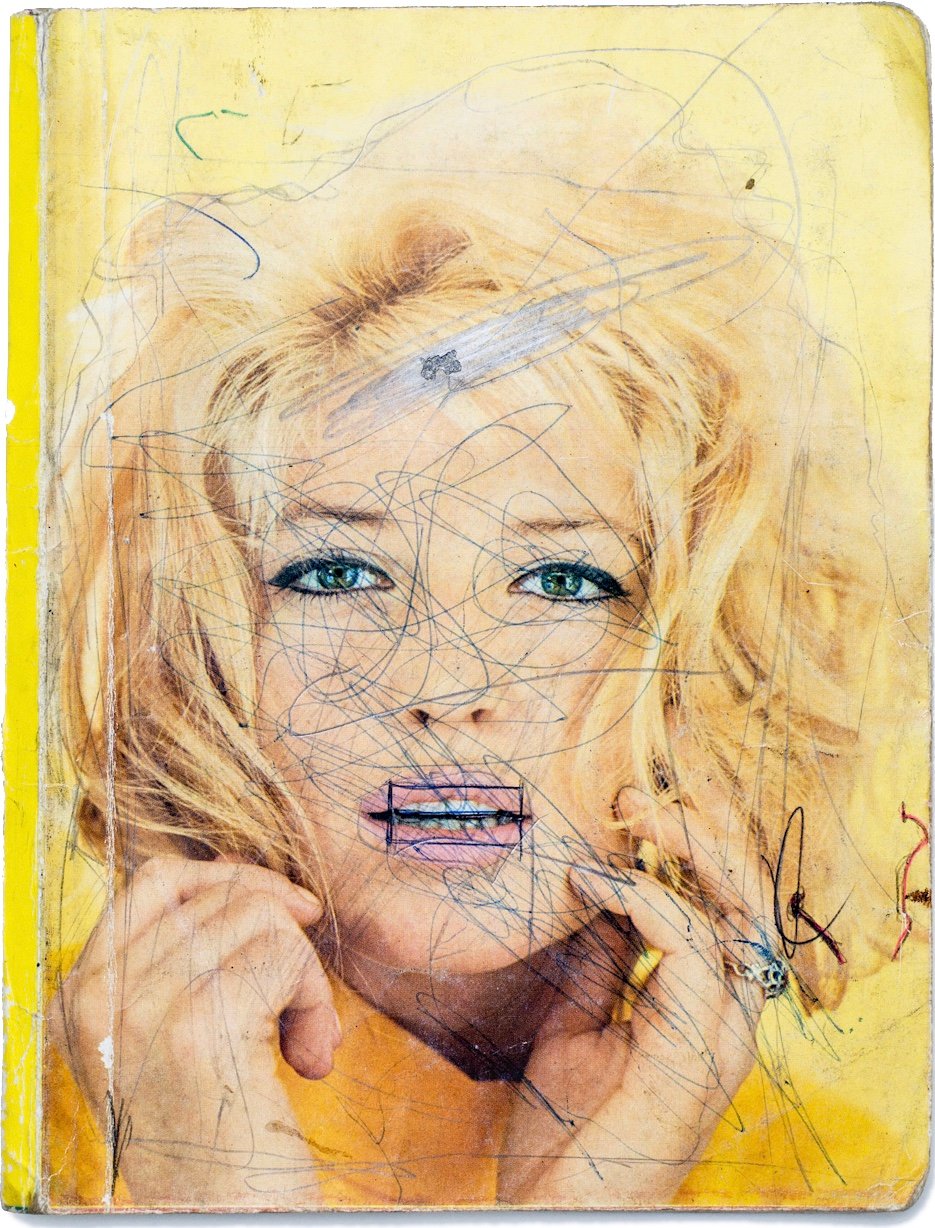
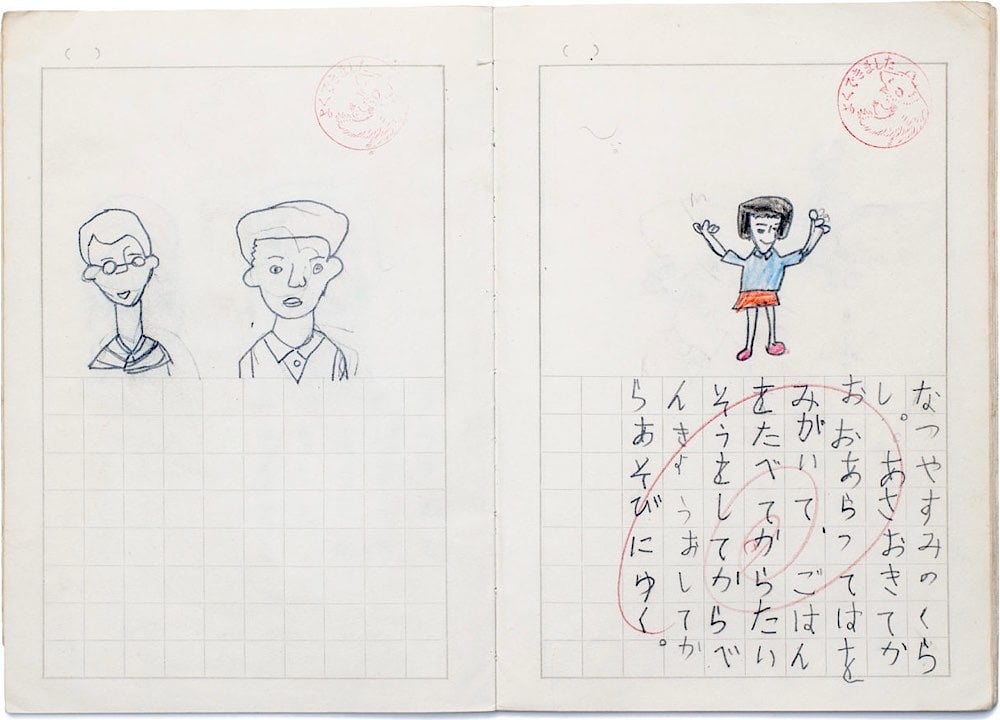
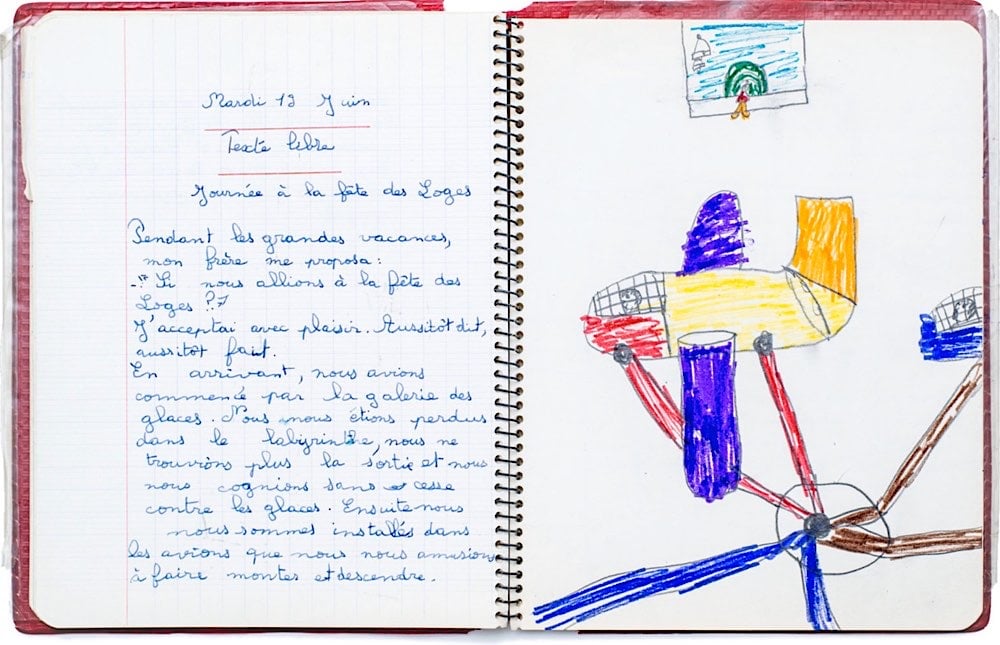
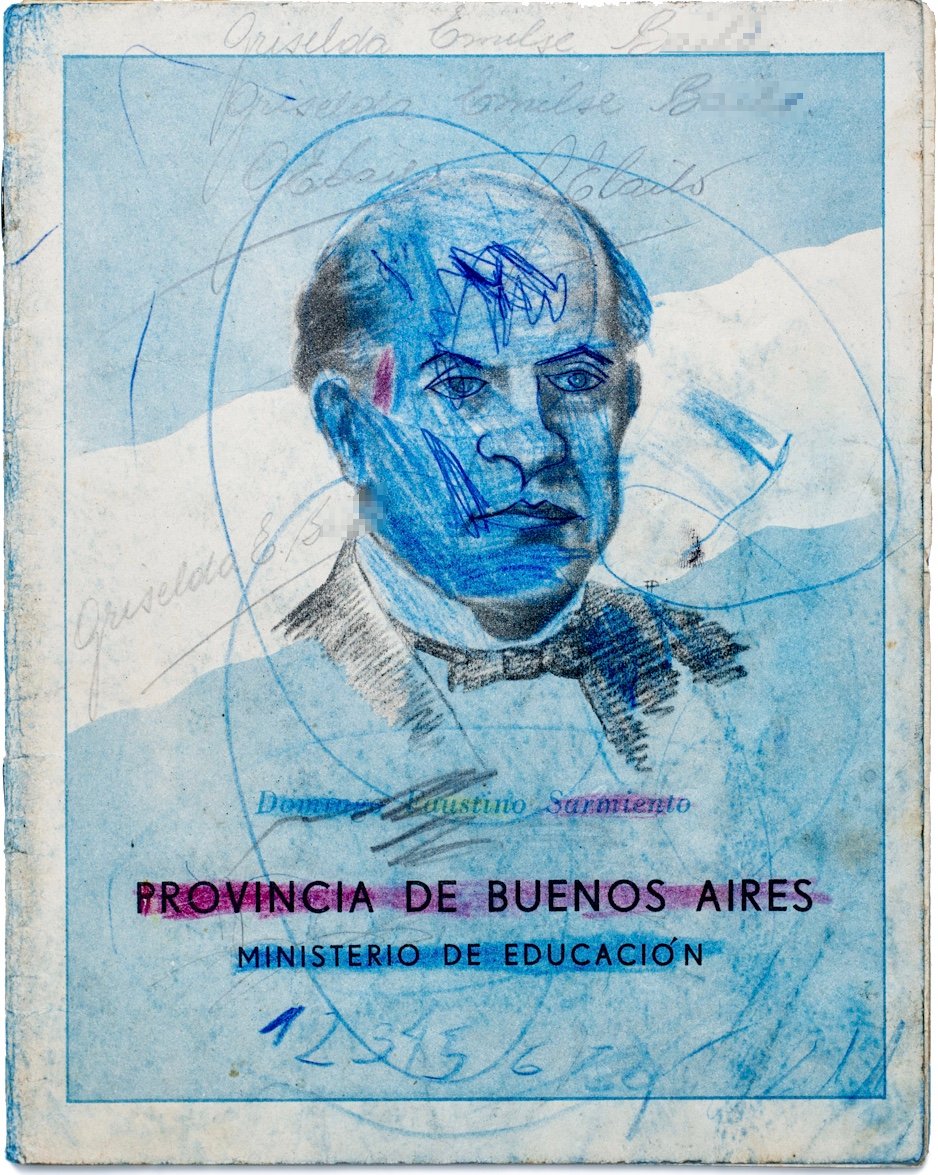
For the past 15 years, the folks at the Exercise Book Archive have been compiling a collection of children’s school notebooks from around the world. In the extensive digital archive, you can find writings, drawings, and aimless doodling in exercise books from as far back as 1773 from countries like the US, Ghana, Latvia, Brazil, and Finland.
The Exercise Book Archive is an ever-growing, participatory archive of old exercise books that allows everyone to discover the history, education, and daily life of children and youth of the past through this unique material. The Archive includes hundreds of exercise books from more than 30 different countries and dated from the late 1700s to the early 2000s. It is preserved and managed by the Milan-based NPO Quaderni Aperti (literally, Open Exercise Books).
If you follow them on Instagram, they are pulling some interesting pieces out of the archive. And if you happen to have any old exercise books from your youth (or your parents’ or grandparents’ youth) lying around, you can donate them to the cause.
In an expanded version of his NY Times’ piece Why Can’t Everyone Get A’s?, Alfie Kohn asks Can Everyone Be Excellent? In the piece, he criticizes our educational system’s practice of ranking students against each other instead of evaluating whether or not they’ve meaningfully improved or successfully learned anything.
But our little thought experiment uncovers a truth that extends well beyond what has been done to our schools in the name of “raising the bar” (a phrase, incidentally, that seems to have originated in the world of show horses). We have been taught to respond with suspicion whenever all members of a defined group are successful. That’s true even when we have no reason to believe that corners have been cut, or that the bar was suspiciously low. In America excellence is treated as an inherently scarce commodity.
Thus, rather than cheering when many people manage to do something well, we’re likely to dismiss that result as meaningless and maybe even mutter darkly about “falling standards” or “being content with mediocrity.” Success seems to matter only if it is attained by a few, and one way to ensure that outcome is to evaluate people (or schools, or companies, or countries) relative to each other. That way, even if everyone has done quite well, or improved over time, half will always fall below the median — and look like failures.
Kohn also touches on the competition inherent in our schools and youth sports:
Reframing excellence in competitive terms can’t be defended on the grounds that setting people against one another leads to improvement in their performance. Indeed, a surprisingly consistent body of social science evidence shows that competition tends to hold us back from doing our best - particularly in comparison with cooperation, in which people work with, not against, each other. Rather, excellence has been defined — for ideological reasons — as something that can’t be reached by everyone.
For the past year or so, my kids and I have been playing Harry Potter Hogwarts Battle. It’s a cooperative game where the players build up individual decks of cards to collectively defeat increasingly difficult villains. I was a bit skeptical of it at first — it seemed a little tedious — but all of us grew to love the collaborative aspect of it. Instead of each of us competing to figure out the best tactics to defeat one another, we’ve had to work together on the best strategies, with long discussions in particularly tough circumstances yielding some of the best lessons. We learned that sometimes the best play for the individual is not the best play for the team. We celebrated our successes and licked our wounds together. As a result, I feel like we all know the game inside and out, better than if we’d been playing a competitive game.
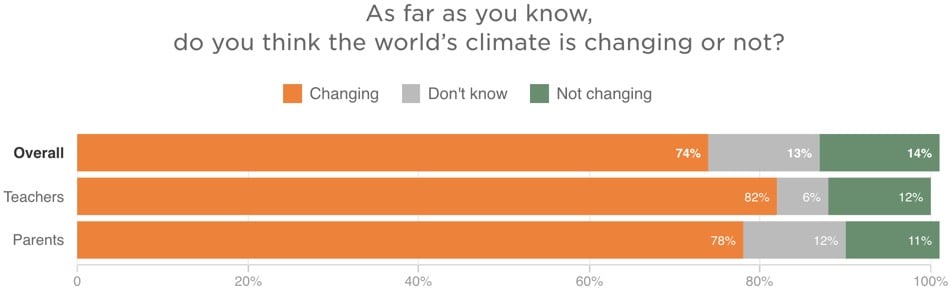
According to a poll conducted by NPR/Ipsos, over 80% of American parents want climate change to be taught in our schools, but only 42% of the teachers polled say that they teach it in their classrooms.
If they don’t hear about it at home, will kids learn about climate change in school? To answer this question, NPR/Ipsos also completed a nationally representative survey of around 500 teachers. These educators were even more likely than the general public to believe in climate change and to support teaching climate change.
In fact, 86% of teachers believe climate change should be taught in schools. In theory.
But in practice, it’s more complicated. More than half — 55% — of teachers we surveyed said they do not cover climate change in their own classrooms or even talk to their students about it.
The most common reason given? Nearly two-thirds (65%) said it’s outside their subject area.
NPR education correspondent Anya Kamenetz shared 8 Ways To Teach Climate Change In Almost Any Classroom, regardless of what subject you teach.
5. Assign a research project, multimedia presentation or speech.
Gay Collins teaches public speaking at Waterford High School in Waterford, Conn. She is interested in “civil discourse” as a tool for problem-solving, so she encourages her students “to shape their speeches around critical topics, like the use of plastics, minimalism, and other environmental issues.
I am, however, still hung up on the 12% of teachers polled who said that the world’s climate is not changing.
Tetris was invented in 1984 by Alexey Pajitnov. It was a hit from the start but became a sensation after it was bundled with Nintendo’s Game Boy. It’s perhaps the most popular video game of all time and was played casually (and not so casually) by hundreds of millions of people around the world. You’d think with all those people playing, the limits of the game were fully probed and the highest scores reached, right? Not quite…
As John Green explains in this video, a few people are actually getting much better at the NES version of Tetris than anyone was back in the 90s. One of the reasons for this is that a smaller dedicated group working together can be more effective than a massive group of people working alone on a problem. Today’s top players can not only compare scores (as people did in the pages of Nintendo Power), but they get together for competitions, share techniques, and post videos of their gameplay to Twitch and YouTube for others to mine for tricks.
The two approaches boil down to ants solving problems vs. deliberate practice. The hundreds of millions of players were able to map out seemingly all corners of the game, but only up to a point. It took a smaller group engaging in a collective deliberate practice to push beyond the mass effort.
Green’s discussion also reminded me of something Malcolm Gladwell said in his conversation with Tyler Cowen:
The most interesting thing happening, to me, in distance running right now is the rise of Japan as a distance-running power. And what’s interesting about Japan is that Japan does not have any one runner, particularly in marathons, does not have any one marathoner who is in the top 10 in the world, or even the top 20 in the world, but they have an enormous number of people who are in the top 100. So, your notion of whether Japan is a distance-running power depends on how you choose to define distance-running power.
We have one definition that we use, where we say we recognize a country as being very good at distance running if they have lots and lots of people in the top 10, but that strikes me as being incredibly arbitrary and it goes to my point about we’re not encouraging mediocrity. Why? All that says is… OK, Kenya’s got 9 of the top 10 of the fastest marathoners right now — why is that better than having 300 of the top 1,000? It’s purely arbitrary that we choose to define greatest as just the country that most densely occupies the 99th percentile. Why can’t we define it as the country that most densely occupies the 75th through 100th percentiles?
Tetris today is like Kenya in distance running…all the best-ever players are active right now. With Tetris in the 90s, you had a much broader group of people who were really good at the game but none of whom would crack the all-time top 20 (or perhaps even top 100).
Maybe you don’t give a flying flip about excellence in Tetris or distance running, but how about education? Should we direct the resources of our educational system to ensure that most people get a pretty good education or that fewer get an excellent education? Having a few super-educated people might result in more significant discoveries in science and achievements in literature or music (that everyone can then take advantage of) but having a broader base of educated citizens would result in better decisions being made in untold numbers of everyday situations. Which of those two situations is better? Which is more just? I’d suggest the answer maybe isn’t that obvious…
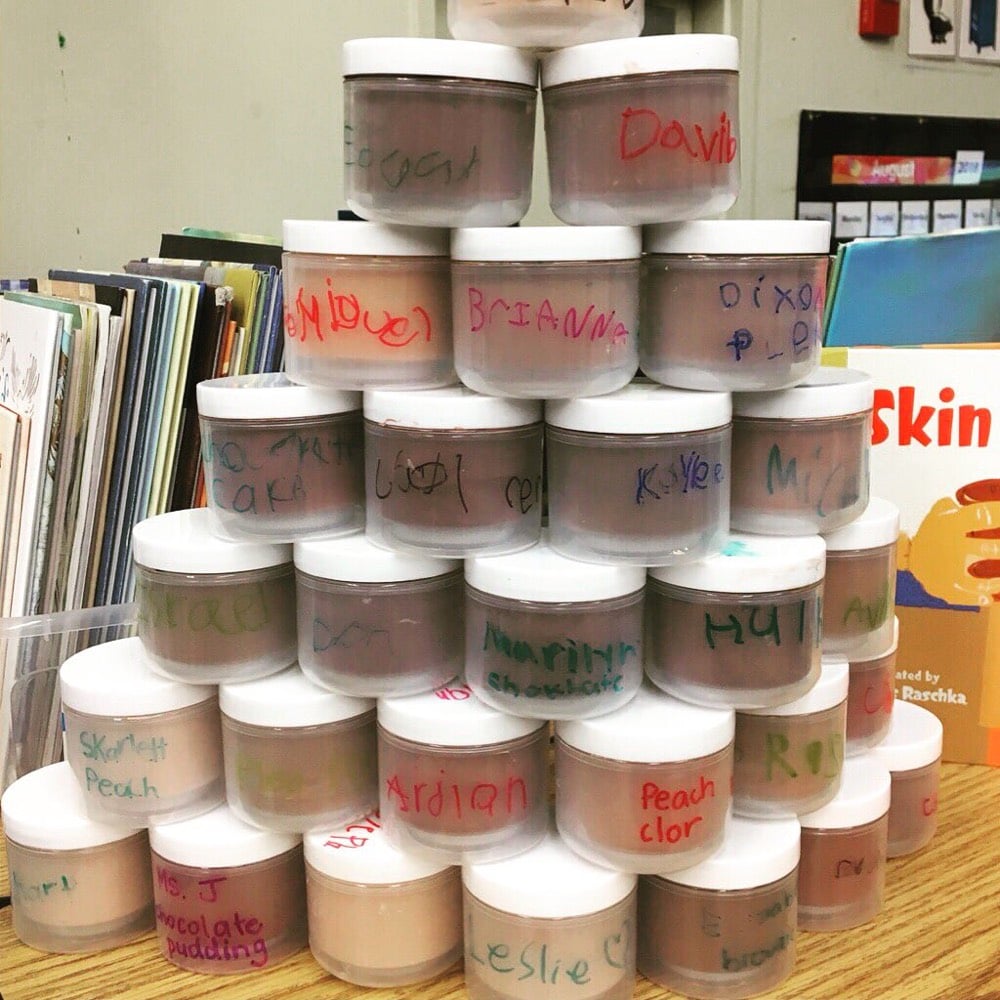
For the beginning of school, second-grade teacher Aeriale Johnson had each of her students mix up a container of paint that matched their skin color so they could use it in paintings of themselves during the rest of the school year.
We started with a base of brown or peach tempera for each child then, in small groups, added white, yellow, red, dark brown and/or green to get to just the right hue. They looked like they were at Ulta trying to find foundation. :) The conversations were great!
Earlier this year, 30,000 teachers in Oklahoma walked out of their classrooms to protest teacher pay and education budget cuts. The walkout ended after nine days with the teachers’ goals partially met. Vice News talked to 18 Oklahoma teachers about why they’ve decided to quit teaching after this year, essentially making their walkouts permanent.
Eric Weingartner worked two side jobs in addition to his role as a full-time 4th grade teacher to make ends meet. Chemistry teacher Becky Smith’s monthly paycheck rose just $300 in sixteen years. Aimee Elmquist spent her own money to stock her biology classroom. Mary West did the same for high school art.
One of the biggest realizations I’ve had in the past few years is that while Americans talk a lot about the importance of children and education, those things actually are not that important to us. You can see it in how we approach our educational system and you can see it in how we our government uses the abuse of children to attempt to curb immigration with relatively little outcry. You can see it in our governance…the people we elect do what’s best for voters, not for future voters. The enthusiasm of hobbyists and desire of gun companies keep our children attending school in fear. Healthcare costs are soaring and coverage for children isn’t guaranteed. Our parental leave policies, maternity care, and all-around treatment of mothers & women in the workplace lags behind other so-called “developed” countries. Children are a priority for the US? Yeah, no.
Older posts





Socials & More