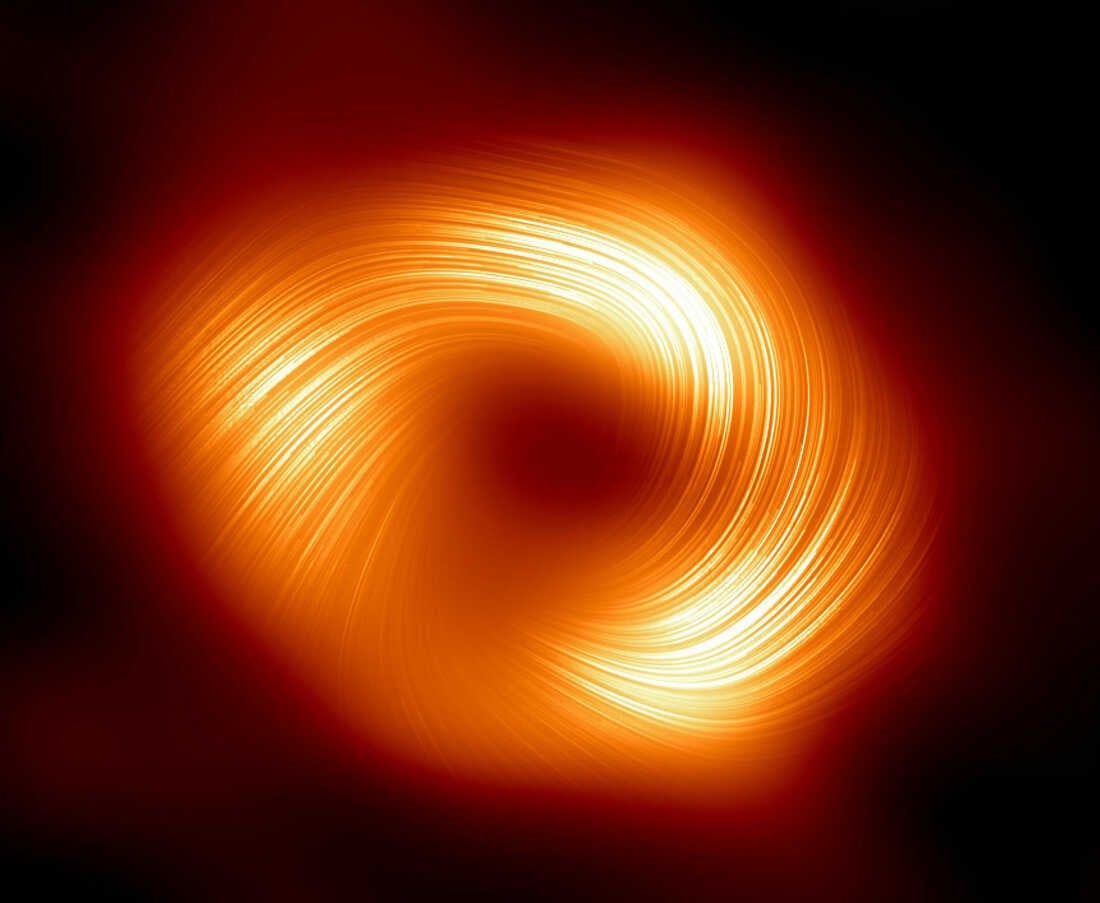
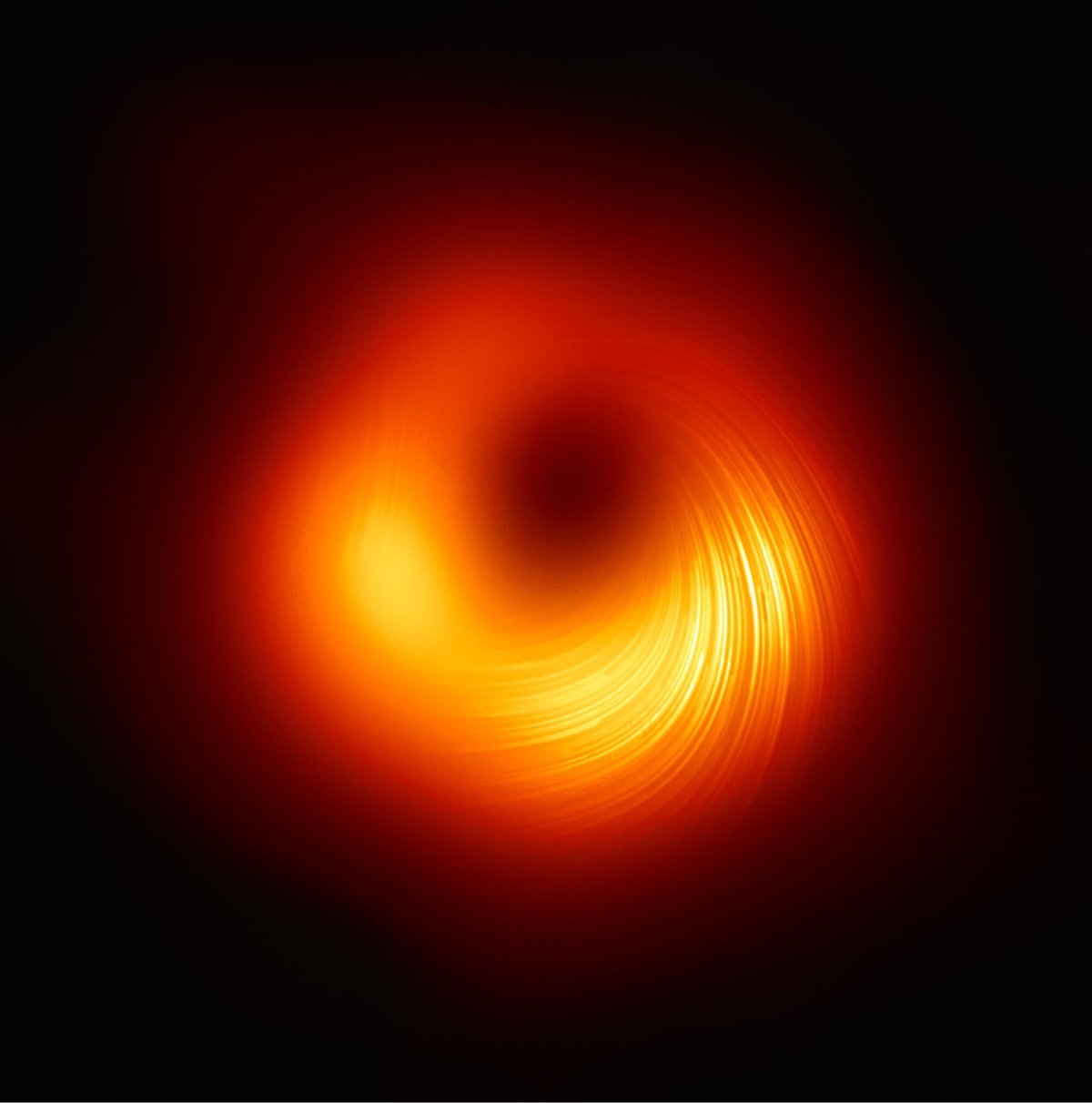
It’s been about five years since scientists captured the first blurry image of a black hole. Using what they learned from that experience, they’ve teased out some more detailed images of the black holes at the centers of the Milky Way galaxy (top) and the M87 galaxy (bottom). The process of collecting the data for these images is interesting:
The only way to “see” a black hole is to image the shadow created by light as it bends in response to the object’s powerful gravitational field. As Ars Science Editor John Timmer reported in 2019, the EHT isn’t a telescope in the traditional sense. Instead, it’s a collection of telescopes scattered around the globe. The EHT is created by interferometry, which uses light in the microwave regime of the electromagnetic spectrum captured at different locations. These recorded images are combined and processed to build an image with a resolution similar to that of a telescope the size of the most distant locations. Interferometry has been used at facilities like ALMA (the Atacama Large Millimeter/submillimeter Array) in northern Chile, where telescopes can be spread across 16 km of desert.
In theory, there’s no upper limit on the size of the array, but to determine which photons originated simultaneously at the source, you need very precise location and timing information on each of the sites. And you still have to gather sufficient photons to see anything at all. So atomic clocks were installed at many of the locations, and exact GPS measurements were built up over time. For the EHT, the large collecting area of ALMA-combined with choosing a wavelength in which supermassive black holes are very bright-ensured sufficient photons.
While this idea may initially sound somewhat mundane, it is anything but. The result is surprising because Sgr A*’s mass is about 4.3 million times that of the Sun, while M87*’s is about 6.5 billion times that of the Sun. Despite the significant difference in mass between the two supermassive black holes, the fact that their magnetic fields behave similarly and are both well-organized is an incredible discovery.
Using a scale model of the solar system the size of New York City and some dazzling visual effects, Epic Spaceman explains that black holes are generally smaller than you might think (because they’re so dense) — even the supermassive black hole at the center of our galaxy. But when you consider some of the biggest black holes we’ve discovered…wow.
Here’s a fun thought experiment: can you destroy a black hole? Nuclear weapons probably won’t work but what about antimatter? Or anti black holes? In this video, Kurzgesagt explores the possibilities and impossibilities. This part baked my noodle (in a good way):
Contrary to widespread belief, the singularity of a black hole is not really “at its center”. It’s in the future of whatever crosses the horizon. Black holes warp the universe so drastically that, at the event horizon, space and time switch their roles. Once you cross it, falling towards the center means going towards the future. That’s why you cannot escape: Stopping your fall and turning back would be just as impossible as stopping time and traveling to the past. So the singularity is actually in your future, not “in front of you”. And just like you can’t see your own future, you won’t see the singularity until you hit it.
Astronomers believe that there’s a black hole at the center of almost every large galaxy in the universe. Some of those black holes are particularly energetic, chewing up the galaxies in which they reside and releasing massive amounts of energy out into the cosmos. Those black holes and the energy emitted from matter and gas falling towards their centers are what astronomers call quasars.
But if we look closely, we see who is actually in charge. Small as a grain of sand compared to the filaments, the centers of some of these galaxies shine with the power of a trillion stars, blasting out huge jets of matter, completely reshaping the cosmos around them. Quasars, the single most powerful objects in existence, so powerful that they can kill a galaxy.
This short animation from NASA shows the sizes of some of the supermassive black holes that feature at the center of galaxies. Some are relatively small:
First up is 1601+3113, a dwarf galaxy hosting a black hole packed with the mass of 100,000 Suns. The matter is so compressed that even the black hole’s shadow is smaller than our Sun.
While others are much larger than the solar system…and this isn’t even the biggest one:
At the animation’s larger scale lies M87’s black hole, now with a updated mass of 5.4 billion Suns. Its shadow is so big that even a beam of light — traveling at 670 million mph (1 billion kph) — would take about two and a half days to cross it.
A group of astronomers say they have evidence that links supermassive black holes at galactic centers with dark energy, the mysterious force that accounts for roughly 68% of the energy in the universe. Here’s the news release and the paper. From the Guardian:
Instead of dark energy being smeared out across spacetime, as many physicists have assumed, the scientists suggest that it is created and remains inside black holes, which form in the crushing forces of collapsing stars.
“We propose that black holes are the source for dark energy,” said Duncan Farrah, an astronomer at the University of Hawaii. “This dark energy is produced when normal matter is compressed during the death and collapse of large stars.”
The claim was met with raised eyebrows from some independent experts, with one noting that while the idea deserved scrutiny, it was far too early to link black holes and dark energy. “There’s a number of counter-arguments and facts that need to be understood if this claim is going to live more than a few months,” said Vitor Cardoso, a professor of physics at the Niels Bohr Institute in Copenhagen.
And here’s a short video explainer:
It’s a radical claim to be sure — it’ll be interesting to see how it shakes out in the weeks and months to come as other scientists interpret the results.
Black holes are the largest single objects in the universe, many times larger than even the biggest stars, and have no upper limit to their size. But practically, how big is the biggest, heaviest black hole in the universe? (A: More massive than the entire Milky Way.)
The largest things in the universe are black holes. In contrast to things like planets or stars they have no physical size limit, and can literally grow endlessly. Although in reality specific things need to happen to create different kinds of black holes, from really tiny ones to the largest single things in the universe. So how do black holes grow and how large is the largest of them all?
Videos about space are where Kurzgesagt really shines. I’ve seen all their videos about black holes and related objects, and I always pick up something I never knew whenever a new one comes out. This time around, it was quasistars and the surprisingly small mass of supermassive black holes located at galactic centers compared to the galaxies themselves.
You’re probably aware that black holes are weird. You can learn more about just how extremely odd they are by watching this animated primer on black holes by Kurzgesagt. The explanation about how long black holes live starting at ~9:30 is legitimately mindblowing — that hourglass metaphor especially.
Let’s say the Earth turned into a black hole. What would happen to someone standing on the surface and for how long would it happen? From Ethan Siegel:
As spectacular as falling into a black hole would actually be, if Earth spontaneously became one, you’d never get to experience it for yourself. You’d get to live for about another 21 minutes in an incredibly odd state: free-falling, while the air around you free-fell at exactly the same rate. As time went on, you’d feel the atmosphere thicken and the air pressure increase as everything around the world accelerated towards the center, while objects that weren’t attached to the ground would appear approach you from all directions.
A research astronomer at NASA’s Jet Propulsion Laboratory, Grojian specializes in — and I’d just like to pause here to emphasize that this is the official title of his research group at JPL — the structure of the universe. Which means the guy not only knows about event horizons and gravitational lensing but stuff like tidal forces (what!), x-ray binaries (hey now!), and active galactic nuclei (oh my god!). Seriously, the guy’s knowledge of black holes is encyclopedic.
Gorjian lost me somewhere in the middle of his conversation with the grad student.
The story begins in the mid-1900s when astronomers expanded their horizons beyond the very narrow range of wavelengths to which our eyes are sensitive. Very strong sources of radio waves were discovered and, when accurate positions were determined, many were found to be centered on distant galaxies. Shortly thereafter, radio antennas were linked together to greatly improve angular resolution. These new “interferometers” revealed a totally unexpected picture of the radio emission from galaxies—the radio waves did not appear to come from the galaxy itself, but from two huge “lobes” symmetrically placed about the galaxy….
Ultimately this led to the technique of Very Long Baseline Interferometry (VLBI), in which radio signals from antennas across the Earth are combined to obtain the angular resolution of a telescope the size of our planet! Radio images made from VLBI observations soon revealed that the sources at the centers of radio galaxies are “microscopic” by galaxy standards, even smaller than the distance between the sun and our nearest star.
When astronomers calculated the energy needed to power radio lobes they were astounded. It required 10 million stars to be “vaporized,” totally converting their mass to energy using Einstein’s famous equation E = mc2! Nuclear reactions, which power stars, cannot even convert 1 percent of a star’s mass to energy. So trying to explain the energy in radio lobes with nuclear power would require more than 1 billion stars, and these stars would have to live within the “microscopic” volume indicated by the VLBI observations. Because of these findings, astronomers began considering alternative energy sources: supermassive black holes.
We’ve also been tracing the orbits of planets, stars, and other objects that do give off conventional light. All this tracks back to suggest the supermassive black holes that Laplace et al first theorized about hundreds of years ago.
So, we knew what we were looking for. That’s how we were able to find it. And boom! Now we’ve got its photograph too. No more hiding from us, you goddamn light-devouring singularities. We’ve got your number.
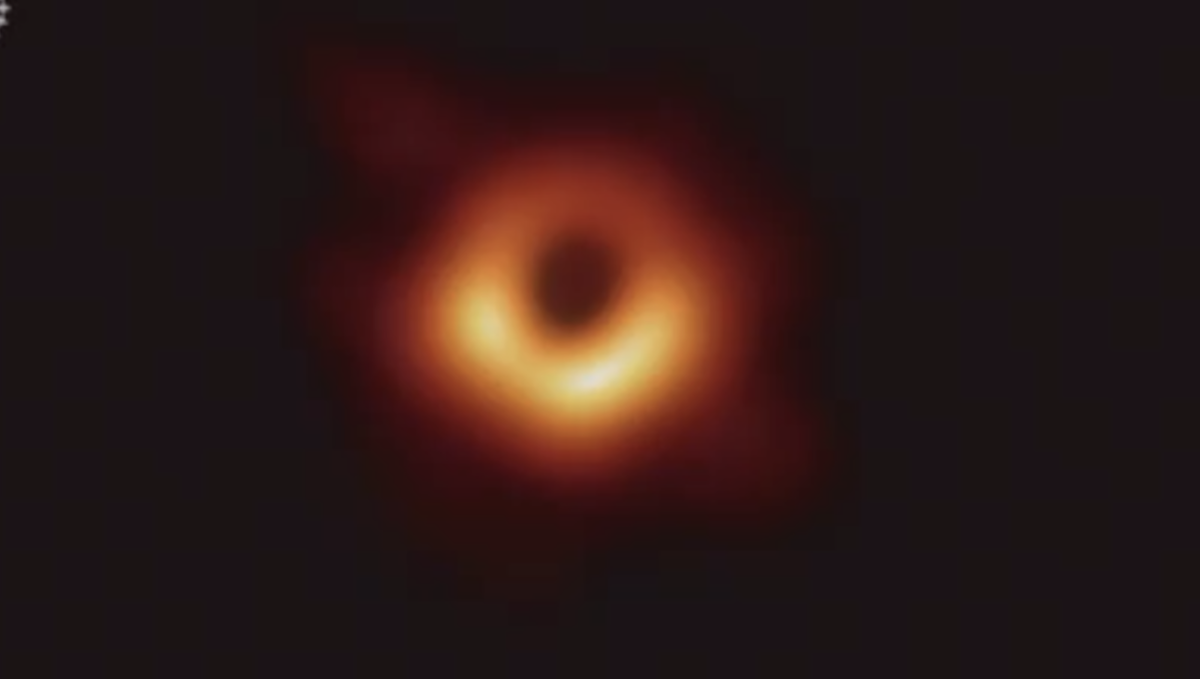
Ok, this is pretty cool. We have the first photo of a supermassive black hole, from imagery taken two years ago of the elliptical galaxy M87 (in the constellation Virgo) by the Event Horizon Telescope project. The EHT team is a group of 200 scientist that has been working on this project for two decades. The image was created using data captured from radio telescopes from Hawaii to the South Pole and beyond using very long baseline interferometry.
The image, of a lopsided ring of light surrounding a dark circle deep in the heart of the galaxy known as Messier 87, some 55 million light-years away from here, resembled the Eye of Sauron, a reminder yet again of the power and malevolence of nature. It is a smoke ring framing a one-way portal to eternity.
Now is a good time to (re)read Jonathan Lethem’s early novel, the absurdist physics love story As She Climbed Across the Table.
Update: Vox’s Joss Fong has a good 6-minute video that explains how the photo was taken:
And this video by Veritasium is even more meaty (and this one too):
As of December 1, 2018, the LIGO experiment has detected gravitational waves from 10 black hole merger events. In the computer simulations shown in this video, you can see what each of the mergers looked like along with the corresponding gravitational waves generated and subsequently observed by the LIGO detectors.
Astronomers behind the Event Horizon Telescope are building a virtual telescope with a diameter of the Earth to photograph the supermassive black hole at the center of our galaxy. The idea is that different observatories from all over the surface of the Earth all look at the black hole at the same time and the resulting data is stitched together by a supercomputer into a coherent picture. Seth Fletcher wrote a great piece about the effort for the NY Times Magazine (it’s an excerpt from his new book, Einstein’s Shadow: A Black Hole, a Band of Astronomers, and the Quest to See the Unseeable):
Astronomical images have a way of putting terrestrial concerns in perspective. Headlines may portend the collapse of Western civilization, but the black hole doesn’t care. It has been there for most of cosmic history; it will witness the death of the universe. In a time of lies, a picture of our own private black hole would be something true. The effort to get that picture speaks well of our species: a bunch of people around the world defying international discord and general ascendant stupidity in unified pursuit of a gloriously esoteric goal. And in these dark days, it’s only fitting that the object of this pursuit is the darkest thing imaginable.
Avery Broderick, a theoretical astrophysicist who works with the Event Horizon Telescope, said in 2014 that the first picture of a black hole could be just as important as “Pale Blue Dot,” the 1990 photo of Earth that the space probe Voyager took from the rings of Saturn, in which our planet is an insignificant speck in a vast vacuum. A new picture, Avery thought, of one of nature’s purest embodiments of chaos and existential unease would have a different message: It would say, There are monsters out there.
A video by the EHT team says that imaging the black hole is like trying to count the dimples on a golf ball located in LA while standing in NYC.
The European Southern Observatory’s Very Large Telescope in Chile has been watching the supermassive black hole in the center of our galaxy and the stars that orbit it. Using observations from the past 20 years, the ESO made this time lapse video of the stars orbiting the black hole, which has the mass of four million suns. I’ve watched this video like 20 times today, my mind blown at being able to observe the motion of these massive objects from such a distance.
New infrared observations from the exquisitely sensitive GRAVITY, SINFONI and NACO instruments on ESO’s Very Large Telescope (VLT) have now allowed astronomers to follow one of these stars, called S2, as it passed very close to the black hole during May 2018. At the closest point this star was at a distance of less than 20 billion kilometres from the black hole and moving at a speed in excess of 25 million kilometres per hour — almost three percent of the speed of light.
S2 has the mass of about 15 suns. That’s 6.6 × 10^31 pounds moving at 3% of the speed of light. Wowowow.
Well, this is a thing I didn’t know about black holes before watching this video. Because some black holes spin, it’s possible to harvest massive amounts of energy from them, even when all other energy sources in the far far future are gone. This process was first proposed by Roger Penrose in a 1971 paper.
The Penrose process (also called Penrose mechanism) is a process theorised by Roger Penrose wherein energy can be extracted from a rotating black hole. That extraction is made possible because the rotational energy of the black hole is located not inside the event horizon of the black hole, but on the outside of it in a region of the Kerr spacetime called the ergosphere, a region in which a particle is necessarily propelled in locomotive concurrence with the rotating spacetime. All objects in the ergosphere become dragged by a rotating spacetime. In the process, a lump of matter enters into the ergosphere of the black hole, and once it enters the ergosphere, it is forcibly split into two parts. For example, the matter might be made of two parts that separate by firing an explosive or rocket which pushes its halves apart. The momentum of the two pieces of matter when they separate can be arranged so that one piece escapes from the black hole (it “escapes to infinity”), whilst the other falls past the event horizon into the black hole. With careful arrangement, the escaping piece of matter can be made to have greater mass-energy than the original piece of matter, and the infalling piece has negative mass-energy.
This same effect can also be used in conjunction with a massive mirror to superradiate electromagnetic energy: you shoot light into a spinning black hole surrounded by mirrors, the light is repeatedly sped up by the ergosphere as it bounces off the mirror, and then you harvest the super-energetic light. After the significant startup costs, it’s basically an infinite source of free energy.
In their latest video, Kurzgesagt takes a look at black holes, specifically how they deal with information. According to the currently accepted theories, one of the fundamental laws of the Universe is that information can never be lost, but black holes destroy information. This is the information paradox…so one or both of our theories must be wrong.
The paradox arose after Hawking showed, in 1974-1975, that black holes surrounded by quantum fields actually will radiate particles (“Hawking radiation”) and shrink in size (Figure 4), eventually evaporating completely. Compare with Figure 2, where the information about the two shells gets stuck inside the black hole. In Figure 4, the black hole is gone. Where did the information go? If it disappeared along with the black hole, that violates quantum theory.
Maybe the information came back out with the Hawking radiation? The problem is that the information in the black hole can’t get out. So the only way it can be in the Hawking radiation (naively) is if what is inside is copied. Having two copies of the information, one inside, one outside, also violates quantum theory.
So maybe black holes holographically encode their information on the surface?
How massive are they? The Sun is 1 solar mass and as wide as 109 Earths. Sagittarius A, the black hole at the center of the Milky Way, weighs 4.3 million solar masses and is as wide as Mercury is far from the Sun. The black hole at the center of the Phoenix Cluster is one of the largest known black holes in the Universe; it’s 73 billion miles across, which is 19 times larger than our entire solar system (from the Sun to Pluto). As for how much it weighs, check this out:
I also like that if you made the Earth into a black hole, it would be the size of a peanut. (thx, reidar)
First of all, not all of the Earth would simply be sucked into the black hole. When the matter near the black hole begins to fall into the black hole, it will be compressed to a very high density that will cause it to be heated to very high temperatures. These high temperatures will cause gamma rays, X-rays, and other radiation to heat up the other matter falling in to the black hole. The net effect will be that there will be a strong outward pressure on the outer layers of the Earth that will first slow down their fall and will eventually ionize and push the outer layers away from the black hole. So some inner portion of the core will fall into the black hole, but the outer layers, including the crust and all of us, would be vaporized to a high temperature plasma and blown into space.
This would be a gigantic explosion — a significant fraction of the rest of the mass of the Earth matter that actually fell into the black hole will be converted into energy.
FYI, that marble-sized black hole would have about the same mass as the Earth. Not that they exist, mind you. Maybe, maybe not. Blackish holes? Dark grey holes? Anyway, really heavy.
Most physicists foolhardy enough to write a paper claiming that “there are no black holes” — at least not in the sense we usually imagine — would probably be dismissed as cranks. But when the call to redefine these cosmic crunchers comes from Stephen Hawking, it’s worth taking notice. In a paper posted online, the physicist, based at the University of Cambridge, UK, and one of the creators of modern black-hole theory, does away with the notion of an event horizon, the invisible boundary thought to shroud every black hole, beyond which nothing, not even light, can escape.
In its stead, Hawking’s radical proposal is a much more benign “apparent horizon”, which only temporarily holds matter and energy prisoner before eventually releasing them, albeit in a more garbled form.
Were you to be close to a black hole, this program shows you what you might observe.
The optical appearance of the stellar sky for an observer in the vicinity of a black hole is dominated by bending of light, frequency shift, and magnification caused by gravitational lensing and aberration. Due to the finite apperture of an observer’s eye or a telescope, Fraunhofer diffraction has to be taken into account. Using todays high performance graphics hardware, we have developed a Qt application which enables the user to interactively explore the stellar sky in the vicinity of a Schwarzschild black hole. For that, we determine what an observer, who can either move quasistatically around the black hole or follow a timelike radial geodesic, would actually see.
For Linux and Windows only, although there are sample videos for non-downloaders or those on other machines.
As black holes evaporate, they release Hawking radiation. Named after the legendary Stephen, who first argued for its existence in 1974, Hawking radiation emitted is measured by the mass, angular momentum, and charge of the black hole. Hawking radiation has been predicted to be part of the eventual catalyst for the heat death of the universe, and recent findings suggest that it’s possibly closer than astronomers originally calculated. Don’t max out your credit cards or adopt a Twinkie diet just yet. Scientists believe that it takes roughly 10^102 years for a supermassive black hole to evaporate, and chances are that global warming, war, or Twinkies will have done in humanity long before then.
It looks like black holes can grow to be as massive as 50 billion suns. How massive is that? It’s approximately 99 duodecillion kilograms….which is a 99 followed by 39 zeros. (Put another way, if you had 99 duodecillion dollars, you could buy as many PlayStation 3s as you wanted. Blows your mind, right?)
How to survive a black hole. If you’re in a rocket ship about to fall into a black hole, you might live a bit longer if you turn on your engines. “But in general a person falling past the horizon won’t have zero velocity to begin with. Then the situation is different — in fact it’s worse. So firing the rocket for a short time can push the astronaut back on to the best-case scenario: the trajectory followed by free fall from rest.”
Update: Many people wrote in to correct me in saying that “submillimeter” referred to the size of the telescopes…it of course referred to the EM wavelength. Me brain not working right.





Stay Connected