
All the Percents on Star Trek: TNG
I 100% love this video of every time someone says a percentage on Star Trek: The Next Generation. And the word “percent” has lost all of its meaning due to semantic satiation. (thx, caroline)

This site is made possible by member support. 💞
Big thanks to Arcustech for hosting the site and offering amazing tech support.
When you buy through links on kottke.org, I may earn an affiliate commission. Thanks for supporting the site!
kottke.org. home of fine hypertext products since 1998.
Beloved by 86.47% of the web.
I 100% love this video of every time someone says a percentage on Star Trek: The Next Generation. And the word “percent” has lost all of its meaning due to semantic satiation. (thx, caroline)
So, I don’t know what kind of nerd you are, but my brand of nerdiness dovetails neatly with this video about the origins of some of the most common symbols on your keyboard: #, @, &, §, *, ¶, †, and ‡, as well as ☞.
The “and” symbol or ampersand does not look like a word, but it is one. In fact, it is a full one. It is the Latin word for “and”: “et”. The Romans themselves used this. How do we know? Because we have this: the earliest known example of it, graffitied onto a wall in the doomed Roman city of Pompeii.
I really like what Razaak Eniola has to say here about human difference.
Before Prince was Prince, Prince was weird. And that goes the same for probably any of your favorite artists. Before Erykah Badu was Erykah Badu, Erykah Badu was weird. Before Marc Rebillet was Marc Rebillet, Marc Rebillet was weird.
Everybody loves to clap at the end — and most of the time we are clapping for the wrong reasons. We live in a culture that loves final products.
It’s cool to be weird, as long as it’s rooted and aligned with what’s true and what’s sincere.
I often tell people they’re weird and it’s always a compliment. Before it came to mean odd-looking or “disturbingly different”, weird meant “having power to control fate” — perhaps you could think of it as describing someone who can forge their own way, make their own luck.
Here’s a short quiz to discover your weirdness: You’re Weirder Than You Think.
For whatever reason, this also reminds me of something I read earlier today by Robin Sloan:
We should never forget that the product of work isn’t only the work — it’s also the worker.
Word nerd Rob Watts explains where the names of all the European countries come from.
Which country is the “land of the rabbits”? Why does Germany have so many different names? Where do the Dutch actually live? What links Croatians and neckties?
(via open culture)
On his YouTube channel, Thomas Whichello reads interesting literature aloud, often in the original languages, dialects, or accents, with the goal of making “classic works intelligible and enjoyable to everybody”. One of his most popular videos is his recitation of book 1 of the Iliad in Ancient Greek.
In the translation for this video, I have attempted to follow the emphasis, division of thought, and order of ideas of the original, as well as its turn of phrase, as closely as the English idiom will bear. By means of the line-breaks, which bear a resemblance to free verse, I hope that the parallel text may serve (as it were) as a speaking version of a Loeb Classical Library book. For these line-breaks have been made to correspond roughly with the phraseology of the Greek, as reflected by my impulses of breath and intonation when speaking, so that even a perceptive person who knows no Greek, may be able to infer at times which parts of the original correspond to the respective parts of the translation.
The video is an hour and 45 minutes long so I confess to not having listened to all of it, but even dipping your toe in a little bit is worthwhile, just for the experience. Whichello’s full text translation is available on his website if you’d like to use it to follow along. (via open culture)
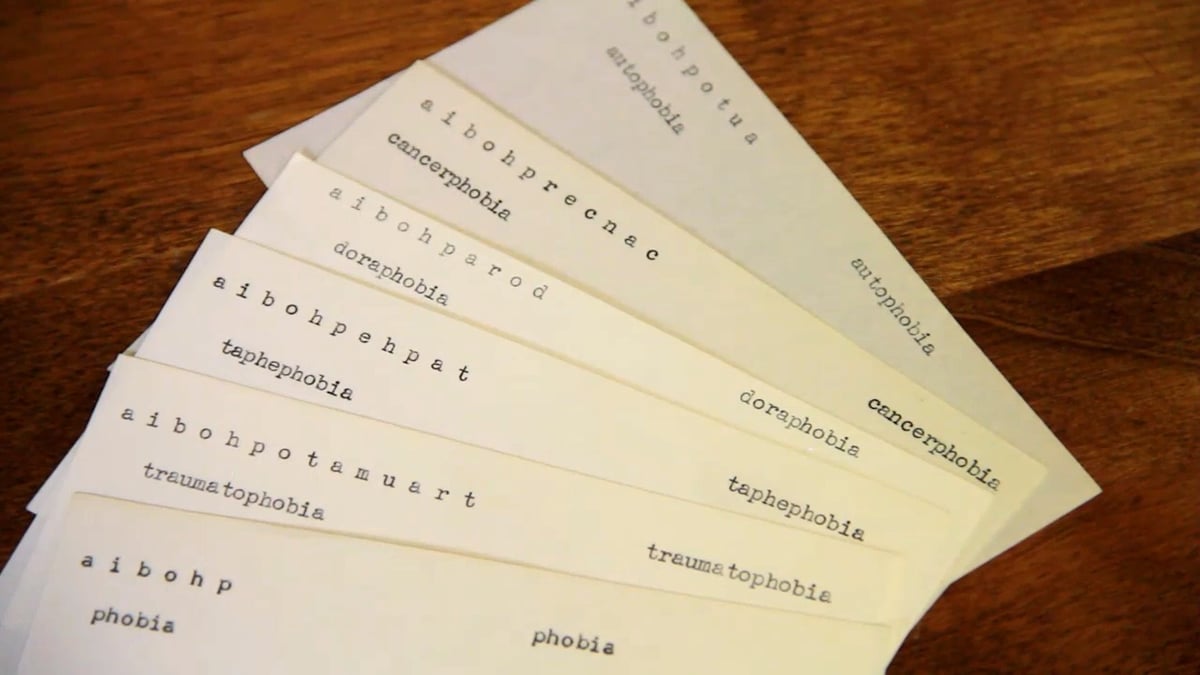
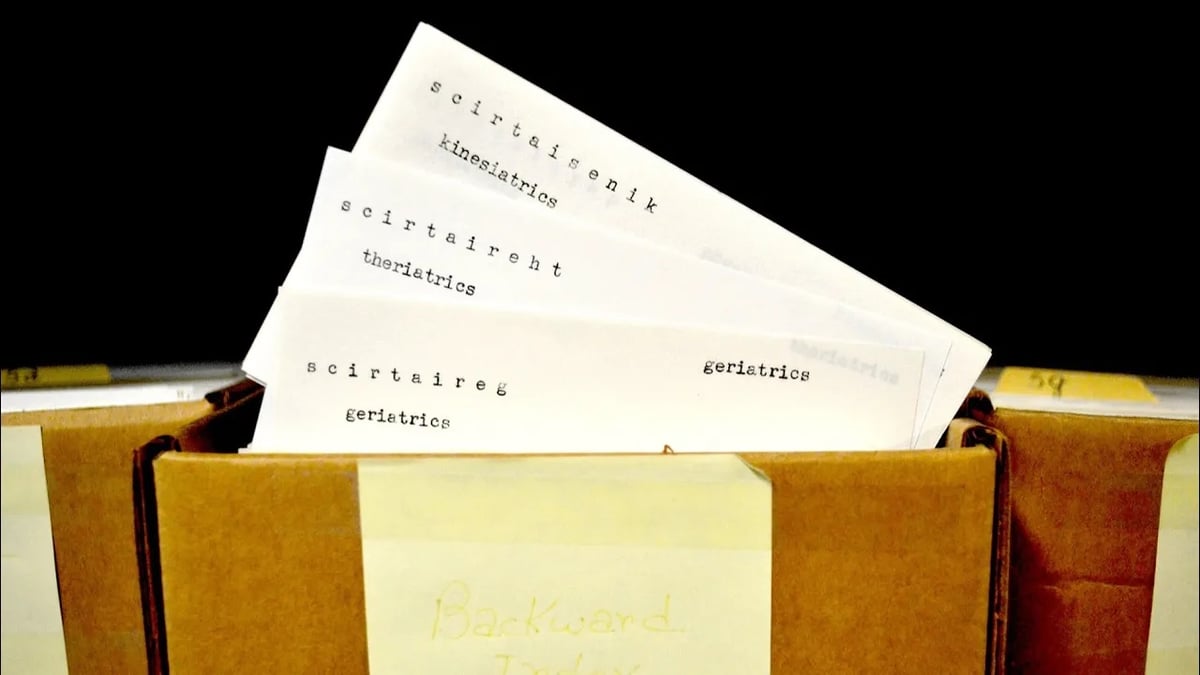
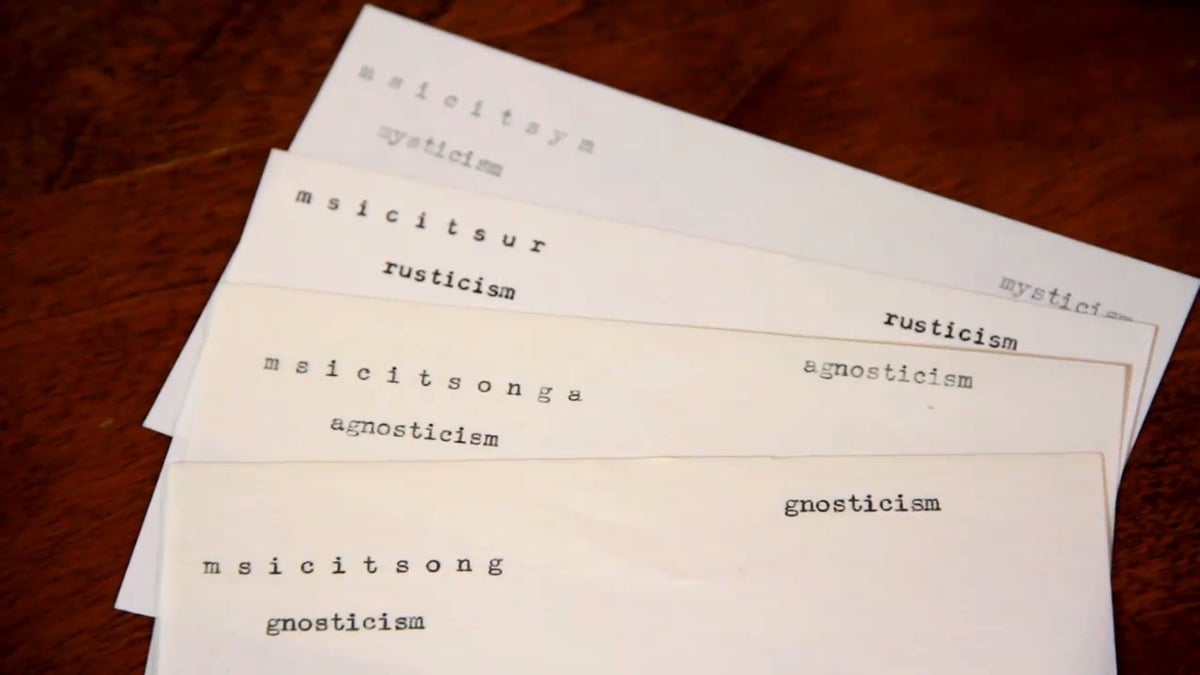
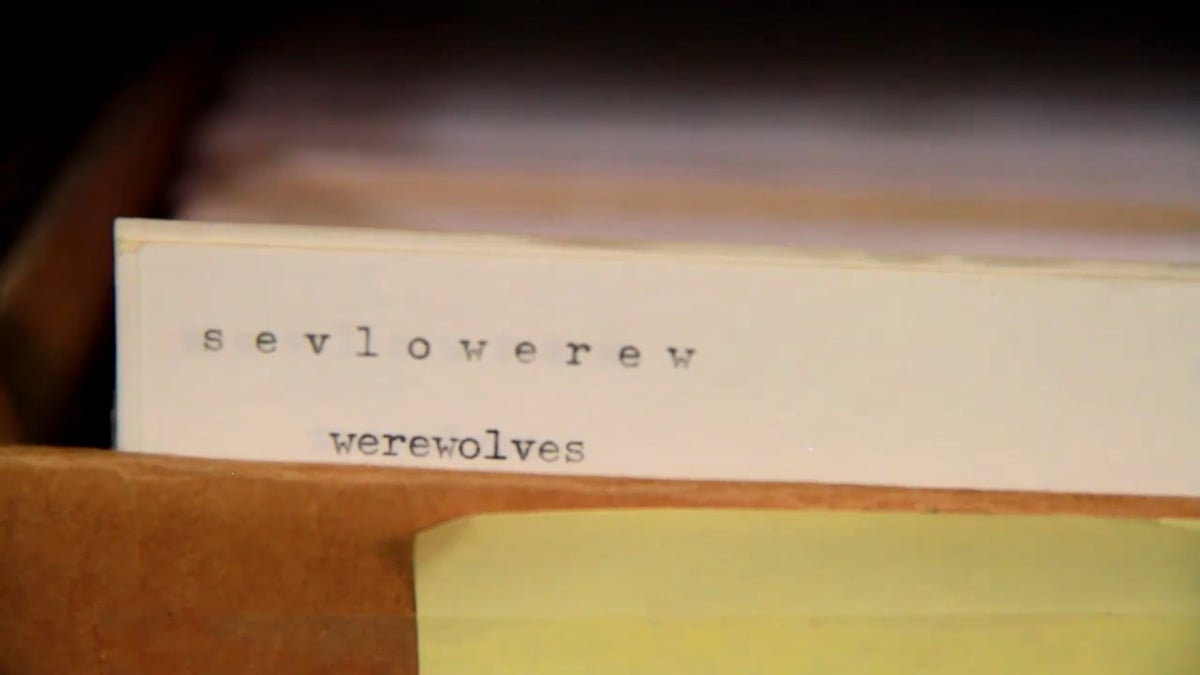
How do dictionary makers keep track of similarly suffixed words, like those ending in -ism, -graphy, -ness, or -ology? With a computer, it’s simple, but how did they do it before the computing age? Starting in the 1950s, lexicographers at Merriam-Webster typed all of the words in the dictionary out backwards and organized them alphabetically into a collection called the Backward Index.
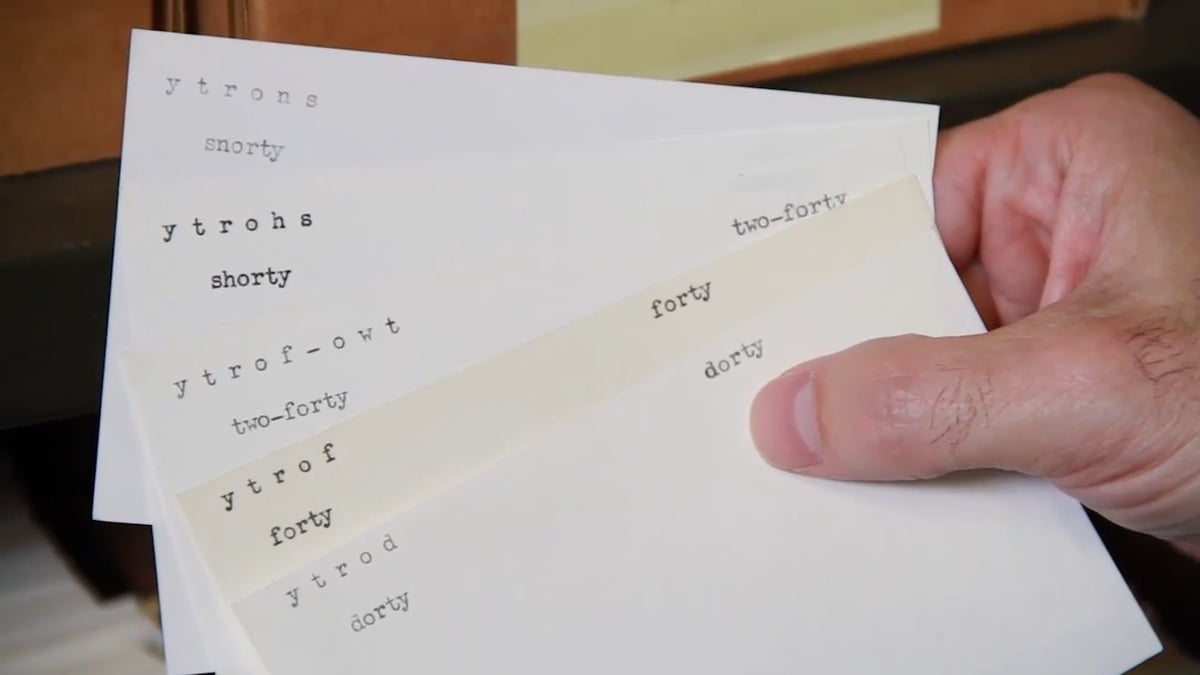
The Backward Index evidently turned out to be a useful tool in the pre-electronic age. For example, it could help identify a set of related terms that should be defined in similar ways, including open compounds (Highland pony, Shetland pony, Welsh pony), closed compounds (blocklike, clocklike, rocklike, socklike, chalklike), and morphologically related terms (phytopathological, ethological, lithological, ornithological). Thus, looking up all the diseases that end in –itis or all the doctrines and theories that end in –ism was now possible. Since rhymes depend on word endings, initial research for a rhyming dictionary also made use of the Index, where sequences such as seepy, steepy, weepy, sweepy and dorty, forty, shorty, snorty, porty, sporty, rorty, torty show up regularly.
The index of reversed words eventually grew to 315,000 entries, each one typed up by one of M-W’s many typists.
We do know a few facts. One is that they were typed up. They were typed up by the typist and I interviewed several retired Merriam-Webster employees, at least a couple of them in their 90s. And they all recall this work. They all recall the file and they say, well, that’s what the typists did when there was no manuscript for them to type. When in the process of making the Unabridged Dictionary, for example, there was an enormous amount of copy at the beginning of the project. But then as the typesetting went on, what happened was through revision and later stages of editing, there was less and less and less of the actual manuscript to type. And that left some of the typing pool available to do other projects. And their assignment was to, when they had the time, to type the headwords in the dictionary backwards.
Here are some more examples of entries from the Backward Index:
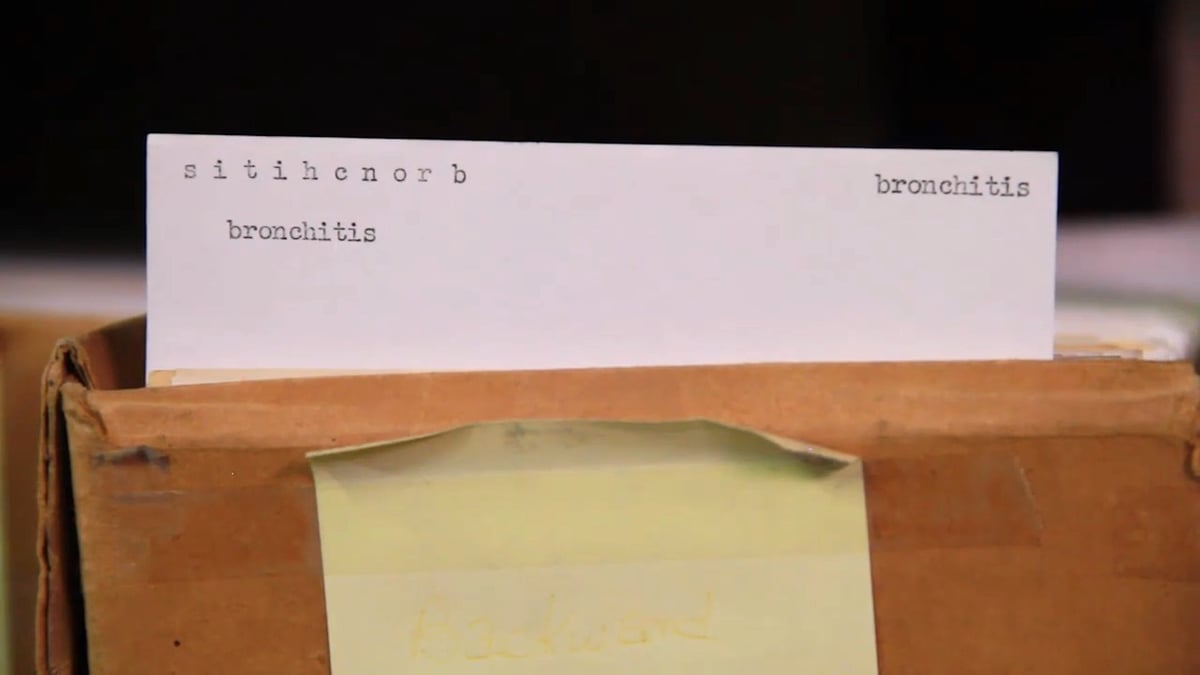
(thx, margaret)
I loved this post by Kelsey Miller for Cup of Jo about “childlore”.
“Remember typing ‘BOOBS’ on a calculator?!” someone will blurt. “Or — or that thing when you’re driving by a cemetery and you have to hold your breath?” I love hearing the tiny differences in details (some people grew up lifting their feet off the floor when passing a graveyard). But what’s wild is how many of us grew up doing, drawing, singing, and believing the exact same funny little things: Miss Susie had a steamboat, Batman smelled, the floor was lava, and stepping on cracks broke our mothers’ backs.
For a definition of childlore, let’s go to the Wikipedia:
Childlore is a folklore or folk culture that focuses specifically on children typically between the ages of 6 and 15. As a branch of folklore, childlore is concerned with those activities which are learned and passed on by children to other children; it excludes the stories and tales told and spread by adults. Childlore can include games, riddles, rhymes, oral stories, codes, fantasies, jokes, and superstitions created by children.
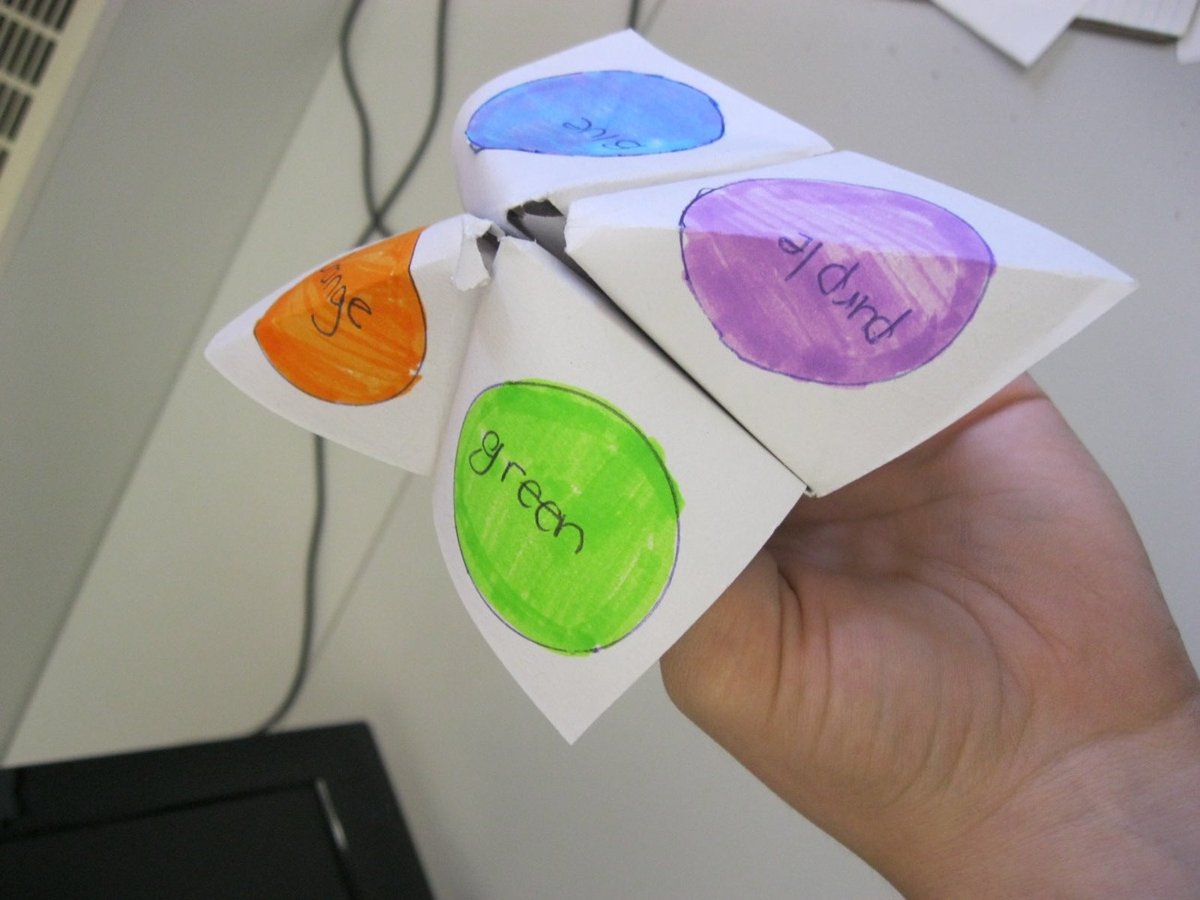
Other than what’s already been mentioned, I can’t remember many specific childlore from my childhood (my recall for such things isn’t great). Perhaps some string games? I can still do cat’s cradle & Jacob’s ladder and taught them to my kids when they were younger. Oh and those cootie catchers.
The commenters at Cup of Jo offered several suggestions: the diarrhea song, padiddle (when you saw a car with only one headlight), and slug bug (or punch buggy). And OMG, I gasped when I read this comment — I used to make these little feet all the time!
Just recently on a field trip with my kids we all traveled in a school bus. We live in Wisconsin so it was chilly in the bus and the bus driver had the heater turned on high. The condensation in the bus was freezing on the inside of the windows as it so often does on a winter morning her and then it’s fun to draw things in the frost. My favorite is to press the side of my fist against the glass to make a little footprint and then use my fingers to make toes. It looks like a baby footprint on the window.
What childlore do you remember from your childhood?
In a video for the V&A Museum, stone carver Miriam Johnson hand-carves a pair of hieroglyphs “using both sunken relief and raised relief techniques”.
The video has minimal narration; mostly it’s just a master craftsperson quietly tapping away at the stone — and getting bits of rock all over the sleeve of her jumper. The effect is pretty relaxing, especially with the more rhythmic tapping for the second carving. (via the kid should see this)
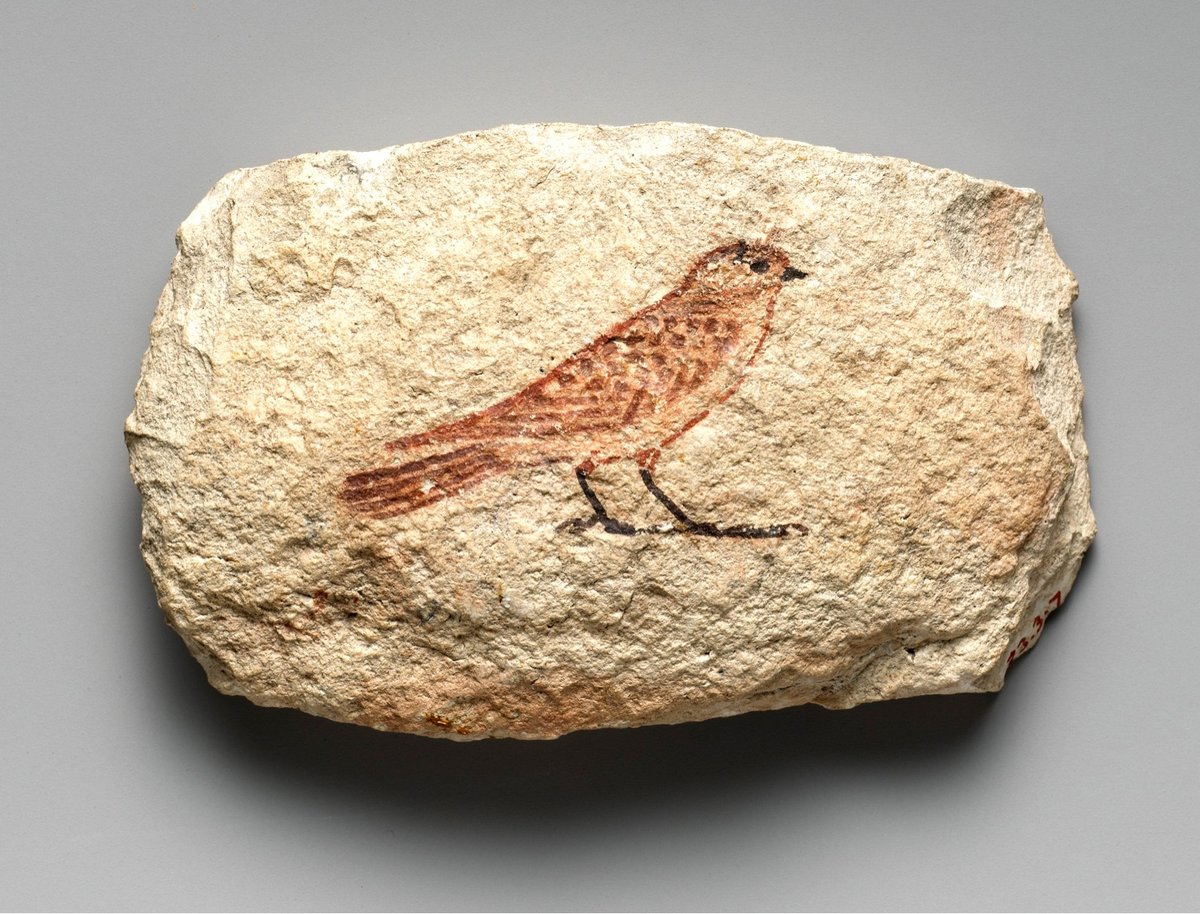
From the collection of the Met, an Egyptian artist’s sketch of a sparrow circa 1479–1458 BCE. Much of the art that filters down to us from ancient civilizations was used for official purposes (state, religion, commerce); it’s nice to see something simpler like this drawing. Archaeologist Alison Fisk:
This may have been a practice drawing of the sparrow hieroglyph which was used for words meaning ‘small’, ‘poor’, or ‘bad’
The Egyptian artisans who decorated tombs and temples, drew sketches and jotted down notes on the plentiful limestone flakes which were by-products of temple and rock-cut tomb construction. Egyptologists refer to them as ‘ostraca’ (singular: ostracon). More info: ancientegyptonline.co.uk/ostracon/
From that link about ostracon:
The word “ostracon” is derived from the Greek “ostrakon” (meaning a piece of pottery used as a voting ballot). When a vote was held on whether to banish a person from society these shards were used to cast votes. This is the origin of the word “ostracism” (literally meaning “to be voted out”).
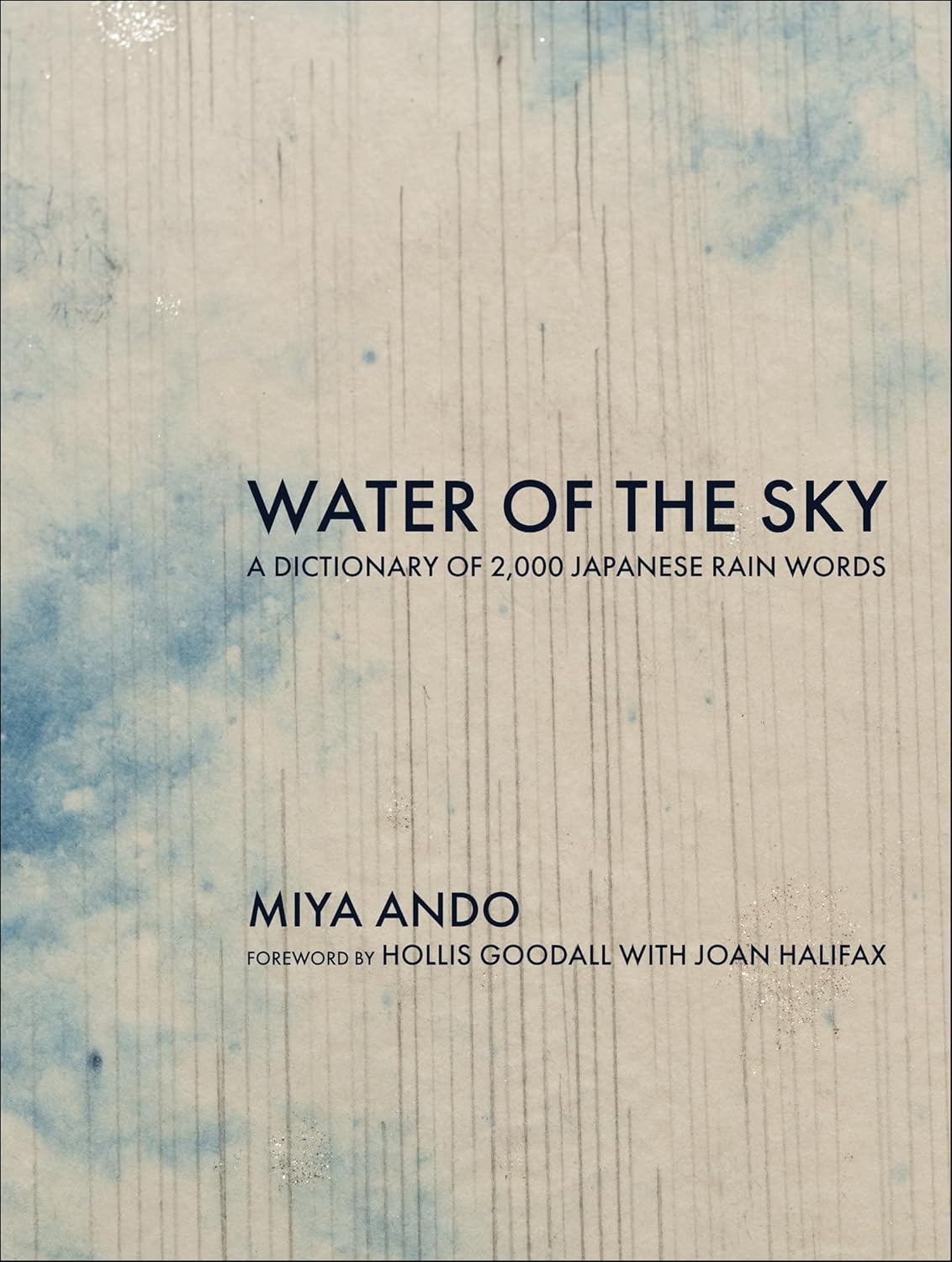
From artist Miya Ando, Water of the Sky, A Dictionary of 2,000 Japanese Rain Words.
Through a collection of 2,000 Japanese words, their English interpretations, and 100 drawings, Ando describes the breadth and diversity of rain’s many expressions: when it falls, how it falls, and how its observer might be transformed physically or emotionally by its presence.
I paged through this at a bookstore recently; it is delightful. From an excerpt of the book, here are a few of Ando’s rain words & phrases:
Tokidoki Niwaka Ame: Sometimes light snow and rain showers
Ama ga Nukeru: The skies open up, it rains like cats and dogs
Shinotsukuame: Intense rain that falls heavily, is very fine and strong like the Bamboo Grove at Shinotake
Giu: False rain
Amadoi: Sliding red beans to resemble the sound of rain
Kōu: Rain that comes exactly when you were waiting for it
Water of the Sky is available at Bookshop, Amazon, and wherever books are sold.
“Ugh, this kid is so sweaty!” my son exclaimed as he came under attack in some game he was playing. This was a few years ago; my ears perked up and I asked him what he meant. He explained that “sweaty” was a derogatory term for gamers who were trying super hard to win. Such players were referred to as “sweats”.
Recently I read something — can’t remember what — and came across the word “swot”. I hadn’t heard that before, so I looked it up. “Swot”, a dialect variant of “sweat”, is a derogatory word in informal British English meaning “a person who studies hard, especially one regarded as spending too much time studying”.
I wonder if these two meanings evolved independently from each other; that would be super interesting. Know Your Meme traced “sweaty” back to its use among those who played the FIFA game series in 2014. It’s possible that British gamers smuggled “swot” into gaming terminology and it quickly evolved into “sweat”. I’m not sure how common “swot” is in Britain…or if “sweat” is used interchangeably with “swot”. But if I had to guess, I’d say they weren’t related. If any etymologists out there are looking for a challenge…
Robert Paxton is one of the world’s foremost scholars of fascism and in his 2004 book The Anatomy of Fascism (Bookshop), he defined the term:
Fascism may be defined as a form of political behavior marked by obsessive preoccupation with community decline, humiliation, or victim-hood and by compensatory cults of unity, energy, and purity, in which a mass-based party of committed nationalist militants, working in uneasy but effective collaboration with traditional elites, abandons democratic liberties and pursues with redemptive violence and without ethical or legal restraints goals of internal cleansing and external expansion.
Paxton famously declined to label Donald Trump a fascist, warning against overuse of the term, before changing his mind after January 6th’s attack on Congress.
Jan. 6 proved to be a turning point. For an American historian of 20th-century Europe, it was hard not to see in the insurrection echoes of Mussolini’s Blackshirts, who marched on Rome in 1922 and took over the capital, or of the violent riot at the French Parliament in 1934 by veterans and far-right groups who sought to disrupt the swearing in of a new left-wing government. But the analogies were less important than what Paxton regarded as a transformation of Trumpism itself. “The turn to violence was so explicit and so overt and so intentional, that you had to change what you said about it,” Paxton told me. “It just seemed to me that a new language was necessary, because a new thing was happening.”
When an editor at Newsweek reached out to Paxton, he decided to publicly declare a change of mind. In a column that appeared online on Jan. 11, 2021, Paxton wrote that the invasion of the Capitol “removes my objection to the fascist label.” Trump’s “open encouragement of civic violence to overturn an election crosses a red line,” he went on. “The label now seems not just acceptable but necessary.”
See also Umberto Eco’s 14 Features of Eternal Fascism, How Fascism Works, Toni Morrison’s Ten Steps Towards Fascism, and Rick Steves’ The Story of Fascism. (via @chadloder.bsky.social)
In this episode of This American Life from a few weeks ago, Masha Gessen read an excerpt from their book Surviving Autocracy about the particular kind of lie used by autocrats like Putin and Trump.
Lies can serve a number of functions. People lie to deflect, to avoid embarrassment or evade punishment by creating doubt, to escape confrontation or lighten the blow, to make themselves appear better, to get others to do or give something, and even to entertain.
However unskilled a person may be at lying, they usually hope that the lie will be convincing. Executives want shareholders to think that they have devised a foolproof path to profits. Defendants want juries to believe that there is a chance that someone else committed the crime.
People in relationships want their partners to think that they have never even considered cheating. Guests want the host to think that they like their fish overcooked. These lies can be annoying or amusing, but they are surmountable. They collapse in the face of facts.
The Trumpian lie is different. It is the power lie or the bully lie. It is the lie of the bigger kid who took your hat and is wearing it while denying that he took it. There is no defense against this lie because the point of the lie is to assert power, to show I can say what I want, when I want to.
The power lie conjures a different reality that demands that you choose between your experience and the bully’s demands. Are you going to insist that you’re wet from the rain or give in and say that the sun is shining?
I believe the bully lie fits into the same general category as fascists seeing hypocrisy as a virtue — it only really makes sense when you think about it in terms of domination or power. (thx, caroline)
Karen Attiah wrote a short opinion piece about how the nationwide assault on diversity, equity and inclusion led by conservatives is actually aimed at resegregation and how being precise in our language about what’s happening is crucial.
These facts, taken together, point to the removal of Black people from academic, corporate and government spaces: resegregation.
People are vowing to push back with their wallets — to shop at Costco and boycott Target, for example. But I believe the fight starts with language. Journalists have a role and an obligation to be precise in naming what we are facing.
Frankly, I wish the media would stop using “DEI” and “diversity hiring” altogether. Any official, including the president, who chooses to blame everything from plane crashes to wildfires on non-White, non-male people should be asked whether they believe that desegregation is to blame. Whether they believe resegregation is the answer. We need to bring back the language that describes what is actually happening.
When I write about difficult or contentious topics where I want to take great care to not be misunderstood and to be as accurate as I can be, I always think about this piece by history professor Michael Todd Landis on the language we use to talk about the Civil War & slavery.
Specifically, let us drop the word “Union” when describing the United States side of the conflagration, as in “Union troops” versus “Confederate troops.” Instead of “Union,” we should say “United States.” By employing “Union” instead of “United States,” we are indirectly supporting the Confederate view of secession wherein the nation of the United States collapsed, having been built on a “sandy foundation” (according to rebel Vice President Alexander Stephens). In reality, however, the United States never ceased to exist. The Constitution continued to operate normally; elections were held; Congress, the presidency, and the courts functioned; diplomacy was conducted; taxes were collected; crimes were punished; etc. Yes, there was a massive, murderous rebellion in at least a dozen states, but that did not mean that the United States disappeared.
Landis notes that scholar Edward Baptist also uses different language:
In his 2014 book The Half Has Never Been Told: Slavery and the Making of American Capitalism (Basic Books), he rejects “plantations” (a term pregnant with false memory and romantic myths) in favor of “labor camps”; instead of “slave-owners” (which seems to legitimate and rationalize the ownership of human beings), he uses “enslavers.” Small changes with big implications. These far more accurate and appropriate terms serve his argument well, as he re-examines the role of unfree labor in the rise of the United States as an economic powerhouse and its place in the global economy. In order to tear down old myths, he eschews the old language.
German museums and public remembrances of the Holocaust use similarly precise language:
Just as important, the language they used on the displays in these places was clear and direct, at least in the English translations. It was almost never mealy-mouthed language like “this person died at Treblinka”…like they’d succumbed to natural causes or something. Instead it was “this person was murdered at Treblinka”, which is much stronger and explicitly places blame on the Nazis for these deaths.
This is why I’ve been so insistent on describing the events of January 6, 2021 as an attack on Congress and as a coup attempt:
This was not an attack on the Capitol Building. This was an attack on Congress, the United States Government, and elected members of our government. It was a coup attempt. Can you imagine what the mob in those videos would have done had they found Nancy Pelosi? Kidnapping or a hostage situation at the very least, assassination in the worst case. Saying that this was an “attack on the Capitol” is such an anodyne way of describing what happened on January 6th that it’s misleading. Words matter and we should use the correct ones when describing this consequential event.
In writing about the 2025 Coup, I’ve been careful to call it a coup because it is. I’ve been repeating words like “illegal” and “unconstitutional” because these actions attacks by Trump and Musk are just that. Our government’s computing systems have been “seized” or “broken into to” or “hacked” (illegal!) rather than “accessed” (sounds routine). In his piece yesterday, Jamelle Bouie argued for more precision in how we describe the coup:
To describe the current situation in the executive branch as merely a constitutional crisis is to understate the significance of what we’re experiencing. “Constitutional crisis” does not even begin to capture the radicalism of what is unfolding in the federal bureaucracy and of what Congress’s decision not to act may liquidate in terms of constitutional meaning.
One of the reason people get so upset at media like the NY Times and Washington Post is because the language they often use is so watered down that it’s actually not truthful. Take the initial opening paragraph to this NYT piece about Trump’s statement about wanting to ethnically cleanse Gaza:
President Trump declared on Tuesday that he would seek to permanently displace the entire Palestinian population of Gaza and take over the devastated seaside enclave as a U.S. territory, one of the most audacious ideas that any American leader has advanced in years.
(They later changed “audacious” to “brazen”.) Audacious? Brazen? Advanced? Ideas? These words all have meanings! And when you put them together, it makes Trump sound like some genius superhero statesman. And “seaside enclave”? That is technically correct but it sounds like they’re talking about fucking Montauk. This is terrible writing that fails to communicate the truth of the situation.
Here’s why this matters: imprecise and euphemistic language is the language of fascists, authoritarians, and oppressors — power-craving leaders who either don’t want people to know what they are doing or don’t want them to think too hard about the illegality or immorality of their actions. The Nazis had all kinds of euphemisms — the “Final Solution to the Jewish Question”, “protective custody”, “work-shy”, “enhanced interrogation” — to mask their mass imprisonment activities and mass murder.
In 1946, Nineteen Eighty-Four author George Orwell published an essay called Politics and the English Language in which he decried the “lack of precision” of political writing:
Each of these passages has faults of its own, but, quite apart from avoidable ugliness, two qualities are common to all of them. The first is staleness of imagery; the other is lack of precision. The writer either has a meaning and cannot express it, or he inadvertently says something else, or he is almost indifferent as to whether his words mean anything or not. This mixture of vagueness and sheer incompetence is the most marked characteristic of modern English prose, and especially of any kind of political writing. As soon as certain topics are raised, the concrete melts into the abstract and no one seems able to think of turns of speech that are not hackneyed: prose consists less and less of words chosen for the sake of their meaning, and more and more of phrases tacked together like the sections of a prefabricated hen-house.
And from his concluding paragraph:
…one ought to recognize that the present political chaos is connected with the decay of language, and that one can probably bring about some improvement by starting at the verbal end. If you simplify your English, you are freed from the worst follies of orthodoxy. You cannot speak any of the necessary dialects, and when you make a stupid remark its stupidity will be obvious, even to yourself. Political language — and with variations this is true of all political parties, from Conservatives to Anarchists — is designed to make lies sound truthful and murder respectable, and to give an appearance of solidity to pure wind. One cannot change this all in a moment, but one can at least change one’s own habits…
You can read Orwell’s whole essay here.
I don’t always succeed, but I try really hard to use precise, concrete language in my writing. As Attiah urges, we should want and expect our media to do the same — anything less is an abdication of their duty to their readers to tell them the truth.
I hope this doesn’t ruin your day, but Baker’s Chocolate wasn’t created for bakers, it’s chocolate originally produced in Dorchester, MA by John Hannon with his partner Dr. James Baker. Hannon sailed to the West Indies in 1779 and never came back, so Dr. Baker changed the name to the Baker Chocolate Company.
Additionally, German Chocolate Cake isn’t German. A homemaker from Dallas sent the Dallas Morning News a recipe for German’s Chocolate Cake made with a sweet baking chocolate invented by Samuel German in 1853. (I’m not including the name of the homemaker because she’s listed everywhere as Mrs. Husband’s Name and YOU KNOW that guy never picked up a sifter to help.) I personally don’t believe coconut or nuts belong in dessert so I don’t fw German Chocolate Cake if I can help it.
Here’s where you’re about to get really mad. Here’s where you’re about to blow a gasket. Here’s the thing what will make you absolutely furious like me. Guess which company’s sales increased 73% after the popularization of German Chocolate Cake as a thing Americans were making regularly? That’s right, it’s Baker’s Chocolate Company, Samuel German’s employer in 1853 when he invented the chocolate. (via @parsnip.bsky.social)
Oh wow, this is cool: an article in Scientific American about the Arecibo message, the first message purposely sent by humanity out into interstellar space. The piece is written by science writer Nadia Drake — the daughter of Frank Drake, who designed the message — and it digs into the details of how the whole thing came about.
I’ve somehow never read about the Arecibo message before. It was sent out from the Arecibo Telescope in Puerto Rico on November 16, 1974 towards global cluster M13. The message was in binary and when properly decoded upon receipt, should look like this:

The drawing on the right is Frank Drake’s recently discovered first draft of the message.
Dad targeted a globular cluster of stars called Messier 13 (M13), or the Great Cluster in the constellation of Hercules, because it would conveniently be overhead at the time of the ceremony (nestled in a sinkhole, Arecibo’s giant dish was not fully steerable). In about 25,000 years, Dad’s message will reach M13 — or at least part of it, because the majority of the cluster’s thousands of stars will have moved out of the telescope’s beam by then. But anyone who’s around to detect the Arecibo transmission, and who figures out how to decode it, will have a blueprint telling them a lot about us: what we look like, which chemical elements and biomolecules make up our DNA, what our planetary system is and how many of us existed in 1974. Dad’s transmission concluded with a binary encoded representation of the Arecibo dish itself.
Read the whole thing…it’s fascinating.
Btw, in addition to creating the Arecibo message, Frank Drake also designed the Drake equation (“a probabilistic argument used to estimate the number of active, communicative extraterrestrial civilizations in the Milky Way Galaxy”), helped design the Pioneer plaque and the Voyager Golden Record, and generally kickstarted the whole SETI effort. (via @https://bsky.app/profile/astrokatie.com)
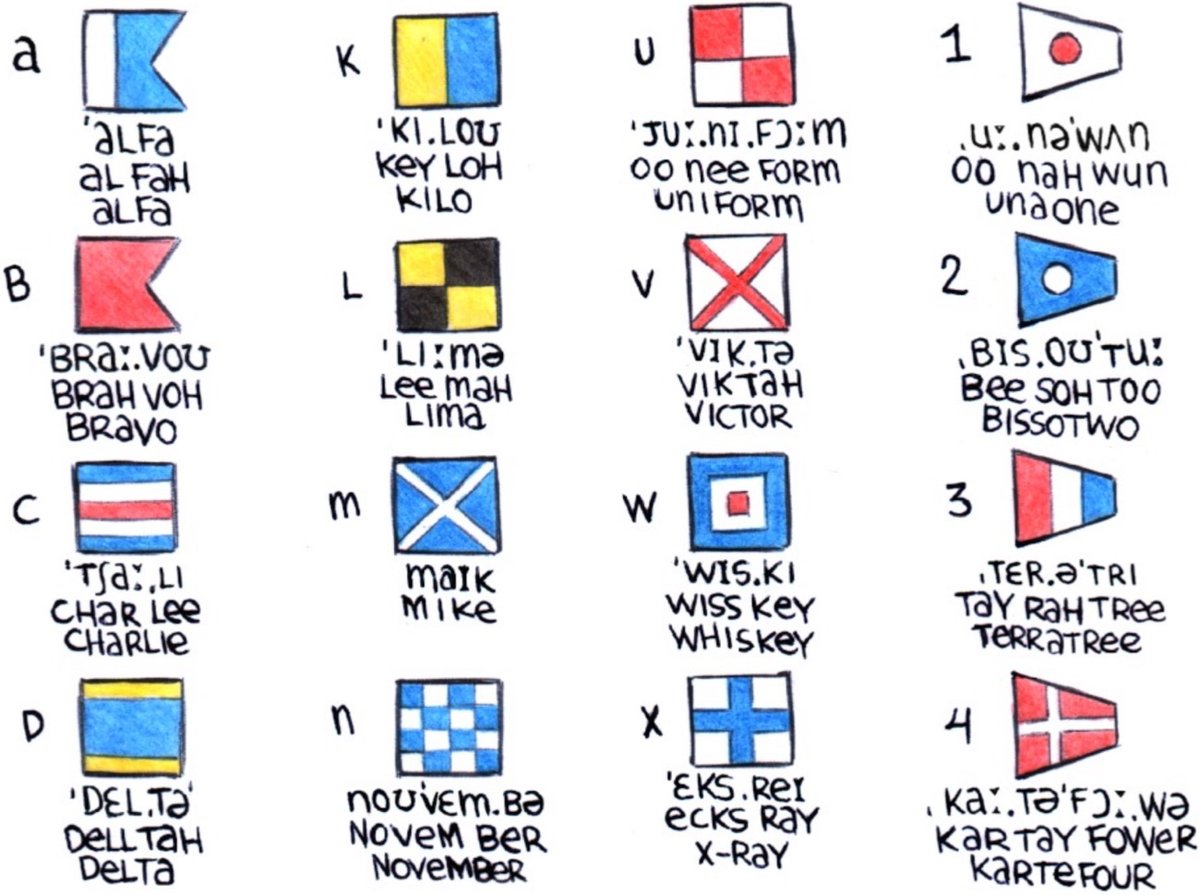
An illustrated and hand-lettered guide to the system of international maritime signal flags that are used to communicate when speaking is difficult (“because of language barriers, distance, etc….”)
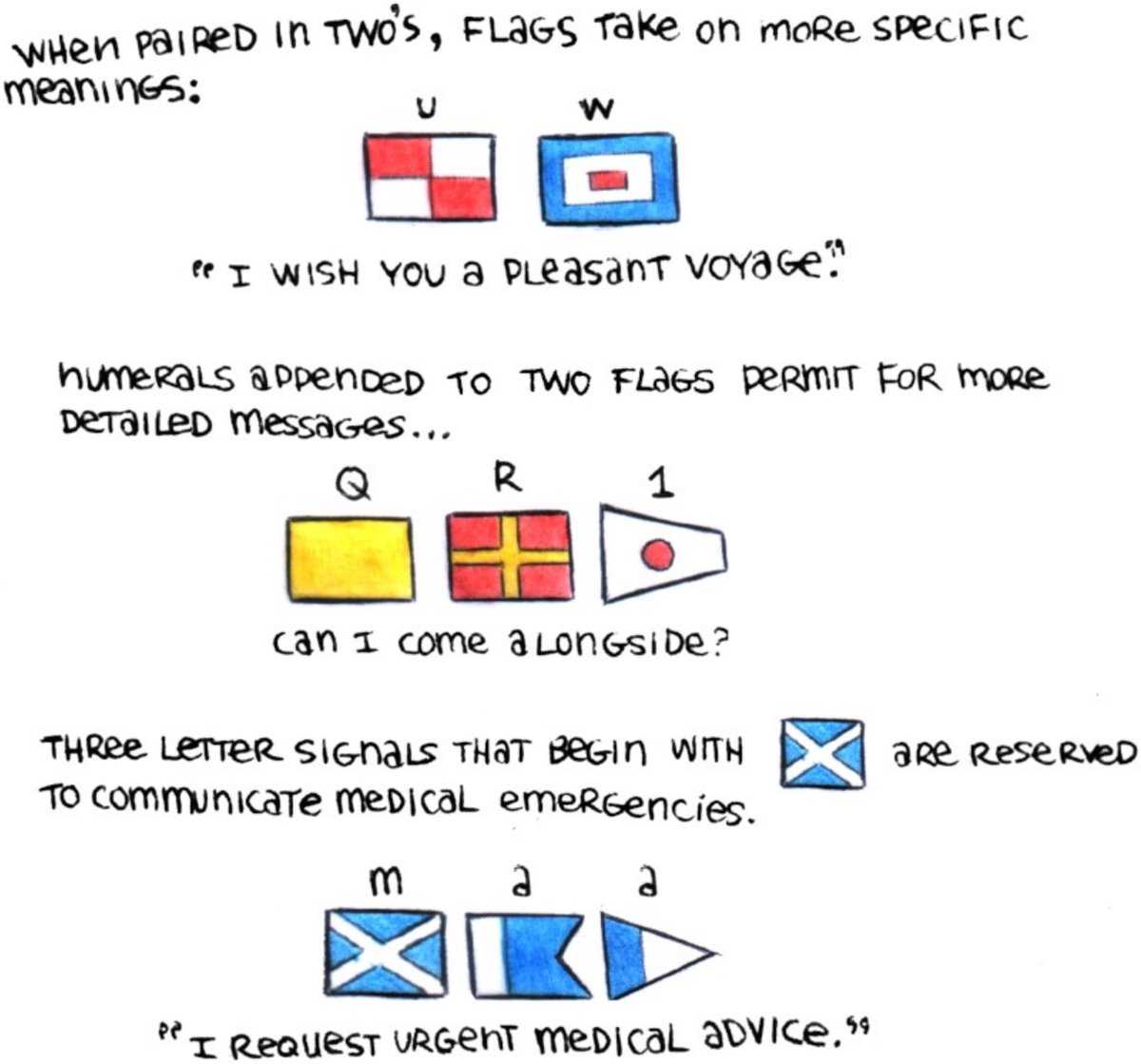
See also hand flag semaphore and day shapes from the same creator.
Irving Finkel, a curator at the British Museum and an expert in cuneiform, takes a look at a 2900-year-old Mesopotamian tablet that contains a map of the world as it was known at the time.
The Babylonian map of the world is the oldest map of the world, in the world. Written and inscribed on clay in Mesopotamia around 2,900-years-ago, it is, like so many cuneiform tablets, incomplete. However, Irving Finkel and a particularly gifted student of his — Edith Horsley — managed to locate a missing piece of the map, slot it back into the cuneiform tablet, and from there set us all on journey through the somewhat mythical landscape of Mesopotamia to find the final resting place of the ark. And yes we mean that ark, as in Noah’s ark. Although in the earlier Mesopotamian version of the flood story, the ark is built by Ziusudra.
Finkel could not possibly look more like a British Museum curator than he does.
Btw, I first heard about the earliest Mesopotamian version of the flood story in a mythology class I took in college. I’d spent a lot of my youth going to church but religion didn’t click for me and I was never a believer. Hearing that flood story clinched it for me — the Old Testament of the Christian bible is just as mythological as the Greek or Mesopotamian gods (everything is a remix) — and I’ve been solidly atheist ever since. (via open culture)
Vice President Kamala Harris has debuted her first ad for her presidential run and it’s a good one. First of all: Beyoncé. But also: “freedom” is a great theme for Harris. For too long Republicans have defined what that word means in America and now’s the time for Democrats to assert their vision. From the ad:
The freedom not just to get by but get ahead. The freedom to be safe from gun violence. The freedom to make decisions about your own body. We choose a future where no child lives in poverty, where we can all afford health care, where no one is above the law.
I think a lot about this 2018 Rolling Stone interview with Pete Buttigieg (when he was still mayor of South Bend, Indiana) in which he offers his thoughts on recasting “concepts that conservatives have traditionally ‘owned’ — like freedom, family, and patriotism — in more progressive terms”.
You’ll hear me talk all the time about freedom. Because I think there is a failure on our side if we allow conservatives to monopolize the idea of freedom - especially now that they’ve produced an authoritarian president. But what actually gives people freedom in their lives? The most profound freedoms of my everyday existence have been safeguarded by progressive policies, mostly. The freedom to marry who I choose, for one, but also the freedom that comes with paved roads and stop lights. Freedom from some obscure regulation is so much more abstract. But that’s the freedom that conservatism has now come down to.
Or think about the idea of family, in the context of everyday life. It’s one thing to talk about family values as a theme, or a wedge — but what’s it actually like to have a family? Your family does better if you get a fair wage, if there’s good public education, if there’s good health care when you need it. These things intuitively make sense, but we’re out of practice talking about them.
I also think we need to talk about a different kind of patriotism: a fidelity to American greatness in its truest sense. You think about this as a local official, of course, but a truly great country is made of great communities. What makes a country great isn’t chauvinism. It’s the kinds of lives you enable people to lead. I think about wastewater management as freedom. If a resident of our city doesn’t have to give it a second thought, she’s freer.
Clean drinking water is freedom. Good public education is freedom. Universal healthcare is freedom. Fair wages are freedom. Policing by consent is freedom. Gun control is freedom. Fighting climate change is freedom. A non-punitive criminal justice system is freedom. Affirmative action is freedom. Decriminalizing poverty is freedom. Easy & secure voting is freedom. This is an idea of freedom I can get behind.
Compare that to the “freedoms” that Republicans are pushing for in Project 2025 — and have been pressing on Americans even before that:
There is the freedom to control — to restrict the bodily autonomy of women and repress the existence of anyone who does not conform to traditional gender roles.
There is the freedom to exploit — to allow the owners of business and capital to weaken labor and take advantage of workers as they see fit.
There is the freedom to censor — to suppress ideas that challenge and threaten the ideologies of the ruling class.
And there is the freedom to menace — to carry weapons wherever you please, to brandish them in public, to turn the right of self-defense into a right to threaten other people.
The Declaration of Independence stated our fledgling nation’s assertion that people are endowed “with certain unalienable Rights, that among these are Life, Liberty and the pursuit of Happiness”. It’s pretty clear which of the two parties’ interpretations of freedom hews closer to that assertion.
Members of the original cast of The Avengers (Robert Downey Jr., Scarlett Johansson, Chris Hemsworth, Chris Evans, Jeremy Renner, and Mark Ruffalo) reunited to dub the movie in the Lakota language.
Mark Ruffalo and members of the initiative sit down with us to share the story of this amazing reunion and its very special cause. From the recording studio to the big screen, we explore this important cinematic milestone and celebrate the release that took over 15 months, 62 Lakota-Dakota language speakers, and the original Avengers team to come together and Assemble!
More details from the Lakota Times:
On June 14th, 2024, Disney plus will release the Avengers film that will be dubbed in Lakota. Cyril “Chuck” Archambault, Ray Taken Alive, Dallas Nelson, Lawrence Archambault along with the Lakota Reclamation Project, Grey Willow Studios, students from McLaughlin school, elders from the Standing Rock community and many others have all worked very hard together to complete this project.
A couple of years ago, Ray and Chuck talked about the idea of dubbing the Avengers movie. From there, Chuck spoke with Mark Ruffalo about the idea and Ruffalo said he will get back to them about it. Several months later, a meeting was set up with Marvel and Disney to discuss this idea. Not only did they approve of the project, but Marvel and Deluxe studios helped them through it.
From there, they were able to receive a grant to help with funding, within the budgets they made sure that the Elders would be the highest paid in the project.
Here’s the poster for the Lakota dub, which is now streaming on Disney+ (change the language option to Lakota).
See also Why Star Wars Was Dubbed Into the Navajo Language.
My teen daughter doesn’t care for crosswords or the Spelling Bee, but she does try to play Connections every day. We were working on this one together a few days ago and when I suggested SNAIL GALAXY CYCLONE SUNFLOWER as a group, she said “I was thinking spirals but sunflowers are round”. Which prompted a discussion about the Fibonacci sequence and the golden ratio (which she’d covered in math class) and a search for videos that explained how the sequence pops up in nature and, specifically, sunflowers.
As beautiful as the sunflower is, isn’t it even lovelier knowing there is a deep mathematical order to it?
That quote reminds me of Richard Feynman’s thoughts on the beauty of nature:
I have a friend who’s an artist and has sometimes taken a view which I don’t agree with very well. He’ll hold up a flower and say “look how beautiful it is,” and I’ll agree. Then he says “I as an artist can see how beautiful this is but you as a scientist take this all apart and it becomes a dull thing,” and I think that he’s kind of nutty.
First of all, the beauty that he sees is available to other people and to me too, I believe. Although I may not be quite as refined aesthetically as he is … I can appreciate the beauty of a flower. At the same time, I see much more about the flower than he sees.
I could imagine the cells in there, the complicated actions inside, which also have a beauty. I mean it’s not just beauty at this dimension, at one centimeter; there’s also beauty at smaller dimensions, the inner structure, also the processes. The fact that the colors in the flower evolved in order to attract insects to pollinate it is interesting; it means that insects can see the color. It adds a question: does this aesthetic sense also exist in the lower forms? Why is it aesthetic? All kinds of interesting questions which the science knowledge only adds to the excitement, the mystery and the awe of a flower. It only adds. I don’t understand how it subtracts.
Games, language, mathematics, the beauty of flowers, science, time spent together — Connections indeed.
I thought for sure that I’d previously written about the secret jelly packet & pickle-based system that chefs at the Waffle House use to “store” all of the orders that come in for food during service, but I can’t find it in the archive. But no matter — the Waffle House training video above runs us through their whole system, including a detailed explanation of their Magic Marker System, which involves zero actual Magic Markers and instead is about arranging condiment packets and other items on plates in a code:
Now let’s talk about our breakfast sandwiches. Just like omelettes, these sandwiches have the same four positions: ham, sausage, bacon, and plain. To mark a sandwich, place two pickle slices in the appropriate position. Here you can see I put two pickle slices in the number three position, which tells me this is a bacon sandwich. If I add a slice of cheese to the plate, I know this is a bacon cheese sandwich. To make this a bacon, egg, and cheese sandwich, I’ll add this right side up mayo packet to the right side of the plate.
Don’t let this mayo pack confuse you - as long as you see two pickles on the plate you know this is a sandwich. When marking a sandwich, this mayo packet and pickles means a sandwich with eggs. If a customer wanted the eggs on their sandwich to be scrambled instead of the standard over well egg, I’d move this mayo pack down to the bottom of the plate to show that the egg is scrambled.
That sounds pretty complicated and they’ve likely faced pressure to change the system over the years, but I bet it works really well in practice and cuts down on errors. I love stuff like this…seeing how different organizations manage their core processes, especially in non-conventional ways. See also Nightclub Hand Signals and The Quarryman’s Symphony. (thx, erik)
This is so highbrow that it’s looped back around to being lowbrow: a cover of Smells Like Teen Spirit sung in classical Latin.
Sine lúce, angor minus
Oblectáte, nunc híc sumus
Mé sentió aeger, stultus
Oblectáte, nunc híc sumus
Barbarus, albínus, culex et, mea libídó
Hei! Hae, ha ha ha ha!
See also Bardcore: Medieval-Style Covers of Pop Songs. (via open culture)

The other day while chatting on Discord, I paused to pick out an emoji to apply to a friend’s comment. I wanted to use a heart to show that I liked the comment, but I’d already used the red heart and wanted to add a little more flair. Usually I just pick a pink one arbitrarily, but in that moment, I was like, WTF do all these little hearts actually mean? Do they have official meanings? Am I using them wrong?
It’s a common question, and the answer seems to essentially be: “No, there are no official meanings,” although according to Emojipedia the hearts do at least have official names: growing heart, beating heart, and revolving hearts (to choose the three that were least obvious to me).

The revolving hearts were the most confusing, in my opinion. Why are they revolving? According to The Pioneer Woman, they mean “falling in love, or deep affection.” That didn’t seem right, so I asked a few friends.
Emojipedia leaves it open-ended in its 💞 emoji-descriptor: “Hearts revolving around one or more other hearts.” (Around even more hearts?) In a 2020 post, Emojipedia also acknowledged that “intrinsically each heart has no more coded meaning than what meets the eye.”
In every issue, the quarterly Buddhist magazine Tricycle publishes a winning haiku from its ongoing monthly haiku contest. The poem appears alongside a column written by the contest’s judge, poet and author Clark Strand. This season’s haiku-adjacent column includes the following bit, about one theory on the nature of haiku:
The Japanese haiku critic Kenkichi Yamamoto (1907–1988) believed that the best haiku strike a balance between humor and existential isolation. “Loneliness in life and the comical elements of life are two sides of the same coin,” he wrote. As a genre of literature, haiku thrives on the flip of that coin — the small element of uncertainty that challenges our ordinary understanding of the world.
I hadn’t realized there were such things as haiku critics (!). I also like the idea of loneliness and humor being related somehow.
Read the Spring 2024 winning haiku here. And enter the monthly contest here. (The next round must include the word “turnip.”)
Ross Andersen for the Atlantic on the effort to talk to sperm whales using AI tech:
Their codas could be orders of magnitude more ancient than Sanskrit. We don’t know how much meaning they convey, but we do know that they’ll be very difficult to decode. Project CETI’s scientists will need to observe the whales for years and achieve fundamental breakthroughs in AI. But if they’re successful, humans could be able to initiate a conversation with whales.
This would be a first-contact scenario involving two species that have lived side by side for ages. I wanted to imagine how it could unfold. I reached out to marine biologists, field scientists who specialize in whales, paleontologists, professors of animal-rights law, linguists, and philosophers. Assume that Project CETI works, I told them. Assume that we are able to communicate something of substance to the sperm whale civilization. What should we say?
One of the worries about whale/human communication is the potential harm a conversation might cause.
Cesar Rodriguez-Garavito, a law professor at NYU who is advising Project CETI, told me that whatever we say, we must avoid harming the whales, and that we shouldn’t be too confident about our ability to predict the harms that a conversation could cause.
The sperm whales may not want to talk. They, like us, can be standoffish even toward members of their own species-and we are much more distant relations. Epochs have passed since our last common ancestor roamed the Earth. In the interim, we have pursued radically different, even alien, lifeways.
Really interesting article.
A team of three students were able to virtually “unroll” a 2000-year-old papyrus scroll that was carbonized during the eruption of Mount Vesuvius in Herculaneum, thereby winning the grand prize in the Vesuvius Challenge. These scrolls (there are hundreds of them) are little more than “lumps of carbonized ash”; this Wikipedia entry helpfully summarizes their fate:
Due to the eruption of Mount Vesuvius in 79 AD, bundles of scrolls were carbonized by the intense heat of the pyroclastic flows. This intense parching took place over an extremely short period of time, in a room deprived of oxygen, resulting in the scrolls’ carbonization into compact and highly fragile blocks. They were then preserved by the layers of cement-like rock.
Using high-resolution CT scans of the scrolls, machine learning, and computer vision techniques, the team was able to read the text inside one of the scrolls without actually unrolling it. I am stunned by how much text they were able to recover from these blackened documents — take a look at this image:
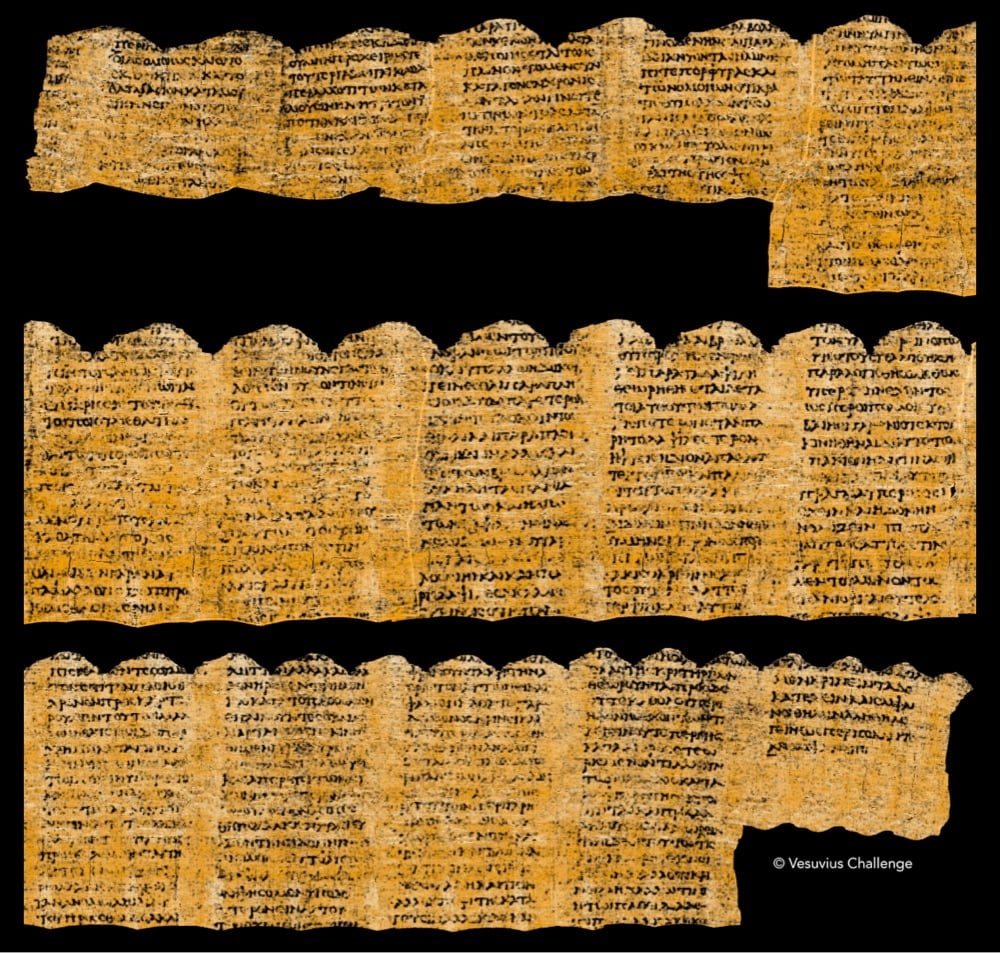
There was one submission that stood out clearly from the rest. Working independently, each member of our team of papyrologists recovered more text from this submission than any other. Remarkably, the entry achieved the criteria we set when announcing the Vesuvius Challenge in March: 4 passages of 140 characters each, with at least 85% of characters recoverable. This was not a given: most of us on the organizing team assigned a less than 30% probability of success when we announced these criteria! And in addition, the submission includes another 11 (!) columns of text - more than 2000 characters total.
If you’re interested, it’s fascinating to read through the whole thing to see just how little they were working with compared to how much they were able to recover. And the best part is, all the contest submissions are open source, so researchers will be able to build each other’s successes. (via waxy.org)
Oh man, I really enjoyed this “infuriating” list of things that don’t seem like they are named after people, including:
It reminds me of trademarked names that have become generic words, including:
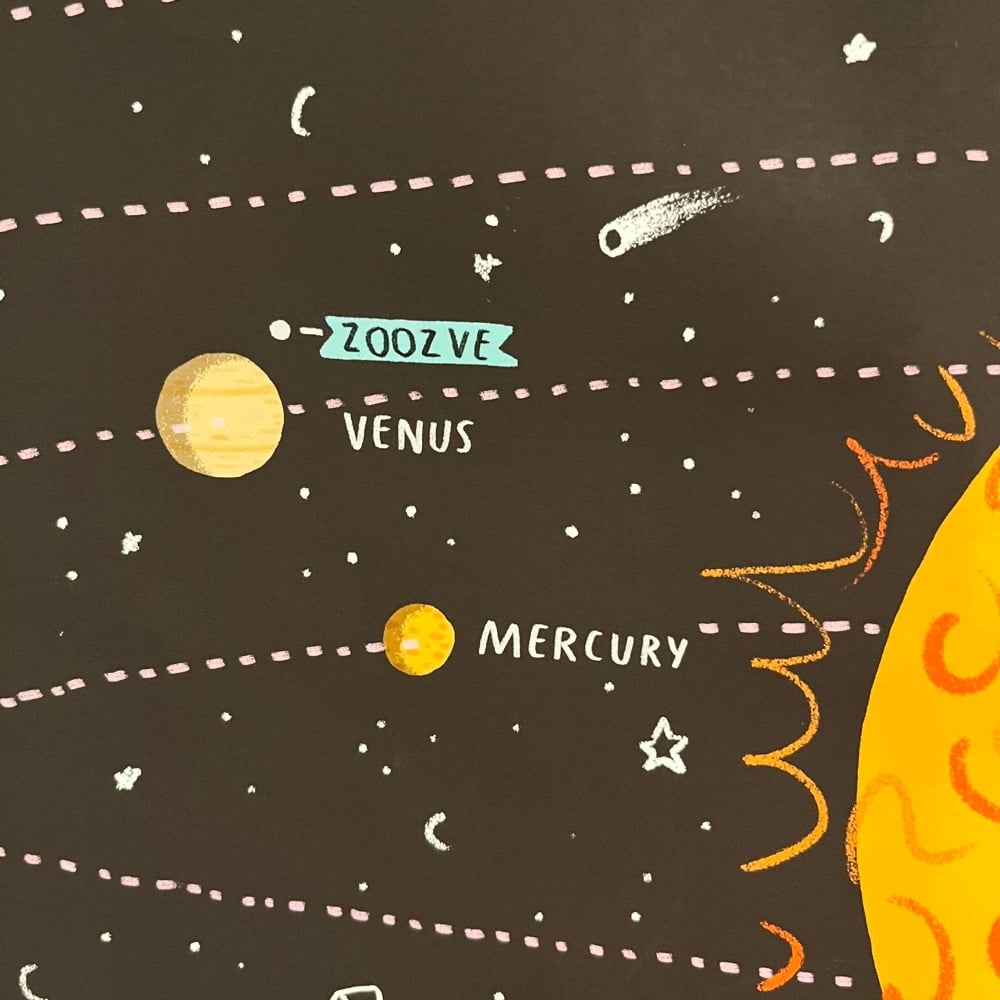
A couple of weeks ago, Radiolab aired an episode about a puzzling object on a children’s poster of the solar system: a Venusian moon called Zoozve. Venus doesn’t have any moons and “Zoozve” didn’t show up on Google at all, so co-host Latif Nasser went on a bit of a mission to find out what the heck this object was. He talked to someone at NASA, the poster’s designer, and various astronomers and physicists, including the person who had discovered Zoozve (aka 2002 VE68).
So begins a tiny mystery that leads to a newly discovered kind of object in our solar system, one that is simultaneously a moon, but also not a moon, and one that waltzes its way into asking one of the most profound questions about our universe: How predictable is it, really? And what does that mean for our place in it?
It’s an entertaining listen and you’ll want to catch the follow-up as well, which I won’t spoil for you. And if you’re a reader rather than a listener, this piece at space.com recaps the whole thing.
This is a quote I like that’s attributed to Alvin Toffler from his 1970 book, Future Shock:
The illiterate of the twenty-first century will not be those who cannot read and write, but those who cannot learn, unlearn, and relearn.
It turns out that’s not a direct quote — it’s been cobbled together from two separate passages in the book:
By instructing students how to learn, unlearn and relearn, a powerful new dimension can be added to education.
and:
Psychologist Herbert Gerjuoy of the Human Resources Research Organization phrases it simply: “The new education must teach the individual how to classify and reclassify information, how to evaluate its veracity, how to change categories when necessary, how to move from the concrete to the abstract and back, how to look at problems from a new direction — how to teach himself. Tomorrow’s illiterate will not be the man who can’t read; he will be the man who has not learned how to learn.”
Somewhere along the line, someone combined Gerjuoy’s observation with Toffler’s phrasing to create, IMHO, a more insightful quote about the flexibility their future (and our present) requires.
For more misattributed quote debunking, see also “I Hate to Write, but I Love Having Written” and Where the Rich Use Public Transportation…
Socials & More