Momofuku's David Chang cooks up some gourmet space food for celeb astronaut Chris Hadfield.
Unfortunately, it doesn't work out so well. Who knew that gravity was so useful? But stay for the best part of the whole thing...right at the end, Hadfield feeds himself asparagus like a fish.
Called Buran (Russian for blizzard or snowstorm), the program was launched by the Kremlin as a reaction to NASA's space shuttle and an attempt to gain an edge in space against the backdrop of Ronald Reagan's "Star Wars" Strategic Defense Initiative. It was also an attempt to fulfill the Soviet Union's dream of reusable spacecraft and payloads, ideas that predated the American space program.
A massive effort began. Over a million and a half people worked on the multi-billion dollar project, while researchers developed new, elaborate schemes for Russian space exploration. Among other tasks, Russian scientists hoped that the Buran would be able to carry the space station back to Earth, and -- the reported reason for its inception -- to allow the USSR to carry out military attacks from space.
The Soviet Shuttle, the Buran (snowstorm) was an aerodynamic clone of the American orbiter, but incorporated many original features that had been considered and rejected for the American program, such as all-liquid rocket boosters, jet engines, ejection seats and an unmanned flight capability. You know you're in trouble when the Russians are adding safety features to your design.
The quick progress of the US space program in the 1960s and 70s and the science fiction of the 70s and 80s seemed to point towards humans living permanently in space. What happened?
Ironically, our actual experiments in space living have largely reinforced this stark perspective. Real life in space is often cramped, unpleasant and even pointless. Some years back, I visited Star City near Moscow, the training centre for cosmonauts since Gagarin, where I had a chance to clamber inside a full-scale training mock-up of the Mir space station. The experience was more like residing inside a computer terminal than one of O'Neill's cylindrical islands, so proximate and abundant were tubes, wires, levers, buttons and unnameable gadgets.
More disorienting was the placement of controls and conveniences: because space was limited, these were distributed throughout the station without reference to Earthly gravity, thus making use of 'ceilings' as sleeping quarters, walls for toilet cubicles and virtually any other surface for any other activity. One could get used to such things (and you'd have to be a true cynic to tire of the view outside your window). But it's a far, far cry from strolling the wide corridors of the Starship Enterprise.
They promised us life in space, flying cars, and jetpacks but all we got were pocket-sized rectangles containing all human knowledge. FAIL.
Great article by Burkhard Bilger about NASA's Curiosity mission to Mars.
The search for life on Mars is now in its sixth decade. Forty spacecraft have been sent there, and not one has found a single fossil or living thing. The closer we look, the more hostile the planet seems: parched and frozen in every season, its atmosphere inert and murderously thin, its surface scoured by solar winds. By the time Earth took its first breath three billion years ago, geologists now believe, Mars had been suffocating for a billion years. The air had thinned and rivers evaporated; dust storms swept up and ice caps seized what was left of the water. The Great Desiccation Event, as it's sometimes called, is even more of a mystery than the Great Oxygenation on Earth. We know only this: one planet lived and the other died. One turned green, the other red.
Perfect read if you've been curious about what Curiosity is up to on Mars but needed something a bit more narrative than the mission home page or Wikipedia page to guide you. Also features the phrase "a self-eating watermelon of despair", so there's that. Oh, and here's the Seven Minutes of Terror video referred to in the story.
In the pages of Sidereus Nuncius, Galileo described the four large moons of Jupiter in a series of 64 sketches which looked a lot like ASCII art in the text:
Click through for an animated GIF of all the comparisons. Not bad for the telescopic state of the art in 1610. For a taste of how celestial objects actually appeared when viewed through Galileo's telescope, check out this video starting around 7:30. (thx, john)
The potential bonanza is, well, astronomical. A single 500-metre metal-rich asteroid might contain the equivalent of all the platinum-group metals mined to date. Icy bodies could provide water to sustain astronauts or be processed into rocket fuel for future missions to Mars.
Since the Sun moves relative to the other stars around it at about 45,000 miles/hr, if you change the frame of reference from the Sun to the surrounding stellar system, you get planetary motion that looks something like this:
I would take this video with a grain of salt though, especially when it says things like "the Sun is like a comet, dragging the planets in its wake"...the planets don't lag behind the Sun. Better to think of the thing as a conceptual schematic: resembling reality but not really accurate. (via @pieratt)
Update: There's a new version of the video that addresses some of the concerns raised about the first video:
However, there's a problem with it: It's wrong. And not just superficially; it's deeply wrong, based on a very wrong premise. While there are some useful visualizations in it, I caution people to take it with a galaxy-sized grain of salt.
So far, humans have taken photos from the surfaces of Earth, the Moon, Venus, and Mars. But I had no idea that a photo from the surface of Titan existed:
The photo of the Saturnian moon was taken in 2005 by the Huygens probe, which was designed to land safely on the moon's surface. From Wikipedia:
After landing, Huygens photographed a dark plain covered in small rocks and pebbles, which are composed of water ice. The two rocks just below the middle of the image on the right are smaller than they may appear: the left-hand one is 15 centimeters across, and the one in the center is 4 centimeters across, at a distance of about 85 centimeters from Huygens. There is evidence of erosion at the base of the rocks, indicating possible fluvial activity. The surface is darker than originally expected, consisting of a mixture of water and hydrocarbon ice. The assumption is that the "soil" visible in the images is precipitation from the hydrocarbon haze above.
And a special close-but-no-cigar award goes to the NEAR Shoemaker probe, which snapped this photo from about 400 feet above the surface of the near-Earth asteroid Eros:
The probe landed on the surface of Eros in February 2001 and transmitted usable data for about two weeks afterwards, none of which was photographic in nature.
That's from a series called Darkened Skies by Thierry Cohen; he photographed various cities (NYC, Paris, Tokyo, SF) and matched them up with starry skies from more remote places like Montana, Nevada, and the Sahara. New Yorkers can see Cohen's work at the Danziger Gallery starting March 28.
Unfortunately, [the X-Plane simulator] is not capable of simulating the hellish environment near the surface of Venus. But physics calculations give us an idea of what flight there would be like. The upshot is: Your plane would fly pretty well, except it would be on fire the whole time, and then it would stop flying, and then stop being a plane.
The Space Shuttle Challenger disintegrated shortly after liftoff 27 years ago today. Physicist Richard Feynman had a hand in determining the reason for the disaster.
I'm an explorer, ok? I get curious about everything and I want to investigate all kinds of stuff.
If a reasonable launch schedule is to be maintained, engineering often cannot be done fast enough to keep up with the expectations of originally conservative certification criteria designed to guarantee a very safe vehicle. In these situations, subtly, and often with apparently logical arguments, the criteria are altered so that flights may still be certified in time. They therefore fly in a relatively unsafe condition, with a chance of failure of the order of a percent (it is difficult to be more accurate).
Official management, on the other hand, claims to believe the probability of failure is a thousand times less. One reason for this may be an attempt to assure the government of NASA perfection and success in order to ensure the supply of funds. The other may be that they sincerely believed it to be true, demonstrating an almost incredible lack of communication between themselves and their working engineers.
In any event this has had very unfortunate consequences, the most serious of which is to encourage ordinary citizens to fly in such a dangerous machine, as if it had attained the safety of an ordinary airliner. The astronauts, like test pilots, should know their risks, and we honor them for their courage. Who can doubt that McAuliffe was equally a person of great courage, who was closer to an awareness of the true risk than NASA management would have us believe?
Let us make recommendations to ensure that NASA officials deal in a world of reality in understanding technological weaknesses and imperfections well enough to be actively trying to eliminate them. They must live in reality in comparing the costs and utility of the Shuttle to other methods of entering space. And they must be realistic in making contracts, in estimating costs, and the difficulty of the projects. Only realistic flight schedules should be proposed, schedules that have a reasonable chance of being met. If in this way the government would not support them, then so be it. NASA owes it to the citizens from whom it asks support to be frank, honest, and informative, so that these citizens can make the wisest decisions for the use of their limited resources.
For a successful technology, reality must take precedence over public relations, for nature cannot be fooled.
Clear thought, clear writing. Feynman was perhaps the most efficient mechanism ever conceived for consuming complexity and pumping out simplicity. (via @ptak)
At the end of a four-day period of controlled explosions, USGS scientists had succeeded in creating a 500 square foot "simulated lunar environment" in Northern Arizona -- forty-seven craters of between five and forty feet in diameter designed to duplicate at a 1:1 scale a specific location (and future Apollo 11 landing site) on the moon, in a region called the Mare Tranquillitatis.
I had no idea there was footage shot on the Moon from the perspective of a lunar rover passenger...basically a lunar rover dash cam. It's the second half of this short video:
Amazing. The first part shows the rover speeding off (at about 6 miles/hr), being put through its paces. From the transcript of the "Grand Prix":
124:58:52 Duke: The suspension system on that thing is fantastic!
124:58:54 England: That sounds good. We sound like we probably got enough of the Grand Prix. We're willing to let you go on from here. Call that a (complete) Grand Prix.
124:59:03 Duke: Okay. (Pause) Man, that was all four wheels off the ground, there. Okay. Max stop.
Filmmaker S.G. Collins argues that in 1969, it was easier to send people to the Moon than to fake the landing in a studio. Technologically speaking, it was impossible to shoot that video anywhere other than the surface of the Moon. Which sounds crazy.
The Smart SPHERES, located in the Kibo laboratory module, were remotely operated from the International Space Station's Mission Control Center at Johnson to demonstrate how a free-flying robot can perform surveys for environmental monitoring, inspection and other routine housekeeping tasks.
In the future, small robots could regularly perform routine maintenance tasks allowing astronauts to spend more time working on science experiments. In the long run, free-flying robots like Smart SPHERES also could be used to inspect the exterior of the space station or future deep-space vehicles.
They are outfitting the Smart SPHERES with Android phones for data collection:
Each SPHERE Satellite is self-contained with power, propulsion, computing and navigation equipment. When Miller's team first designed the SPHERES, all of their potential uses couldn't be imagined up front. So, the team built an "expansion port" into each satellite where additional sensors and appendages, such as cameras and wireless power transfer systems, could be added. This is how the Nexus S handset -- the SPHERES' first smartphone upgrade -- is going to be attached.
"Because the SPHERES were originally designed for a different purpose, they need some upgrades to become remotely operated robots," said DW Wheeler, lead engineer in the Intelligent Robotics Group at Ames. "By connecting a smartphone, we can immediately make SPHERES more intelligent. With the smartphone, the SPHERES will have a built-in camera to take pictures and video, sensors to help conduct inspections, a powerful computing unit to make calculations, and a Wi-Fi connection that we will use to transfer data in real-time to the space station and mission control."
NASA astronaut Sunita Williams, who has spent almost a year in space, gives us a 25-minute tour of the International Space Station. AKA the nerdiest episode of MTV Cribs.
The timeline of the far future artice is far from the longest page on Wikipedia, but it might take you several hours to get through because it contains so many enticing detours. What's Pangaea Ultima? Oooh, Roche limit! The Degenerate Era, Poincaré recurrence time, the Big Rip scenario, the cosmic light horizon, the list goes on and on. And the article itself is a trove of fascinating facts and eye-popping phrases. Here are a few of my favorites. (Keep in mind that the universe is only 13.75 billion years old. Unless we're living in a computer simulation.)
50,000 years: "Niagara Falls erodes away the remaining 32 km to Lake Erie and ceases to exist."
1 million years: "Highest estimated time until the red supergiant star Betelgeuse explodes in a supernova. The explosion is expected to be easily visible in daylight."
1.4 million years: "The star Gliese 710 passes as close as 1.1 light years to the Sun before moving away. This may gravitationally perturb members of the Oort cloud; a halo of icy bodies orbiting at the edge of the Solar System. As a consequence, the likelihood of a cometary impact in the inner Solar System will increase."
230 million years: "Beyond this time, the orbits of the planets become impossible to predict."
800 million years: "Carbon dioxide levels fall to the point at which C4 photosynthesis is no longer possible. Multicellular life dies out."
4 billion years: "Median point by which the Andromeda Galaxy will have collided with the Milky Way, which will thereafter merge to form a galaxy dubbed 'Milkomeda'."
7.9 billion years: "The Sun reaches the tip of the red giant branch, achieving its maximum radius of 256 times the present day value. In the process, Mercury, Venus and possibly Earth are destroyed. During these times, it is possible that Saturn's moon Titan could achieve surface temperatures necessary to support life."
100 billion years: "The Universe's expansion causes all galaxies beyond the Milky Way's Local Group to disappear beyond the cosmic light horizon, removing them from the observable universe."
1 trillion years: "The universe's expansion, assuming a constant dark energy density, multiplies the wavelength of the cosmic microwave background by 10^29, exceeding the scale of the cosmic light horizon and rendering its evidence of the Big Bang undetectable."
1 quadrillion years: "Estimated time until stellar close encounters detach all planets in the Solar System from their orbits. By this point, the Sun will have cooled to five degrees above absolute zero."
10^65 years: "Assuming that protons do not decay, estimated time for rigid objects like rocks to rearrange their atoms and molecules via quantum tunneling. On this timescale all matter is liquid."
10^10^56 years: "Estimated time for random quantum fluctuations to generate a new Big Bang, according to Caroll and Chen."
Read the whole thing, it's worth the effort. (via @daveg)
There are only a handful of engines that allow a combination of high thrust and low mass ratio. The most promising are Orion nuclear pulse propulsion and the nuclear salt water rocket. Some nuclear thermal designs also have thrust high enough to possibly be useful, although only for a small ship. The user "RJP" on Spacebattles also suggested something called a fission fragment drive which works by throwing high-velocity fuel fragments out the back of the ship, but other sites I've researched suggest it would be a low-thrust high-ISP [in-space propulsion] system more suitable to an explorer than a warship. Orion works by the (seemingly insane, but actually quite effective) method of throwing nuclear bombs behind the spacecraft and having it ride the blasts. The hot gasses from the detonations hit a heavy pusher plate at the back of the ship and drive it forward. NSWR [nuclear salt water rocket] is similar, but it instead uses a solution of fissionables in salt water that spontaneously explodes as it leaves the rocket nozzle. Both systems cleverly shift the propulsive reaction outside the spacecraft, eliminating the need to deal with most of the heat it produces and allowing it to be made much more energetic.
For the same reason that we have Space Shuttle launch delays, we'll be able to tell exactly what trajectories our enemies could take between planets: the launch window. At any given point in time, there are only so many routes from here to Mars that will leave our imperialist forces enough fuel and energy to put down the colonists' revolt.
If you've got a hankering to go hands on, the video games EVE and FTL approach realistic space battles in their own ways.
At a distance of just over 4.3 light years, the stars of Alpha Centauri are only a cosmic stone's throw away. To reach Alpha Centauri B b, as this new world is called, would require a journey of some 25 trillion miles. For comparison, the next-nearest known exoplanet is a gas giant orbiting the orange star Epsilon Eridani, more than twice as far away. But don't pack your bags quite yet. With a probable surface temperature well above a thousand degrees Fahrenheit, Alpha Centauri B b is no Goldilocks world. Still, its presence is promising: Planets tend to come in packs, and some theorists had believed no planets at all could form in multi-star systems like Alpha Centauri, which are more common than singleton suns throughout our galaxy. It seems increasingly likely that small planets exist around most if not all stars, near and far alike, and that Alpha Centauri B may possess additional worlds further out in clement, habitable orbits, tantalizingly within reach.
On Saturday, the Space Shuttle Endeavour was driven 12 miles through the streets of Los Angeles on its way to the California Science Center. It was a tight fit at times.
While driving a couple weeks ago, I happened to catch a meteor shooting across the sky:
Saw one of the coolest things ever tonight: a meteor burning up in the lower atmosphere. Super bright, exploded at the end like a firework.
It turned out that "one of the coolest things ever" wasn't hyperbole. You see, earlier that day over the UK, a meteor streaked across the sky for about 50 seconds:
And then the one I saw happened about two-and-a-half hours later. Spurred by this unlikely coincidence, mathematician Esko Lyytinen of the colorfully named Finnish Fireball Working Group of the Ursa Astronomical Association did some calculations and determined that the two events were actually the same meteor.
He believes a large body grazed the upper atmosphere, dipping to an altitude of 33 miles (53 km) over Ireland before escaping back to space. Because it arrived moving at only about 8 miles (13 km) per second, barely above Earth's escape velocity, it lingered for more than a minute as it crossed the sky. (This explains why some witnesses mistook it for reentering spacecraft debris.)
Lyytinen says the brief atmospheric passage took its toll. As the meteoroid broke apart, its velocity dropped to just 5.7 miles (9.2 km) per second, too slow to make an escape back to space. Instead, it became a temporary satellite of Earth, looping completely around the globe before reentering the atmosphere -- this time for good. "It looks now that the fireball witnessed 155 minutes later in U.S. and Canada, may have been one fragment of the British fireball, most probably the biggest one," Lyytinen explains.
These earth-grazers are not common but they do happen from time to time. But a visible Earth grazing meteor that enters the atmosphere twice? Unprecedented. So cool! (thx, alex)
From Our City, Our Story, the story of a Rockford, Illinois gear factory that made all of the gears for the Mars Curiosity rover.
What might be more remarkable than creating crucial equipment destined for Mars? For a second time? Well, creating a thriving motivated company culture with a team of career employees -- the kind who lie in bed at night thinking, "what can I do in the morning when I get there?" The kind who take on responsibility, impose their own high standards and like Amy Sovina, have the "mindset something I touched is now on the surface of Mars."
I would love to have seen a live feed of these gear shop employees watching the landing.
Although he had been a Navy fighter pilot, a test pilot for NASA's forerunner and an astronaut, Mr. Armstrong never allowed himself to be caught up in the celebrity and glamour of the space program.
"I am, and ever will be, a white socks, pocket protector, nerdy engineer," he said in February 2000 in one a rare public appearance. "And I take a substantial amount of pride in the accomplishments of my profession."
A sad day; Armstrong was one of my few heroes. In my eyes, Armstrong safely guiding the LEM to the surface of the Moon, at times by the seat of his pants, is among the most impressive and important things ever done by a human being.
'There's a popular belief that projects like this are going to be very advanced but there are things that mitigate against that. These designs were proposed in 2004, and you don't get to propose one specification and then go off and develop something else. 2MP with 8GB of flash [memory] didn't sound too bad in 2004. But it doesn't compare well to what you get in an iPhone today.'
The cameras were also supposed to be outfitted with zoom lenses but that part of the project was scrapped.
The rest of you can have your Olympics, but the early August event I'm most looking forward to is the arrival on Mars of the Curiosity rover. But NASA has had someproblems in the past delivering payloads to Mars, so this is going to be somewhat of a nail-biter. If you haven't seen it, Curiosity's Seven Minutes of Terror is well worth watching to see the logistical challenge of getting the rover down to the surface.
Curiosity will hopefully land on the surface on Aug 6 at about 1:30 am ET.
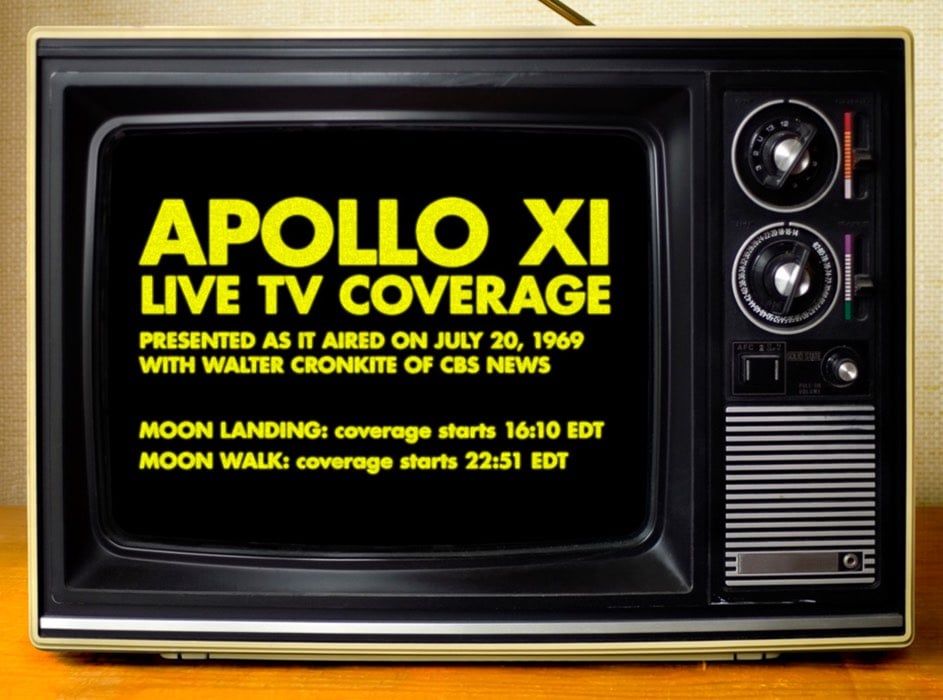
The Apollo 11 Lunar Module landed on the surface of the Moon 43 years ago today. For the 40th anniversary of the landing in 2009, I put together a page where you can watch the original CBS News coverage of Walter Cronkite reporting on the Moon landing and the first Moon walk, synced to the present-day time. I've updated the page to work again this year: just open this page in your browser and the coverage will start playing at the proper time. Here's the schedule:
Moon landing broacast start: 4:10:30 pm EDT on July 20
Moon landing shown: 4:17:40 pm EDT
Moon landing broadcast end: 4:20:15 pm EDT {break}
Moon walk broadcast start: 10:51:27 pm EDT
First step on Moon: 10:56:15 pm EDT
Nixon speaks to the Eagle crew: approx 11:51:30 pm EDT
Moon walk broadcast end: 12:00:30 pm EDT on July 21
If you've never seen this coverage, I urge you to watch at least the landing segment (~10 min.) and the first 10-20 minutes of the Moon walk. I hope that with the old time TV display and poor YouTube quality, you get a small sense of how someone 40 years ago might have experienced it. I've watched the whole thing a couple of times while putting this together and I'm struck by two things: 1) how it's almost more amazing that hundreds of millions of people watched the first Moon walk *live* on TV than it is that they got to the Moon in the first place, and 2) that pretty much the sole purpose of the Apollo 11 Moon walk was to photograph it and broadcast it live back to Earth.
This is a video showing all 135 launches of the various Space Shuttle at once.
Turn up your sound. I've seen this done with episodes of the Simpsons and Star Trek, but this is way better. The fade out on the tiny Challenger square is surprisingly affecting. Created by McLean Fahnestock.
When they were launched in 1977, the two Voyager spacecraft each carried with them a 12-inch gold-plated copper record containing multimedia pertaining to life on Earth, the idea being that if an extraterrestrial ran across one of these records millions of years from now, they could play it an learn something about our planet. This site has a listing of some of the music, images, and sounds contained on the records. Here are two of the images included...the first is a rudimentary mathematics primer and the second is a family portrait:
I wonder when we'll see these records again. I mean, it seems more plausible that Elon Musk's grandson will mount an expedition to retrieve a Voyager probe in 2077 than some alien running across the thing.
Venus passed in front of the Sun yesterday for the last time until 2117. The transit took almost seven hours but this NASA video shows it in under a minute.
I missed this last July when the news came out, but since I've been following the Pioneer Anomaly for the past eight years, I wanted to mention it here for closure purposes. First, what the hell is the Pioneer Anomaly?
The Pioneer anomaly or Pioneer effect is the observed deviation from predicted accelerations of the Pioneer 10 and Pioneer 11 spacecraft after they passed about 20 astronomical units (3×10^9 km; 2×10^9 mi) on their trajectories out of the Solar System. Both Pioneer spacecraft are escaping the Solar System, but are slowing under the influence of the Sun's gravity. Upon very close examination of navigational data, the spacecraft were found to be slowing slightly more than expected. The effect is an extremely small but unexplained acceleration towards the Sun, of 8.74±1.33x10^-10 m/s^2.
For their new analysis, Turyshev et. al. compiled a lot more data than had ever been analyzed before, spanning a much longer period of the Pioneers' flight times. They studied 23 years of data from Pioneer 10 instead of just 11, and 11 years of data from Pioneer 11 instead of 3. As explained in their new paper, the more complete data sets reveal that the spacecraft's anomalous acceleration did indeed seem to decrease with time. In short, the undying force had been dying after all, just like the decaying plutonium.
A more recent paper by the same researchers offers even more support for their theory. Case closed, I say.
Mustafa invented a way of tapping this quantum effect via what's known as the dynamic Casimir effect. This uses a "moving mirror" cavity, where two very reflective very flat plates are held close together, and then moved slightly to interact with the quantum particle sea. It's horribly technical, but the end result is that Mustafa's use of shaped silicon plates similar to those used in solar power cells results in a net force being delivered. A force, of course, means a push or a pull and in space this equates to a drive or engine.
"The wind, rain, and surf sounds are pretty cool, but I usually sort of zone out when it gets to the crickets chirping, and then I just end up turning it off," said Ellinger, adding that he will sometimes put the record on as background noise when he's cleaning his electro-biological habitat.
Current status of The Onion: still really pretty good.
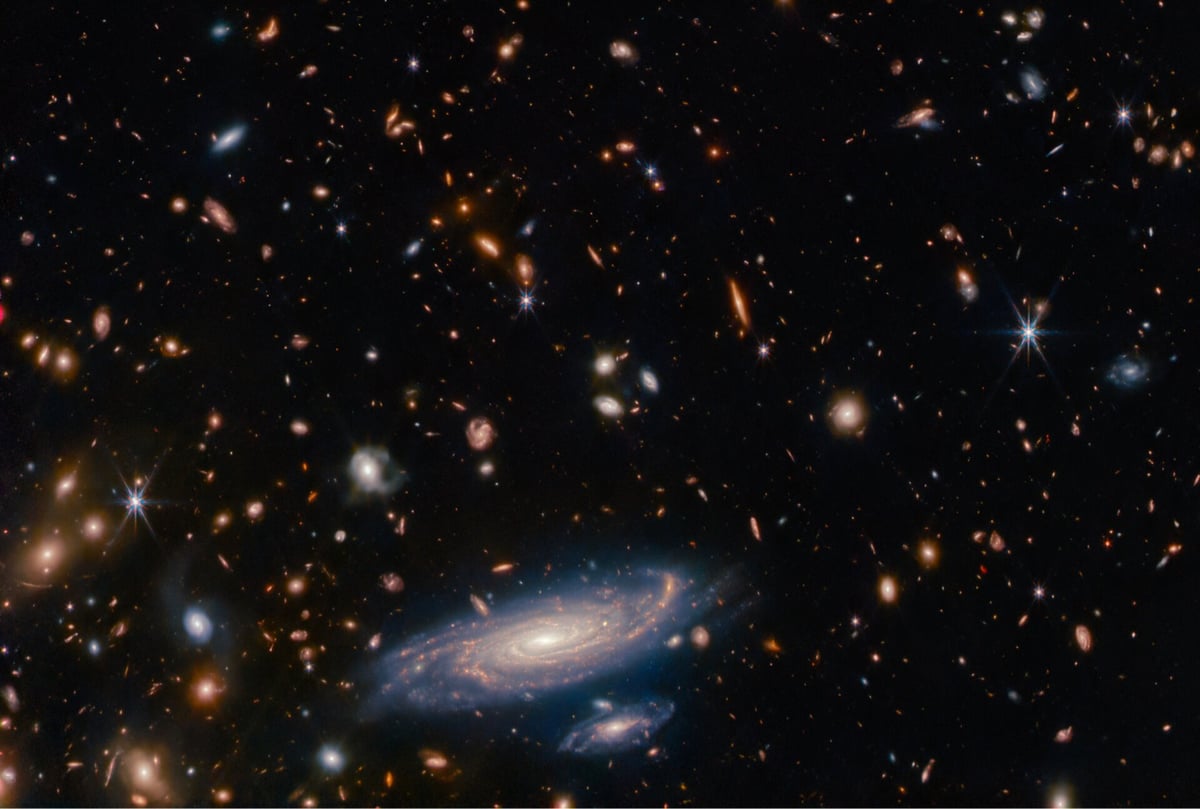
I've spent years studying all this, and it still sometimes gets to me: just how flipping BIG the Universe is! And this picture is still just a tiny piece of it: it's 1.2 x 1.5 degrees in size, which means it's only 0.004% of the sky! And it's not even complete: more observations of this region are planned, allowing astronomers to see even deeper yet.
Here's a full view of the image that looks sorta unimpressive:
You've likely seen other videos taken from cameras attached to the Space Shuttle and its boosters, but this is one is exceptional in two regards: it's in HD and the sound has been remastered by Skywalker Sound.
Watch, and more importantly, listen to the whole thing...at the very end, you can see the second booster land a few hundred yards away from the first one. Who knew that being in space sounds like being trapped with a whale underwater in a tin pail? (via ★mouser)
On a recent pass, the Mars Reconnaissance Orbiter caught this dust devil dancing its way across the surface of Mars.
The active dust devil displays a delicate arc produced by a westerly breeze partway up its height. The dust plume is about 30 yards or meters in diameter.
The image was taken during the time of Martian year when that planet is farthest from the sun. Just as on Earth, winds on Mars are powered by solar heating. Exposure to the sun's rays declines during this season, yet even now, dust devils act relentlessly to clean the surface of freshly deposited dust, a little at a time.
Dust devils occur on Earth as well as on Mars. They are spinning columns of air, made visible by the dust they pull off the ground. Unlike a tornado, a dust devil typically forms on a clear day when the ground is heated by the sun, warming the air just above the ground. As heated air near the surface rises quickly through a small pocket of cooler air above it, the air may begin to rotate, if conditions are just right.
Space always seems so far away and much of it actually is. But space is actually quite close to where we are all sitting right now. The Kármán line, the commonly accepted boundary between the Earth's atmosphere and space, is only 62 miles above sea level.
The line was named after Theodore von Kármán, (1881-1963) a Hungarian-American engineer and physicist who was active primarily in the fields of aeronautics and astronautics. He first calculated that around this altitude the Earth's atmosphere becomes too thin for aeronautical purposes (because any vehicle at this altitude would have to travel faster than orbital velocity in order to derive sufficient aerodynamic lift from the atmosphere to support itself). Also, there is an abrupt increase in atmospheric temperature and interaction with solar radiation.
A distance of 62 miles can covered by a car on the interstate in less than an hour. Stable Earth orbits are achievable at only 100 miles above the Earth, with the ISS and Space Shuttles usually orbiting at a height of ~200 miles. To show how small a distance that really is, I made the following image...the orange line in the upper left represents 200 miles away from the surface.
Scott Carpenter was one of the original seven Mercury astronauts and the second American to orbit the Earth. Just before he went into space, his father wrote this wonderful letter.
And I venture to predict that after all the huzzas have been uttered and the public acclaim is but a memory, you will derive the greatest satisfaction from the serene knowledge that you have discovered new truths. You can say to yourself: this I saw, this I experienced, this I know to be the truth. This experience is a precious thing; it is known to all researchers, in whatever field of endeavour, who have ventured into the unknown and have discovered new truths.
Time lapse movie composed of photographs taken from the International Space Station as it orbits the Earth at night.
This movie begins over the Pacific Ocean and continues over North and South America before entering daylight near Antarctica. Visible cities, countries and landmarks include (in order) Vancouver Island, Victoria, Vancouver, Seattle, Portland, San Fransisco, Los Angeles. Phoenix. Multiple cities in Texas, New Mexico and Mexico. Mexico City, the Gulf of Mexico, the Yucatan Peninsula, Lightning in the Pacific Ocean, Guatemala, Panama, Columbia, Ecuador, Peru, Chile, and the Amazon. Also visible is the earths ionosphere (thin yellow line) and the stars of our galaxy.
Dark, finger-like features appear and extend down some Martian slopes during late spring through summer, fade in winter, and return during the next spring. Repeated observations have tracked the seasonal changes in these recurring features on several steep slopes in the middle latitudes of Mars' southern hemisphere.
"The best explanation for these observations so far is the flow of briny water," said Alfred McEwen of the University of Arizona, Tucson. McEwen is the principal investigator for the orbiter's High Resolution Imaging Science Experiment (HiRISE) and lead author of a report about the recurring flows published in Thursday's edition of the journal Science.
Space photography and videography all looks pretty much the same: high contrast, lots of black backgrounds, smooth, and often sterile. Designer Chris Abbas took a bunch of photos from the Cassini Mission (to Saturn) and made them into something that is definitely not your usual NASA video.
This is a wonderful seven-minute HD video tour of Earth using video shot from orbit.
Look at this neat picture of Great Salt Lake in Utah. And the variation in color? That's due to an almost a complete blockage of the circulation of the lake by a trestle for a railroad that crosses from one side to the other. It stops the circulation and things get a little bit saltier and certainly saltier at the north end of the lake.
The timing couldn't be worse, say SETI scientists. After millenniums of musings, this spring astronomers announced that 1,235 new possible planets had been observed by Kepler, a telescope on a space satellite. They predict that dozens of these planets will be Earth-sized -- and some will be in the "habitable zone," where the temperatures are just right for liquid water, a prerequisite of life as we know it.
Indian lunar orbiter Chandrayaan-1 has discovered a large cave on the Moon. Aside from the hey, cool, there's a cave on the Moon factor, the other big feature of the cave is its constant and temperate temperature.
Temperatures on the moon swing wildly, from a maximum of 262 degrees Fahrenheit to a minimum of -292. The cave holds steady at a (relatively) comfortable -4, since the moon's weather can't penetrate its 40-foot-thick wall. It could also protect astronauts from "hazardous radiations, micro-meteoritic impacts," and dust storms, according to paper published by the journal Current Science.
Humans are sexual beings and it can be predicted that male and female astronauts will engage in sexual relations during a mission to Mars, leading to conflicts and pregnancies and the first baby born on the Red Planet. Non-human primate and astronaut sexual behavior is reviewed including romantic conflicts involving astronauts who flew aboard the Space Shuttle and in simulated missions to Mars, and men and women team members in the Antarctic. The possibilities of pregnancy and the effects of gravity and radiation on the testes, ovaries, menstruation, and developing fetus, including a child born on Mars, are discussed. What may lead to and how to prevent sexual conflicts, sexual violence, sexual competition, and pregnancy are detailed. Recommendations include the possibility that male and female astronauts on a mission to Mars, should fly in separate space craft.
Redfield blogged a scathing attack on Saturday. Over the weekend, a few other scientists took to the Internet as well. Was this merely a case of a few isolated cranks? To find out, I reached out to a dozen experts on Monday. Almost unanimously, they think the NASA scientists have failed to make their case. "It would be really cool if such a bug existed," said San Diego State University's Forest Rohwer, a microbiologist who looks for new species of bacteria and viruses in coral reefs. But, he added, "none of the arguments are very convincing on their own." That was about as positive as the critics could get. "This paper should not have been published," said Shelley Copley of the University of Colorado.
In 2057, the Sun is dying, and the Earth is freezing. So the ship Icarus 2 goes on a mission to reignite it with a massive bomb. This is the movie Sunshine, and if you get a chance to see it, watch it on a big screen. The crew themselves watch the Sun close-up, awestruck, from a view-port the exact dimensions of a movie screen, so the Sun fills your picture too and you spend half the film bathing in powerful yellow light. Like some kind of church.
Although I didn't, Matt, appreciate the diss of Pluto. Never forget, my friend.
Houston, we've had a problem. We've had a MAIN B BUS UNDERVOLT.
Wonderful stuff. The site is looking for help with getting more missions transcripts up...go here and scroll down to "Getting involved without technical knowledge". Although I think they'd get more people involved if they didn't just dump people into GitHub. (thx, the 50 people who sent this to me this morning)
NASA will hold a news conference at 2 p.m. EST on Thursday, Dec. 2, to discuss an astrobiology finding that will impact the search for evidence of extraterrestrial life. Astrobiology is the study of the origin, evolution, distribution and future of life in the universe.
I did a little research on the news conference participants and found:
2. Felisa Wolfe-Simon (an oceanographer) has written extensively on photosynthesis using arsenic recently (she worked on the team mentioned in this article)
4. James Elser (an ecologist) is involved with a NASA-funded astrobiology program called Follow the Elements, which emphasizes looking at the chemistry of environments where life evolves (and not just looking at water or carbon or oxygen).
So, if I had to guess at what NASA is going to reveal on Thursday, I'd say that they've discovered arsenic on Titan and maybe even detected chemical evidence of bacteria utilizing it for photosynthesis (by following the elements). Or something like that. (thx, sippey)
For one thing, sleeping is more troublesome than you'd think, considering the remote location:
The onslaught of apparent days and nights would play havoc with astronauts' body clocks, so a shutters-down and bedtime schedule is imposed by mission controllers. Each of the crew has a closet-like cabin where they can hook a sleeping bag to the wall and settle down for the night. Some strap pillows to their heads to make it feel more like lying down. The lights don't go out completely, though. People dozing in orbit see streaks and bursts of bright colour caused by high-energy cosmic rays painlessly slamming into their retinas. Fans and air filters add to the distractions, so some astronauts wear ear plugs to block out the constant hum.
Unsurprisingly, falling asleep can take some getting used to. Just as you are nodding off, you can feel as though you've fallen off a 10-storey building. People who look half asleep will suddenly throw their heads back with a start and fling out their arms. It gets easier with time. One Russian crew member is renowned for doing without a sleeping bag and falling asleep wherever he ends the day. Anyone still awake after bedtime would see his snoozing form drift by, slowly bouncing off the walls, his course set by the air currents that gently pushed and pulled him.
Astronomer Francesco Pepe of the Geneva Observatory in Switzerland, who spoke Oct. 11 at an International Astronomical Union symposium on planetary systems, reported a new analysis using only HARPS data, but adding an extra 60 data points to the observations published in 2008. He and his colleagues could find no trace of the planet.
The paper reports the discovery of two new planets around the nearby red dwarf star Gliese 581. This brings the total number of known planets around this star to six, the most yet discovered in a planetary system other than our own solar system. Like our solar system, the planets around Gliese 581 have nearly circular orbits.
The most interesting of the two new planets is Gliese 581g, with a mass three to four times that of the Earth and an orbital period of just under 37 days. Its mass indicates that it is probably a rocky planet with a definite surface and that it has enough gravity to hold on to an atmosphere, according to Vogt.
Gliese 581, located 20 light years away from Earth in the constellation Libra, has a somewhat checkered history of habitable-planet claims. Two previously detected planets in the system lie at the edges of the habitable zone, one on the hot side (planet c) and one on the cold side (planet d). While some astronomers still think planet d may be habitable if it has a thick atmosphere with a strong greenhouse effect to warm it up, others are skeptical. The newly discovered planet g, however, lies right in the middle of the habitable zone.
Sam Arbesman's prediction of May 2011 might have been too conservative. And 20 light years...that means we could send a signal there, and if someone of sufficient technological capability is there and listening, we could hear something back within our lifetime. Contact! (thx, jimray)
Due to the Moon's relative position in the sky as Neil Armstrong started his moonwalk, Australia was able to capture the first few minutes of his descent down the ladder before NASA was able to find a signal. But it was lost until recently; the restored footage will be shown next week at an event in Sydney.
Of course, it's a bit more complicated than that, but here's an overview of what we did. Using the properties of previously discovered exoplanets, we developed a simple metric of habitability for each planet that uses its mass and temperature to rate it on a scale of 0 to 1, where 1 is Earth-like, and 0 is so very not Earth-like. Plotting these values over time and taking the upper envelope yields a nice march towards habitability.
The authors don't address this directly in their paper, but I wondered what the Moore's Law for planetary discovery might be -- e.g. every X years (or months?), the habitability of the most habitable planet discovered doubles. So I emailed Sam Arbesman and he said that his quick back of the envelope calculation would be "half a month or so"...which is an astounding pace.
Back in July, Ben Terrett wrote a post about how many instances of the word "helvetica" set in unkerned 100 pt Helvetica it would take to go from the Earth to the Moon:
The distance to the moon is 385,000,000,000 mm. The size of an unkerned piece of normal cut Helvetica at 100pt is 136.23 mm. Therefore it would take 2,826,206,643.42 helveticas to get to the moon.
But let's say you wanted to stretch one "helvetica" over the same distance...at what point size would you need to set it? The answer is 282.6 billion points. At that size, the "h" would be 44,600 miles tall, roughly 5.6 times as tall as the Earth. Here's what that would look like:
The Earth is on the left and that little speck on the right side is the Moon. Here's a close-up of the Earth and the "h":
And if you wanted to put it yet another way, the Earth is set in 50.2 billion point type -- Helvetically speaking -- while the Moon is set in 13.7 billion point type. (thx, @brainpicker)
Just leave this page open in your browser and at the appointed times (schedule is below), the broadcast will begin (no manual page refresh necessary).
Schedule:
Moon landing broacast start: 4:10:30 pm EDT on July 20
Moon landing shown: 4:17:40 pm EDT
Moon landing broadcast end: 4:20:15 pm EDT
...
Moon walk broadcast start: 10:51:27 pm EDT
First step on Moon: 10:56:15 pm EDT
Nixon speaks to the Eagle crew: approx 11:51:30 pm EDT
Moon walk broadcast end: 12:00:30 am EDT on July 21
If you've never seen this coverage, I urge you to watch at least the landing segment (~10 min.) and the first 10-20 minutes of the Moon walk. I hope that with the old time TV display and poor YouTube quality, you get a small sense of how someone 40 years ago might have experienced it.
Please note that schedule times are approximate, based on your computer's clock, and that the syncing of the videos might not be perfect. You need to have JS and Flash 8+ to view. This is just like real TV...if you miss the appointed time, there's no rewind or anything...the video is playing "live". I have not done extensive browser testing so it may not work perfectly in your browser. If you run into any problems, just reload the page. Thanks for tuning in.
Remember the boiling tongue water story from yesterday's post about how long a human can last in the vacuum of space? Here's the video of that depressurization event, with the participants taking about it:
At NASA's Manned Spacecraft Center (now renamed Johnson Space Center) we had a test subject accidentally exposed to a near vacuum (less than 1 psi) in an incident involving a leaking space suit in a vacuum chamber back in '65. He remained conscious for about 14 seconds, which is about the time it takes for O2 deprived blood to go from the lungs to the brain. The suit probably did not reach a hard vacuum, and we began repressurizing the chamber within 15 seconds. The subject regained consciousness at around 15,000 feet equivalent altitude. The subject later reported that he could feel and hear the air leaking out, and his last conscious memory was of the water on his tongue beginning to boil.
The view is from one of the cameras close to the engines. The narration is great; you really get a sense of how many things had to be considered to make it to the Moon (like the launch pad paint that burned and charred in order to protect the underlying materials). (via df)
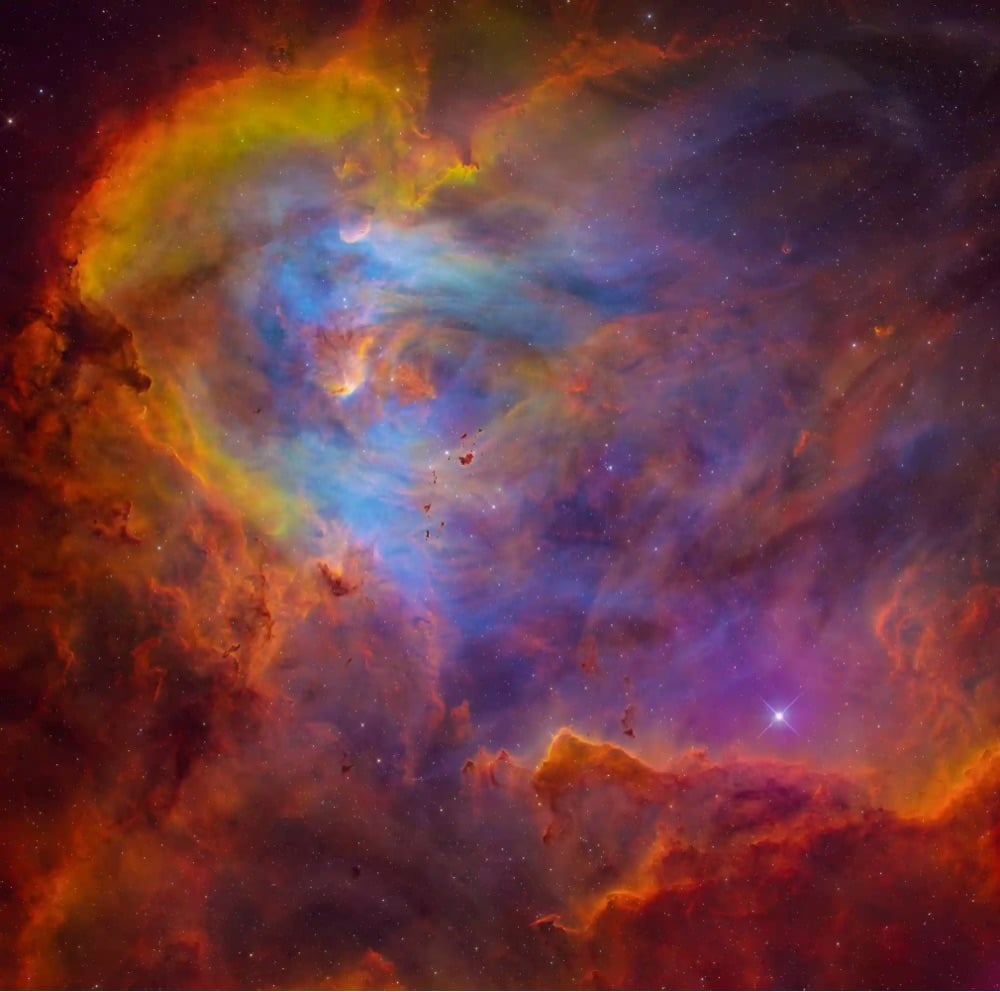
The colors in Hubble images, which are assigned for various reasons, aren't always what we'd see if we were able to visit the imaged objects in a spacecraft. We often use color as a tool, whether it is to enhance an object's detail or to visualize what ordinarily could never be seen by the human eye.
For the same reason that we have Space Shuttle launch delays, we'll be able to tell exactly what trajectories our enemies could take between planets: the launch window. At any given point in time, there are only so many routes from here to Mars that will leave our imperialist forces enough fuel and energy to put down the colonists' revolt.
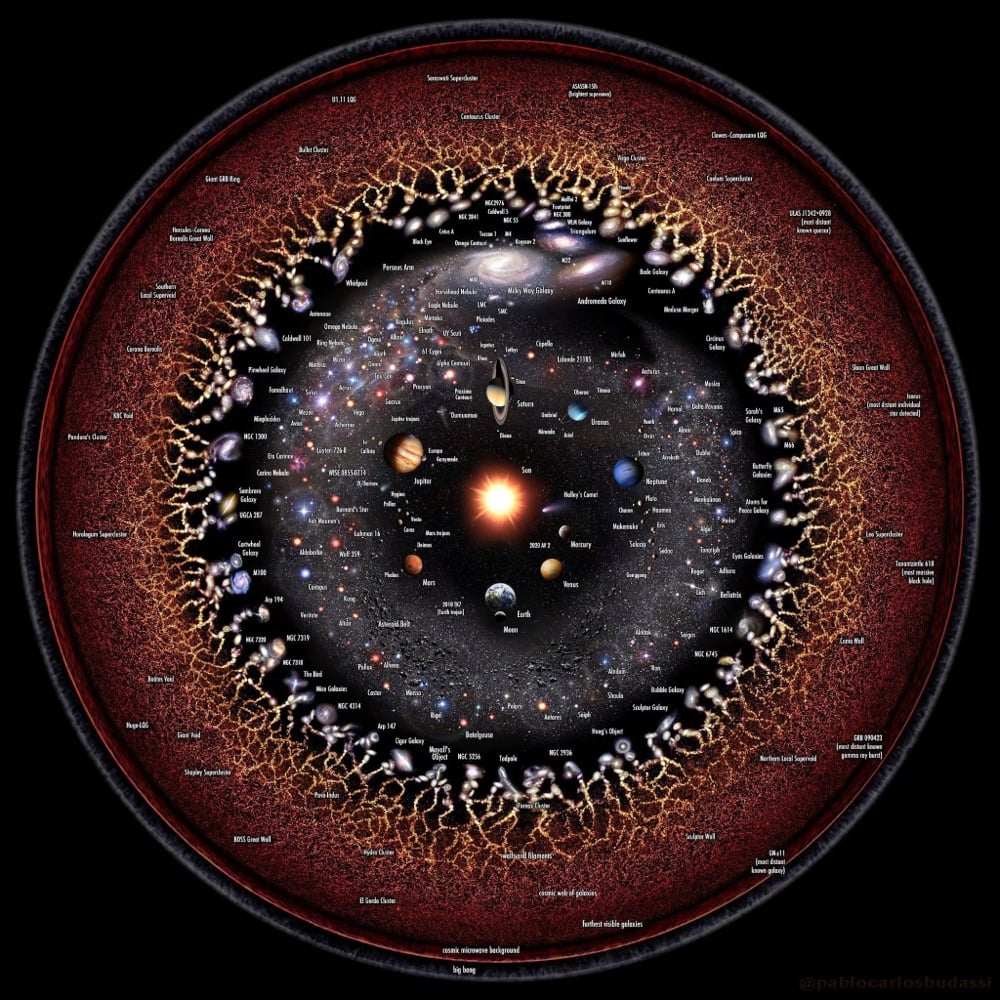
The Known Universe zooms out from Tibet to the limits of the observable universe. Dim the lights, full-screen it in HD, and you're in for a treat.
Like Powers of Ten, except astronomically accurate. It's not a dramatization, it's a map; the positioning data was pulled from Hayden Planetarium's Digital Universe Atlas, which is available for free download.
Since 1998, the American Museum of Natural History and the Hayden Planetarium have engaged in the three-dimensional mapping of the Universe. This cosmic cartography brings a new perspective to our place in the Universe and will redefine your sense of home. The Digital Universe Atlas is distributed to you via packages that contain our data products, like the Milky Way Atlas and the Extragalactic Atlas, and requires free software allowing you to explore the atlas by flying through it on your computer.
In 2004, the Hubble Space Telescope took an image called the Hubble Ultra Deep Field; basically astronomers pointed the Hubble toward an "empty" part of space and took a long-exposure shot in the visible spectrum. What they found were thousands of far away galaxies from early in the development of the universe. Now the Hubble has peered even deeper into the universe in near-infrared and captured this image:
Each one of those little specks is an entire galaxy, some only 600 million years old. Here's a zoomed-in section:
NASA announced that it has found pretty hard evidence of significant amounts of water on the Moon.
"We are ecstatic," said Anthony Colaprete, LCROSS project scientist and principal investigator at NASA's Ames Research Center in Moffett Field, Calif. "Multiple lines of evidence show water was present in both the high angle vapor plume and the ejecta curtain created by the LCROSS Centaur impact. The concentration and distribution of water and other substances requires further analysis, but it is safe to say Cabeus holds water."
I don't have to tell you about the implications here. Just think of how much you could sell authentic Moon bottled water for.
As black holes evaporate, they release Hawking radiation. Named after the legendary Stephen, who first argued for its existence in 1974, Hawking radiation emitted is measured by the mass, angular momentum, and charge of the black hole. Hawking radiation has been predicted to be part of the eventual catalyst for the heat death of the universe, and recent findings suggest that it's possibly closer than astronomers originally calculated. Don't max out your credit cards or adopt a Twinkie diet just yet. Scientists believe that it takes roughly 10^102 years for a supermassive black hole to evaporate, and chances are that global warming, war, or Twinkies will have done in humanity long before then.
From an article in The Boston Globe by Samuel Arbesman, about his quest to name an asteroid after author George Plimpton:
There is a whole group of asteroids named after rock stars. Each member of Rush has a minor planet. Fantasia, Hammurabi, and Jerrylewis are all out there. While Goldfinger is not named after the Bond film (it's named after an astronomer), Vespa is named after the motor scooter. Here is where we find the asteroid named Qwerty, and even an asteroid named ASCII.
While the author was on his mission to get Mr. Plimpton's name on a piece of space real estate, he discovered some of the intricacies of naming objects up there. For example, the moons of Uranus have all been named after characters from works by Shakespeare and Alexander Pope. Also, those "name a star" advertisements on the radio are bunk. Although you get a certificate claiming your star has been named, the monikers aren't recognized by the International Astronomical Union, the one organization that has authority in the matter.
Borsch, sticky rice with sweet bean paste, duck cassoulet, and tvorog (Russian cottage cheese and nuts) are just a smattering of the culinary variety served up in space. On board the Discovery Space Shuttle, the various offerings reflect the amalgamation of nations that make up the ships temporary inhabitants. Recent Discovery visitor Danny Olivas brought a little American fare to the deck, perfecting the zero-g breakfast burrito. If you're looking to spice up your food between the stars, be warned: salt and pepper are only available in liquid form.
Update: Nuts aren't an essential ingredient of tvorog, and it's actually not cottage cheese at all. The thickened dairy treat is a relative of German quark, and is consumed throughout Central and Eastern Europe. Its add-ins vary depending on location, but vanilla and fruit are popular additives in both the Netherlands and Germany.
Nothing like a little science on the Moon, I always say.
Astronaut David Scott in 1971, from the Apollo 15 Lunar Surface Journal. Scott was part of the Apollo 15 crew, and applied Galileo's findings about gravity and mass by testing a falcon feather and a hammer. The film, shown in countless high school physics classes, is the nerdy, oft-neglected cousin of Neil Armstrong's space paces.
Within hours, telegraph wires in both the United States and Europe spontaneously shorted out, causing numerous fires, while the Northern Lights, solar-induced phenomena more closely associated with regions near Earth's North Pole, were documented as far south as Rome, Havana and Hawaii, with similar effects at the South Pole.
For those of you who missed the show last night or if you just want a replay, the CBS News footage of the Apollo 11 Moon landing and Moon walk, presented by Walter Cronkite, is available on YouTube. The Moon landing video is here and the first of 7 videos of the Moon walk is here.
On July 17, 1969, The New York Times issued a correction related to an editorial the paper published in 1920 that dismissed the idea of rocket travel in the vacuum of space. The editorial read, in part:
That Professor Goddard, with his 'chair' in Clark College and the countenancing of the Smithsonian Institution, does not know the relation of action to reaction, and of the need to have something better than a vacuum against which to react -- to say that would be absurd. Of course he only seems to lack the knowledge ladled out daily in high school.
The correction stated:
Further investigation and experimentation have confirmed the findings of Issac Newton in the 17th Century and it is now definitely established that a rocket can function in a vacuum as well as in an atmosphere. The Times regrets the error.
The Times regrets the error! Wish I'd written that next to a few muffed physics exam questions. Here's a pretty good explanation of why rockets work in vacuums. (via @davidfg)
Just leave this page open in your browser and at the appointed times (schedule is below), the broadcast will begin (no manual page refresh necessary).
Schedule:
Moon landing broacast start: 4:10:30 pm EDT on July 20
Moon landing shown: 4:17:40 pm EDT
Moon landing broadcast end: 4:20:15 pm EDT
Moon walk broadcast start: 10:51:27 pm EDT
First step on Moon: 10:56:15 pm EDT
Nixon speaks to the Eagle crew: approx 11:51:30 pm EDT
Moon walk broadcast end: 12:00:30 pm EDT on July 21
If you've never seen this coverage, I urge you to watch at least the landing segment (~10 min.) and the first 10-20 minutes of the Moon walk. I hope that with the old time TV display and poor YouTube quality, you get a small sense of how someone 40 years ago might have experienced it. I've watched the whole thing a couple of times while putting this together and I'm struck by two things: 1) how it's almost more amazing that hundreds of millions of people watched the first Moon walk *live* on TV than it is that they got to the Moon in the first place, and 2) that pretty much the sole purpose of the Apollo 11 Moon walk was to photograph it and broadcast it live back to Earth.
Thanks to Meg for her JS help...any errors or sloppy code are mine. Please note that schedule times are approximate, based on your computer's clock, and that the syncing of the videos might not be perfect. You need to have JS and Flash 8+ to view. This is just like real TV...if you miss the appointed time, there's no rewind or anything...the video is playing "live". I have not done extensive browser testing so it may not work perfectly in your browser. Bug reports are welcome and I will try to fix things as they crop up. If you run into any problems, just reload the page. To ensure that you have the latest (hopefully bug-free) version before the broadcast begins, reload the page. Other than that, if you leave it open, the broadcast will happen automatically.
The lunar module is the small white bit in the middle casting the long shadow. The Apollo 14 site is the coolest...you can see the path the astronauts took out to some scientific instruments. The LRO hasn't reached its final orbit yet so future images "will have two to three times greater resolution". !!! See also my giant Apollo 11 post.
Yesterday was the 40th anniversary of the launch of Apollo 11 and Monday is the same for both the first Moon landing and the first walk on the surface. In this entry, I've collected some of the best resources on the web related to the anniversary...articles, historical documents, audio, video, transcripts, photos, and the like. Enjoy.
We Choose the Moon is tracking the activities of the Apollo 11 mission as it happened 40 years ago. Very nicely done.
For its July 21, 1969 issue, The NY Times used 96 pt. type to declare that MEN WALK ON MOON.
The landing was made four miles west of the aiming point, but well within the designated area. An apparent error in some data fed into the craft's guidance computer from the earth was said to have accounted for the discrepancy.
Suddenly the astronauts were startled to see that the computer was guiding them toward a possibly disastrous touchdown in a boulder-filled crater about the size of a football field.
Mr. Armstrong grabbed manual control of the vehicle and guided it safely over the crater to a smoother spot, the rocket engine stirring a cloud of moon dust during the final seconds of descent.
John Noble Wilford, the Times journalist who wrote the front page story underneath the 96 pt. type -- "the biggest single story of my career" -- recounts his Apollo 11 experience and ponders the Apollo program's legacy in a great piece for the Times.
It then occurs to me that if Columbus and Capt. James Cook were alive, they might be less astonished by two men landing on the Moon than by the millions of people, worldwide, watching every step of the walk as it happens. Exploring is old, but instantaneous telecommunications is new and marvelous.
In just 1.3 seconds, the time it takes for radio waves to travel the 238,000 miles from Moon to Earth, each step by Armstrong and Aldrin is seen, and their voices heard, throughout the world they have for the time being left behind. In contrast to exploration's previous landfalls, the whole world shares in this moment.
Let the lunar surface be the ultimate global commons while we focus on more distant and sustainable goals to revitalize our space program. Our next generation must think boldly in terms of a goal for the space program: Mars for America's future. I am not suggesting a few visits to plant flags and do photo ops but a journey to make the first homestead in space: an American colony on a new world.
Robotic exploration of Mars has yielded tantalizing clues about what was once a water-soaked planet. Deep beneath the soils of Mars may lie trapped frozen water, possibly with traces of still-extant primitive life forms. Climate change on a vast scale has reshaped Mars. With Earth in the throes of its own climate evolution, human outposts on Mars could be a virtual laboratory to study these vast planetary changes. And the best way to study Mars is with the two hands, eyes and ears of a geologist, first at a moon orbiting Mars and then on the Red Planet's surface.
Around these [landing sites] are scattered smaller artefacts and personal items, such as Neil Armstrong's boots and portable life-support system, scientific instruments and their power generators -- and, of course, the iconic US flag which remains planted in the moon's surface. Then there are the footprints and rover tread paths. Despite the passing of the years, these remain carved into the dust because the moon has no wind or rain to wash them away.
Anthropologist P. J. Capelotti of Penn State University in Abington has mapped out five "lunar parks". These cover the areas where the majority of the artefacts are concentrated and could be used as a basis for future preservation efforts. "Nobody's saying that the whole moon has to be off limits, but as people are starting to make plans for tourism and mineral extraction, or for putting a base there, they just need to be aware of them and work around them."
Since returning from the Moon, Neil Armstrong has been less and less willing to speak in public about his Apollo 11 experience. For the 40th anniversary, Armstrong will not take part in the NASA event to commemorate the landing. His only appearance related to the anniversary will be a 15-minute lecture at a Smithsonian Institution event on Sunday night. I found this event on the National Air and Space Museum site...maybe that's it? If so, then Armstrong's lecture will be webcast live on the NASA TV site that evening.
7. When Buzz Aldrin joined Armstrong on the surface, he had to make sure not to lock the Eagle's door because there was no outer handle.
Moonwalk One is a documentary film about Apollo released in 1970 to little fanfare, even though it won an award at the Cannes Film Festival. The film was commissioned by NASA but with so much Apollo activity and information happening in the late 60s and early 70s, no one was interested in distributing or seeing the film and it was soon forgotten. Recently, the only remaining 35mm print of the film was located under the director's desk, restored, and offered for sale on DVD in time for the 40th anniversary.
To get a feel of what it was like in the Soviet Union during the Apollo 11 mission, Scientific American interviewed Sergei Khrushchev, son of former Russian premier Nikita Khrushchev. The reaction was somewhat more subdued than in other parts of the world.
Of course, you cannot have people land on the moon and just say nothing. It was published in all the newspapers. But if you remember [back then] when Americans spoke of the first man in space, they were always talking of "the first American in space" [not Yuri Gagarin]. The same feeling was prevalent in Russia. There were small articles when Apollo 11 was launched. Actually, there was a small article on the first page of Pravda and then three columns on page five. I looked it up again.
The Apollo crew even dined on thermo-stabilized cheddar cheese spread and hot dogs during the moon mission, bringing at least a bit of America in July to the sterile flight craft. And yes, there was bacon - foreshadowing the current bacon craze, the first meal eaten by man on the moon was none other than bacon cubes, coated with gelatin to combat crumbs.
Finally, there's still some good stuff to be had on the old telly on Monday. The History Channel has As It Happened: Man on the Moon at 8pm ET:
This special takes viewers back to July 1969 to experience the actual CBS News/Walter Cronkite coverage of man's first lunar landing. Using minimal editing and leaving the original footage untouched viewers will feel as if they are watching the CBS coverage in July of 1969. While today we know the outcome of Apollo 11's mission it was not a given then. This will become evident watching Walter Cronkite and his colleagues as they watch the historic lunar mission unfold before them.
Everybody, including Congress, was caught up in the adrenal rush of it all. But then, on the morning after, congressmen began to wonder about something that hadn't dawned on them since Kennedy's oration. What was this single combat stuff -- they didn't use the actual term -- really all about? It had been a battle for morale at home and image abroad. Fine, O.K., we won, but it had no tactical military meaning whatsoever. And it had cost a fortune, $150 billion or so. And this business of sending a man to Mars and whatnot? Just more of the same, when you got right down to it. How laudable ... how far-seeing ... but why don't we just do a Scarlett O'Hara and think about it tomorrow?
He was the first man to walk on the moon, taking that one giant leap for mankind -- yet most of the famous shots are of his fellow astronaut Buzz Aldrin, as it was Armstrong who manned the stills camera.
New Scientist overlaid the Apollo lunar excursion maps on top of cities in Google Earth. Neil and Buzz didn't even leave Trafalgar Square on their trip to the Moon.
Lunar archaeologists, interested in making the Apollo 11 site a National Historic Landmark, hope the planned photos will answer some of these longstanding questions: What is the condition of Tranquility Base after 40 years? Was the American flag blown over on the Eagle's ascent and is it now a bleached skeleton? What are the relatively long term effects of the lunar environment on human artifacts?
This should quiet the people who still think it was all a hoax...although NASA could be faking these photos as well.
Today is the 40th anniversary of the liftoff of Apollo 11. You can follow along on We Choose the Moon, on Twitter, and with a NASA audio program. (Is there a video launch being broadcast anywhere?)
NASA is also releasing "greatly improved video imagery" of the Apollo 11 moon walks. !!! So look for that later today.
We Choose the Moon is a site that tracks the activities of the Apollo 11 mission as it happened 40 years ago. Nice work. The transmissions from the spacecraft, CAPCOM, and the lunar lander are cleverly published to and pulled in from Twitter.
With all this 40th anniversary stuff, I'm having trouble getting my mind around that the first Moon landing is as far removed from the present as the low point of The Great Depression was from my birth (i.e. the Moon landing, culturally speaking, is Ollie's Great Depression). See also timeline twins. (via jimray)
When they are passing in front of their stars, their atmospheres are backlit in a way that can make spectroscopic analysis of the different chemicals in their atmospheres comparatively easy: the wavelengths of light absorbed by the various chemicals will show up, in a tiny way, in the spectrum of the starlight. And this is what makes it possible to imagine looking at them for signs of life.
What scientists would look for are planets with unstable atmospheres, which James Lovelock said was an indication of life.
After the extragalactic planet post this morning, Sam Arbesman sent me a link to systemic, a blog dedicated to the search for extrasolar planets written by Greg Laughlin, one of the scientists involved in the effort. Here are two relevant posts. In Forward, Laughlin says we're very close to finding a nearby Earth-like planet:
Detailed Monte-Carlo simulations indicate that there's a 98% probability that TESS will locate a potentially habitable transiting terrestrial planet orbiting a red dwarf lying closer than 50 parsecs. When this planet is found, JWST (which will launch near the end of TESS's two year mission) can take its spectrum and obtain resolved measurements of molecular absorption in the atmosphere.
In Too cheap to meter, Laughlin presents a formula for the land value of such a discovery that depends on how far away the planet is, the age of the star it orbits, and the star's visual magnitude.
Applying the formula to an exact Earth-analog orbiting Alpha Cen B, the value is boosted to 6.4 billion dollars, which seems to be the right order of magnitude. And applying the formula to Earth (using the Sun's apparent visual magnitude) one arrives at a figure close to 5 quadrillion dollars, which is roughly the economic value of Earth (~100x the Earth's current yearly GDP)...
RV shifts are how the vast majority of extrasolar worlds have been discovered, but only because these planets, called "hot Jupiters," are extremely massive and in hellishly close orbits around their stars. Their stellar wobbles are measurable in meters per second; seeing the much smaller centimeters-per-second wobble of an Earth twin is orders of magnitude more difficult. For the Alpha Centauri system, the feat is akin to detecting a bacterium orbiting a meter from a sand grain-from a distance of 10 kilometers. But by devoting hundreds of nights of telescope time to collecting hundreds of thousands of individual observations of just these two stars, Fischer believes she can eventually distill the faint RV signal of any Earth-like planets. It's simply a matter of statistics and brute force. The planets wouldn't reveal themselves as images in a telescope, but as steadily strengthening probabilistic peaks.
Live on NASA TV right now: the launch of the Space Shuttle Atlantis, tasked to repair the Hubble telescope. Looks like if the weather holds, lift-off is around 2:01pm. (via @noahkalina)
I am hoping that Moon will be awesome and not just a mashup of 2001 and Solaris. The score is by Clint Mansell, who has scored all of Darren Aronofsky's movies, most notably Requiem for a Dream. Moon opens on June 12 in NYC and LA. (via sarahnomics)
I was re-reading Carl Sagan's novel Contact recently, essentially a series of arguments about SETI wrapped into a story, and he alludes to some sort of cosmic Grand Central Station. That, coupled with my longtime interest in transit maps, got me thinking about all of this.
There has never been a generation of humans in all of history who could see such an event. If you ever get a little depressed, or lonely, or think like there's nothing going on that's interesting any more, think on that for a moment or two. A thousand generations of people could only imagine such a thing, but we can actually do it.