This is a video slideshow of some of the best images from the Mars missions — Spirit, Opportunity, Curiosity, and Perseverance — presented in 4K resolution at 60fps. These look amazing on the biggest hi-res screen you can find. (via open culture)
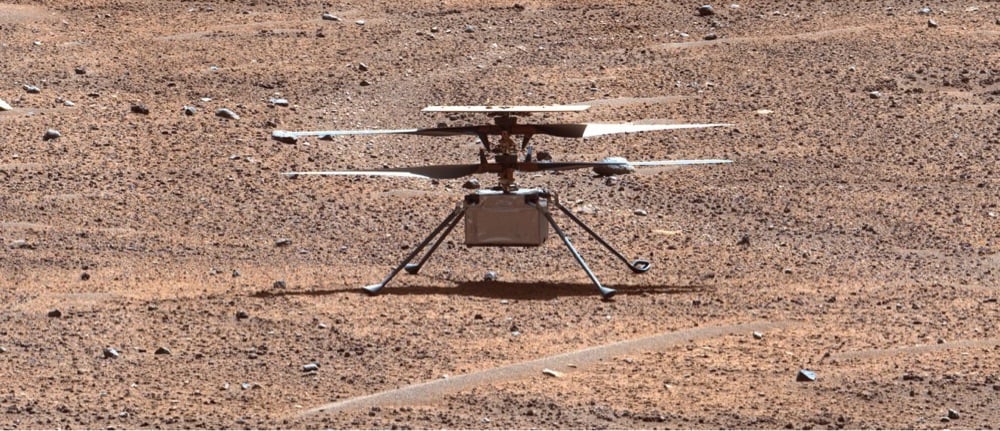
While the helicopter remains upright and in communication with ground controllers, imagery of its Jan. 18 flight sent to Earth this week indicates one or more of its rotor blades sustained damage during landing and it is no longer capable of flight.
Originally designed as a technology demonstration to perform up to five experimental test flights over 30 days, the first aircraft on another world operated from the Martian surface for almost three years, performed 72 flights, and flew more than 14 times farther than planned while logging more than two hours of total flight time.
This short, relaxing, mesmerizing video of an Martian impact crater called Aram Chaos was taken by the HiRISE camera on the Mars Reconnaissance Orbiter. The images were run through an enhanced color red-green-blue filter, which tends to highlight the structure and geology rather than the true color. For example, the blue in the video often represents basalt, an igneous rock of volcanic origin.
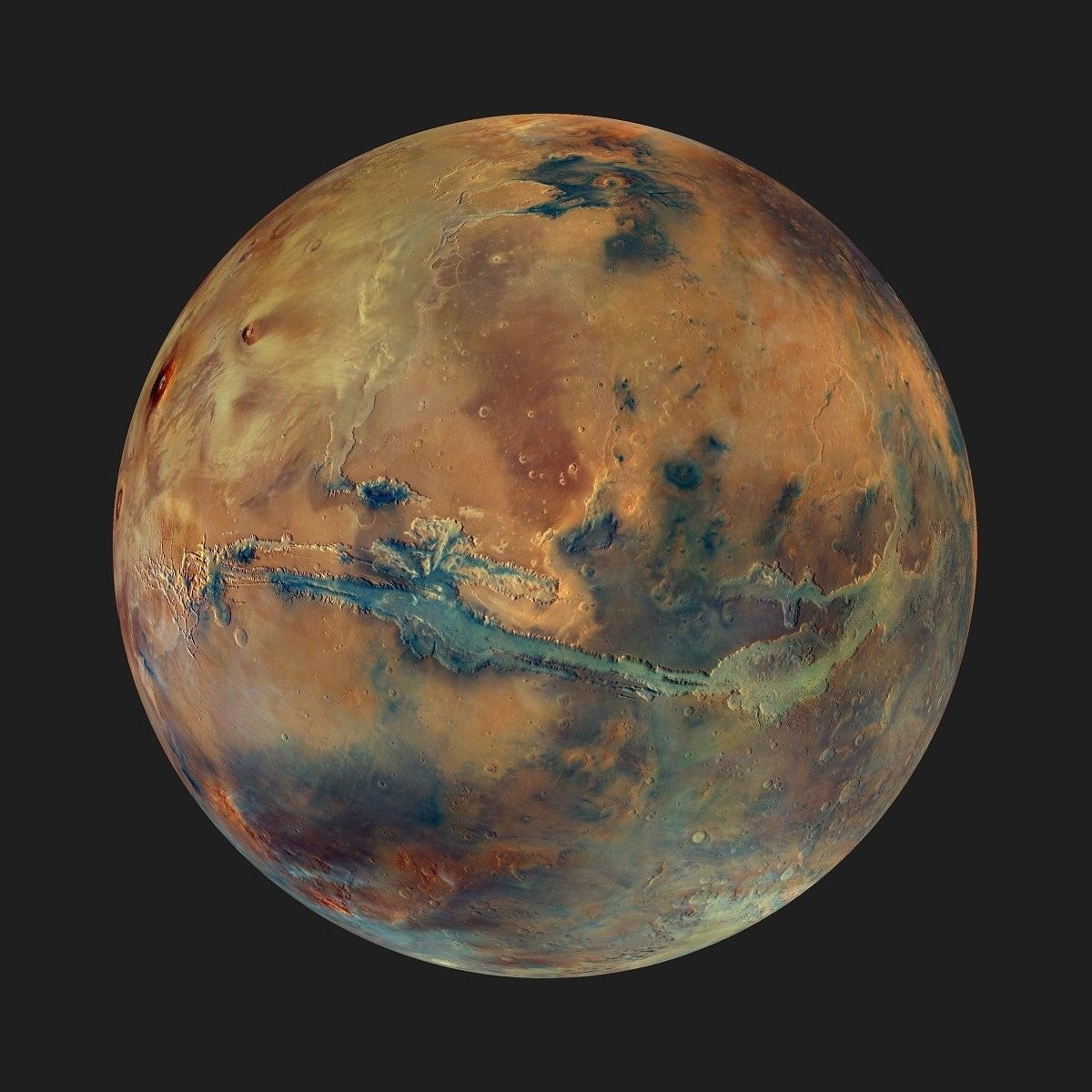
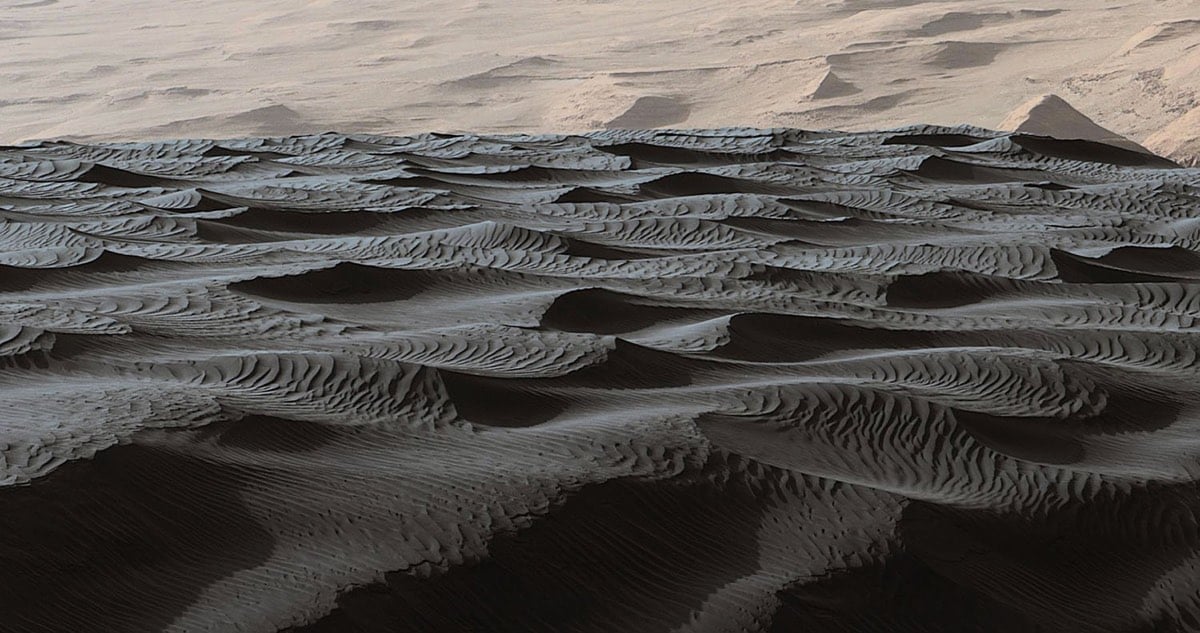
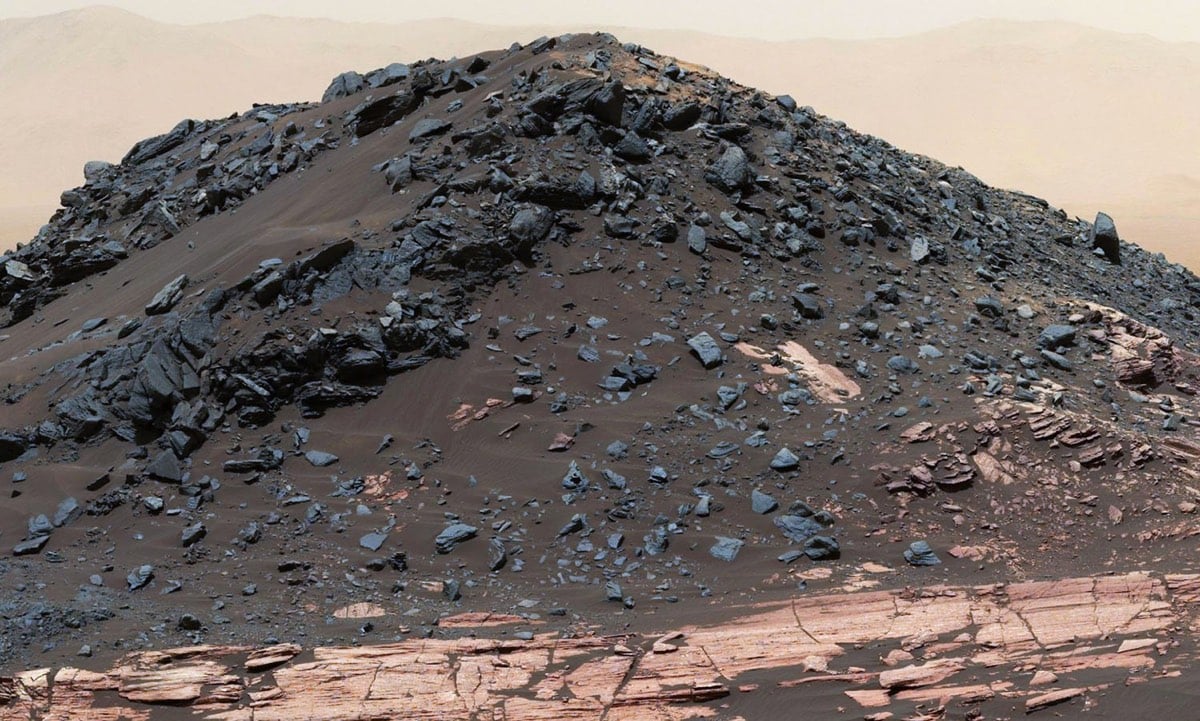
It is well known that most of Mars is reddish in colour, due to the high amount of oxidised iron in the dust on its surface, earning it the nickname the ‘Red Planet’. But it is also immediately noticeable that a considerable region of Mars is rather dark, appearing bluish in colour in image 1. These regions represent greyish-blackish-bluish sands, which are volcanic in origin and form large, dark sand layers on Mars. They were primarily piled up by the wind to form imposing sand dunes or enormous dune fields on the floor of impact craters. These unweathered sands consist of dark, basaltic minerals, of which volcanic lava on Earth is also composed. Basalt is the most widespread volcanic rock on Earth — and in the Solar System. Earth’s ocean floor is made of basalt, as are the extinct volcanoes of the Eifel, Mount Etna in Sicily and volcanoes of the Hawaiian archipelago.
In my mind, the best bit is how much clearer you can see the various geographical features of the planet. (via bad astronomy)
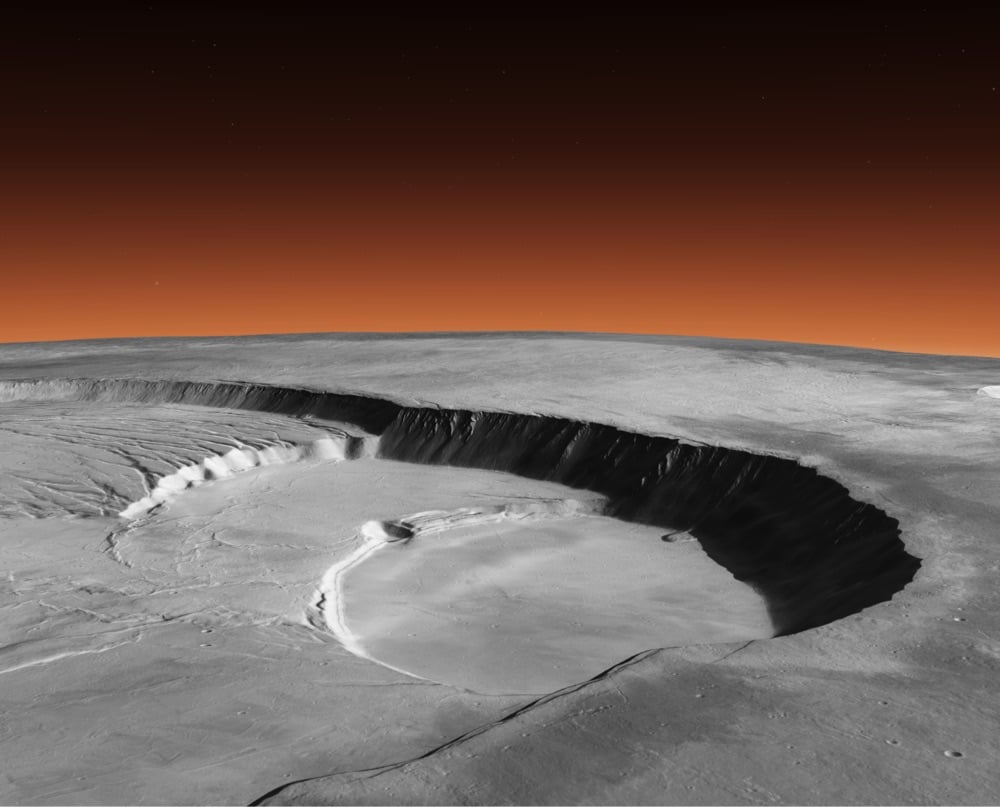
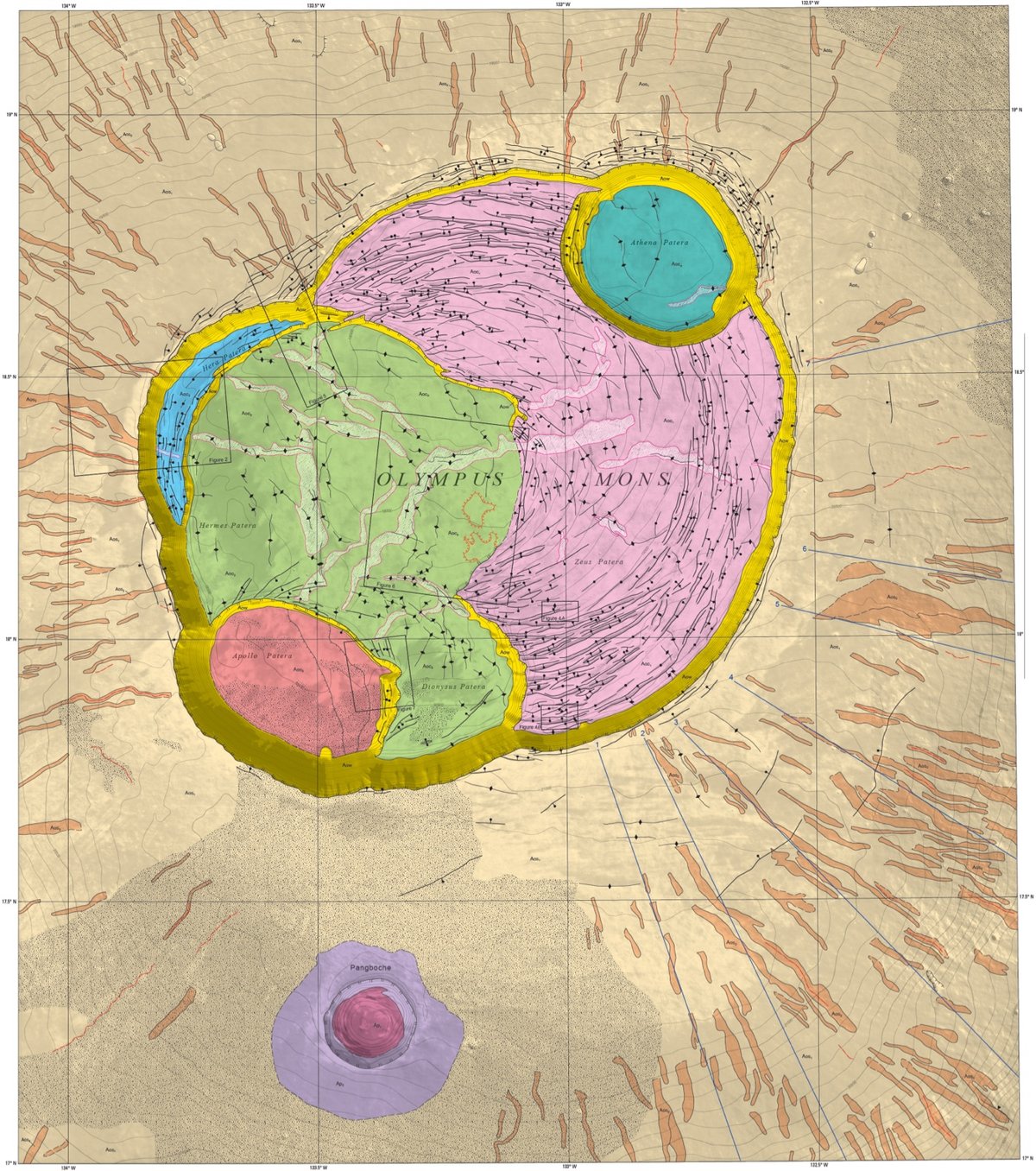
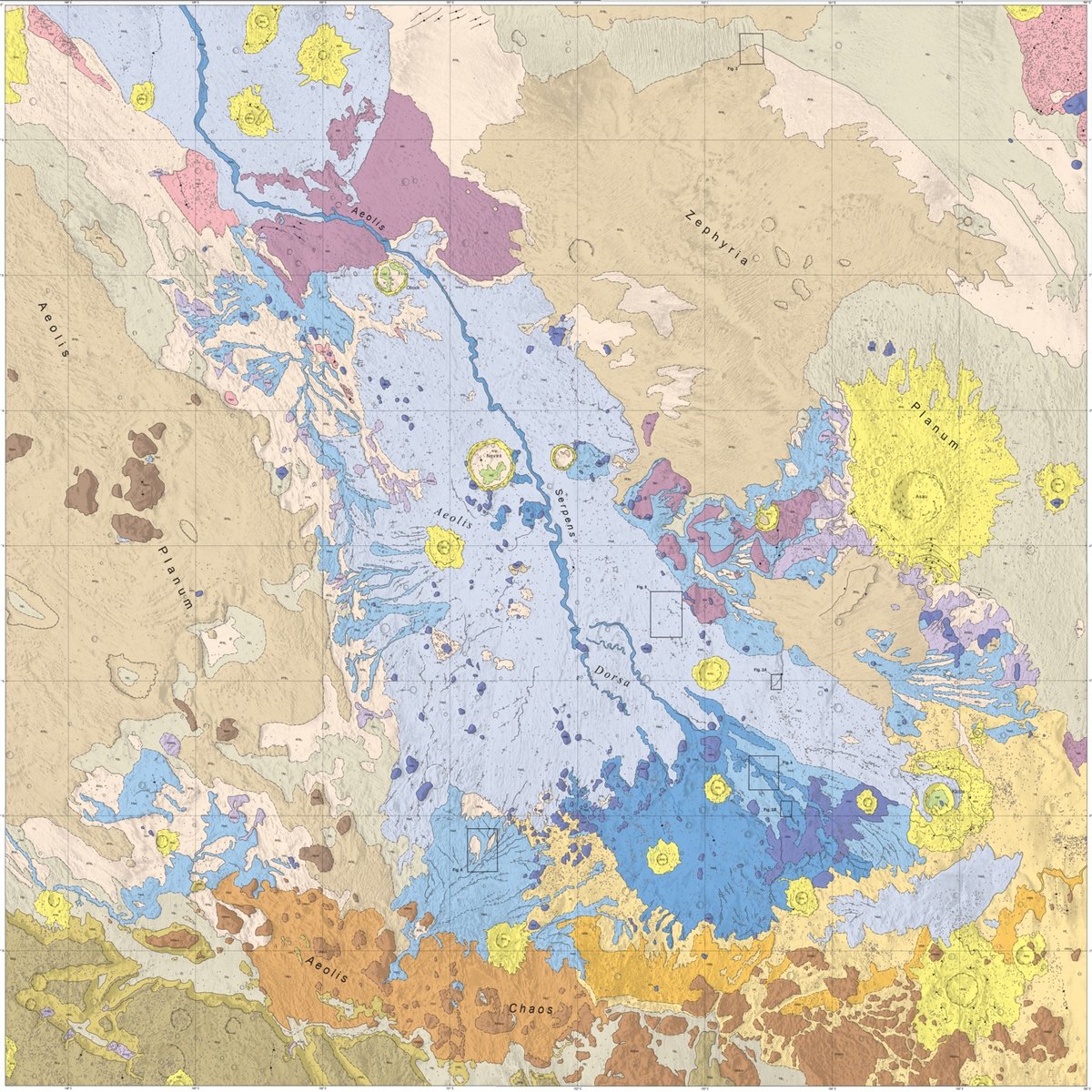
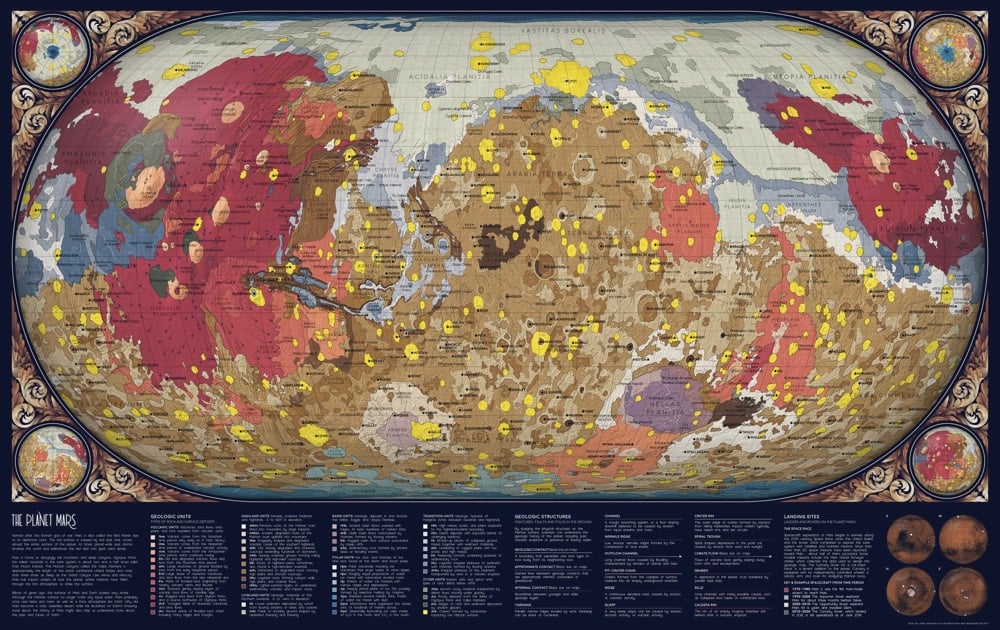
The USGS Astrogeology Science Center recently released a series of detailed geological maps of Mars that detail features from the red planet’s past like volcanos and flowing water. If you’re thinking, “hey that looks a lot like a river in that second image”, you’re not far off.
One particularly interesting feature that hints at Mars’ watery past is the sinuous ridge, which is a winding, narrow ridge that looks like an inverted river channel. These ridges are interpreted to be aqueous (formed by water), making them possible clues about the history of water on Mars.
The scale of the maps is useful for identifying geologic changes over time:
The new map of Aeolis Dorsa adds to the hypothesis that Mars was once wet and had abundant active river systems in the past before aqueous activity decreased over time. This change caused the primary depositional methods in the region to shift from rivers (fluvial) to sediment fans with intermittent deposition (alluvial) and eventually to a dry and wind-driven (aeolian) system. This local pattern mimics our current understanding of the global environmental history of Mars.
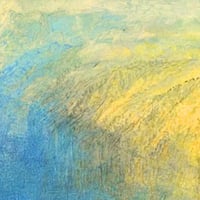
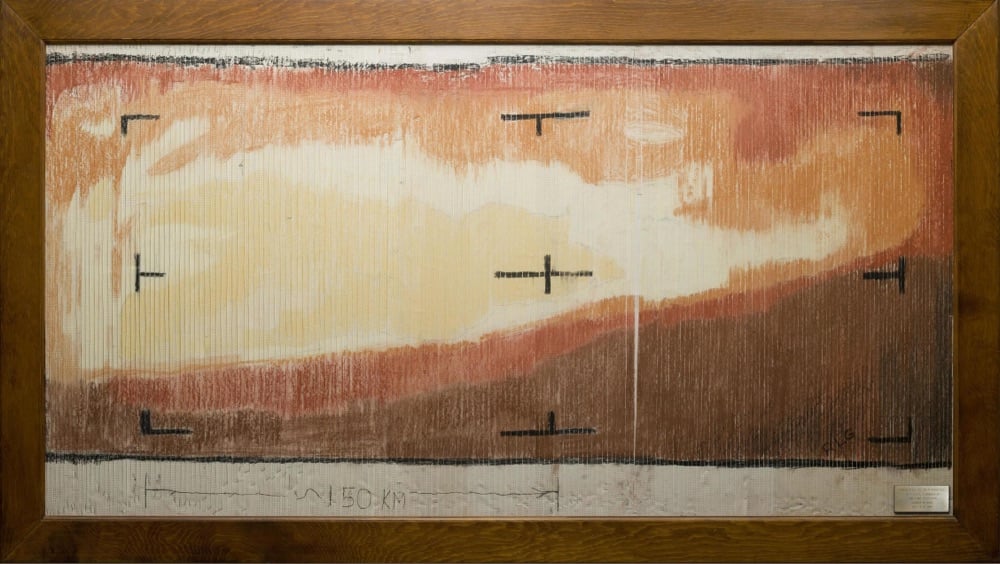
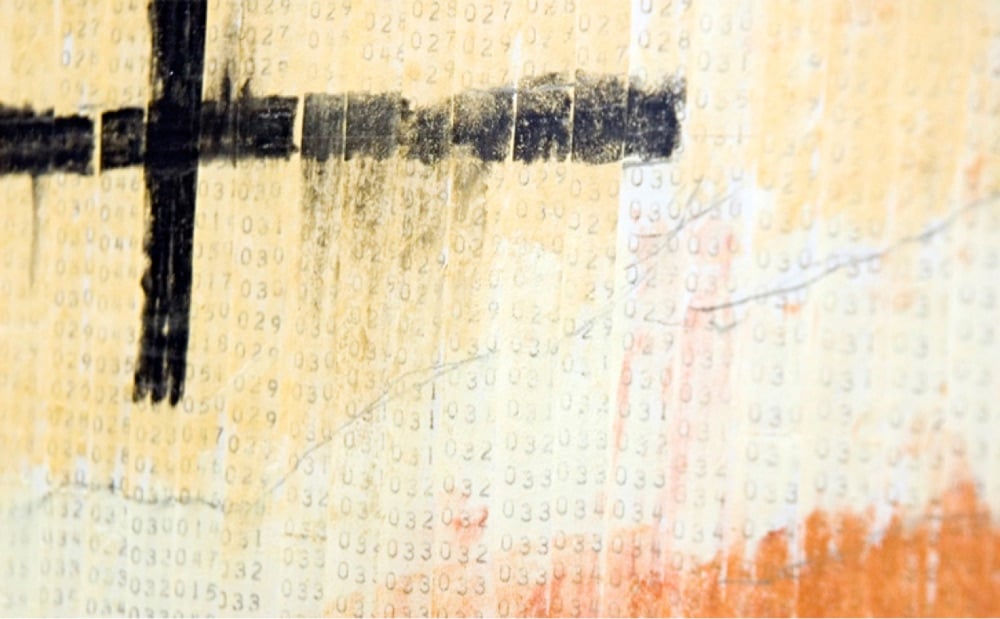
On July 15, 1965, NASA’s Mariner 4 probe flew within 6,118 miles of the surface of Mars, capturing images as it passed over the planet. The image data was transmitted back to scientists on Earth, but they didn’t have a good way to quickly render a photograph from it. They determined that the fastest way to see what Mariner 4 had seen was to print out the imaging data as a series of numbers, paste them into a grid, buy a set of pastels from a nearby art store, and do a paint-by-numbers job with the pastels on the data grid. The result (pictured above) was the first closeup representation of the surface of an extraterrestrial planet — in color, no less!
After the flyby of the planet it would take several hours for computers to process a real image. So while they were waiting, the engineers thought of different ways of taking the 1’s and 0’s from the actual data and create an image. After a few variations, it seemed most efficient to print out the digits and color over them based upon how bright each pixel was. So Mr. Grumm went to a local art store and asked for a set of chalk with different shades of gray. The art store replied that they “did not sell chalk” (as that was apparently too low for them, only convenience stores sold “chalk”), but they did have colored pastels. Richard did not want to spend a lot of time arguing with them, so he bought the pastels (actual pastels seen below), had the 1’s and 0’s printed out on ticker tape about 3in wide, and his team colored them by their brightness level (color key seen below).
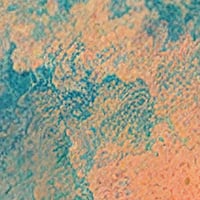
Here’s a closer view of the pastels and numbers:
The choice of color palette was serendipitous:
Though he used a brown/red color scheme, the thought that Mars was red did not enter his mind. He really was looking for the colors that best represented a grey scale, since that was what they were going to get anyway. It is uncanny how close his color scheme is to the actual colors of Mars. It’s as if they came right out of current images of the planet.
“There’s definitely a sci-fi element to it,” Ian Clark, an engineer who worked on Perseverance’s parachute system, said of photographs released on Wednesday. “It exudes otherworldly, doesn’t it?”
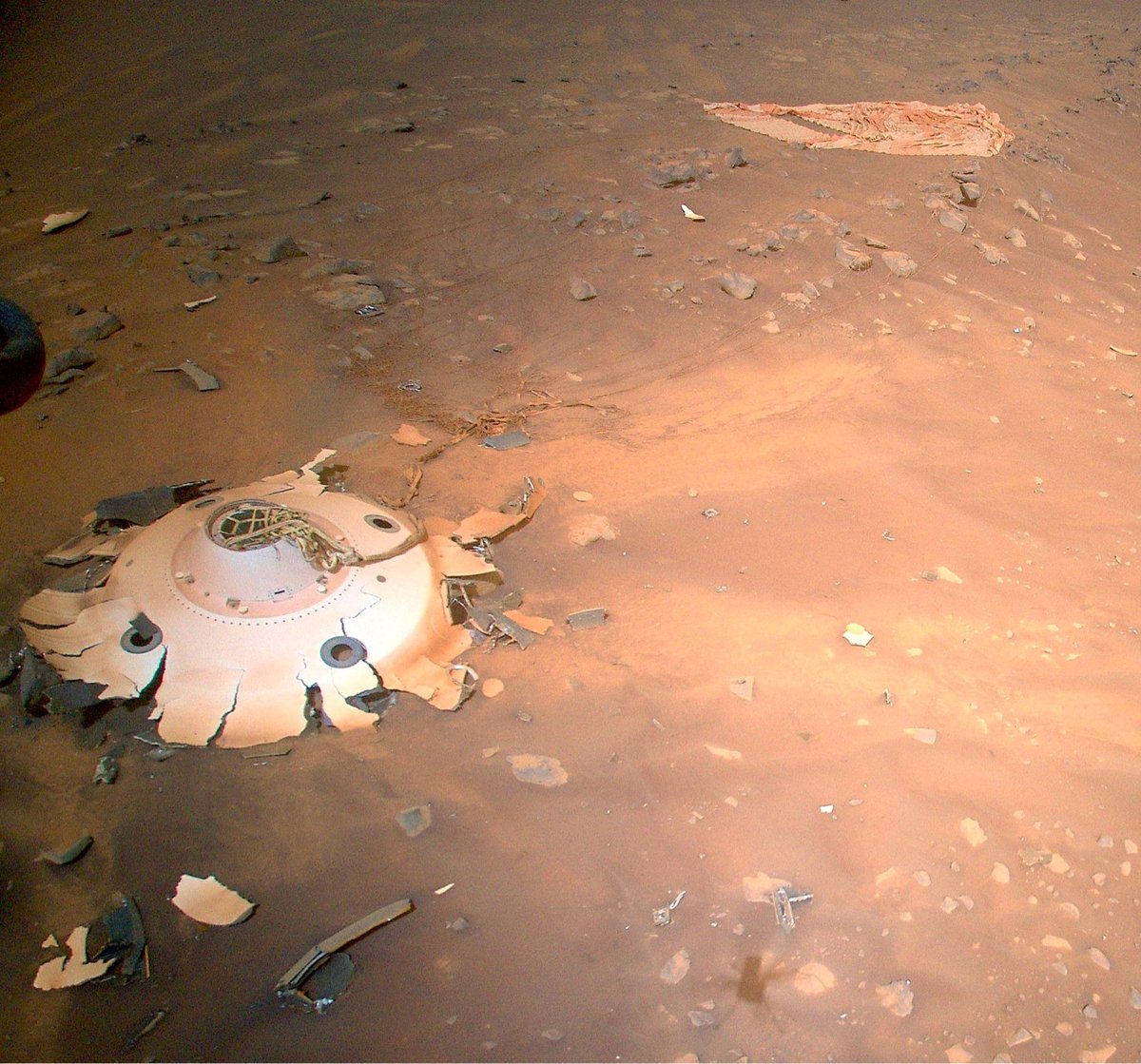
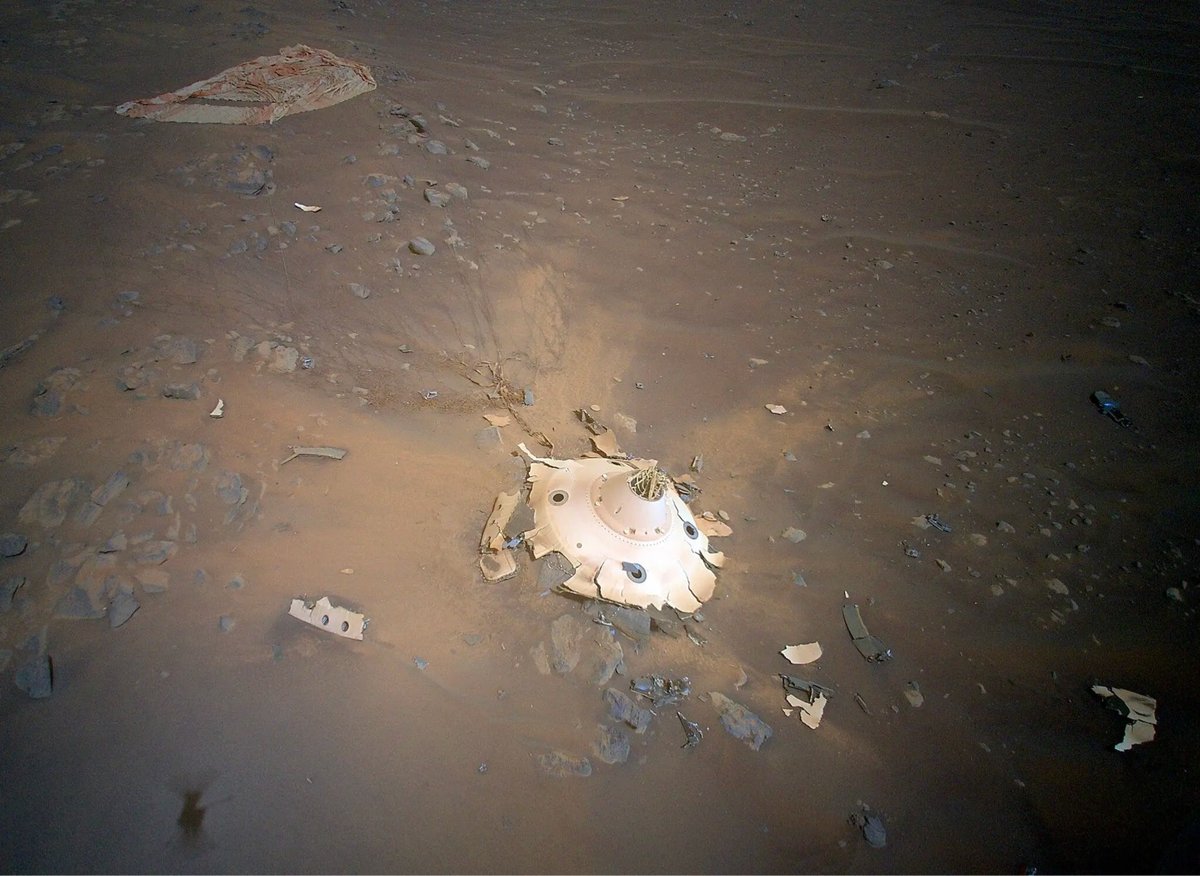
Part of the reason NASA had Ingenuity go take a look is to see how all of that equipment held up during the landing process. Data from the photos will inform future missions.
“Perseverance had the best-documented Mars landing in history, with cameras showing everything from parachute inflation to touchdown,” said JPL’s Ian Clark, former Perseverance systems engineer and now Mars Sample Return ascent phase lead. “But Ingenuity’s images offer a different vantage point. If they either reinforce that our systems worked as we think they worked or provide even one dataset of engineering information we can use for Mars Sample Return planning, it will be amazing. And if not, the pictures are still phenomenal and inspiring.”
In the images of the upright backshell and the debris field that resulted from it impacting the surface at about 78 mph (126 kph), the backshell’s protective coating appears to have remained intact during Mars atmospheric entry. Many of the 80 high-strength suspension lines connecting the backshell to the parachute are visible and also appear intact. Spread out and covered in dust, only about a third of the orange-and-white parachute — at 70.5 feet (21.5 meters) wide, it was the biggest ever deployed on Mars — can be seen, but the canopy shows no signs of damage from the supersonic airflow during inflation. Several weeks of analysis will be needed for a more final verdict.
It is really remarkable, the images we’re seeing from Mars, taken by a robotic helicopter.
Wow, NASA just released a video shot by the Mars Perseverance rover of a solar eclipse by the moon Phobos. The video description calls it “the most zoomed-in, highest frame-rate observation of a Phobos solar eclipse ever taken from the Martian surface”. According to this article from JPL, the video of the eclipse is played in realtime; it only lasted about 40 seconds.
Captured with Perseverance’s next-generation Mastcam-Z camera on April 2, the 397th Martian day, or sol, of the mission, the eclipse lasted a little over 40 seconds — much shorter than a typical solar eclipse involving Earth’s Moon. (Phobos is about 157 times smaller than Earth’s Moon. Mars’ other moon, Deimos, is even smaller.)
Just a hunk of space rock passing in front of a massive burning ball of gas recorded by a robot from the surface of an extraterrestrial planet, no big deal.
Seán Doran strikes again. In this short flyover rendered in 8K resolution by Doran, we’re treated to a detailed look at a crater on Mars. The imagery is from the HiRISE camera onboard the Mars Reconnaissance Orbiter. Beautiful — worth taking a second or third pass to catch all the details.
For the last nine months, NASA’s Perseverance rover has been rolling around on Mars taking photos and doing science. It’s also been recording audio of its environment with a pair of microphones and in this video, a pair of NASA scientists share some of those recordings and what we might learn about Mars from them.
This is one of my absolute favorite sounds. This is the sound of a helicopter flying on Mars. We used this sound to actually understand the propagation of sound in general through the Martian atmosphere, and it turns out that we were totally wrong with our models. The Martian atmosphere can propagate sound a lot further than we thought it could.
And surprisingly for me, that’s my friend Nina in the video! (We eclipse-chased together in 2017.) I knew she was working on the rovers but didn’t know she was going to pop up in this video I found on Twitter this morning. Fun!
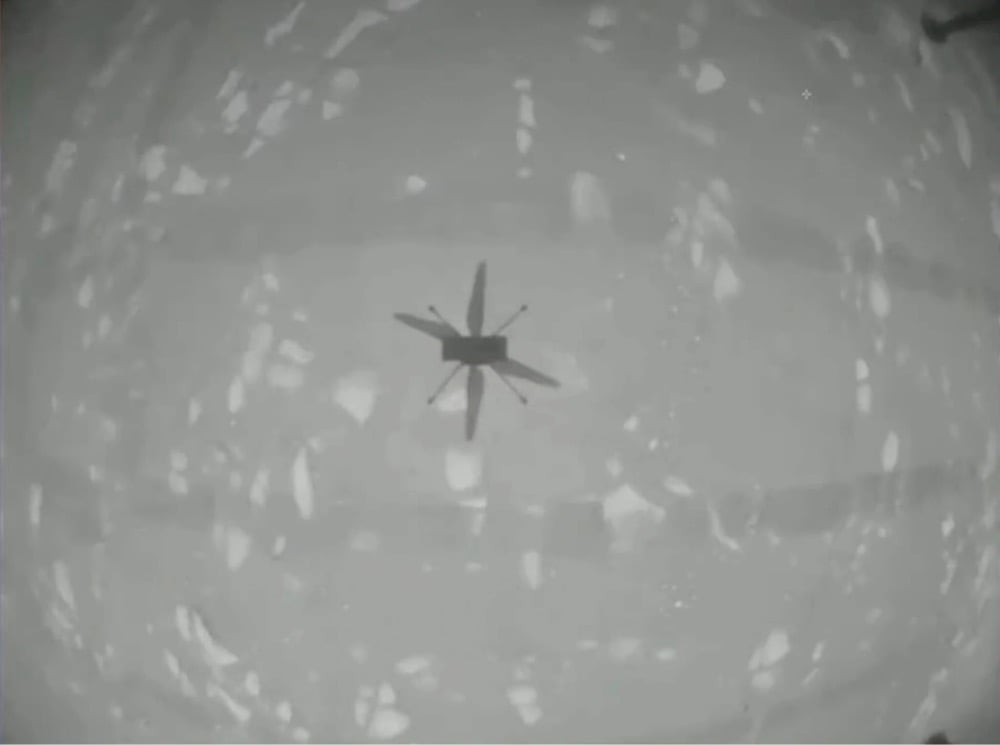
The solar-powered helicopter first became airborne at 3:34 a.m. EDT (12:34 a.m. PDT) — 12:33 Local Mean Solar Time (Mars time) — a time the Ingenuity team determined would have optimal energy and flight conditions. Altimeter data indicate Ingenuity climbed to its prescribed maximum altitude of 10 feet (3 meters) and maintained a stable hover for 30 seconds. It then descended, touching back down on the surface of Mars after logging a total of 39.1 seconds of flight. Additional details on the test are expected in upcoming downlinks.
Ingenuity’s initial flight demonstration was autonomous — piloted by onboard guidance, navigation, and control systems running algorithms developed by the team at JPL. Because data must be sent to and returned from the Red Planet over hundreds of millions of miles using orbiting satellites and NASA’s Deep Space Network, Ingenuity cannot be flown with a joystick, and its flight was not observable from Earth in real time.
NASA livestreamed the team in Mission Control as the test results were transmitted back to Earth. The photo above is of Ingenuity’s shadow taken while in flight by its onboard camera.
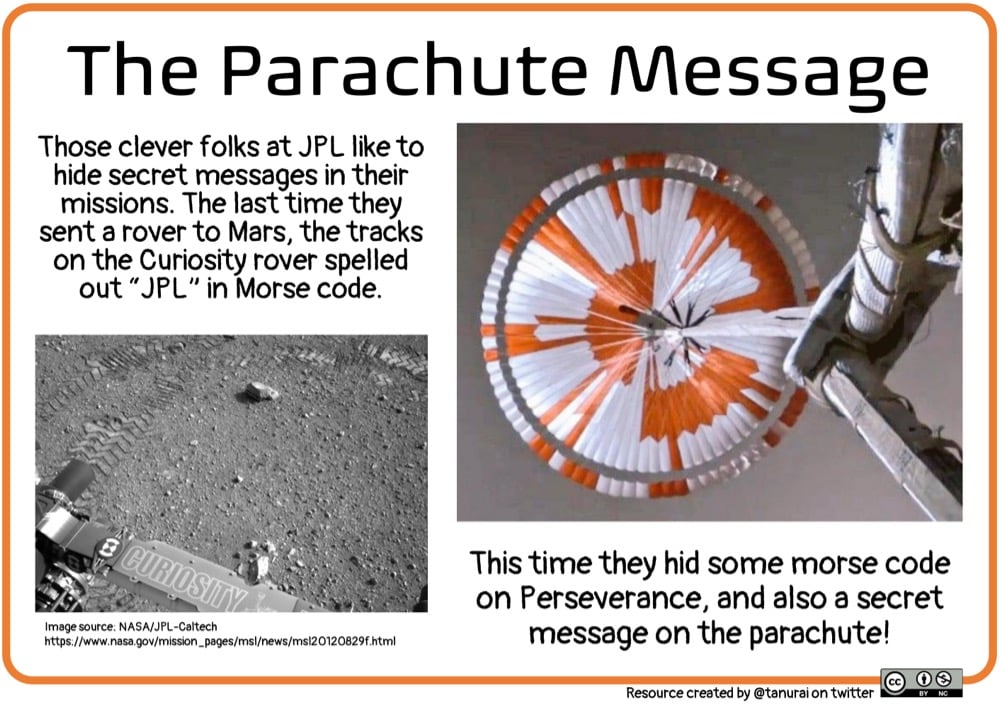
NASA engineers encoded a secret message in the parachute the Perseverance rover used to slow its descent to the surface of Mars. Tanya Fish provided a handy guide to decoding it on Twitter and as a PDF available on GitHub.
Just a few days after the Perseverance rover successfully touched down on Mars, NASA has released onboard video from the descent and landing from multiple perspectives. I watched this with my kids last night and all three of us had our mouths hanging open.
The real footage in this video was captured by several cameras that are part of the rover’s entry, descent, and landing suite. The views include a camera looking down from the spacecraft’s descent stage (a kind of rocket-powered jet pack that helps fly the rover to its landing site), a camera on the rover looking up at the descent stage, a camera on the top of the aeroshell (a capsule protecting the rover) looking up at that parachute, and a camera on the bottom of the rover looking down at the Martian surface.
After watching it again just now, I am struck by two things:
Sometime in my lifetime, live broadcasts from Mars will likely become commonplace. There will be dozens or hundreds of Mars webcams you can pull up on whatever the 2052 internet equivalent is. It will be amazing how boring it all is. (Or perhaps it’ll be boring how amazing it all is.)
Today is the day! NASA’s latest Mars rover is scheduled to touch down on the surface of Mars at around 3:55pm EST today1 and you can follow along online. You probably know the drill by now: what you’ll be watching isn’t actually live (it’s delayed by 11 minutes & 22 seconds, the time it takes for data to reach the Earth from Mars) and there’s no video to watch…there’s just telemetry from the rover that indicates where it is and what it’s doing. But I can say having watched the Curiosity landing in 2012, it’s still super exciting and nerve-wracking.
All times in this post (and stated by NASA in their schedules) are when we here on Earth will learn of events after the 11 minute & 22 second informational travel time from Mars is factored in. So while the Mars landing will actually occur around 3:44pm EST, we won’t know about it until 3:55pm EST.↩
Curiosity is about to get some company. NASA’s newest rover, Perseverance, is set to land on Mars beginning tomorrow at around 3pm EST. The video above walks us through the 7-minute landing routine in which the rover ditches its spacecraft, heat shields its way through the Martian atmosphere, deploys its parachute, uses an onboard guidance system to navigate to a good landing spot, and finally is lowered down to the surface via a sky crane. The rover’s destination is Jezero Crater, site of an ancient river delta and lakebed.
Jezero Crater tells a story of the on-again, off-again nature of the wet past of Mars. More than 3.5 billion years ago, river channels spilled over the crater wall and created a lake. Scientists see evidence that water carried clay minerals from the surrounding area into the crater lake. Conceivably, microbial life could have lived in Jezero during one or more of these wet times. If so, signs of their remains might be found in lakebed or shoreline sediments. Scientists will study how the region formed and evolved, seek signs of past life, and collect samples of Mars rock and soil that might preserve these signs.
Here’s how you can watch the landing “live” tomorrow (i.e. delayed by the 11 minutes & 22 seconds it takes for signals to travel from Mars). I’ll do a separate post tomorrow w/ the proper YouTube embeds so we can all follow along together.
To create this ultra HD footage of the surface of Mars, high-definition panoramas created from hundreds of still photos taken by the Mars rovers are panned over using the Ken Burns effect. The end product is pretty compelling — it’s not video, but it’s not not video either.
A question often asked is: ‘Why don’t we actually have live video from Mars?’
Although the cameras are high quality, the rate at which the rovers can send data back to earth is the biggest challenge. Curiosity can only send data directly back to earth at 32 kilo-bits per second.
Instead, when the rover can connect to the Mars Reconnaissance Orbiter, we get more favourable speeds of 2 Megabytes per second.
However, this link is only available for about 8 minutes each Sol, or Martian day.
As you would expect, sending HD video at these speeds would take a long long time. As nothing really moves on Mars, it makes more sense to take and send back images.
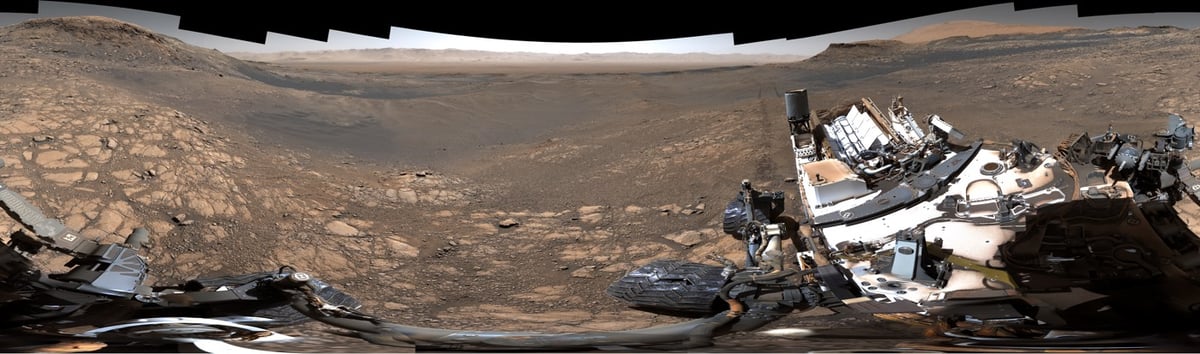
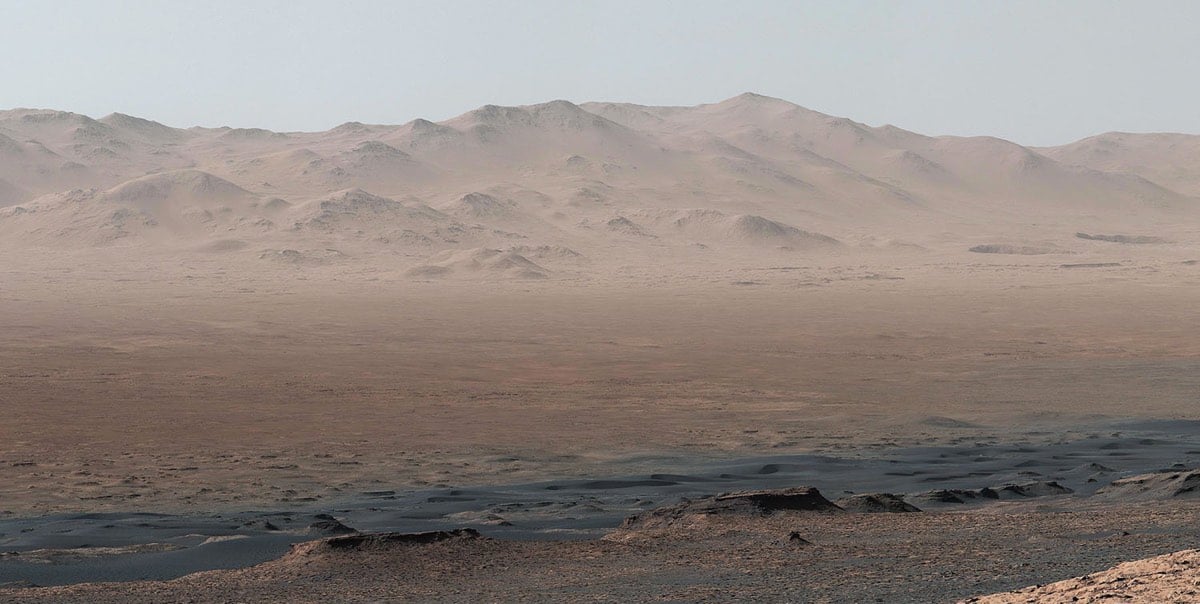
Late last year, NASA’s Curiosity rover took over a thousand photos of the Martian landscape while exploring a mountainside. NASA stitched the photos together and recently released this 1.8 gigapixel panorama of Mars (along with a mere 650 megapixel panorama, pictured above). Here’s a version you can pan and zoom:
And a narrated video of the panorama:
Both panoramas showcase “Glen Torridon,” a region on the side of Mount Sharp that Curiosity is exploring. They were taken between Nov. 24 and Dec. 1, when the mission team was out for the Thanksgiving holiday. Sitting still with few tasks to do while awaiting the team to return and provide its next commands, the rover had a rare chance to image its surroundings from the same vantage point several days in a row.
I like how NASA is casually suggesting that the rover is just kinda taking some vacation snaps while waiting on friends.
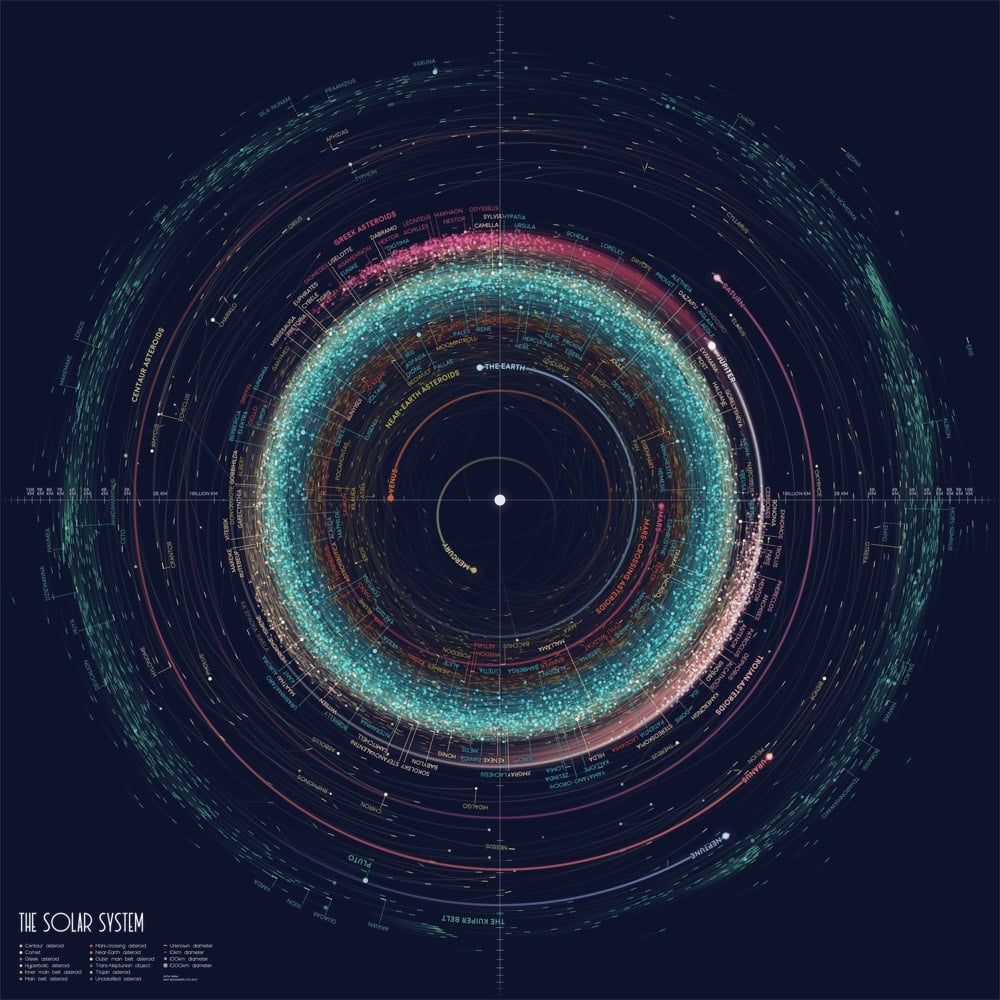
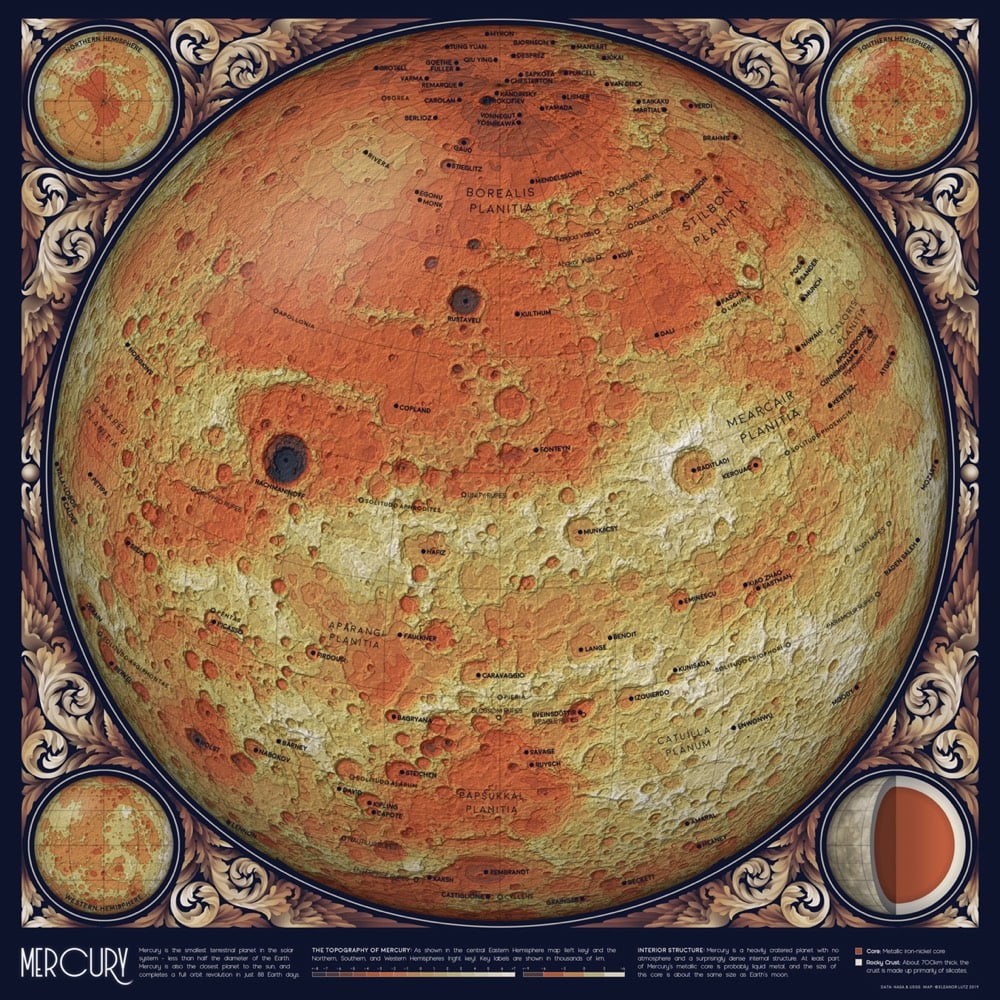
Over the past year and a half I’ve been working on a collection of ten maps on planets, moons, and outer space. To name a few, I’ve made an animated map of the seasons on Earth, a map of Mars geology, and a map of everything in the solar system bigger than 10km.
As promised, Lutz has posted the source code for each project to her GitHub account: Mercury topography, asteroid orbits. What a great resource for aspiring data visualization designers. Stay tuned to her site, Twitter, or Tumblr for upcoming installments of the atlas.
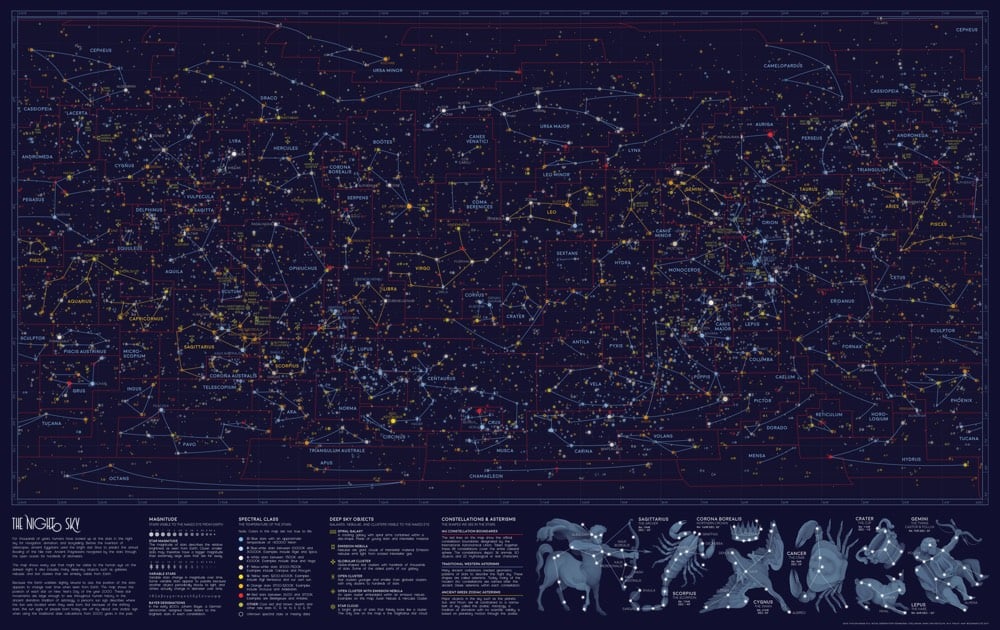
This week’s map shows every single star visible from Earth, on the darkest night with the clearest sky. The map also includes all of the brightest galaxies, nebulae, and star clusters from W.H. Finlay’s Concise Catalog of Deep-sky Objects. I illustrated the familiar Western star patterns — or asterisms — in blue and gold, as well as the scientific constellation boundaries in red.
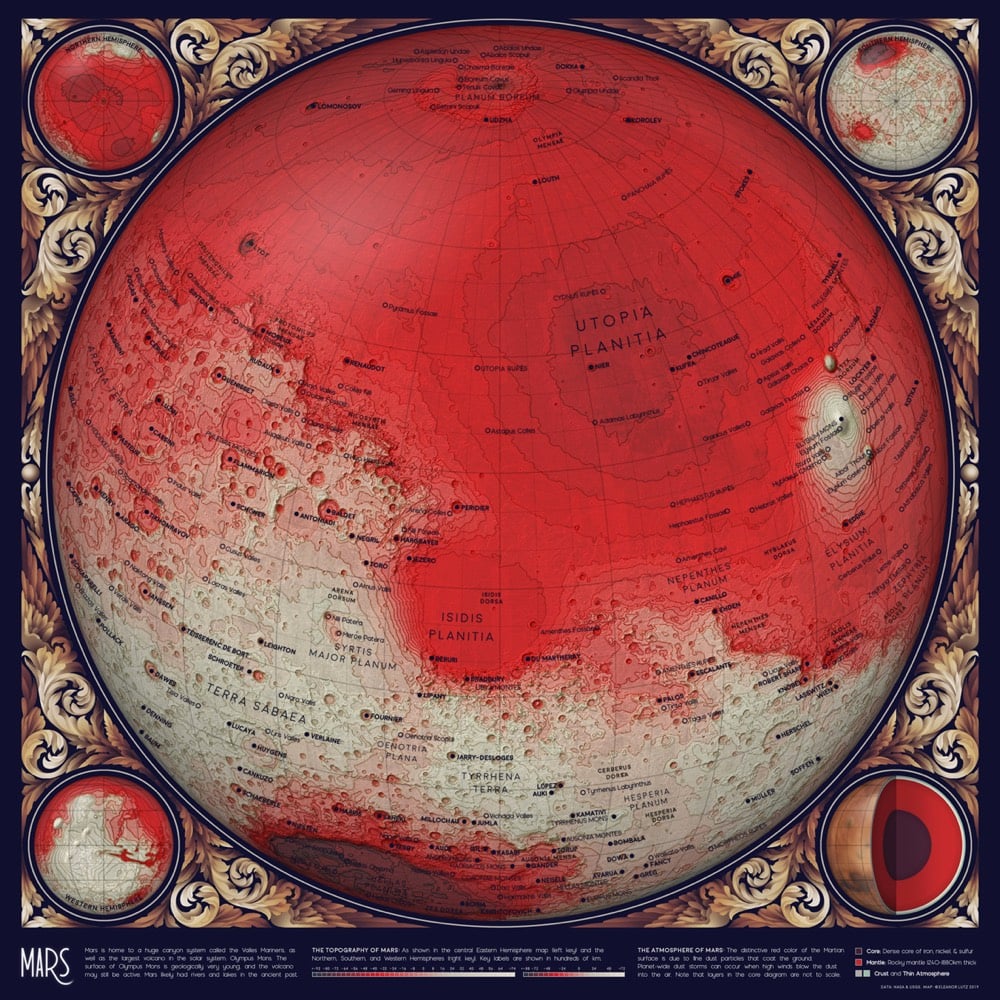
Update: Holy moly, I think Lutz’s Topographic Map of Mars might be her most beautiful one yet.
Update: I couldn’t keep up with all of Lutz’s additions to her atlas. You can check out all of the installments in the archive, including the last part (for now), The Geology of the Moon.
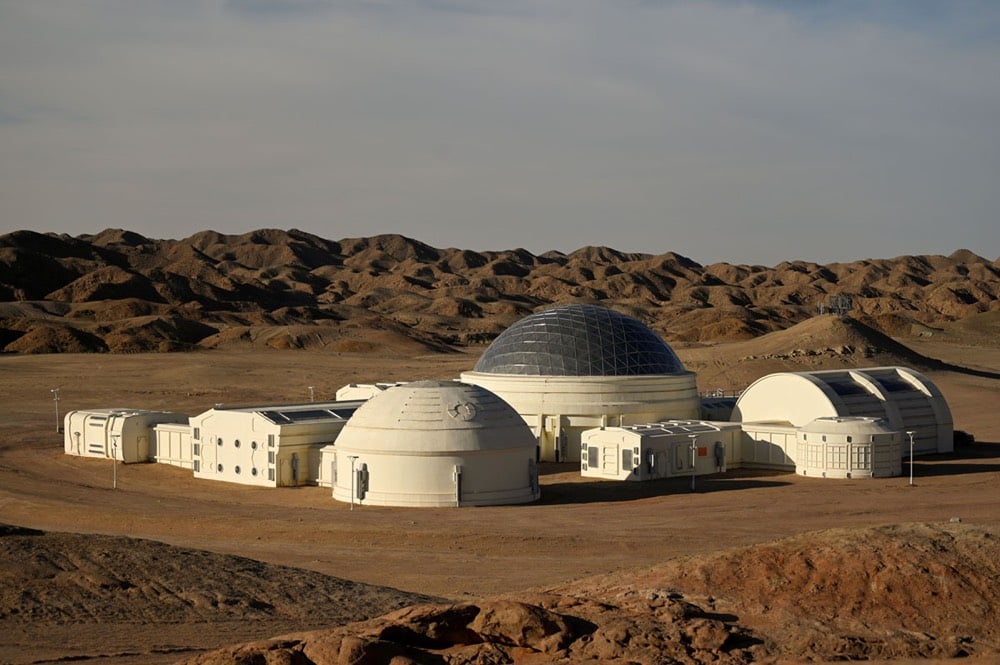
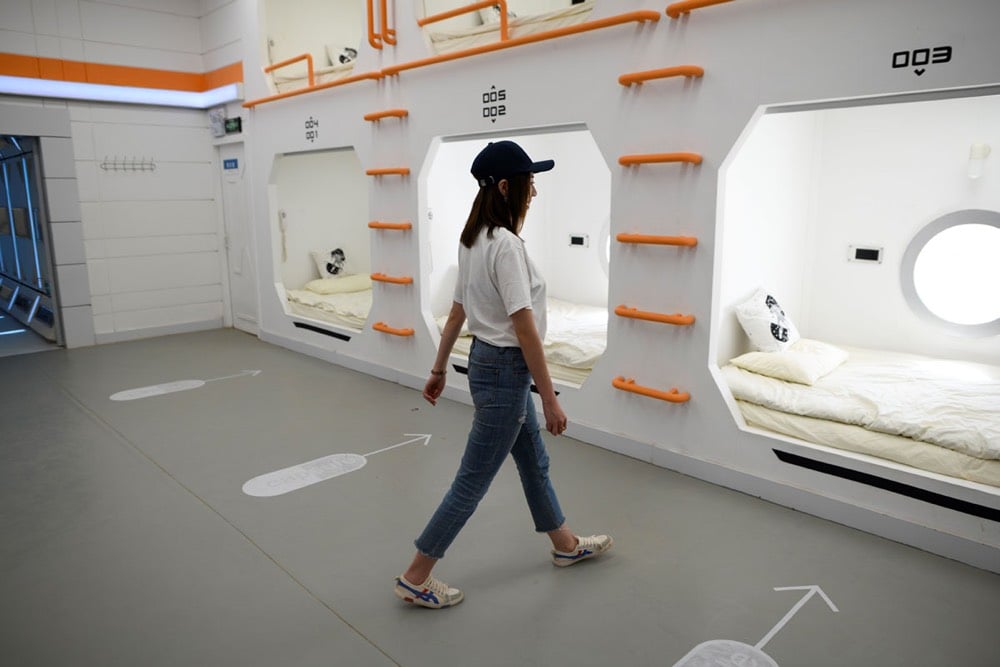
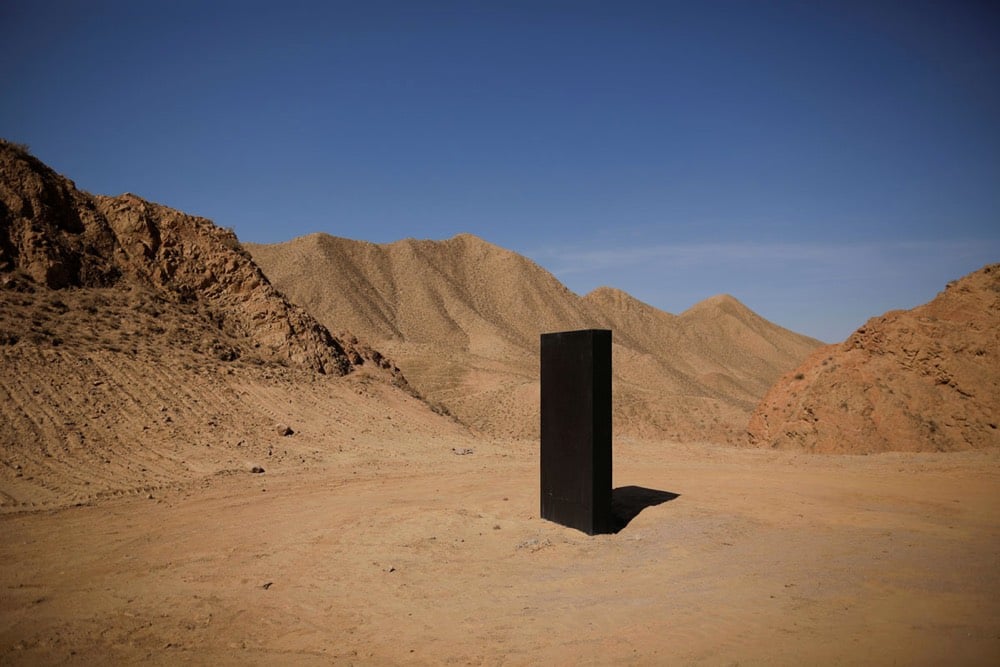
A Chinese company called C-Space has built a simulation of a Mars base in the Gobi desert. Currently used for educational purposes, the company plans to open “Mars Base 1” up for tourism to give visitors a glimpse of what living on Mars would be like.
The facility’s unveiling comes as China is making progress in its efforts to catch up to the United States and become a space power, with ambitions of sending humans to the moon someday.
The white-coloured base has a silver dome and nine modules, including living quarters, a control room, a greenhouse and an airlock.
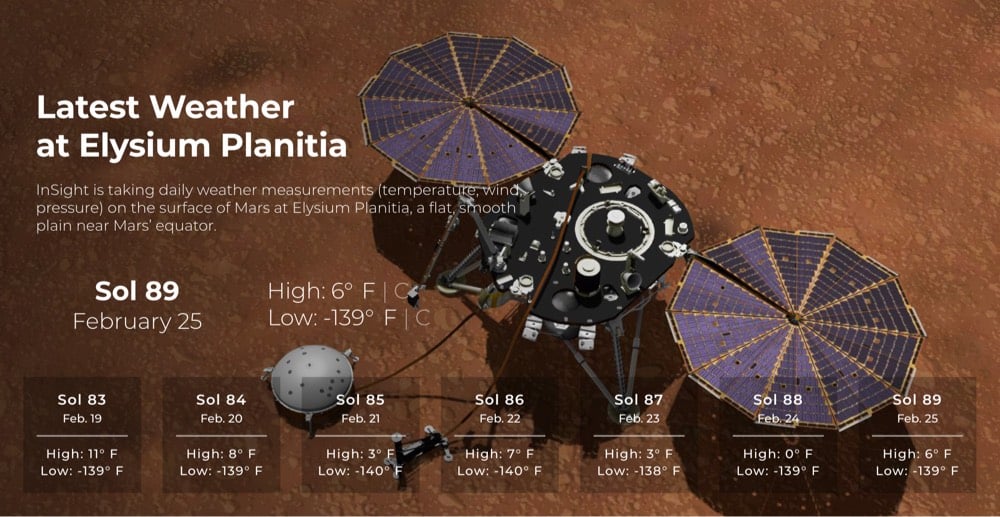
The report is delayed by a day or so (communications delay? non-essential data delay?), but it’s still really cool to see what the temperature, wind speed, and barometric pressure is at Elysium Planitia.
I’d just like to note for the record that at some point on Monday, it was actually warmer on Mars than it is right now in Vermont. ♫ Gotta get up, gotta get out, gotta get out into the Martian sun… ♫
One of the most successful and enduring feats of interplanetary exploration, NASA’s Opportunity rover mission is at an end after almost 15 years exploring the surface of Mars and helping lay the groundwork for NASA’s return to the Red Planet.
The Opportunity rover stopped communicating with Earth when a severe Mars-wide dust storm blanketed its location in June 2018. After more than a thousand commands to restore contact, engineers in the Space Flight Operations Facility at NASA’s Jet Propulsion Laboratory (JPL) made their last attempt to revive Opportunity Tuesday, to no avail. The solar-powered rover’s final communication was received June 10.
Opportunity was the longest-lived robot ever sent to another planet; it lasted longer than anyone could have imagined.
Designed to last just 90 Martian days and travel 1,100 yards (1,000 meters), Opportunity vastly surpassed all expectations in its endurance, scientific value and longevity. In addition to exceeding its life expectancy by 60 times, the rover traveled more than 28 miles (45 kilometers) by the time it reached its most appropriate final resting spot on Mars — Perseverance Valley.
Here’s a quick video overview of the milestones of Opportunity’s mission:
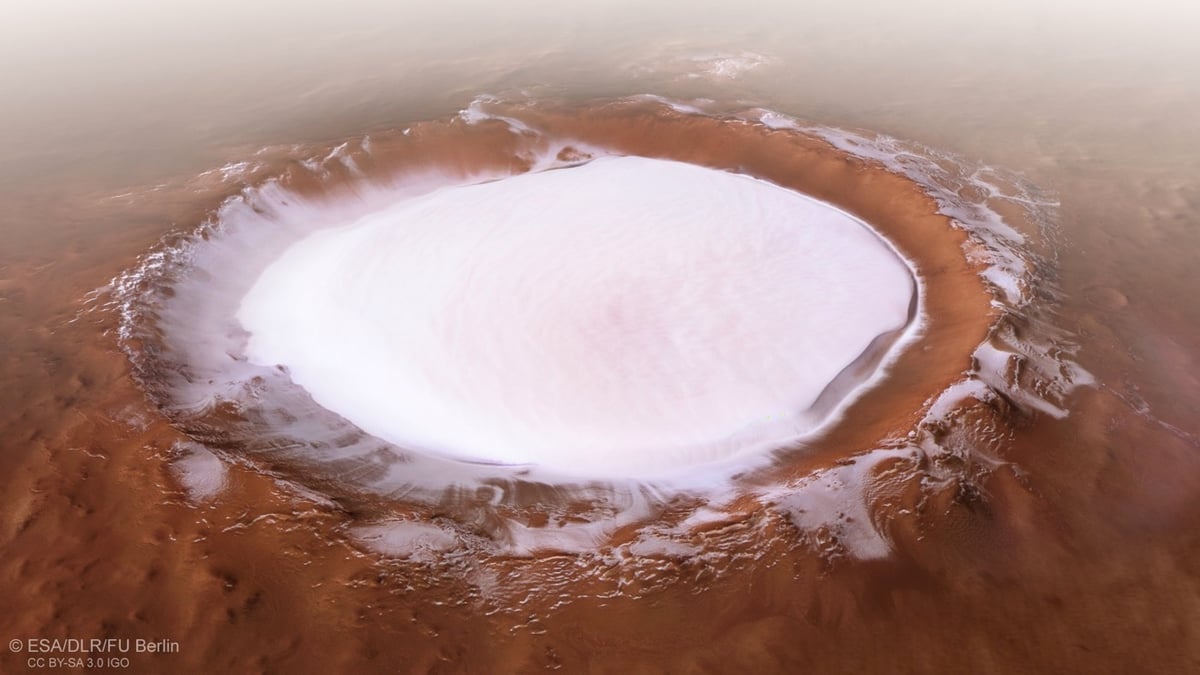
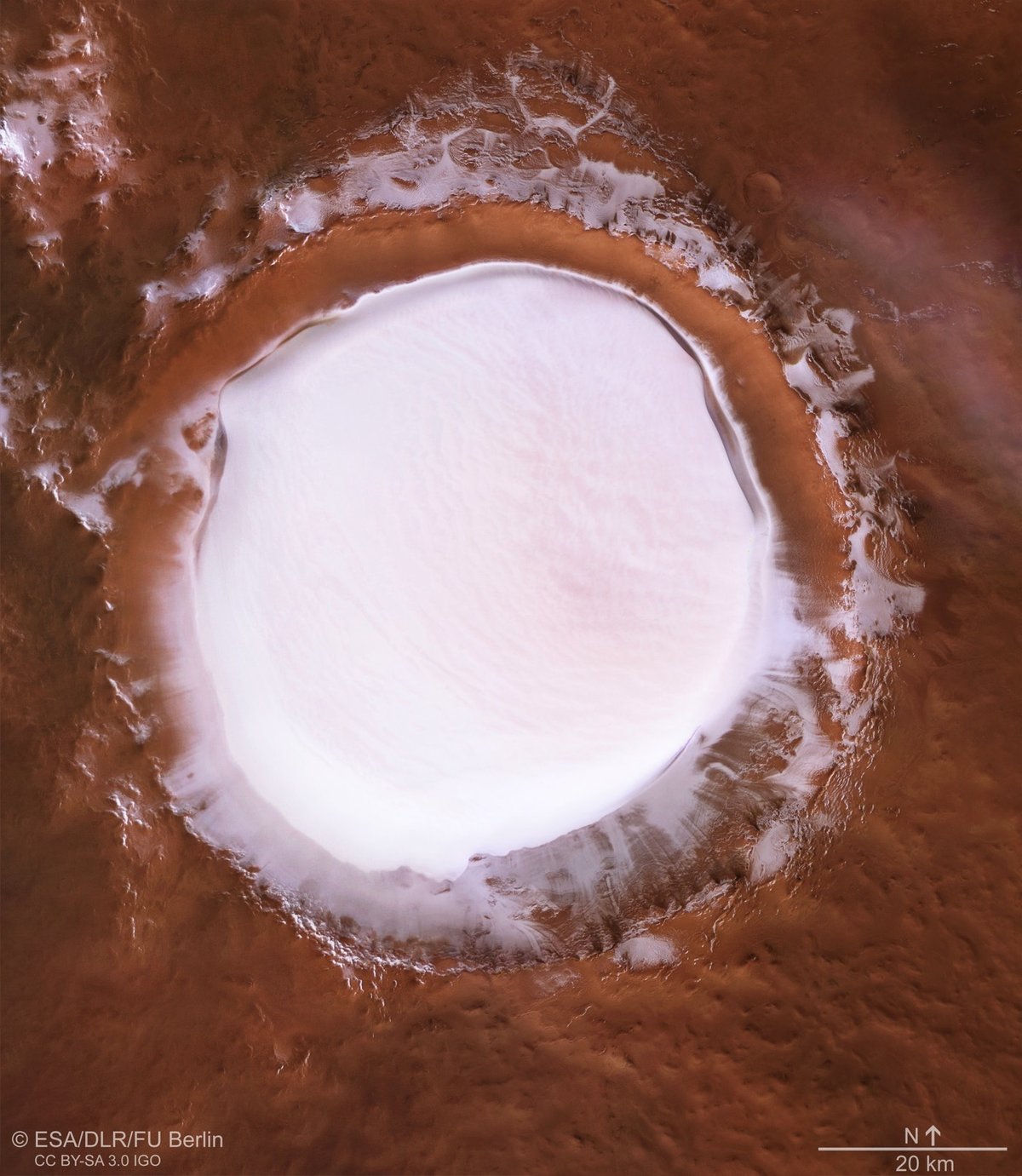
ESA’s Mars Express mission recently photographed the Korolev crater on Mars, filled almost to the brim with water ice.1 When I first saw this image I thought, oh cute!, assuming the crater was maybe a few dozen feet across. But no, it’s about 51 miles across and the thickest part of the ice is over a mile thick.
This ever-icy presence is due to an interesting phenomenon known as a ‘cold trap’, which occurs as the name suggests. The crater’s floor is deep, lying some two kilometres vertically beneath its rim.
The very deepest parts of Korolev crater, those containing ice, act as a natural cold trap: the air moving over the deposit of ice cools down and sinks, creating a layer of cold air that sits directly above the ice itself.
Behaving as a shield, this layer helps the ice remain stable and stops it from heating up and disappearing. Air is a poor conductor of heat, exacerbating this effect and keeping Korolev crater permanently icy.
NASA’s InSight mission recently landed on Mars and like other missions before it, the lander is a equipped with a camera and has sent back some pictures of the red planet. But InSight is also carrying a couple of instruments that made it possible to record something no human has ever experienced: what Mars sounds like:
Two very sensitive sensors on the spacecraft detected these wind vibrations: an air pressure sensor inside the lander and a seismometer sitting on the lander’s deck, awaiting deployment by InSight’s robotic arm. The two instruments recorded the wind noise in different ways. The air pressure sensor, part of the Auxiliary Payload Sensor Subsystem (APSS), which will collect meteorological data, recorded these air vibrations directly. The seismometer recorded lander vibrations caused by the wind moving over the spacecraft’s solar panels, which are each 7 feet (2.2 meters) in diameter and stick out from the sides of the lander like a giant pair of ears.
The sounds are best heard with a good pair of headphones.
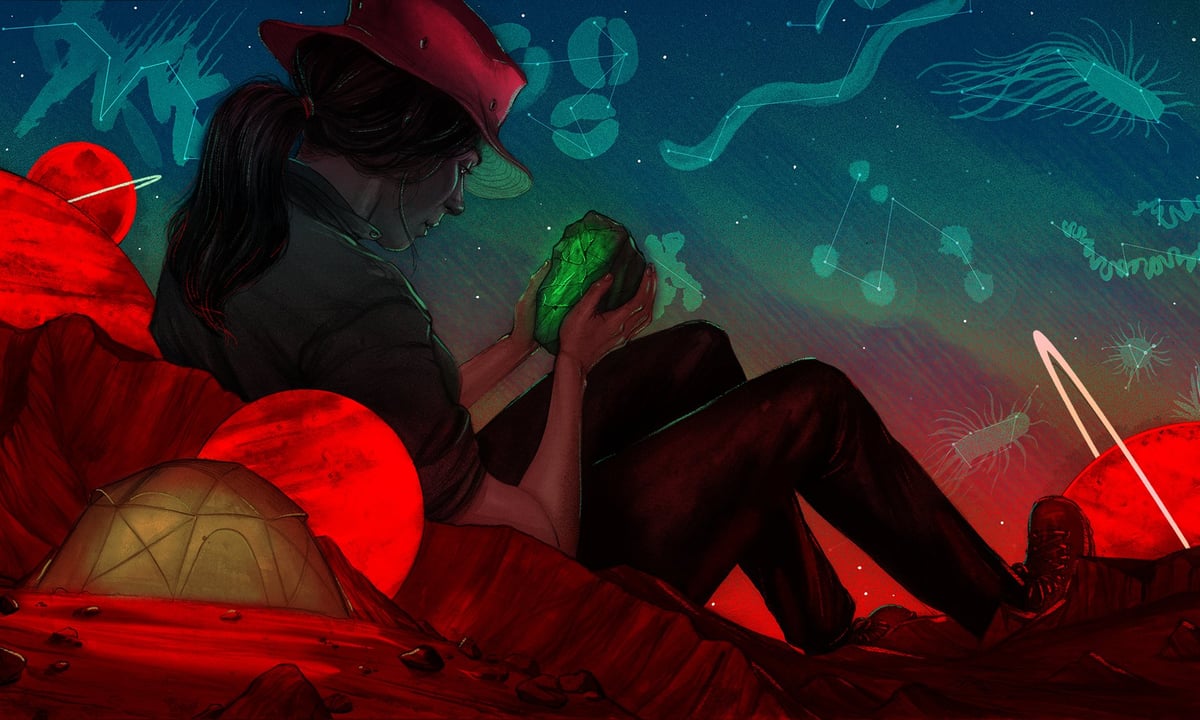
The Atacama Desert stretches 600 miles south from the Peruvian border, nestled between the Pacific Cordillera and the Andes, “a cross extended over Chile,” in the words of the Chilean poet Raúl Zurita. Some parts of it are so devoid of life that their microbe-per-inch count can compete with near-sterile hospital surgical suites. Some areas of the Atacama, Earth’s driest nonpolar desert and the oldest desert anywhere, have been rainless for at least 23 million years, and maybe as long as 40 million years. Carbon cycling happens on timescales of thousands of years, comparable to Antarctic permafrost and places deep within Earth’s crust; the Atacama contains some of the most lifeless soils on the planet. The Atacama is one reason that Chile has become a haven for astrobiologists and astronomers: Its pristine dark skies offer an unparalleled view of the stars, and its depleted desert offers a peerless lab for studying the dry limits of life, including how life might survive among those stars. And honestly, it just looks a lot like Mars. It is the closest that these astrobiologists will ever get to the planet that occupies their grant proposals and their imaginations.
I’m neither an astrobiologist nor a professional astronomer, but I spend a lot of time thinking about Mars. I keep tabs on the robots spread across its surface and in its orbit, and sometimes I check their nightly photo downloads. The Atacama is not a giant leap from the Mars of my mind. As I drove up the coast, I found the view so much more like Mars than Earth. There are no palm trees or tourists or bleating gulls. There is nothing but brown, tumbling tanly down the hills, darkening to chocolate inside shadowy ravines and runnels, bleaching to an impoverished shade of cardboard, and crumbling into fine white beach before being swallowed by the cobalt hues of sea and sky. With no trees or succulents or even a blade of grass—not a smidge of green—the only disruption in the brown is a strip of asphalt, Ruta 1. With my cruise control set and David Bowie blaring, I pictured myself driving through Meridiani Planum, a vast equatorial Martian plain, en route to visit the Opportunity rover. The only reminders of other humans were the grim commemorations of car-wreck victims: Almost every mile of Ruta 1 is marked with roadside shrines to the dead…
Salar Grande was once a coastal inlet, much like today’s San Francisco Bay. It dried up between 1.8 and 5.3 million years ago, leaving behind a salt flat between 225 and 300 feet thick. The salar is therefore an analogue for the last time Mars was habitable, after Mars’ oceans, if there were any, dried up, when Martian ecosystems became concentrated in smaller places. And, like Mars itself, the Atacama is a glimpse into Earth’s own future. One day, billions of years from now, all of Earth may resemble this parched land of fissures and knobs, after our own oceans boil away, after the last trees fall, after the algae are all that is left of us.
“In the beginning,” Davila said, “there was bacteria. And at the end, there will be bacteria.”
The second piece is literally a letter, written to the Curiosity Rover that’s explored the red planet since 2012.
I think of you often. For much of this year, I saw Mars shining red in the window right above my computer. It was nice, like keeping an eye on you. And when I went to Mars earlier this year—actually the Atacama, a desert at the bottom of this world—the landscape made me think of you a lot. It made me grateful for the Mars you gave me, the Mars of my mind. Even more than your forebears did, you helped me understand why Mars stands out among the planets.
Earth’s other neighbors are interesting, sure. Jupiter is a peach-and-tan inkwell stirred with gothic darkness. Saturn and its orrery of moons trace feverish circles, as if brushed onto the void by the painter Kandinsky. Uranus and Neptune are the plain Christmas ornaments I hang next to the ornate ones, just to make the tree seem less busy. Mercury is a purple version of the moon, and Venus is a blast-furnace hellscape.
But Mars, little red Mars—it’s just like home. When you gaze out on the Murray Buttes, I see my Rocky Mountains.
That Mars — so like our world, yet so unlike it. Like a lover who understands and compliments us through similarity amid difference. It may be in the distance, but it is next.
And its visitors, like Curiosity, are already our friends:
I admire Juno’s photos of Jupiter and Cassini’s photos of Saturn, sure, but I don’t see the spacecraft in those images. And that means I don’t see myself. My connection to Mars comes from seeing you there. Seeing the terrain as you see it, that’s wonderful—but seeing you seeing it, feeling the photographer’s undeniable presence, is transformative.
At one point, after a couple hours of driving south, I needed a break. I needed to smell the ocean, mere feet to my right. I pulled over to the shoulder, parked my silver SUV on the sand, and walked a few feet. I was completely on my own. I saw nothing alive—no gull, no driver, no seaweed, no plant. I stared at the Pacific and felt my chest tighten. I was thousands of miles from my family, and I have never felt more alone.
The ocean was loud, dashing against dark rocks, and within a minute I felt like its rhythm was a part of me. It was going to swallow me and the sun was going to drive me mad. I strained to see anything else alive, some sign that I was still on Earth, but I saw nothing but sand and blue.
I squinted for a minute. The entire planet looks like this, from a great distance. From the Moon, you can make out the continents, patches of brown and green beneath a light frosting of clouds. But the general impression of Earth is one of blue and white. Ocean and sky. Our blue marble.
I listened to the Pacific and took a step forward. I was on Earth. I was so lucky to be here. So goddamn lucky I suddenly wanted to scream. Do you know how rare it is to have a planet covered in water? How precious it is to get out of the car, walk a few feet, and touch the ocean? It was the deep blue of my daughter’s eyes. This water is flowing through me, through her, through all of us here, together. Is this enlightenment? I thought to myself. I don’t know enough about Buddhism.
It was hard to get back in the car after that. But I feared that if I didn’t, the Pacific would rise up and consume me, swallow me whole before I had a chance to tell anyone I saw it. I had to tell her what I saw.
After a seven-month journey covering over 300 million miles, NASA’s InSight probe will land on the surface of Mars today around 3pm. The video embedded above is a live stream of mission control at NASA’s Jet Propulsion Laboratory that starts at 2pm and will be the best thing to watch as the probe lands. (See also this live stream of NASA TV.) The landing will occur around 2:47pm ET but the landing signal from Mars won’t arrive on Earth until 2:54pm ET at the earliest. And no video from the landing itself of course…”live” is a bit of a misnomer here but it still should be exciting.
NASA produced this short video that shows what’s involved in the landing process, aka how the probe goes from doing 13,000 mph to resting on the surface in just six-and-a-half minutes.
NASA’s study of Mars has focused on the planet’s surface and the possibility of life early in its history. By contrast, the InSight mission — the name is a compression of Interior Exploration Using Seismic Investigations, Geodesy and Heat Transport — will study the mysteries of the planet’s deep interior, aiming to answer geophysical questions about its structure, composition and how it formed.
I love this stuff…the kids and I will be watching for sure!
I loved this imaginative and clever piece by Geoff Manaugh called How Will Police Solve Murders on Mars? about how a future human settlement on Mars would handle matters of law and order. For one things, crimes might be more difficult to investigate.
Consider the basic science of crime-scene analysis. In the dry, freezer-like air and extreme solar exposure of Mars, DNA will age differently than it does on Earth. Blood from blunt-trauma and stab wounds will produce dramatically new spatter patterns in the planet’s low gravity. Electrostatic charge will give a new kind of evidentiary value to dust found clinging to the exteriors of space suits and nearby surfaces. Even radiocarbon dating will be different on Mars, Darwent reminded me, due to the planet’s atmospheric chemistry, making it difficult to date older crime scenes.
The Martian environment itself is also already so lethal that even a violent murder could be disguised as a natural act. Darwent suggested that a would-be murderer on the Red Planet could use the environment’s ambient lethality to her advantage. A fatal poisoning could be staged to seem as if the victim simply died of exposure to abrasive chemicals, known as perchlorates, in the Martian rocks. A weak seal on a space suit, or an oxygen meter that appears to have failed but was actually tampered with, could really be a clever homicide hiding in plain sight.
At a broader level, what sort of political system develops because of the Martian environment might shape how law enforcement happens.
In the precarious Martian environment, where so much depends on the efficient, seamless operation of life-support systems, sabotage becomes an existential threat. A saboteur might tamper with the oxygen generators or fatally disable a settlement’s most crucial airlock. When human life is so thoroughly entwined with its technical environment, we should not consider these sorts of acts mere petty crimes, he explained to me. In a literal sense, they would be crimes against humanity-even, on a large enough scale, attempted genocide.
“I think the fact that tyranny is easier in space is a foregone conclusion,” he explained to me, precisely because there is nowhere to escape without risking instant death from extreme cold or asphyxiation. In other words, the constant presence of nearly instant environmental lethality will encourage systems of strong social control with little tolerance for error. Orders and procedures will need to be followed exactly as designed, because the consequences of a single misstep could be catastrophic.
A few paragraphs after this, the terrifyingly wonderful phrase “politically motivated depressurization” is used. I don’t think we’re super close to the colonization of Mars, but Manaugh says, better to think about it now before we “unwittingly construct an interplanetary dystopia run by cops who shoot first and ask questions later”.
NASA’s Curiosity rover has been on Mars for more than 2000 days now, and it has sent back over 460,000 images of the planet. Looking at them, it still boggles the mind that we can see the surface of another planet with such clarity, like we’re looking out the window at our front yard. Alan Taylor has collected a bunch of Curiosity’s photos from its mission, many of which look like holiday snapshots from the rover’s trip to the American Southwest.
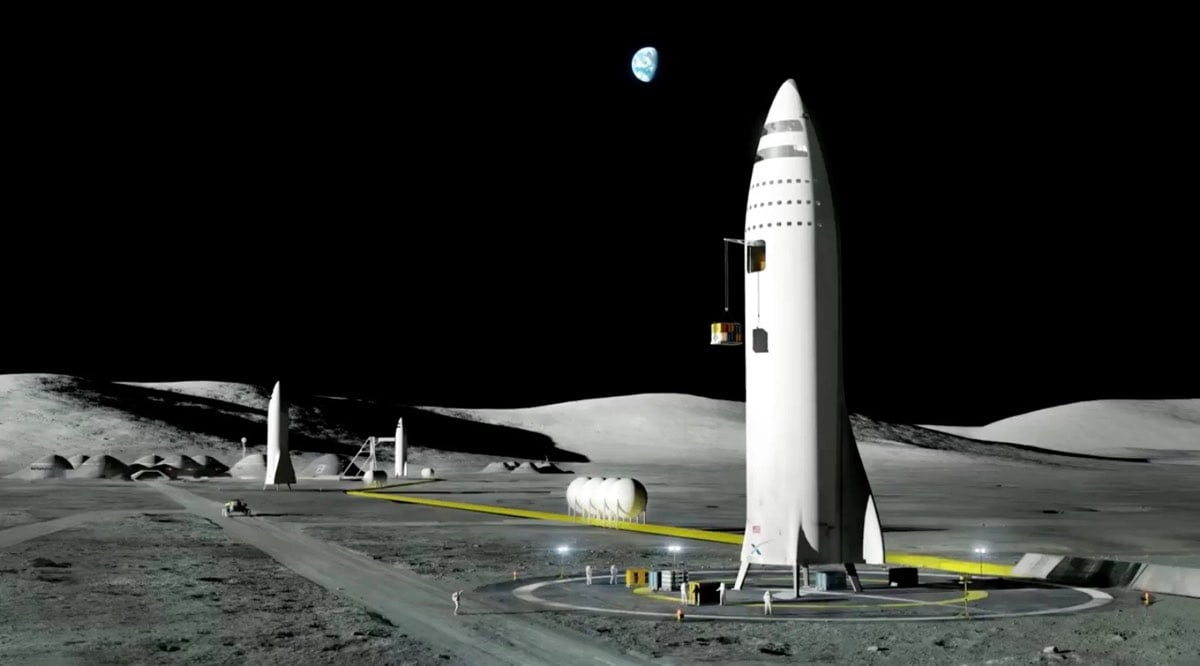
Elon Musk says SpaceX is on target to send cargo to Mars in 2022 and people in 2024. The way the company will do it is by focusing its resources on a new vehicle, the Interplanetary Transport System (codename: the BFR). That vehicle will be able to travel to Mars, but can also be used to generate revenue for the company through launching satellites, resupplying the ISS, and going to the Moon.
Musk also proposed a variety of new uses for the scaled-down rocket beyond just going to Mars. Supposedly, the ITS can be used to launch satellites, take cargo to the International Space Station, and even do lunar missions to set up a Moon base. SpaceX’s current Falcon 9 fleet is used to do a few of those things already, but Musk says eventually the company will turn to the ITS to do all of its space missions.
“We can build a system that cannibalizes our own products, makes our own products redundant, then all the resources we use for Falcon Heavy and Dragon can be applied to one system,” he said at the conference. Musk says the cost of launching cargo on the ITS will be fairly cheap, too, since the rocket and spaceship will be a fully reusable system — unlike the Falcon 9, which is only 70 to 80 percent reusable.
He ended his talk with a pretty incredible promise: using that same interplanetary rocket system for long distance travel on Earth. Musk showed a demonstration of the idea on stage, claiming that it will allow passengers to take “most long distance trips” in just 30 minutes, and go “anywhere on Earth in under an hour” for around the same price of an economy airline ticket.
As they say, “huge if true”. Musk is like the sci-fi Oprah here: You get a electric car! And you get a trip to Mars! And you get a self-driving car! And you get a 30-minute Hyperloop trip from SF to LA! And you get a rocket shuttle from NYC to Mumbai in 43 minutes for $1200! Beeeeeeeeees!!!!
In a meditative video for the NY Times, Dennis Overbye takes us on a tour of eclipses that happen in our solar system and beyond.
On the 21st day of August, 2017, the moon will slide between the Earth and the sun, painting a swath of darkness across North America. The Great American Solar Eclipse. An exercise in cosmic geometry. A reminder that we live on one sphere among many, all moving to the laws of Kepler, Newton and Einstein.
Humans have many more vantage points from which to observe solar eclipses than when the last solar eclipse occurred in the US in 1979. I had no idea that the Mars rovers had caught partial solar eclipses on Mars…so cool. (via @jossfong)






Stay Connected