kottke.org posts about legal
Swift Justice is a short documentary that, perhaps for the first time, takes viewers inside a rural Afghan courtroom operated by the Taliban, whose arbiters decide cases using Sharia law. [Content warning: a man is visibly beaten in the courtroom to make him “speak the truth”.]
To Westerners, the term “Sharia law” may call to mind sword-wielding fanatics with Old Testament sensibilities. Traditionally, though, less than ten per cent of the Sharia—Arabic for “religious law”—relates to criminal injury like murder, rape, or theft. The rest concerns family and marital relations and prosaic matters of commercial transactions and ritual. Sharia courts have existed in Afghanistan for centuries, and during the U.S. occupation they formed one of three distinct legal systems. There were also the official courts of the U.S.-backed Afghan government that were notoriously corrupt and inefficient. Bribery was this system’s lubricant; murderers often walked free, while the innocent languished in prisons rife with torture and other abuses. And there was the tribal system, an informal and sometimes ad-hoc approach to dispute resolution based on rural Pashtun practices. Few rural Pashtuns miss the old Afghan government courts; instead, today the central tension is between tribal and religious law.
Disney dropped the trailer for The Mandalorian and Grogu today, a feature-length film that will debut in theaters in May 2026. As this Star Wars Explained breakdown, er, explains, that the trailer was going to come out earlier but:
Word on the street is that it was supposed to come out this past Friday, but Disney was and is in the middle of some hot water. Acting like cowards in the face of authoritarianism will do that, especially when one of the franchises you own {shows footage of Andor} is about the exact opposite.
Last week, Disney made the decision to pull Jimmy Kimmel Live from the schedule because of threats from the Trump regime, prompting protests. Kimmel returns to the air tomorrow night:
“Last Wednesday, we made the decision to suspend production on the show to avoid further inflaming a tense situation at an emotional moment for our country. It is a decision we made because we felt some of the comments were ill-timed and thus insensitive,” the company said in a statement. “We have spent the last days having thoughtful conversations with Jimmy, and after those conversations, we reached the decision to return the show on Tuesday.”

From Akela Lacy at The Intercept, Palestinian Student Leader Was Called In for Citizenship Interview — Then Arrested by ICE (archive):
Mohsen K. Mahdawi arrived at the U.S. Citizenship and Immigration Services office in Burlington, Vermont, on Monday. A Palestinian student at Columbia University, he hoped that, after 10 years in the U.S., he would pass the test to become a naturalized citizen.
Instead, agents from U.S. Immigration and Customs Enforcement arrested him and began the process to deport him to the occupied West Bank. Mahdawi, a leader of the campus protest movement against Israel’s war on Gaza, became yet another green card holder arrested and facing removal.
“Mohsen Mahdawi was unlawfully detained today for no reason other than his Palestinian identity,” Mahdawi’s attorney Luna Droubi said in a statement to The Intercept. “He came to this country hoping to be free to speak out about the atrocities he has witnessed, only to be punished for such speech.”
Windsor County state senator Rebecca White took a video of Mahdawi being escorted in handcuffs (also on Reddit & YouTube) from the U.S. Citizenship and Immigration Services in Colchester, VT by hooded and masked men to a group of unmarked vehicles.
(thx, caroline)
Heather Cox Richardson on where we are right now in terms of what type of government we currently have:
Here’s the thing: Once you give up the idea that we are all equal before the law and have the right to due process, you have given up the whole game. You have admitted the principle that some people have more rights than others. Once you have replaced the principle of equality before the law with the idea that some people have no rights, you have granted your approval to the idea of an authoritarian government. At that point, all you can do is to hope that the dictator and his henchmen overlook you.
They are 100% going to try to do this with citizens:
Make no mistake: as Supreme Court Justices Sonia Sotomayor, Elena Kagan, and Ketanji Brown Jackson recently warned, if the administration can take noncitizens off the streets, render them to prison in another country, and then claim it is helpless to correct the error either because the person is out of reach of U.S. jurisdiction, it could do the same thing to citizens.
Meanwhile, Trump’s approval rating is still well above 40% (and is even higher if you don’t factor in the economy/tariffs). 🤷♂️
There’s a letter at the end of this post that’s very much worth the read, but I have to explain some context first because otherwise it won’t make any sense. So:
The Trump regime has been targeting law firms “whose lawyers have provided legal work that Trump disagrees with” with executive orders that take away their security clearances and terminate their federal contracts. Yesterday, Trump rescinded his order against the firm of Paul, Weiss, Rifkind, Wharton & Garrison in exchange for a bribe in the form of the firm providing “$40m in free legal services to support his administration’s goals”. The settlement also includes an apparent agreement by Paul Weiss “to disavow the use of diversity, equity and inclusion considerations in its hiring and promotion decisions”.
Another of the law firms targeted by Trump is Perkins Coie, which has filed a lawsuit to fight the EO:
On March 11, 2025, we filed a legal action in response to a recent Executive Order that unlawfully targets Perkins Coie. The order violates core constitutional rights, including the rights to free speech and due process. At the heart of the order is an unlawful attack on the freedom of all Americans to select counsel of their choice without fear of retribution or punishment from the government. We were compelled to take this action to protect our firm and our clients.
In response to the Paul Weiss settlement news, Rachel Cohen, an associate at another law firm, Skadden Arps, sent a company-wide email to her colleagues last night with her “conditional” resignation notice, outlining her frustration with her firm’s unwillingness to support Perkins Coie’s lawsuit and related matters. She posted the letter to LinkedIn in image form — here’s the whole thing as text (boldface mine):
With gratitude and urgency.
Jeremy and colleagues,
Many deals I work on have concepts of conditional notice. This is mine.
Please consider this email my two week notice, revocable if the firm comes up with a satisfactory response to the current moment, which should include at minimum i) signing on to the firm amicus brief in support of Perkins Coie in its litigation fighting the Trump administration’s executive order against it, ii) committing to broad future representation, regardless of whether powerful people view it as adverse to them, iii) refusal to cooperate with the EEOC’s request for personal information of our colleagues clearly targeted at intimidating non-white employees, (iv) public refusal to fire or otherwise force out employees at the Trump administration’s directive or implied directive and (v) public commitment to maintenance of affinity groups and related initiatives.
This is not what I saw for my career or for my evening, but Paul Weiss’ decision to cave to the Trump administration on DEl, representation and staffing has forced my hand. We do not have time. It is now or it is never, and if it is never, I will not continue to work here.
When I went to law school and to Skadden, I did so in pursuit of agency. I was driven by a desire to be in rooms where decision-makers were, to get to play a role in things that mattered, because things felt so needlessly terrible. It never occurred to me that the people in those rooms might feel that they were powerless. I am forced to hope that our lack of response to the Trump administration’s attacks on our peers, both those at other large firms and the many people in this country with far fewer resources, is rooted in feelings of fear and powerlessness, as opposed to tacit agreement or desire to maximize profit. I still hope that is true. But it has not yet been borne out.
It feels mortifying to say “I suspect you know who I am,” but I suspect you know who I am. Over the last few weeks, I have devoted an inordinate amount of time trying to leverage various relationships and privileges to get our firm and broader industry to admit that we are in the throes of early-stage authoritarianism and that we are uniquely positioned to halt it. There is an open letter (now signed by over 600 other AmLaw 200 associates, many of them at this firm), mainstream media coverage and an oped explaining why I feel this way.
To anyone who feels sympathetic to the views I’ve espoused but wonders why I have taken the path I have: on Thursday, March 6, after the issuance of the Perkins Executive Order, I sent emails to multiple trusted partners in management asking to help with whatever response we coordinated.
One of them replied offering to talk and then failed to reply to my email asking for a time until a week later, significantly after I had begun speaking publicly. Know that I attended internal meetings about this topic, sent emails to decision makers, avoided commenting on the EEOC investigation publicly or airing any internal firm discourse publicly.
I did all of these things out of hope that we would do the right thing if given time and opportunity.
The firm has been given time and opportunity to do the right thing. Thus far, we have not. This is a moment that demands urgency. Whether we are failing to meet it because we are unprepared or because we don’t wish to is irrelevant to me — and to the world — where the outcome is the same. If we were going to resist, we would have done so already. If we were not going to respond to the EEOC (a refusal that would be fully legal), the firm would have already told us.
This is the first firmwide email that has been sent on this topic. What. Are. We. Doing.
Colleagues, if you question if it is as bad as you think it is, it is ten times worse. Whether what we measure is the cowardice in face of lost profits, or the proximity to authoritarianism, or the trauma inflicted on our colleagues who are nonwhite, or the disappointment that I feel in this moment, take what you suspect and multiply it by a factor of ten. Act accordingly.
I recognize not everyone is positioned as I am, and cannot act the same way. But do not recruit for this firm if they cannot protect their employees. Do not pretend that what is happening is normal or excusable. It isn’t.
To the many superiors, support staff and friends that I know I disappoint by making this announcement firmwide instead of talking to you first, I sincerely apologize. There are so many thank yous that I have for so many people at this firm. Please know that if you suspect that you have helped me or taught me or cared for me, that I agree and am eternally grateful. In the coming days, I will make every effort to reach out to you separately, but there is urgency here that makes it impossible to go to each of you first. I will do everything in my power to mitigate difficulties caused by my unexpected departure.
Like any self-important adolescent, I spent most of my high school history classes wondering what I would do in the moments before true horror or chaos or where my values were tested and demanded great sacrifice. I do not wonder anymore. I know who I am. I thought I knew who we all were.
Thank you for the opportunity. My personal email is cc’d. I wish each of you the best, and that you use the privileges you hold to work for the best for others.
Rachel
Cohen offered an update shortly after publishing her letter:
As an update, I no longer have access to my firm email, so I guess it’s just notice.
They owe me a payout for 24 accrued vacation days. Thank you and good night.
(via @annabower.bsky.social)

Yesterday was Public Domain Day and Duke University’s Center for the Study of the Public Domain has the scoop on what works entered the public domain in the US on January 1, 2025. They include:
- William Faulkner, The Sound and the Fury
- Ernest Hemingway, A Farewell to Arms
- Virginia Woolf, A Room of One’s Own
- Dashiell Hammett, The Maltese Falcon (as serialized in Black Mask magazine)
- Agatha Christie, Seven Dials Mystery
- Rainer Maria Rilke, Letters to a Young Poet (only the original German version, Briefe an einen jungen Dichter)
- A dozen more Mickey Mouse animations (including Mickey’s first talking appearance in The Karnival Kid)
- The Cocoanuts, directed by Robert Florey and Joseph Santley (the first Marx Brothers feature film)
- The Skeleton Dance, directed by Walt Disney and animated by Ub Iwerks (the first Silly Symphony short from Disney)
- Spite Marriage, directed by Edward Sedgwick and Buster Keaton (Keaton’s final silent feature)
- E. C. Segar, Popeye (in “Gobs of Work” from the Thimble Theatre comic strip)
- Hergé (Georges Remi), Tintin (in “Les Aventures de Tintin” from the magazine Le Petit Vingtième)
- Singin’ in the Rain, lyrics by Arthur Freed, music by Nacio Herb Brown
- Ain’t Misbehavin’, lyrics by Andy Paul Razaf, music by Thomas W. (“Fats”) Waller & Harry Brooks (from the musical Hot Chocolates)
- An American in Paris, George Gershwin
- Rhapsody in Blue, recorded by George Gershwin
The Internet Archive is hosting several of the newly sprung works, free for you to remix, reuse, misuse, and generally do whatever you would like with. Huzzah!
Oh, and here’s why the public domain matters:
The public domain is also a wellspring for creativity. You could think of it as the yin to copyright’s yang. Copyright law gives authors important rights that encourage creativity and distribution — this is a very good thing. But the United States Constitution requires that those rights last only for a “limited time,” so that when they expire, works go into the public domain, where future authors can legally build on the past — reimagining the books, making them into films, adapting the songs and movies. That’s a good thing too! It is part of copyright’s ecosystem. The point of copyright is to promote creativity, and the public domain plays a central role in doing so.
How does the public domain feed creativity? Here are just two examples from 2024. You may have enjoyed the film Wicked in 2024. Like many of its predecessors, it is based on L. Frank Baum’s The Wonderful Wizard of Oz books, and it offers origin stories for the Wicked Witch of the West and Glinda the Good. From the literary realm, Percival Everett’s 2024 novel James reimagines Mark Twain’s Adventures of Huckleberry Finn from the perspective of Jim, Huckleberry’s friend who is an escaped slave. The novel won the 2024 National Book Award and Kirkus Prize and was a finalist for the Booker Prize. As summed up by a New York Times review: “‘Huck Finn’ Is a Masterpiece. This Retelling Just Might Be, Too.” Mark Twain famously wanted copyright to last forever — if he had his wish, would his heirs have sued Everett? Thankfully, we did not have to find out, and Everett could publish James without such litigation.
A group of Costco shareholders, emboldened by the Supreme Court’s continued assault on the equal protection clause of the 14th Amendment, called on the company’s board to “conduct an evaluation and publish a report” on the risks involved in maintaining their DEI program, which these shareholders called “illegal discrimination” against employees who are “white, Asian, male or straight”. The board responded with a recommendation to vote against this proposal:
Our Board has considered this proposal and believes that our commitment to an enterprise rooted in respect and inclusion is appropriate and necessary. The report requested by this proposal would not provide meaningful additional information to our shareholders, and the Board thus unanimously recommends a vote AGAINST this proposal.
Our success at Costco Wholesale has been built on service to our critical stakeholders: employees, members, and suppliers. Our efforts around diversity, equity and inclusion follow our code of ethics:
For our employees, these efforts are built around inclusion – having all of our employees feel valued and respected. Our efforts at diversity, equity and inclusion remind and reinforce with everyone at our Company the importance of creating opportunities for all. We believe that these efforts enhance our capacity to attract and retain employees who will help our business succeed. This capacity is critical because we owe our success to our now over 300,000 employees around the globe.
But the board then went further, blaming these shareholders for wasting their time and resources:
The proponent professes concern about legal and financial risks to the Company and its shareholders associated with the diversity initiatives. The supporting statement demonstrates that it is the proponent and others that are responsible for inflicting burdens on companies with their challenges to longstanding diversity programs. The proponent’s broader agenda is not reducing risk for the Company but abolition of diversity initiatives.
This is the way. The whole shareholder proposal and the board’s response is worth reading. (via @heartwoodandsteel.bsky.social)
This short video takes us on a trip through the criminal justice system and highlights a “hidden form of punishment” directed toward incarcerated people: fees. At every turn, people who are sentenced to incarceration are subject to tens of thousands of dollars in fees: bail fees, public defender fees, filing fees, court costs, mandatory contributions to funds like the state police fund, room & board, phone calls, money transfer fees, medical co-pays, and fees for post-incarceration monitoring. This is on top of any penalties that are paid by offenders.
We’re not talking about fines, those monetary punishments that judges impose on offenders. And this isn’t about restitution, which is an additional sanction intended to reimburse victims. Fees are far more insidious, functioning like predatory taxes that raise revenue for the government. They can vary from state to state, municipality to municipality, institution to institution.
And they can have severe economic consequences, particularly for people who are already broke when they enter the system — that is, most people who run afoul of the law. The resulting debts can destroy people’s credit, prevent them from voting and interfere with their ability to find employment and housing.
And guess what? People in debt turn to crime to pay their bills. This is all just another way that America’s criminal justice system is punitive and not rehabilitative.
Well this is delightful: Vanity Fair set up Ayo Edebiri with a selection of personal beefs and several gavels (and maybe there’s a meat tenderizer in there, I don’t know), she listened to both sides of each argument, and then passed judgment. Listen until at least the second case before you pass judgment on watching the whole thing (verdict: you should)…it involves someone stealing a french fry from a room service tray.
I don’t know how to tell you this…but your father has murdered people before. There are bodies in the ground. ‘I don’t know what she’s so upset about. It’s a victimless crime. Nobody’s gonna miss that fry. Nobody’s gonna miss THAT KID!’
Vox recently invited two people with differing views on the decriminalization and commercialization of cannabis to have an on-camera debate. The topic is interesting and relevant, but I’m mostly highlighting this for the format. Instead of just doing a traditional debate, the producers and participants came up with a list of facts that both parties accepted as true to discuss and rebut:
We thought both of their perspectives were worth hearing but didn’t want to stage a traditional debate where viewers so often come away confused about what to believe. So we created a format that would help establish a shared foundation of facts while still communicating what each of these advocates believe is the most important information to know.
In this new take on a debate, we asked both participants to identify facts that their opponent would have to concede are true. They were given an opportunity to review their adversary’s facts in advance and in a video call agreed on a set of six. In the video, you’ll see those facts presented, with each participant given the opportunity to add a “footnote” to their opponent’s facts.
Producer Joss Fong said of this novel format:
We made something new: a debate format where you don’t have to trust either of the adversaries (or trust us!) to learn something new and valuable about a policy issue.
I think it worked really well — more facts, less arguing & peacocking. I’d definitely welcome a podcast with this debate format.
Speaking of the fundamentalist movement to repeal the 20th century, Jack Mirkinson isn’t writing for The Atlantic and therefore is free to not mince words:
[Alito] says that Roe should be scrapped because the right to an abortion is “not deeply rooted in the Nation’s history and traditions” — a byzantine litmus test that would wipe out just about every modern civil rights protection you can think of, given the nature of American history. He forthrightly casts aside the notion that the court should be cautious about overturning decades of precedent. He sends unmistakable signals that other civil rights opinions, especially ones protecting gay rights, are in the crosshairs.
The final opinion could differ, but what we have in front of us is an extremist, illegitimate opinion from an extremist, illegitimate court, one that sees women as serfs and breeders, that sees queer people as subhuman, that sees minorities of every kind as dirt under its collective shoe. It is happily dragging us into the dark ages. Alito and everyone who joins him are evil people. No hell is too hot for them.
(via waxy)
Adam Serwer writing in The Atlantic about the leaked Supreme Court opinion draft penned by conservative justice Samuel Alito that will, if it remains substantially unmodified, overturn Roe v Wade and other precedents that guarantee the right to an abortion in the United States.
“The majority can believe that it’s only eviscerating a right to abortion in this draft,” Stephen Vladeck, a law professor at the University of Texas at Austin, told me, “but the means by which it does so would open the door to similar attacks on other unenumerated rights, both directly, by attacking the underpinnings of those doctrines, and indirectly, by setting a precedent for such an attack.”
Aside from rights specifically mentioned in the text of the Constitution, Alito argues, only those rights “deeply rooted in the nation’s history in tradition” deserve its protections. This is as arbitrary as it is lawless. Alito is saying there is no freedom from state coercion that conservatives cannot strip away if conservatives find that freedom personally distasteful. The rights of heterosexual married couples to obtain contraception, or of LGBTQ people to be free from discrimination, are obvious targets. But other rights that Americans now take for granted could easily be excluded by this capricious reasoning.
“In a series of cases beginning in the early 1920s, the Court carved out a protected space for family, marriage, and children that the government is constrained from regulating,” Kimberly Wehle wrote last December. “A rollback of Roe could split this sphere open if the conservative theory that implied rights are constitutionally invalid takes hold, and states begin passing draconian laws that creep into other areas of intimate personal life.”
And:
On the grounds that it constitutes a form of religious discrimination, conservatives will be able to claim an exemption from any generally applicable rule they do not wish to follow, while imposing their own religious and ideological views on those who do not share them. Although the right-wing justices present this rule in the language of constitutionalism, they are simply imposing their ideological and cultural preferences on the rest of the country.
Abortion, same-sex marriage, birth control, rights for trans persons, other LGBTQ protections, other civil rights — it’s all on the table, they’re coming for all of it.
Update: See also This is just the beginning:
I ask you to re-read the above passage and substitute for the word “abortion” any other modern liberty not mentioned in the Constitution: the right to use contraception, same-sex marriage, the right of same-sex couples to adopt children, marriage between different “races,” the right of any consenting adults to engage in sex, the right of unmarried couples to live together, and the rights of LGBTQ people to be treated with equal dignity.
Each of the above rights — now widely accepted — was criminalized or prohibited in many U.S. states until the latter part of the 20th century. Under Justice Alito’s reasoning, because the Constitution “makes no reference to those rights” and they were “unknown” in American jurisprudence until recently, the Constitution affords them no protection. Alito does handsprings to claim the draft ruling does not reach other rights rooted in the same legal ground as Roe and Casey. But there is no difference under Alito’s reasoning between abortion and contraception, same sex marriage, same-sex adoption, and bans against “fornication,” “sodomy,” cohabitation, and “miscegenation.”
This is just the beginning.
For the curious and open-minded, many explanations of what “Black Lives Matter” means and what it doesn’t (e.g. White lives don’t matter) are readily available online. But in terms of pure clarity, it’s hard to beat what Whittier Law School professor Patricia Leary wrote in response to a letter sent to her by an anonymous group of students in 2016. This group of students was offended by Leary wearing a “Black Lives Matter” t-shirt on campus, writing in part:
We write this letter to you with concern about your inappropriate conduct at XXXXXXX Law School.
Specifically, you have presented yourself on campus, on at least one occasion, wearing a “Black Lives Matter” t-shirt. We believe this is an inappropriate and unnecessary statement that has no legitimate place within our institution of higher learning. The statement you represented and endorsed is also highly offensive and extremely inflammatory. We are here to learn the law. We do not spend three years of our lives and tens of thousands of dollars to be subjected to indoctrination or personal opinions of our professors.
XXXXXXX Law School has prided itself on the diverse demographics represented within the student body. Your actions however, clearly represent your View that some of those demographics matter more than others. That alienates and isolates all non-black groups.
As someone who is charged to teach criminal law, it should be abundantly clear to you and beyond any question that ALL lives matter, as it is expressed unequivocally in the law. Furthermore, the “Black Lives Matter” statement is racist and anti-law enforcement and has been known to incite violence in this country. As someone who is paid to teach the law, you should be ashamed of yourself.
If you’re going to argue with law professors, you should bring your A game, and Leary wastes no time in informing these students that they did not do so.
Premise: You are not paying for my opinion.
Critique: You are not paying me to pretend I don’t have one.
And on the meaning of “Black Lives Matter”:
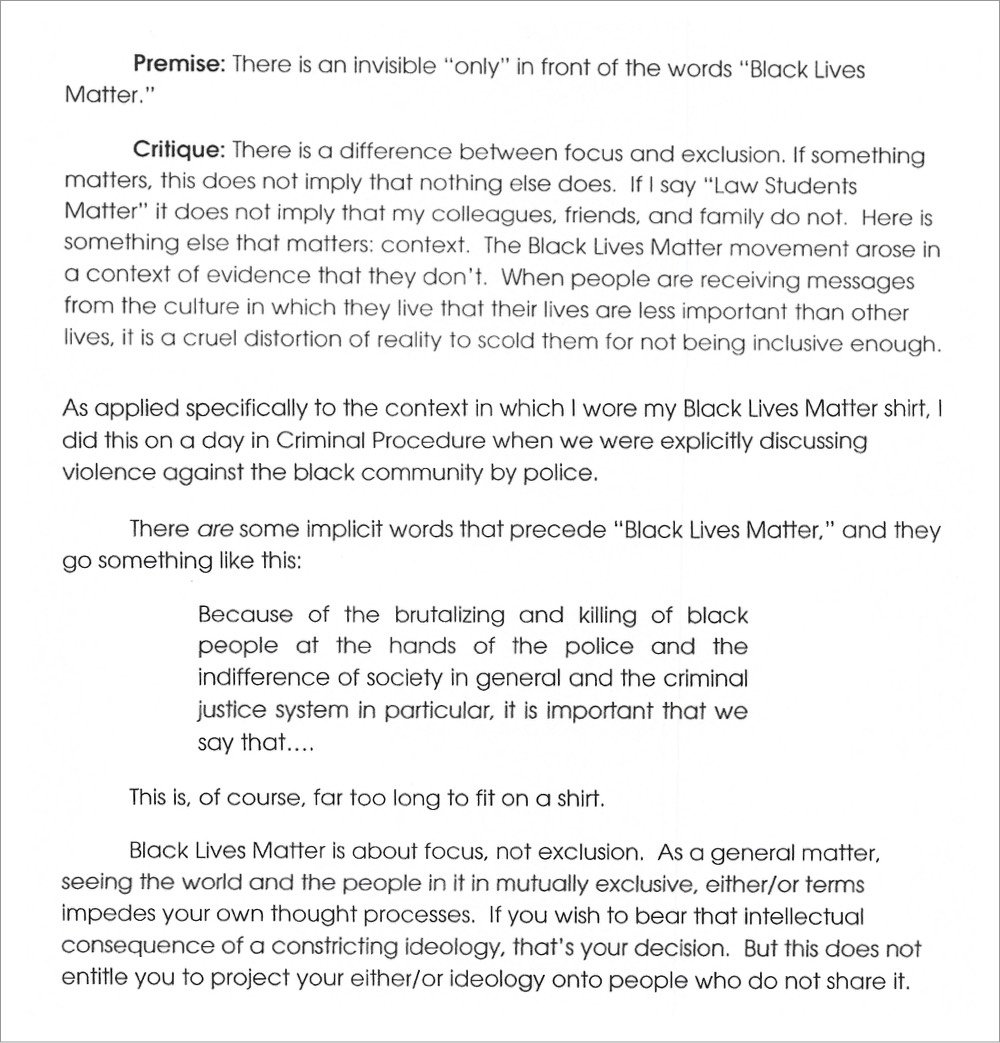
Premise: There is an invisible “only” in front of the words “Black Lives Matter.”
Critique: There is a difference between focus and exclusion. If something matters, this does not imply that nothing else does. If I say “Law Students Matter” it does not imply that my colleagues, friends, and family do not. Here is something else that matters: context. The Black Lives Matter movement arose in a context of evidence that they don’t. When people are receiving messages from the culture in which they live that their lives are less important than other lives, it is a cruel distortion of reality to scold them for not being inclusive enough.
As applied specifically to the context in which I wore my Black Lives Matter shirt, I did this on a day in Criminal Procedure when we were explicitly discussing violence against the black community by police.
There are some implicit words that precede “Black Lives Matter,” and they go something like this:
“Because of the brutalizing and killing of black people at the hands of the police and the indifference of society in general and the criminal justice system in particular. It is important that we say that…”
This is, of course, far too long to fit on a shirt.
Black Lives Matter is about focus, not exclusion. As a general matter, seeing the world and the people in it in mutually exclusive, either/or terms impedes your own thought processes. If you wish to bear that intellectual consequence of a constricting ideology, that’s your decision. But this does not entitle you to project your either/or ideology onto people who do not share it.
The rest of her response is worth a read, particularly the part about the misconception that “what you think something means is the same as what it actually means”.
And then in part 2 of the letter, she rips the batteries right out of the anonymous students by critiquing how they wrote the letter.
Frame the issue precisely and then focus on it. Don’t overgeneralize. You begin by stating that the issue is my “inappropriate conduct,” which sounds very general. Then you narrow the issue to “specifically” one event that occurred on a particular day last semester. Your use of hyperbolic rhetoric throughout the memo suggests that you really are angry about more than just a T-shirt. If it really is about just the T-shirt, then by overgeneralizing from a specific occurrence, your message is swamped by exaggeration. If it really is about other “conduct” on my part, I can’t tell what that is. By the end of the memo you have lost focus completely, generalizing (in statements that are unexplained and inexplicable) about bar passage and about the faculty and administration of the entire law school.
Well, they did ask her to teach…
Confessions of a Former Bastard Cop is an essay allegedly written by a former police officer with ten years of experience in “a major metropolitan area in California with a predominantly poor, non-white population”. In it, he attempts to explain the system under which cops are trained and operate, “not to excuse their behavior, but to explain it and to indict the structures that perpetuate it.” At the very least, this essay corroborates what activists have been saying about the police for decades.
I could write an entire book of the awful things I’ve done, seen done, and heard others bragging about doing. But, to me, the bigger question is “How did it get this way?”. While I was a police officer in a city 30 miles from where I lived, many of my fellow officers were from the community and treated their neighbors just as badly as I did. While every cop’s individual biases come into play, it’s the profession itself that is toxic, and it starts from day 1 of training.
Every police academy is different but all of them share certain features: taught by old cops, run like a paramilitary bootcamp, strong emphasis on protecting yourself more than anyone else. The majority of my time in the academy was spent doing aggressive physical training and watching video after video after video of police officers being murdered on duty.
I want to highlight this: nearly everyone coming into law enforcement is bombarded with dash cam footage of police officers being ambushed and killed. Over and over and over. Colorless VHS mortality plays, cops screaming for help over their radios, their bodies going limp as a pair of tail lights speed away into a grainy black horizon. In my case, with commentary from an old racist cop who used to brag about assaulting Black Panthers.
And this, uh, training doesn’t prepare officers for what their actual job ends up being:
And consider this: my job as a police officer required me to be a marriage counselor, a mental health crisis professional, a conflict negotiator, a social worker, a child advocate, a traffic safety expert, a sexual assault specialist, and, every once in awhile, a public safety officer authorized to use force, all after only a 1000 hours of training at a police academy. Does the person we send to catch a robber also need to be the person we send to interview a rape victim or document a fender bender? Should one profession be expected to do all that important community care (with very little training) all at the same time?
To put this another way: I made double the salary most social workers made to do a fraction of what they could do to mitigate the causes of crimes and desperation. I can count very few times my monopoly on state violence actually made our citizens safer, and even then, it’s hard to say better-funded social safety nets and dozens of other community care specialists wouldn’t have prevented a problem before it started.
Armed, indoctrinated (and dare I say, traumatized) cops do not make you safer; community mutual aid networks who can unite other people with the resources they need to stay fed, clothed, and housed make you safer. I really want to hammer this home: every cop in your neighborhood is damaged by their training, emboldened by their immunity, and they have a gun and the ability to take your life with near-impunity. This does not make you safer, even if you’re white.
His conclusion: “consider abolishing the police” and “creating a society focused on reconciliation and restorative justice instead of punishment, pain, and suffering — a system that sees people in crisis as humans, not monsters”.
As someone who did it for nearly a decade, I need you to understand that by and large, police protection is marginal, incidental. It’s an illusion created by decades of copaganda designed to fool you into thinking these brave men and women are holding back the barbarians at the gates.
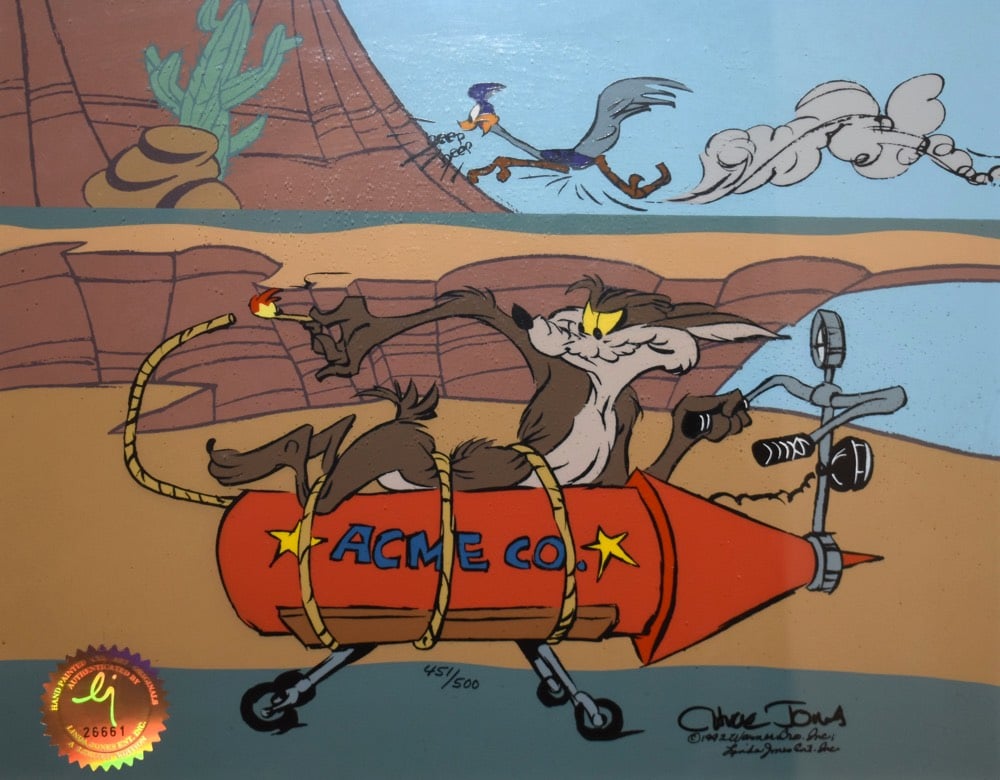
In a classic New Yorker article from 1990, Ian Frazier writes about an imagined lawsuit filed by Wile E. Coyote against the Acme Company in which he “seeks compensation for personal injuries, loss of business income, and mental suffering” due to the company’s defective products.
Mr. Coyote states that on December 13th he received of Defendant via parcel post one Acme Rocket Sled. The intention of Mr. Coyote was to use the Rocket Sled to aid him in pursuit of his prey. Upon receipt of the Rocket Sled Mr. Coyote removed it from its wooden shipping crate and, sighting his prey in the distance, activated the ignition. As Mr. Coyote gripped the handlebars, the Rocket Sled accelerated with such sudden and precipitate force as to stretch Mr. Coyote’s forelimbs to a length of fifty feet. Subsequently, the rest of Mr. Coyote’s body shot forward with a violent jolt, causing severe strain to his back and neck and placing him unexpectedly astride the Rocket Sled. Disappearing over the horizon at such speed as to leave a diminishing jet trail along its path, the Rocket Sled soon brought Mr. Coyote abreast of his prey. At that moment the animal he was pursuing veered sharply to the right. Mr. Coyote vigorously attempted to follow this maneuver but was unable to, due to poorly designed steering on the Rocket Sled and a faulty or nonexistent braking system. Shortly thereafter, the unchecked progress of the Rocket Sled brought it and Mr. Coyote into collision with the side of a mesa.
See also the rules followed by animator Chuck Jones and his team while making the Wile E. Coyote and Road Runner cartoons.
Have you ever wanted to hear Jay Z rap the “To Be, Or Not To Be” soliloquy from Hamlet? You are in luck:
What about Bob Dylan singing Britney Spears’ “…Baby One More Time”? Here you go:
Bill Clinton reciting “Baby Got Back” by Sir Mix-A-Lot? Yep:
And I know you’re always wanted to hear six US Presidents rap NWA’s “Fuck Tha Police”. Voila:
This version with the backing track is even better. These audio deepfakes were created using AI:
The voices in this video were entirely computer-generated using a text-to-speech model trained on the speech patterns of Barack Obama, Ronald Reagan, John F. Kennedy, Franklin Roosevelt, Bill Clinton, and Donald Trump.
The program listens to a bunch of speech spoken by someone and then, in theory, you can provide any text you want and the virtual Obama or Jay Z can speak it. Some of these are more convincing than others — with a bit of manual tinkering, I bet you could clean these up enough to make them convincing.
Two of the videos featuring Jay Z’s synthesized voice were forced offline by a copyright claim from his record company but were reinstated. As Andy Baio notes, these deepfakes are legally interesting:
With these takedowns, Roc Nation is making two claims:
1. These videos are an infringing use of Jay-Z’s copyright.
2. The videos “unlawfully uses an AI to impersonate our client’s voice.”
But are either of these true? With a technology this new, we’re in untested legal waters.
The Vocal Synthesis audio clips were created by training a model with a large corpus of audio samples and text transcriptions. In this case, he fed Jay-Z songs and lyrics into Tacotron 2, a neural network architecture developed by Google.
It seems reasonable to assume that a model and audio generated from copyrighted audio recordings would be considered derivative works.
But is it copyright infringement? Like virtually everything in the world of copyright, it depends-on how it was used, and for what purpose.
Celebrity impressions by people are allowed, why not ones by machines? It’ll be interesting to see where this goes as the tech gets better.
In this recent TED Talk, lawyer, musician, and technologist Damien Riehl talks about the rapidly diminishing number of melodies available to songwriters under the current system of copyright. In order to help songwriters avoid these melodic legal landmines (some of which are documented here), Riehl and his pal Noah Rubin designed and wrote a program to record every possible 8-note, 12-beat melody and released the results — all 68+ billion melodies, 2.6 terabytes of data — into the public domain.
It’s interesting that the litigious nature of the music business and the finite number of melodies (and the even smaller number of pleasing melodies) has turned an artistic endeavor into a land-grab — whoever gets to a certain melody first owns it forever (or at least for dozens of years). (via @tedgioia)

Illustrator Wendy MacNaughton spent a week at Guantánamo Bay sketching the proceedings at the 9/11 military court for this NY Times piece. In a behind-the-scenes piece, MacNaughton describes how she made the drawings, including the creative challenge posed by the restrictions and censorship enforced by US military officials.
Of the 30-something drawings I presented, Mr. Lavender shook his head at only two. The first contained some classified items in the courtroom. That made sense. The second was a handwritten list of everything that I was not allowed to draw, which I’d made to use as a reminder while working. I wanted to keep it. He refused.
I argued that the information it contained had been disclosed elsewhere. But Mr. Lavender and his supervisor came to the conclusion that my handwritten list was indeed a drawing, technically containing things I couldn’t draw. My “No” list was a no-go.
That’s Guantánamo.
Every drawing she made needed a signed approval sticker from the court’s censor, and in this piece and on Instagram, MacNaughton didn’t photoshop the sticker out, reinforcing that the censorship is a vital part of the story she’s trying to tell. Even the paper towel she used to clean her paint brushes needed a sticker:

This video catalogs every borrowed sample from Paul’s Boutique by the Beastie Boys, from the soundtrack to Car Wash to the Sugarhill Gang to the Eagles to the Ramones to the Beatles. They play the original first and then what they did with it on the album.
Somehow this video only has 31,000 views?! You can also listen to this remix of Paul’s Boutique on Soundcloud, which combines the source tracks with Beastie Boys vocals and some audio commentary.
Tim Carmody made a Spotify playlist of all the sampled songs or you can download zip files of the original songs sampled in Paul’s Boutique and five of their other albums.
They just don’t make ‘em like this anymore, mostly because clearing all of the samples would be prohibitively expensive if not impossible.
Hip-hop sampling began as a live technique, with DJs working turntables at parties and clubs. Whether it was strictly legal or not, nobody was going to try to sue anyone about it. As the genre’s popularity grew, people naturally started recording performances and releasing them as albums. Early sampling tended to come fast and furious. In the ’80s, short clips of existing recordings were the order of the day, often — as in the case of the Beastie Boys — lots of them, layered and shuffled in a clearly creative way. As hip-hop pushed further into the mainstream, however, the stakes got bigger and so did the samples.
1990 saw the release of both M.C. Hammer’s “U Can’t Touch This” and Vanilla Ice’s “Ice, Ice, Baby.” Not only did both songs sample, they each relied heavily on one particular sample — the baselines from Rick James’ “Superfreak” and Queen and David Bowie’s “Under Pressure” — for their main hook. Both hits resulted in legal controversy.
In a recent issue of Why is this interesting?, Noah Brier collects a number of perspectives on whether (and by whom) a work created by an artificial intelligence can be copyrighted.
But as I dug in a much bigger question emerged: Can you actually copyright work produced by AI? Traditionally, the law has been that only work created by people can receive copyright. You might remember the monkey selfie copyright claim from a few years back. In that case, a photographer gave his camera to a monkey who then snapped a selfie. The photographer then tried to claim ownership and PETA sued him to try to claim it back for the monkey. In the end, the photograph was judged to be in the public domain, since copyright requires human involvement. Machines, like monkeys, can’t own work, but clearly something made with the help of a human still qualifies for copyright. The question, then, is where do we draw the line?
Twitter user @WPCelebration recently compiled a list of nine activities and rights denied to women in America in 1971, just 48 years ago. The list includes:
Ms magazine published a similar list back in 2013 that also included the difficulty in getting a divorce without cause and obtain a safe & legal abortion in all 50 states. Bustle talked to several women about what discrimination was like before many of these changes took place.
I was denied a job in 1970 because I was newly pregnant. They actually had a question on the application regarding the date of your last menstrual period. Also, with my second child in 1974, they were not required to hold your position while you were on maternity leave, and I was told that my job was no longer open and I had to file for unemployment.
As a reminder, women only gained the right to vote in America fewer than 100 years ago.
Since reading Gregory Shill’s writing about how heavily subsidized cars are in the United States, I’ve been on the lookout for different frameworks for thinking about America’s relationship to cars. I recently ran across a pair of interesting things about cars & housing. First, a refresher on what Shill had to say about how our nation’s laws have made cars all but mandatory:
Let’s begin at the state and local level. A key player in the story of automobile supremacy is single-family-only zoning, a shadow segregation regime that is now justifiably on the defensive for outlawing duplexes and apartments in huge swaths of the country. Through these and other land-use restrictions — laws that separate residential and commercial areas or require needlessly large yards — zoning rules scatter Americans across distances and highway-like roads that are impractical or dangerous to traverse on foot. The resulting densities are also too low to sustain high-frequency public transit.
Aaron Bady shared a few meaty pages from Nathanael Lauster’s The Death and Life of the Single-Family House: Lessons from Vancouver on Building a Livable City about houses being urban parasites and their symbiotic relationship with cars. Here’s an excerpt (italics mine):
Returning to the metaphor provided by the pine beetle and blue stain fungus, one parasite often works with another. In similar form, houses cultivate cars. Integrated through planning, they displace vastly more habitat than either could manage alone. Because houses consume space and tend to surround themselves with other houses, which also consume space, people often cannot walk to where they need to go. Because all that space results in a relatively low population density, it is also not very efficient to run public transit lines to areas with many houses. Low-density areas tend to end up with very few riders for what are often very expensive systems to maintain. In short, public transit loves density. The relationship between urban density and public transit use is exceptionally strong, with some suggestion of a cutoff — perhaps around twelve persons per acre (or about three thousand per square kilometer) — below which ridership drops off and expense per user makes transit impractical. By contrast, cars love the sprawl associated with houses and houses love cars back.
Houses cultivate cars. Cars love the sprawl associated with houses and houses love cars back. Lauster continues with the nature metaphor:
Altogether, house habitat displaces alternatives. The establishment of a Great House Reserve has protected house habitat even as it continues to expand in size. Agricultural and wild lands suffer in an immediate sense, as do the more urban habitats prevented from expanding beyond a constrained Urban Core. The house allies itself with the car at the same time as both contribute to global warming, potentially risking the displacement of everyone and everything. The house habitat excludes the poor. But even for those who can afford to live there, the Great House Reserve is a troublesome place to live. By its nature it leads to disengagement, contributes to inequality, and encourages a sedentary, unhealthy lifestyle.
And so on:
Houses are not just unaffordable for most people; they’re ultimately unaffordable for cities too. The fiscal situation of cities varies from place to place, but overall, houses tend to create a drain on municipal coffers. They are often taxed at lower rates than other properties, reflecting zoning restrictions on what could be built on single-family lots and how they can be used. But houses are more expensive to service on a per-unit basis, both in terms of the basic utilities infrastructure and, as previously noted, in terms of transit and transportation infrastructure. This could mean that my modestly wealthy neighbors and I, living in low-rises and town houses, end up supporting the very wealthy house owner nearby by paying more property tax relative to the amount of urban land and services we receive. The disparity becomes more notable as one crosses municipal boundaries into nearby house-dominated suburbs, where residents frequently enjoy the services (e.g., roads, commerce, employment opportunities) provided by the city without paying into the municipal tax base at all.
Josh Vredevoogd’s No Parking Here is about the poor parking policy in LA and leads with the statement: “Let’s build houses for people, not cars.”
For commercial buildings, it’s common to see a parking space required for every 100-200 sq ft. Meaning that parking is built at an almost 2:1 ratio to actual retail space, marginalizing the place that actually creates value and prioritizing temporary car storage. This inefficiency is carried into rent, groceries, meals, and overall raises the floor for cost of living.
Per City of LA code, a set of storefronts like above are illegal to build, instead they are required to be surrounded with empty pavement at the cost of walkability and comfort.
This forces people into driving. Parking requirements increase the density of cars but reduce the density of people. It also puts pressure on businesses by taking up useful real estate and replacing it with car storage.
Certainly a lot of food for thought here. See also Cars! What’s the Matter with Cars Today? and on a lighter note, What On Earth!, Kal Pindal’s Oscar-nominated short film about Martians visiting Earth and their observations about the dominant form of life here, the automobile.
This is a fascinating & provocative article from law professor Gregory Shill: Americans Shouldn’t Have to Drive, but the Law Insists on It. The first line of the piece sets the stage: “In a country where the laws compel the use of cars, Americans are condemned to lose friends and relatives to traffic violence.”
Let’s begin at the state and local level. A key player in the story of automobile supremacy is single-family-only zoning, a shadow segregation regime that is now justifiably on the defensive for outlawing duplexes and apartments in huge swaths of the country. Through these and other land-use restrictions-laws that separate residential and commercial areas or require needlessly large yards-zoning rules scatter Americans across distances and highway-like roads that are impractical or dangerous to traverse on foot. The resulting densities are also too low to sustain high-frequency public transit.
Further entrenching automobile supremacy are laws that require landowners who build housing and office space to build housing for cars as well. In large part because of parking quotas, parking lots now cover more than a third of the land area of some U.S. cities; Houston is estimated to have 30 parking spaces for every resident. As UCLA urban planning professor Donald Shoup has written, this mismatch flows from legal mandates rather than market demand. Every employee who brings a car to the office essentially doubles the amount of space he takes up at work, and in urban areas his employer may be required by law to build him a $50,000 garage parking space.
Cars and car ownership are massively subsidized on a state, local, and federal level and our laws and regulations have built a nation where cars are mandatory and “driving is the price of first-class citizenship”.
Why are we taxing bus riders to pay rich people to buy McMansions and luxury electric SUVs?
And this speed limit thing is just eye-poppingly fucked up:
The National Transportation Safety Board has determined that speed is a top risk factor in motor vehicle crashes. Yet the most prominent way of setting and adjusting speed limits, known as the operating speed method, actually incentivizes faster driving. It calls for setting speed limits that 85 percent of drivers will obey. This method makes little provision for whether there’s a park or senior center on a street, or for people walking or biking.
As a matter of law, the operating speed method is exceptional. It enables those who violate the law-speeding motorists-to rewrite it: speed limits ratchet higher until no more than 15 percent of motorists violate them. The perverse incentives are obvious. Imagine a rule saying that, once 15 percent of Americans acquired an illegal type of machine gun, that weapon would automatically become legal.
Ok, this is one of those articles where I want to excerpt every paragraph…just go read the whole thing. (via @olgakhazan)
Update: Eric Jaffe shared some interesting bits from Shill’s recent paper, Should Law Subsidize Driving?, in a Twitter thread.
Until the 1910s, “street parking was broadly outlawed: if you owned a car in a city, you were responsible for storing it, just as you would be any other piece of movable property.”
“Tax subsidies for commuting prioritize driving. Those who walk, bike, or carpool to work, and in some cases those who take transit, pay other people to drive to work.”
Never realized (or forgot) that CAFE fuel economy rules — generally a good thing — have a loophole that “light trucks” don’t need to be as fuel efficient as cars. “Light trucks” have come to mean SUVs, which means SUVs are easier to produce. No coincidence that the share of “light trucks” has soared from 20% in 1976 to 69% of market today. The upshot, of course, is that SUVs are much worse for pedestrian safety: you’re 3.4x more likely to be killed if hit by an SUV vs. a car.
Vox recently asked a group of writers, advocates, and thinkers about ideas & practices that we accept now that will be unthinkable or barbaric to people living 50 years from now. Kathleen Frydl asserts that “the war on drugs” will be one such practice.
Today, heroin is still classified as a Schedule I, or prohibited, drug. The consequences of this fateful decision continue to haunt us. Gross failures of our criminal justice system, ranging from police corruption to excessive use of force, all achieve a scale, and foster a profound alienation, as a result of drug prohibition and the militant drug war it spawned.
Maybe in times of only modest failure, or devastation that affects only the marginalized, the tactics of deflection traditionally used to defend the drug war would be enough to sustain it. But it is untenable in the midst of the opioid crisis, the worst drug epidemic in our country’s history.
It is my belief that its staggering body count gives us little choice but face hard truths, even in the face of the deep dependence on the drug war that the US government has developed. What falls between now and that awful reckoning is nothing but denial.
Meredith Broussard believes that self-driving cars will be unthinkable 50 years from now:
The simple explanation for why this situation didn’t escalate: the unspoken social contract of the bus driver’s authority in this space. We have invested years in developing social contracts around both private and public transportation. When you get into a bus or a train, or even a car, you acknowledge that the person at the wheel is in charge. This power relationship is what allows shared transportation to flourish, and this social contract is what helps many of us in marginalized groups feel safer while riding transportation. It doesn’t feel safe to imagine riding in a shared driverless vehicle. Not just because the technology doesn’t work — but because it doesn’t feel safe to be alone in a small, enclosed space with strange men.
Ava DuVerney has written and directed a four-part TV series called When They See Us that “chronicles the notorious case of five teenagers of color, labeled the Central Park Five, who were convicted of a rape they did not commit”. Here’s a teaser trailer:
The series starts airing on Netflix on May 31.
And if you haven’t seen it, the documentary The Central Park Five (directed by Ken Burns, Sarah Burns, and David McMahon) is excellent.
Set to air on HBO starting March 3rd, Leaving Neverland is a two-part documentary film about the experiences of two men who were befriended by and allegedly sexually abused by Michael Jackson as young boys. Here’s the trailer:
Leaving Neverland is a two-part documentary exploring the separate but parallel experiences of two young boys, James Safechuck, at age ten, and Wade Robson, at age seven, both of whom were befriended by Michael Jackson. Through gut-wrenching interviews with Safechuck, now 37, and Robson, now 41, as well as their mothers, wives and siblings, the film crafts a portrait of sustained abuse, exploring the complicated feelings that led both men to confront their experiences after both had a young son of his own.
As this quick timeline of abuse allegations against Jackson notes, both Safechuck and Robson previously denied that Jackson had abused them.
Robson, by this point a choreographer for stars like Britney Spears, testified that he had spent the night at Neverland more than 20 times but that Jackson had never molested him or taken a shower with him.
James Safechuck, who had met Jackson as a young boy in the 1980s when he was cast in a Pepsi commercial, also denied publicly that he had been abused, although he was not called to testify.
David Ehrlich saw the film at Sundance and was completely convinced by the stories of the two men.
It may not be much of a secret that Michael Jackson acted inappropriately with a number of young boys, but there’s no way to prepare yourself for the sickening forensic details presented in Dan Reed’s four-hour exposé. It’s one thing to be vaguely aware of the various allegations that were made against the King of Pop; the asterisks that will always be next to the late mega-star’s name. It’s quite another to hear the horrifyingly lucid testimony that stretches across the entire duration of “Leaving Neverland,” as two of Jackson’s most repeat victims bravely lay bare how a universal icon seduced them away from their realities, splintered their families beyond all recognition, and leveraged their love for him into a disturbing litany of sexual acts.
The eloquent and straightforward “Leaving Neverland” was made for no other reason than to give shape to a nebulous cloud of rumors, many of which were floated in public before they were silenced behind settlements, and none of which a jury was able to prove beyond a reasonable doubt. In the wake of Reed’s film and the shattering interview footage that it exists to share with us, there’s no longer a reasonable doubt. There’s no longer any doubt at all. Not only do the documentary’s two main subjects perfectly corroborate their separate accounts in all of the most tragic of ways, but they do so with a degree of vulnerability that denies any room for skepticism.
Other stars who previously had private or ignored abuse allegations leveled against them — Kevin Spacey, Bill Cosby, R. Kelly, Woody Allen, Louis CK — have been judged more harshly and their accusers have taken more seriously in recent years, and it’ll be interesting to see what happens with Jackson after the documentary airs.
Maybe you’ve heard the term “intersectionality” used on social media — in the context of feminism or racism — and you know in a hand-wavy sort of way what it means but don’t really know its exact definition or where it came from. Well, Kat Blaque has you covered. In this YouTube video and in this Twitter thread, she explains that intersectionality was first described by Kimberlé Crenshaw, now Professor of Law at UCLA and Columbia Law School, in a 1989 article called Demarginalizing the Intersection of Race and Sex: A Black Feminist Critique of Antidiscrimination Doctrine, Feminist Theory and Antiracist Politics.
Blaque’s summary of the paper on Twitter is crisp and concise:
To summarize what she meant when she defined intersectionality: It was about how black women were erased in conversations about discrimination because the feminist movement and the civil rights movement focused largely on its most privileged members.
So feminism, at the time (and arguably still) focused largely on white women’s experiences with sexism and the civil rights movement focused, at the time (and arguably still) focused on how black men experienced racism. So black women’s experiences had to be measured against that.
Meaning that in several legal cases, explained in the document and my video, if a black woman’s experiences with discrimination weren’t paralleled to how black men experience racism and white women experience sexism, their cases were dismissed or thrown out.
So you had cases where black women would sue a company for racial discrimination and then you’d have the judge say that it was impossible for that to be true, because they currently employed black people. The problem was, the black people were all men.
There’s obviously a lot more in Crenshaw’s paper, including this point near the end:
It is somewhat ironic that those concerned with alleviating the ills of racism and sexism should adopt such a top-down approach to discrimination. If their efforts instead began with addressing the needs and problems of those who are most disadvantaged and with restructuring and remaking the world where necessary, then others who are singularly disadvantaged would also benefit. In addition, it seems that placing those who currently are marginalized in the center is the most effective way to resist efforts to compartmentalize experiences and undermine potential collective action.
(via @john_overholt)
Another thing I learned on my visit to Topographie Des Terrors in Berlin was how the Nazis subtly twisted the meaning of “protective custody”. That term is typically thought of as a measure to safeguard an individual who might be harmed. It’s not always a positive term — “custody” after all is not freedom and in US prisons, protective custody often subjects the person being protected to solitary confinement.
Beginning in 1933, the Nazis began placing people deemed subversive to the Reich under protective custody, presumably so they would not be harmed by German people upset with their disruptive influence in society. But really, protective custody was a euphemism for jailing Jews, homosexuals, the disabled, Communists, the elderly, Roma, “work-shy”, and political opponents outside of the normal judicial system.
With the reinterpretation of “protective custody” (Schutzhaft) in 1933, police power became independent of judicial controls. In Nazi terminology, protective custody meant the arrest — without judicial review — of real and potential opponents of the regime. “Protective custody” prisoners were not confined within the normal prison system but in concentration camps under the exclusive authority of the SS (Schutzstaffel; the elite guard of the Nazi state).
No due process…these people went straight to concentration camps and were then often murdered. The entity being protected in protected custody was the Nazi regime. From a 1939 article in The Atlantic written by someone who had been imprisoned in the Sachsenhausen concentration camp::
In Germany the words ‘protective custody’ have a double meaning. Originally the term meant the incarceration of people who were threatened by others and who were guarded for their own safety so that they might be protected from their enemies. Now, however, men in protective custody are mostly those who are brought, for the ‘protection of the people and the State,’ into a concentration camp without hearing, without court sentence, without the possibility of redress, and for an indefinite time.
Language, as Orwell and others have long noted, is a powerful tool of fascists and authoritarians. In addition to “protective custody”, the Nazis referred to their plans for Jewish genocide as the “Final Solution to the Jewish Question” and murdering people as subjecting them to “special treatment”. It all sounds so civilized and palatable, easily digestible to normal folks.
This short film by Lance Oppenheim is uncomfortably fascinating. It’s about sentencing mitigation videos, short films produced by defense attorneys to help sway judges into giving their clients lighter sentences than the guidelines suggest. Oppenheim’s subject is Doug Passon, an attorney who helps “lawyers incorporate powerful and persuasive moving pictures into the litigation process”.
Lance Oppenheim’s short documentary, No Jail Time: The Movie, profiles Passon and his controversial practice in all its variegated shades of gray. In the process, the film offers a meta-analysis of objectivity in the realm of narrative nonfiction. “Passon treats sentencing videos in an artful manner nearly indistinguishable from narrative-driven, fictional films,” Oppenheim recently told The Atlantic. According to Oppenheim, defense attorneys and sentencing video makers are increasingly drawing inspiration from true-crime entertainment, such as The Jinx and The Thin Blue Line, “to bend the rules of reality in the courtroom with visual storytelling.”
There’s even a film festival for sentencing mitigation videos. (!!!) You can view a few examples of Passon’s videos on his site.
P.S. You may remember Oppenheim as the director of this short film, Meet the Happiest Guy in the World, which is about a man who has lived on a cruise ship for the past 20 years.
I loved this imaginative and clever piece by Geoff Manaugh called How Will Police Solve Murders on Mars? about how a future human settlement on Mars would handle matters of law and order. For one things, crimes might be more difficult to investigate.
Consider the basic science of crime-scene analysis. In the dry, freezer-like air and extreme solar exposure of Mars, DNA will age differently than it does on Earth. Blood from blunt-trauma and stab wounds will produce dramatically new spatter patterns in the planet’s low gravity. Electrostatic charge will give a new kind of evidentiary value to dust found clinging to the exteriors of space suits and nearby surfaces. Even radiocarbon dating will be different on Mars, Darwent reminded me, due to the planet’s atmospheric chemistry, making it difficult to date older crime scenes.
The Martian environment itself is also already so lethal that even a violent murder could be disguised as a natural act. Darwent suggested that a would-be murderer on the Red Planet could use the environment’s ambient lethality to her advantage. A fatal poisoning could be staged to seem as if the victim simply died of exposure to abrasive chemicals, known as perchlorates, in the Martian rocks. A weak seal on a space suit, or an oxygen meter that appears to have failed but was actually tampered with, could really be a clever homicide hiding in plain sight.
At a broader level, what sort of political system develops because of the Martian environment might shape how law enforcement happens.
In the precarious Martian environment, where so much depends on the efficient, seamless operation of life-support systems, sabotage becomes an existential threat. A saboteur might tamper with the oxygen generators or fatally disable a settlement’s most crucial airlock. When human life is so thoroughly entwined with its technical environment, we should not consider these sorts of acts mere petty crimes, he explained to me. In a literal sense, they would be crimes against humanity-even, on a large enough scale, attempted genocide.
“I think the fact that tyranny is easier in space is a foregone conclusion,” he explained to me, precisely because there is nowhere to escape without risking instant death from extreme cold or asphyxiation. In other words, the constant presence of nearly instant environmental lethality will encourage systems of strong social control with little tolerance for error. Orders and procedures will need to be followed exactly as designed, because the consequences of a single misstep could be catastrophic.
A few paragraphs after this, the terrifyingly wonderful phrase “politically motivated depressurization” is used. I don’t think we’re super close to the colonization of Mars, but Manaugh says, better to think about it now before we “unwittingly construct an interplanetary dystopia run by cops who shoot first and ask questions later”.
Older posts





Socials & More