Advertise here with Carbon Ads

This site is made possible by member support. 💞

Big thanks to Arcustech for hosting the site and offering amazing tech support.

When you buy through links on kottke.org, I may earn an affiliate commission. Thanks for supporting the site!

kottke.org. home of fine hypertext products since 1998.

Beloved by 86.47% of the web.

🍔  💀  📸  😭  🕳️  🤠  🎬  🥔

kottke.org posts about USA

How Russell Vought Became the Shadow President

One of the biggest assholes in the Trump regime is Russell Vought — and that’s really saying something; it’s a fierce competition. He’s the guy who said in 2023 that he wanted to put federal workers “in trauma”. ProPublica produced a video in Oct 2025 about how Vought is acting as a shadow president in his drive to dismantle the US federal government.

Russell Vought is one of the most powerful people in the Trump administration. For almost three decades, he worked in Congress and held prominent roles at conservative think tanks. But he was little known outside of political circles. He’s now the director of the White House Office of Management and Budget and the chief architect of President Donald Trump’s campaign to radically reduce the size of the federal bureaucracy.

In this video, ProPublica reporter Andy Kroll tells the story of Vought’s rise from a young staffer for Texas Sen. Phil Gramm to his role as the driving force behind Trump’s plan to dismantle the so-called “administrative state.” Vought declined to be interviewed. Kroll’s account is drawn from dozens of interviews, thousands of pages of documents and hours of videos and recordings of Vought’s briefings to supporters, including one where Vought says he wanted to put federal workers “in trauma.”

ProPublica and the New Yorker co-published a lengthy companion article as well.

During the Biden years, Vought labored to translate the lessons of Trump’s tumultuous first term into a more effective second presidency. He chaired the transition portion of Project 2025, a joint effort by a coalition of conservative groups to develop a road map for the next Republican administration, helping to draft some 350 executive orders, regulations and other plans to more fully empower the president. “Despite his best thinking and the ­aggressive things they tried in Trump One, nothing really stuck,” a former OMB branch chief who served under Vought during the first Trump administration told me. “Most administrations don’t get a four-year pause or have the chance to think about ‘Why isn’t this working?’” The former branch chief added, “Now he gets to come back and steamroll everyone.”


When Your Participation Is Decoration

This is a smart piece about where we are in America right now, post-Citizen’s United, post-Voting Rights Amendment, post-Dobbs, mid-MAGA: The VRA Was the Nice Version (archive).

First, let’s be honest about what the Voting Rights Act actually was, because everything here on out flows from it. It wasn’t a gift, not charity, and definitely not some magnanimous extension of democracy to people who’d been waiting their turn.

It was architecture. Lyndon Johnson, who had few illusions about how power actually worked, understood something the current Court either doesn’t know or doesn’t care to.

The bargain was simple: your participation produces results, so stay in the game.

That deal wasn’t made for the benefit of Black Americans alone, though it was Black blood that paid for it. It was made for the benefit of a country that needed a working, peaceful way for people with every reason in the world to burn the whole thing down to instead choose to work within it. The VRA wasn’t just the nice move — it was the smart one. Its purpose was to keep legitimate grievance inside the system rather than outside it.

Now they’ve put it back outside.

And what happens when you can’t work within the system to effect change? People want to route around it (emphasis mine):

The question is whether this country holds or comes apart, and coming apart doesn’t mean a stern editorial in The Atlantic. It means what it has always meant, every time a society told a critical mass of its members that their participation was decoration. It means blood. It means whole regions of this country deciding that the social contract is a piece of paper the other side already burned, and they’re under no obligation to honor a corpse.

That’s the alternative. Not inconvenience, not even a bad news cycle. That.

The whole thing is worth a read.


The World Press Freedom Index at Global 25-Year Low

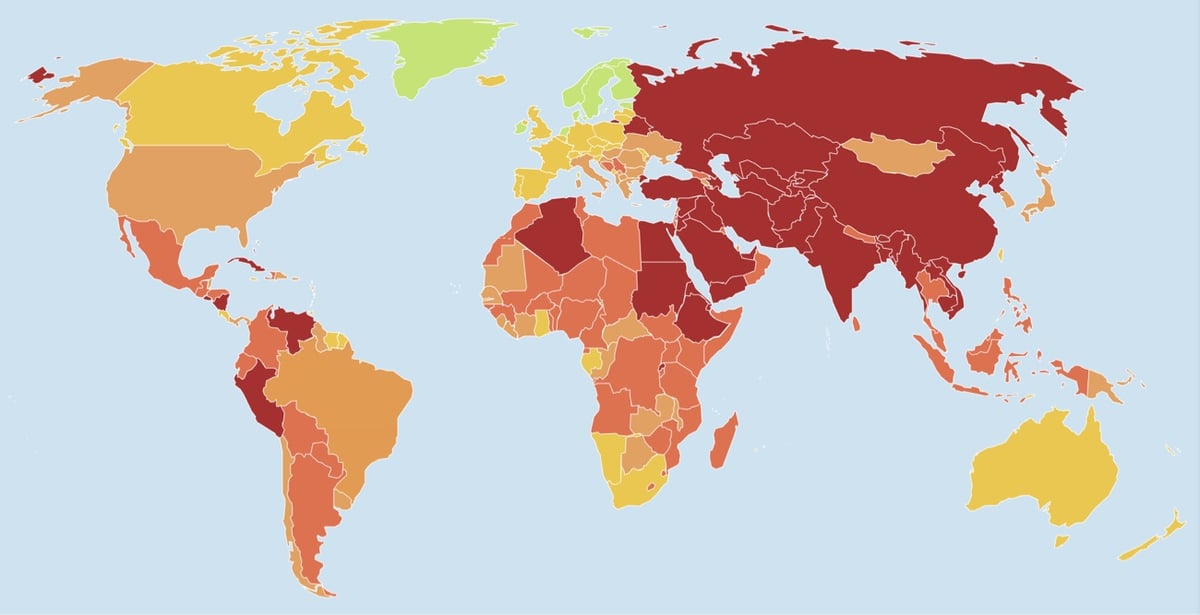
Since Reporters Without Borders started tracking their World Press Freedom Index 25 years ago, the global rating has never been lower than the 2026 score. From a summary of their analysis:

For the first time in the history of the Reporters Without Borders (RSF) World Press Freedom Index, over half of the world’s countries now fall into the “difficult” or “very serious” categories for press freedom. In 25 years, the average score of all 180 countries and territories surveyed in the Index has never been so low. Since 2001, the expansion of increasingly restrictive legal arsenals — particularly those linked to national security policies — has been steadily eroding the right to information, even in democratic countries. The Index’s legal indicator has declined the most over the past year, a clear sign that journalism is increasingly criminalised worldwide. In the Americas, the situation has evolved significantly, with the United States dropping seven places and several Latin American countries sliding deeper into a spiral of violence and repression.

The United States ranks 64th out of 180 countries, a pathetic showing for a country that claims to value the First Amendment:

US President Donald Trump has turned his repeated attacks on the press and journalists into a systematic policy, pushing the US down to 64th place (-7). The detention of Salvadoran journalist Mario Guevara, who was later deported, has contributed to the deterioration of an already tense security environment marked by police violence. The drastic cuts to the US Agency for Global Media (USAGM) workforce had global repercussions, leading to the closure, suspension and downsizing of international broadcasters such as Voice of America (VOA), Radio Free Europe/Radio Liberty (RFE/RL) and Radio Free Asia (RFA) in countries where they were some of the last reliable sources of information.

Some other takeaways from the 2026 report:

Post-Assad Syria has seen the biggest improvement in press freedom of all the countries and territories in the 2026 Index, climbing 36 places in the ranking.

In 2002, 20% of the global population lived in a country where the state of press freedom was categorised as “good.” Twenty-five years later, less than 1% of the world’s population lives in a country that falls under this category.

In some countries, the information space has shrunk over the past 25 years due to political changes and increasingly draconian regimes. This has notably been the case in Hong Kong (140th, -122) since Beijing tightened its control on the territory; in El Salvador (143rd), which dropped 105 places since 2014 and the start of the war on maras, or “gangs”; and in Georgia (135th), which has dropped 75 places as the crackdown on the press has intensified in recent years.

Twenty-five years after the attacks of 11 September 2001 in the United States, expanding the scope of defence secrets and national security has become a means to prohibit coverage of issues of public interest in many countries. This trend, which is particularly prevalent in authoritarian regimes, has also gained traction in democracies and typically goes hand in hand with abusive applications of the law against journalists, notably in the name of combatting terrorism.

(thx, margaret)

Reply · 0

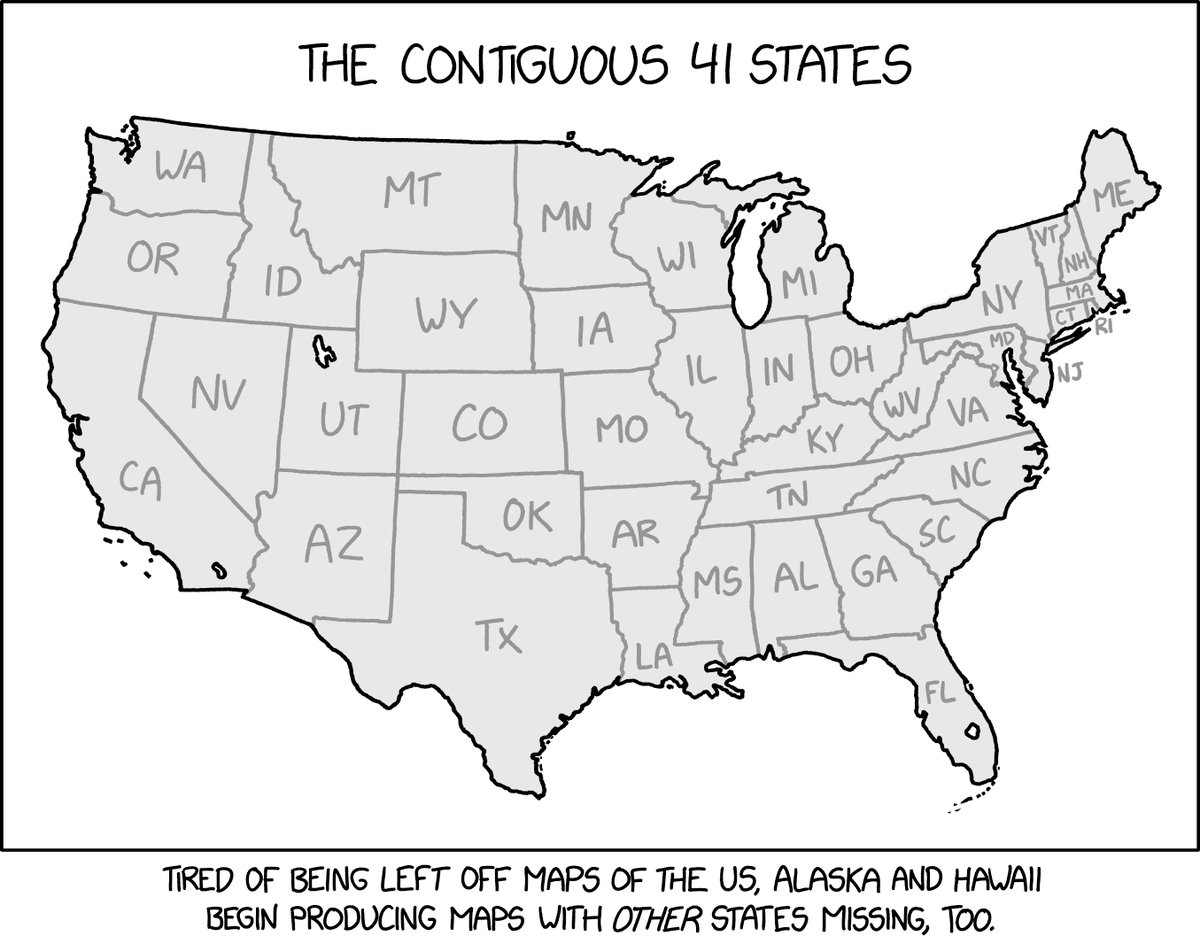
The Contiguous 41 States

Nowhere on XKCD’s map of The Contiguous 41 States does it say that you need to find the missing seven states, but that’s immediately where my mind went. And it was a little more challenging than I anticipated — all of New England is present & accounted for somehow?

The answer key is here, along with this tidbit:

The United States did have exactly 41 states for a few days in 1889, from the admission of Montana, the 41st state, on November 8, to the admission of Washington (the state, not DC), the 42nd state, on November 11.

See also this super-sized US map with 64 states.

And then after I wrote all of the above, I decided to check and of course I’d posted about this map before, soon after it came out. *sigh*

Reply · 5

The Supreme Court Is Corrupt. This Is What We Can Do About It.

This is excellent: Jamelle Bouie explains why he thinks the Supreme Court is corrupt and what we (through Congress) can do about it. Not all video transcripts work as text, but this one does, so I’m including his full remarks here:

The Supreme Court is corrupt.

You might hear that and think, “Well, Jamelle, you just disagree with the rulings. They’re not corrupt. They’re doing their jobs.” But I want to posit to you that they’re not doing their jobs. They’re in fact doing something very different. They’re acting as a super legislature, an unelected group of people who have taken it upon themselves to correct Congress. Not when Congress has overstepped its bounds, not when Congress has overstepped its powers, but when the court simply doesn’t like what they’re doing.

Typically when we use the word corruption, we are thinking about monetary corruption, bribes and the like. And it should be said there’s some of this. Clarence Thomas in particular is known for taking large sums, large gifts from his wealthy benefactors. Alito has also been the beneficiary of wealthy friends. So there is that kind of corruption as well.

But corruption also has a broader meaning. It can mean the malign use of power, the substitution of the public trust for your own private will, your own private interest. And that is more than anything else what is happening with the Supreme Court. You can see it in many different ways. The Roberts Court is quite fond of simply ignoring the plain text of the Constitution whenever it gets into the way of their particular political and ideological projects.

The Roberts Court wants to do a few things. It wants to gut the Reconstruction Amendments. It wants to aggrandize presidential power. It wants to free corporate speech. It wants to allow the wealthy to interact with the political system in any way they choose. And it wants to pursue the particular partisan interest of the Republican party. And so when the text of the Constitution gets in the way, they changed the text or they ignore it.

The text of the Constitution clearly gives Congress the power to handle racial discrimination and voting. And when it came up to the court in 2013 in Shelby County, the court simply made up a new doctrine, state sovereignty. All states have to be treated equally in order to undermine a provision that subjected states with histories of voting discrimination to stricter scrutiny by the federal government. When the court wanted to protect its special boy, Donald Trump from criminal prosecution, it invented a doctrine of criminal immunity for core duties found nowhere in the Constitution and frankly contradicted by the text, history, and theory behind the Constitution. More recently, rather than just shutting down Trump’s efforts to unravel birthright citizenship, the court has taken them seriously despite the clear text and history of the 14th amendment. Where the text interferes with partisan political goals, this Supreme Court says to hell with the text.

The other manner in which the court demonstrates corruption is by not having any particularly consistent jurisprudence. Despite grand claims of being originalist or textualist, this court often decides not based on any particular theory of jurisprudence, but simply on whether they have a decided interest in the case in question — a partisan or political interest.

Consider two days in 2022, back to back. On the first of those days, the court held that because you cannot find gun regulation in the annals of American history, therefore there’s no history or tradition supporting New York State’s attempt to regulate individual gun ownership. And then the very next day, the court releases an opinion stating that despite the fact that you cannot find very much evidence of abortion regulation in the American past, that doesn’t mean states can’t regulate abortion or ban it outright. On one hand, gun rights, which the court likes, history is an obstacle. On the other hand, abortion rights, which the court does not like, history is no limit.

In Trump v. Hawaii, the court held that yes, the Trump administration can use race, can use religion, in determining its travel bans — there’s nothing against the Constitution involved in that. Just last year, the court held that you can use race in immigration stops. That’s why we’re calling them Kavanaugh stops. (Brett Kavanaugh wrote that opinion.)

But as it comes to voting, as we’ve just seen, states can’t use race to remedy past discrimination. States can’t consider race to ensure fair minority representation. States can however engage in racial gerrymandering as long as it’s done under the guise of partisan gerrymandering. What’s the difference? Well, the court likes the president’s nativeist policies. It likes the fact that Republicans can try to gerrymander themselves in the permanent majorities. And so, if it needs to use race to do that, the court has no particular problem with it. Only when it comes time to hamper discrimination to protect rights is race impermissible.

The other manner in which we see the court acting in a corrupt way is in its clear preference for Republican presidents and Republican power. Under Trump, aggressive assertions of executive power were given deference. They were allowed to move forward. Aggressive reinterpretations of existing congressional statutes, reinterpretations that may cut against Congress’s intent were given deference, allowed to move forward. Broad policy changes — such as ending agency independence against the clear text of the law and against 90 years of precedence — are given deference under the idea that the president needs to be able to pursue his priorities.

But Barack Obama wants to use the EPA to reduce carbon emissions? Well, that’s a major question. Congress has to deal with that. Joe Biden wants to forgive student loans? Well, that’s another major question. Congress has to deal with that. Under this court, presidential power when held by Republicans is broad and expansive. Under Democrats, it’s cramped, barely legitimate.

I could go on like this, but the last point I’ll make, the last example of the corruption I’ll give, is the total absence of regularity by this court. What makes a court a court is that there are well-defined procedures, processes — they’re predictable. Courts pay attention to precedent. They have the same rules for all plaintiffs and they explain their decisions. Not so much this court.

There’s the shadow docket in which this court issues broad and important rulings with no explanation, shoots down district court decisions with no explanation, and then insists that those courts hew to its new precedents, which it has offered, again, with no explanation.

In cases where the justices have clear political or ideological interests, they will make up fact patterns to support their case. A religious liberty dispute where a coach says that he is having a private prayer, but in fact he’s having a large public prayer pressuring other students. Well, Neil Gorsuch will simply pretend that the private prayer is what was happening, not the actual public prayer. A plaintiff sues not because they have any particular injury because of a law, but because they hypothetically might have an injury because of a law, despite the fact that they’re not even engaged in the particular business that would bring them that injury. Well, the court says, “Hey, no problem. We’ll still give you standing and we’ll still decide your case because we have a vested interest in making sure that religious liberty means you can discriminate against LGBTQ people.”

And again, there is the shadow docket. Major decisions made without a whiff and inkling of reasoning. Congressionally mandated agencies disrupted. Tens of thousands of livelihoods destroyed. All without a single bit of explanation, simply deference to the president’s desires and decrees. It is capricious and arbitrary. It is the essence of an anti-democratic action of an anti-constitutional action.

It is abundantly clear that as long as John Roberts has his majority, nothing the left of center in this country wants to do is safe or stable. Everything can be killed by the court. We can have democracy and self-government in this country or we can have the Supreme Court as it exists, but we cannot have both. We cannot have both.

And so what is there to be done about the court? There is a real chance that Democrats will have a trifecta in 2029. They might even have large majorities. And in that environment, court reform must be table stakes. There is no other choice, no other option. The rest of the agenda is simply not possible without court reform.

The usual proposals for court reform are expanding the court. And I think that should be done. Expand the court, expand the entire federal judiciary, expand the number of circuits, expand the number of justices commensurate with the circuits. But I think there’s much more to be done than just court expansion. Because it’s not simply that the court is not on the right side. It’s that the court is too powerful. It’s concentrated too much power in itself and we have to deal with a concentration of power.

So court reform legislation has to be geared towards reducing the court’s power. One of those tools would be what’s called jurisdiction stripping, which is permitted under article 3 section 2 of the Constitution. Congress should say that the court simply cannot adjudicate these particular issues. The Congress should impose ethics reform on the court and it should put sharp limits on justice’s ability to get book deals, go on tours, collect honorariums.

But that’s all small ball stuff. There are more radical options as well. We’re going to talk about those more radical options that really would break up the power of the court and cut the court back down to size to remind it that it doesn’t stand above the entire American system as a council of kings, that it is very much part of the American system, in dialogue with the other branches and accountable to the people.

So we can turn the Supreme Court’s neoclassical building, first and foremost, into a museum of some sort and the court will return to its original place: the basement of Congress. Hell, maybe even an office park in Northern Virginia. I don’t care. Court will lose its ability to select its clerks. We’ll take away a patronage system that has corrupted the legal profession. And the court will lose its ability to choose cases. Remember, much of the court’s procedure is already by statute. The building, the clerks, the ability to choose cases, all of that already determined by Congress, and what Congress can give, Congress can take away. The only thing the Constitution mandates that there shall be a Supreme Court. And it gives it a very narrow original jurisdiction. Disputes between states, disputes involving ambassadors, impeachments, that kind of thing.

So, I know I said I support expanding the court, but I also said that was small ball. The other thing you could do totally constitutionally is restrict the court exclusively to its original jurisdiction — to end its ability to hear appeals and then instead to create a new national appeals court comprised of judges from all the existing circuits. We’re already having full-on judicial expansion and so we’re going to create a couple more circuits. Let’s say we have 15 total circuits and each circuit sends two judges to this national appeals court. A random panel of nine judges chooses cases and a random panel of nine judges hears cases. The original Supreme Court can, again, hear whatever is in its original jurisdiction.

If that sounds too extreme to you, then the other option is just to expand the Supreme Court, give it 20 justices, 21 justices, and have it hear cases based off of randomly selected panels. I’m sure there are other options we can think of here, but the goal is not simply to make the court something that is favorable to my views. The goal is to make the court weaker. The goal is to make it more difficult to game the court’s decision-making. The goal is to uncapture the court, to transform it into an actual court and not some tool of partisan and ideological control. There is simply no other choice here. We can have government by judges or we can have government by the people. But we cannot have both. We cannot have both.


Reply · 1

Farewell, Voting Rights Act

Adam Serwer writing about the yesterday’s Supreme Court decision that guts much of whatever remains of the Voting Rights Act:

In states with large Black populations that remain under Republican control — half of the Black American population resides in the South — lawmakers will now be able to draw districts that dilute Black residents’ voting power. In his opinion for the right-wing majority, Justice Samuel Alito wrote that “in considering the constitutionality of a districting scheme, courts must treat partisan advantage like any other race-neutral aim: a constitutionally permissible criterion that States may rely on as desired.” The Court’s decision is consonant with the philosophy, articulated by Kilpatrick in his earlier days, that the state is oppressive when it interferes with the right to discriminate, and respects liberty when it allows discrimination. And the decision fits just as well with Kilpatrick’s later spin on that philosophy: Attempts to ban racial discrimination are themselves discriminatory — against white people.

What Kilpatrick wanted, and what the Roberts Court is making possible, is a country where white people can maintain their political dominance at the expense of Americans who are not white. The anticaste provisions of the Reconstruction amendments, intended by their authors to reverse the “horrid blasphemy” that America was a white man’s country, are being inverted to defend that dominance. This is not the color-blindness of Martin Luther King Jr., but what the scholar Ian Haney López has called “reactionary colorblindness,” the purpose of which is to maintain racial hierarchy through superficially neutral means. It takes the view that the Constitution’s “color-blindness” renders any attempt to remedy anti-Black racism unconstitutional, because by definition that would involve making racial distinctions. Similarly, the ruling in this case does not explicitly overturn the VRA’s ban on racial discrimination in voting so much as rewrite it to allow such discrimination.

I can’t tell you how much I fucking hate this, and every other stupid fucking thing conservatives have done to this country. I try to keep my cynicism (or what I like to think of as being realistic) about the American political situation off the site for the most part, but seeing this decision come down yesterday morning let all the air out of my balloon. Not that it contained much air to begin with…the balloon is shot right through with holes from the past decade+ of authoritarian shenanigans and general acquiescence of institutions that are supposed to protect us.

On a personal note, in these moments I find it increasingly difficult to go on — being engaged here, keeping up with the news, highlighting positives in the world, showcasing the enthusiasms of others, informing ppl of harms & how they can help, hyping hope, not letting the bastards grind me down. It’s nothing new — I’ve talked about it here before — but as the situation becomes more unstable & uncertain (or rather: as I grow more certain about its instability & fuckedness), it grows more difficult to keep going. I know this is self-defeating & self-centered, but I’m angry and scared and grieving and tired. I’m gonna publish this before I just delete the whole stupid thing.

Reply · 6

The Self-Defeating Both-Sidesism of the US Press

Greg Sargent writing for The New Republic:

There’s no clean way to hive off terms like fascism or authoritarianism from Trump’s policies. Even if you disagree that the words apply, their use is backed up by a genuine attempt at intellectual justification for it. The use of these terms just is deeply linked to assessments of Trump’s actual policies, from the lawless renditions to foreign gulags to the unleashing of heavily armed militias in American cities to the naked intimidation of large swaths of civil society.

By contrast, when Trump and MAGA media figures call Democrats “Communists” or “antifa,” all of that is entirely disconnected from any policy realities. Many press figures would like it if there were an Archimedean midpoint between the two parties on all these matters. But there isn’t. At the most basic level, one party continues to function as an actor in a liberal democracy, whereas Trump and much of his movement, with the eager participation of many Republicans, simply do not. Dispensing with harsh but accurate descriptions of his real goals would whitewash them.

See also Republican Extremism and the Myth of “Both Sides” in American Politics.


The K-Shaped Economy

I think I’d heard the term “k-shaped economy” somewhere before but didn’t really know what it meant until I watched this video:

American Airlines is changing the layout of some of their aircraft to add 31 first class and premium seats while cutting out 73 economy seats. This is the hot new trend in air travel: pulling out all the stops to cater to the wealthy.

Airlines are adding suites with more bed space, privacy doors, an extra ottoman for guests. They’re offering caviar, free PJs, luxury skin care products, and multi-course meals with wine pairings made by gourmet chefs. They’re also building more airport lounges. Meanwhile, economy is getting more cramped and low-cost carriers are going bankrupt. It’s because wealthy passengers are where the money’s at.

For years, airlines have made more money from their credit cards than from actually flying passengers around. And these days, premium seating is bringing in more revenue than the economy cabin. It’s a perfect example of the K-shaped economy.

Here’s an AP article about the K-shaped economy from late last year.

Corporate executives are paying attention and in some cases explicitly adjusting their businesses to account for it. They are seeking ways to sell more high-priced items to the wealthy while also reducing package sizes and taking other steps to target struggling consumers.


The America That Could Be

The main point of Adam Bonica’s post The Wall Looks Permanent Until It Falls is about the optimism of this moment: that the US could be ripe for a Berlin Wall-falling moment that opens the door for a better future. I’m not in the mood for that message these days (IMO, our Wall-falling is a ways off in the future), but Bonica’s analysis of how the US compares to 30 other wealthy democracies, our economic peers, is important.

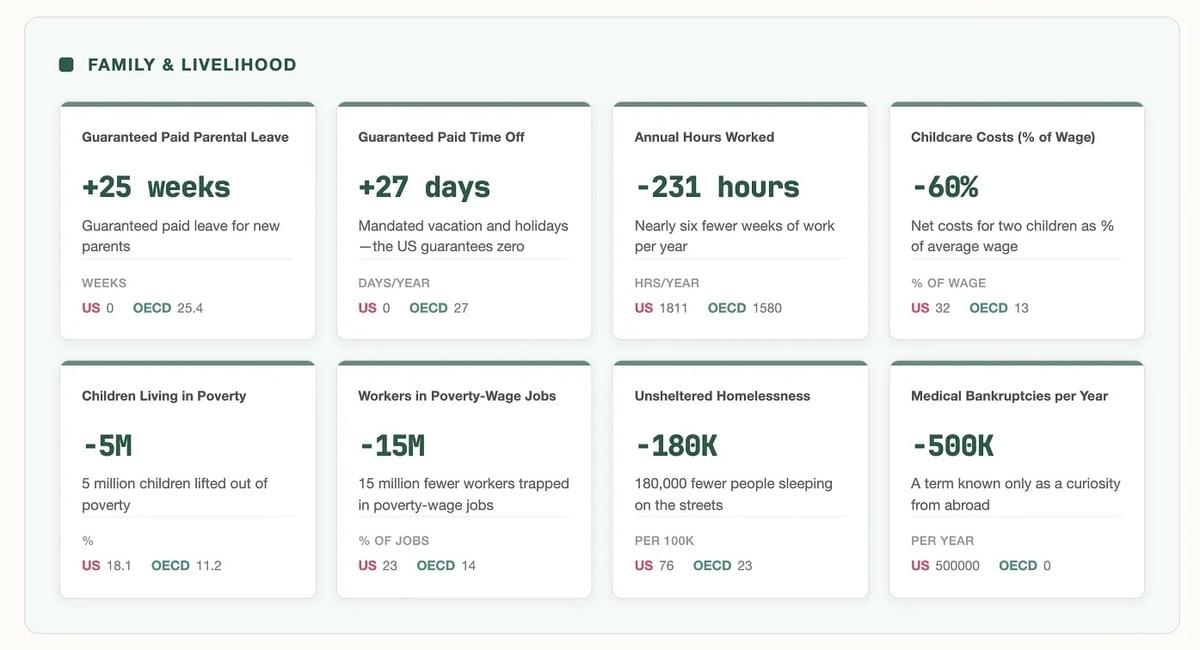
Start with work and economic life. Americans work longer hours, pay more out-of-pocket for college and childcare, lack parental leave, and enjoy less economic mobility. The share of income going to the top 1 percent is nearly double the OECD average. American CEOs earn, on average, 354 times as much as their workers. More workers are trapped in poverty-wage jobs. Collective bargaining covers fewer workers. And social protections are less generous for those who fall on hard times, with the government raising less in taxes and spending more on the military.

The economy is just the beginning.

We spend nearly twice as much on healthcare as other wealthy countries do. Yet life expectancy is well below average, infant and maternal mortality rates are alarmingly high, and more Americans remain uninsured.

We suffer from overlapping public health crises — the highest rates of teenage births, drug overdoses, obesity, and gun deaths among peer nations.

His description of our unique exceptionalism goes on for several more paragraphs. But then he does something quite simple and revealing: he does the math and imagines, in concrete terms, what the US would be like if it were just an average country in its cohort. Bonica calls it “Latent America: the nation that would exist if our democracy functioned to serve the public rather than protect the already powerful”. Here’s part of his analysis:

I don’t think I’ve seen this analysis done in quite this way before. You should click through to see the whole graphic, but some of the other stats are:

  • $19,000 added income per household per year (and $96K more wealth)
  • $2.1 trillion less spending on healthcare
  • 4.1 more years of life expectancy at birth
  • 51 million more Americans voting
  • 1.4 million fewer Americans behind bars
  • 60 more women serving in Congress

And this is just if the US were an average nation. Imagine if the US took its exceptionalism seriously and tried to maximally improve the lives of its citizens & residents instead of generating, as Bonica puts it, “enormous prosperity while deliberately withholding it from those who need it most”.


Abolish ICE

Abolish ICE. Abolish ICE. Abolish ICE. Abolish ICE. Abolish ICE. Abolish ICE. Abolish ICE. Abolish ICE. Abolish ICE. Abolish ICE. Abolish ICE. Abolish ICE. Abolish ICE. Abolish ICE. Abolish ICE. Abolish ICE. Abolish ICE. Abolish ICE. Abolish ICE.


What We Will Use as Weapons: A List of School Supplies

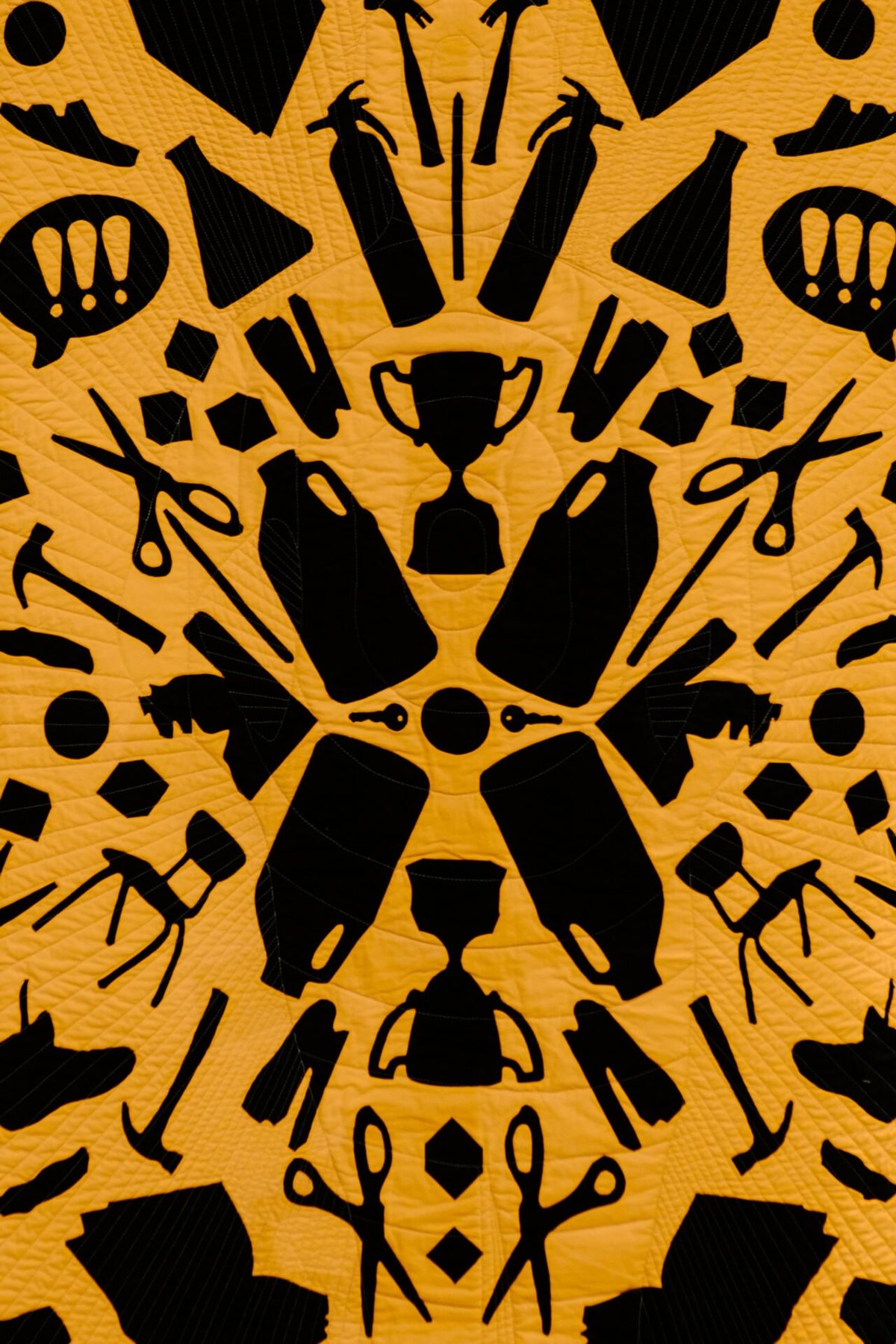
quilt called What We Will Use as Weapons: A List of School Supplies

In 2024, schoolteacher Ginny Robinson won the Best in Show award at a quilting convention for her quilt called What We Will Use as Weapons: A List of School Supplies.

This is a protest quilt. It was made by an artist whose day job puts her on the front lines of one of the most grotesque realities in America today. She is a teacher.

What We Will Use as Weapons: A List of School Supplies is the title for this provocative work of art that features school supplies hurling toward the center on the front and an assault rifle on the back. This long, narrow quilt is the actual size and shape of a door. An outline of a human is stitched through the layers. On the front, the person is meant to represent a shooter, and on the reverse side, a teacher.

Robinson’s quilt is now part of the collection at the International Quilt Museum.

Reply · 1

Born Poor

Born Poor (PBS/Frontline) is a documentary filmed across 14 years about three kids in the US as they grow into young adults while “dealing with an economy where they face more obstacles than opportunities”. Free to watch online (probably US-only, so fire up your VPN if you live elsewhere). From an accompanying article:

More than a decade ago, the Emmy-nominated documentary Poor Kids portrayed poverty in America as it’s rarely seen: through the eyes of children.

Now, those kids — Brittany, Johnny and Kaylie — are all grown up, fighting to overcome the lingering impact of childhood poverty as they navigate young adulthood.

“Once you get in the hole, it’s extremely hard to find your way out,” Brittany says.

She, Johnny and Kaylie continue to share their experiences with the American public in Born Poor, FRONTLINE’s season premiere. Filmed across 14 years, the documentary follows these three kids from three families across three chapters of their lives — from childhood through the teen years to young adulthood — and offers a powerful, personal and longitudinal look at the realities of growing up in poverty in the U.S.

“Do I ever get tired of the struggle? Absolutely,” Johnny says. “But I feel like if you get another day to breathe and wake up and make something happen, you got to get off your butt and make it happen.”

The original documentary was filmed in 2012; I couldn’t find it on PBS’s YT channel, but I think this is it:

The filmmakers updated the film in 2017:

I haven’t watched all of these so I don’t know how much the three versions overlap, but the 2025 version at the top is ~30 minutes longer than the other two.

See also the Up film series.


The US Downgraded in Civic Freedoms Rating

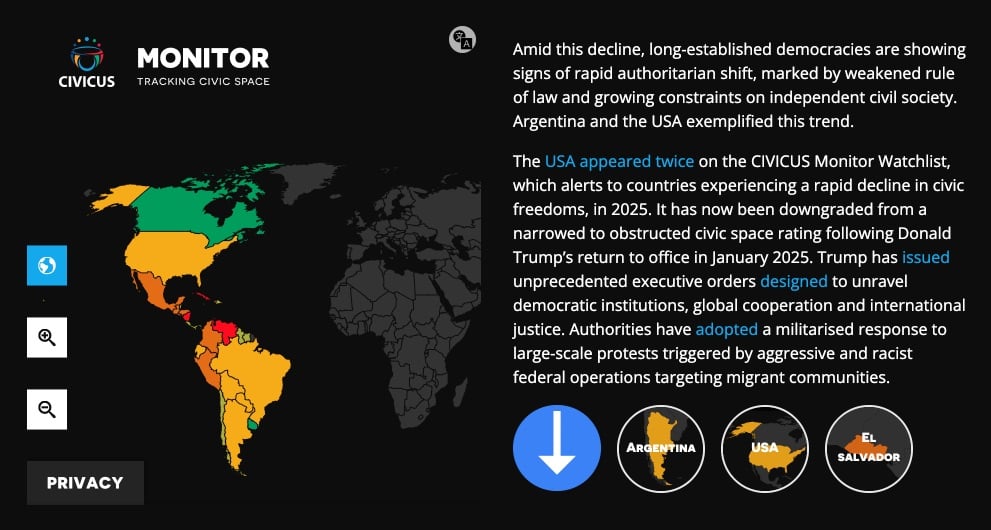
Civicus monitors the health of civic societies and their freedoms around the world. In their annual assessment on civic freedoms for 2025, they downgraded the United States from “narrowed” to “obstructed”.

The CIVICUS Monitor has downgraded the United States of America’s civic space rating, reflecting a sharp deterioration of fundamental freedoms in the country. The People Power Under Attack report now rates the USA as “Obstructed” following a year of sweeping executive actions, restrictive laws, and aggressive crackdowns on free speech and dissent.

The downgrade comes following Donald Trump’s return to office in January 2025, which triggered a wave of measures undermining democratic institutions and civic freedoms. The report flags a drastic surge in violations of the rights to freedom of expression, association, and peaceful assembly.

“The backsliding on rule of law and fundamental freedoms in the United States is truly alarming,” said Mandeep Tiwana, secretary general of CIVICUS. “We are witnessing a rapid and systematic attempt to stifle civic freedoms that Americans have come to take for granted, such as critiquing authorities and protesting peacefully.”

From an article in the Guardian on the report:

The report cited militarized crackdowns on protests in the US, pointing to Donald Trump’s deployment of the national guard to Los Angeles and other cities, as well as the widespread use of ICE agents across gatherings and immigrant communities.

It further highlighted escalating restrictions on free speech across college campuses, particularly around Palestinian solidarity activism.

“Universities have suspended student groups and opened investigations under broad and vague accusations of ‘material support for terrorism.’ Foreign-born students and faculty have been disproportionately targeted, facing disciplinary actions, visa threats, and professional retaliation for supporting Palestinian rights,” the report stated.

Civicus moreover warned that media freedoms were under mounting pressure nationwide, citing the Federal Communications Commission’s threats to revoke broadcast licenses and Trump’s lawsuits against various media companies.

It also pointed to Trump’s revocation of funding for public broadcasters including NPR and PBS, as well as the new White House Wire, an administration-run news website that promotes positive news about itself.


Thoughts and Prayers

This is the trailer for an HBO documentary called Thoughts and Prayers about “the impact of the $3 billion active shooter preparedness industry on schools and communities across America”.

It’s tough to watch, as is this clip from the film in which a girl describes a bag of supplies that she carries in her backpack in case there’s a school shooting.

From David Ehrlich’s review in IndieWire:

Bulletproof desks that students can flip over at the first sign of trouble. A robot dog the size of a Pomeranian that jumps and yaps at the sight of an intruder. Inflatable body armor light enough for a first grader to blow up and hide behind. These are just a few of the more sensible products that are on display in the opening moments of Zackary Canepari and Jessica Dimmock’s utterly damning “Thoughts & Prayers” — the least farcical selection of props that contribute to America’s burgeoning active shooter defense industry, which now grosses more than three billion dollars per year.

Of course, that’s a small price to pay for the laughably transparent illusion that we’re taking any meaningful steps toward protecting our kids from being slaughtered in their classrooms. In a crumbling empire where common sense has been eroded by ideology, and the political will to solve a problem can’t hope to compete with the ghoulish impulse to profit from it, creating a new business sector might just be the only kind of healing that the richest country on Earth can afford.

It is totally and utterly and completely sickening that we choose to live this way in America.


Climate Change in America: Is It Too Late to Wake Up?

From Vann R. Newkirk II, a editor & journalist who hosts the Floodlines podcast (about Hurricane Katrina), a long piece about the climate chaos that’s taking hold in the US: What Climate Change Will Do to America by Mid-Century.

Over the next 30 years or so, the changes to American life might be short of apocalyptic. But miles of heartbreak lie between here and the apocalypse, and the future toward which we are heading will mean heartbreak for millions. Many people will go in search of new homes in cooler, more predictable places. Those travelers will leave behind growing portions of America where services and comforts will be in short supply — let’s call them “dead zones.” Should the demolition of America’s rule of law continue, authoritarianism and climate change will reinforce each other, a vicious spiral from which it will be difficult to exit.

Newkirk details how the increasing effects of the climate crisis might play out in “a landscape of inequality” like the United States.

Even if climate change does not trigger a full-fledged economic panic, whole regions will be thinned out and impoverished. Residential areas are the centerpiece of local economies, yet without insurance, people cannot get mortgages, and so most cannot buy houses. The mere prospect of that makes business investment riskier. Jesse Keenan, a professor at Tulane University who studies climate change and real estate, told me that some places are already becoming economic “no-go” zones.

I remember reading about the coming climate-driven crisis in insurance back in the early 2000s — e.g. Michael Lewis’s post-Katrina piece in the NY Times Magazine — and hoping it wouldn’t come to that but knowing that it would as years went by without significant action on climate. And now here we are.

Reply · 1

High Horse: The Black Cowboy

High Horse: The Black Cowboy is a three-part documentary about the culture of Black cowboys & cowgirls and their erasure from the history of the western United States.

From executive producer Jordan Peele and Monkeypaw Productions, the pop culture and historical documentary confronts and reclaims the Wild West while revealing the story of the Black cowboy — a history that has largely been untold. It rides into the forgotten corners of history, shattering myths and celebrating the Black cowboys, farmers, jockeys, musicians, and rodeo champions who built the West — and now takes back their place in the saddle, sitting high atop the horse.

High Horse: The Black Cowboy starts streaming Nov 20th on Peacock.


Kara Walker Creates Haunted Beast From Butchered Confederate Statue

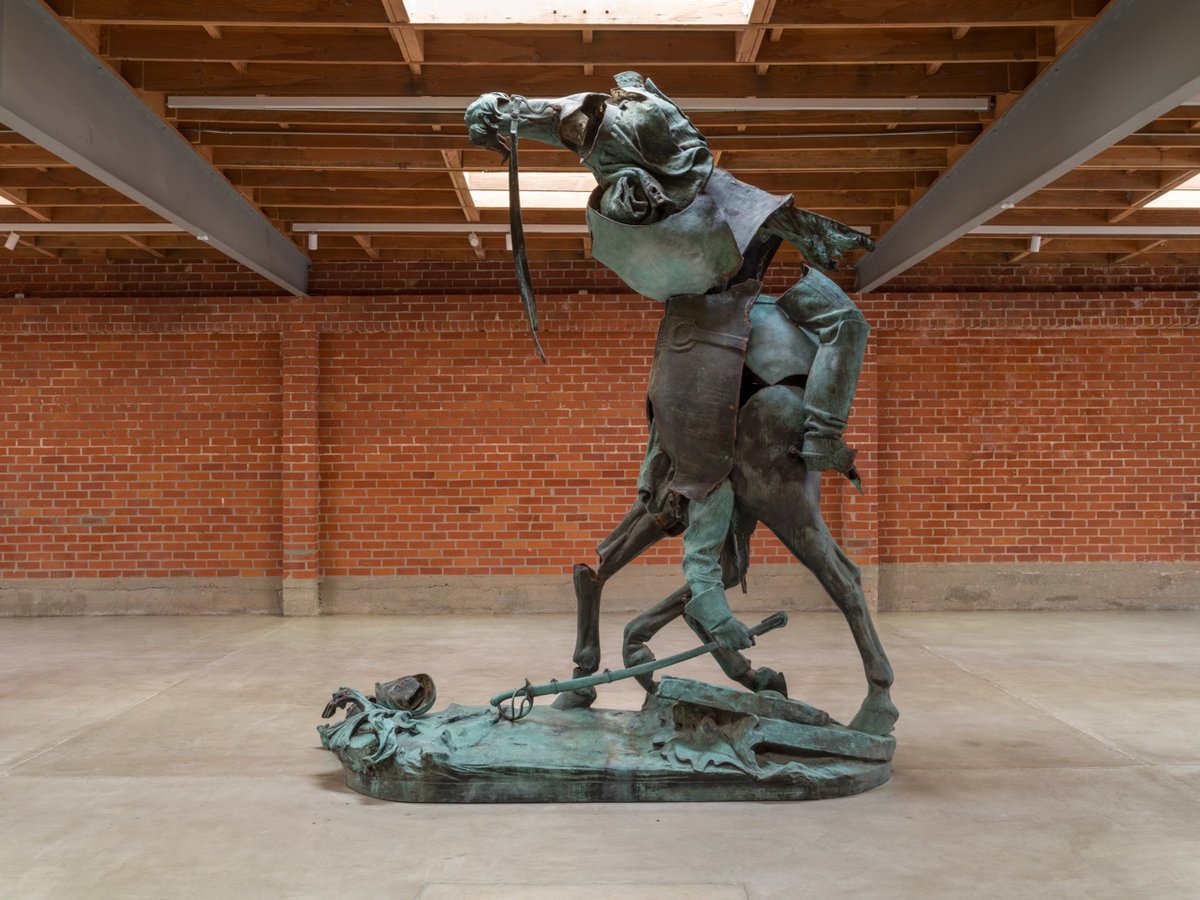
a sculpture of a monstrous figure

a sculpture of a monstrous figure

This is incredible: artist Kara Walker took a statue of Confederate general Stonewall Jackson that had stood in Charlottesville, Virginia until 2021, chopped it up, and reconstituted it into a disfigured beast. It’s part of an exhibition of several such works called Monuments, which opens at The Geffen Contemporary at MOCA in LA on October 23. From the press release:

In 2021, The Brick (then known as LAXART) acquired a decommissioned equestrian monument of “Stonewall” Jackson from the city of Charlottesville, Virginia. The monument was given to Kara Walker to create the new work Unmanned Drone (2023). The original bronze statue portrayed Jackson spurring his steed into the heat of battle. Walker dissected the statue and reshuffled the parts in a Hieronymous Bosch-like fashion. The result is still horse and rider, but instead of charging into battle, Walker’s horseman wanders in Civil War purgatory, dragging its sword over a ruined battlefield.

Here’s the statue as it looked in Charlottesville:

a statue of Stonewall Jackson, astride his horse

Walker described the intent of the work in this NY Times piece:

She likened the result to a haint — a Southern concept with roots in Gullah Geechee culture that designates a spirit that has slipped its human form and roams about making mischief and exacting vengeance. Here, what is deconstructed is not just a statue but the myth of suppressed Confederate glory that it represents. Her sculpture, she suggested, “exists as a sort of haint of itself — the imagination of the Lost Cause having to recognize itself for what it is.”

The Guardian also has a long article on the show and Walker’s piece.

Reply · 5

The Armed Takeover of US Cities by the President Is Not a “Distraction”

Jamelle Bouie on Democratic politicians who maddeningly cannot recognize and acknowledge what is going on in the country.

From my perspective, the story of American politics right now is that the president, who fashions himself a kind of king of America, is attempting to barricade himself in the capital by unleashing a military occupation on its residents. And he’s promised to extend this military occupation to other cities and other states that he views as political opponents.

That to me is the big story of American politics right now: a mad king openly exerting tyrannical power over Americans and threatening further tyrannical power against other Americans, all under a pretext of crime reduction.


The Boston Globe’s Prescient 2016 View of Our Trumpist Future

On April 9, 2016, several months before Donald Trump was elected President for the first time, the Boston Globe ran an editorial entitled “The GOP must stop Donald Trump”.

Donald J. Trump’s vision for the future of our nation is as deeply disturbing as it is profoundly un-American.

It is easy to find historical antecedents. The rise of demagogic strongmen is an all too common phenomenon on our small planet. And what marks each of those dark episodes is a failure to fathom where a leader’s vision leads, to carry rhetoric to its logical conclusion. The satirical front page of this section attempts to do just that, to envision what America looks like with Trump in the White House.

It is an exercise in taking a man at his word. And his vision of America promises to be as appalling in real life as it is in black and white on the page. It is a vision that demands an active and engaged opposition. It requires an opposition as focused on denying Trump the White House as the candidate is flippant and reckless about securing it.

As part of the editorial, they imagined a Globe front page one year into a future Trump presidency:

the imagined front page of the Boston Globe

Some of the headlines read “Deportations to Begin: President Trump calls for tripling of ICE force; riots continue” and “Markets sink as trade war looms”. They may have gotten the timeline and some of the details wrong, but many of the Globe’s fake headlines now read as tame.

In his second term, Trump has removed any pretense of governing and is full steam ahead on indulging his bigotry, filling his coffers, playing Big Boy Diplomat, and replacing the American system of democracy with a conservative authoritarian government. And as the editorial notes, all you had to do to predict it was to take Trump at his word. (via @epicciuto.bsky.social)


Jamelle Bouie on the Death of the Fourth American Republic

This is a great piece from Jamelle Bouie on the likely death of the Voting Rights Act and, zooming out, the end of an era in American society that began with the Act’s signing.

Americans pride ourselves, by contrast, on our undivided history under one Constitution — a single, ongoing experiment in self-government. But look closely at American history and you’ll see that this is an illusion of continuity that belies a reality of change, and sometimes radical transformation, over time. There are several American republics and at least two Constitutions, a first and a second founding. Our first republic began with ratification in 1788 and collapsed at Fort Sumter in 1861. Our second emerged from the wreckage of the Civil War and was dismantled, as the University of Connecticut historian Manisha Sinha argues, by Jim Crow at home and imperial ambition abroad. If the third American republic took shape under the unusual circumstances of the middle decades of the 20th century — what the Vanderbilt historian Jefferson Cowie calls “the great exception” of depression, war and a political system indelibly shaped by immigration restriction and the near-total exclusion of millions of American citizens from the political system — then the fourth began with the achievements of the civil rights movement, which included a newly open door to the world.

America’s fourth republic was one “built on multiracial pluralism” and it’s under siege by the Trump regime, which wants to return control of America to white men.

It’s this America that Donald Trump and his movement hope to condemn to the ash heap of history. It’s this America that they’re fighting to destroy with their attacks on immigration, civil rights laws, higher education and the very notion of a pluralistic society of equals.


The End of America as a Center of Science

Ross Anderson writes about how scientific empires, from the ancient Sumerians to the Nazis to the Soviet Union in the 1950s, have crumbled (or been willfully dismantled by ideologues) and the clear signs that the same thing is happening here in the United States under the conservative regime.

The very best scientists are like elite basketball players: They come to America from all over the world so that they can spend their prime years working alongside top talent. “It’s very hard to find a leading scientist who has not done at least some research in the U.S. as an undergraduate or graduate student or postdoc or faculty,” Michael Gordin, a historian of science and the dean of Princeton University’s undergraduate academics, told me. That may no longer be the case a generation from now.

Foreign researchers have recently been made to feel unwelcome in the U.S. They have been surveilled and harassed. The Trump administration has made it more difficult for research institutions to enroll them. Top universities have been placed under federal investigation. Their accreditation and tax-exempt status have been threatened. The Trump administration has proposed severe budget cuts at the agencies that fund American science — the NSF, the NIH, and NASA, among others — and laid off staffers in large numbers. Existing research grants have been canceled or suspended en masse. Committees of expert scientists that once advised the government have been disbanded. In May, the president ordered that all federally funded research meet higher standards for rigor and reproducibility — or else be subject to correction by political appointees.

And so:

Funding for American science has fluctuated in the decades since [World War II]. It spiked after Sputnik and dipped at the end of the Cold War. But until Trump took power for the second time and began his multipronged assault on America’s research institutions, broad support for science was a given under both Democratic and Republican administrations. Trump’s interference in the sciences is something new. It shares features with the science-damaging policies of Stalin and Hitler, says David Wootton, a historian of science at the University of York. But in the English-speaking world, it has no precedent, he told me: “This is an unparalleled destruction from within.”


The Most Observed Plants & Animals in Each US State

a hand-drawn map of the US labeled with tthe most observed plant and animal for all 50 US states as reported by iNaturalist users

XKCD mapped the most observed plant and animal for all 50 US states as reported by iNaturalist users. I had no idea bumble bees were such a popularly observed animal — the common eastern bumble bee (Bombus impatiens) is most-observed in Vermont, Wisconsin, Maine, Connecticut, Illinois, and Minnesota. Also popular: white-tailed deer, bison, milkweed, honeysuckle, and robins.

Reply · 6

The Black Panther Party Ten-Point Program

In 1966, Huey Newton & Bobby Seale formed the Black Panther Party and wrote a 10-point manifesto of what the group stood for and what they wanted. Here’s the full text of the plan.

4. We Want Decent Housing Fit For The Shelter of Human Beings.

We believe that if the White Landlords will not give decent housing to our Black community, then the housing and the land should be made into cooperatives so that our community, with government aid, can build and make decent housing for its people.

5. We Want Education for Our People That Exposes The True Nature Of This Decadent American Society. We Want Education That Teaches Us Our True History And Our Role in the Present-Day Society.

We believe in an educational system that will give to our people a knowledge of self. If a man does not have knowledge of himself and his position in society and the world then he has little chance to relate to anything else.


There’s No Undo Button For Our Fallen Democracy

Tressie McMillan Cottom, one of America’s leading public intellectuals, posted this to Bluesky yesterday:

I’m going to be very honest and clear.

I am fully preparing myself to die under this new American regime. That’s not to say that it’s the end of the world. It isn’t. But I am almost 50 years old. It will take so long to do anything with this mess that this is the new normal for *me*.

I do hope a lot of you run. I hope you vote, sure. Maybe do a general strike or rent strike. All great!

But I spent the last week reading things and this is not, for ME, an electoral fix. So now I will spend time reflecting on how to integrate this normal into my understanding of the future.

Most of this will be personal. Some of it will be public — how we move in the world.

Right now, I know that I need to make a decision on my risk sensitivity. How much can I take? I also need to meditate HARD on accepting the randomness of that risk. No amount of strategy can protect me.

Those are things I am thinking about.

In response, Anil Dash posted:

Yeah, I keep telling people this is a rest-of-my-life fight, and… they do *not* want to hear it.

Author Meg Elison:

I’ve been thinking something like this for a few months now. We will fight, we will resist, etc. But we will also not live the lives we picked out and planned on. They’re not available anymore.

Therapist and political activist Leah McElrath:

Since Trump regained office, I’ve talked about this both gently and bluntly to try to help people understand that we lived in one era but we’re going to die in another.

I am, at least. I know my probable life expectancy and, at 61, have about 15 years left.

And @2naonwheat.bsky.social:

We’re all going to have to start planting shade trees we fully know we’ll never sit under.

Cottom nails how I’ve been feeling for the past few months (and honestly why it’s been a little uneven around KDO recently). America’s democratic collapse has been coming for years, always just over the horizon. But when everything that happened during Trump’s first three months in office happened and (here’s the important part) shockingly little was done by the few groups (Congress, the Supreme Court, the Democratic Party, American corporations & other large institutions, media companies) who had the power to counter it, I knew it was over. And over in a way that is irreversible, for a good long while at least.

Since then, I’ve been recalibrating and grieving. Feeling angry — furious, really. Fighting resignation. Trying not to fall prey to doomerism and subsequently spreading it to others. (This post is perhaps an exception, but I believe, as Cottom does, in being “honest and clear” when times call for it.) Getting out. Biking, so much biking. Paying less attention to the news. Trying to celebrate other facets of our collective humanity here on KDO — or just being silly & stupid. Feeling overwhelmed. Feeling numb. But also (occasionally, somehow) hope?

All of this is exhausting. Destabilizing. I don’t know what I’m doing or what I should be doing or how I can be of the most service to others. (Put on your oxygen mask before assisting others, they say. Is my mask on yet? I don’t know — how can I even tell?) I barely know what I’m trying to say and don’t know how to end this post so I’m just gonna say that the comments are open on this post (be gentle with each other, don’t make me regret this) and I’ll be back with you here after the, uh, holiday.

Reply · 28

What Was Jim Crow?

This is an excellent video explanation from Jamelle Bouie of what Jim Crow was, how it developed, and how it continues to reverberate in American society and politics today.

If you are an American watching this, and you had a standard social studies or history class in high school, you may think of Jim Crow as more or less simply being separate institutions, separate bathrooms, separate water fountains — various kinds of public disrespect. And those certainly were the symbols of Jim Crow, symbols of outward public disrespect. But that’s not what the system was.

Jim Crow the system was something we would recognize today, and describe as today, as authoritarian. And specifically, it was an authoritarian system of labor control and political control. The Jim Crow states sharply limited political participation by large parts of their population — most of them black, but not a small number of them white as well — and the Jim Crow states themselves were largely vehicles for the interest of powerful owners of capital and property: land owners, factory owners — people who had a vested interest in direct control of labor. The social separation, the extreme and atavistic violence, the theft, the plunder — all of these things were downstream of this effort to control political behavior and control labor. They were the mechanisms of that control, the way to keep people in line or keep them bought into the system if they were on the white side of the color line.

The video is long and it gets into some detail that’s not super exciting (but is nevertheless important), but stick with it — I learned a lot.


What Is Juneteenth and Why Does It Matter?

Historian Heather Cox Richardson is now doing visual versions of her daily newsletter on YouTube. Yesterday’s video explains the origins and significance of Juneteenth.

Black people in Galveston met the news Order No. 3 brought with celebrations in the streets, but emancipation was not a gift from white Americans. Black Americans had fought and died for the United States. They had worked as soldiers, as nurses, and as day laborers in the Union army. Those who could had demonstrated their hatred of enslavement and the Confederacy by leaving their homes for the northern lines, sometimes delivering valuable information or matériel to the Union, while those unable to leave had hidden wounded U.S. soldiers and helped them get back to Union lines.

But white former Confederates in Texas were demoralized and angered by the changes in their circumstances. “It looked like everything worth living for was gone,” Texas cattleman Charles Goodnight later recalled.


Shifting Baselines and the New Normal of the Trump Era

This Is Fine

Among a number of things I’ve read online that I think about all the time is David Roberts’ 2020 piece for Vox about shifting baselines.

Humans often don’t remember what we’ve lost or demand that it be restored. Rather, we adjust to what we’ve got.

Concepts developed in sociology and psychology can help us understand why it happens — and why it is such a danger in an age of accelerating, interlocking crises. Tackling climate change, pandemics, or any of a range of modern global problems means keeping our attention on what’s being lost, not just over our lifetimes, but over generations.

Roberts cites the work of fisheries scientist Daniel Pauly in explaining the concept:

So what are shifting baselines? Consider a species of fish that is fished to extinction in a region over, say, 100 years. A given generation of fishers becomes conscious of the fish at a particular level of abundance. When those fishers retire, the level is lower. To the generation that enters after them, that diminished level is the new normal, the new baseline. They rarely know the baseline used by the previous generation; it holds little emotional salience relative to their personal experience.

And so it goes, each new generation shifting the baseline downward. By the end, the fishers are operating in a radically degraded ecosystem, but it does not seem that way to them, because their baselines were set at an already low level.

Over time, the fish goes extinct — an enormous, tragic loss — but no fisher experiences the full transition from abundance to desolation. No generation experiences the totality of the loss. It is doled out in portions, over time, no portion quite large enough to spur preventative action. By the time the fish go extinct, the fishers barely notice, because they no longer valued the fish anyway.

Shifting baselines can also occur in individuals and across shorter timelines, especially in intense situations. In a recent piece for the NY Times, M. Gessen warns that we’re entering a new phase of the Trump Era:

In this country, too, fewer and fewer things can surprise us. Once you’ve absorbed the shock of deportations to El Salvador, plans to deport people to South Sudan aren’t that remarkable. Once you’ve wrapped your mind around the Trump administration’s revoking the legal status of individual international students, a blanket ban on international enrollment at Harvard isn’t entirely unexpected.

Once you’ve realized that the administration is intent on driving thousands of trans people out of the U.S. military, a ban on Medicaid coverage for gender-affirming care, which could have devastating effects for hundreds of thousands, just becomes more of the same. As in a country at war, reports of human tragedy and extreme cruelty have become routine — not news.

This stasis, complacency, and boredom is what I was getting at in this post from March:

And but so anyway, the point is that there’s so much important stuff going on! Fundamental human rights are under fresh attack daily! This is not a drill! But at the same time, the fundamental situation has not materially changed in a few weeks. There was a coup. It was successful. It is ongoing and escalating. Elon Musk retains more or less total control over a huge amount of the federal government’s apparatus and its spending. Protests are building. Congress largely hasn’t reacted. The Democratic Party shows few signs of behaving like an opposition party. Some of the purges are being walked back, piecemeal. The judiciary is weighing in, slowly. There’s talk of cracks in the conservative coalition. We’re in a weird sort of stasis where each day’s events are both extremely significant and also just more of the same.

Humans can get used to almost anything. At times, our shifting baselines can be a source of resilience even in the face of great peril. They also can result in great injustice. I don’t have any advice about staying engaged during periods like these, but awareness is surely part of it.


Three Fascism Experts on Why They’re Leaving the US

At the end of March, I posted some news about three prominent scholars of fascism and authoritarianism who were leaving the United States to live and work in Canada. In this video for the NY Times, We Study Fascism, and We’re Leaving the U.S., Marci Shore, Timothy Snyder, and Jason Stanley explain their reasons for going. Here’s some of what they had to say:

I’m leaving to the University of Toronto because I want to do my work without the fear that I will be punished for my words.

The lesson of 1933 is you get out sooner rather than later.

My colleagues and friends, they were walking around and saying, “We have checks and balances. So let’s inhale, checks and balances, exhale, checks and balances.” And I thought my God, we’re like people on the Titanic saying our ship can’t sink. We’ve got the best ship. We’ve got the strongest ship. We’ve got the biggest ship. Our ship can’t sink. And what you know is a historian is that there is no such thing as a ship that can’t sink.

I want Americans to realize that this is a democratic emergency.

Toni Morrison warned us: “The descent into a final solution is not a jump. It’s one step. And then another. And then another.” We are seeing those steps accelerated right now.

Reply · 2

“None of Us Knows What the Future Will Deliver”

On Friday, Heather Cox Richardson spoke at an event marking the 250th anniversary of the lighting of the lanterns at Boston’s Old North Church. The lantern lighting — “one if by land, two if by seas” — was part of years-long effort by some American colonists to resist what they thought of as unjust behavior by a tyrant king, and led to the start of the Revolutionary War. Richardson’s speech is well worth reading.

It was hard for people to fathom that the country had come to such division. Only a dozen years before, at the end of the French and Indian War, Bostonians looked forward to a happy future in the British empire. British authorities had spent time and money protecting the colonies, and colonists saw themselves as valued members of the empire. They expected to prosper as they moved to the rich lands on the other side of the Appalachian Mountains and their ships plied the oceans to expand the colonies’ trade with other countries.

That euphoria faded fast.

Almost as soon as the French and Indian War was over, to prevent colonists from stirring up another expensive struggle with Indigenous Americans, King George III prohibited the colonists from crossing the Appalachian Mountains. Then, to pay for the war just past, the king’s ministers pushed through Parliament a number of revenue laws.

In 1765, Parliament passed the Stamp Act, requiring the payment of a tax on all printed material—from newspapers and legal documents to playing cards. It would hit virtually everyone in the North American colonies. Knowing that local juries would acquit their fellow colonists who violated the revenue acts, Parliament took away the right to civil trials and declared that suspects would be tried before admiralty courts overseen by British military officers. Then Parliament required colonials to pay the expenses for the room and board of British troops who would be stationed in the colonies, a law known as the Quartering Act.

But what Parliament saw as a way to raise money to pay for an expensive war—one that had benefited the colonists, after all—colonial leaders saw as an abuse of power. The British government had regulated trade in the empire for more than a century. But now, for the first time, the British government had placed a direct tax on the colonists without their consent. Then it had taken away the right to a trial by jury, and now it was forcing colonists to pay for a military to police them.

You can also watch Richardson give her speech at the Old North Church (she begins at the ~1:18:30 mark):

You can also listen to her read it on Apple Podcasts, Spotify, or wherever you get your podcasts. (thx, meg)


Unequal Rights

Heather Cox Richardson on where we are right now in terms of what type of government we currently have:

Here’s the thing: Once you give up the idea that we are all equal before the law and have the right to due process, you have given up the whole game. You have admitted the principle that some people have more rights than others. Once you have replaced the principle of equality before the law with the idea that some people have no rights, you have granted your approval to the idea of an authoritarian government. At that point, all you can do is to hope that the dictator and his henchmen overlook you.

They are 100% going to try to do this with citizens:

Make no mistake: as Supreme Court Justices Sonia Sotomayor, Elena Kagan, and Ketanji Brown Jackson recently warned, if the administration can take noncitizens off the streets, render them to prison in another country, and then claim it is helpless to correct the error either because the person is out of reach of U.S. jurisdiction, it could do the same thing to citizens.

Meanwhile, Trump’s approval rating is still well above 40% (and is even higher if you don’t factor in the economy/tariffs). 🤷‍♂️