kottke.org posts about audio
Some genius has taken an audio sample of the hum of a grocery store freezer, cleaned it up, and extended it into a 10-hour video. The freezer’s hum, variously compared to Brian Eno’s music and “an electrical gong bath”, went viral enough to warrant an article in the Guardian last month:
“Anyone noticed how nice the freezers sound in the eccy road co-op?” someone wrote on the Sheffield Reddit page in January. “It’s like all the fans have been carefully tuned to the calmest droning chord ever, it’s like being in an electrical gong bath.”
Earlier this week, another Redditor shared a video of the freezers in all their aural glory, later earning a huge second audience when reposted to X. A debate ensued. Was it tuned to C# major? Could you hear the opening of Nothing Compares 2 U somewhere in the electronic hum? “I think it’s developed a slight discordant edge over the last couple of months,” one Reddit user wrote. “It’s ageing like fine wine.”

Intertapes is a collection of found cassette tapes — some contain music and others voice memos. Each entry includes images of the tape, a description/track listing, and the actual audio (on Soundcloud).
This one was recorded off of a NYC radio station in 1994 and includes tracks from Mary J. Blige, Wu-Tang, Snoop Dogg, and Heavy D.
This tape found recently in Berlin was also recorded in 1994 by someone named Sven and includes tracks by Underworld & Laurent Garnier.
Ok so this is weird and delightful. Swedish electronics company Teenage Engineering makes a collection of singing wooden dolls called the Choir. The dolls are basically speakers but with some autonomy and personality…and they can work together:
what you see are eight wooden dolls, made to serenade you with a repertoire of choral classics as well as perform your own original compositions through midi over ble. each member has their own characteristic vocal range. individually one can sing a dynamic solo, together they perform an immersive a cappella concert.

Composer Rob Simonsen used three Choirs together to help create the score for Elio, the newest Pixar movie that takes place in space.
we were looking for an otherworldly sound—something that sounded relatable, that echoed vocalizations, communication that humans could understand, but felt like it was from another world. i came across these choir dolls and heard their sound. it was beautiful — electronic, but human. each body is handcrafted. they have a robotic but organic sound at the same time. it felt like a perfect answer to what we were looking for.
In this interview with Simonsen, he talks about working with the Choir to create the movie’s sound; the relevant part starts at the 15:20 mark and includes some of the music they composed with it.
There’s a flip flop element to this too: they mic’d up the dolls to record the audio, just like they would with human performers.
Here’s another short clip of the Choir in action:
Like I said, weird and delightful. You can get your own full ensemble from Teenage Engineering for about $2000.
See also Dueling Carls, which this reminded me of for some reason.
I’ve posted before about Charles Brooks’ fantastic series of photographs of the insides of musical instruments. Recently, Brooks had the opportunity to apply his technique to capture the innards of a particle accelerator.

Brooks says of the photo:
Despite being a scientific instrument, it behaves a lot like a musical instrument. Electrons pulse through this tunnel in tight, synchronized waves. The powerful magnets above and below make them undulate — just like the vibrating string of a fine cello — creating an intense X-ray beam used to probe hidden structures of our world.
As part of the project, accelerator physicist Eugene Tan converted the pulsing of the electrons in the chamber into sound, “letting us hear the movement of electrons at nearly the speed of light”.
Petapixel has a lot more on how this image was captured.
“This was an instant yes for me,” Brooks tells PetaPixel. “It ticked so many boxes: I’m always drawn to photographing hidden or complex spaces, and this was one of the most intricate objects I could possibly shoot.”
(via colossal)
On Friday, Heather Cox Richardson spoke at an event marking the 250th anniversary of the lighting of the lanterns at Boston’s Old North Church. The lantern lighting — “one if by land, two if by seas” — was part of years-long effort by some American colonists to resist what they thought of as unjust behavior by a tyrant king, and led to the start of the Revolutionary War. Richardson’s speech is well worth reading.
It was hard for people to fathom that the country had come to such division. Only a dozen years before, at the end of the French and Indian War, Bostonians looked forward to a happy future in the British empire. British authorities had spent time and money protecting the colonies, and colonists saw themselves as valued members of the empire. They expected to prosper as they moved to the rich lands on the other side of the Appalachian Mountains and their ships plied the oceans to expand the colonies’ trade with other countries.
That euphoria faded fast.
Almost as soon as the French and Indian War was over, to prevent colonists from stirring up another expensive struggle with Indigenous Americans, King George III prohibited the colonists from crossing the Appalachian Mountains. Then, to pay for the war just past, the king’s ministers pushed through Parliament a number of revenue laws.
In 1765, Parliament passed the Stamp Act, requiring the payment of a tax on all printed material—from newspapers and legal documents to playing cards. It would hit virtually everyone in the North American colonies. Knowing that local juries would acquit their fellow colonists who violated the revenue acts, Parliament took away the right to civil trials and declared that suspects would be tried before admiralty courts overseen by British military officers. Then Parliament required colonials to pay the expenses for the room and board of British troops who would be stationed in the colonies, a law known as the Quartering Act.
But what Parliament saw as a way to raise money to pay for an expensive war—one that had benefited the colonists, after all—colonial leaders saw as an abuse of power. The British government had regulated trade in the empire for more than a century. But now, for the first time, the British government had placed a direct tax on the colonists without their consent. Then it had taken away the right to a trial by jury, and now it was forcing colonists to pay for a military to police them.
You can also watch Richardson give her speech at the Old North Church (she begins at the ~1:18:30 mark):
You can also listen to her read it on Apple Podcasts, Spotify, or wherever you get your podcasts. (thx, meg)
In 2017, Audible released a pair of immersive audio dramas of The X-Files, with David Duchovny as Mulder and Gillian Anderson as Scully, that fit “somewhere between season 10 and 11” of the TV series. Then at some point, Audible removed them from their site/service, making them completely unavailable. So, a fan put them up on YouTube for X-Files fans to enjoy.
The Cold Cases audio drama is 6 episodes and about 4 hours long; here’s the first episode:
The Stolen Lives audio drama is 7 episodes and about 3h 45m long; here’s the first episode:
(via ironic sans)

Over the past several months, I’ve settled into a routine that involves reading one book at a time on paper or on the Kindle and listening to one book on audiobook. This way, I can switch back and forth without feeling like I am abandoning one book for the other. Right now, I am most of the way through James by Percival Everett on audiobook and just (finally!) started Craig Mod’s fine-art edition of Things Become Other Things. (Both are about very different kinds of journeys.)
For the last three years, I’ve been been getting my audiobooks through Libro.fm. You can listen through their app or download DRM-free mp3 or m4b files to listen in the app of your choice. They are a social purpose corporation, 100% employee owned, and partner with local bookstores to offer audiobooks & share profits. They don’t have every title because of Audible’s strategy of locking up exclusives (like Emily Wilson’s translations of The Iliad and the Odyssey), but they have most of what you’d want to read. They also make it easy to gift audiobooks to friends and family (and I suppose, enemies and strangers if you want?)
Just in the past few months, I’ve listened to:
- All Fours by Miranda July. This is one of those books that’s better as an audiobook. July is an actress as well as an author and the audiobook is more like a performance than a reading.
- James by Percival Everett. Already mentioned this one, but the narration by Dominic Hoffman is superb and emphasizes some of the vernacular differences that are key to the story that might be tougher to express in print. (Hoffman also narrated James McBride’s Deacon King Kong and Ted Chiang’s Exhalation.)
- Midnight in Chernobyl by Adam Higginbotham. This is the definitive account of the Chernobyl nuclear power plant disaster and a great companion to HBO’s Chernobyl miniseries.
- The First Fifteen Lives of Harry August by Claire North. A fun sci-fi story that presents an alternative version of Groundhog Day-style time travel.
You can purchase individual audiobooks through the site or sign up for a membership where you get one free credit a month and each credit to good for one audiobook, regardless of price.
When you buy through links on kottke.org, I may earn an affiliate commission. Thanks for supporting the site!
The different kinds of sounds that carmakers have had to come up with to make EVs audible to pedestrians, bikers, and other drivers are wild: orchestras, pitch-shifted didgeridoos, gas car noises.
For over a century, the internal combustion engine powered vehicles with an intricate combination of moving parts and tiny explosions. That combustion process inevitably made noise, and that noise came to define the background soundscape of our roads, cities, and day-to-day life. But as hybrids and EVs became increasingly mainstream — and more of their near-silent electric motors filled the streets — it became clear that silent vehicles didn’t fit in the ecosystem we’d built around cars.
Spearheaded by associations of the blind and visually impaired, legislation eventually began to require electric vehicles to emit an artificial engine noise out of hidden external speakers. These hidden speaker systems, called “Acoustic Vehicle Alerting Systems” — or AVAS — had to meet certain sonic criteria. But they were also a blank slate for sound designers to decide how the cars of the future should sound.
Reminder: cities aren’t noisy, cars are.

On social media this morning, I ran across this evergreen quote from Toni Morrison about the true function of racism:
It’s important, therefore, to know who the real enemy is, and to know the function, the very serious function of racism, which is distraction. It keeps you from doing your work. It keeps you explaining over and over again, your reason for being. Somebody says you have no language and so you spend 20 years proving that you do. Somebody says your head isn’t shaped properly so you have scientists working on the fact that it is. Somebody says that you have no art so you dredge that up. Somebody says that you have no kingdoms and so you dredge that up. None of that is necessary. There will always be one more thing.
Morrison said this during a speech titled The Humanist View at Portland State University on May 30, 1975. The text above, which is slightly different than you’ll see on social media or Goodreads, is taken directly from the transcript. You can also listen to Morrison’s full remarks on Soundcloud:
The snippet quoted above starts at about 35:45. (via @greg.org)
As someone who is interested in birds but doesn’t know a whole lot about them, this new animated video series from Will Rose is right up my alley. What Bird Is That? is a beginners guide to birding. The second episode, embedded above, is all about how to identify birds from their calls.
What’s that bird that sounds like Star Wars singing on my roof? What bird sings it’s own name? What’s that laughing sound you heard in the woods?
Right now, I “cheat” by using Cornell Lab of Ornithology’s eBird app, which allows you to record a bit of birdsong and it’ll ID the bird for you. (via the kid should see this)
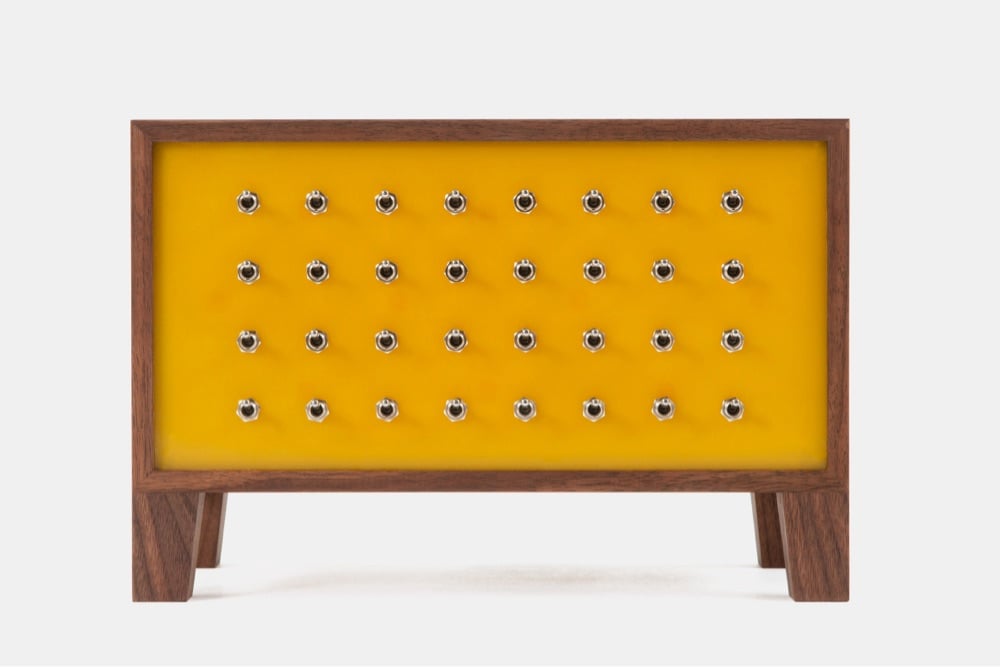
Yuri Suzuki’s The Ambient Machine is a device for creating atmosphere, playing ambient sounds. The machine has 32 toggle switches on it; each switch actives a different sound (waves, running water, birds, wind, white noise) that you can blend to create your perfect aural backdrop.
The Ambient Machine provides us with a variety of sounds and music that we can use to design our own background ambience. White noise can mask unpleasant sounds around us and give us a sense of relief, Natural sounds can provide the feeling of relocating to a new environment, providing a break from the environments we have been confined to, and musical rhythms can provide patterns for us to find stability with.
Only 20 models of the original machine were created and sold, but you can preorder a slightly different version for ¥143,000 (~$1,000).

What I like about the still image above, along with the rest of the images in a project called In Anxious Anticipation by Aaron Tilley & Kyle Bean, is that it makes a noise. It’s so cool how your brain sees what’s about to happen and then you hear eggs smashing on a hard surface — splat, splat, splat. More still art should make noise! (via moss & fog)
Earlier today, I posted a Quick Link to the 2nd-generation AirPods Pro on Amazon because they were $50 off, a good deal for an item that’s rarely on sale. I’ve been using a pair of these for the past month or so after a strong recommendation from John Gruber, and I can’t believe how much better they performed over the 1st-gen ones (which were fine…better than fine even). The sound quality seems better, Transparency Mode (where you can simultaneously hear your music and amplified sound near you) is significantly improved, and the earbuds themselves are more comfortable than their predecessors.
But the real star for me is the noise cancelling. I try to use my treadmill a few times a week during the winter to keep fit/active and generally listen to music or watch some TV on my iPad while I walk/run. With my old AirPods Pro, I could still hear the whirring of the treadmill behind the music even with noise cancelling on. But with these new ones, the treadmill noise is nearly gone, especially if I’m listening to something particularly energetic. I took an airplane trip recently and was amazed to find that nearly all of the airplane noise was cancelled out…even playing some quiet classical music at a reasonable volume felt like I was listening in a quiet room. I’ve even been wearing them to listen to music while I work…they just sound better than my HomePod mini speaker and keep me more focused on my work.
So anyway, I posted that link and then discovered via the ensuing thread on Mastodon that you can tweak AirPods Pro using the accessibility settings on your phone to do stuff like amplifying soft sounds and tuning Transparency Mode to further boost audio to focus on a person in front of you:
Turn on Custom Transparency Mode, then adjust the amplification, balance, tone, and ambient noise reduction to help you hear what’s happening around you. You can also turn on Conversation Boost to focus on a person talking in front of you.
What an amazing feature for people who are hard of hearing or who have trouble focusing their audio attention (definitely me sometimes). And what’s more, you can actually upload an audiogram to create a custom profile that adjusts audio levels specifically to how you hear. What? I had no idea. Here’s Paul Lefebvre:
But, by far, the #1 thing for me is the hearing assistive features. I used the Mimi hearing app to take a hearing test and generate a hearing profile (I have slight high-end hearing loss). I then was able to apply this hearing profile to the AirPods and the sound got even better! I also turned on other settings to make sounds clearer in transparency mode.
Now I sometimes put these AirPods on with just transparency mode and use them to hear things from across the room or to better understand conversations.
And @mtwebb on Mastodon:
I also recently upgraded to the 2nd gen and imported my audiogram from a recent hearing test. They literally changed my life in certain noisy situations. I also recommend them, especially if you have some hearing loss but don’t quite need hearing aids.
And Marques Brownlee’s review is a good one:
To create an audiogram of your hearing, you can use the Mimi Hearing Test or SonicCloud Personalized Sound apps and then import it into your settings. I have no idea how good these audiograms are compared to an actual hearing test…you should talk to your doctor or head to a specialist if you’re in need of something really accurate. But for many people, I bet these apps work just fine. I haven’t done my audiogram yet - I’m gonna do the test after I publish this.
You can get the 2nd-gen AirPods Pro from Apple or at Amazon for $50 off (deal still valid as of 8am on 4/14).
There are few sounds that can transport me back to a specific time and place like the handshake of a dialup modem. I heard that arrangement of noises thousands of times sitting at my desk in rural Wisconsin, trying to soak up the entire internet. That sound meant freedom, connection, knowledge.
Oona Räisänen created this great visualization and explanation of what’s going on when a modem is making those noises.
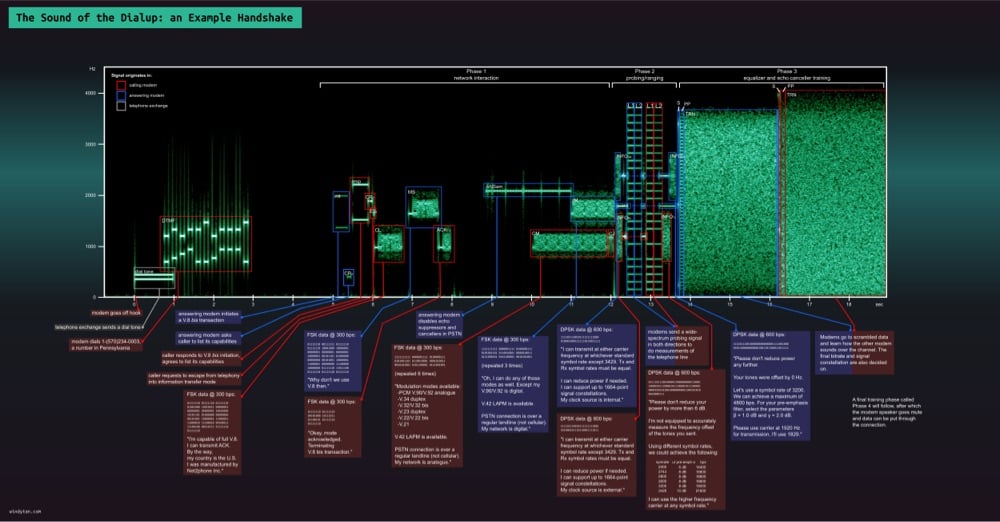
If you ever connected to the Internet before the 2000s, you probably remember that it made a peculiar sound. But despite becoming so familiar, it remained a mystery for most of us. What do these sounds mean?
As many already know, what you’re hearing is often called a handshake, the start of a telephone conversation between two modems. The modems are trying to find a common language and determine the weaknesses of the telephone channel originally meant for human speech.
See also this other visualization of dialup sounds, opera singers dubbed with dialup modems, and a vocal arrangement of the modem handshake.
Insider has been doing a whole series of videos on how movie props are made (view the entire thing here) and I found this one on how prop makers rely on noiseless props to be particularly interesting. To cut down on distracting on-set noise (so dialogue can be heard, for instance), they swap racquetball balls for pool balls, silicon chunks for ice cubes, and paper bags made out of coffee filter material for real paper bags. So weird to watch those objects in action without their usual sounds. (thx, caroline)
In this video from 1965, electronic music pioneer Delia Derbyshire, who arranged the original theme music for Doctor Who, demonstrates how electronic music was made at the BBC Radiophonic Workshop. It’s such a treat watching her construct songs from electronic sound generators and sampled sounds played at different speeds and pitches; you can even see her layering sounds on different tape machines and beat matching, just like DJs would years later.
Amazingly, you can try your hand at layering and looping this music yourself with this Tape Loops demo from the BBC. You can also make Dalek and Cybermen noises with the Ring Modulator, create Gunfire Effects, or use the Wobbulator (my favorite).
See also The Definitive Guide to Doctor Who Theme Music, the trailer for Delia Derbyshire: The Myths and the Legendary Tapes, and this incredible proto-techno track Derbyshire made in the 60s. (via @austinkleon)
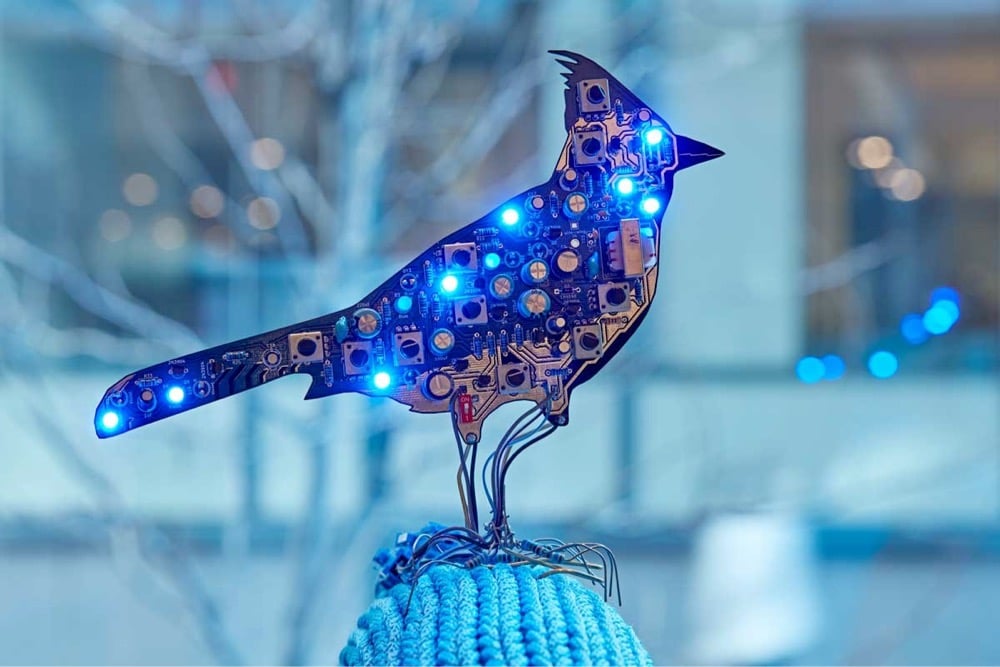
As part of her Circuit Garden project, artist Kelly Heaton makes birds out of electronic circuitry that can be adjusted to produce a wide variety of birdsong. Here she demonstrated with a printed circuit bluejay:
As Heaton explains, the sounds made by the birds aren’t recordings…they’re generated by the electronics, like a synthesizer.
My “printed circuit birds” are self-contained sound generators. The electronics are [100%] analog: no audio recordings or software are involved. By “analog” I mean that the sound is dynamically produced by the bird’s body (circuit), like a vintage synthesizer. In this video, I adjust knobs to change resistance in the circuit, thereby altering the song quality. You can think of this like adjusting neurons in a bird’s brain to alter the impulse by which it vocalizes.
(via clive thompson)
Is there a physical limit to how loud a noise can be? As you might imagine, the answer is somewhat complicated, even if you assume normal atmospheric conditions. In video, Benn Jordan discusses a few possible answers, as well as how we should think about the question in the first place. One possible answer is 194 decibels, although experiencing a sound that loud would probably kill you.
See also The World’s Loudest Sound, aka the sound generated by the Krakatoa volcanic eruption in 1883, which Jordan mentions in the video.
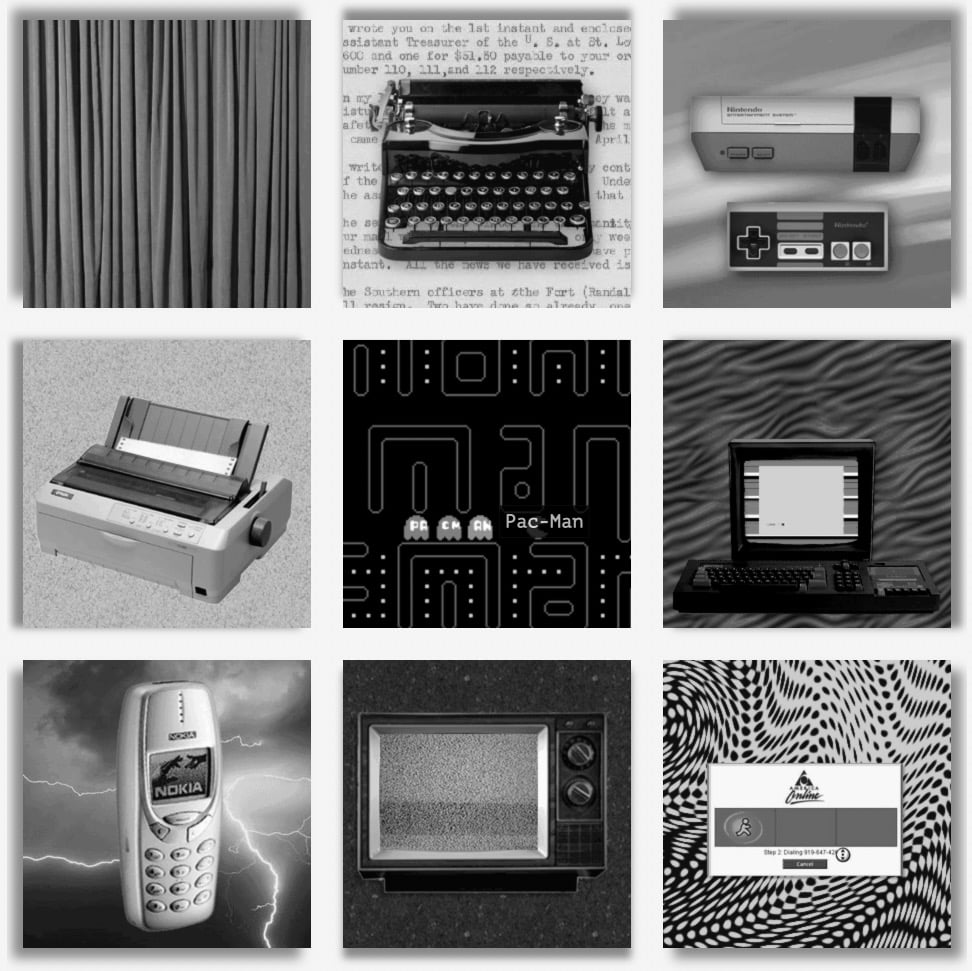
The Museum of Endangered Sounds is a soundboard of dozens of sounds from old technologies, from the ICQ message notification (“uh oh!”) to the Windows 95 startup sound to a rotary telephone to a dial-up modem. Suuuuper nostalgic.
See also Conserve the Sound. (via swissmiss)
For the radio program CBS Radio Workshop that premiered in January 1956, Aldous Huxley read a one-hour dramatization of his 1932 dystopian1 science fiction novel Brave New World. You can listen to it here or at Internet Archive:
A contemporary review in Time magazine noted the extensive production work that went into the production:
It took three radio sound men, a control-room engineer and five hours of hard work to create the sound that was heard for less than 30 seconds on the air. The sound consisted of a ticking metronome, tom-tom beats, bubbling water, air hose, cow moo, boing! (two types), oscillator, dripping water (two types) and three kinds of wine glasses clicking against each other. Judiciously blended and recorded on tape, the effect was still not quite right. Then the tape was played backward with a little echo added. That did it. The sound depicted the manufacturing of babies in the radio version of Aldous Huxley’s Brave New World.
In addition to Huxley’s book, CBS Radio Workshop dramatized for radio the work of Sinclair Lewis, Edgar Allan Poe, James Thurber, and Mark Twain — you can listen to the entire run of the show here. (via open culture)
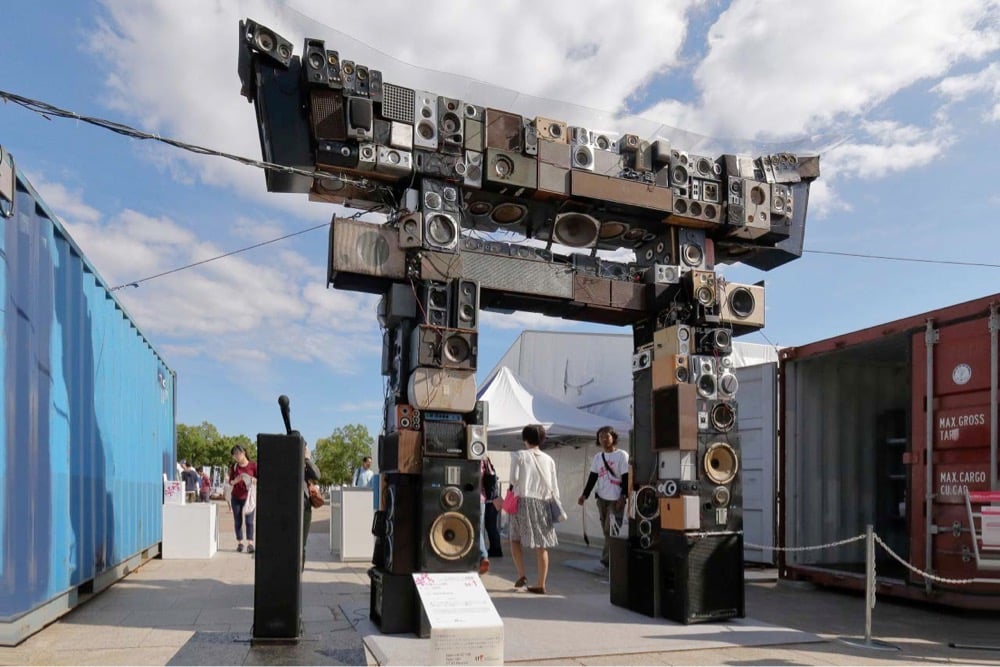
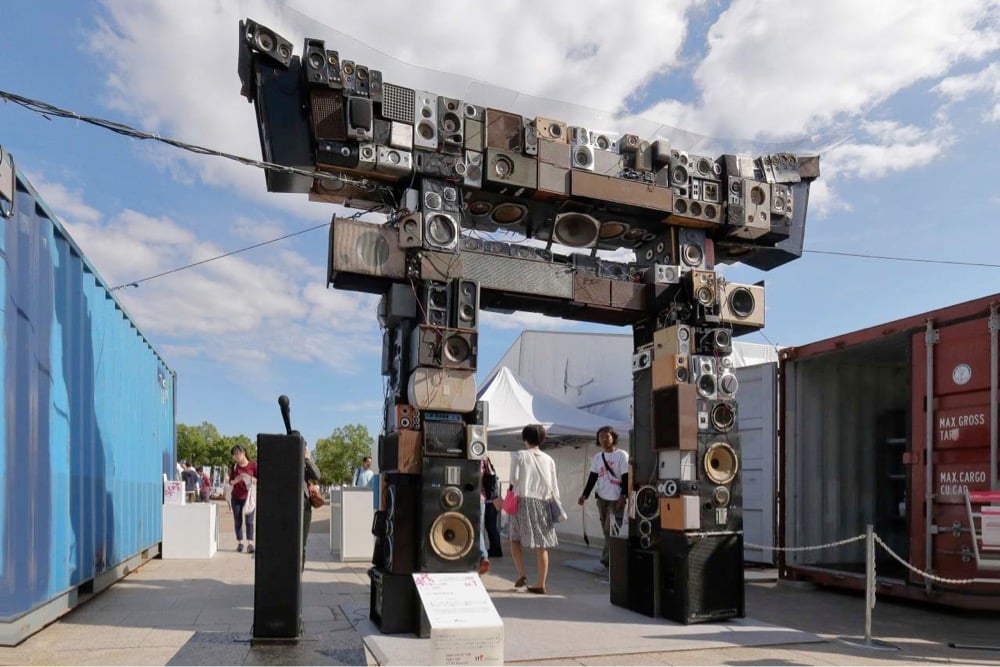
For the Kobe Biennale held in Kobe, Japan in 2016, sculptor Benoît Maubrey created a traditional Japanese torii gate out of speakers and a bunch of inputs (Bluetooth, line-in, even an 8-track). Using microphones or their phones, passersby could connect to the torii to play music or sounds, talk to each other over the mics, or sing karaoke. The structure was later relocated to Kamiyama. Maubrey has made several similar artworks; here’s what he says about his work:
Artistically I use loudspeakers much in the same way that a sculptor uses clay or wood: as a modern medium to create monumental artworks with the added attraction that they can make the air vibrate (“sound”) around them and create a public “hotspot”.
The audio part of my sculptures is also site-specific and flexible: in all my work the sound level is controllable and the interactivity is regulated via a mixing board (a bell tower or pendulum clock also make sound).
Participation: according to the sculpture site and purpose my sculptures can be equipped with a microphone (self expression), Bluetooth receivers (individuals can play their own tunes music), telephone answering machines (people can call and express themselves Live), radio receivers (for low-level cosmic white noise that sound like whispering pines), and “audio” twitter that allows people to send phonic messages. In some cases the whole system can be used as a PA system for announcements, concerts, open mike sessions, and DJ events.
Built in 1905 and recently restored to working order, the Sumburgh Foghorn is perhaps the last functioning foghorn in Scotland. This two-minute film, which is simply but beautifully shot, documents the surprisingly elaborate process of sounding the horn.
Out of use since 1987, the foghorn was painstakingly restored by Brian Johnson. Shown in the video is the annual Foghorn sounding at Sumburgh Lighthouse, Shetland, Scotland. Brian starts up the 1951 Kelvin K-Series Diesel 44hp Engines. The engines power the Alley and MacLellan compressors, which in turn, power the foghorn.
Just so’s you know, the horn was originally much louder at the end, but YouTube’s audio algorithm turned the volume down. I tried several versions but it wasn’t having it.
I wish we could experience the true loudness of the horn through the video — it was so powerful that it could be heard at a range of 20 miles on foggy days. (thx, mick)
For the last nine months, NASA’s Perseverance rover has been rolling around on Mars taking photos and doing science. It’s also been recording audio of its environment with a pair of microphones and in this video, a pair of NASA scientists share some of those recordings and what we might learn about Mars from them.
This is one of my absolute favorite sounds. This is the sound of a helicopter flying on Mars. We used this sound to actually understand the propagation of sound in general through the Martian atmosphere, and it turns out that we were totally wrong with our models. The Martian atmosphere can propagate sound a lot further than we thought it could.
And surprisingly for me, that’s my friend Nina in the video! (We eclipse-chased together in 2017.) I knew she was working on the rovers but didn’t know she was going to pop up in this video I found on Twitter this morning. Fun!
In The Hidden Melodies of Subways Around the World, the NY Times takes a look at an often overlooked aspect of transit design: the door closing sounds on the subway. My favorite door jingle is from the Paris Metro — I never knew where it came from:
In Paris, a simple “A” note plays as the doors shut. This is also a throwback, a sound that mimics the vibrations of a mechanical part that is no longer in use on any of the system’s trains. “But for a half century Parisians and visitors alike became used to that sound, so we decided to keep it, and recorded a synthesized version,” said Song Phanekham, a communications manager for the Paris transit system. “It’s a tribute to the heritage of the Paris Metro.”
In Tokyo, each station has its own custom jingle to signal departures. In Rio de Janeiro, the subway’s door chime pays homage to bossa nova. In Vancouver, the doors still close to a three-note sound that was recorded in the 1980s on a Yamaha DX7. (“The hallmark of any mid-80s pop song,” said Ian Fisher, manager of operations planning at British Columbia Rapid Transit Company.)
You can listen to more sounds of subway doors closing in these three videos recorded by Ted Green.
Update: Composer Minoru Mukaiya has made distinct door-closing jingles for each subway station in Tokyo.
(via waxy)
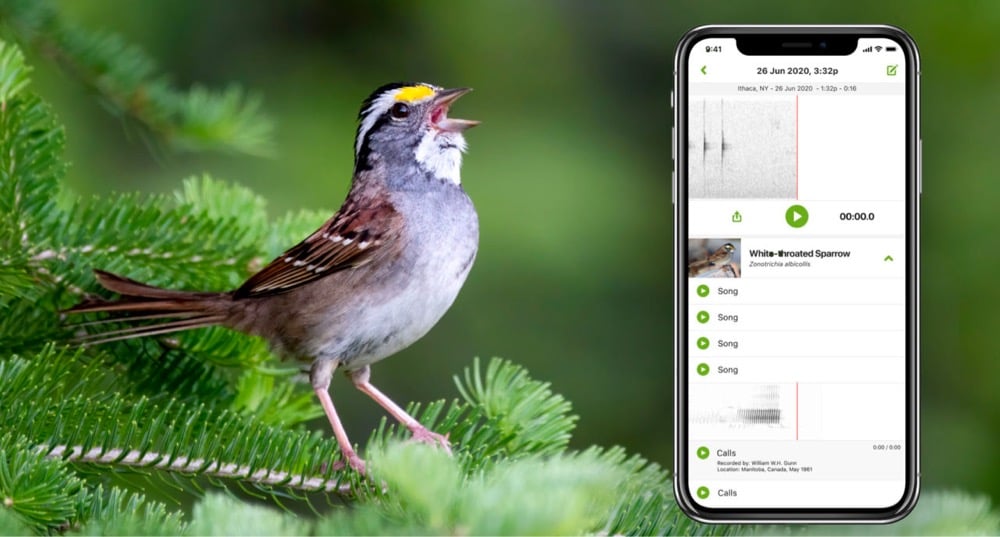
The Cornell Lab of Ornithology recently added the ability to identify birds from hearing their birdsong to their Merlin Bird ID app — a “Shazam for bird songs” as Fast Company says. You just start recording with your phone and the app starts telling you the birds it’s hearing. Here’s how it works:
Automatic song ID has been a dream for decades, but analyzing sound has always been extremely difficult. The breakthrough came when researchers, including Merlin lead researcher Grant Van Horn, began treating the sounds as images and applying new and powerful image classification algorithms like the ones that power Merlin’s Photo ID feature.
“Each sound recording a user makes gets converted from a waveform to a spectrogram-a way to visualize the amplitude [volume], frequency [pitch], and duration of the sound,” Van Horn says. “So just like Merlin can identify a picture of a bird, it can now use this picture of a bird’s sound to make an ID,” Van Horn says.
This pioneering sound-identification technology is integrated into the existing Merlin Bird ID app, meaning Merlin now offers four ways to identify a bird: by a sound, by a photo, by answering five questions about a bird you saw, or by exploring a list of the birds expected where you are.
Margaret Renkl tried the app out and it seems to work pretty well:
I set my phone down on the table on my back deck, opened the Merlin app, chose “Sound ID” and hit the microphone button. Immediately a spectrogram of sound waves began to scroll across the screen. Every time a bird sings, the sound registers as a kind of picture of the song. By comparing that picture with others in its database, the app arrives at an ID.
I watched as Merlin rolled out the names of bird after bird — tufted titmouse, European starling, Carolina chickadee, northern cardinal, American crow, white-breasted nuthatch, eastern towhee, house wren, American goldfinch, blue jay, eastern bluebird, American robin, Carolina wren, house finch. It didn’t miss a single one.
What amazed me was not merely the accuracy of the ID but also the way the app untangled the layers of song, correctly identifying the birds that were singing in my yard, as well the birds that were singing next door and the birds that were singing across the street. If the same bird sang a second time, the app highlighted the name it had already listed. Watching those highlights play across the growing list of birds was almost like watching fingers fly across a piano keyboard.
See also this video review. You can download the app here. I’m going to give this a shot over my lunch hour today. I try to eat outside when the weather is nice and there are always birds out singing.
Car warning sounds urging drivers to buckle up or turn off the headlights can be quite unpleasant to listen to. So Nissan teamed up with sound designers at Bandai Namco, the gaming company known for Pac-Man and Tekken, to replace those warning noises with something more musical.
I had a car once that beeped really sharply and loudly whenever the temperature dropped to 37°F as a warning for potential slippery roads and it scared the shit out of me every time. As someone who is sensitive to sound, I applaud efforts like these to make non-emergency sounds less jarring. (via rob walker (again))
In this collaboration between musician and filmmaker John Boswell (aka melodysheep) and the sound podcast Twenty Thousand Hertz, we get to listen to some of the actual and theoretical sounds of space, from what the Sun would sound like if space weren’t a vacuum (we’d hear it as loud as a jackhammer on Earth) to the sound of the Universe just after the Big Bang to thunder in the thick atmosphere of Venus to dreamlike piano music on Mars.
Floating in the silent void of space are trillions of islands of sound, each with their own sonic flavor — some eerily familiar, some wildly different than Earth’s. And even space itself was once brimming with sound.
This short film takes you on a journey back in time and to the edge of our solar system and beyond, to discover what other worlds of sound are lurking beyond Earth’s atmosphere. You won’t believe your ears :)
This is really well done, which isn’t surprising considering Boswell did the excellent Timelapse of the Future video a few years back. The soundtrack to The Sounds of Space video is available on Bandcamp. (via aeon)
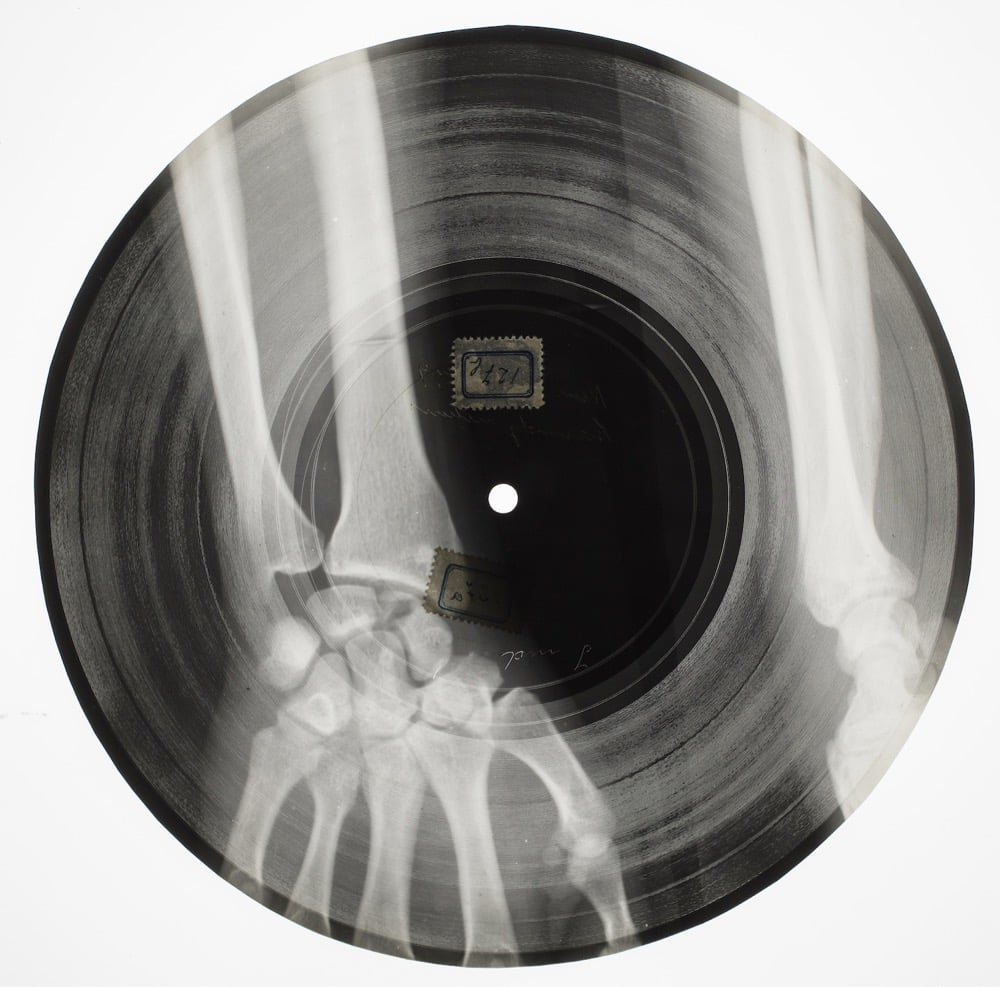
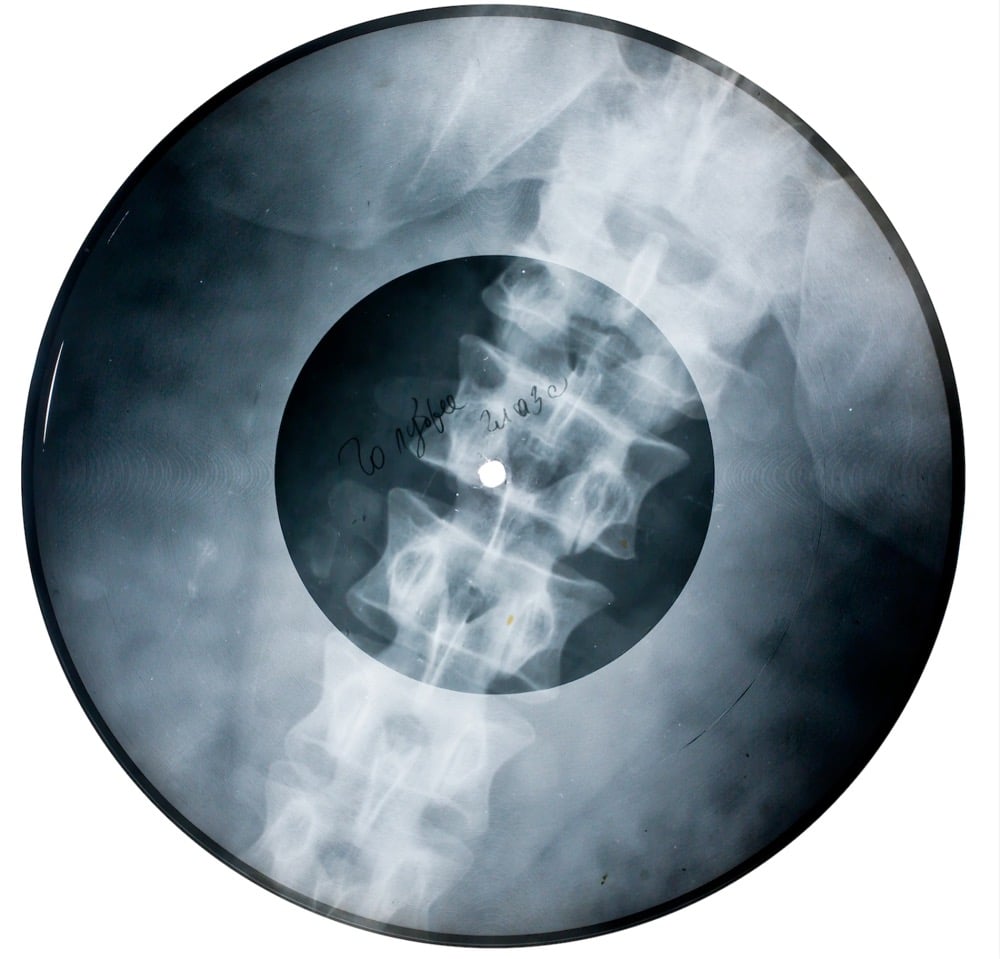
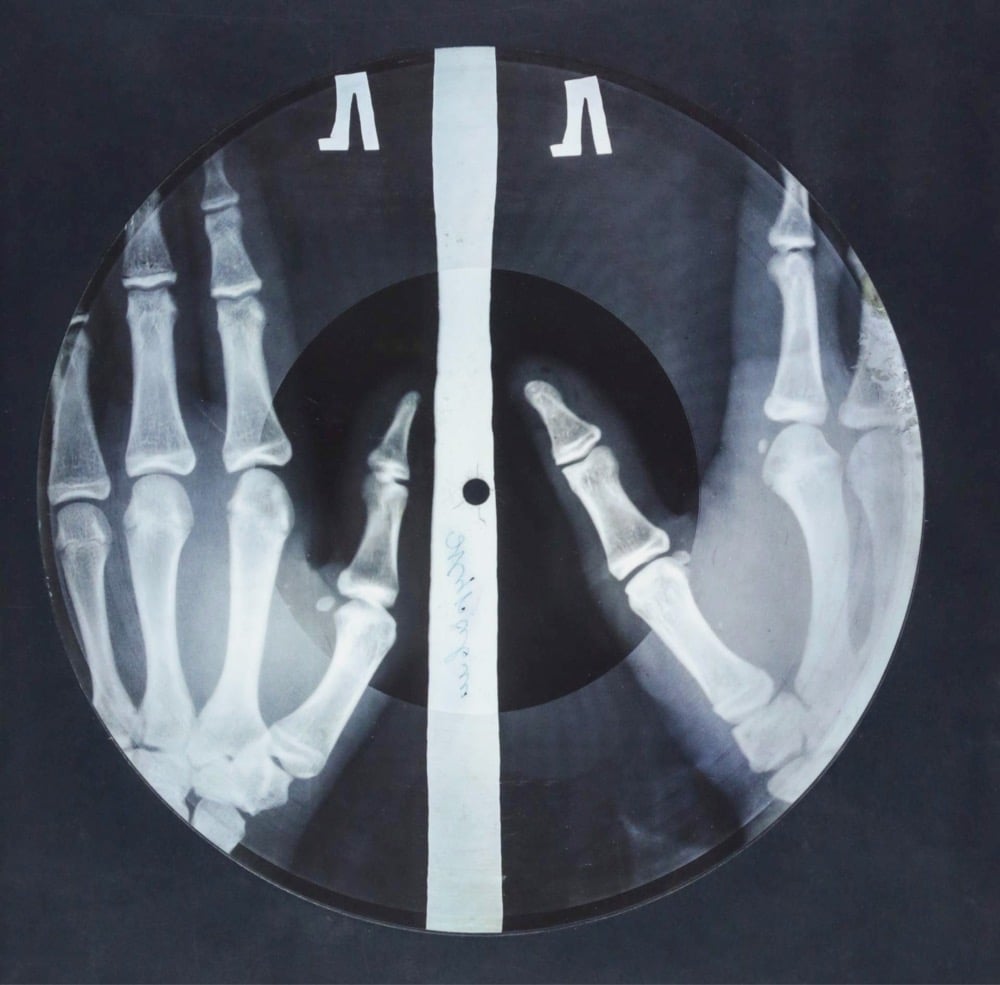
During the Cold War, the Soviet Union controlled the music recording industry and even restricted the types of music that were allowed to be played & listened to. Or they tried to anyway. Enterprising Soviet bootleggers took used x-ray films, many of them still containing images of bones and skulls, and recorded forbidden music on them, including jazz and rock & roll from the West. They called it ribs, bones, bone music, or jazz on ribs. From a 2017 article in Vice:
X-rays proved to be an suitable medium. They were cheaply and easily (albeit illegally) acquired from local hospitals that were required to throw out the flammable sheets. They took the groove relatively well, though nowhere near as well as vinyl — some X-ray discs apparently sound like listening to music through sand — and they were easy to fold into a shirt sleeve of pocket for a quick transaction. The X-rays were also stunningly beautiful.
And from an NPR article on Soviet samizdat:
Before the availability of the tape recorder and during the 1950s, when vinyl was scarce, ingenious Russians began recording banned bootlegged jazz, boogie woogie and rock ‘n’ roll on exposed X-ray film salvaged from hospital waste bins and archives.
“Usually it was the Western music they wanted to copy,” says Sergei Khrushchev. “Before the tape recorders they used the X-ray film of bones and recorded music on the bones, bone music.”
“They would cut the X-ray into a crude circle with manicure scissors and use a cigarette to burn a hole,” says author Anya von Bremzen. “You’d have Elvis on the lungs, Duke Ellington on Aunt Masha’s brain scan - forbidden Western music captured on the interiors of Soviet citizens.”
To learn more about bone music, you can check out Stephen Coates’ book X-Ray Audio, The X-Ray Audio Project (which includes digital recordings made from some of the bone records — here’s Lullaby of Birdland by Ella Fitzgerald), and this short documentary:
As I’ve said before many times, I will never stop being fascinated by the work of Foley artists, the folks who make the sounds you hear in movies and TV shows. In this short film, we meet three Foley artists who work at Footsteps Studios, a custom designed facility in rural Ontario that includes a massive warehouse of props that can make any sound you can dream of. This video is full of lovely little moments and details — recommended.
I’m always on the lookout for sounds that help you focus and/or relax; I’ve collected a number of video soundscapes here. If you happen to find the sounds of Lego bricks relaxing, you can add these videos to your routine:
The first one features the sound of Legos being poured and the second one is the sound of someone digging through the Lego bin & snapping pieces together. The full 3.5-hour album of Lego sounds is available to stream on Spotify and Apple Music.
Here’s the company’s press release and a behind-the-scenes look at the album’s production from The Guardian.
The project was devised by Lego’s “head of creative” Primus Manokaran, who describes the streaming-only album as “a collection of soundscapes” designed to promote relaxation and mindfulness. Although the seven tracks, which each run to half an hour in length, are different in their granular details, essentially they were made by Lego pieces being poured out of tubs, sifted through and clicked together.
Manokaran’s team began thinking about why people love Lego during lockdown, and realised that a big hook was how it sounds. Inspired by the online craze for white noise as an aid to relaxation and focus, they began recording. “The acoustic properties of each brick was slightly different,” he says. “It was like composing with 10,000 tiny instruments.”
(thx, martin)
Older posts


Socials & More