kottke.org posts about Pixar
Ok so this is weird and delightful. Swedish electronics company Teenage Engineering makes a collection of singing wooden dolls called the Choir. The dolls are basically speakers but with some autonomy and personality…and they can work together:
what you see are eight wooden dolls, made to serenade you with a repertoire of choral classics as well as perform your own original compositions through midi over ble. each member has their own characteristic vocal range. individually one can sing a dynamic solo, together they perform an immersive a cappella concert.

Composer Rob Simonsen used three Choirs together to help create the score for Elio, the newest Pixar movie that takes place in space.
we were looking for an otherworldly sound—something that sounded relatable, that echoed vocalizations, communication that humans could understand, but felt like it was from another world. i came across these choir dolls and heard their sound. it was beautiful — electronic, but human. each body is handcrafted. they have a robotic but organic sound at the same time. it felt like a perfect answer to what we were looking for.
In this interview with Simonsen, he talks about working with the Choir to create the movie’s sound; the relevant part starts at the 15:20 mark and includes some of the music they composed with it.
There’s a flip flop element to this too: they mic’d up the dolls to record the audio, just like they would with human performers.
Here’s another short clip of the Choir in action:
Like I said, weird and delightful. You can get your own full ensemble from Teenage Engineering for about $2000.
See also Dueling Carls, which this reminded me of for some reason.
For National Geographic, Tony Hale (who played Fear in Inside Out 2) talks to psychologist and author Dr. Lisa Damour about Pixar’s new film, her role as a consultant for the filmmakers, and what science says about the emotions in the movie. From The Kid Should See This:
By blending Pixar’s storytelling with scientific expertise, the Inside Out films and this discussion help make the complex topic of emotional development approachable and more familiar. They offer viewers of all ages vocabulary to better understand and express their feelings, while normalizing the intricate emotional experiences we encounter throughout life.
I have heard a lot of good things about Damour’s books from other parents, particularly Untangled: Guiding Teenage Girls Through the Seven Transitions into Adulthood and The Emotional Lives of Teenagers: Raising Connected, Capable, and Compassionate Adolescents.
Vox also has a really interesting article on the science of the emotions of Inside Out 2, with quotes from Damour and emotion scientist Dacher Keltner.
One of the things that happens when people become teenagers is that their brain becomes more sophisticated, and it allows for self-conscious emotions. Before age 13, kids are concrete in their thinking. They can’t always see things from another perspective. Then around 13 or 14, the ability to picture oneself on the outside, to imagine different scenarios, arrives as a result of brain development.
With that arrival comes the ability to be embarrassed and to imagine what other people think of you. Or to have envy, to want something somebody else has and to want to know why you don’t have it. Ennui is so funny and wonderful and really maps onto the natural disdain and over-it-ness teenagers can have for everything. Then, of course, anxiety is a major player in this movie. What anxiety requires is the ability to imagine and anticipate. Fear is our response to the threat right in front of us, whereas anxiety is picturing things that might happen.
See also The Making of “Inside Out 2” episode of Damour’s podcast.
As the parent of two teens and also as someone who perhaps remembers a little too much what it felt like to be a teenager, I found Inside Out 2’s portrayal of the emotions (and how to manage them) to be really convincing. (via the kid should see this)
NY Times critic Maya Phillips wrote about seeing her anxiety reflected in Pixar’s Inside Out 2.
When an emotion takes over in the “Inside Out” movies, a control board in Riley’s mind changes to that feeling’s color; Anxiety’s takeover, however, is more absolute. She creates a stronghold in Riley’s imagination, where she forces mind workers to illustrate negative hypothetical scenarios for Riley’s future. Soon, Riley’s chief inner belief is of her inadequacy; the emotions hear “I’m not good enough” as a low, rumbling refrain in her mind.
I’m familiar with anxiety’s hold on the imagination; my mind is always writing the script to the next worst day of my life. It’s already embraced all possibilities of failure. And my anxiety’s ruthless demands for perfection often turn my thoughts into an unrelenting roll-call of self-criticisms and insecurities.
And yet — Anxiety isn’t the villain of this movie.
A cursory spin around social media reveals many other people who identified with that aspect of the film.
I really enjoyed this movie and loved that they didn’t make Anxiety the villain. It would have been so easy to do so — Hollywood has a habit of really dumbing things down, especially in movies aimed at kids. The filmmakers seemed to understand that anxiety is the flip-side of a coin that includes some mixture of watchfulness, anticipation, and exhilaration. That emotion can be useful to people, until it spins out of the control as in the movie and then it wreaks havoc.
This is pretty clever actually: Disney+ and ESPN+ will air a real-time, Toy Story-ified version of the Oct 1st Jacksonville Jaguars and Atlanta Falcons NFL game. From Deadline:
Using the NFL’s Next Gen Stats and on-field tracking data, every player and play will be presented in “Andy’s Room,” the familiar, brightly colored setting for the Toy Story franchise. The action will be virtually simultaneous with the main game telecast, with most plays recreated after an expected delay in the neighborhood of about 30 seconds. Woody, Buzz Lightyear and many other characters will be visible throughout, and a press release notes they will be “participating from the sidelines and in other non-gameplay elements.” Along with game action, the announcers, graphics, scoreboard, referees’ penalty announcements, celebrations and other parts of the experience will all be rendered in a Toy Story-centric fashion.
I stopped watching the NFL years ago, but I might tune in to see how this works.
In the midst of the zaniness of Everything Everywhere All at Once is one of the funniest things I have seen in a movie theater in years: Raccacoonie. (If you know, you know.) Inverse talked to a bunch of people involved with the film about how Raccacoonie came about and what the folks at Pixar thought about the riff on Ratatouille. First off, here’s the initial mention of Raccacoonie in the movie:
The initial idea came from stories that producer Jonathan Wang would tell about his father messing up the names of American movies:
I think it’s pretty common when you have parents who are speaking English as a second language: They butcher movie titles. [My dad] would call James Bond “double seven” instead of “double-O seven.” He would just mess up movie titles all the time. My favorite one he would say was “Outside Good People Shooting” — that one is Good Will Hunting.
Costume designer Shirley Kurata added:
Being an Asian American and having parents where English isn’t their native language, I was used to hearing my parents mispronounce things. I had this memory when I was really young and I saw this word and I didn’t know what it said. I asked my mom. She was like, “Pin-oh-shee-oh.” I think both of us just laughed because we realized she totally mispronounced Pinocchio.
What did the folks at Pixar think? Of course, they loved it — because it’s great.
I never even thought about whether or not we would get a call from Disney or if Pixar was going to be mad. We did a tour of the Pixar campus and got to hang out with [animator/director] Domee Shi, and she’s so great. We were like, “Have you guys talked about, uh… us ripping off Ratatouille?” Everyone loves it there, and it seemed like no one was really upset. That was the only thing we thought of: Are we going to get flagged for this? But lawyers cleared it; everyone cleared it.
It’s worth reading the whole thing — I hadn’t realized they got Randy Newman to do a song for it.
When Spider-Man: Into the Spider-Verse came out in 2018, it had a very different look than most other animated feature-length films. Since the release of Toy Story in the mid-90s, digitally animated films made by the large studios had taken their cues from Pixar. “The Pixar Look” was “extremely high quality, physically based, and in some cases almost photorealistic”. Spider-Verse introduced a different style and since then, digital animation studios have been experimenting with non-photorealism. This video looks at how that shift is happening.
Pixar is doing an origin story prequel of Toy Story called Lightyear. The teaser trailer is above. Chris Evans is taking over from Tim Allen as the voice of Buzz. Release date is sometime next summer. Like the folks at Polygon, I too am confused about the time bending that seems to be going on here:
does the existence of a #RealBuzzLightyear zipping through space in the far future imply that the world of Toy Story is also set in the far future
And:
That doesn’t mean he’s a real guy. Toy Story is not set in a world where aliens are just real and that’s fine with everyone. That isn’t a thing in those films. That’s just not the case. We would know if it were.
Is the movie going to explain any of this? Or is everyone just overthinking an (absurdly beautiful and expensive) kids cartoon movie (that likely has themes and humor that will resonate with adults)? Or or am I just yearning for some fun, dumb, low-stakes online arguments to replace the dangerous, dumb, and high-stakes online, uh, discourse? that we’re subjected to 24/7/365/2021/?????? (I think the answer to all of these is “yes”.)
Insider takes a look at how big Hollywood blockbusters (Marvel movies, in this case) are increasingly made, with an extensive digital previsualization stage that happens before any of the shooting starts. Think of it as supercharged storyboarding — the digital version of what Bong Joon-ho created for Parasite for instance. This is how digitally animated movies have been made for decades now — studios like Pixar always create roughly animated cuts of their movies before moving along to the expensive and time-consuming visual effects step. Big blockbusters like the Avengers movies are essentially animated films now, with live actors seamlessly inserted into the mix, like Bob Hoskins in Who Framed Roger Rabbit?
The “techvis” layer of the process is super interesting. Based on the previsualization, the system can output camera angles, movements, and settings that directors & camera operators can use on set to get the shots they want, speeding up production. This is the reverse of a technique that Pixar uses, in which real-world motion is captured and then programmed into virtual cameras:
To get the motion just right for the baby carriage scene in the antique store for TS4, they took an actual baby carriage, strapped a camera to it, plopped a Woody doll in it, and took it for a spin around campus. They took the video from that, motion-captured the bounce and sway of the carriage, and made it available as a setting in the software that they could apply to the virtual camera.
The flip-flop they’re doing in filmmaking right now is fascinating to watch.
Using an AI-based framework called Pixel2Style2Pixel and searching for faces in a dataset harvested from Flickr, Nathan Shipley made some more photorealistic faces for Pixar characters.
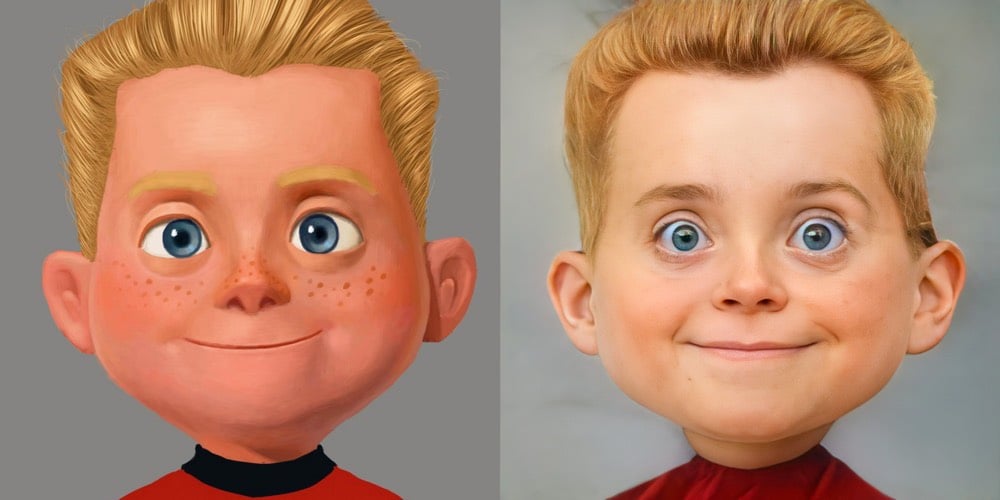
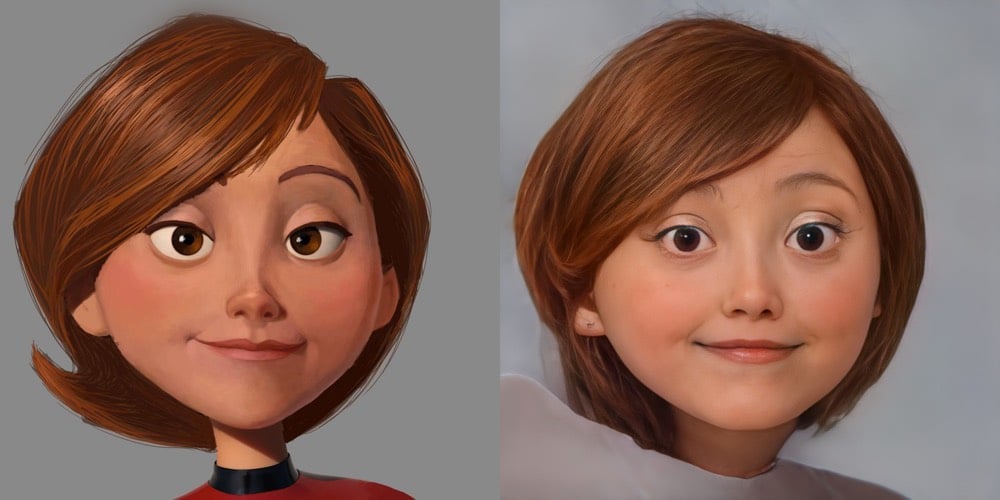
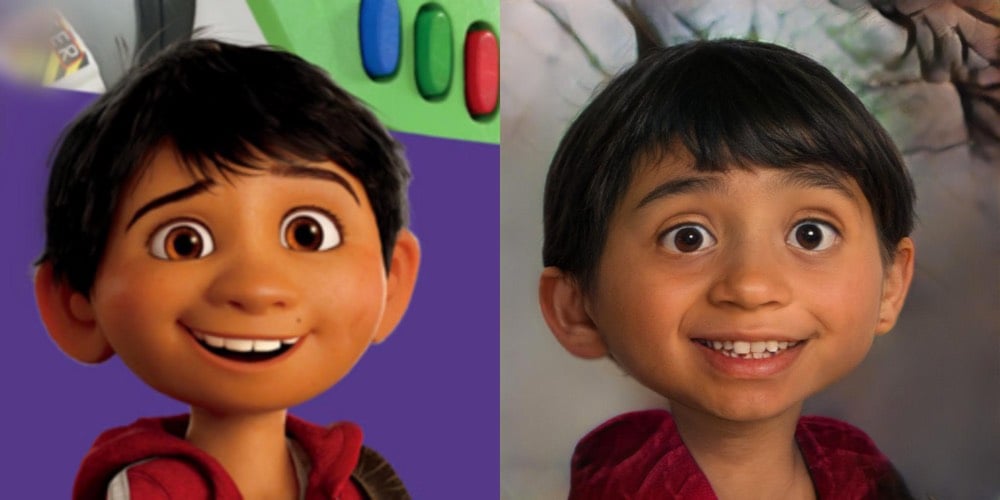
In response to a reader suggestion, Shipley fed the generated image for Dash back into the system and this happened:
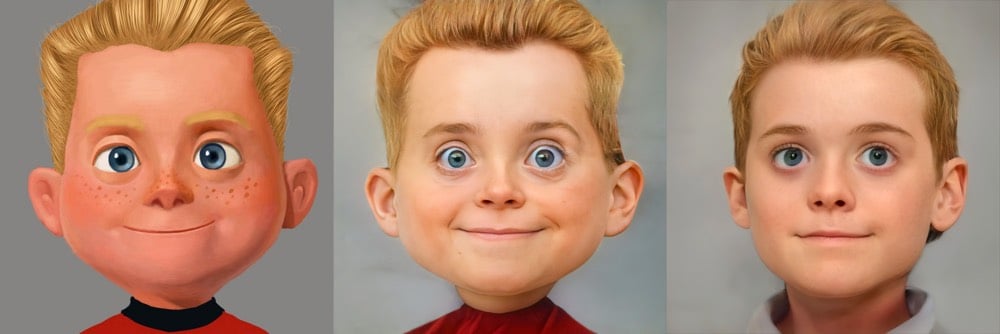
I cannot tell where these images should live in the uncanny valley. You can see some similar experiments from Shipley here: a more realistic version of Miles from Spider-Verse, images of Frida Kahlo and Diego Rivera “reverse engineered” from paintings, and an image generated from a Rembrandt self-portrait.
Pixar is always trying to push the envelope of animation and filmmaking, going beyond what they’ve done before. For the studio’s latest release, Toy Story 4, the filmmakers worked to inject as much reality into the animation as possible and to make it feel like a live-action movie shot with real cameras using familiar lenses and standard techniques. In the latest episode of Nerdwriter, Evan Puschak shares how they did that:
As I learned when I visited Pixar this summer,1 all of the virtual cameras and lenses they use in their 3D software to “shoot” scenes are based on real cameras and lenses. As the first part of the video shows, when they want two things to be in focus at the same time, they use a lens with a split focus diopter. You can tell that’s what they’re doing because you can see the artifacts on the screen — the blurring, the line marking the diopter transition point — just as you would in a live-action film.
They’re doing a similar thing by capturing the movement of actual cameras and then importing the motion into their software:
To get the motion just right for the baby carriage scene in the antique store for TS4, they took an actual baby carriage, strapped a camera to it, plopped a Woody doll in it, and took it for a spin around campus. They took the video from that, motion-captured the bounce and sway of the carriage, and made it available as a setting in the software that they could apply to the virtual camera.
Now, this is a really interesting decision on Pixar’s part! Since their filmmaking is completely animated and digital, they can easily put any number of objects in focus in the same scene or simply erase the evidence that a diopter was used. But no, they keep it in because making something look like it was shot in the real world with real cameras helps the audience believe the action on the screen. Our brains have been conditioned by more than 100 years of cinema to understand the visual language of movies, including how cameras move and lenses capture scenes. Harnessing that visual language helps Pixar’s filmmakers make the presentation of the action on the screen seem familiar rather than unrealistic.
As I mentioned in a post about my west coast roadtrip, one of the things I heard about during my visit to Pixar was their AI spiders. For Toy Story 4, the production team wanted to add some dusty ambiance to the antique store in the form of cobwebs.
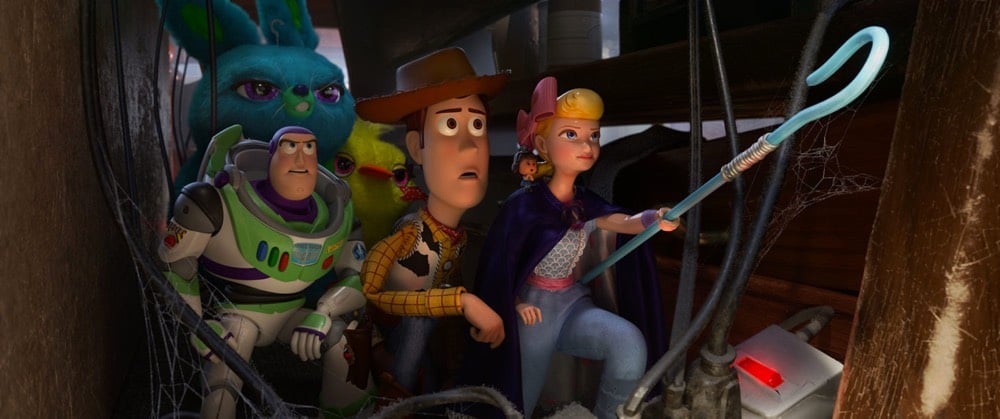
Rather than having to painstakingly create the webs by hand as they’d done in the past, technical director Hosuk Chang created a swarm of AI spiders that could weave the webs just like a real spider would.
We actually saw the AI spiders in action and it was jaw-dropping to see something so simple, yet so technically amazing to create realistic backgrounds elements like cobwebs. The spiders appeared as red dots that would weave their way between two wood elements just like a real spider would.
All the animators had to do is tell the spiders where the cobwebs needed to be.
“He guided the spiders to where he wanted them to build cobwebs, and they’d do the job for us. And when you see those cobwebs overlaid on the rest of the scene, it gives the audience the sense that this place has been here for a while.” Without that program, animators would have had to make the webs one strand at a time, which would have taken several months. “You have to tell the spider where the connection points of the cobweb should go,” Jordan says, “but then it does the rest.”
Chang and his colleague David Luoh presented a paper about the spiders (and dust) at SIGGRAPH ‘19 in late July (which is unfortunately behind a paywall).
Purl, directed by Kristen Lester, is an animated short from Pixar about a ball of yarn that starts a new job at B.R.O. Capital and quickly feels out of place among all the men in suits. The story was inspired by Lester’s experience working in animation as the only woman at her company.
In order to do the thing that I loved, I sort of became one of the guys. And then I came to Pixar and I started to work on teams with women for the first time. And that actually made me realize how much of the female aspect of myself I had buried and left behind.
(via @cabel)
While it’s billed as “How Pixar Helped Win 27 of the Last 30 Oscars for Visual Effects”, this video from Wired works pretty well as a short history of computer-generated visual effects, from the Genesis visualization in Star Trek II: The Wrath of Khan to Jurassic Park’s dinosaurs to Pixar’s own Coco.
Bao, a short film by Domee Shi, was shown in front of The Incredibles 2 at theaters this past summer.
In “Bao,” an aging Chinese mom suffering from empty nest syndrome gets another chance at motherhood when one of her dumplings springs to life as a lively, giggly dumpling boy. Mom excitedly welcomes this new bundle of joy into her life, but Dumpling starts growing up fast, and Mom must come to the bittersweet revelation that nothing stays cute and small forever. This short film from Pixar Animation Studios and director Domee Shi explores the ups and downs of the parent-child relationship through the colorful, rich, and tasty lens of the Chinese immigrant community in Canada.
Pixar recently posted the entire short online on Twitter so you can watch it if you missed it in theaters.
Shi, who is developing a full-length feature for Pixar, did an interview with the LA Times about her inspiration for Bao and its portrayal of the Chinese immigrant experience.
We also brought my mom in twice to do dumpling-making classes for the whole crew. That was really fun research because we actually filmed her hands kneading the dough and making the wrappers, and that was used as reference for the opening shots of the short.
I’m posting this mostly for my son. We were talking about this movie the other day and he remembered exactly where we were and what we were doing when I first told him Pixar was making an Incredibles sequel. Like it was the Moon landing or JFK getting shot.
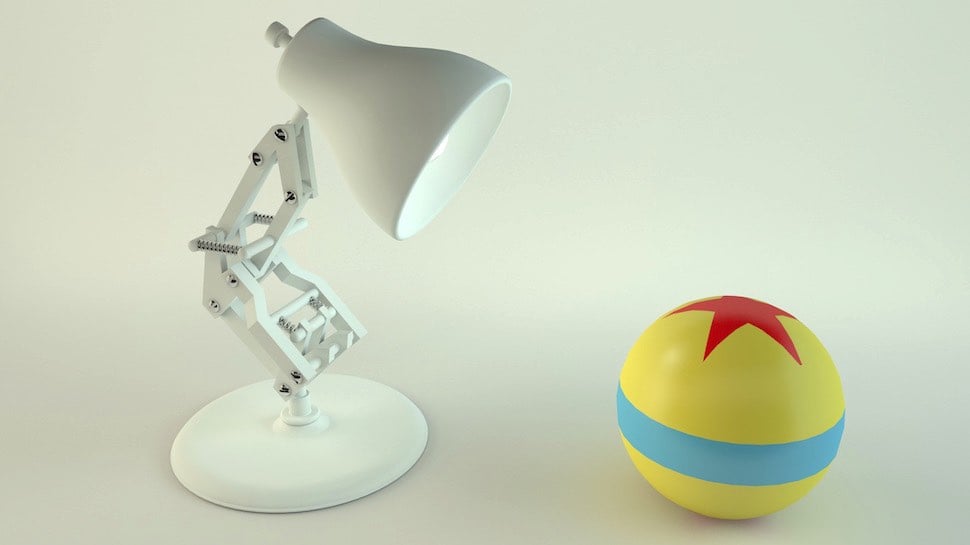
Spencer Porter’s father works for Pixar and because of an impromptu office game of catch, the pair of them became the models for John Lasseter’s short film, Luxo Jr.
“Luxo Jr.” is, to me, a home movie. It’s me and my dad. Encouraging, comforting, energetic and kind, that big lamp, Luxo Sr., is as much my father as I am Luxo Jr. Every time I see my little lamp logo hop out in front of a Pixar movie, it’s not me I think about — it’s my dad. How he spent an afternoon hitting ground balls to me the day before my first Little League practice, and how proud I was when the other coach on my team said, “Well, I think we found our shortstop.” I must have been 7 years old, and I still remember that moment with such clarity. I can still feel the hard fabric on the bag of baseballs, the position of the sun in the sky.
Fair warning: this story takes a hard right turn midway through and you might find yourself in tears near the end.
Pixar’s next movie, Coco, is coming out in November and here’s the first trailer.
Despite his family’s baffling generations-old ban on music, Miguel dreams of becoming an accomplished musician like his idol, Ernesto de la Cruz. Desperate to prove his talent, Miguel finds himself in the stunning and colorful Land of the Dead following a mysterious chain of events.
Lee Unkrich (Finding Nemo, Toy Story 3) directs and the movie is out on November 22.
Since 2001, the Oscars have awarded The Academy Award for Best Animated Feature. The video above shows a scene from each of the winning movies: Shrek, Spirited Away, Finding Nemo, The Incredibles, Wallace & Gromit: The Curse of the Were-Rabbit, Happy Feet, Ratatouille, Wall-E, Up, Toy Story 3, Rango, Brave, Frozen, Big Hero 6, and Inside Out….as well as 2016’s five nominees: Kubo and the Two Strings, Moana, My Life as a Zucchini, The Red Turtle, and Zootopia. Pixar has dominated the category with 8 wins (and 10 nominations) out of 15 years, but the strong field this year meant the studio’s critically acclaimed blockbuster Finding Dory wasn’t even nominated, joining Cars 2, Monsters University, and The Good Dinosaur as the only Pixar films made during that period not to be nominated.
In partnership with Khan Academy, Pixar is offering a number of free online lessons in making 3D animated movies and storytelling called Pixar in a Box. Here’s a video introduction of what courses are available:
There are lessons on rendering, shading, crowds, virtual cameras, and many other topics, but the most accessible for people of all ages/interests is probably the lessons on The Art of Storytelling, which were just posted earlier this week. Here’s the introductory video for that, featuring Pete Docter, director of Up and Inside Out.
This is pretty cool. I’m hoping to spend some more time with this over the weekend.
I watched Finding Dory with my daughter this weekend. It was our second time through and while I’d enjoyed it when we saw it in the theater, this time the theme really hit home. At the most basic level, Finding Dory is about animals with disabilities, how their supposed weaknesses can be strengths, and the challenges faced and strategies employed by parents of children with disabilities. The characters from the movie use their varying abilities in many different to help their friends.
Hank is an octopus who is missing a tentacle and struggles with anxiety about the open ocean. He’s able to fight through that anxiety to form a fast bond with Dory and return to the ocean.
Becky is a loon who appears unbalanced but is a very loyal friend once you’ve made a personal connection with her. Nemo believes in Becky and she comes through in a crucial moment in the movie. (Note that “loon” is a bird but is also slang for someone who is mentally ill.)
One of Nemo’s fins is smaller than the other. It doesn’t slow him down. In this film as well as in Finding Nemo, Nemo journeys across the ocean and helps his friends out of numerous scrapes.
Marlin, Nemo’s father, struggles with anxiety related to parenthood1 after he lost his mate and all but one of his children in a terrible accident. In Finding Nemo, that anxiety fuels him as he searches an entire ocean for his missing son, but at a crucial moment he also realizes that it’s damaging his relationship with his son and holding him back. In this movie, he comes to accept Dory and her full abilities and, with the help of his son, is able to put himself in her shoes — “What would Dory do?” — to make a timely escape.
Destiny is a nearsighted whale shark who nevertheless has a keen ability to help people find their way using her superior verbal communication skills. With the help and encouragement of friends, she is able to escape her tank and help rescue her friend Dory.
Bailey is a beluga whale who temporarily loses his echolocation and struggles with a lack of confidence. With their friends in need, Destiny encourages Bailey to rediscover his ability to help. (Basically, Bailey and Destiny help each other “see” in different ways.)
Jenny and Charlie are Dory’s parents. When Dory was young, they taught her to face her disability head-on and spent countless hours providing her with the encouragement and skills that she needed to become self-sufficient. And after Dory disappeared, they escaped to the ocean, built an elaborate display designed to help Dory find her way back to them, and waited years for her to return.
And Dory, the hero of the story, has short-term memory loss. Her inability to remember things for more than a minute or two has equipped her with a fierce sense of loyalty for her friends & family, a canny impulse for action when they are in need, and an infectious enthusiasm. Again and again, she acts when something needs to be done without the burden of past or future holding her back. In the end, with the help of Nemo and Marlin, she comes to see that her disability is a great strength and uses it to save her friends and find her parents.
Yeah, Pixar makes movies for children that are fun and full of gags & engaging characters. But time and again, from The Incredibles to Wall-E to Ratatouille to Inside Out, Pixar challenges audiences of all ages with larger themes relevant to society at large. If you missed it the first time around or just left your kids to watch it alone, I encourage you to give Finding Dory a chance. Bona fide blockbuster movies 1 that deal intelligently and with care about marginalized issues like disability are hard to come by.
The Pixar Theory is an idea forwarded by Jon Negroni that all of Pixar’s movies take place in the same universe and are all connected to each other somehow. (Negroni turned the theory into a 100-page book.)
Centuries later, the animals from Brave that have been experimented on by the witch have interbred, creating a large-scale population of animals slowly gaining personification and intelligence on their own.
There are two progressions: the progression of the animals and the progression of artificial intelligence. The events of the following movies set up a power struggle between humans, animals, and machines.
The stage for all-out war in regards to animals is set by Ratatouille, Finding Nemo, and Up, in that order. Notice I left out A Bug’s Life, but I’ll explain why later.
Last week, the official Toy Story account released a video on Facebook that make explicit many of the connections between the films:
One of the dinosaurs from The Good Dinosaur shows up in Inside Out, a Monsters Inc. character is pictured in Brave, a Lightning McQueen toy is in Toy Story 3, a moped from Ratatouille is in Wall-E’s junkyard, etc. etc. This is a perfect bit of superfan trolling from the Pixar team. Kudos.
Watch how far Pixar’s skill in animation has come over the past 30+ years, from their initial shorts to the nearly photorealistic animation in last year’s The Good Dinosaur to Finding Dory.
It’s incredible how dated the original Toy Story looks now. It’s going to look positively prehistoric in 20 years and it’ll be impossible for anyone who didn’t see it at the time to understand how astounding and groundbreaking it was.
Adam Summers is a biomechanist who worked as a consultant on fish behavior and anatomy for Pixar’s Finding Nemo and its sequel, Finding Dory. How do you figure out where and how to stick to the known science (or sneak it in sideways) in a movie about talking fish? It’s not an easy question to answer.
This question is very important for the entertainment industry: does it matter whether you’re right, when you’re telling a story to entertain? Under some circumstances, I don’t think it matters. But with an animated movie about real, living systems, when you use the truth — their complexity and beauty — as a springboard for the story, you add a level of gravitas that is vitally important to creating a broad and deep appeal. A young audience is much more sophisticated than you think, and a story informed by a lot of facts alerts them to the presence of real concepts. I got an e-mail from an eight-year-old about Finding Nemo, explaining that characters could not emerge from a whale’s blowhole if they were in its mouth, because there is no link between the trachea and the oesophagus.
There are over 100 inaccuracies in Finding Nemo, but Summers says only one is a genuine error. (He doesn’t name it, but it might be Mr. Ray, who lists names of classes in his song about aquatic species.) Everything else, from the whale’s blowhole to ignoring clownfish’s ability to switch between male and female (although what if Marlin does become female, but just never spawns again?) is an intentional gloss or omission for storytelling purposes.
Or aesthetic ones. “The claspers — external, stick-like sexual organs on sharks — were cut off Bruce the great white shark,” says Summers, “not because of family values, but because he’s spherical, and when you add a bunch of sticks to spherical sharks, they look really stupid.” Noted.
Summers admits there’s also just a lot about the species in Pixar’s fish movies that nobody really knows.
They did ask me some questions about the biology of whale sharks (Rhincodon typus) that we just don’t know the answers to. It’s the largest fish in the sea, yet I think there’s just one record of a pregnant female, which revealed that they can have more than 300 pups at a time. That’s not much to know about the reproductive biology of such an iconic fish.
This video is a quick look at how Pixar thinks about its characters and storytelling. It focuses on one item on this loose list of Pixar’s rules for storytelling:
Why must you tell THIS story? What’s the belief burning within you that your story feeds off of? That’s the heart of it.
Hmm. I… Hmm. Up until Wall-E, Finding Nemo was my favorite Pixar film. And…I’m not sure about this. (via trailer town)
The teaser trailer for Pixar’s sequel to Finding Nemo is out. I’m excited for this one. Nemo was my favorite Pixar movie for a long while, until Wall-E came out. (via devour)
Charlie Jane Anders of io9 has a great preview of Pixar’s upcoming film, The Good Dinosaur, including some juicy details on how the film was made. Because the film uses many big landscape shots, which would have been impossible to render in a timely fashion using their usual processes, the filmmakers needed to come up with another solution. They ended up using real topographical data and satellite images to render the landscapes.
Enter the U.S. Geographical Survey, which posts incredible amounts of topographical data to its website-including the height above sea level of all of the land features, and lots of satellite images. So Munier and his team tried downloading a lot of the USGS data and putting it into their computer, and then using that to “render” the real-life landscape. And it worked: They were able to take a classic Ansel Adams photograph of the Grand Tetons and duplicate it pretty closely using their computer-generated landscape. And with this data, they could point a digital “camera” anywhere, in a 360-degree rotation, and get an image.
From 2003, a 25-minute documentary (plus a few extras) on how Pixar made Finding Nemo.
How far does Pixar go to get a movie made correctly? Far. For instance, everyone on the Nemo team got certified in scuba diving. (via @drwave)
John Lasseter, Chief Creative Officer of Pixar, writing in The Onion: I’ve Got You Dumb Motherfuckers Eating Right Out Of My Hand.
Yes, after the success of our first few movies we had a hunch you’d continue to enjoy the wonderfully designed animation and our smart, lyrical writing, but I didn’t think we’d create a horde of drooling morons ready to drop everything just to watch a fucking rat cook dinner. Time and time again, though, there you chumps are, lined up around the block with your stupid little kids, eager to have your stupid little hearts filled with whimsy.
See also Disney’s Lasseter: Woody will find love in ‘Toy Story 4’.
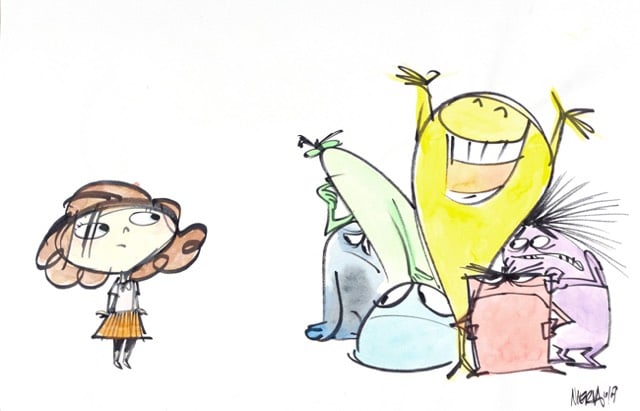
Pixar: The Design of Story is an upcoming exhibition at the Cooper Hewitt National Design Museum here in NYC.
Through concept art from films such as Toy Story, Wall-E, Up, Brave, The Incredibles and Cars, among others, the exhibition will focus on Pixar’s process of iteration, collaboration and research, and is organized into three key design principles: story, believability and appeal. The exhibition will be on view in the museum’s immersive Process Lab — an interactive space that was launched with the transformed Cooper Hewitt in December 2014 — whose rotating exhibitions engage visitors with activities that focus on the design process, emphasizing the role of experimentation in design thinking and making.
More details are available in the press release. Definitely going to check this out and take the kids.
Older posts






Socials & More