

Fantastic Mr. Fox, trailer number two
New trailer for Fantastic Mr. Fox.

This site is made possible by member support. 💞
Big thanks to Arcustech for hosting the site and offering amazing tech support.
When you buy through links on kottke.org, I may earn an affiliate commission. Thanks for supporting the site!
kottke.org. home of fine hypertext products since 1998.
Beloved by 86.47% of the web.
Mary Norris works as a page O.K.’er for the New Yorker.
It’s always good, before changing something, to stop and wonder if this is a mistake or if the writer did this for a reason. When you’ve read a piece five or more times, it is tempting to believe that it must be perfect, but you have to stay alert for anything you might have missed. Eternal vigilance!
(thx, jen)
Too soon for that title? Anyway, Hitfix takes an early look at the Oscar contenders for 2010. Among them, Clint Eastwood’s Invictus, Star Trek, Where the Wild Things Are, Malick’s The Tree of Life, The Road, Amelia, and The Lovely Bones.
Rachel Sussman has travelled the world to take photographs of the oldest living things in the world. This is actinobacteria from Siberia; it’s 400,000 years old.

There’s a map and a progress blog and an unassociated Wikipedia entry that tells of the ocean-going species Turritopsis nutricula:
The Hydrozoan species Turritopsis nutricula is capable of cycling from a mature adult stage to an immature polyp stage and back again. This means that there may be no natural limit to its life span.
Who wants to bet that Ray Kurzweil drinks a Turritopsis nutricula smoothie every morning? (via @bobulate)
Rich Cohen has a really fantastic article about the American history of the automobile and car salesman in the September issue of The Believer.
The history of America is the history of the automobile industry: it starts in fields and garages and ends in boardrooms and dumps; it starts with daredevils and tinkerers and ends with bureaucrats and congressmen; it starts with a sense of here-goes-let’s-hope-it-works and ends with help-help-help. We tend to think of it as an American history that opens, as if summoned by the nature of the age, early in the last century, when the big mills and factories were already spewing smoke above Flint and Detroit, but we tend to be wrong. The history of the car is far older and stranger than you might suppose. Its early life is like the knock-around life one of the stars of the ’80s lived in the ’70s, Stallone before Rocky, say, picking up odd jobs, working the grift, and, of course, porn. The first automobile turned up outside Paris in 1789, when Detroit was an open field. (The hot rod belonged to the Grand Armee before it belonged to Neal and Jack.) It was another of the great innovations that seemed to appear in that age of revolution.
Cohen references one of my favorite pieces from a few years ago, Confessions of a Car Salesman, in which a journalist goes undercover for three months at a pair of Southern California car dealerships. Required reading before purchasing a car.
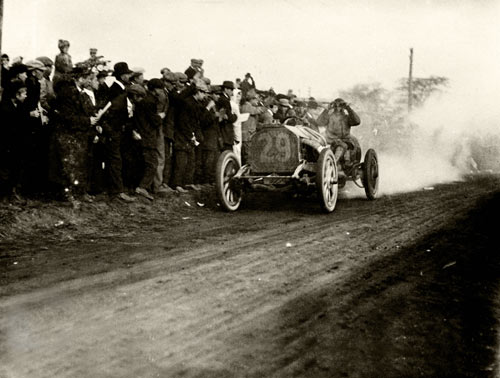
Cohen’s article also reminded me just how many of the American cars on the road today owe their names to the people who actually started these companies and built these cars back in the early days. Ransom Olds, Louis Chevrolet, Walter Chrysler, Horace and John Dodge, Henry Ford, David Buick…some of these read like a joke from The Simpsons. Here’s Louis Chevrolet racing a Buick in 1910:
Looking overseas, there’s Karl Benz, Michio Suzuki (who didn’t actually start out building cars), Wilhelm Maybach, Ferdinand Porsche, and many others. In an interesting reversal of that trend, Daimler Motoren Gesellschaft (which eventually became part of Daimler-Benz) built a custom sports car for Emil Jellinek, who named it Mercedes after his daughter. Jellinek was so fond of the car that he legally changed his last name to Jellinek-Mercedes and thereafter went by E.J. Mercédès.
An interesting article in The Brooklyn Rail debates the value of commercialism versus criticism in the art world. Riffing off of an essay called “Frivolity and Unction” from Dave Hickey’s book, Air Guitar, writer Shane McAdams opines that art doesn’t have to be “important” to be good:
“Art” can be unimportant and still allow for the experience of a work of art to be life-changing. I value the memories I have of listening to baseball games on my grandparents’ porch, but Baseball, as a concept, remains entirely unimportant. Such concepts as baseball, art, and Hickey’s example of rock and roll, are wholly unimportant except for the experiences they foster and the history to which they contribute.
The Psychrolutes marcidus, aka blobfish, is a fish that adapted to the deep waters off the Australian coast.

Located 800 meters under water (roughly a half-mile down,) the pressure in the mesopelagic zone is 80 times greater than the pressure on sea level. Most fish use gas bladders to remain buoyant, but the pressure that far down would be too great for an average, gas-bladder equipped fish to efficiently survive. The blobfish’s advantage is that its body consists of a gelatinous goo that is slightly less dense than water. This allows it to simply float along without expending any energy on swimming. The fish, which resembles a candle that’s been burning for way too long, consumes whatever tasty morsels bob by its mouth, choosing to eat what’s served to it. The unsightliness of the blobfish probably hasn’t caused it to develop a complex, though. It lives in the oceanic equivalent of the sticks, so it doesn’t get many visitors.
Update: It appears the blobfish has a bit of a craft-inclined cult following: there’s a gentleman who knitted his friend a blobfish bath toy and there also appears to be a stuffed, plush blobfish floating around out there, too.
(thx caroline)
A couple in London have found the ultimate space-saving solution for a city-dwelling book lover: a staircase bookshelf. UK-based Levitate Architects came up with the page-turning passage as a unique way to augment a loft sleeping space in the attic with discreet storage. If they could create a record crate bathroom, I’d be ready to move in.
Kasey McMahon decided to combine an interest in taxidermy with her PC. Fearing that the natural world is being replaced by technology, the artist installed a working computer inside of an idle beaver. First, she crafted a computer from the motherboard up, tested it, then hollowed out a stuffed beaver and molded the two together using spandex spray, resin, and fiberglass. After three months of work, the result was Compubeaver, followed up by its accessory, Text-o-Possum, a stuffed possum that’s equipped with a laser in its back leg that projects a virtual keyboard. McMahon was generous enough to provide a 29-step guide for the rest of us, in the hope that we’ll each case mod a beaver and create our own animal-based data processor. Just imagine using a raccoon laptop at Starbucks. Perhaps that would inspire them to provide free WiFi.
Update: See also installing Linux on a dead badger. (thx, michael)
The baked bean index and other economic indicators orig. from Sep 21, 2009
A little Grace Kelly orig. from Sep 28, 2009
* Q: Wha? A: These previously published entries have been updated with new information in the last 24 hours. You can find past updates here.
Gay and lesbian teens are coming out of the closet earlier and earlier with responses ranging from acceptance to “but you’re so young”.
Though most adolescents who come out do so in high school, sex researchers and counselors say that middle-school students are increasingly coming out to friends or family or to an adult in school. Just how they’re faring in a world that wasn’t expecting them — and that isn’t so sure a 12-year-old can know if he’s gay — is a complicated question that defies simple geographical explanations. Though gay kids in the South and in rural areas tend to have a harder time than those on the coasts, I met gay youth who were doing well in socially conservative areas like Tulsa and others in progressive cities who were afraid to come out.
Daring Fireball, Talking Points Memo, Technologizer, and Macworld recently posted some information about what operating systems and browsers their readers are using. Here’s the report for kottke.org.
OS statistics
| OS | Now | 6 mo | 1 yr | 1.5 yr | 2 yr | 2.5 yr | All-time |
| Windows | 54.1% | 56.5% | 63.4% | 63.3% | 65.6% | 70.1% | 62.5% |
| Mac | 40.2% | 38.2% | 31.7% | 32.2% | 29.9% | 27.2% | 32.9% |
| Linux | 2.5% | 2.9% | 3.2% | 3.4% | 4.2% | 2.4% | 3.1% |
| iPhone | 2.3% | 1.6% | 1.2% | 0.6% | - | - | 0.9% |
The general trends are obvious here. Mac usage among kottke.org readers has risen — over the past year in particular — while Windows usage has fallen by the same amount. Forty percent of all kottke.org readers now use a Mac.
The adoption rate of Snow Leopard (OS X 10.6) by kottke.org readers is less than that of Daring Fireball readers. Of Mac users who visit kottke.org, 47.4% are on 10.5, 34.4% are on 10.6, 8.1% on 10.4, 4.0% on 10.4 (PPC) and 3.7% on 10.5 (PPC). Among Windows visitors, 61.9% are still using XP compared to 32.6% on Vista.
Browser statistics
| Browser | Now | 6 mo | 1 yr | 1.5 yr | 2 yr | 2.5 yr | All-time |
| Firefox | 44.6% | 46.1% | 50.4% | 48.9% | 47.0% | 50.1% | 47.9% |
| Safari | 27.9% | 25.4% | 17.3% | 17.7% | 15.9% | 13.7% | 19.1% |
| IE | 18.5% | 21.3% | 25.9% | 28.7% | 31.1% | 32.2% | 27.0% |
| Chrome | 5.6% | 3.7% | 2.8% | - | - | - | 1.8% |
The numbers for Firefox and IE are falling while Safari and Chrome usage are surging. The Safari nummbers are surprising to me…Safari is not a new browser but its usage by kottke.org readers has increased by more than 60% in the past year. I predict Chrome will surge in the next 12 months to overtake IE.
Two miscellaneous things
1. Google is ruling the search space more than ever. 93.2% of the incoming search traffic to kottke.org comes from Google. That’s up from 91.2% a year ago and 83.7% two years ago (!!). Bing is second with 3.4% (MSN and Live combined for 5% two years ago) and Yahoo is a very sad third at 1.5% (they were at 6.9% two years ago).
2. Twitter now accounts for 2.9% of all traffic to kottke.org while Facebook is 0.9%. That’s understandable considering I invest a lot of time on Twitter and almost none on Facebook. For reference, StumbleUpon is at 6.5% and incoming Google search traffic is 25.5%.
Brian Dettmer began crafting skeletons from cassette tapes after being inspired by the relatively rapid death of analog media. The artist, whose previous work includes meticulous autopsies of books, enjoys deconstructing found objects and transforming them into complex, chimerical sculptures. His plastic bones have resulted in a series of skulls, both human and animal, crafted from tapes consistent with a musical genre, such as rock and metal. Each piece is devoid of any adhesive, and although Dettmer keeps his process a secret, it’s rumored that the cassettes are welded together using heat, moulds, and his damp hands. No word yet on how they sound.
Michael Ruhlman announces the winners of his BLT From Scratch contest.
From scratch means: You grow your tomato, you grow your lettuce, you cure your own bacon or pancetta, you bake your own bread (wild yeast preferred and gets higher marks but is not required), you make your own mayo. All other embellishments, creative interpretations of the BLT welcome.
Don’t miss the winner’s BLT flow chart; he made his own sea salt from sea water.
An interesting way to hold onto summer would be to engineer a lunchbox that comes with its own outdoor setting. For those who are craftily inclined, this article contains instructions on how to pack more than a sandwich with your mid-day snack, using turf, an image of the outdoors, and some old fashioned ingenuity. With lunch inside the box, nestled among a handmade diorama of the outdoors, complete with a patch of grass, the “Green Space Travel Case” provides a tiny slice of countryside for those confined to a concrete cityscape. Ants and screaming children packed separately.
A new species of ghostshark was found off the coast of California. The odd-looking creature is a bit of an evolution-born exhibitionist: the males float through the deep with a club-like sex organ protruding from their heads. Scientists are unsure why this is the case, though some speculate that it is to grasp the female during mating. The Eastern Pacific black ghostshark joins the ranks of a special group referred to as “big black chimaeras.” This classification is reserved for an ever-growing clique of sea creatures that feature characteristics that aren’t found on other living creatures, though one could argue that the males of many species often combine their sex organs and their heads.
There are some architects who theorize that intuitive, adaptable buildings are in our future. These structures might be made of components that adjust to certain variables: a particularly rainy evening, a raucous Super Bowl party on the third floor, or a brutally cold December day. Says German architect Axel Ritter:
Buildings of the future will be able to change colour, size, shape and opacity in reaction to stimuli. Architects will be able to design buildings that change their geometry according to the weight of the people inside.
The use of these reactive materials would alter the relationship between architecture and building behavior. If you’re lucky, it might also improve your apartment’s laughable square footage.
The Radiohead frontman is forming a new band “for fun”…members include long-time Radiohead collaborator Nigel Godrich and Flea.
In the past couple of weeks i’ve been getting a band together for fun to play the eraser stuff live and the new songs etc.. to see if it could work! here’s a photo.. its me, joey waronker, mauro refosco, flea and nigel godrich.
(via @linklog)
This robot can sort pancakes at a rate of over 400 ppm (pancakes per minute).
The action gets going at about 1:15…don’t miss the explanation of the pancake buffer shelf about 2/3s of the way through. (via eat me daily)
Each frame of this 19th century film by the Lumière brothers was hand-colored to create an early color moving picture. The color-shifting effect of the dress looks quite modern.
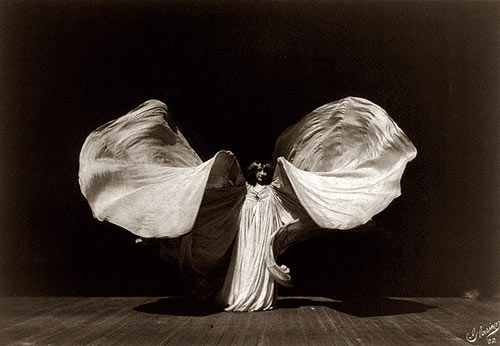
The dancing was inspired by Loie Fuller, a modern dance pioneer.
The Spanish ribbed newt has an interesting method of dealing with perceived threats. The creature activates its ribcage like mini switchblades, forcing them through its own skin. Even more remarkable, the newt’s highly adapted immune system and collagen-cased bones allow it to heal quickly and without risk of infection, which makes it one job interview away from a position with the X-Men.
I can’t get this to work (because I’m in the US?) but the BBC has put up a collection of David Attenborough’s favorite moments from his last 30 years of shooting nature documentary videos. More info here.
It has always been my hope that through filmmaking I can bring the wonder of the natural world into people’s sitting rooms, inspire people to find out more and to care about the world we share.
(via @dunstan)
I love this shot of a woman in Milan from the Sartorialist.

As Schuman notes, there’s a sense of style here that tons of expensive flashy clothes can’t compete with.
Update: On the other hand, this sort of thing has its charms.
A recent Improv Everywhere endeavor had a photo booth set up in a New York subway car. They told riders that the MTA had hired them to take photographs of every person who used the subway, and that there would be a yearbook at the end of the year. The result was one interesting, if misinformed, class.
A farmer in China has grown pears in the shape of babies. Using fiberglass and plastic moulds, Hao Xianzhang has been able to cultivate fruit in the shape of newborns. The popularity likely extends beyond those who catch the literary reference: in the Chinese novel Journey to the West a mythical fruit in the shape of an infant bestows immortality to all who consume it. Xianzhang’s pears cost $7 (50 yuan) each, not too pricey for a piece of the eternal. For those who aren’t inclined to snack on athanasia, the farmer plans on growing fruit in the shape of other figures, including comedy icon Charlie Chaplin.
Update: Turns out that some sources are calling these “Buddha shaped pears,” not baby shaped. Chewing on a deity or consuming your young, either way, it’s some peculiar produce.
(thx anna)
As you may have already noticed, Ainsley Drew is back and will be helping me out here for the next couple of weeks on a part time editorial basis as my wife and I deal with our new houseguest. (I’ll be posting stuff as well…just at odd hours.) Welcome, Ainsley!
In case you ever wondered why you’re cheering for a group of young bears, Northern statesmen, or tiny birds, here’s a Venn diagram of baseball team names and their etymology.
Your company? There’s an app for that. orig. from Sep 16, 2009
* Q: Wha? A: These previously published entries have been updated with new information in the last 24 hours. You can find past updates here.
I really like Sophie Blackall’s illustrations of missed connections ads from Craiglist and other sites. The style reminds me a bit of Maira Kalman.

If this were on Tumblr, she’d already have a book deal.
Update: About that book thing:
Ms. Blackall’s whimsical drawings have also caught the attention of publishers: She says she’s currently negotiating a deal to create a book of her illustrations, which would likely land on shelves sometime in the next year to 18 months.
To sort out the uncultured, ill-tempered, and just plain ugly, Moscow clubs use a process called face control (or feis kontrol), a particularly picky version of the typical velvet rope system employed at clubs around the world.
Not that Pasha doesn’t take his role seriously. As he sees it, his job, or that of any face control expert, is necessary because Russia is filled with “people who have just made their first million and think they deserve to be in the club, that they should get everything they want.” This, of course, is a problem. “But in fact they’re just a bunch of miners and day laborers,” Pasha said. “They don’t have respect or culture.”
When Obama poses for photos, he smiles in exactly the same way each time.
And I thought Paris was consistent.
Did Jackson Pollock hide his name in one of his most well-known paintings?
Pollock’s possibly writing his name in Mural testifies to an overlooked feature of his works: they have a structure, contrary to the popular notion that they could be done by any 5-year-old with a knack for splatters. In my view, Pollock organized the painting around his name according to a compositional system-vertical markings that serve as the loci of rhythmic spirals-borrowed directly from his mentor, Benton.
Try and find it for yourself.
Is cropping a photo lying? orig. from Sep 17, 2009
The baked bean index and other economic indicators orig. from Sep 21, 2009
Picturing Burj Dubai in midtown Manhattan orig. from Sep 23, 2009
SiteKey sucks orig. from Apr 12, 2007
An abundance of death orig. from Aug 18, 2009
The history of Levi’s jeans orig. from Aug 25, 2009
Astronomy Photographer of the Year winners orig. from Sep 10, 2009
The McFarthest Spot orig. from Sep 23, 2009
What a well-placed $20 gets you orig. from Sep 24, 2009
* Q: Wha? A: These previously published entries have been updated with new information in the last 24 hours. You can find past updates here.
At the end of the 19th century, Henry Harrison created color photographs by painting them on-site.
In 1907, Dr. Duncan MacDougall found a bunch of people who were about to die and weighed them as they expired. MacDougall claimed that at the point of death, the bodies became lighter. That lost weight, the doctor assumed, was the escaping soul. He even postulated that the souls of the sluggish in life are slow in death:
The subject was that of a man of larger physical build, with a pronounced sluggish temperament. When life ceased, as the body lay in bed upon the scales, for a full minute there appeared to be no change in weight. The physicians waiting in the room looked into each other’s faces silently, shaking their heads in the conviction that out test had failed.
Then suddenly the same thing happened that had occurred in the other cases. There was a sudden diminution in weight, which was soon found to be the same as that of the preceding experiments.
I believe that in this case, that of a phlegmatic man slow of thought and action, that the soul remained suspended in the body after death, during the minute that elapsed before it came to the consciousness of its freedom. There is no other way of accounting for it, and it is what might be expected to happen in a man of the subject’s temperament.
The weight lost of MacDougall’s first subject at death was 3/4 of an ounce…or about 21 grams. (via radiolab)
The Informant (Steven Soderbergh, Matt Damon) is out in theaters now. I had no idea it was based on a true story…a genuinely crazy true story of corporate price fixing, FBI informants, and an eager-to-please executive. Kurt Eichenwald wrote a series of article about the case for The New York Times, which he fashioned into a book. This American Life devoted an entire hour to this story back in 2000…it’s a fascinating listen.
We hear from Kurt Eichenwald, whose book The Informant is about the price fixing conspiracy at the food company ADM, Archer Daniels Midland, and the executive who cooperated with the FBI in recording over 250 hours of secret video and audio tapes, probably the most remarkable videotapes ever made of an American company in the middle of a criminal act.
Tom Chiarella took a stack of $20 bills with him to New York City just to see what he could get by offering them to the right people at the right time. Turns out, quite a bit. I probably linked to this a few years ago (it’s from 2003), but it’s worth another look. I just love this kind of thing…probably because I’m too much of a candy ass to ever attempt something similar.
A twenty should not be a ticket so much as a solution. You have a problem, you need something from the back room, you don’t want to wait, you whip out the twenty.
I could have stood in line at the airport cabstand for fifteen minutes like every other mook in the world, freezing my balls off, but such is not the way of the twenty-dollar millionaire. I walked straight to the front of the line and offered a woman twenty bucks for her spot. She took it with a shrug. Behind her, people crackled. “Hey! Ho!” they shouted. I knew exactly what that meant. It wasn’t good. I needed to get in a cab soon. One of the guys flagging cabs pointed me to the back of the line. That’s when I grabbed him by the elbow, pulled him close, and shook his hand, passing the next twenty. I was now down forty dollars for a twenty-dollar cab ride. He tilted his head and nodded to his partner. I peeled another twenty and they let me climb in. As we pulled away, someone in the line threw a half-empty cup of coffee against my window.
A few months later, Chiarella tried the same technique in Salt Lake City, Vegas, and LA.
I pushed around; the ballsier I became, the more success I experienced. I got tablecloths, a personal garlic press, a dozen extra forks in one meal, chopsticks in a steak house. I bought primo parking spaces from people who had just parallel-parked.
Aha, turns out I linked to a similar article by Chiarella in which he haggles on items like hot dogs, TiVos, and gasoline. (via big contrarian)
Update: Ah, I’ve also previously linked to this one, from Gourmet in 2000.
It’s just after 8 P.M. on a balmy summer Saturday and I’m heading toward one of New York’s most overbooked restaurants, Balthazar, where celebrities regularly go to be celebrated and where lay diners like me call a month in advance to try and secure a reservation. I don’t have a reservation. I don’t have a connection. I don’t have a secret phone number. The only things I have are a $20, a $50, and a $100 bill, neatly folded in my pocket.
(thx, david)
To get to a McDonald’s in the lower 48 United States, it’s never more than 145 miles by car. And the McFarthest Spot in the US is in South Dakota.
For maximum McSparseness, we look westward, towards the deepest, darkest holes in our map: the barren deserts of central Nevada, the arid hills of southeastern Oregon, the rugged wilderness of Idaho’s Salmon River Mountains, and the conspicuous well of blackness on the high plains of northwestern South Dakota.
See also maximum Starbucks density and Starbucks center of gravity of Manhattan.
Update: The distribution of McDonald’s in Australia is a bit more uneven. (thx, kit)
Update: As of December 2018, the point the farthest away from any McDonald’s in the lower 48 US states is in Nevada, 120 miles away from the nearest McDonald’s.
Congrats to the team at Dopplr on their acquisition by Nokia. Of course, the source is TechCrunch so grain of salt and all that.
What would the world’s tallest building look like in NYC? Probably something like this.

Wow. (thx, ethan)
Update: And here are some images from Google Earth on what the Manhattan views from Burj Dubai would look like. The Top of the Rock one is crazy.
McSweeney’s has an iPhone app called Small Chair.
We hereby announce the debut of the Small Chair, a weekly sampler from all branches of the McSweeney’s family. One week you might receive a story from the upcoming Quarterly, the next week an interview from the Believer, the next a short film from a future Wholphin. Occasionally, it might be a song, an art portfolio, who knows. Early contributors will include Spike Jonze, Wells Tower, Chris Ware, and Jonathan Ames. This material will not be available online and is pretty sure to be good stuff.
My iPhone usage has been almost exclusively baby-related for the past few days, but I hope to try this app out soon.
If all the gaming consoles in the US formed their own city, that city would use as much power as San Diego, the 9th-largest city in the country.
Two books by North Korean dictator Kim Jong Il are available at Amazon: Kim Jong Il on the Art of Opera and On the Art of the Cinema. From the preface of the latter:
The cinema is now one of the main objects on which efforts should be concentrated in order to conduct the revolution in art and literature. The cinema occupies an important place in the overall development of art and literature. As such it is a powerful ideological weapon for the revolution and construction. Therefore, concentrating efforts on the cinema, making breakthroughs and following up success in all areas of art and literature is the basic principle that we must adhere to in revolutionizing art and literature.
Here’s more information about Dear Leader’s cinematic and operatic interests.
On the Art of Opera describes how Kim and his dad, the late Great Leader Kim Il Sung, discovered the husk of a tired art form and gave it a much-needed shot of North Korean communism. Any impartial observer would agree that Kim’s aesthetic prescriptions are every bit as crowd-pleasing as his economic policies.
“In conventional operas,” Kim writes, “the personalities of the characters were abstract, their acting clumsy, and the flow of the drama tedious, because the singers were forced to sing unnaturally and their acting was neglected.” Furthermore, until the arrival of the Kims, “no one interwove dance and story very closely.”
And now? “The ‘Sea of Blood’-style opera,” he observes, “has opened up a new phase in dramaturgy.” In case you’ve been living in a cave, Sea of Blood is North Korea’s longest-running production, the Cats of Pyongyang. It has been staged 1,500 times, according to the official Korea News Service, which calls it an “immortal classical masterpiece.” Kim claims to have revamped the form by chucking the aria out the window and replacing all solo performance with a cunning Kim innovation: the pangchang, a more satisfying off-stage chorus representing groupthink.
I don’t have time for a proper play, but the sequel to Hedgehog Launch is out. It’s more of the same, only different. (thx, ben)
PS. In case you missed it on Friday, all the fun Flash games I post have their own page now: addictive Flash games. There it is, your whole day. Waiting to be ruined.
My wife almost wet her pants at this part of a TV ad for the Neckline Slimmer. This odd little device reminds me a bit of the eye exercises that Speed Reader did on The Great Space Coaster. (Congrats if you get that reference.)
They play video games, dance, fish, hang out with Wall-E, and all kinds of other stuff. I can’t decide which is my favorite…this one, this one, or this one? No, it’s gotta be this one:
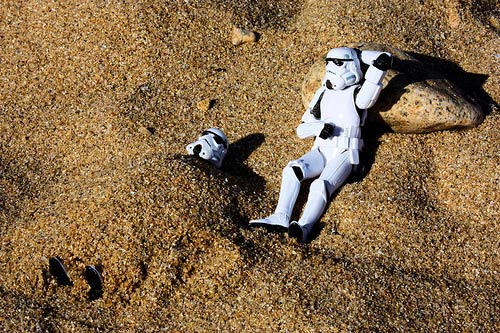
(via @ettagirl)
Hello everyone. I’d like you to meet Ollie’s little sister, Minna Kottke.
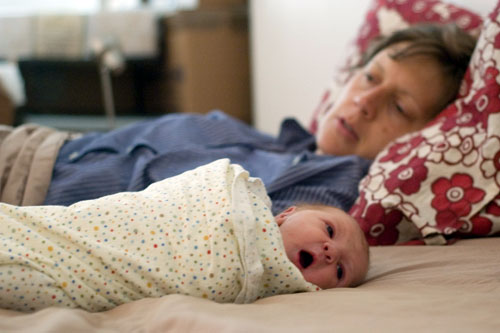
Big yawn! She was born at home (on purpose!) early this morning; mother and baby are resting comfortably. I am weakened by an unrelated sickness but proud and happy. Ollie can’t stop talking about her. “Minna! Minna!” He’s going to be a great big brother.
So, things are going to be a little slow around here for a bit, especially the rest of this week. Starting next Monday, I’ll be joined by a part-time guest editor for a couple weeks. But more on that later. Now: sleep.
On Reddit, an informal Q&A with a $30 million lottery winner about how the money has changed his life.
I went to the lottery’s website after finding the ticket and realized that I had won. I freaked out ran up to my apartment’s door and locked all the locks. It was completely irrational.
(via cyn-c)
A bunch of odd economic indicators that I have read about recently. The use of the 2nd Street Tunnel in Los Angeles in car commercials:
According to FilmL.A., the nonprofit organization that coordinates on-location shooting in the city, no permits have been issued in 2009 for car commercials. Although commercial production in the city is flagging anyway — down 34% in the first quarter — the 100% drop in tunnel permits suggests “very tough times in the car business,” FilmL.A. spokesman Todd Lindgren said.
The reinstatement of the £90 lingerie-and-blouse allowance at London law firm Clifford Chance:
Inevitably dubbed the “90 nicker knicker allowance”, this may or may not be the most reliable indicator yet that the credit crunch is over. (Business is apparently so hectic that the firm has also installed sleeping pods.)
And from this article, several others, including:
The baked bean index — my colleague Anthony Reuben noted in the spring how the value of sales of baked beans — a classic recession food — had risen 21.6% in April compared with the same month last year. Could a reverse signal the start of a recovery?
The number of people signing up to dating agencies offering extra-marital affairs, on the basis that demand goes up either in times of excessive confidence — “I won’t get caught”; or depression — “I don’t care”. (Sex had to figure somewhere.)
(via schott’s vocab log)
Update: But wait, there’s more! Sex dolls, vendor gifts, and the Puma Index.
Update: The 90-pound knicker allowance is bollocks. (thx, cheryl)
Update: How about the closing speed of car salesmen around a prospective buyer?
Here’s an indicator economists should study as they study GDP: speed with which, upon entering a store, you are surrounded by salesmen. (I would record both gather-rate-in fractions of a second-and density.) I was approached by the first salesman as I came in the door, picked up another as I went by the reception desk, picked up a third as I skirted a Buick Enclave. I looked back when I reached the Corvettes. There must have been ten salesmen back there and more coming, spilling out of offices and break rooms like police cruisers appearing from side streets to chase Burt Reynolds in Smokey and the Bandit. We moved in a buzzing cloud around the Corvette. From a distance, we would have made a fine subject for a painting in the National Gallery: Salesmen and Commission; or, Depression and Its Discontents. When I stood and stared and pretended to think, they stood back and stared and pretended to think. “You know, it’s not so expensive if you realize you’re buying it over the course of three years.”
Update: And a bunch more from Time’s Cheapskate blog.
Update: And still more! Hair dye (more is sold in down times) and complimentary kids crayons at restaurants (50% fewer crayons per package).
This is Adrian Bejan on how the current offensive explosion in NFL scoring can be thought of in terms of a river’s effect on its basin.
Over time, a river relentlessly wears away its banks and, as a result, water flows faster and faster toward its mouth. When obstacles fall in its way, say, a tree, or a boulder-or in the case of an NFL offense, beefy linebackers like the Baltimore Ravens’ Ray Lewis or the Chicago Bears’ Brian Urlacher-it will figure out how to wear those away, too. “The game is a flow system, a river basin of bodies that are milling around trying to find the most effective and easiest way to move,” says Prof. Bejan. “Over time you will end up with the right way to play the game, with the patterns that are the most efficient.”



Socials & More