kottke.org posts about Lego


Bradley Barber remixes Lego sets into other things, e.g. the Millennium Falcon from Back to the Future DeLorean parts, an AT-AT into the USS Enterprise, and a Pirates of the Caribbean ship from the parts of a Lego bonsai tree set.
He is not alone in this pursuit; you can find tens of thousands of custom Lego designs at Rebrickable, including dozens of Barber’s designs.
As you know, I love me some Lego engineering builds. This one is pretty fun: using a large syringe, a Raspberry Pi, neodymium magnets, a controller scavenged from a toy submarine, and a bunch of Lego pieces, Brick Experiment Channel built a remote-controlled submarine. And it works so well! They even tested it by navigating 200 meters in a real stream.
I haven’t gotten my Brick Technology fix in awhile, so here’s a video featuring a series of more and more capable Lego vehicles climbing over taller and taller walls. As I have written before, here’s what makes these videos so compelling:
They’re not even really about Lego…that’s just the playful hook to get you through the door. They’re really about science and engineering — trial and error, repeated failure, iteration, small gains, switching tactics when confronted with dead ends, how innovation can result in significant advantages. Of course, none of this is unique to engineering; these are all factors in any creative endeavor — painting, sports, photography, writing, programming. But the real magic here is seeing it all happen in just a few minutes.
See also their recent video about Lego cars crossing a treadmill bridge. (via the kid should see this)


Lego is coming out with a near 1:1 replica of Nintendo’s iconic Game Boy handheld video game system. It’s not playable, but you can insert & remove Lego game cartridges and use different lenticular screens to pretend. Here’s a short video showing how it “works”:
You can preorder the kit from Amazon; the price is $60, which is only $30 less than the actual Game Boy cost when it was released.1
I still have my original Game Boy from 1989 — it’s sitting on a table near where I’m typing this. I played so so much Tetris on that thing… (via moss & fog)
The Great Ball Contraption is a class of machines built with Lego that transport small balls from place to place in many different ways.
The otherwise pointless handling of balls, and the myriad ways this is accomplished, gives great ball contraptions the impression of a Rube Goldberg machine.
These machines can be quite large and elaborate and are displayed at Lego events around the world. Here’s a recent GBC at an event in Japan:
It’s worth watching for a bit for the ingenuity and all of the different mechanisms for moving objects around — plus, it’s mesmerizing. And it obviously reminds me of Chris Burden’s Metropolis II.
You can build your own Great Ball Contraption (or team up with others to do so) with the rules & resources listed here.
See also 20 Mechanical Principles Combined in a Useless Lego Machine, Treasure Trove of Over 1700 Mechanical Animations, Five Hundred and Seven Mechanical Movements, and Gears and Other Mechanical Things.
Brick Technology’s new video features increasingly powerful Lego machines designed to topple ever stronger towers. I love their iterative engineering videos (and those from Brick Experiment Channel). As I’ve written about these videos before:
They’re not even really about Lego…that’s just the playful hook to get you through the door. They’re really about science and engineering — trial and error, repeated failure, iteration, small gains, switching tactics when confronted with dead ends, how innovation can result in significant advantages. Of course, none of this is unique to engineering; these are all factors in any creative endeavor — painting, sports, photography, writing, programming. But the real magic here is seeing it all happen in just a few minutes.
I am uncomfortably close to buying some Technic and Mindstorms to dork around with my own little machines. (via waxy)

Using the official instructions and bricks from their own collection, a father & son team built a colorful DIY version of Lego’s massive Millennium Falcon (7541 pieces, $830 MSRP, kitty for scale).
I love this — much better than that dingy gray. I know it’s not quite the same, but the colorful Falcon harkens back to when Lego was more about throwing together whatever kaleidoscopic Franken-creations you could from your pile of bricks instead of completing just-so kits. (via @migurski)
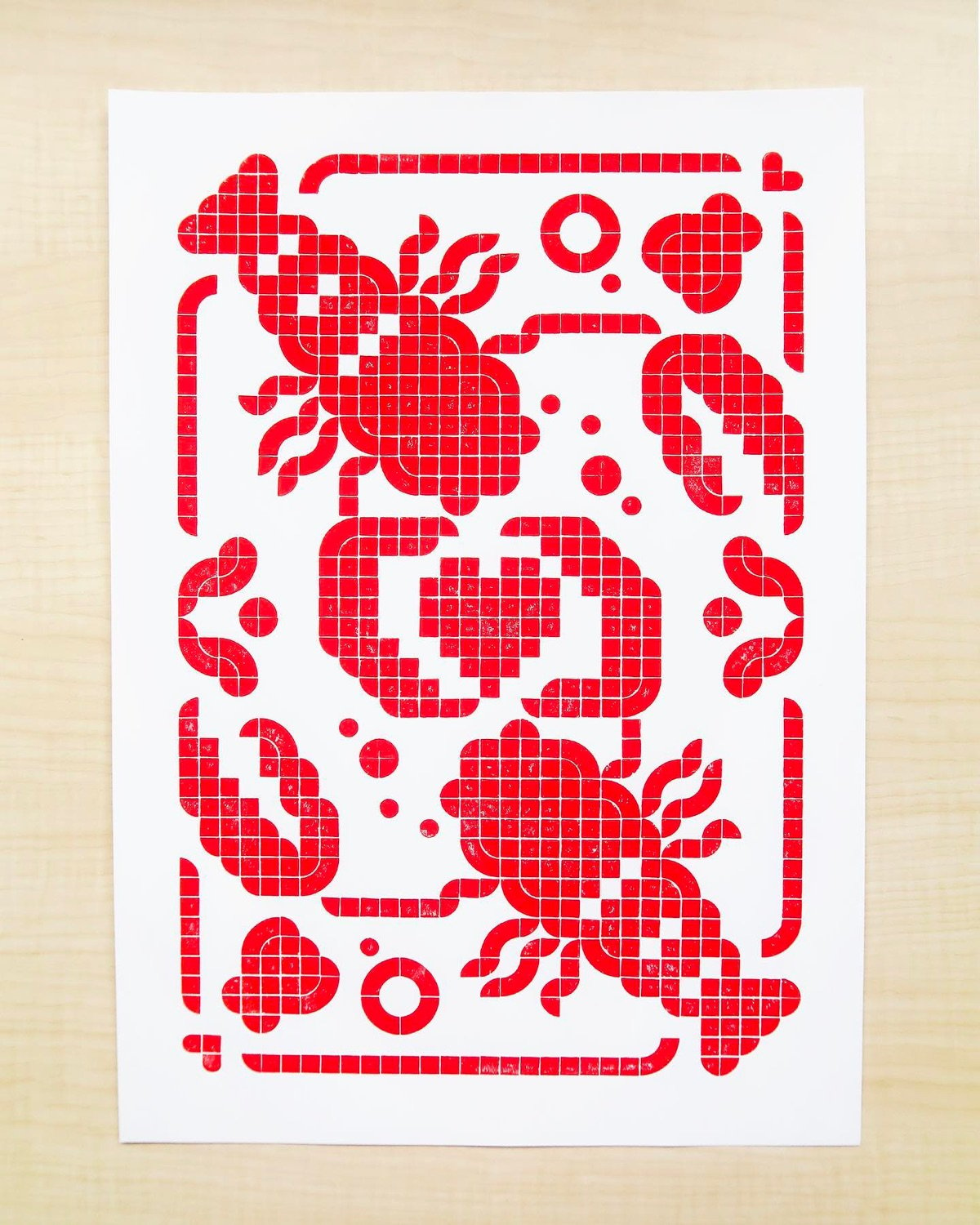
Check out this letterpress print of a lobster made by Eunice Chiong with Lego pieces as the stamps (watch a short video of her printing process). Chiong has been working with Legos and letterpress for many months now…check out more of her creations on Instagram and in her portfolio.
See also Letterpress Prints of Birds Printed Using Lego Bricks.
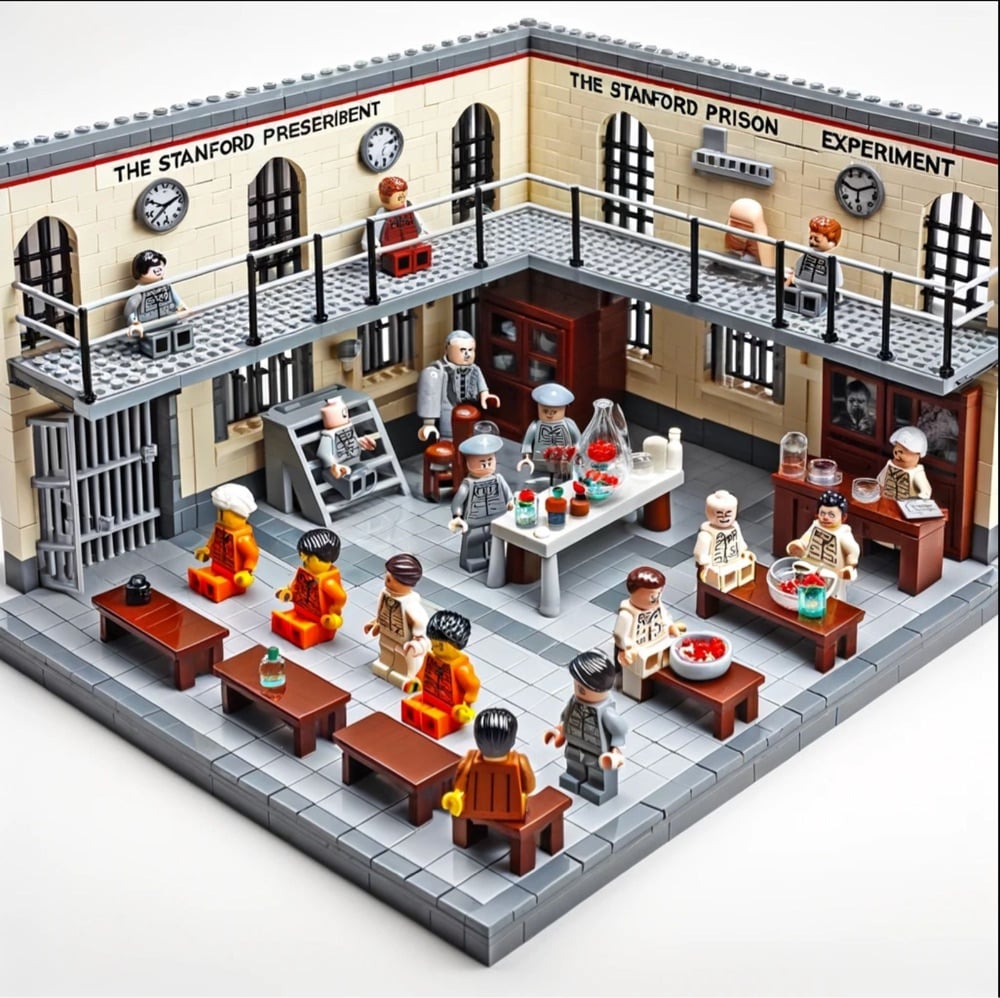
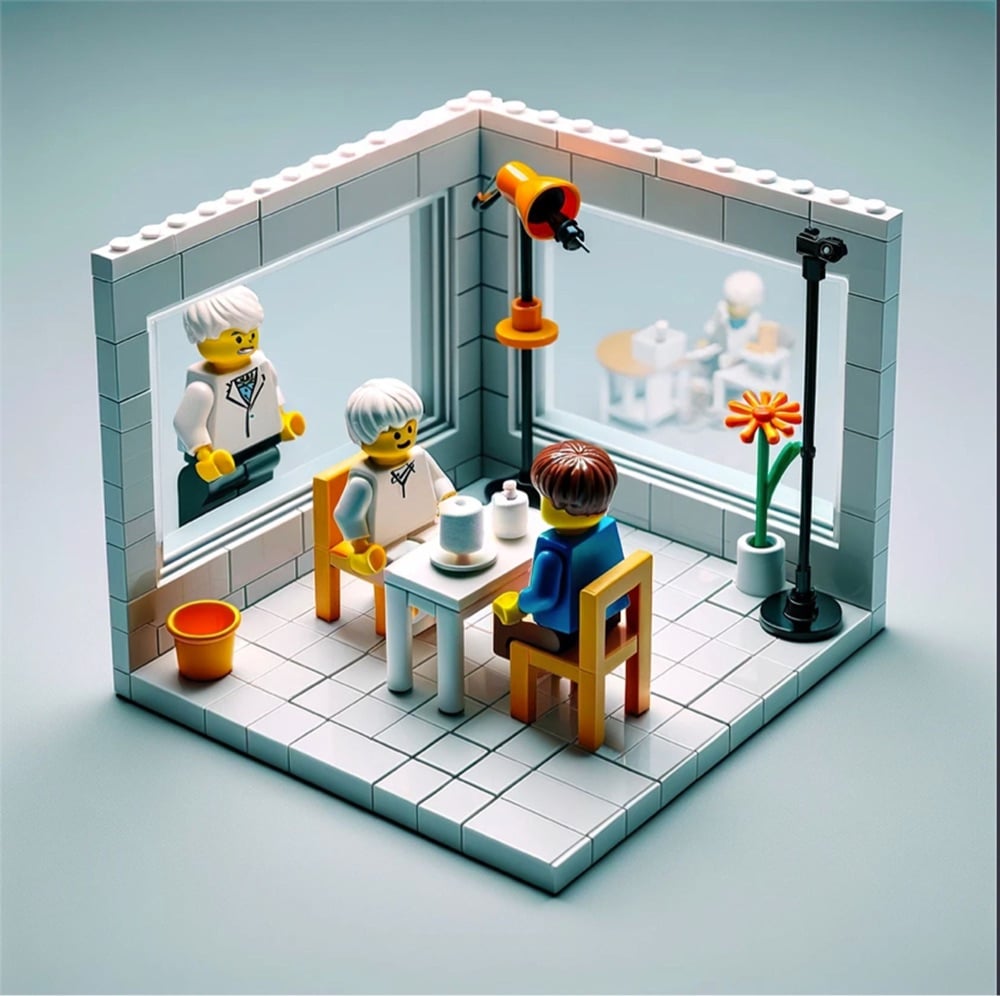

I love these depictions of famous moments in psychology and cognitive science via @tomerullman. From top to bottom: the Stanford prison experiment, the marshmallow test, and the selective attention test.
These didn’t track as AI-generated at first…and then I tried to read the text — THE STANFORD PRESERIBENT. You can see the whole set on Bluesky (if you have access).
Lego master Jumpei Mitsui spent over 400 hours building a 3D version of Hokusai’s Great Wave off Kanagawa out of 50,000 Lego bricks — you can watch a time lapse of the construction in the video above. The build was included at an exhibition of Hokusai’s work at the MFA in Boston:
In order to create Hokusai’s Wave in three dimensions, he made a detailed study of rogue waves and their characteristics. He also drew on childhood memories of waves near his family home at Akashi on the Inland Sea.
The video slows down to realtime in spots, so you can see how fast he’s actually building (quite fast). And you can also see the level of trial and error involved as he builds and then un-builds the waves until he’s happy with them. (via the kid should see this)


Lego is coming out with a huge new set that’s based on Denis Villeneuve’s two-installment adaptation of Dune (or, as it’s know around these parts, DUNC). OMG, the Baron Harkonnen minifig!! It reminds me of something…ah yes:

Longbaron is looooooooong.
Anyway, it’s coming out in February and the main build is a 1369-piece model of the Atreides Royal Ornithopter with “fold-out, flappable wings, deployable landing gear and an opening cockpit”. Baron Harkooooooooooooonnen. I can’t stop! I, uh, may have pre-ordered this the second I saw it. (via polygon)
Update: Absolutely perfect:
(via @justgregb)
In this ASMR stop motion cooking video, a chef butchers a huge Lego salmon and prepares a salmon and rice bowl. This video is surprisingly visceral, what with the sound effects and the (Lego) blood.
This reminds me more than a little of the sushi scene in Isle of Dogs. (thx, caroline)
I just really love the hell out of these iterative Lego build videos from Brick Experiment Channel and Brick Technology. In this one, a car is repeatedly modified to roll perfectly on an increasingly inclined treadmill. I started watching and in 10 seconds I was 100% invested.
They’re not even really about Lego…that’s just the playful hook to get you through the door. They’re really about science and engineering — trial and error, repeated failure, iteration, small gains, switching tactics when confronted with dead ends, how innovation can result in significant advantages. Of course, none of this is unique to engineering; these are all factors in any creative endeavor — painting, sports, photography, writing, programming. But the real magic here is seeing it all happen in just a few minutes.
See also A Lego 5-Speed Manual Transmission, Designing a Lego Car to Cross Gaps, Engineering a Capable Climbing Lego Car, Making A Solar-Powered Billion-Year Lego Clock, and 20 Mechanical Principles Combined in a Useless Lego Machine.
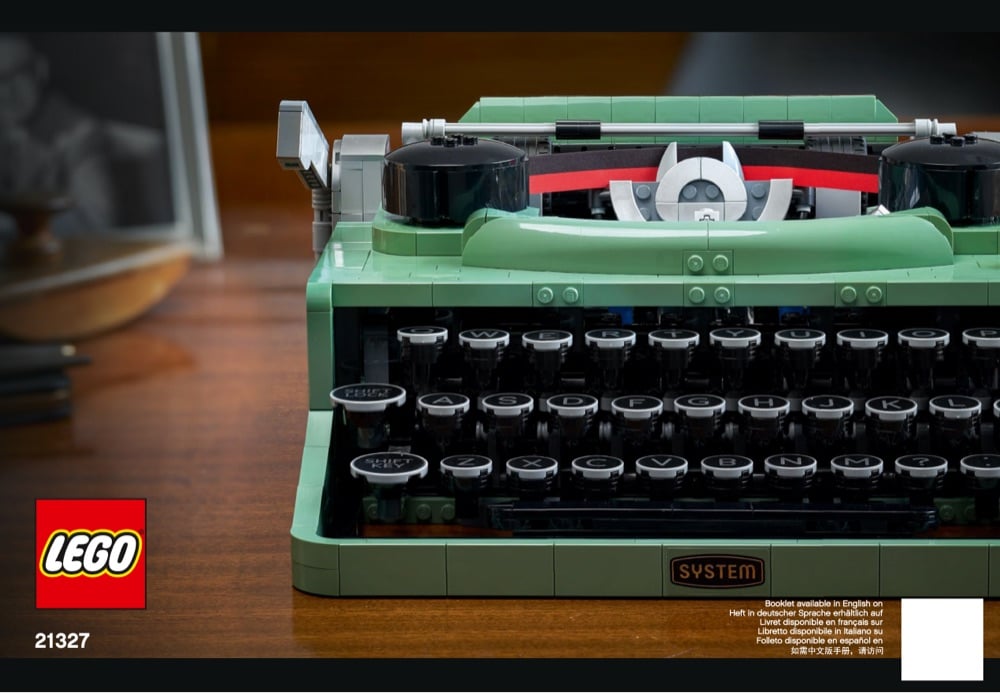
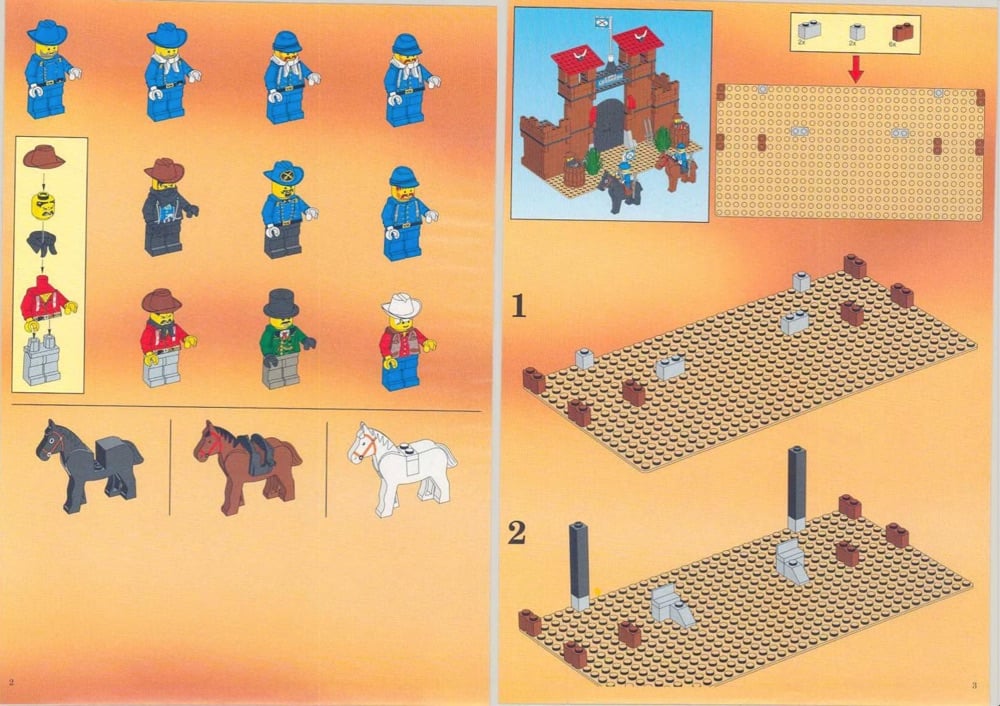

The Internet Archive is an international treasure, a trove of human creative output spanning decades and even centuries — a modern library of Alexandria. Among the collection is more than 6000 downloadable PDFs of Lego instruction manuals for projects ranging from old school sets like Fort Legoredo to big Star Wars sets like the Millennium Falcon to sets geared towards adults like the typewriter.
You can also look for instruction sets on Lego’s website as well as at Rebrickable, Brick Instructions, and at Brickset. (via open culture)
The creepy twins. Jack feverish at the typewriter. Danny riding his Big Wheel through carpeted hallways. The elevators of blood. These familiar scenes from Stanley Kubrick’s horror classic The Shining (and several more) have been recreated in this Lego stop-motion animation. The video took 50-60 hours over a three-week period to make and was an exercise in constraints:
“Mostly, it came down to choosing the right pieces,” he says. “I made this movie only with pieces I already had in my collection, so I had to do with just what I had laying around. For instance, the famous carpet pattern in the hallway could have been more realistic, but with the pieces I had, it became a little more abstract. I went with clay for the bloody elevator scene also because I do not have thousands of red translucent pieces.”
(via boing boing)
Older posts





Socials & More