



Advertise here with Carbon Ads

This site is made possible by member support. 💞

Big thanks to Arcustech for hosting the site and offering amazing tech support.

When you buy through links on kottke.org, I may earn an affiliate commission. Thanks for supporting the site!

kottke.org. home of fine hypertext products since 1998.

Beloved by 86.47% of the web.

🍔  💀  📸  😭  🕳️  🤠  🎬  🥔

kottke.org posts about Meg Hourihan

Computers are for people

The Kottke post I probably think about most often is 2009’s “One-handed computing with the iPhone.” It just has all these perfectly rounded sentences in it, like this one:

A portable networked computing and gaming device that can be easily operated with one hand can be used in a surprising variety of situations.

Try to take the adjectives and adverbs out of that sentence. (Strunk and White say to “write with nouns and verbs, not adjectives and adverbs.” Strunk and White are often surprisingly stupid.)

But try adding any more adjectives or adverbs. Try adding in or taking away any of the clauses. Try writing a better sentence that describes the same thing. (This is also known as Mohammed’s “produce a better surah” Test.) Try to misunderstand what the sentence means. I’m a professional writer. So is Jason. I appreciate this stuff.

There’s also a lot of structural and emotional variety in this post. The author gets mad. He makes jokes. But mostly, he observes. He studies. He empathizes.

People carry things. Coffee, shopping bags, books, bags, babies, small dogs, hot dogs, water bottles, coats, etc. It’s nice to be able to not put all that crap down just to quickly Google for the closest public restroom (aka Starbucks).

It is very occasionally necessary to use the iPhone while driving. No, not for checking your stock portfolio, you asshole. For directions. Glance quickly and keep your thoughts on the road ahead.

My wife spends about five hours a day breastfeeding our daughter and has only one hand available for non-feeding activities. That hand is frequently occupied by her iPhone; it helps her keep abreast (hey’o!) of current events, stay connected with pals through Twitter & email, track feeding/sleeping/diaper changing times, keep notes (she plans meals and grocery “shops” at 3am), and alert her layabout husband via SMS to come and get the damned baby already.

I liked “layabout husband” so much when I read it, I started referring to Jason as “noted layabout Jason Kottke.” At a certain point, I forgot where the phrase came from.

But read that last paragraph again. You can’t read that description of Meg and not think of it every time you’re doing any of the things she does in that sentence: every time you have to have to carry a bag and use your phone, every time you have to open a door and use your phone, every time you don’t have to use your phone while walking down the street but you do it anyways, because you can, and the fact that you can now means that you have to.

I think about it every time I cover a new gadget and companies start touting its hands-free features; how it’s added a new voice interface; how its new keyboard algorithm makes it easier to correct for typos. People didn’t really use to market that sort of thing. But companies started to notice that these were the features their customers liked best.

I also thought about it when I read these tweets Meg wrote, just yesterday and this morning, about how the newer iPhone’s longer screen borks its one-handed functionality.

I have enormous man-hands, and I still think that the trend toward enormous screen sizes on smartphones stinks. Not only is it harder to use a phone with one hand, it’s harder to fit a phone in a pants pocket, and a long, thin phone is more likely to tip over and get knocked off a table or shelf.

Markets are gonna market, and specs are gonna spec, but it often feels like companies are forgetting that computers are for people, first. And people have bodies, those bodies have limitations, and all of us have limitations in specific situations.

We’re all disabled sometimes. If I turn off the lights in your room, you can’t see. If I fill the room with enough noise, you can’t hear. If your hands are full, you can’t use them to do anything else.

But as Sara Hendren writes, “all technology is assistive technology.” When it’s working right, technology helps people of every ability overcome these limitations. It doesn’t throw us back into the world of assumptions that expects us all to be fully capable all of the time.

That’s not what good technology does. That’s not what good design does. That’s what assholes do.

I think often about Jason’s post on one-handed computing because I’m in the story. He wrote it for his wife, and he wrote it for me. I’d badly broken my right arm in an accident, snapping my radius in half and shooting it out of my body. Emergency room doctors stabilized my arm, then surgeons took the fibula from my left leg and used it to create a graft to replace my missing arm bone.

I’d broken my right leg, too, and sustained a concussion. With both legs unstable, I was stuck in a bed most days, and even when I could start putting weight on my left leg again, I couldn’t climb in or out of bed to get into a wheelchair without help. I’m over six feet tall and I weigh about 300 pounds, so most nurses and orderlies were out of luck helping me. I couldn’t type. I couldn’t use the bathroom. I had hallucinations from the pain medicine. I was extremely fucked up.

Another victim of the accident was my Blackberry, my first-ever smartphone, which I bought just before I finally got my PhD. (I revealed this once in a 2010 post for Wired. Commenters called for my head, saying anyone whose first smartphone was bought in 2009 had no business writing for a gadget blog. “I’m sorry,” I told them. “I spent my twenties learning things, not buying things.”)

After I was discharged from the hospital, I spent money I didn’t have to get an iPhone 3G, which was my phone for the next three years. It was mailed to me at the rehab institute where I learned how to walk again. And it changed everything for me. Even with my left hand, I could tweet, send emails, browse the web. I could even read books again — even print books weren’t as easy as the iPhone.

And then I read Jason’s post about one-handed computing. And I thought and thought and thought.

I started blogging again. I even started my own community blog about the future of reading. The next year, that led to some articles for Alexis Madrigal at The Atlantic.

I was back home by then. My injuries had cost me my postdoctoral fellowship and a second crack at the academic job market. But I was able to audition for and win an entry-level job writing for Wired the same week that I did my first stint guest-hosting for Kottke.

And I swore to myself that I would never forget: technology is for people.

Anyways, the accident that broke my arm in half was four years ago today.

It was on Jason’s birthday. He was 36 then; I was 29. His son was two, almost exactly the same age as my son, his brand new baby daughter less than a week old.

It was all so very long ago. It was the beginning of the rest of my life.

If you ask me why Jason Kottke is important to me, it’s because in 2005, he found my little Blogspot blog when it only had a couple dozen readers and started linking to it. It’s because his idea of “Liberal Arts 2.0” led to a book I made with friends, some of whom went off to make extraordinary things of their own. (We offered to let Jason write the forward; characteristically, he declined.)

Then Jason became my friend. Every so often, he gives me the keys to this place he’s built — home to the best audience on the internet — and lets me write about things I care about. And because of all of that, I got a second chance — me, with all of my flaws and frailties, my misdeeds and mistakes.

But really Jason is important to me because Jason is always writing about how technology is for human beings. He doesn’t bang gavels and rattle sabres and shout “TECHNOLOGY IS FOR HUMAN BEINGS!” That’s partly because Jason is not a gavel-banging, sabre-rattling sort of person. But it’s mostly because it wouldn’t occur to him to talk about it in any other way. It’s so obvious.

The thing that tech companies forget — that journalists forget, that Wall Street never knew, that commenters who root for tech companies like sports fans for their teams could never formulate — that technology is for people — is obvious to Jason. Technology is for us. All of us. People who carry things.

People. Us. These stupid, stubborn, spectacular machines made of meat and electricity, friends and laughter, genes and dreams.

Happy birthday, Jason. Here’s to the next forty years of Kottke.org.
Fave · 0

Gawker’s Kinja, circa 2003

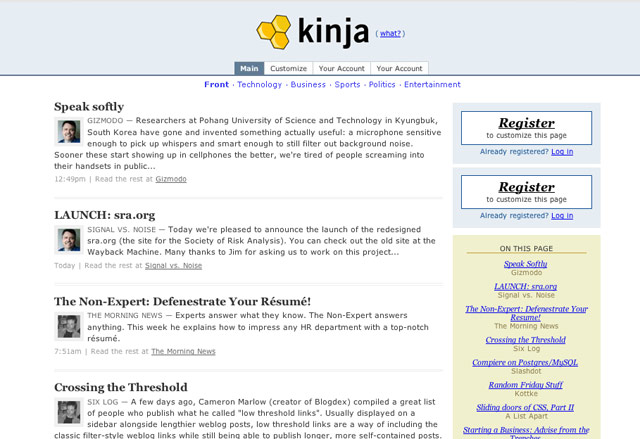
Gawker has rebranded their new commenting system…it’s now called Kinja. The name is recycled from a project that Nick Denton worked on with Meg Hourihan starting in 2003. Kinja 1 was an attempt to build a blog aggregator without relying solely on RSS, which was not then ubiquitous. Here’s a mockup of the site I did for them in late 2003:

Kinja 2003

Luckily they got some real designers to finish the job…here’s a version that 37signals did that was closer to how it looked at launch.

Where is the team that worked on that Kinja? Nick’s still hammering away at Gawker, Meg is raising two great children (a more difficult and rewarding task than building software), programmer Mark Wilkie is director of technology at Buzzfeed, programmer Matt Hamer still works for Gawker (I think?), intern Gina Trapani is running her own publishing/development empire & is cofounder of ThinkUp, and 37signals (they worked on the design of the site) is flying high.

Fave · 0

The pine nut diet

My wife ate some pine nuts a few days ago and has had a weird metallic taste in her mouth ever since.

Monday for lunch I ate the leftovers, including a bunch of whole pine nuts that had fallen to the bottom of the dish. By Tuesday evening I had a weird taste in the back of my throat, so weird that when I when I woke up during the night, I couldn’t get back to sleep.

The taste was so bad that she doesn’t really feel like eating anything. That got me thinking: the pine nut diet. When you need to drop some pounds, eat a few of the offending pine nuts and boom!, eat as much as you want…as long as you can stand the taste.

P.S. Meg’s back to blogging over at Megnut.

Fave · 0

Minna Kottke

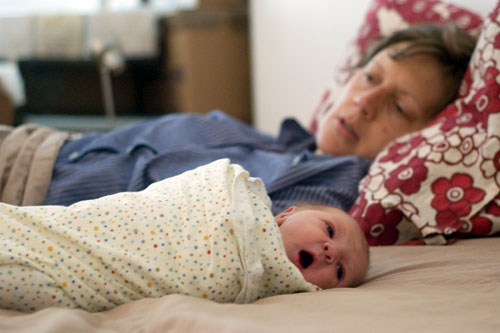
Hello everyone. I’d like you to meet Ollie’s little sister, Minna Kottke.

Minna's first day

Big yawn! She was born at home (on purpose!) early this morning; mother and baby are resting comfortably. I am weakened by an unrelated sickness but proud and happy. Ollie can’t stop talking about her. “Minna! Minna!” He’s going to be a great big brother.

So, things are going to be a little slow around here for a bit, especially the rest of this week. Starting next Monday, I’ll be joined by a part-time guest editor for a couple weeks. But more on that later. Now: sleep.

Fave · 0

The importance of first aid

My wife recently got re-certified in first aid and CPR and was able to use those skills the other day on the street.

Walking home, I realized being certified isn’t necessarily about providing the aid. I didn’t stop the bleeding, though it subsided on its own. I didn’t try to examine her. This was in part because she refused my help initially but also because I knew the ambulance would be along soon. Mostly it was about providing comfort to someone in a difficult situation, helping them feel ok, and letting them know they weren’t alone. The certification gave me the confidence to do that: to kneel on the sidewalk, holding an old woman’s hand, and to help make those scary few minutes hopefully just a little bit better.

Fave · 0

A beautiful baby portrait

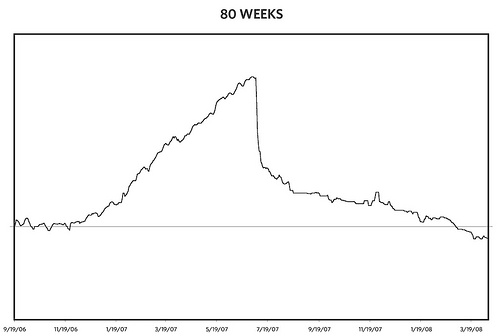
My wife is a bit of a statistics nut. A few years ago, she hooked herself up to a heart rate monitor during a playoff football game and graphed the results. Sometimes I think she does things just so she’s got an excuse to open up Excel. So I wasn’t really surprised when she showed me this graph yesterday afternoon:

Meg's weight chart

That’s a record of Meg’s weight from when she got pregnant with Ollie to the present, 80 weeks of data in all…40 weeks with Ollie on the inside and 40 on the outside.

Charles Joseph Minard may get all the accolades for his graphic of Napolean’s march to Moscow, but for me, the above chart is the most beautiful ever created. When I look at it, I see Ollie. The graph is a portrait of him, as sure as this photo is. It’s also a record of an intense time for our family. I’m reminded of Meg, happy and pregnant but also struggling with her changing body. Trips we took, doctor visits, the growing belly and anticipation, the birth itself, and then falling off the cliff into the giddy, difficult unknown of new parenthood. And then you can see Meg slowly but surely getting back into shape while being a full-time stay-at-home mom (and managing an architecture project to boot), and achieving her goal of getting back to her pre-baby fitness level in a scant 8 months. You can’t really see it, but there’s a happy father and proud husband in there somewhere as well.

That’s a lot of emotional impact for a simple black and white line graph with few labels. Imagine if it were in color and isometric 3-D! ;)

Fave · 0

Following an editorial in the NY Times by Steven Shaw about doctors’ food recommendations for pregnant women, my wife Meg wrote a post about how she ate while pregnant. “I found my balance between enjoying food and tolerating risk, and it included the occasional Wellfleet on the half-shell. It’s easy to get overwhelmed by all the recommendations, and to live in fear of every bite of food you put into your mouth. But that makes for a very stressful, anxious, long nine (plus) months. And that certainly isn’t good for the fetus.”

Fave · 0

Ollie Kottke

Dear internet, I’d like you to meet Ollie Kottke.

Ollie Kottke

Some vital statistics: He was born on July 3 just before 1pm, weighed about 7 lbs., 2 oz., loves to eat (and then sleep), is O.K. (ha!), dislikes sponge baths, unfortunately doesn’t have any descenders in his name, both mom and baby are home and doing fine, Ollie is not a particularly popular name right now (and is not short for Oliver), and I’ve never been quite so content as when he fell asleep on my chest yesterday and we snoozed together on the couch for an hour or so. A little slice of heaven.

Also, I’m going to be taking about two months of paternity leave from working on kottke.org. I’ll probably post a few things here and there when I can, but it won’t be a priority by any means. I hope you all have a good rest of the summer and that you’ll find the site again when I start back up in the fall.

Update: Meg has a post up too and there are photos on Flickr.

Fave · 0

Food plagiarism

Rebecca Charles, owner of the Pearl Oyster Bar in NYC, a seafood place modeled after hundreds of similar restaurants in New England offering similar menus, is suing a former employee (of six years) for copying too closely her restaurant and menu in opening his new place, Ed’s Lobster Bar.

Many parallels here to the design/art/film world…what is mere inspiration versus outright theft? The key question in these kinds of cases for me is: does the person exercise creativity in the appropriation? Did they add something to it instead of just copying or superficially changing it? Clam shacks are everywhere in New England, but an upscale seafood establishment with a premium lobster roll is a unique creative twist on that concept brought to NYC by Charles. An upscale clam shack blocks away from a nearly identical restaurant at which the owner used to work for six years…that seems a bit lame to me, not the work of a creative restaurateur. Who knows how this stuff is going to play out legally; it’s a complex issue with lots of slippery slope potential.

Meg has more thoughts on the issue and Ed Levine weighs in over at Serious Eats with information not found in the NY Times article. It was Ed who first raised the issue about Ed’s Lobster Bar earlier in the month.

Update: I forgot to link to the menus above. Here’s the menu for Pearl Oyster Bar and here’s the menu for Ed’s Lobster Bar. For comparison, here are the menus for a couple of traditional clam shacks: the Clam Box in Ipswich, MA and Woodman’s in Essex, MA.

Fave · 0

Undiscovered bedrooms, the typical dream of the New Yorker. I always thought the undiscovered room dream story was apocryphal until Meg, unaware of the story at the time, dreamt of finding another room in our apartment a few months ago.

Fave · 0

My wife Meg makes A Mean Chocolate Chip Cookie. That is to say, she asked her readers for their best chocolate chip cookie recipes, averaged the ingredient amounts, baking times, chilling times, butter consistencies, and other various techniques and baked according to the resulting recipe (which she includes so you can bake up your own batch). Some of the ingredients: “2.04 cups all-purpose flour; 0.79 tsp. salt; 0.79 tsp. baking soda; 0.805 stick unsalted butter, softened to room temperature; 0.2737 stick unsalted butter, cold; 0.5313 stick unsalted butter, melted.” Reminds me a bit of The Most Wanted Paintings project by Komar & Melamid, who averaged aesthetic preferences and taste in painting to produce works of art that appealed to everyone (to hilarious effect). (digg this?)

Fave · 0

Zodiac

Meg woke up at 1:30am the night we saw Zodiac, unable to sleep because she couldn’t get a stabbing from the movie out of her head. To get back to sleep, she convened an impromptu cutest baby animal tournament in her head. Kittens were cuter than puppies, baby pandas beat out kittens, and so on until she eventually was able to fall back to a stab-free sleep. Just putting that out there for whenever O’Reilly gets around to releasing their Sleep Hacks book.

Fave · 0

Hey you, web designer! Looking for a job?

Serious Eats is looking for a web designer who’s familiar with blogs, isn’t afraid of a little PHP code, and is located in (or is planning on relocating to) NYC. Serious Eats is a start-up that is focused on sharing food enthusiasm through blogs and online community. You’ll be working with a fine group of folks. SE is headed up by Ed Levine, who Gourmet editor-in-chief Ruth Reichl calls the “missionary of the delicious” and Meg Hourihan, who co-founded blogger.com and happens also to be married to me. Alaina Browne, formerly of A Full Belly and Mule Design, and Adam Kuban, pizza and burger expert, round out SE’s crew of passionate food people.

Fringe benefits: you can’t imagine all the culinary goodies that make their way into that office everyday. Meg comes home and casually says things like, “oh, we had a private tasting of the new Haagen-Dazs flavors in the office today” all the freaking time. If you’re a web designer with an interest in food, this is your place.

Fave · 0

Pete Wells writes in Food and Wine about recipes, copyrights, and patents. Meg picks up the thread and argues that copyrighting recipes would stifle innovation, not promote it, rewarding mostly the lawyers who insert themselves between our food and mouths. A commenter says, “By nature, food people are generous of spirit, and recognize that the great fun of food is in the sharing.”

Fave · 0

My Beating Heart is a blog matching personal experiences with data from a GPS-enabled heart-rate monitor. Meg hooked herself up to a heart-rate monitor for the 2004 AFC Championship.

Fave · 0