kottke.org posts about subway
This is a mindblowing time capsule of ordinary life: video of a group of friends taking the NYC subway to Coney Island in 1987. Because it was before mobile phones, they had to arrange to meet one of the group members in the first car of the train along the way.
The film was shot by Nelson Sullivan, a videographer who recorded the arts, music, and LGBTQ+ communities in NYC in this same ur-vlogging style.
Viewed today, Sullivan’s video record of his life represents a pre-Internet form of vlogging, while his frequently used technique of turning the camera to face himself clearly anticipates the modern selfie.
You can watch hundreds more of Sullivan’s films on YouTube, including a trip to McDonald’s (the most popular video on the channel), several RuPaul videos, a holiday party at Michael Alig & DJ Keoki’s apartment, and Keith Haring’s NYE party. Sullivan sadly died of a presumed heart attack two years later at the age of 41. (thx, caroline)
Giorgia Lupi and her team at Pentagram have created a data-driven animation for the MTA called A Data Love Letter to the Subway.


More from Lupi (who calls this an “absolute dream project”):
The project, “A Data Love Letter to the Subway,” visualizes each train line as a character whose unique qualities are extracted from MTA data. Data like length, location, and transfers were abstracted into train behaviors and attributes. Imaginatively animating each train line’s age, length, and path, we wrote a poetic story that explores the trains’ interwoven encounters with commuters and one another.
Our “Love Letter” draws on the elemental nature of picture books to unpack the visual system of the subway with curiosity and wonder. Drawing from the MTA’s Open Data Program, with my team we translated train data into a narrative made of attributes and behaviors, providing a rich view of the interactions, roles, differences, and the connections made and sometimes missed within the subway ecosystem.
Maps, NYC, the subway, data visualization…I am not sure how much more in my wheelhouse a thing could be.
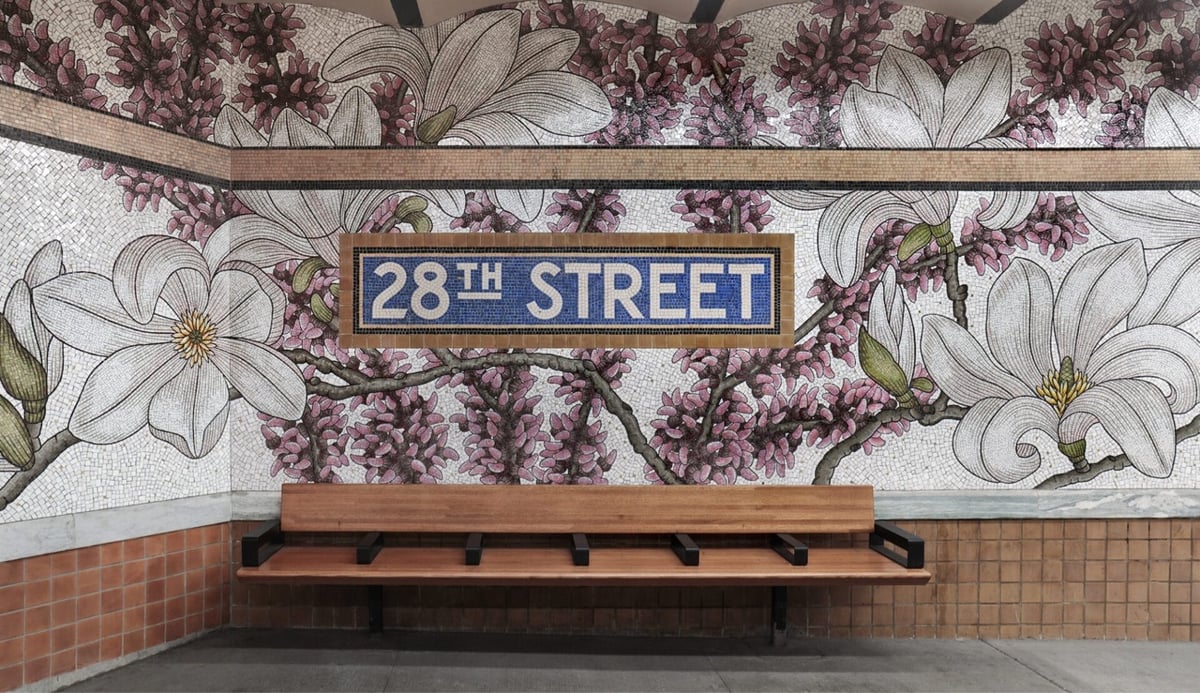

From The Monacelli Press, Contemporary Art Underground: MTA Arts & Design New York is a forthcoming book about the art projects the MTA has completed in the last decade in the NYC transit system.
Of special interest is the discussion of fabricating and transposing the artist’s rendering or model into mosaic, glass, or metal, the materials that can survive in the transit environment.
Nancy Blum’s piece at the 28th Street station (top, above) is my favorite piece in the entire subway system; I love it so much. (via colossal)
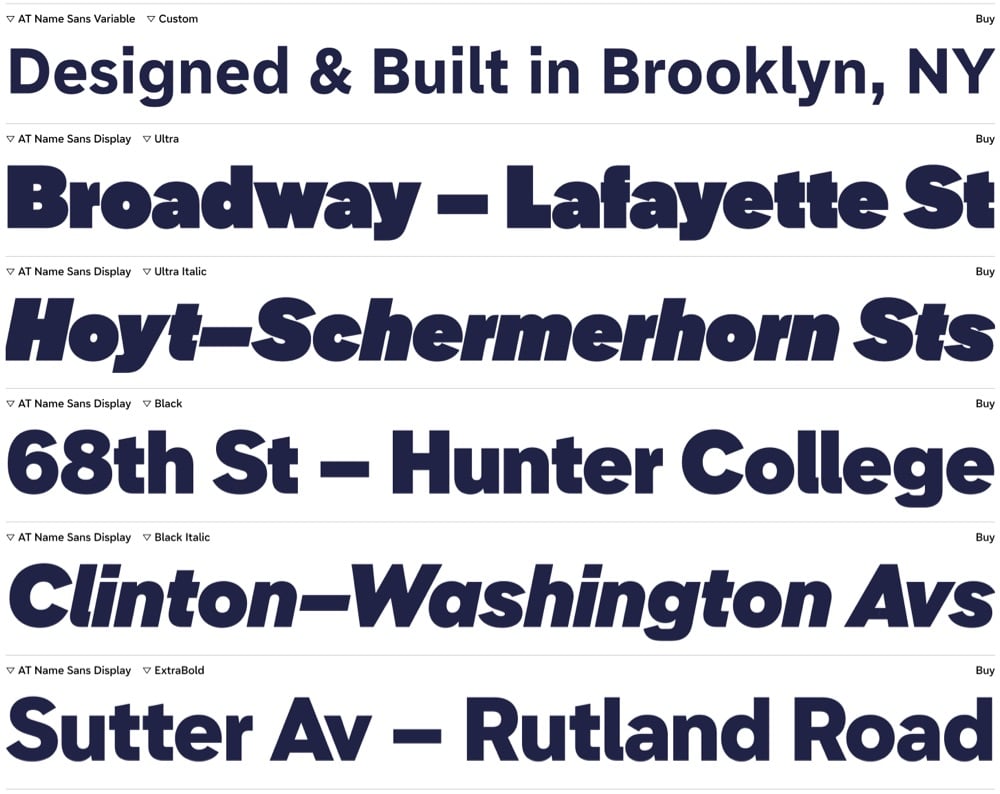
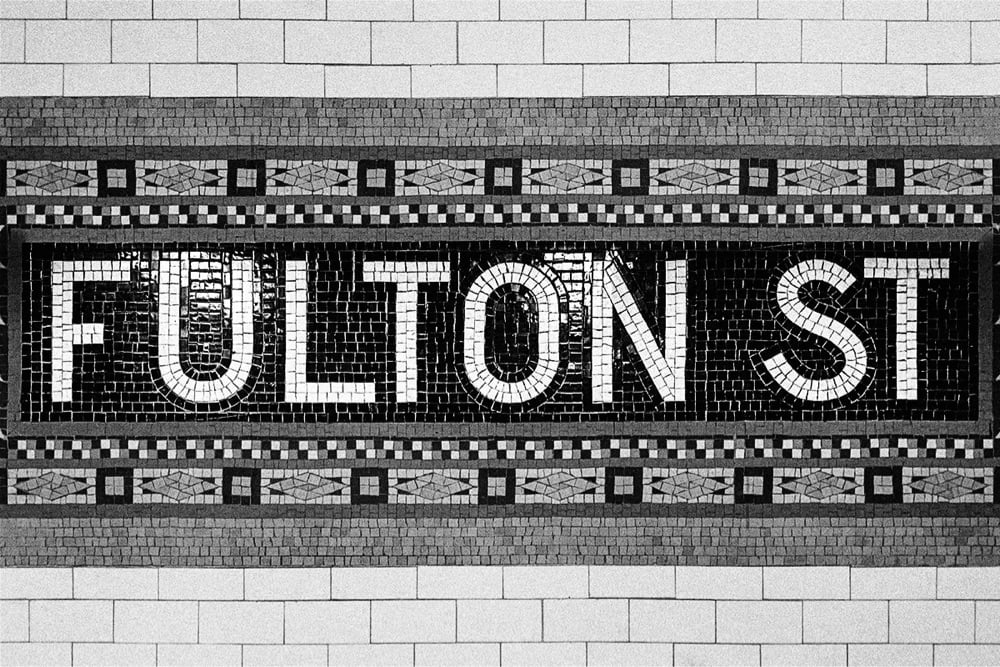
Name Sans is a typeface based on the tile mosaic lettering found in NYC subway stations.
The architects and craftworkers who designed & laid these tiles used a letter construction that was part geometric and part grotesque, with typographic optical corrections often either exaggerated or totally missing. Name Sans interprets these ideas into an extensive type system that is at once anonymous and full of personality, useful for everything from branding to wayfinding to digital interfaces.
Lovely. I like this a lot.
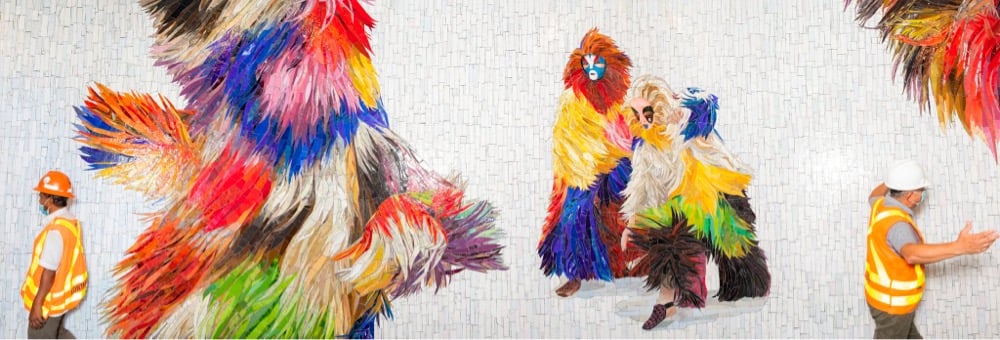
Oh, I really like this new NYC subway mosaic installed in the corridor between Times Square and Bryant Park designed by Nick Cave.1 It’s based on Cave’s Soundsuits project, full-body suits that “camouflage the shape of the wearer, enveloping and creating a second skin that hides gender, race, and class, thus compelling the audience to watch without judgment”. From a NY Times piece on the mosaic:
The Soundsuits have always been an amalgam of cultural references, Cave explained: the concepts of shamans and masquerade, obscuring the race, gender and class of the wearer and forging a new identity. They contain ties to Africa, the Caribbean and Haiti.
“It’s very important that you can make references, you can connect to something,” Cave said. “In one of the mosaics in the corridor, there’s a sneaker. So that brings it to this urban, right-now time.”
From beneath a pink-and-black cloak of raffia, carefully crafted out of glass shards, pokes a contemporary sneaker in shades of salmon, white and maroon. Cave likes the play that’s happening here: The form is sometimes figurative, sometimes abstract. “Sometimes it’s identifiable and sometimes it’s not,” he said. “But that’s the beauty of it all.”
(thx, caroline)
In The Hidden Melodies of Subways Around the World, the NY Times takes a look at an often overlooked aspect of transit design: the door closing sounds on the subway. My favorite door jingle is from the Paris Metro — I never knew where it came from:
In Paris, a simple “A” note plays as the doors shut. This is also a throwback, a sound that mimics the vibrations of a mechanical part that is no longer in use on any of the system’s trains. “But for a half century Parisians and visitors alike became used to that sound, so we decided to keep it, and recorded a synthesized version,” said Song Phanekham, a communications manager for the Paris transit system. “It’s a tribute to the heritage of the Paris Metro.”
In Tokyo, each station has its own custom jingle to signal departures. In Rio de Janeiro, the subway’s door chime pays homage to bossa nova. In Vancouver, the doors still close to a three-note sound that was recorded in the 1980s on a Yamaha DX7. (“The hallmark of any mid-80s pop song,” said Ian Fisher, manager of operations planning at British Columbia Rapid Transit Company.)
You can listen to more sounds of subway doors closing in these three videos recorded by Ted Green.
Update: Composer Minoru Mukaiya has made distinct door-closing jingles for each subway station in Tokyo.
(via waxy)
BuzzFeed enlisted NYU track athlete Jon Diaz to help answer a burning question: Can a fast runner beat an NYC subway train from one station to the next? I don’t want to spoil the answer, but they probably wouldn’t have made the video if he’d failed, right? (via clive thompson)
Update: See also subway races in other cities like London & Paris. (via @philipkennedy)
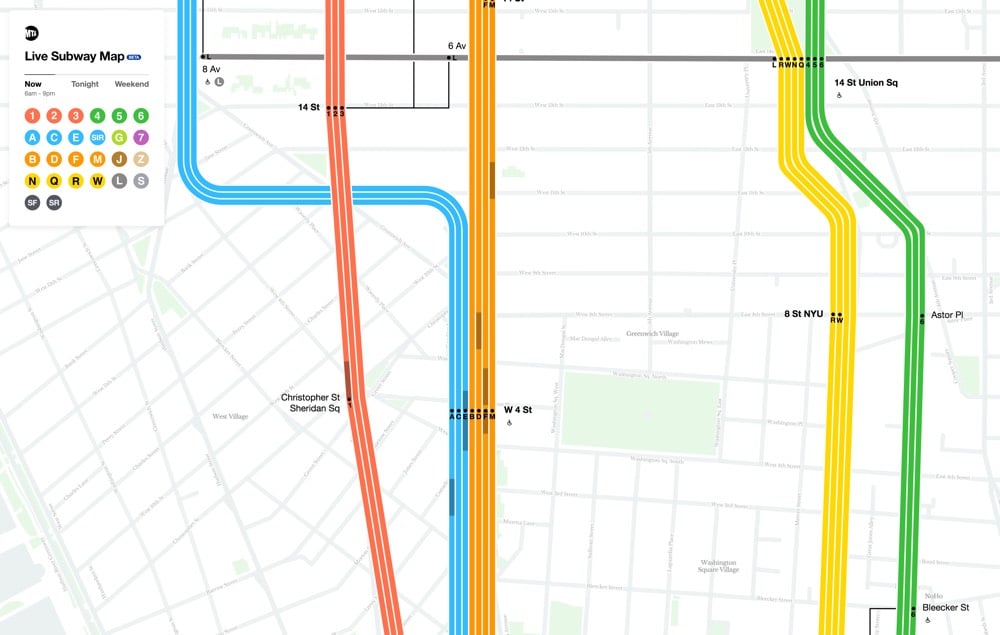
New York City has a new digital subway map that reflects the current status of the subway lines. And you can even see the trains moving, right on the map. (Finally!!) Visually, the new map combines the styles of two past maps, each beloved in their own way.1 Fast Company explains:
The first map is that by Massimo Vignelli, who simplified the snaking subway system into a clean diagram which traded geographic literality for graphical clarity. This elegant simplification turns the confounding subway into a logical system. But the main Vignelli map was scorned by New Yorkers because it wasn’t an actual map, and it was quickly replaced (though a permutation actually lives on as the MTA’s Weekender diagram, which signals weekend services). Meanwhile, the primary map the MTA uses today was created by Unimark International and Michael Hertz Associates. It’s more geographically accurate, but it actually condenses information that was in the Vignelli map. For example, it combines individual train lines such as the C, D, and E lines into singular trunks.
Here’s a video from filmmaker Gary Huswit that shows how the team came up with the new map:
Zooming the map in and out, you see different levels of detail, just like with Google or Apple Maps. I like it — a good combination of form and function.2
Update: A reader reminded me of designer Eddie Jabbour’s Kick Map of the NYC subway, which effectively melded the styles of the Vignelli and Hertz maps together more than 15 years ago.
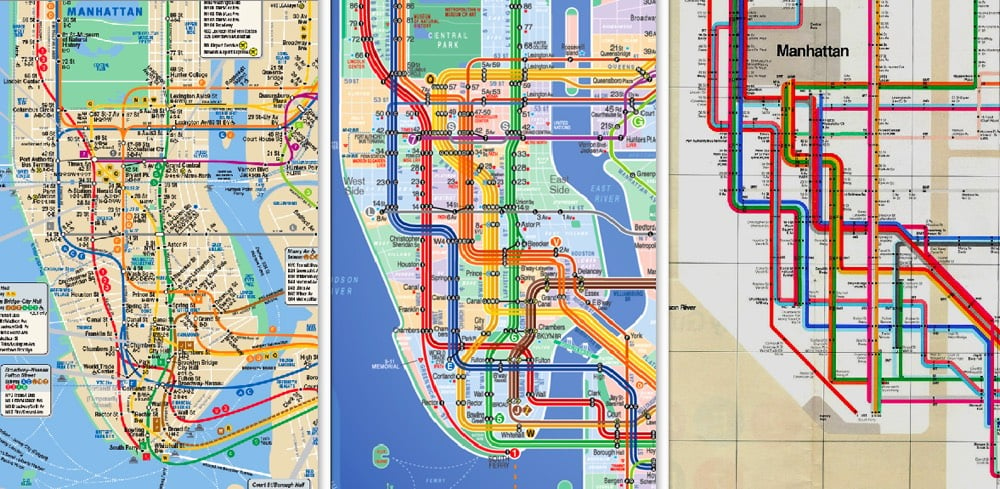
What’s interesting is that the MTA explicitly rejected and criticized the Kick Map but ended up doing something quite similar with the new digital map. I think Jabbour’s effort deserves to be acknowledged here. (thx, nicolas)

Inspired by a trip to Venice, the world’s most prominent example of what life could be like in many of our coastal cities in the years to come, Hayden Williams made a series of 3D rendered images showing what our world might look like underwater. (via the morning news)
File this under “I Love NYC”. On Sunday night, riders on a Brooklyn-bound L train were treated to a full Thanksgiving dinner, courtesy of some of their fellow straphangers. For more than 20 minutes, a group of riders dined and passed out plates of turkey, collards, stuffing, squash, and mashed potatoes to other folks in the car. Here’s a 21-minute chunk of the action:
They started the meal with a prayer and everything. An onlooker said of the event:
It was a 7 PM Sunday L from union square and was not crowded at all. They said it was an inclusive gesture to emphasize no one should go without food on Thanksgiving. They were loud but not rowdy or a nuisance. They even handed out plates to everyone in the car — I got one and the turkey was a solid 7/10 and collard 8.5/10. I’m glad I got to experience something like this. Makes a great story!
There were even MTA employees amongst us but no one objected.
Here’s a shorter video with some of the highlights:
(thx, johana)
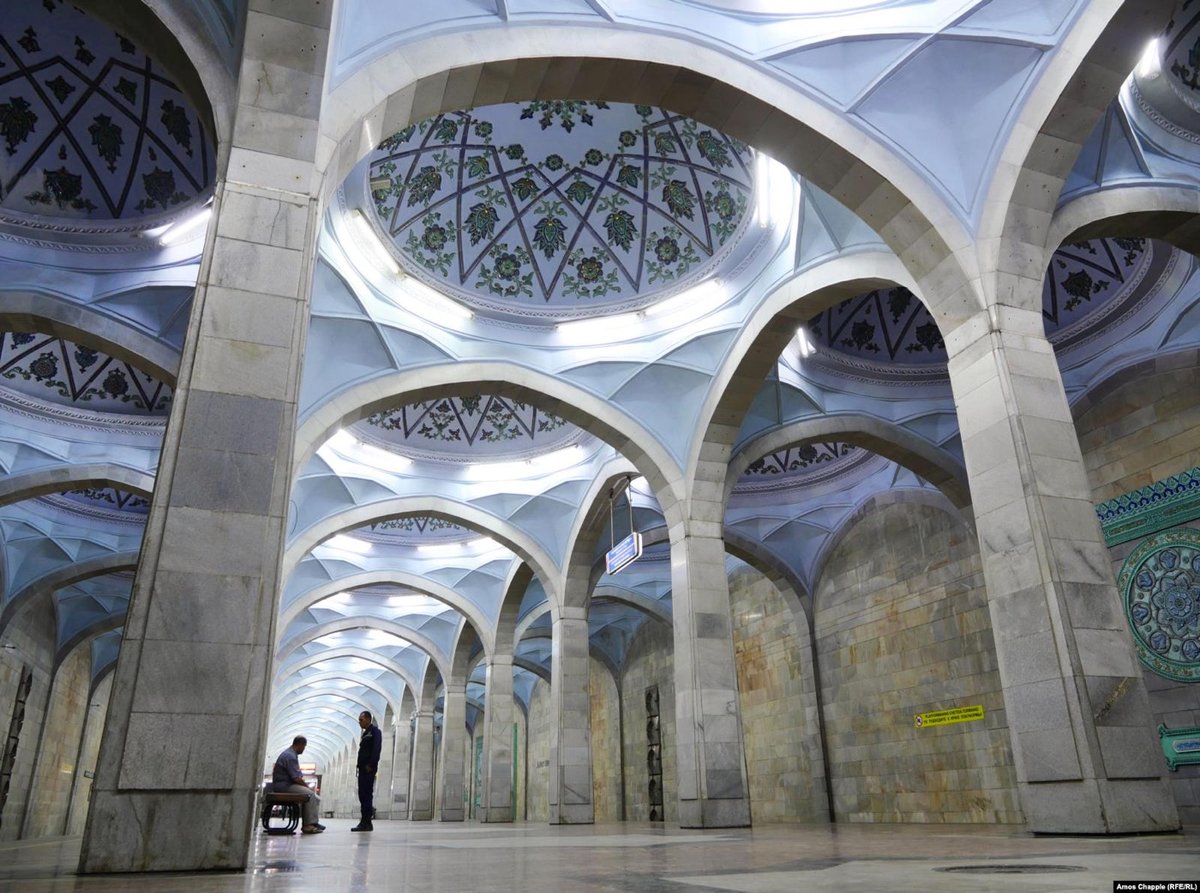
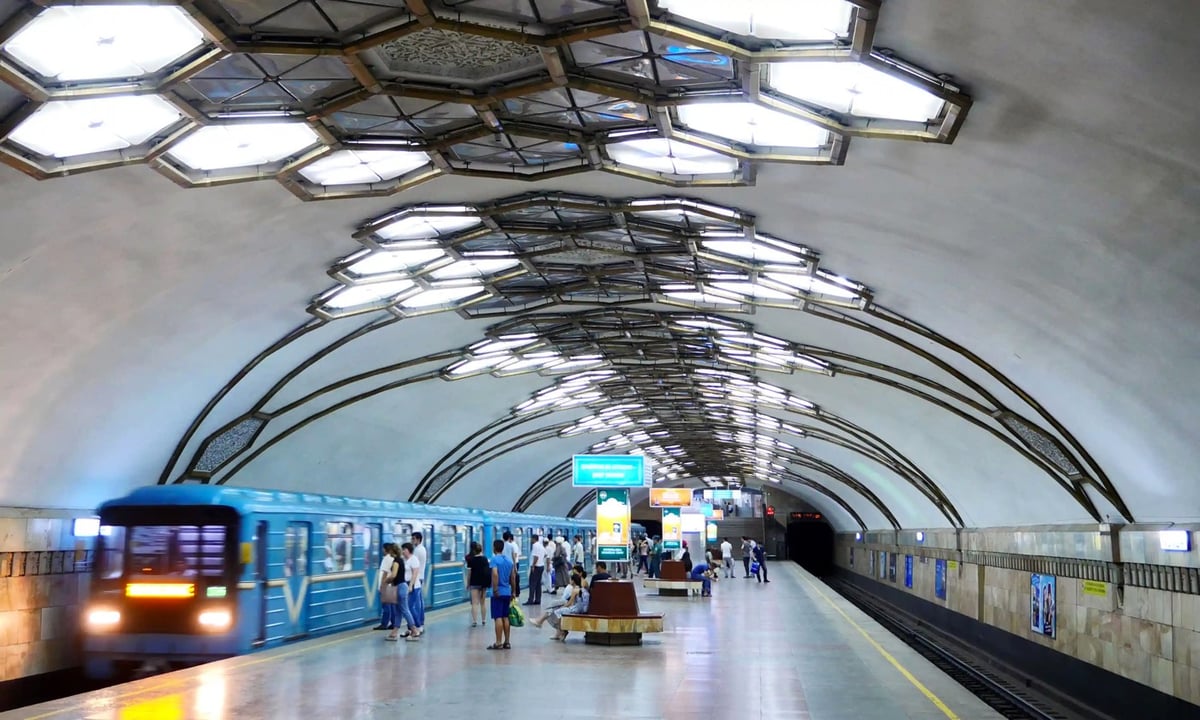
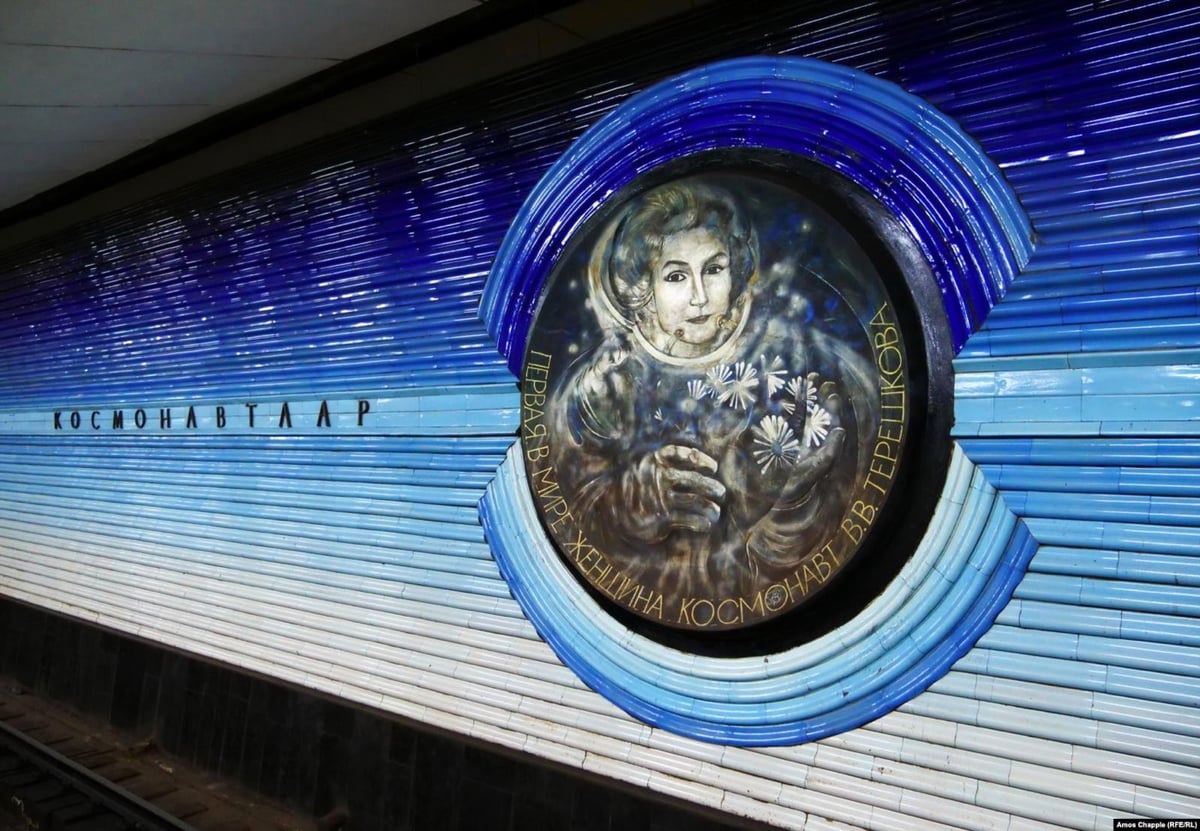
Once a stop along the Silk Roads from Europe to Asia, the city of Tashkent, Uzbekistan boasts many cultural treasures but perhaps the most unlikely is the city’s metro system and its colorful & artistic stations. In 2018, not long after a photography ban was lifted, Amos Chapple took a series of photos of Tashkent’s metro.
See also Photos of Grand Soviet-Era Subway Stations. (via @bennglazier)
From Metrobits, a fantastic resource for all things to do with metros and subways around the world, comes this collection of metro logos (older page w/ larger logos here).
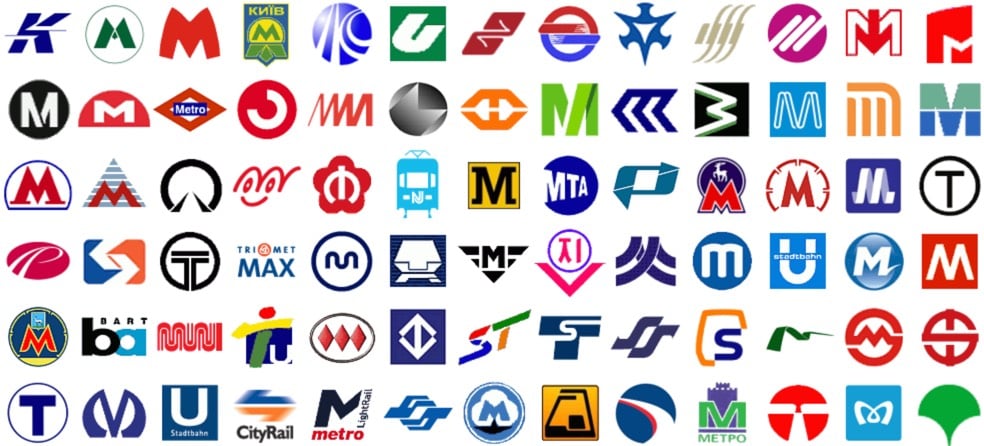
See also metro fonts (names + designers), fare collection schemes, and ratings of the art and architecture of metro stations from around the world (highest marks go to Moscow, Paris, Saint Petersburg, and Stockholm). The Moscow and Saint Petersburg stations are incredible.
This is a short video of a set of subway stairs in Brooklyn where one of the steps is juuuust a bit taller than the rest, which makes most people trip on it.
We don’t often think about it but even the least graceful humans move in a finely calibrated way. When we’re climbing stairs, our feet don’t clear the treads by much, so that even the tiniest deviation in the height of a step can spell trouble.
I’d love to see a study of how quickly our bodies learn how high the steps are in a new flight of stairs. Like, maybe we clear the first couple of steps by an inch or two but then we’re locked in and subsequent clearances are much smaller.
Is there a word for the way people tend to speed up after they trip climbing stairs? The stumble hustle? It’s such a small & endearing little thing that most people do.
My least favorite flight of stairs in the entire NYC subway system are, I believe, at the SW corner of 14th St and 6th Ave in Manhattan. Each of the steps is a different height, making for a tricky ascent and a downright dangerous descent. I keep thinking they’re gonna get fixed, but I used them on my last visit to the city in June. At this point, they’re like an old friend who’s kind of a jerk but you’ve known him so long that whaddya gonna do? (via @fishtopher)
Update: On Twitter, André Filipe Barro shared the Brazilian phrase for speeding up after tripping up the stairs: “went on a chicken chase”. Excellent!
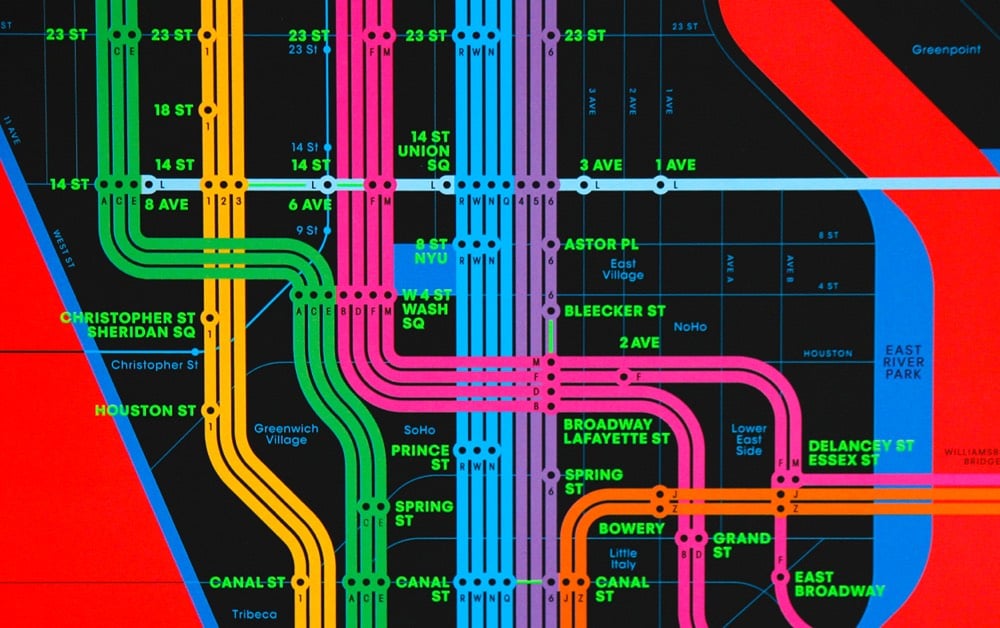
From the orange 123 line to the green ACE to the purple 456, the color designations on the NYC subway lines on the Wrong Color Subway Map will mess with your head. Get the print here. From the folks who brought us the One-Color Subway Map. (via @khoi)
The NYC subway is home to many interesting characters and creatures but perhaps none as delightfully weird as Matthew Grabelsky’s straphanger chimeras.


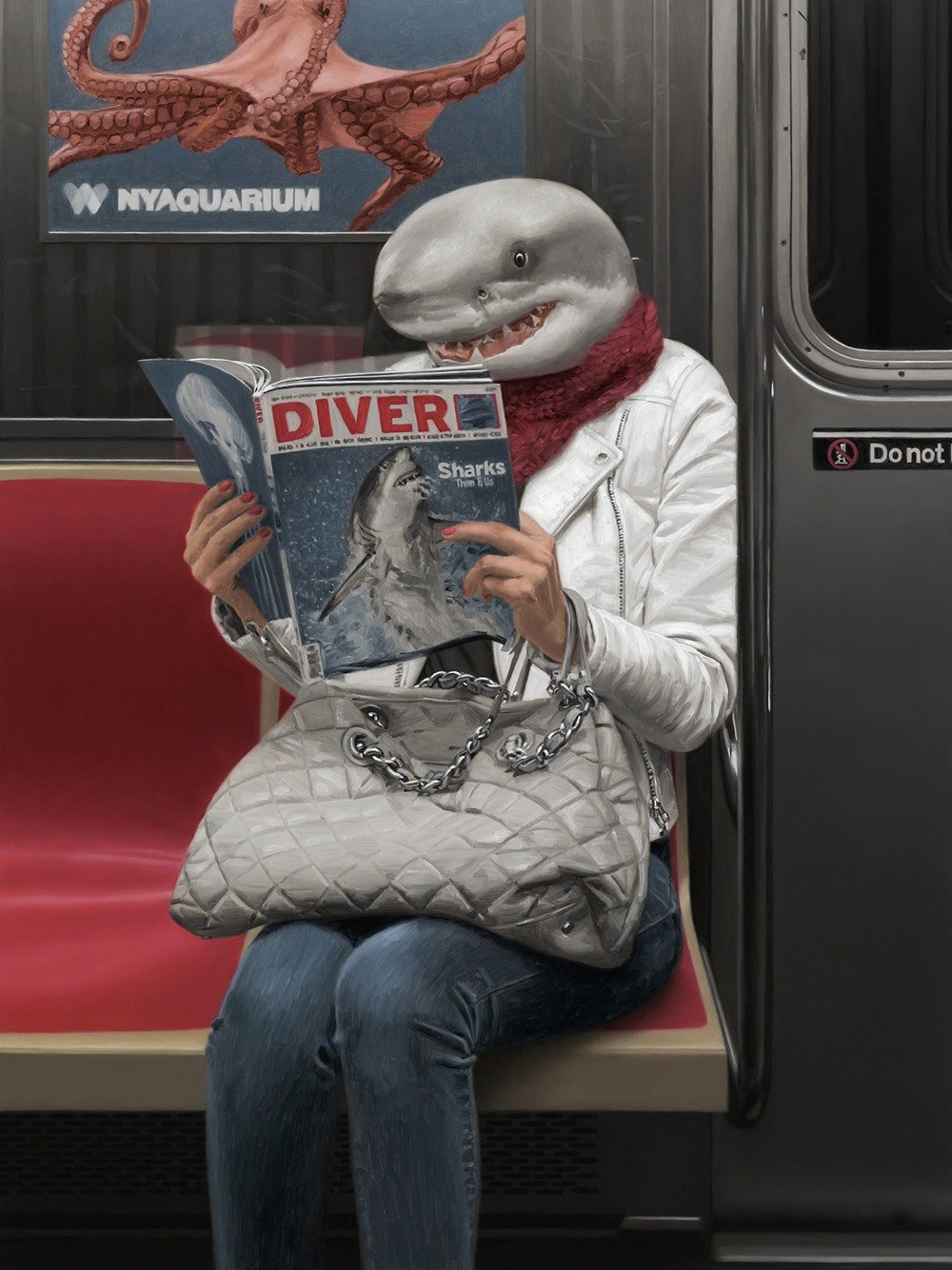
(via colossal)
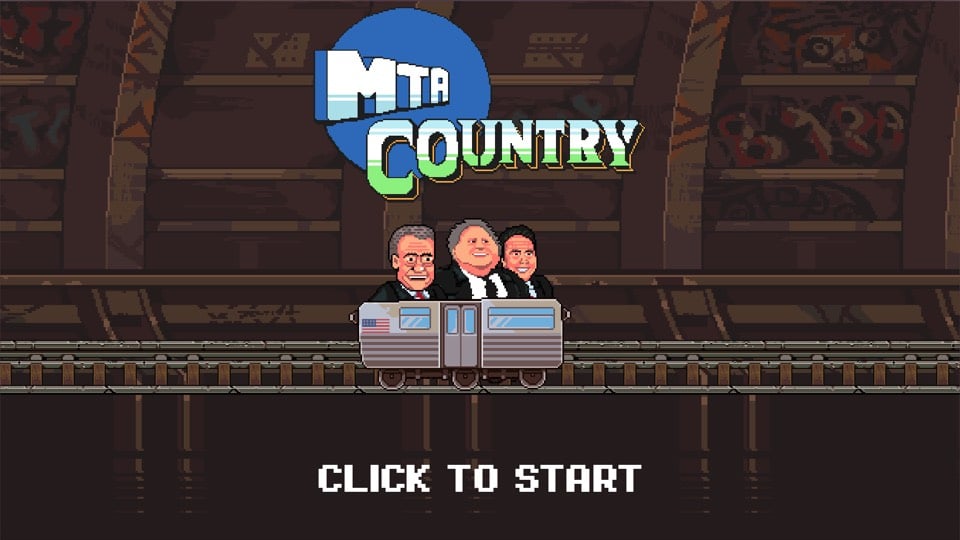
Everyday Arcade, which is responsible for The GOP Arcade (sample game titles include The Voter Suppression Trail and Thoughts & Prayers: The Game!), has designed a new game called MTA Country. Based on the SNES title Donkey Kong Country, the goal of MTA Country is to guide Andrew Cuomo, Bill de Blasio, and celebrity straphanger Gregg Turkin past hazards like track fires and stalled trains to their destination. That ending though… Hmm…
In the NY Times, architect and urban designer John Massengale discusses how four European cities (London, Amsterdam, Stockholm, Copenhagen) addressed their urban traffic problems and how NYC might apply those lessons to fix its own traffic issues. Massengale shared what the Dutch learned in reconfiguring their streets:
1. When drivers slow down to 20 m.p.h. or below, they are less likely to hit people and much less likely to seriously injure or kill people if they do hit them.
2. The best way to slow cars down is to throw away all the techniques that traffic engineers developed to make traffic flow quickly.
3. When you throw out all the detritus of traffic engineering, it becomes much easier to make beautiful places where people want to walk. Bike riding becomes more pleasant and safer as well.
His four-step plan to fix traffic in Manhattan is equally simple in principle:
The next step is to adopt congestion pricing below 96th Street in Manhattan and then:
1. Decrease the number of Manhattan streets that function as transportation corridors primarily devoted to moving machines through the city.
2. Design and build Slow Zones where people actually drive slowly.
3. Make the transportation corridors that remain better urban places, with a better balance between city life and moving cars.
Seems to me a vital part of this is fixing, expanding, and subsidizing the subway system…get everyone using the subway. Better, more reliable, and cheaper public transportation = less demand for taxis and Lyfts. As Bogota mayor Enrique Peñalosa said, “A developed country is not a place where the poor have cars. It’s where the rich use public transport.”
In 1990, China, Hong Kong, and Taiwan had only a handful of subway lines. In the early 2000s, growth in the number of cities with subways started to increase dramatically, as did the number of lines in the bigger cities like Beijing and Shanghai. As of 2020, more than 40 Chinese cities will have subway systems. Check out this time lapse map by “transit nerd” Peter Dovak (who also did these Mini Metros maps):
In this time, Beijing and Shanghai in particular have ballooned from nearly nothing into the world’s two largest, in both length and annual ridership. The timeline of their expansion alone is mesmerizing.
Meanwhile, the NYC subway system is…
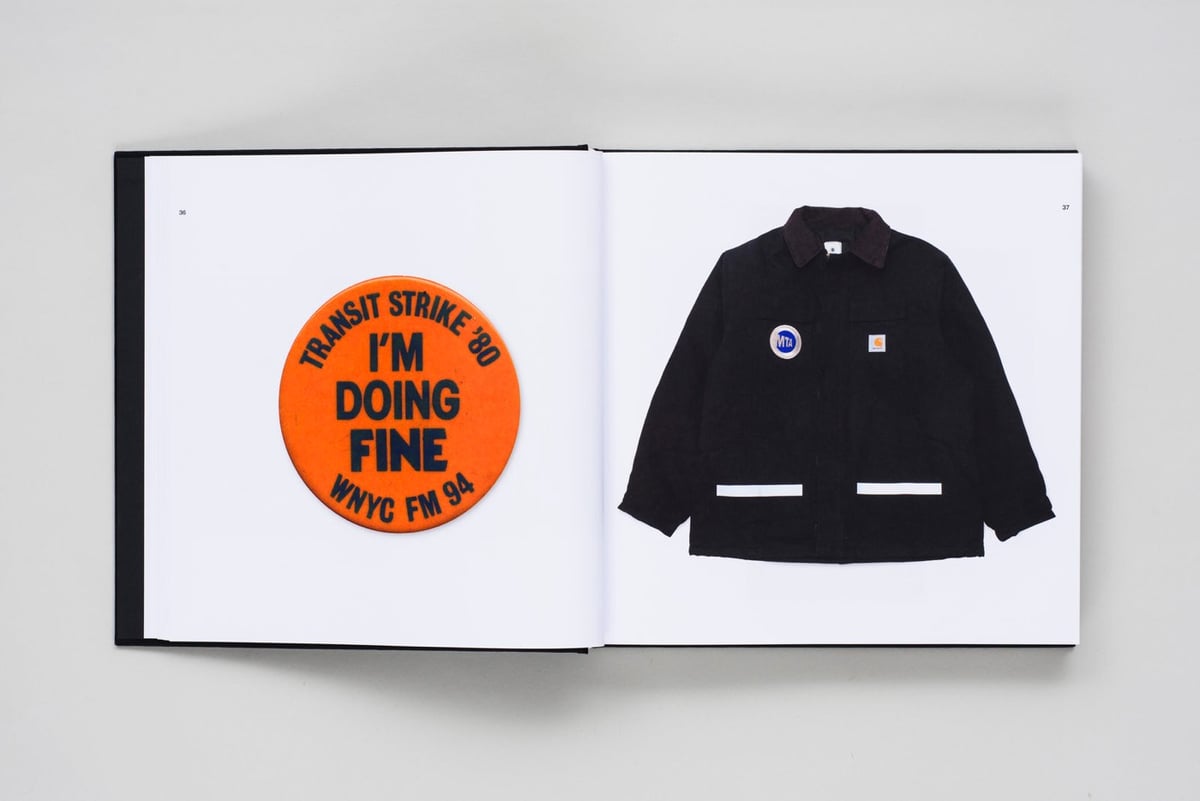
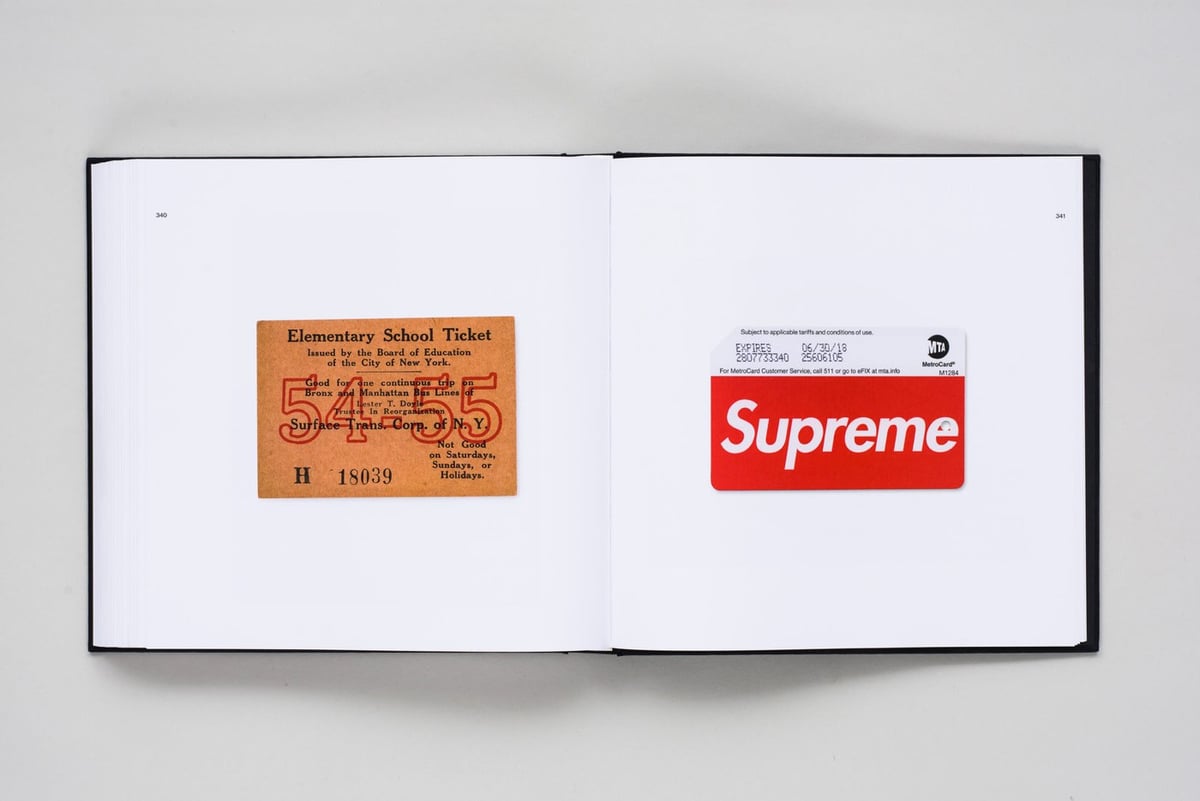
From the team that brought us the reissues of the NASA Standards Manual and the NYCTA Graphics Standards Manual comes New York City Transit Authority: Objects by Brian Kelley (@ Amazon), a book full of photographs of artifacts related to the NYC subway and other transit systems in the city.
Kelley started collecting MTA MetroCards in 2011, and he quickly became fascinated by other Subway-related objects. This catalogue is the first of its kind — presenting a previously uncollated archive of subway ephemera that spans three centuries.
Kelley posts photos of many of the artifacts he’s found on Instagram.
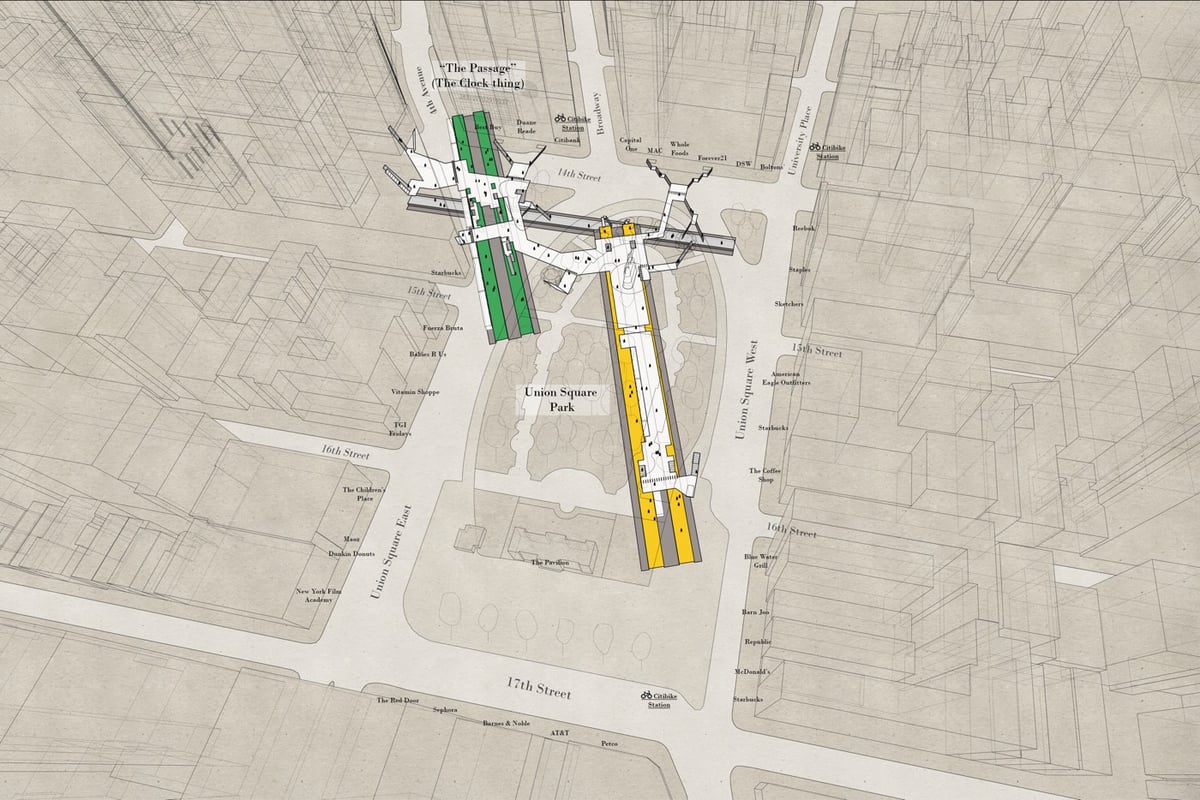
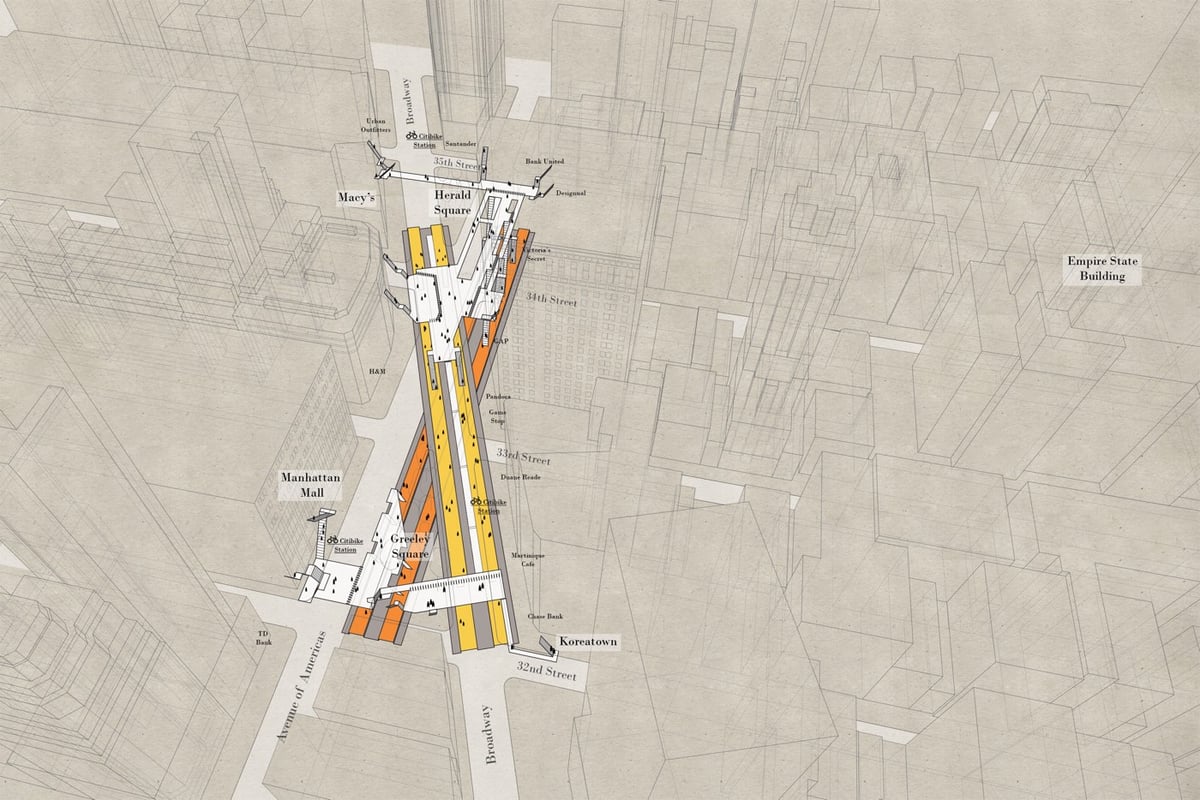
The subway and the street level of NYC are two very different worlds and even long-term residents have a difficult time understanding how they fit together. Architect Candy Chan has drawn a series of x-ray maps of NYC subway stations that show their layouts and orientation compared to the geography of the streets above. (Tip: you can zoom the maps for more detail.)
The series is an extension of her station layouts series. Prints are available in Chan’s shop.
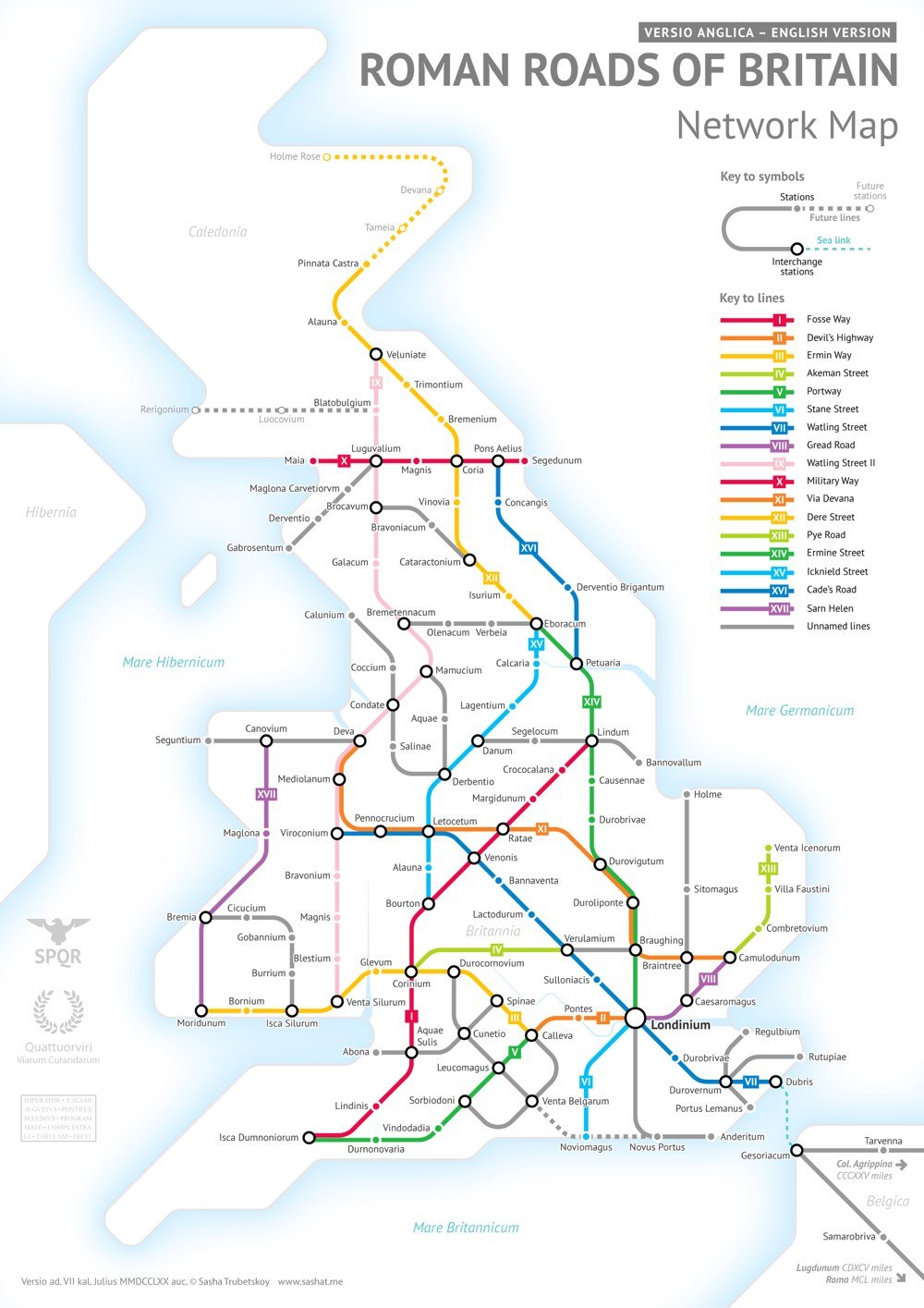
After completing his subway-style map of the roads of the entire Roman Empire, Sasha Trubetskoy began work on a highly requested follow-up: a similar map of the Roman roads in Britain.
This was far more complicated than I had initially anticipated. Not only were there way more Roman Roads in Britain than I initially thought, but also their exact locations and extents are not very clear. In a few places I had to get rather creative with the historical evidence.
As Wikipedia notes, most of the roads were completed by 180 AD and many of them are still in use today.
After the Romans departed, systematic construction of paved highways in the UK did not resume until the early 18th century. The Roman road network remained the only nationally-managed highway system within Britain until the establishment of the Ministry of Transport in the early 20th century.
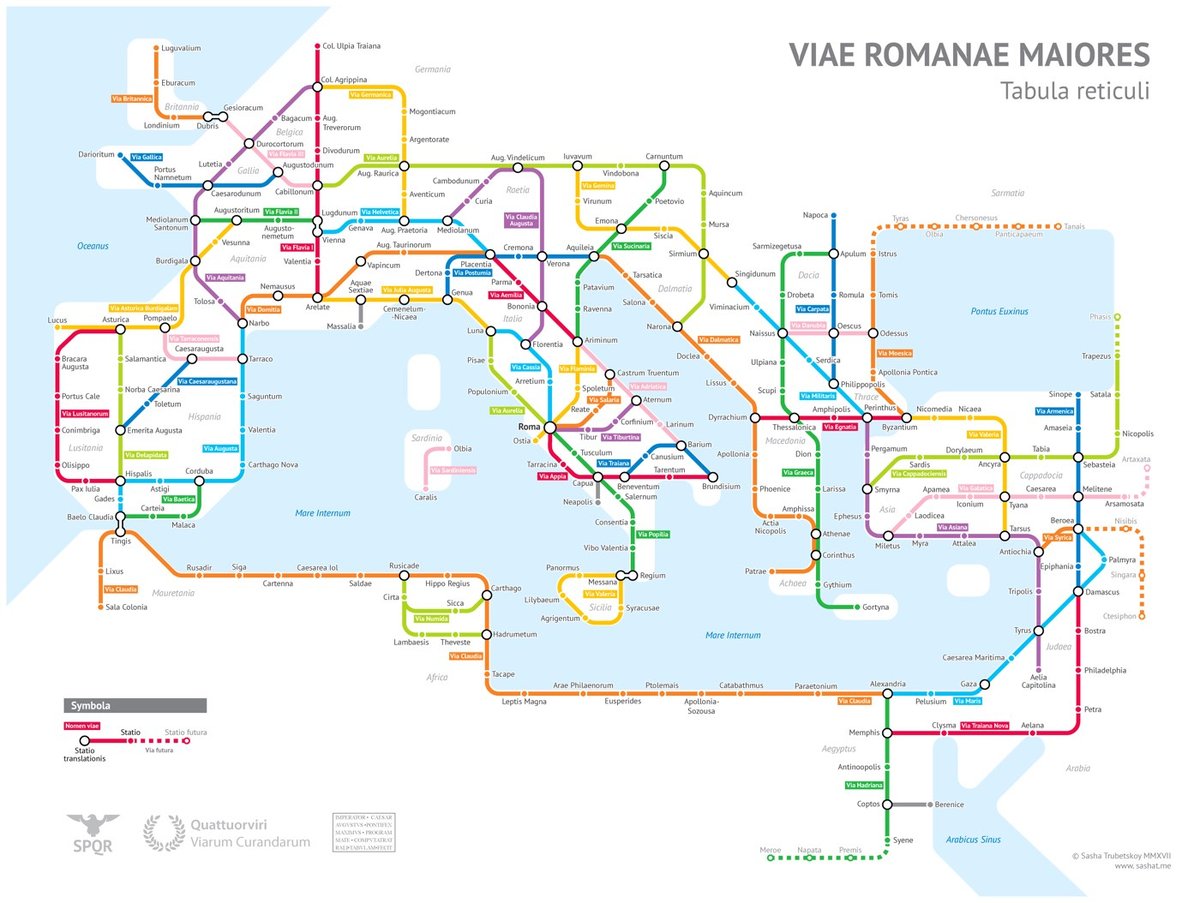
After much research, Sasha Trubetskoy has completed a subway-style map of the road system of the Roman Empire. From about 300 BC, the Romans built or improved over 250,000 miles of roads (50,000 miles were stone paved) that extended into the farthest reaches of the Empire: from Spain to modern-day Iraq to Britain to northern Africa.
Creating this required far more research than I had expected — there is not a single consistent source that was particularly good for this. Huge shoutout to: Stanford’s ORBIS model, The Pelagios Project, and the Antonine Itinerary (found a full PDF online but lost the url).
The lines are a combination of actual, named roads (like the Via Appia or Via Militaris) as well as roads that do not have a known historic name (in which case I creatively invented some names). Skip to the “Creative liberties taken” section for specifics.
(via @zachklein)
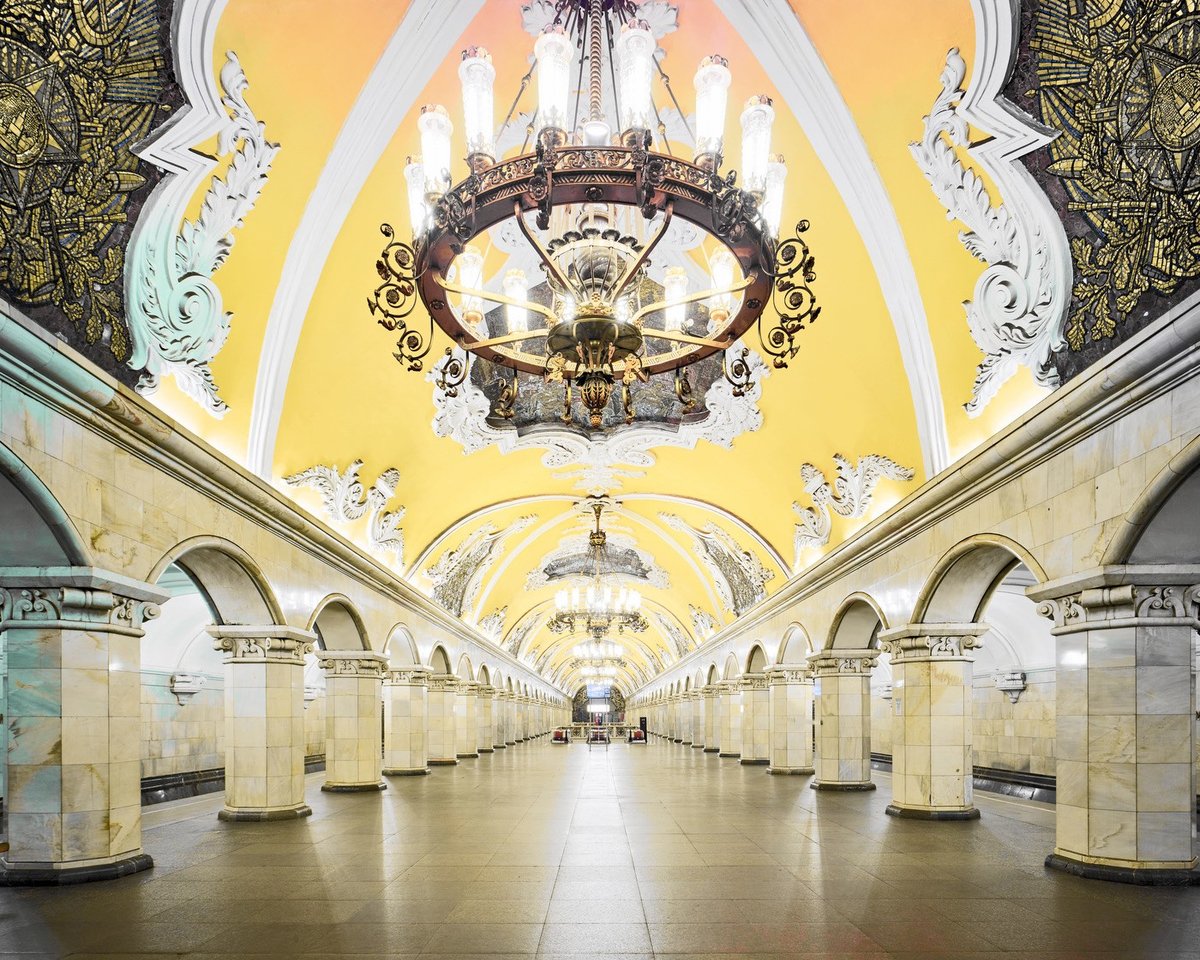
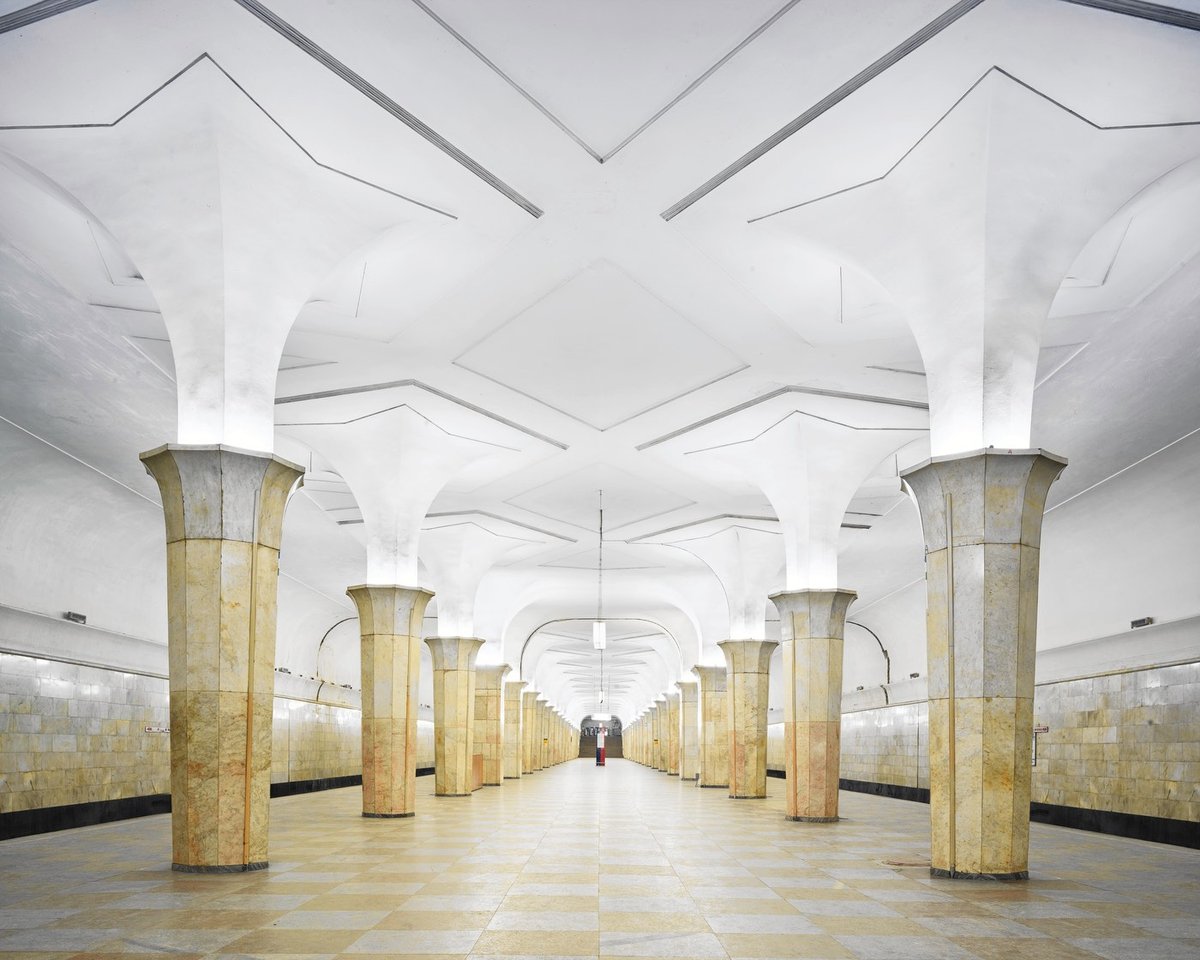
Back in the days before the US bankrupted the Soviet Union with the space race and the nuclear arms race, the Soviets spent lavishly on some public works…like these amazing metro stations built in the Stalin era. Photographer David Burdeny got special middle-of-the-night access to these stations in Moscow and St. Petersburg and came away with these great photographs. Could you imagine an NYC subway station with chandeliers? Or even moderately clean walls? (via petapixel)
In 2012, Francois De La Taille posted a video of himself racing a Paris Metro train from one station to the next, on foot. He exited the train, dashed out of the station, sprinted down the street (after pausing for a bus crossing the road), ran into the next station (after falling on the stairs), and hopped back onto the same train he’d just gotten off of.
Two years later, James Heptonstall did the same thing on the London Tube and, after a slow start, it went viral. Soon, people from all over the world were racing their hometown subway trains: Taiwan, Stockholm, Hong Kong, etc. If you’re wondering whether such a thing would be possible in NYC, the answer is yes, even if you pick the wrong door to start with:
(via @ftrain)
From the New Yorker, Rebecca Solnit on how the world’s places are mostly named after men.
A horde of dead men with live identities haunt New York City and almost every city in the Western world. Their names are on the streets, buildings, parks, squares, colleges, businesses, and banks, and their figures are on the monuments. For example, at Fifty-ninth and Grand Army Plaza, right by the Pulitzer Fountain (for the newspaper magnate Joseph Pulitzer), is a pair of golden figures: General William Tecumseh Sherman on horseback and a woman leading him, who appears to be Victory and also a nameless no one in par-ticular. She is someone else’s victory.
The biggest statue in the city is a woman, who welcomes everyone and is no one: the Statue of Liberty, with that poem by Emma Lazarus at her feet, the one that few remember calls her “Mother of Exiles.” Statues of women are not uncommon, but they’re allegories and nobodies, mothers and muses and props but not Presidents.
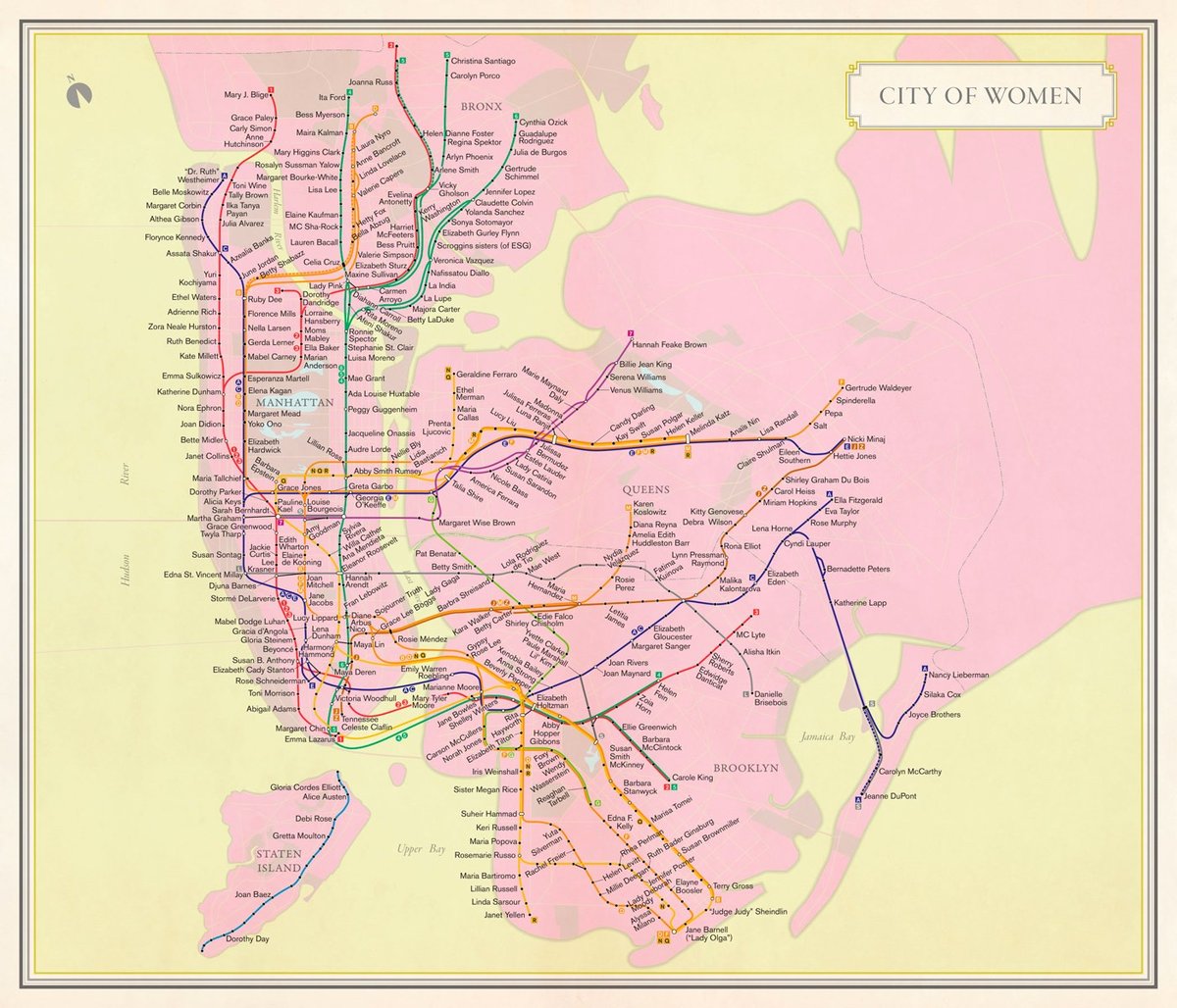
For her book Nonstop Metropolis: A New York City Atlas, Solnit and her co-author Joshua Jelly-Schapiro commissioned Molly Roy to make a subway map of NYC that uses only the names of the city’s prominent women for the station names.
It’s a map that reflects the remarkable history of charismatic women who have shaped New York City from the beginning, such as the seventeenth-century Quaker preacher Hannah Feake Bowne, who is routinely written out of history — even the home in Flushing where she held meetings is often called the John Bowne house. Three of the four female Supreme Court justices have come from the city, and quite a bit of the history of American feminism has unfolded here, from Victoria Woodhull to Shirley Chisholm to the Guerrilla Girls.
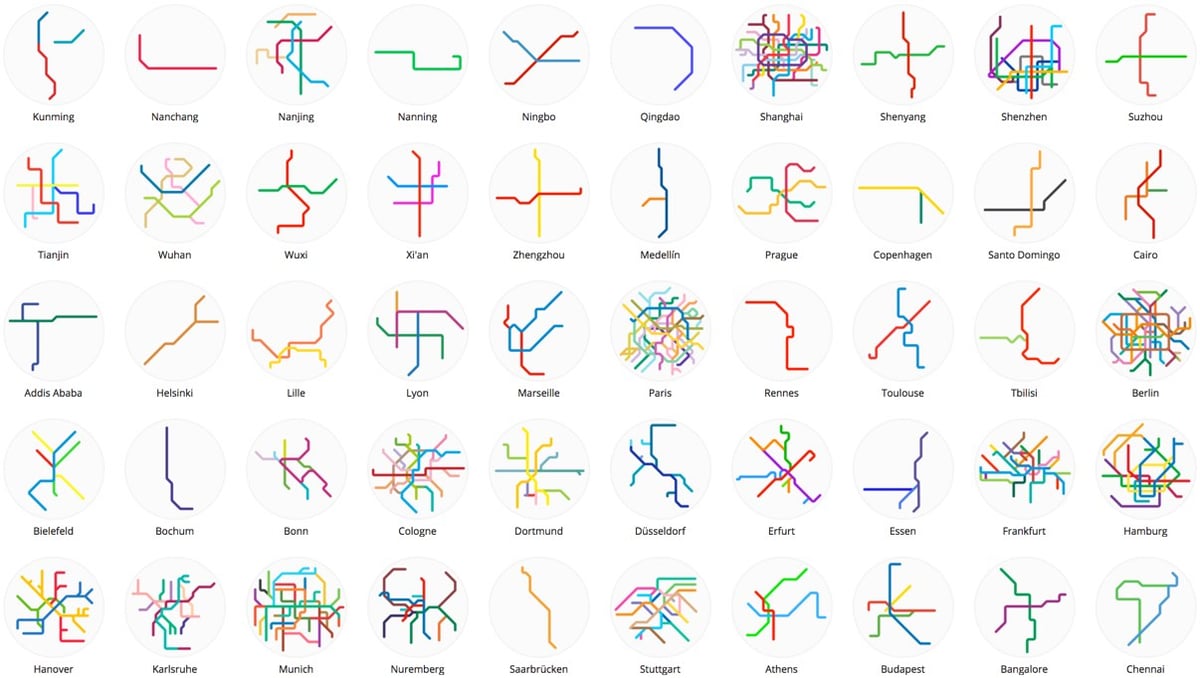
Mini Metros features small and simplified maps of over 200 metro and light rail systems from around the world. Many of the systems are small and simple themselves, just a single line or two, like in Edmonton, Mumbai, Seville, and Qingdao. Others, like in Munich, Shanghai, Tokyo, London, Seoul, and New York, are densely interconnected.
Prints and mugs are available.
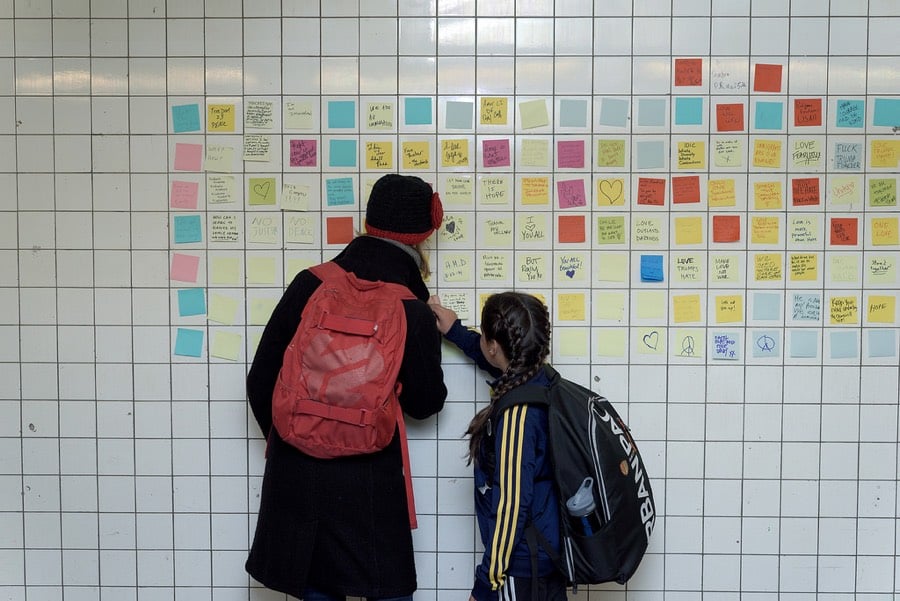
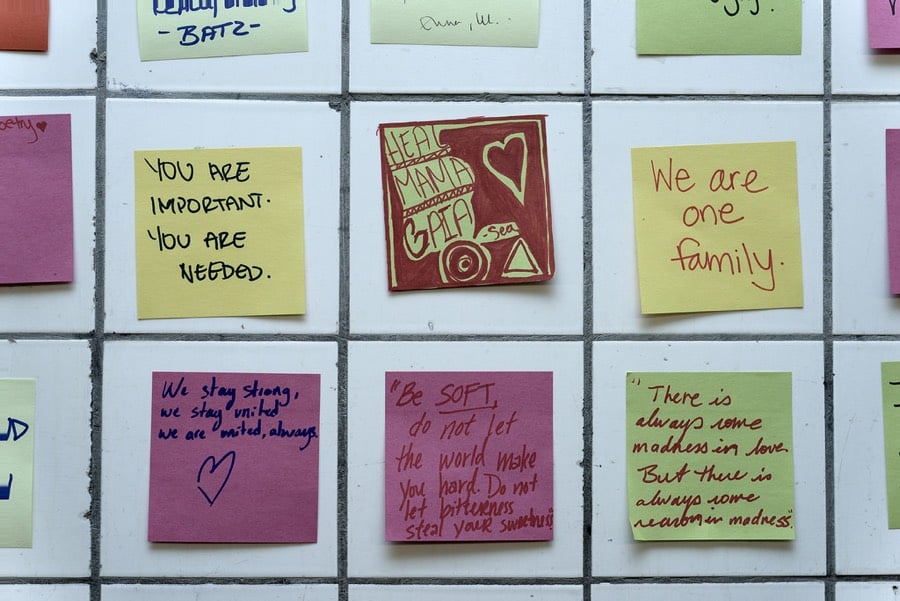
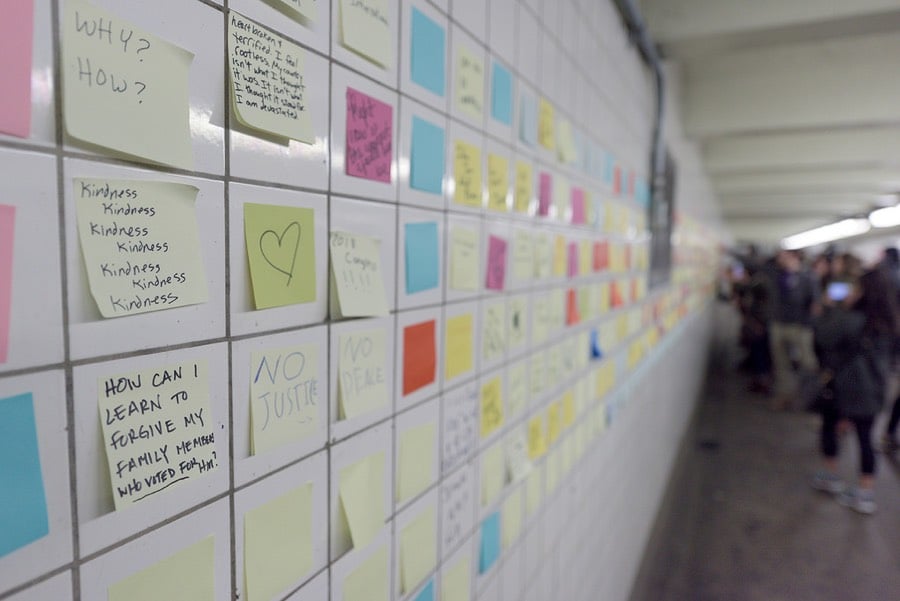
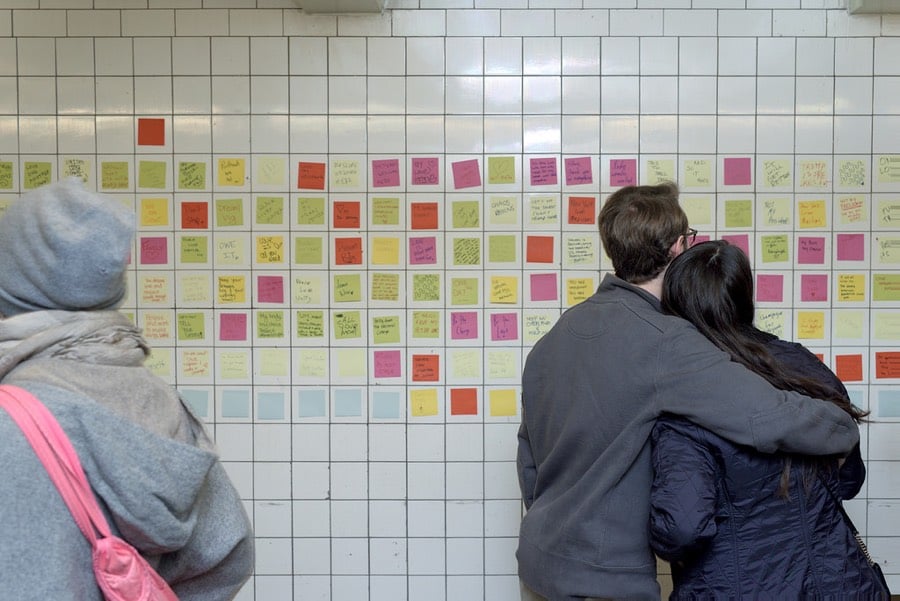
In the wake of the election, Matthew Chavez, who goes by “Levee” and is the instigator of Subway Therapy, encouraged New Yorkers to share their post-election grief on Post-it Notes stuck to the wall of the tunnel between the 6th and 7th Ave subway stations on 14th St. Joe Holmes visited the tunnel and took photos of people interacting with the wall. (All photos above by Joe Holmes.)
Whoa, this is the coolest! Jason Wright’s Brand New Subway allows players to alter the NYC subway system as they see fit. You can start with existing maps and the choices you make affect ridership and the price of a Metrocard.
Players can choose to start from scratch or one of several NYC subway maps (including present-day, maps dating back to the early 1900s, or maps from the future). They can build new stations and lines to expand the system to new areas, or tear it down and redesign the whole thing. The game intends to evoke an imaginative spirit, to empower people to envision transportation according to their needs and desires, and to arouse the fun of tinkering with maps.
This project is an entry in The Power Broker Game Design Competition, the goal of which is to adapt Robert Caro’s The Power Broker into a playable experience. Wright explains how his game hits the mark:
Bottom-up vs. top-down design. Moses was infamous for his top-down approach to urban planning. He held “the public” as a concept in high regard while simultaneously showing contempt for the individuals who made up that public, in the form of arrogance, spitefulness, and an utter lack of concern for the millions displaced for his expressways and parks. Later on in his career, as the span of his projects increased, Moses would make monumentally important decisions about the fate of a neighborhood without once setting foot there. He was known for building 13 bridges and hundreds of miles of parkways despite never driving a car.
Although Brand New Subway might appeal to someone who enjoyed SimCity but who has never set foot in New York City, it’s targeted primarily at those who actually ride the subway and who might feel invested in what they design. In that regard, it inverts Moses’ paradigm by encouraging players to improve on transportation in their own neighborhoods and in ways to which they have a personal connection.
I reeeeeeally didn’t want to spend the rest of my day playing with this, but that super express train from Manhattan to JFK isn’t going to build itself! (via @byroncheng)
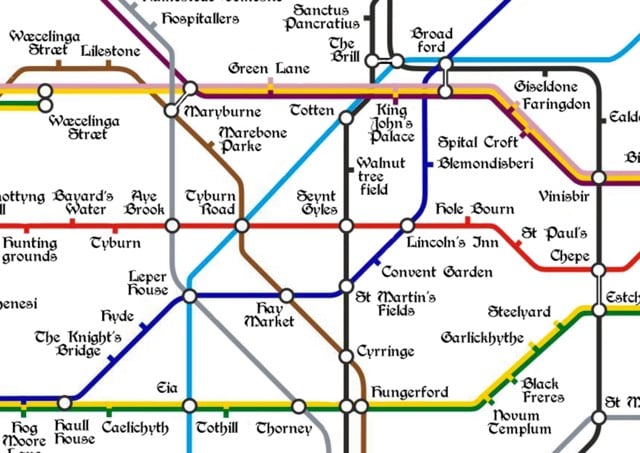
Londonist created a map of the London Underground with station names contemporary to medieval London.
The medieval period spans something like 1,000 years, covering the centuries from the Roman withdrawal around 400 AD to the rise of the Tudors in the late 15th century. Place names, of course, changed greatly over this time and those on the map were not necessarily all in use at the same time. Where applicable, we’ve favoured spellings used in the Domesday survey of 1086. Elsewhere, we’ve taken the earliest recorded version of a place name.
Older posts






Socials & More