Giorgia Lupi and her team at Pentagram have created a data-driven animation for the MTA called A Data Love Letter to the Subway.


More from Lupi (who calls this an “absolute dream project”):
The project, “A Data Love Letter to the Subway,” visualizes each train line as a character whose unique qualities are extracted from MTA data. Data like length, location, and transfers were abstracted into train behaviors and attributes. Imaginatively animating each train line’s age, length, and path, we wrote a poetic story that explores the trains’ interwoven encounters with commuters and one another.
Our “Love Letter” draws on the elemental nature of picture books to unpack the visual system of the subway with curiosity and wonder. Drawing from the MTA’s Open Data Program, with my team we translated train data into a narrative made of attributes and behaviors, providing a rich view of the interactions, roles, differences, and the connections made and sometimes missed within the subway ecosystem.
Maps, NYC, the subway, data visualization…I am not sure how much more in my wheelhouse a thing could be.
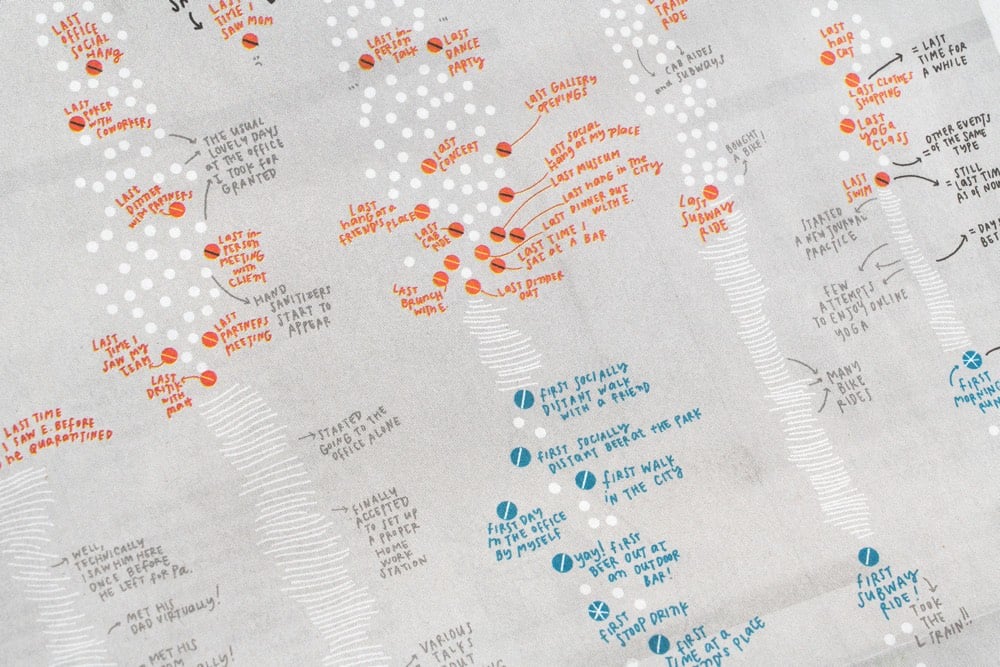
For the print version of the NY Times from this past Sunday, information designer Giorgia Lupi created a hand-drawn visualization that “tracks the last time [she] did something before the pandemic hit, and the first time she did something new with social distancing”.
Our lives have been transformed during the Covid-19 pandemic as the activities we used to do every day have been put on hold and new, socially distanced routines have taken their place. Pentagram partner Giorgia Lupi documents these changes in her own life in a data visualization commissioned by The New York Times for the cover of its “At Home” section, which runs as part of the newspaper’s Sunday edition. The hand-drawn visualization is a personal timeline that tracks the “last” time Giorgia did something before the pandemic hit, and the “first” time she did something new as she started to emerge from lockdown.
Not hand-drawn, but I remember pretty clearly what my lasts were:
- Last movie (w/ kids): Onward in mid-March
- Last movie (solo): Portrait of a Lady on Fire in mid-March
- Last visit to NYC: late October 2019
- Last trip: Vietnam/Singapore/Qatar in Jan/Feb 2020
- Last restaurant (solo): a forgettable ramen place in Burlington in mid-March
- Last restaurant (w/ a friend): better local ramen place in early March
- Last cocktail bar: Bar Stories in Singapore in early February
- Last museum: Museum of Islamic Art in Doha, Qatar in early February
I don’t remember my firsts as well, although one that sticks out is eating french fries (take-out) in July. On a normal day, french fries are delicious but when you haven’t had them in months, they are otherworldly.
Design firm Pentagram has brought in a new partner to their New York office, information designer Giorgia Lupi, who joins heavy hitters like Michael Bierut, Paula Scher, and Eddie Opera. I remain fascinated with how Pentagram operates:
Established in 1972, the firm has a collectivist attitude and adheres to a longstanding constitution, which exists in its original form with only small modifications. It spreads profits and decision-making power equally among its self-governed partners — all designers — irrespective of seniority or how much business they brought in during a given year. There’s no CEO. The partners do collaborate with one another, often across disciplines, but essentially operate their own studios, though the local offices meet on a weekly basis and the entire group convenes twice a year. These all-partner meetings, chaired by one of the partners on a rotating basis, are about sharing work with the group and discussing business dynamics, Pentagram’s publishing program, its website, and trends in the industry.
The process for bringing in a new partner can take years from start to finish and requires the unanimous consent of the rest of the partners:
“One vote against and it’s over, truly,” says Miller. “We’ve seen it happen.”
I’ve often thought about if a collective structure could work for independent content sites. I wouldn’t want to sell kottke.org to anyone, but the idea of sharing resources and infrastructure with a couple dozen similar sites is appealing. You could collect the sites into a membership bundle; hire dedicated staff for customer support, ad sales, & devops; do cross-promotion, syndicate the content via a meta-site, and generally help small indie sites punch above their weight. This is what The Deck could have evolved into, I suppose. Aw well.





Socials & More