Entries for July 2008
For the past few years, Mark Bottrell has been tracking how many players who have appeared in RBI Baseball (from 1988) and Tecmo Super Bowl (from 1991) are still active in MLB and the NFL. Sad news this year…only one player is still active.
The New Yorker pulled one over on me. The recent Summer Fiction Issue contained a piece (not online) by novelist Haruki Murakami which I skimmed right over, thinking it was a piece of short fiction. Turns out it’s an excerpt from Murakami’s memoir, What I Talk About When I Talk About Running, a book detailing how he became a novelist and an avid runner.
In other words, you can’t please everybody.
Even when I ran the club, I understood this. A lot of the customers came to the club. If one of out ten enjoyed the place and decided to come again, that was enough. If one out of ten was a repeat customer, then the business would survive. To put it another way, it didn’t matter if nine out of ten people didn’t like the club. Realizing this lifted a weight off my shoulders. Still, I had to make sure that the one person who did like the place really liked it. In order to do that, I had to make my philosophy absolutely clear, and patiently maintain that philosophy no matter what. This is what I learned from running a business.
After “A Wild Sheep Chase,” I continued to write with the same attitude that I’d developed as a business owner. And with each work my readership — the one-in-ten repeaters — increased.
In addition to writing his dozen novels, Murakami has also run 26 marathons. The Economist calls the book both puzzling and intriguing and stops just short of recommending it, while the A.V. Club really liked it. The Observer has another excerpt from the book about the author’s ultramarathon attempt.
In October 2007, the International Documentary Association made a list of the 25 best documentaries.
1. Hoop Dreams (1994), Steve James
2. The Thin Blue Line (1988), Errol Morris
3. Bowling for Columbine (2002), Michael Moore
4. Spellbound (2002), Jeffrey Blitz
5. Harlan County U.S.A. (1976), Barbara Kopple
6. An Inconvenient Truth (2006), Davis Guggenheim
7. Crumb (1994), Terry Zwigoff
8. Gimme Shelter (1970), Albert Maysles, David Maysles, and Charlotte Zwerin
9. The Fog of War (2003), Errol Morris
10. Roger & Me (1989), Michael Moore
11. Super Size Me (2004), Morgan Spurlock
12. Don’t Look Back (1967) D.A. Pennebaker
13. Salesman (1968), Albert Maysles, David Maysles, and Charlotte Zwerin
14. Koyaanisqatsi: Life Out of Balance (1982), Godfrey Reggio
15. Sherman’s March (1986), Ross McElwee
16. Grey Gardens (1976), Albert Maysles, David Maysles, Ellen Hovde, and Muffie Meyer
17. Capturing the Friedmans (2003), Andrew Jarecki
18. Born into Brothels, (2004), Ross Kauffman and Zana Briski
19. Titicut Follies (1967), Frederick Wiseman
20. Buena Vista Social Club (1999), Wim Wenders
21. Fahrenheit 9/11 (2004), Michael Moore
22. Winged Migration (2002), Jacques Perrin
23. Grizzly Man (2005), Werner Herzog
24. Night and Fog (1955), Alain Resnais
25. Woodstock (1970), Michael Wadleigh
James Danziger notes that the issue of Vogue Italia following the acclaimed issue featuring only black models has zero black models in it.
How absolutely great, but now the August issue is out — themed around a faux funeral photo tribute to Yves Saint Laurent — and there’s apparently not one black model to be found. This is especially ironic given the fact that Yves Saint Laurent was one of the first major designers to regularly feature black models in his runway shows. You would have thought they could have found room to at least fit Naomi Campbell in somewhere. Wouldn’t she look chic in widow’s weeds? This kind of tokenism ultimately seems a step backwards to me.
From an article on a new book written by a woman whose ex-boyfriend has been stalking her for more than a decade, a curious phrase: micro-tampering.
No matter how many times Ms. Brennan changed the locks, she writes, her apartment was entered and subtly rearranged. “I find a bar of soap from the second-floor bathroom on the third-floor kitchen counter,” she writes. “A teaspoon from a kitchen drawer lies on the middle of my bed.”
Update: See also: gaslighting. (thx, alex)
A thoughtful letter from a librarian to a woman who wanted a book depicting gay marriage removed from the children’s section of the library.
I fully appreciate that you, and some of your friends, strongly disagree with its viewpoint. But if the library is doing its job, there are lots of books in our collection that people won’t agree with; there are certainly many that I object to. Library collections don’t imply endorsement; they imply access to the many different ideas of our culture, which is precisely our purpose in public life.
Law professor Eugene Volokh rounds up some cases where courts ruled on unusual name changes (like Talula Does the Hula From Hawaii).
Misteri N***er, second “i” silent. No, said the California Court of Appeal in 1992, because it constitutes “fighting words”: “[I]f a man asks appellant his name and he answers ‘Mister N***er,’ the man might think appellant was calling him ‘Mister N***er.’ Moreover, third persons, including children hearing the epithet, may be embarrassed, shocked or offended by simply hearing the word.
Ah, the old “them’s fightin’ words” argument.
The minions of Bowser get together for a little chat about their frustrations.
The Mario jumps over me every time. I don’t know why Bowser put this goddamn chain on my body.
The top nine songs about masturbation. Includes the obvious I Touch Myself by The Divinyls and some less-obvious songs. (via buzzfeed)
Human activities can trigger natural disasters such as earthquakes and flooding.
“Dams are the most dangerous man-made structure likely to cause quake,” says David Booth of the British Geological Survey. By artificially holding a large volume of water in one place, dams increase pressure on fractures beneath the surface of the earth. What’s more, water has a lubricating effect, making it easier for the fractures — or faults — to slip.
Tyler Cowen on why blogs should cover some topics randomly.
But with Google and Wikipedia you must choose the topic. A good blog writer can randomize the topic for you, much like a good DJ controls the sequence of the music. Sometimes you might trust us more than you trust other aggregators, but we can’t count on that and arguably the other aggregators improve at a rate faster than we do.
The economics posts on Marginal Revolution are often less interesting to me than the supposedly off-topic posts.
In the late 1950s and 1960s, two brothers from Turin claim to have intercepted dozens of transmissions of secret Soviet space launches, including those of cosmonauts who perished in space before Yuri Gagarin officially became the first man in space.
There are those who believe that somewhere in the vast blackness of space, about nine billion miles from the Sun, the first human is about to cross the boundary of our Solar System into interstellar space. His body, perfectly preserved, is frozen at -270 degrees C (-454 °F); his tiny capsule has been silently sailing away from the Earth at 18,000 mph (29,000km/h) for the last 45 years. He is the original lost cosmonaut, whose rocket went up and, instead of coming back down, just kept on going.
You can hear a couple of their recordings here. Naturally, there is quite a bit of skepticism about the brothers’ exploits.
This is late notice and who knows if there are even tickets left, but David Simon and several cast members of The Wire (Carver, Daniels, Gus, Lester, and the Bunk) will be discussing the show in NYC tonight in a Museum of the Moving Image program.
Exformation is “explicitly discarded information”.
Effective communication depends on a shared body of knowledge between the persons communicating. In using words, sounds and gestures the speaker has deliberately thrown away a huge body of information, though it remains implied. This shared context is called exformation. Exformation is everything we do not actually say but have in our heads when, or before, we say anything at all — whereas information is the measurable, demonstrable utterance we actually come out with.
In my opinion, the more exformation you generate, the better your writing, design, art, photography, or blogging will be. (thx, ze)
A very interesting graph of the estimated ideological positions of US voters, senators, and representatives shows that members of Congress are much more liberal and conservative than are US voters, who fall somewhere in the middle. (via 3qd)
Matt Thompson has some advice for you: stop buying cheap-ish pseudo-generic drugs from Walgreens, Rite-Aid, and Duane Reade and start buying really cheap true generics.
As you might know, Benadryl (available at Walgreens.com for $5.29 for a box of 24 capsules) and Wal-dryl ($3.99 / 24 capsules) are otherwise known as “25 mg. of diphenhydramine HCI.” Compare [with the true generic available at Amazon]. Yes, that is 400 tablets containing 25 mg. of diphenhydramine HCI, for about $10 when you factor in shipping.
Heed his words. Here’s 300 tablets of generic Claritin for $11.00, 100 tablets of generic Zyrtec for $6.99, 240 tablets of generic Zantac, 1000 capsules of generic Benadryl for $20.34, 1000 tablets of generic Advil for $11.70, and 1000 caplets of generic Tylenol for $13.91.
Update: It’s been brought to my attention that the Kirkland brand is Costco’s store brand so any Kirkland products sold on Amazon are being resold by people buying them from Costco. (thx, ivan)
The last man to finish the Tour de France gets the unofficial title of winner of the Lanterne Rouge. Finishing last is not as easy as you might suppose.
The designation falls somewhere between insult and accolade. Mr. Vansevenant, who after Stage 18 sits in 150th place, some 3 hours and 45 minutes behind Mr. Sastre, is indeed the worst-placed rider in the Tour de France. But, in turn, he has outlasted those who abandoned the Tour through illness, injury or simple exhaustion; those who were eliminated for failing to finish within each day’s time limit and are forced to withdraw; and those who were banned or withdrew for doping-related causes. From year to year, about 20% of the riders drop out. In other words, you can’t simply coast to last place; you have to work for it.
Wim Vansevenant did hang on to become the first three-time winner of the Lanterne Rouge.
A collection of the often banal and artless images used in the development and testing of 3-D modeling technologies and digital imaging.
While the “end user” rarely sees any of these images or objects, a handful of them (Lena, the mandrill, the Utah Teapot, the Stanford Bunny and the Cornell Box) are well known to the point of being iconic within the digital imaging research community. They have even become the subjects of inside jokes between programmers and animators: 3D models of the Utah Teapot are hidden in Pixar’s Toy Story, a screensaver that comes as part of Microsoft Windows, and the Simpsons episode where Homer stumbles into a computer-generated “Third Dimension”.
After the launch of Sputnik by the Soviet Union in late 1957 awoke the US to the possibility of a developing outer space “gap” with the Russkies, President Eisenhower signed the National Aeronautics and Space Act into law on July 29, 1958, thereby creating NASA. Only 11 years later, NASA landed men on the moon. Happy birthday, NASA.
Merlin Mann:
Some days, the web feels like 5 people trying to make something; 5k people turning it into a list; and 500MM people saying, “FAIL.”
The first death of an airplane passenger occurred nearly 100 years ago.
It was Sept. 17, 1908. Orville Wright was showing off a new “aeroplane” at Fort Myer, Va., for about 2,000 people, including Army brass. He took up a 26-year-old lieutenant in the Army Signal Corps, Thomas E. Selfridge, “an aeroplanist himself,” according to the report in this newspaper. Contemporary accounts vary, but the pair apparently made three and a half successful circuits at an altitude of about 75 feet, before a propeller split and hit other parts of the plane, causing it to crash. Orville was badly hurt.
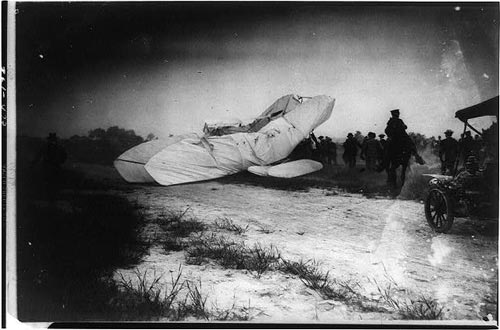
From the NY Times account of the crash on Sept 18, 1908:
The aeroplane has made three complete circuits of the big parade ground and was dashing around a curve at the far end of the field on the final lap of its fourth when the propellor blade broke. It snapped short off close to the shaft and was hurled sixty feet away.
The aeroplane seemed to tip sharply for a fraction of a second, then it started up for about ten feet; this was followed by a short, sharp dive and a crash in the field. Instantly the dust rose in a yellow, choking cloud that spread a dull pall over the great white man-made bird that had dashed to its death.
I am powerless against YouTube videos with names like Federer Madness. The video’s so crappy that I can’t even see the ball most of the time and yet I cannot stop watching. From there, it’s federer legendary 10 top shots, Rafael Nadal neat ball trick, and Michael Chang’s underhand serve at the 1989 French Open. Send help and Gatorade!
HD version of Presto, the short film shown before Pixar’s Wall-E. The shorts shown before Pixar films seemingly have something to do with the next film in the company’s pipeline. Boundin’ preceded Cars (both were set in the desert Southwest), One Man Band came out before Ratatouille (the former set in Italy, the later in France, but with similar “set” design), and Lifted preceded Wall-E (both featured outer space and spaceships), but I can’t figure out what Presto has to do with Up (the teaser’s no help).
Objectified is an upcoming film about industrial design by Gary Hustwit, director of Helvetica.
Objectified is a documentary about industrial design; it’s about the manufactured objects we surround ourselves with, and the people who make them. On an average day, each of us uses hundreds of objects. (Don’t believe it? Start counting: alarm clock, light switch, faucet, shampoo bottle, toothbrush, razor…) Who makes all these things, and why do they look and feel the way they do? All of these objects are “designed,” but how can good design make them, and our lives, better?
The film is due out in early 2009. (via design observer)
Many early 20th century hackers found the Ford Model T a perfect platform on which to build all manner of different mobile machines.
Among the 800 vintage automobiles brought by collectors were ones that had been converted to snowmobiles, racing coups and tow trucks. That was only a glimmer of the many innovative changes made by Model T owners, for uses Henry Ford never had in mind. They transformed the cars into tractors, pickup trucks, paddy wagons, mobile lumber mills and power plants for milling grain. An itinerant preacher converted his into a four-wheeled chapel.
Check out the slideshow for several examples, including the goat sidecar.
The Natural History Museum in NYC has put a collection of historical photos online, including some fantastic images of the construction of some of their famous displays and dioramas. Pruned pulled out a few of the best for a recent post.
During the first decades of the 20th century, the AMNH posed its T. rex bones in an upright position, propped on its tail. Skeletons were broken, some bent and others removed altogether so that it looked like the “marauding predator” people thought they were. And also so that it didn’t look too diminutive in the large exhibition hall. Natural history as a function of architecture: it had to reach high up to the ceiling, fill up all that space, loom large over the crowds.
A pair of Levi’s from the 1890s are up on eBay.
This old pair of LEVI’S were found in a mine in the Rand Mining District, on the Mojave Desert,. California. They are covered in candlewax from the candle’s the miner was using to light the tunnel he was working in. They were found with and old paper bag with the name of a mercantile store which operated between 1895 and 1898 in the town or Randsburg. Their was also a gunny sack with the initials A.P.K. and Randsburg marked on it. A.P.K. is through to be Adam P. Kuffel who was a partner in the mercantile store.
These pants have the cloth label vice the leather label. The label (pictured) indicates that they are size W34 x L33, They are copper riveted with the rivets marked L.S. & Co. S.F. They are buckle back (pictured) with suspender buttons. Buttons are silver in color and are all marked LEVI STRAUSS & CO. S.F.CAL. Tthe pants were made with just one back pocket on the right hand side.
With 2 days to go, the current high bid stands at $7300. (via reference library)
Update: Another seller is contemplating listing another old pair of pants.
The jeans were uncovered in an old miners cabin here in montana and have been dated between 1890 and 1901 by the rivets on the jeans. There was gold in the watch pocket of the blue jeans and has been saved in a vial, do you think we should include it in the auction? there is also the miners diaries and a couple of shaker boxes too.
Four-star chef Eric Ripert checked out the burgers at McDonald’s and Burger King to use as a pattern for a burger at his new D.C. restaurant. Part of what he learned is proportion is everything.
Just looking at the basic burgers at each of these chains — particularly the Big Mac — showed me a couple of very key things: First of all, the burgers are a perfect size. You can grab them in both hands, and they’re never too tall or too wide to hold on to. And the toppings are the perfect size, too — all to scale, including the thickness of the tomatoes, the amount of lettuce, etc. In terms of the actual flavors, they taste okay, but you can count on them to be consistent; you always know what you’re going to get.
Ripert’s findings dovetail quite nicely with my theory of sandwichcraft.
Paul Krugman on the how the NY Times makes its money.
The New York Times is known for its hard news coverage, but he observes that from a business perspective it’s primarily a fashion and food publication that runs a small political news operation on the side. One issue of T Magazine, he says, pays for an entire NYT European bureau.
At Piedmont High School in California, two coaches have devised an offense in which all 11 men are responsible for carrying the ball down the field Plays start with two quarterbacks and go from there.
Yes, per the rules of the game, only five players are eligible to catch a pass during a particular play and seven players have to set up on the line of scrimmage. But in the minds of Bryan and Humphries, you can develop an infinite number of plays with an infinite number of formations.
Talk about confusing a defense.
“It presents a different set of challenges for defenses because they have to account for which guys go out or might go out,” Bryan said. “Those guys who are ineligible to go down the field and catch a pass, they can take a reverse pitch or a negative screen or a hitch behind the line of scrimmage.
This 4-minute video provides a good look at how the offense functions and there’s lots more at a11offense.com. (via clusterflock)
In order to create art for the 10,000-year Clock chamber, Edward Burtynsky has been investigating how to make photographic prints that last a long time.
Burtynsky went on a quest for a technical solution. He thought that automobile paint, which holds up to harsh sunlight, might work if it could be run through an inkjet printer, but that didn’t work out. Then he came across a process first discovered in 1855, called “carbon transfer print.” It uses magenta, cyan, and yellow inks made of ground stone-the magenta stone can only be found in one mine in Germany-and the black ink is carbon.
On the stage Burtynsky showed a large carbon transfer print of one of his ultra-high resolution photographs. The color and detail were perfect. Accelerated studies show that the print could hang in someone’s living room for 500 years and show no loss of quality. Kept in the Clock’s mountain in archival conditions it would remain unchanged for 10,000 years.
Nice remembrance from Roger Ebert on the end of the long-running At the Movies show.
One thing we never did, apart from an occasional special show, was depart from the format: Two critics debating the week’s new movies. No “advance looks” at trailers for movies we hadn’t even seen. No celebrity interviews. No red carpet sound bites. Just two guys talking about the movies. At one point, our show and two clones were on the air simultaneously. Then we were left alone again: The only show on TV that would actually tell you if we thought a movie was bad.
Jonah Lerher, author of Proust Was a Neuroscientist, has a piece in the New Yorker this week (not online1) about how the process of insight works in the brain. The main takeaway is that insight comes easiest when our brains are relaxed and not focused on too much detail so that it is able to look for more general associations between seemingly disparate ideas.
Kounios tells a story about an expert Zen meditator who took part in one of the C.R.A. insight experiments. At first, the meditator couldn’t solve any of the insight problems. “This Zen guy went through thirty or so of the verbal puzzles and just drew a blank,” Kounios said. “He was used to being very focussed, but you can’t solve these problems if you’re too focussed.” Then, just as he was about to give up, he started solving one puzzle after another, until, by the end of the experiment, he was getting them all right. It was an unprecedented streak. “Normally, people don’t get better as the task goes along,” Kounios said. “If anything, they get a little bored.” Kounios believes that the dramatic improvement of the Zen meditator came from his paradoxical ability to focus on not being focussed, so that he could pay attention to those remote associations in the right hemisphere. “He had the cognitive control to let go,” Kounios said. “He became an insight machine.”
[1] There’s a samizdat PDF of the article here. ↩
I’ve been meaning to post about the remarkable new Apple keyboard. It took me a day to get used to it, but now I love it. Typing on it is effortless, silent, and fast…I had no idea a change in keyboard could result in such a perceptible speed increase. Tim Bray calls the keyboard “great”:
The current line-up of Apple keyboards isn’t good, it is (the sizing flaw aside) great. The feel is both sensitive and rock-solid and I think I’m typing faster than any time in the last twenty years or so.
Rafe likes it too and Robert bought extras in case Apple discontinues them.
Lots of people love the Flip video camera for its smallness and ease-of-use but Kodak looks like they may one-up the Flip with the Zi6. The real attraction of the slightly more expensive Zi6 is that it shoots in 16x9 HD at 720p. The Kodak site says the camera is due out in August but the pre-order page at Amazon says October 1. Retail price is $180. We never pulled the trigger on the Flip so getting this to record video of Ollie is a no-brainer. (via df)
What would happen if there were no stop signs and a large corporation attempted to design one?
“We’re targeting women, but we’re also targeting men, secondarily.”
Gay marriage should be allowed and encouraged in the US but denied to brides who want their bridesmaids to get Botox or boob jobs before walking down the aisle with them.
Becky Lee, 39, a Manhattan photographer, declined when a friend asked her — and five other attendants — to have their breasts enhanced. “We’re all Asian and didn’t have a whole lot of cleavage, and she found a doctor in L.A. who was willing to do four for the price of two,” said Ms. Lee, who wore a push-up bra instead. Not for nothing are some maids known as slaves of honor, but this kind of cajoling is a recent development on the wedding front.
Another woman requested professional spray tans for all her bridesmaids…two declined and were removed from the wedding party. Ugh, what horrible self-centered people.
In California, it’s pretty much legal now to buy, sell, grow, and smoke pot, provided you’ve got the proper documentation from a doctor, which is pretty easy to get. This article from the New Yorker details the industry that’s sprung up around this legalization, filled with people who, you get the feeling, really like smoking pot for recreational and not medical reasons.
The counties of California were allowed to amend the state guidelines, and the result was a patchwork of rules and regulations. Upstate in Humboldt County, the heartland of high-grade marijuana farming in California, the district attorney, Paul Gallegos, decided that a resident could grow up to ninety-nine plants at a time, in a space of a hundred square feet or less, on behalf of a qualified patient. The limited legal protections afforded to pot growers and dispensary owners have turned marijuana cultivation and distribution in California into a classic “gray area” business, like gambling or strip clubs, which are tolerated or not, to varying degrees, depending on where you live and on how aggressive your local sheriff is feeling that afternoon. This summer, Jerry Brown, the state’s attorney general, plans to release a more consistent set of regulations on medical marijuana, but it is not clear that California’s judges will uphold his effort. In May, the state Court of Appeal, in Los Angeles, ruled that Senate Bill 420’s cap on the amount of marijuana a patient could possess was unconstitutional, because voters had not approved the limits.
Senate Bill 420! The LAPD and DEA have taken the stance that federal law takes precedence over state law and are routinely busting people for growing, selling, and possession. It’ll be interesting to see what happens in the future here.
Population densities in the United States vary over nine orders of magnitude.
In case you’re wondering, the most densely populated block group is one in New York County, New York — 3,240 people in 0.0097 square miles, for about 330,000 per square mile. The least dense is in the North Slope Borough of Alaska — 3 people in 3,246 square miles, or one per 1,082 square miles. The Manhattan block group I mention here is 360 million times more dense than the Alaska one; population densities vary over a huge range.
That’s approximately the same range from the height of an iPod to the diameter of the Earth. (via fakeisthenewreal)
Firefighters Turned Away From Exclusive Nightclub Blaze.
“There was no way I could let them in dressed like that,” said bouncer Ken Hess, who asked emergency personnel to step aside while he allowed a group of good-looking, scantily clad women directly into the blaze.
Is Paris stagnant?
“Paris, and France, are definitely having an identity crisis,” says Christophe Boicos, a gallery owner and art professor for several American universities. “They have been living off their 19th- and 20th-century heritage for a long time. At the opening of the 21st century, they need to redefine themselves.”
Artists looking for the buzz go to London or Berlin, or further afield to New York, rather than Paris, says German art historian Wilfried Rogasch. “Paris is in stagnation. Talented people from around the world go to Paris. But they don’t go there for stimulation, they go to see Paris.”
I’ve said this before, but Paris — the central part of it anyway — seems like a giant museum. We’ve thought of living there for a year or two but after a recent one-day trip there, that doesn’t seem like such a good idea anymore. (via vqr)
Older posts




Socials & More