At the beginning of the ninth episode of his 13-part series Cosmos: A Personal Voyage, Carl Sagan says:
If you wish to make an apple pie from scratch, you must first invent the universe.
Taking a page from Sagan’s book, Zack Scholl made a site called Recursive Recipes, which allows you to drill down into the ingredients of some common foods, replacing them with other recipes.
A recursive recipe is one where ingredients in the recipe can be replaced by another recipe. The more ingredients you replace, the more that the recipe is made truly from scratch.
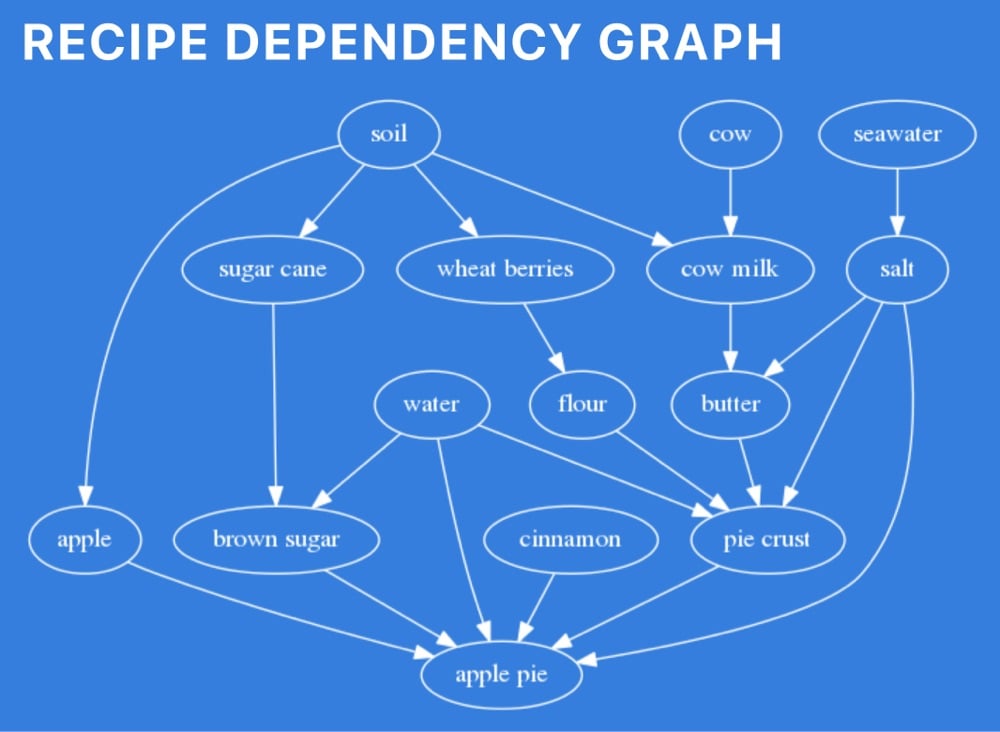
Here’s what the apple pie recipe looks like when you make everything you can from scratch:
You don’t quite begin at the Big Bang, but if you start with soil, a cow, and some seawater, it’s still going to take you almost 8 years to make that pie. The wheat needed for the flour, for instance:
Plant winter wheat in fall to allow for six to eight weeks of growth before the soil freezes. This allows time for good root development. If the wheat is planted too early, it may smother itself the following spring and it could be vulnerable to some late-summer insects that won’t be an issue in the cooler fall weather. If winter wheat is planted too late, it will not overwinter well.
Thwaites reverse engineered a seven dollar toaster into 400 separate parts and then set about recreating steel from iron ore rocks, plastic from microwaved potatoes and copper from homemade bromide mush.
This is sobering: in an ad for the United Nations Global Compact, the words of Carl Sagan from nearly 40 years ago warn us of the necessity for urgent action on climate change, deforestation, and extinction.
Life is something rare and precious. There is something extraordinary about the planet that we are privileged to live on. The human species is destroying forests and we’re doing it at a rate of one acre of forest every second. We’re doing something immensely stupid.
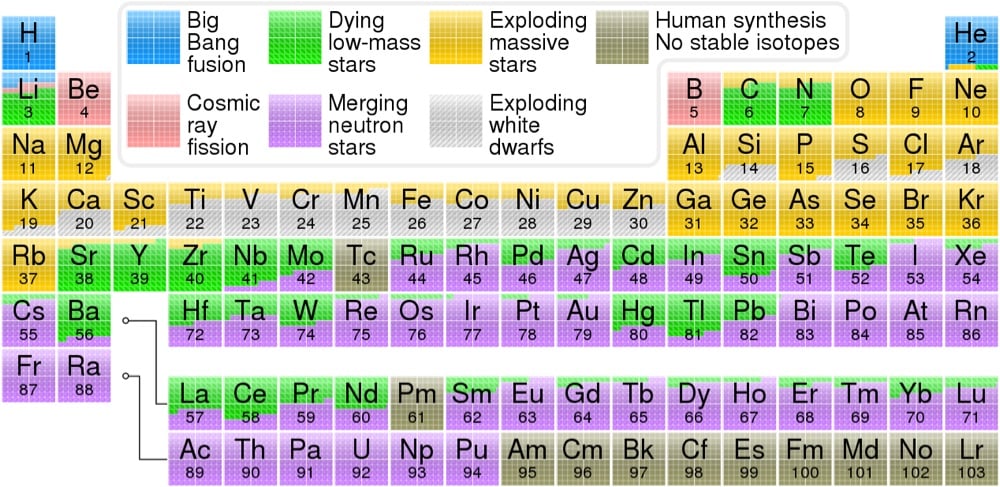
From Wikipedia contributor Cmglee and Astronomy Picture of the Day, a color-coded periodic table that displays which cosmic events — the Big Bang, exploding stars, merging neutron stars, etc. — was responsible for creating each element, according to our present understanding of the universe.
The hydrogen in your body, present in every molecule of water, came from the Big Bang. There are no other appreciable sources of hydrogen in the universe. The carbon in your body was made by nuclear fusion in the interior of stars, as was the oxygen. Much of the iron in your body was made during supernovas of stars that occurred long ago and far away. The gold in your jewelry was likely made from neutron stars during collisions that may have been visible as short-duration gamma-ray bursts or gravitational wave events.
The nitrogen in our DNA, the calcium in our teeth, the iron in our blood, the carbon in our apple pies were made in the interiors of collapsing stars. We are made of starstuff.
During a Tonight Show appearance in 1978, Johnny Carson asked Carl Sagan about the scientific accuracy of Star Wars. Sagan replied:
The 11-year-old in me loved them but they could have made a better effort to to do things right. A lot of different aspects of things — Star Wars starts out saying it’s on some other galaxy and then you see there’s people. Starting in scene one there’s a problem, because human beings are the result of a unique evolutionary sequence based upon so many individually unlikely random events on the Earth.
In fact, I think most evolutionary biologists would agree that if you started the Earth out again and just let those random factors operate you might wind up with beings that are as smart as us and as ethical and artistic and all the rest, but they would not be human beings. That’s for the Earth. So in another planet, different environment, very unlikely to have a human being. It’s extremely unlikely that there would be creatures as similar to us as as the dominant ones in Star Wars.
And a whole bunch of other things: they’re all white. The skin of all the humans in Star Wars, oddly enough, is like this. And not even the other colors represented on the Earth at present, much less greens and blues and purples and oranges.
Carson pushes back slightly at this point: “They did have the scene of Star Wars with a lot of strange characters.” But Sagan persists:
Yeah, but none of them seem to be in charge of the galaxy. Everybody in charge of the galaxy seemed to look like us. And I thought it was a large amount of human chauvinism.
Sagan also complained about Han Solo’s boast of doing the Kessel Run in less than 12 parsecs. According to the script, this was an “obvious” lie on Han’s part to make his ship sound impressive, so Sagan missed that. But then, post-Lucas, the Kessel Run was explained in Solo: A Star Wars Story as a distance shortcut and not an elapsed completion time, so…. (via digg)
I love rocket launches. They are loud, carry cool things into space, and last a surprisingly long time considering how fast the rocket is already traveling when it clears the tower. But I think we’re going to look back on this era of space travel and marvel that launches & rockets were our only means of getting things into and around space (planetary gravity assists notwithstanding). We’re already moving in that direction; the initial tests of a space sail inspired by Carl Sagan have been promising. Another space propulsion idea is to use spinning space tethers to whip smaller, slower space vehicles from relatively low altitudes to higher orbits or even to the Moon, Mars, or beyond. This video from Kurzgesagt explains how these tethers work and what we could do with them.
I believe Neal Stephenson wrote about space tethers (or something very similar) in Seveneves.
In his 1995 book The Demon-Haunted World, astrophysicist Carl Sagan presented a partial list of “tools for skeptical thinking” which can be used to construct & understand reasoned arguments and reject fraudulent ones.
Wherever possible there must be independent confirmation of the “facts.”
Encourage substantive debate on the evidence by knowledgeable proponents of all points of view.
Arguments from authority carry little weight — “authorities” have made mistakes in the past. They will do so again in the future. Perhaps a better way to say it is that in science there are no authorities; at most, there are experts.
Spin more than one hypothesis. If there’s something to be explained, think of all the different ways in which it could be explained. Then think of tests by which you might systematically disprove each of the alternatives. What survives, the hypothesis that resists disproof in this Darwinian selection among “multiple working hypotheses,” has a much better chance of being the right answer than if you had simply run with the first idea that caught your fancy.
Try not to get overly attached to a hypothesis just because it’s yours. It’s only a way station in the pursuit of knowledge. Ask yourself why you like the idea. Compare it fairly with the alternatives. See if you can find reasons for rejecting it. If you don’t, others will.
Quantify. If whatever it is you’re explaining has some measure, some numerical quantity attached to it, you’ll be much better able to discriminate among competing hypotheses. What is vague and qualitative is open to many explanations. Of course there are truths to be sought in the many qualitative issues we are obliged to confront, but finding them is more challenging.
If there’s a chain of argument, every link in the chain must work (including the premise) — not just most of them.
Occam’s Razor. This convenient rule-of-thumb urges us when faced with two hypotheses that explain the data equally well to choose the simpler.
Always ask whether the hypothesis can be, at least in principle, falsified. Propositions that are untestable, unfalsifiable are not worth much. Consider the grand idea that our Universe and everything in it is just an elementary particle — an electron, say — in a much bigger Cosmos. But if we can never acquire information from outside our Universe, is not the idea incapable of disproof? You must be able to check assertions out. Inveterate skeptics must be given the chance to follow your reasoning, to duplicate your experiments and see if they get the same result.
I found this via Open Culture, which remarked on Sagan’s prescient remarks about people being “unable to distinguish between what feels good and what’s true”.
Like many a science communicator after him, Sagan was very much concerned with the influence of superstitious religious beliefs. He also foresaw a time in the near future much like our own. Elsewhere in The Demon-Haunted World, Sagan writes of “America in my children’s or grandchildren’s time…. when awesome technological powers are in the hands of a very few.” The loss of control over media and education renders people “unable to distinguish between what feels good and what’s true.”
This state involves, he says a “slide… back into superstition” of the religious variety and also a general “celebration of ignorance,” such that well-supported scientific theories carry the same weight or less than explanations made up on the spot by authorities whom people have lost the ability to “knowledgeably question.”
Yeeeeeeeep.
Update: After I posted this, a reader let me know that Michael Shermer has been accused by several women of sexually inappropriate & predatory behavior and rape at professional conferences. I personally believe women, and I further believe that if Shermer was actually serious about rationality and his ten rules for critical thinking listed above, he wouldn’t have pulled this shit in the first place (nor tried to hamfistedly explain it away). I’ve rewritten the post to remove the references to Shermer, which actually made it more succinct and put the focus fully on Sagan, which was my intention in the first place (the title remains unchanged). (via @dmetilli)
While preparing for a conference talk/conversation I’m doing in Amsterdam this weekend, I was reading about the Golden Record that NASA sent along as a potential greeting from Earth to alien civilizations who might run across the Voyager probes in interstellar space millions of years from now. For the 40th anniversary of the Voyager launches, science writer Timothy Ferris (author of the Pulitzer-nominated Coming of Age in the Milky Way) wrote about the production of the Record for the New Yorker.
In the winter of 1976, Carl was visiting with me and my fiancee at the time, Ann Druyan, and asked whether we’d help him create a plaque or something of the sort for Voyager. We immediately agreed. Soon, he and one of his colleagues at Cornell, Frank Drake, had decided on a record. By the time nasa approved the idea, we had less than six months to put it together, so we had to move fast. Ann began gathering material for a sonic description of Earth’s history. Linda Salzman Sagan, Carl’s wife at the time, went to work recording samples of human voices speaking in many different languages. The space artist Jon Lomberg rounded up photographs, a method having been found to encode them into the record’s grooves. I produced the record, which meant overseeing the technical side of things. We all worked on selecting the music.
Carl Sagan was project director, Ann Druyan the creative director, and Ferris produced the Record. And the sound engineer for the Golden Record? I was surprised to learn: none other than Jimmy Iovine, who was recommended to Ferris by John Lennon.
I sought to recruit John Lennon, of the Beatles, for the project, but tax considerations obliged him to leave the country. Lennon did help us, though, in two ways. First, he recommended that we use his engineer, Jimmy Iovine, who brought energy and expertise to the studio. (Jimmy later became famous as a rock and hip-hop producer and record-company executive.)
Lennon, Springsteen, Tom Petty, Patti Smith, Stevie Nicks, Interscope, Dre, Snoop, Death Row Records, Eminem, Lady Gaga, Beats By Dre, Apple, *and* The Golden Record? Iovine is like the record industry’s Forrest Gump or something. How was this not in The Defiant Ones?
Once Ellie and her team discover the signal from Vega, seemingly every scene in the film features a monitor or some kind of television-related paraphernalia. Whether that’s unpacking a TV to unveil the Olympic footage, people watching news reports on CNN, a terrorist videotaping himself, or multiple scenes in the screen-filled Mission Control, Contact is filled with monitors, forcing both the characters and the audience to watch them. Full scenes of the film are made up of fuzzy TV footage. There are numerous press conferences on TV. The selection of the Machine representative unfolds via the news. Ellie’s interactions with Hadden are almost entirely done over a monitor. Even in scenes where the camera is in a room with the characters, Zemeckis often films them watching TV, or simply puts TV monitors in the frame to constantly remind us they’re there.
But that’s not it. People video chat regularly, which was not common in 1997. The terrorist attack on the Machine is first discovered on a TV monitor and subsequently played out there too. Then, finally, what’s the smoking gun of Ellie’s whole trip at the end of the movie? Eighteen hours of video footage. I could go on and on with examples where Contact uses television and monitors, but once you start seeing the film’s obsession with video, it’s almost comical how often it’s used. Which poses the obvious question, “Why?”
In this light, the organized religion & organized science depicted in the film are just other forms of mediated experience, separate from the personal experience of seeing something with your own eyes.
Contact is one of my favorite movies — I watch it every 12-18 months or so — and this makes me appreciate it all the more. And I had forgotten how good the trailer was:
It’s dead simple: that amazingly resonant Vega signal sound over a series of quickly cut scenes that tells the story in miniature. Surely this belongs on best movie trailers lists as much as any of these.
Oh, and while I’m not generally a fan of reboots, I would love to see what Denis Villeneuve could do with Sagan’s story. I’m also not crazy about Jodie Foster — I find her less and less tolerable as Arroway with each viewing — so it would be cool to see another actress in the role. Arrival’s Amy Adams is almost too on the nose…how about Lupita Nyong’o, ?Emma Watson, Janelle Monáe, Brie Larson, or Emma Stone?
Flat-Earthers aside, people have known that the Earth is round since at least the 3rd century BC. This quick video explores a few of the ways we know the world is spherical, some of them quite simple to recreate as experiments. See also Top 10 Ways to Know the Earth is Not Flat.
(5) Seeing Farther from Higher
Standing in a flat plateau, you look ahead of you towards the horizon. You strain your eyes, then take out your favorite binoculars and stare through them, as far as your eyes (with the help of the binocular lenses) can see.
Then, you climb up the closest tree — the higher the better, just be careful not to drop those binoculars and break their lenses. You then look again, strain your eyes, stare through the binoculars out to the horizon.
The higher up you are the farther you will see. Usually, we tend to relate this to Earthly obstacles, like the fact we have houses or other trees obstructing our vision on the ground, and climbing upwards we have a clear view, but that’s not the true reason. Even if you would have a completely clear plateau with no obstacles between you and the horizon, you would see much farther from greater height than you would on the ground.
This phenomena is caused by the curvature of the Earth as well, and would not happen if the Earth was flat.
Update: Carl Sagan explains how Greek astronomer and mathematician Eratosthenes figured out how the Earth was round in ~200 BC.
From his seminal TV program Cosmos, Carl Sagan attempts to explain the fourth dimension of spacetime. The story starts with Edwin Abbott’s Flatland, but Sagan being Sagan, his explanation is especially lucid.
This video is a combination of two things I like very much: long zoom histories and how things are made. The first part of the video follows the story of graphite back to the Big Bang.
[Carl Sagan-eque interlude: “If you want to make a pencil from scratch, first you must invent the universe.”]
The second part shows how pencils are made. Most surprising discovery while watching: Henry David Thoreau (yes, that one) was a talented pencil engineer:
John’s thoughtful son David*, unemployed after graduating from college, started helping out with the family business. He developed new refining techniques that made Thoreau pencils less brittle, less greasy — at the time, they were the finest pencils America had to offer. The Thoreaus were able to offer a variety of pencils, from No. 1 (the softest) to No. 4 (the hardest). That numbering system survives today.
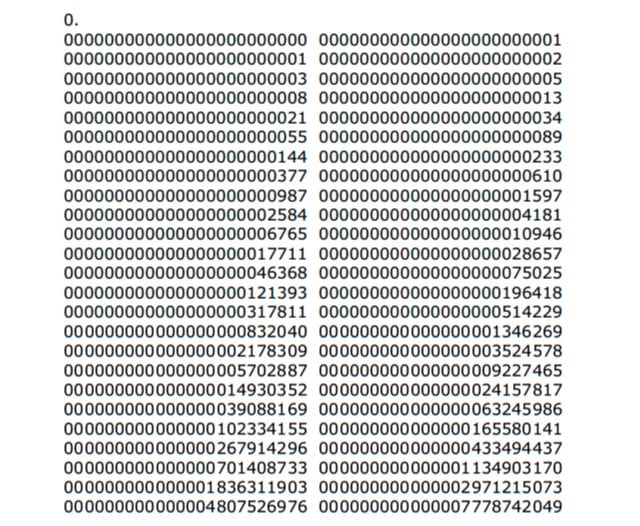
If you divide 1 by 999,999,999,999,999,999,999,998,999,999,999,999,999,999,999,999 (that’s 999 quattuordecillion btw), the Fibonacci sequence neatly pops out. MATH FTW!
At the end of Carl Sagan’s Contact (spoilers!), the aliens give Ellie a hint about something hidden deep in the digits of π. After a long search, a circle made from a sequence of 1s and 0s is found, providing evidence that intelligence was built into the fabric of the Universe. I don’t know if this Fibonacci division thing is on quite the same level, but it might bake your noodle if you think about it too hard. (via @stevenstrogatz)
Update: From svat at Hacker News, an explanation of the magic behind the math.
It’s actually easier to understand if you work backwards and arrive at the expression yourself, by asking yourself: “If I wanted the number that starts like 0.0…000 0…001 0…001 0…002 0…003 0…005 0…008 … (with each block being 24 digits long), how would I express that number?”
Why do humans explore space? We “love to sail forbidden seas”. This is a beautiful short video narrated by Carl Sagan showing future human exploration of our solar system.
Without any apparent story, other than what you may fill in by yourself, the idea of the film is primarily to show a glimpse of the fantastic and beautiful nature that surrounds us on our neighboring worlds — and above all, how it might appear to us if we were there.
The shot starting at 2:25 of the exploration of one of Jupiter’s moons (Europa?) is fantastic. (via ★interesting)
Raffi Khatchadourian’s long piece on the construction of the International Thermonuclear Experimental Reactor (ITER) is at once fascinating (for science reasons) and depressing (for political/bureaucratic reasons). Fusion reactors hold incredible promise:
But if it is truly possible to bottle up a star, and to do so economically, the technology could solve the world’s energy problems for the next thirty million years, and help save the planet from environmental catastrophe. Hydrogen, a primordial element, is the most abundant atom in the universe, a potential fuel that poses little risk of scarcity. Eventually, physicists hope, commercial reactors modelled on iter will be built, too-generating terawatts of power with no carbon, virtually no pollution, and scant radioactive waste. The reactor would run on no more than seawater and lithium. It would never melt down. It would realize a yearning, as old as the story of Prometheus, to bring the light of the heavens to Earth, and bend it to humanity’s will. iter, in Latin, means “the way.”
But ITER is a collaborative effort between 35 different countries, which means the project is political, slow, and expensive.
For the machine’s creators, this process-sparking and controlling a self-sustaining synthetic star-will be the culmination of decades of preparation, billions of dollars’ worth of investment, and immeasurable ingenuity, misdirection, recalibration, infighting, heartache, and ridicule. Few engineering feats can compare, in scale, in technical complexity, in ambition or hubris. Even the iter organization, a makeshift scientific United Nations, assembled eight years ago to construct the machine, is unprecedented. Thirty-five countries, representing more than half the world’s population, are invested in the project, which is so complex to finance that it requires its own currency: the iter Unit of Account.
No one knows iter’s true cost, which may be incalculable, but estimates have been rising steadily, and a conservative figure rests at twenty billion dollars — a sum that makes iter the most expensive scientific instrument on Earth.
I wonder what the project would look like if, say, Google or Apple were to take the reins instead. In that context, it’s only $20 billion to build a tiny Sun on the Earth. Facebook just paid $19 billion for WhatsApp, Apple has a whopping $158.8 billion in cash, and Google & Microsoft both have more than $50 billion in cash. Google in particular, which is making a self-driving car and has been buying up robots by the company-full recently, might want their own tiny star.
But back to reality, the circumstances of ITER’s international construction consortium reminded me of the building of The Machine in Carl Sagan’s Contact. In the book, the countries of the world work together to make a machine of unknown function from plans beamed to them from an alien intelligence, which results in the development of several new lucrative life-enhancing technologies and generally unites humanity. In Sagan’s view, that’s the power of science. Hopefully the ITER can work through its difficulties to achieve something similar.
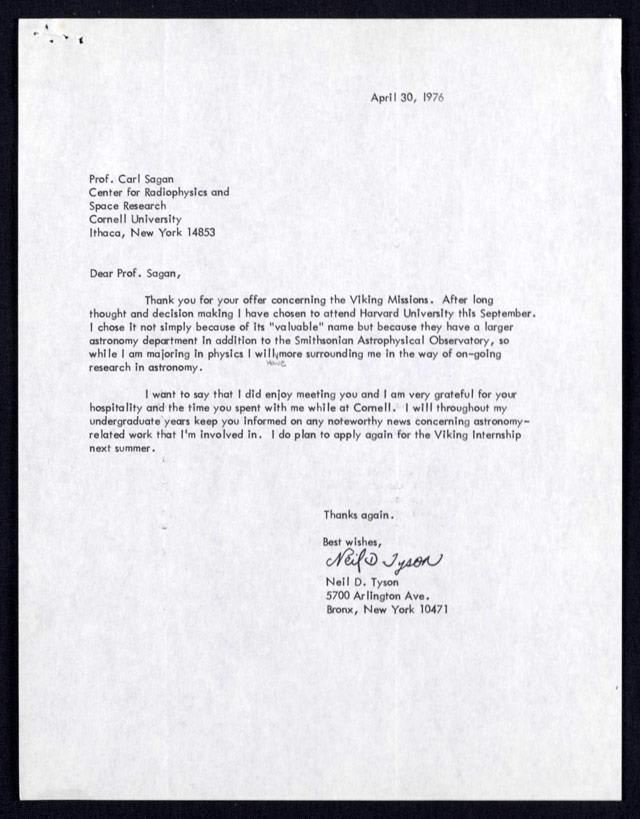
In 1976, legendary cosmologist and astronomer Carl Sagan tried to recruit a 17-year-old Neil deGrasse Tyson to Cornell University. In April of that year, Tyson wrote Sagan a letter informing him of his intention to enroll at Harvard instead:
The Viking Missions referred to in the letter were the two probes sent to Mars in the mid-1970s.
Tyson occupies a role in today’s society similar to Sagan’s in the 1980s as an unofficial public spokesman of the wonderous world of science. Tyson is even hosting an updated version of Sagan’s seminal Cosmos series for Fox, which debuts on March 9th. Here’s a trailer:
Been waiting for this one for awhile: a three-minute trailer for Cosmos: A Spacetime Odyssey, a sequel to Carl Sagan’s Cosmos.
The show will be hosted by Neil deGrasse Tyson and is being produced by Seth MacFarlane (Family Guy) and Sagan’s widow Ann Druyan. If MacFarlane’s involvement raises some eyebrows, it shouldn’t: he came up with the idea of rebooting the series and is apparently a big space nerd and fan of the original series. (via devour)
From a collection of his papers recently acquired by The Library of Congress, a 1954 reading list from physicist Carl Sagan. Huxley, Plato, Shakespeare, and the Bible are all on there among many others. If I understand mathematics properly, and I think I do, using the associative property, if you read all these books, you will become as smart and cool as Carl Sagan was. Or is it the transitive property?
This is a bit of a head-scratcher…the guy behind the Family Guy (Seth MacFarlane) is teaming up with Carl Sagan’s widow and Neil DeGrasse Tyson to do a sequel to the landmark science series, Cosmos. The series will air in primetime on Fox.
The producers of the show say the new series will tell “the story of how human beings began to comprehend the laws of nature and find our place in space and time.” They go on to boast: “It will take viewers to other worlds and travel across the universe for a vision of the cosmos on the grandest scale. The most profound scientific concepts will be presented with stunning clarity, uniting skepticism and wonder, and weaving rigorous science with the emotional and spiritual into a transcendent experience.”
I’ll be tuning in but will be pleasantly surprised if it does well in the ratings or is any good.
Maybe you’re tired of un-pop-music-like things being run through Auto-Tune, but I’m not quite there yet. This Auto-Tuned Carl Sagan mix is very nearly sublime.
[Cosmos] covered a wide range of scientific subjects including the origin of life and a perspective of our place in the universe. The series was first broadcast by the Public Broadcasting Service in 1980, and was the most widely watched series in the history of American public television until 1990’s The Civil War. It is still the most widely watched PBS series in the world. It won an Emmy and a Peabody Award and has since been broadcast in more than 60 countries and seen by over 600 million people, according to the Science Channel.
I was re-reading Carl Sagan’s novel Contact recently, essentially a series of arguments about SETI wrapped into a story, and he alludes to some sort of cosmic Grand Central Station. That, coupled with my longtime interest in transit maps, got me thinking about all of this.
At the very moment that humans discovered the scale of the universe and found that their most unconstrained fancies were in fact dwarfed by the true dimensions of even the Milky Way Galaxy, they took steps that ensured that their descendants would be unable to see the stars at all. For a million years humans had grown up with a personal daily knowledge of the vault of heaven. In the last few thousand years they began building and emigrating to the cities. In the last few decades, a major fraction of the human population had abandoned a rustic way of life. As technology developed and the cities were polluted, the nights became starless. New generations grew to maturity wholly ignorant of the sky that had transfixed their ancestors and had stimulated the modern age of science and technology. Without even noticing, just as astronomy entered a golden age most people cut themselves off from the sky, a cosmic isolationism that only ended with the dawn of space exploration.
They wonder whether the digits contain a hidden rule, an as yet unseen architecture, close to the mind of God. A subtle and fantastic order may appear in the digits of pi way out there somewhere; no one knows. No one has ever proved, for example, that pi does not turn into nothing but nines and zeros, spattered to infinity in some peculiar arrangement. If we were to explore the digits of pi far enough, they might resolve into a breathtaking numerical pattern, as knotty as “The Book of Kells,” and it might mean something. It might be a small but interesting message from God, hidden in the crypt of the circle, awaiting notice by a mathematician.
The Chudnovsky article also reminds me of Contact by Carl Sagan in which pi is prominently featured as well.
According to Wolfram Research’s Mathworld, the current world record for the calculation of digits in pi is 1241100000000 digits, held by Japanese computer scientists Kanada, Ushio and Kuroda. Kanada is named in the article as the Chudnovskys main competitor at the time.
(Oh, and as for patterns hidden in pi, we’ve already found one. It’s called the circle. Just because humans discovered circles first and pi later shouldn’t mean that the latter is derived from the former.)





Stay Connected