kottke.org posts about Contact
Contact, based on Carl Sagan’s book of the same name, is on its face a movie about science vs. religion. On the 20th anniversary of its release, Germain Lussier rewatched the film and came away with a different impression: director Robert Zemeckis wanted viewers to think about our relationship to media and technology.
Once Ellie and her team discover the signal from Vega, seemingly every scene in the film features a monitor or some kind of television-related paraphernalia. Whether that’s unpacking a TV to unveil the Olympic footage, people watching news reports on CNN, a terrorist videotaping himself, or multiple scenes in the screen-filled Mission Control, Contact is filled with monitors, forcing both the characters and the audience to watch them. Full scenes of the film are made up of fuzzy TV footage. There are numerous press conferences on TV. The selection of the Machine representative unfolds via the news. Ellie’s interactions with Hadden are almost entirely done over a monitor. Even in scenes where the camera is in a room with the characters, Zemeckis often films them watching TV, or simply puts TV monitors in the frame to constantly remind us they’re there.
But that’s not it. People video chat regularly, which was not common in 1997. The terrorist attack on the Machine is first discovered on a TV monitor and subsequently played out there too. Then, finally, what’s the smoking gun of Ellie’s whole trip at the end of the movie? Eighteen hours of video footage. I could go on and on with examples where Contact uses television and monitors, but once you start seeing the film’s obsession with video, it’s almost comical how often it’s used. Which poses the obvious question, “Why?”
In this light, the organized religion & organized science depicted in the film are just other forms of mediated experience, separate from the personal experience of seeing something with your own eyes.
Contact is one of my favorite movies — I watch it every 12-18 months or so — and this makes me appreciate it all the more. And I had forgotten how good the trailer was:
It’s dead simple: that amazingly resonant Vega signal sound over a series of quickly cut scenes that tells the story in miniature. Surely this belongs on best movie trailers lists as much as any of these.
Oh, and while I’m not generally a fan of reboots, I would love to see what Denis Villeneuve could do with Sagan’s story. I’m also not crazy about Jodie Foster — I find her less and less tolerable as Arroway with each viewing — so it would be cool to see another actress in the role. Arrival’s Amy Adams is almost too on the nose…how about Lupita Nyong’o, ?Emma Watson, Janelle Monáe, Brie Larson, or Emma Stone?
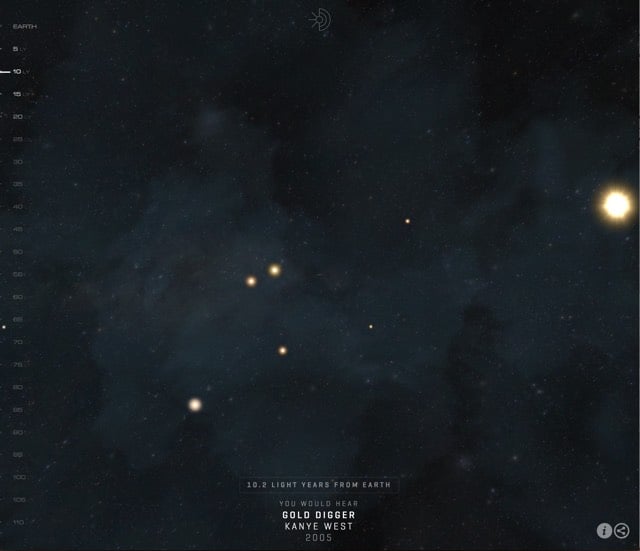
Taking inspiration from the opening sequence of Contact, lightyear.fm is a musical journey away from the Earth. As you get farther out (say, 10 light years away, just past star Ross 154 in the constellation of Sagittarius), you hear music that was broadcast on the radio at that time (Gold Digger by Kanye West).
Radio broadcasts leave Earth at the speed of light. Scroll away from Earth and hear how far the biggest hits of the past have travelled. The farther away you get, the longer the waves take to travel there — and the older the music you’ll hear.
This is the coolest.
If you divide 1 by 999,999,999,999,999,999,999,998,999,999,999,999,999,999,999,999 (that’s 999 quattuordecillion btw), the Fibonacci sequence neatly pops out. MATH FTW!
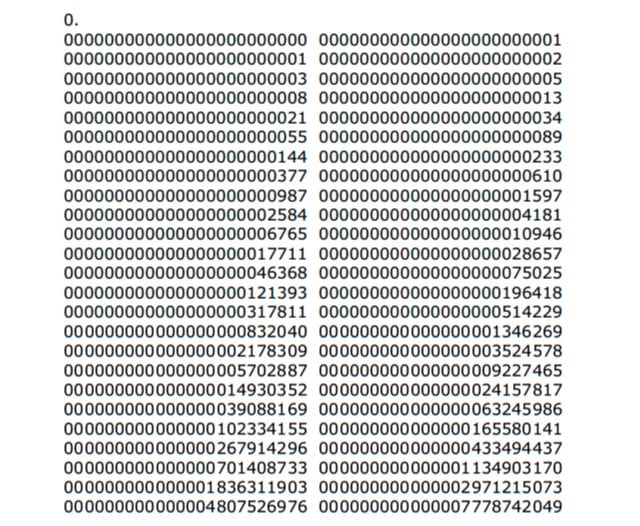
At the end of Carl Sagan’s Contact (spoilers!), the aliens give Ellie a hint about something hidden deep in the digits of π. After a long search, a circle made from a sequence of 1s and 0s is found, providing evidence that intelligence was built into the fabric of the Universe. I don’t know if this Fibonacci division thing is on quite the same level, but it might bake your noodle if you think about it too hard. (via @stevenstrogatz)
Update: From svat at Hacker News, an explanation of the magic behind the math.
It’s actually easier to understand if you work backwards and arrive at the expression yourself, by asking yourself: “If I wanted the number that starts like 0.0…000 0…001 0…001 0…002 0…003 0…005 0…008 … (with each block being 24 digits long), how would I express that number?”
(thx, taylor)
Raffi Khatchadourian’s long piece on the construction of the International Thermonuclear Experimental Reactor (ITER) is at once fascinating (for science reasons) and depressing (for political/bureaucratic reasons). Fusion reactors hold incredible promise:
But if it is truly possible to bottle up a star, and to do so economically, the technology could solve the world’s energy problems for the next thirty million years, and help save the planet from environmental catastrophe. Hydrogen, a primordial element, is the most abundant atom in the universe, a potential fuel that poses little risk of scarcity. Eventually, physicists hope, commercial reactors modelled on iter will be built, too-generating terawatts of power with no carbon, virtually no pollution, and scant radioactive waste. The reactor would run on no more than seawater and lithium. It would never melt down. It would realize a yearning, as old as the story of Prometheus, to bring the light of the heavens to Earth, and bend it to humanity’s will. iter, in Latin, means “the way.”
But ITER is a collaborative effort between 35 different countries, which means the project is political, slow, and expensive.
For the machine’s creators, this process-sparking and controlling a self-sustaining synthetic star-will be the culmination of decades of preparation, billions of dollars’ worth of investment, and immeasurable ingenuity, misdirection, recalibration, infighting, heartache, and ridicule. Few engineering feats can compare, in scale, in technical complexity, in ambition or hubris. Even the iter organization, a makeshift scientific United Nations, assembled eight years ago to construct the machine, is unprecedented. Thirty-five countries, representing more than half the world’s population, are invested in the project, which is so complex to finance that it requires its own currency: the iter Unit of Account.
No one knows iter’s true cost, which may be incalculable, but estimates have been rising steadily, and a conservative figure rests at twenty billion dollars — a sum that makes iter the most expensive scientific instrument on Earth.
I wonder what the project would look like if, say, Google or Apple were to take the reins instead. In that context, it’s only $20 billion to build a tiny Sun on the Earth. Facebook just paid $19 billion for WhatsApp, Apple has a whopping $158.8 billion in cash, and Google & Microsoft both have more than $50 billion in cash. Google in particular, which is making a self-driving car and has been buying up robots by the company-full recently, might want their own tiny star.
But back to reality, the circumstances of ITER’s international construction consortium reminded me of the building of The Machine in Carl Sagan’s Contact. In the book, the countries of the world work together to make a machine of unknown function from plans beamed to them from an alien intelligence, which results in the development of several new lucrative life-enhancing technologies and generally unites humanity. In Sagan’s view, that’s the power of science. Hopefully the ITER can work through its difficulties to achieve something similar.
From XKCD, a chart of the memes that various star systems are just hearing from the Earth’s light-speed communications.
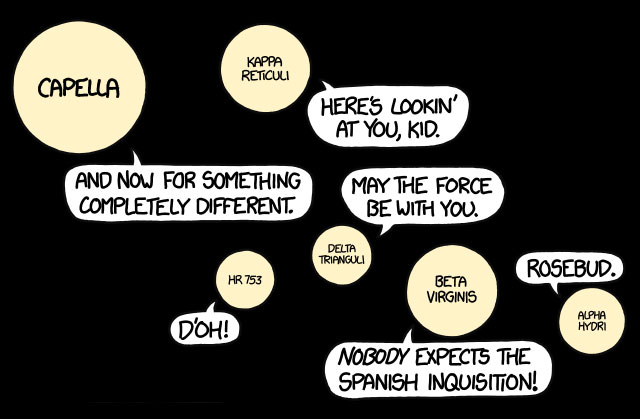
This is the meme version of Contact’s opening credits scene, which is one of my favorites:
A team of scientists has discovered a potentially habitable planet located about 20 light years from Earth.
The paper reports the discovery of two new planets around the nearby red dwarf star Gliese 581. This brings the total number of known planets around this star to six, the most yet discovered in a planetary system other than our own solar system. Like our solar system, the planets around Gliese 581 have nearly circular orbits.
The most interesting of the two new planets is Gliese 581g, with a mass three to four times that of the Earth and an orbital period of just under 37 days. Its mass indicates that it is probably a rocky planet with a definite surface and that it has enough gravity to hold on to an atmosphere, according to Vogt.
Gliese 581, located 20 light years away from Earth in the constellation Libra, has a somewhat checkered history of habitable-planet claims. Two previously detected planets in the system lie at the edges of the habitable zone, one on the hot side (planet c) and one on the cold side (planet d). While some astronomers still think planet d may be habitable if it has a thick atmosphere with a strong greenhouse effect to warm it up, others are skeptical. The newly discovered planet g, however, lies right in the middle of the habitable zone.
Sam Arbesman’s prediction of May 2011 might have been too conservative. And 20 light years…that means we could send a signal there, and if someone of sufficient technological capability is there and listening, we could hear something back within our lifetime. Contact! (thx, jimray)
Strange Maps has a map of What’s On Earth Tonight, basically a TV Guide for the Milky Way. The map is not that big yet because TV signals have only been sent out from Earth since the late 1920s.
The first tv images of World War II are about to hit Aldebaran star system, 65 light years [ly] away. If there’s anybody out there alive and with eyes to see it, the barrage of actual and dramatised footage of WW2 will keep them shocked and/or entertained for decades to come. Which is just as well, for they’ll have to wait quite a few years to catch the first episodes of such seminal series as The Twilight Zone and Bonanza (both 1959), just about now hitting the (putative) extraterrestrial biological entities of the Mu Arae area (appr. 50 ly). The Cosby Show, Miami Vice and Night Court (all 1984) should be all the rage on Fomalhaut (25 ly). Meanwhile, the sentient, tv-watching creatures near Alpha Centauri (4.4 ly), our closest extrasolar star, are just recovering from the infamous “wardrobe malfunction” during Janet Jackson and Justin Timberlake’s halftime show during the 2004 Superbowl.
See also the opening scene from Contact.
A map of the Milky Way done in the style of the London tube map.
I was re-reading Carl Sagan’s novel Contact recently, essentially a series of arguments about SETI wrapped into a story, and he alludes to some sort of cosmic Grand Central Station. That, coupled with my longtime interest in transit maps, got me thinking about all of this.
At the very moment that humans discovered the scale of the universe and found that their most unconstrained fancies were in fact dwarfed by the true dimensions of even the Milky Way Galaxy, they took steps that ensured that their descendants would be unable to see the stars at all. For a million years humans had grown up with a personal daily knowledge of the vault of heaven. In the last few thousand years they began building and emigrating to the cities. In the last few decades, a major fraction of the human population had abandoned a rustic way of life. As technology developed and the cities were polluted, the nights became starless. New generations grew to maturity wholly ignorant of the sky that had transfixed their ancestors and had stimulated the modern age of science and technology. Without even noticing, just as astronomy entered a golden age most people cut themselves off from the sky, a cosmic isolationism that only ended with the dawn of space exploration.
That’s Carl Sagan in Contact from 1985. The effects of light pollution were documented in the New Yorker last August.
The New Yorker recently ran a feature on how a couple of mathematicians helped The Met photograph a part of The Hunt of the Unicorn tapestries. That same week, they ran from their extensive archives a 1992 profile of the same mathematicians, brothers David and Gregory Chudnovsky. The Chudnovskys were then engaged in calculating as many digits of pi as they could using a homemade supercomputer housed in their Manhattan apartment. There’s some speculation that director Darren Aronfsky based his 1998 film, Pi, on the Chudnovskys and after reading the above article, there’s little doubt that’s exactly what he did:
They wonder whether the digits contain a hidden rule, an as yet unseen architecture, close to the mind of God. A subtle and fantastic order may appear in the digits of pi way out there somewhere; no one knows. No one has ever proved, for example, that pi does not turn into nothing but nines and zeros, spattered to infinity in some peculiar arrangement. If we were to explore the digits of pi far enough, they might resolve into a breathtaking numerical pattern, as knotty as “The Book of Kells,” and it might mean something. It might be a small but interesting message from God, hidden in the crypt of the circle, awaiting notice by a mathematician.
The Chudnovsky article also reminds me of Contact by Carl Sagan in which pi is prominently featured as well.
According to Wolfram Research’s Mathworld, the current world record for the calculation of digits in pi is 1241100000000 digits, held by Japanese computer scientists Kanada, Ushio and Kuroda. Kanada is named in the article as the Chudnovskys main competitor at the time.
(Oh, and as for patterns hidden in pi, we’ve already found one. It’s called the circle. Just because humans discovered circles first and pi later shouldn’t mean that the latter is derived from the former.)





Socials & More