kottke.org posts about humans
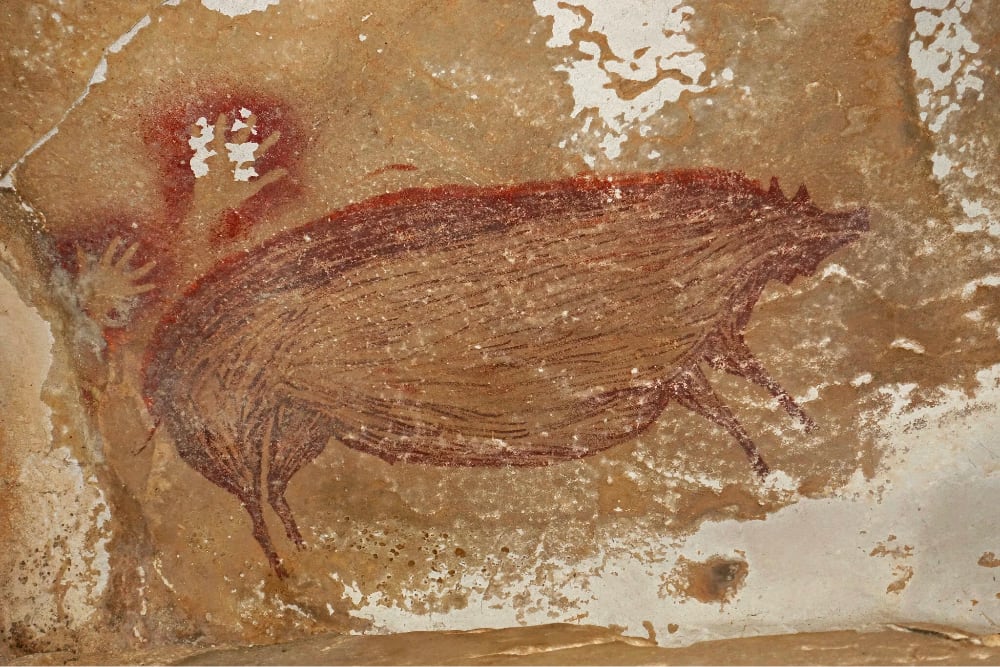
According to a study published this week, archaeologists have determined that a recently discovered cave painting of a warty pig is at least 45,500 years old. From the NY Times:
In a hidden valley on an Indonesian island, there is a cave decorated with what may be the oldest figurative art ever glimpsed by modern eyes.
The vivid depiction of a wild pig, outlined and filled in with mulberry-hued pigment, dates back at least 45,500 years, according to a study published on Wednesday in Science Advances. It was discovered deep inside a cave called Leang Tedongnge in December 2017, during an archaeological survey led by Basran Burhan, a graduate student at Griffith University and co-author of the new research. The animal in the painting resembles the warty pig, a species still living today on the island of Sulawesi where the cave is.
Still up for debate: who painted it? Not the individual who painted it — we’ll never know that — but what species painted it.
Human skeletal remains as old as 45,500 years have never been found in Sulawesi, so it is not clear that the artists were anatomically modern humans. The islands that are now called Indonesia were inhabited by different hominins — the broader family to which humans belong — over long periods of time. Some of these hominin remains date “to over a million years old,” said Rasmi Shoocongdej, an archaeologist at Silpakorn University in Thailand who was not involved in the study.

October 31, 2000 was the last day all humans were together on Earth. That day, the rocket containing the crew of Expedition 1 lifted off from the Baikonur Cosmodrome in Kazakhstan and carried them to the International Space Station for a long-term stay. Fittingly, the mission left from the same launchpad that was used to launch Yuri Gagarin into space on April 2, 1961, which was the first time in history that all humans were not together on Earth. Ever since the Expedition 1 crew docked, there’s been an uninterrupted human presence on the ISS, which may continue until 2028 or 2030, by which time there may be humans on the Moon or Mars on a permanent basis. Will humans ever be only Earth-bound again?
BTW, I guess you could argue that the ISS isn’t really separate enough from Earth or that since regular commercial airplane flights began, humans have been separate from the Earth. You could also say that at any given time, thousands of people are in the air while jumping and therefore not on the Earth with the rest of us. I don’t find any of those arguments meaningful. Perhaps someday if space travel is more routine — “just popped up into orbit to visit my daughter” — and the human population is much more distributed, these same distinctions won’t hold, but for now the ISS is definitely apart from the Earth in a way that flying or jumping are not.
From the American Museum of Natural History in NYC, an animated timeline of human evolution, from when hominins first show up in the fossil record in Africa some seven million years ago to the appearance of Homo sapiens about 200,000 years ago. You can see artifacts and fossil remains of many of the hominins at the museum in the Hall of Human Origins. I haven’t been there in awhile…might be time for a visit.
I got this from Open Culture, where Colin Marshall goes into more detail:
And though hominins may have walked upright, they also climbed trees, but eventually lost the grasping feet needed to do so. Later they compensated with the very human-like development of making and using stone tools. Two million years ago, the well-known Homo erectus, with their large brains, long legs, and dextrous hands, made the famous migration out of Africa.
We know that by 1.2 million years thereafter Homo erectus’ brains had grown larger still, fueled by new cooking techniques. Only about 200,000 years ago do we, Homo sapiens, enter the picture, but not long after, we interbreed with the various hominin species already in existence as we spread outward to fill “every geographic niche” of the Earth.
The last bit of the video was unexpectedly sobering:
Homo sapiens were highly adaptable, quickly filling nearly every geographic niche. Other hominins went extinct. Climate pressures and competition with Homo sapiens may have wiped them out.
If we don’t change our ways soon, one way to look at the recent history of life on Earth is that modern humans came along 200,000 years ago and systematically conquered and killed the all of the animals on the planet larger than an ant. Not such a great deal for anything but people.
Gizmodo’s Daniel Kolitz recently asked a panel of anatomists and evolutionary biologists about what the most useless part of the human body might be. Biology professor Dr. Nathan Lents reminds us that our bodies contain ample evidence of our design by evolution:
It’s hard to pick just one! The human wrist is a clunky hodgepodge of unnecessary bones. If we could design that joint from scratch, there is no way we would stick eight small, fixed, and mostly useless bones in there. We also have the stump of a tail that we could totally do without. It does nothing for us except occasionally gets injured or develops cancer.
I think my favorite useless body part is the pyramidalis muscle, which is located in our pelvic floor and attaches to the pelvis and some other connective tissue in our nether regions. What does it do? Well, when you flex this muscle, you can sort of squish the tissue in that area around pointlessly, but in monkeys and other mammals, it helps to manipulate the tail. So useless is this muscle that at least 20% of us don’t even have one and we don’t even miss it. I always enjoy telling people that, although humans and other apes don’t have tails, we still have the muscles to flex them!
While studying some of the oldest art in the world found in caves and engraved on animal bones or shells, paleoanthropologist Genevieve von Petzinger has found evidence of a proto-writing system that perhaps developed in Africa and then spread throughout the world.
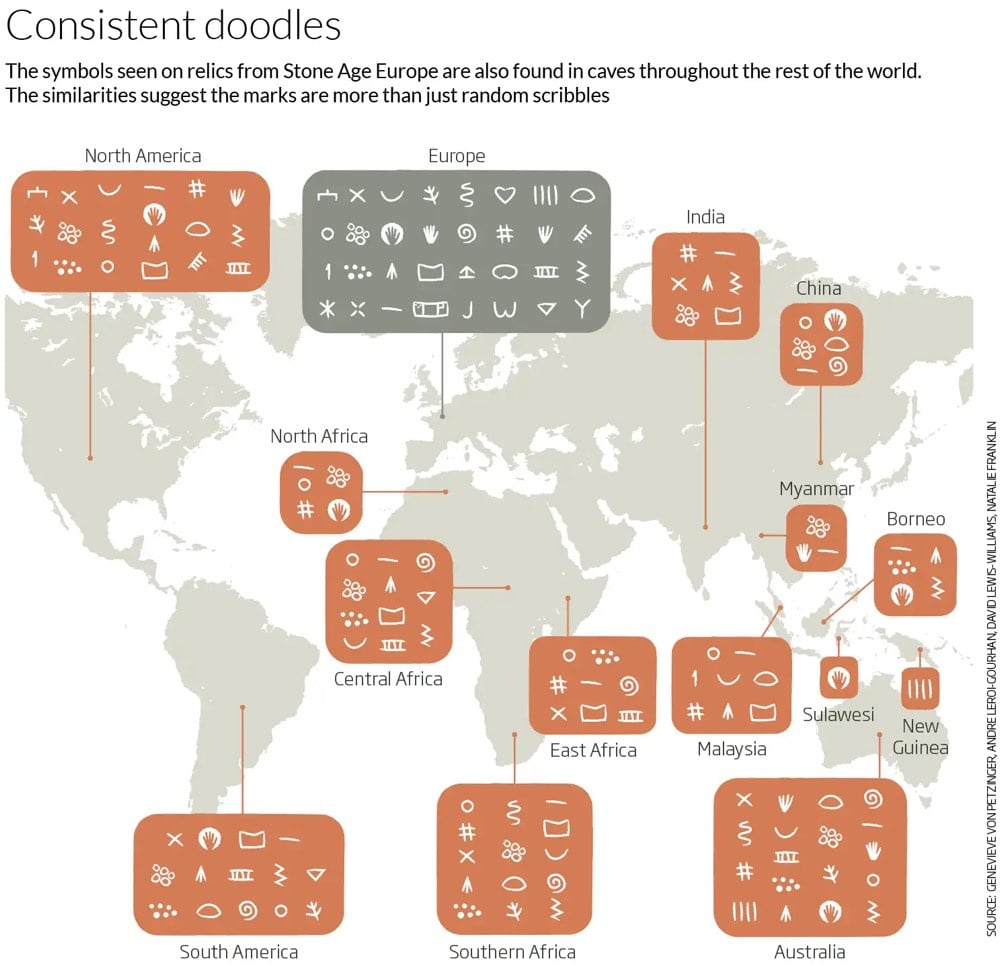
The research also reveals that modern humans were using two-thirds of these signs when they first settled in Europe, which creates another intriguing possibility. “This does not look like the start-up phase of a brand-new invention,” von Petzinger writes in her recently published book, The First Signs: Unlocking the mysteries of the world’s oldest symbols (Simon and Schuster). In other words, when modern humans first started moving into Europe from Africa, they must have brought a mental dictionary of symbols with them.
That fits well with the discovery of a 70,000-year-old block of ochre etched with cross-hatching in Blombos cave in South Africa. And when von Petzinger looked through archaeology papers for mentions or illustrations of symbols in cave art outside Europe, she found that many of her 32 signs were used around the world. There is even tantalising evidence that an earlier human, Homo erectus, deliberately etched a zigzag on a shell on Java some 500,000 years ago. “The ability of humans to produce a system of signs is clearly not something that starts 40,000 years ago. This capacity goes back at least 100,000 years,” says Francesco d’Errico from the University of Bordeaux, France.
Nonetheless, something quite special seems to have happened in ice age Europe. In various caves, von Petzinger frequently found certain symbols used together. For instance, starting 40,000 years ago, hand stencils are often found alongside dots. Later, between 28,000 and 22,000 years ago, they are joined by thumb stencils and finger fluting — parallel lines created by dragging fingers through soft cave deposits.
Von Petzinger lays out the results of her work in a 2016 book called The First Signs: Unlocking the Mysteries of the World’s Oldest Symbols and in a TED Talk from 2015:
It’s not writing (because the symbols don’t appear to be capable of representing the full range of spoken language) and it’s not an alphabet, but it’s definitely an intriguing something. (via open culture)
In an essay adapted from his forthcoming book, The Goodness Paradox: The Strange Relationship Between Virtue and Violence in Human Evolution, anthropologist Richard Wrangham says that before humans domesticated dogs, cows, and pigs, we domesticated ourselves.
No other mammal has the brainpower to organize capital punishment. When language became sufficiently sophisticated, our ancestors’ ability to conspire led not only to a more peaceful species but also to a new kind of hierarchy. No longer would human groups be ruled by the physical force of an individual. The emergence of capital punishment meant that henceforth, anyone aspiring to be an alpha couldn’t get away with just being a fighter. He had to be a politician, too.
The result of generations of such selective pressure is that human beings are best understood as an animal species that has been domesticated — like dogs, horses or chickens. Recent archaeological evidence suggests that humans became increasingly docile and less reactively aggressive around the time of becoming Homo sapiens, a process that started about 300,000 years ago.
Markers of domestication show up in the fossil records of domesticated animals and they are present in human fossils too:
Dr. Leach listed four characteristics of the bones of domesticated animals: They mainly have smaller bodies than their wild ancestors; their faces tend to be shorter and don’t project as far forward; the differences between males and females are less highly developed; and they tend to have smaller brain cavities (and thus brains). As it turns out, all of these changes appear in human fossils. Even our brain size fits the pattern: While the human brain grew steadily over the last two million years, that trajectory took a sudden turn about 30,000 years ago, when brains started to become smaller.
The essay is from the WSJ and might be paywalled…here’s an article from Big Think early last year that goes over some of the same material. I couldn’t find a definitive paper that Wrangham has written on the topic…feel free to browse through his published papers on Google Scholar.
Brain Pickings is surfacing some gems from their archives in honor of what would have been Ursula Le Guin’s 89th birthday. The novelist, poet, and essayist died in January.

Le Guin on conversation:
“Words are events, they do things, change things. They transform both speaker and hearer; they feed energy back and forth and amplify it. They feed understanding or emotion back and forth and amplify it.”
Le Guin on libraries:
“Knowledge sets us free, art sets us free. A great library is freedom.”
Le Guin on time (hear astrophysicist Janna Levin read the full poem):
Time is being and being
time, it is all one thing,
the shining, the seeing,
the dark abounding.
Le Guin on loyalty:
To break a promise is to deny the reality of the past; therefore it is to deny the hope of a real future. If time and reason are functions of each other, if we are creatures of time, then we had better know it, and try to make the best of it. To act responsibly.
Le Guin on the environment:
“To use the world well, to be able to stop wasting it and our time in it, we need to relearn our being in it.”
Wow! Genetic analysis of a human bone fragment found in Siberia reveals that her parents belonged to two different groups of humans: her father was Denisovan and her mother Neanderthal.
A female who died around 90,000 years ago was half Neanderthal and half Denisovan, according to genome analysis of a bone discovered in a Siberian cave. This is the first time scientists have identified an ancient individual whose parents belonged to distinct human groups. The findings were published on 22 August in Nature1.
“To find a first-generation person of mixed ancestry from these groups is absolutely extraordinary,” says population geneticist Pontus Skoglund at the Francis Crick Institute in London. “It’s really great science coupled with a little bit of luck.”
Luck is right…what a needle in a haystack.

I love reading and rereading about the origin of humanity. I love that it’s not settled science: we’re still making new discoveries about when humans first left Africa, how and when we interbred with other hominins, and what makes us human in the first place. It’s just the coolest story, which is also every story.
Popular Science has a really nice new primer on the current state of research on early humanity. Embedded in it is a series of studies on tool use by early humans in Kenya that caught my attention. Basically, the tools got smaller and more portable, the materials used were more exotic (sourced from farther away), and they were decorated with pigments.
“That’s where there’s a similarity to technology in recent times; things start out big and clunky and they get small and portable,” says Richard Potts, head of the Smithsonian’s Human Origins Program and a co-author of the papers. “The history [of] technology has been the same ever since.”
I wonder, though, if all three vectors hold up across history: greater portability, greater range of materials, and greater decorative value.
I suspect the null hypothesis would be that technologies that work tend to stay roughly the same over time. (For most of early human history, our tools didn’t change up that much, which is exactly why the burst of activity in east Africa is noteworthy.) You need something to shake things up: either sudden availability of new materials, or a deprivation of old ones (like the Bronze Age collapse, which eventually helped usher in the Iron Age).
As it turns out, that’s exactly what happened.
“One of the things we see is that around 500,000 years ago in the rift valley of southern Kenya, all hell breaks loose. There’s faulting that occurs, and earthquake activity was moving the landscape up and down. The climate record shows there is a stronger degree of oscillation between wet and dry. That would have disrupted the predictability of food and water, for those early people,” Potts says. “It’s exactly under those conditions that almost any organism—but especially a hunter-gatherer human, even an early one—would begin to expand geography of obtaining food or obtaining resources. It’s under those conditions that you begin to run into other groups of hominins and you become aware of resources beyond your usual boundaries.”
This animation shows how humans have spread and organized themselves across the Earth over the past 200,000 years. The time lapse starts with the migration of homo sapiens out of sub-Saharan Africa 200,000 years ago, with a few thousand years passing every second. As the agricultural revolution gets underway and the pace of civilization quickens, the animation slows down to hundreds of years per second and eventually, as it nears modern times, 1-2 years per second.
See also time lapse animations of the history of Europe from the fall of Rome to modern times and human population through time. (via open culture)
DNA analysis of remains found at archaeological sites is changing the story of how humans populated the Americas. Analysis of a pair of infants found in Alaska suggests that only one wave of humans settled the Americas around 20,900 years ago.
Genetic evidence published today in Nature is the first to show that all Native Americans can trace their ancestry back to a single migration event that happened at the tail-end of the last Ice Age. The evidence — gleaned from the full genomic profile of the six-week-old girl and the partial genomic remains of another infant — suggests the continent’s first settlers arrived in a single migratory wave around 20,900 years ago. But this population then split into two groups — one group that would go on to become the ancestors of all Native North Americans, and another that would venture no further than Alaska — a previously unknown population of ancient North Americans now dubbed the “Ancient Beringians.”
(via clive thompson)
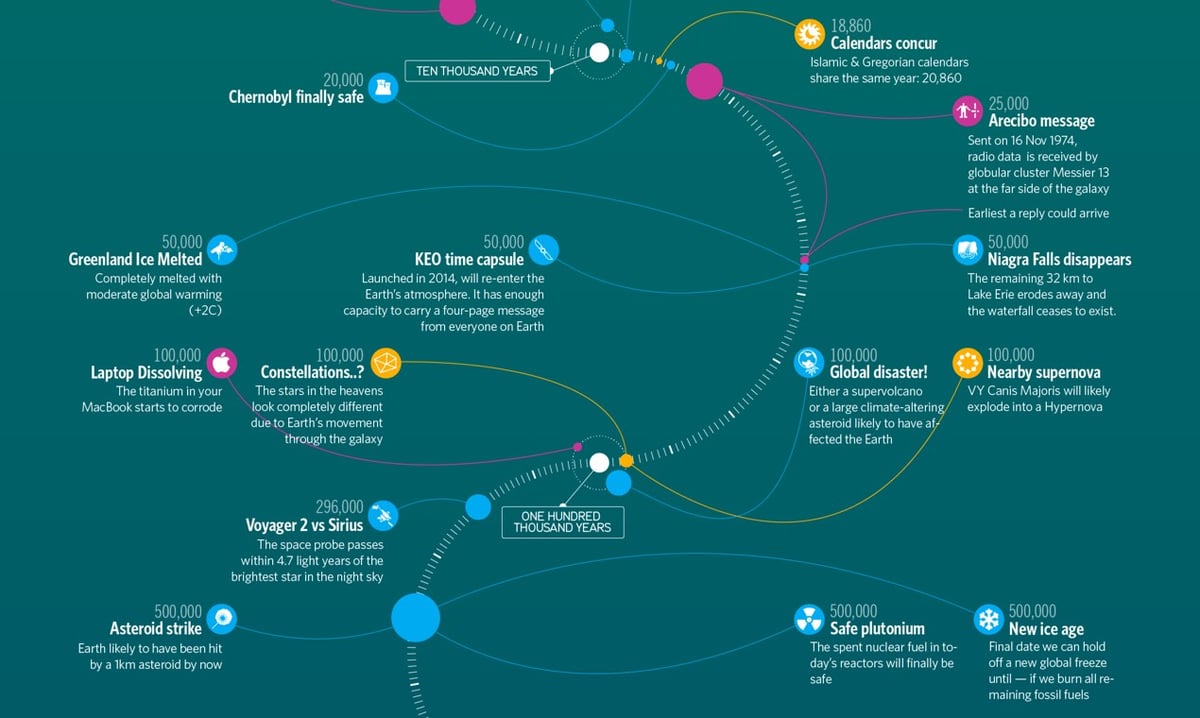
Timeline of the far future is one of my favorite pages on Wikipedia. It details what might happen to humanity, human artifacts, the Earth, the solar system, and the Universe from 10,000 years from now until long past the heat death of the Universe. Information is Beautiful has made a lovely infographic of the timeline.
Reading through the timeline is a glorious way to spend time…here are a few favorites I noticed this time around as well as some from my first post.
August 20, 10,663: “A simultaneous total solar eclipse and transit of Mercury.”
20,000 years: “The Chernobyl Exclusion Zone, the 1,000 sq mi area of Ukraine and Belarus left deserted by the 1986 Chernobyl disaster, becomes safe for human life.”
296,000 years: “Voyager 2 passes within 4.3 light-years of Sirius, the brightest star in the night sky.”
1 million years: “Highest estimated time until the red supergiant star Betelgeuse explodes in a supernova. The explosion is expected to be easily visible in daylight.”
1 million years: “On the Moon, Neil Armstrong’s ‘one small step’ footprint at Tranquility Base will erode by this time, along with those left by all twelve Apollo moonwalkers, due to the accumulated effects of space weathering.”
15.7 million: “Half-life of iodine-129, the most durable long-lived fission product in uranium-derived nuclear waste.”
100 million years: “Future archaeologists should be able to identify an ‘Urban Stratum’ of fossilized great coastal cities, mostly through the remains of underground infrastructure such as building foundations and utility tunnels.”
1 billion years: “Estimated lifespan of the two Voyager Golden Records, before the information stored on them is rendered unrecoverable.”
4 billion years: “Median point by which the Andromeda Galaxy will have collided with the Milky Way, which will thereafter merge to form a galaxy dubbed ‘Milkomeda’.”
7.59 billion years: The Earth and Moon are very likely destroyed by falling into the Sun, just before the Sun reaches the tip of its red giant phase and its maximum radius of 256 times the present-day value. Before the final collision, the Moon possibly spirals below Earth’s Roche limit, breaking into a ring of debris, most of which falls to the Earth’s surface.
100 billion years: “The Universe’s expansion causes all galaxies beyond the Milky Way’s Local Group to disappear beyond the cosmic light horizon, removing them from the observable universe.”
The prevailing theory of how the Americas were settled has been than human hunters followed big game across the ice-free land bridge between North America and Asia around 13,000 years ago. These are the Clovis people you may have learned about in school. But evidence is mounting that the first humans to settle the Americas came down the Pacific Coast somewhat earlier than that.
The Cedros Island sites add to a small but growing list that supports a once-heretical view of the peopling of the Americas. Whereas archaeologists once thought that the earliest arrivals wandered into the continent through a gap in the ice age glaciers covering Canada, most researchers today think the first inhabitants came by sea. In this view, maritime explorers voyaged by boat out of Beringia — the ancient land now partially submerged under the waters of the Bering Strait — about 16,000 years ago and quickly moved down the Pacific coast, reaching Chile by at least 14,500 years ago.
Part of the problem in confirming this hypothesis is that the rise in sea level that accompanied the melting of the glaciers (a 120-meter rise globally) submerged likely settlement sites, trapping archeological evidence under hundreds of feet of ocean. (via @CharlesCMann)

The oldest known fossils of homo sapiens have been found in Morocco. The bones date back to ~300,000 years ago, more than 100,000 years earlier than previous fossils found. Here’s Carl Zimmer reporting for the NY Times about the paper in Nature:
Dating back roughly 300,000 years, the bones indicate that mankind evolved earlier than had been known, experts say, and open a new window on our origins.
The fossils also show that early Homo sapiens had faces much like our own, although their brains differed in fundamental ways.
Until now, the oldest fossils of our species, found in Ethiopia, dated back just 195,000 years. The new fossils suggest our species evolved across Africa.
“We did not evolve from a single cradle of mankind somewhere in East Africa,” said Phillipp Gunz, a paleoanthropologist at the Max Planck Institute for Evolutionary Anthropology in Liepzig, Germany, and a co-author of two new studies on the fossils, published in the journal Nature.
The previous oldest fossils were found clear across the continent in Ethiopia, in eastern Africa. From a New Yorker article on the discovery:
And the specimens in question were found not in East Africa, which has become synonymous with a sort of paleoanthropological Garden of Eden, but clear on the other side of the continent — and the Sahara — in Morocco. “We’re not claiming that Morocco is the cradle of modern humankind,” the lead author, Jean-Jacques Hublin, of the Max Planck Institute for Evolutionary Anthropology, said at a press conference yesterday. Rather, he added, our emergence as a species was pan-African. “There is no Garden of Eden in Africa — or if there is, it’s Africa,” Hublin said. “The Garden of Eden is the size of Africa.”

In a 1959 talk at Caltech titled There’s Plenty of Room at the Bottom, Richard Feynman outlined a new field of study in physics: nanotechnology. He argued there was much to be explored in the realm of the very small — information storage, more powerful microscopes, biological research, computing — and that that exploration would be enormously useful.
I would like to describe a field, in which little has been done, but in which an enormous amount can be done in principle. This field is not quite the same as the others in that it will not tell us much of fundamental physics (in the sense of, “What are the strange particles?”) but it is more like solid-state physics in the sense that it might tell us much of great interest about the strange phenomena that occur in complex situations. Furthermore, a point that is most important is that it would have an enormous number of technical applications.
In a reaction to Elon Musk’s plan to colonize Mars, David Galbraith suggests there might be plenty of room at the bottom for human civilization as well. Don’t colonize Mars, miniaturize humanity. Create nano sapiens.
If we think of this as a design problem, there is a much better solution. Instead of expanding our environment to another planet at massive cost, why wouldn’t we miniaturise ourselves so we can expand without increasing our habitat or energy requirements, but still maintain our ability to create culture and knowledge, via information exchange.
The history of information technology and the preservation of Moore’s law has been driven by exactly this phenomenon of miniaturization. So why shouldn’t the same apply to the post technological evolution of humankind as it approaches the hypothetical ‘singularity’ and the potential ability for us to be physically embodied in silicon rather than carbon form.
When humans get smaller, the world and its resources get bigger. We’d live in smaller houses, drive smaller cars that use less gas, eat less food, etc. It wouldn’t even take much to realize gains from a Honey, I Shrunk Humanity scheme: because of scaling laws, a height/weight proportional human maxing out at 3 feet tall would not use half the resources of a 6-foot human but would use somewhere between 1/4 and 1/8 of the resources, depending on whether the resource varied with volume or surface area. Six-inch-tall humans would potentially use 1728 times fewer resources.1
Galbraith also speculates about nano aliens as a possible explanation for the Fermi paradox:
Interestingly, the same rules of energy use and distance between planets and stars would apply to any extraterrestrial aliens, so one possible explanation for the Fermi paradox is that we all get smaller and less visible as we get more technologically advanced. Rather than favoring interstellar colonization with its mind boggling distances which are impossible to communicate across within the lifetimes of individuals (and therefore impossible to hold together in any meaningful way as a civilization) perhaps advanced civilizations stick to their home planets but just get more efficient to be sustainable.
Humans are explorers. Curiosity about new worlds and ideas is one of humanity’s defining traits. One of the most striking things about the Eames’ Powers of Ten video is how similar outer space and inner space look — vast distances punctuated occasionally by matter. What if, instead of using more and more energy exploring planets, stars, and galaxies across larger and larger distances (the first half of the Eames’ video), we went the other way and focused on using less energy to explore cells, molecules, and atoms across smaller and smaller distances. It wouldn’t be so much giving up human space exploration as it would be exchanging it for a very similar and more accessible exploration of the molecular and atomic realm. There is, after all, plenty of room down there.
Update: I knew the responses to this would be good. Galbraith’s idea has a name: the transcension hypothesis, formulated by the aptly named John Smart. Jason Silva explains in this video:
The transcension hypothesis proposes that a universal process of evolutionary development guides all sufficiently advanced civilizations into what may be called “inner space,” a computationally optimal domain of increasingly dense, productive, miniaturized, and efficient scales of space, time, energy, and matter, and eventually, to a black-hole-like destination. Transcension as a developmental destiny might also contribute to the solution to the Fermi paradox, the question of why we have not seen evidence of or received beacons from intelligent civilizations.
Before we get there, however, there are a few challenges we need to overcome, as Joe Hanson explains in The Small Problem With Shrinking Ourselves:
As it often seems in such matters, science follows science fiction here. In Kurt Vonnegut’s Slapstick (Amazon), the Chinese miniaturize themselves in response to the Earth’s decreasing resources.
In the meantime, Western civilization is nearing collapse as oil runs out, and the Chinese are making vast leaps forward by miniaturizing themselves and training groups of hundreds to think as one. Eventually, the miniaturization proceeds to the point that they become so small that they cause a plague among those who accidentally inhale them, ultimately destroying Western civilization beyond repair.
Blood Music by Greg Bear (Amazon) has a nano-civilization theme:
Through infection, conversion and assimilation of humans and other organisms the cells eventually aggregate most of the biosphere of North America into a region seven thousand kilometres wide. This civilization, which incorporates both the evolved noocytes and recently assimilated conventional humans, is eventually forced to abandon the normal plane of existence in favor of one in which thought does not require a physical substrate.
James Blish’s short story Surface Tension tells the tale of microscopic human colonists. (via @harryh, @mariosaldana, @EndlessForms, @vanjacosic, @chumunculus)
Update: For some years, director Alexander Payne has been working on a film called Downsizing:
“Downsizing,” after all, starts off in Norway and takes place in a not-too-distant future where humans are now able to shrink themselves to 1/8 their size as a means to battle over-consumption and the rapid depletion of earth’s natural resources, thanks to enlightened hippie-like Scandinavian scientists. “Smalls” get small, then become members of small cities (the main characters moves to a city called Leisureland) protected by large nets (keeps the bugs out) and built like Disney’s Celebration Town (all planned, all pre-fabricated). Small people cash-in their savings and retire small; 1 big dollar equals 500 small dollars. Smalls live on less food, less land, and produce less trash. As the story progresses, Americans are free to get small, but in Europe, where resources are beginning to truly run out, legislation arises suggesting 40% of the population get shrunk (whether they like it or not). For the big, the world grows smaller and scarier; for the small, the world grows bigger and scarier.
Word is that Matt Damon will play the lead role. Mr. Payne, consider a title change to “Nano Sapiens”? (via @stephenosberg)
Photo by Poy.
In Sapiens (which I enjoyed and recommend), Yuval Noah Harari gave us a “brief history of humankind”. In his upcoming Homo Deus, Harari turns “his focus toward humanity’s future, and our quest to upgrade humans into gods”.
Over the past century humankind has managed to do the impossible and rein in famine, plague, and war. This may seem hard to accept, but, as Harari explains in his trademark style — thorough, yet riveting — famine, plague and war have been transformed from incomprehensible and uncontrollable forces of nature into manageable challenges. For the first time ever, more people die from eating too much than from eating too little; more people die from old age than from infectious diseases; and more people commit suicide than are killed by soldiers, terrorists and criminals put together. The average American is a thousand times more likely to die from binging at McDonalds than from being blown up by Al Qaeda.
What then will replace famine, plague, and war at the top of the human agenda? As the self-made gods of planet earth, what destinies will we set ourselves, and which quests will we undertake? Homo Deus explores the projects, dreams and nightmares that will shape the twenty-first century — from overcoming death to creating artificial life. It asks the fundamental questions: Where do we go from here? And how will we protect this fragile world from our own destructive powers? This is the next stage of evolution. This is Homo Deus.
How old are different parts of our bodies? Does anything stick around the entire time? The hair on our bodies lasts only a few years. Fingernails are fully replaced every six months. Your skin lasts 2-4 weeks. Even your blood and bones regenerate every so often. There’s at least one part of your body with lasts the whole time you’re alive, which I found somewhat surprising. See the ship of Theseus paradox.
The ship wherein Theseus and the youth of Athens returned from Crete had thirty oars, and was preserved by the Athenians down even to the time of Demetrius Phalereus, for they took away the old planks as they decayed, putting in new and stronger timber in their places, in so much that this ship became a standing example among the philosophers, for the logical question of things that grow; one side holding that the ship remained the same, and the other contending that it was not the same.
How do we know the lifespans of different cells in the body? Carbon-14 levels from nuclear testing done in the 50s and 60s.
Analysis of growth rings from pine trees in Sweden shows that the proliferation of atomic tests in the 1950s and 1960s led to an explosion in levels of atmospheric carbon 14. Now, Jonas Frisen and colleagues at the Karolinska Institute in Stockholm have taken advantage of this spike in C14 to devise a method to date the birth of human cells. Because this test can be used retrospectively, unlike many of the current methods used to detect cell proliferation, and because it does not require the ingestion of a radioactive or chemical tracer, the method can be readily applied to both in vivo and postmortem samples of human tissues.
Kurzgesagt gives us a short tour of human history, from the six different species of human that existed 100,000 years ago to the present. If you found that interesting and want more detail, you should read Sapiens…Kurzgesagt used it as a major reference here.
Most books about the history of humanity pursue either a historical or a biological approach, but Dr. Yuval Noah Harari breaks the mold with this highly original book that begins about 70,000 years ago with the appearance of modern cognition. From examining the role evolving humans have played in the global ecosystem to charting the rise of empires, Sapiens integrates history and science to reconsider accepted narratives, connect past developments with contemporary concerns, and examine specific events within the context of larger ideas.
Kurzgesagt and CGPGrey collaborated on a pair of videos about the self. The first video considers the human being as a collection of cells. How many of those cells can you take away before you stop being you? And does that question even make sense? The second video notes that if you sever the connection between the two halves of the human brain, they will each seemingly continue to operate as separate entities. But which of those entities is you? Are there two yous?
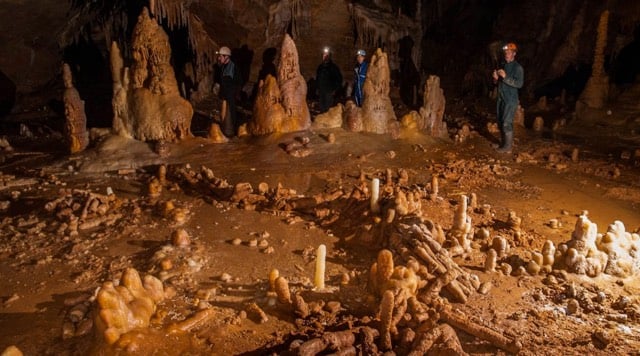
In the 90s, Bruniquel Cave was discovered to have a chamber containing an interesting human-built structure made from broken stalagmites. Carbon dating of a burnt bear bone within the chamber put the age of the activity at 47,600 years ago, smack dab in the Neanderthal era in that area. But recently, after a lull in research about these cave structures, analysis of uranium levels in the broken stalagmites resulted in a much older date for the construction: 176,500 years ago.
Nor is it clear how the Neanderthals made the structures. Verheyden says it couldn’t have been one lone artisan, toiling away in the dark. Most likely, there was a team, and a technically skilled one at that. They broke rocks deliberately, and arranged them precisely. They used fire, too. More than 120 fragments have red and black streaks that aren’t found elsewhere in the chamber or the cave beyond. They were the result of deliberately applied heat, at intensities strong enough to occasionally crack the rock. “The Neanderthal group responsible for these constructions had a level of social organization that was more complex than previously thought,” the team writes.
There are some things that humans don’t need to survive anymore still hanging around on our bodies, including unnecessary arm muscles and vestigial tail bones.
From the landmark science series Cosmos, Carl Sagan narrates the evolution of humans from the first cells billions of years ago.
There’s a new (extinct) hominin on the block (in a cave system in Africa): Homo naledi.
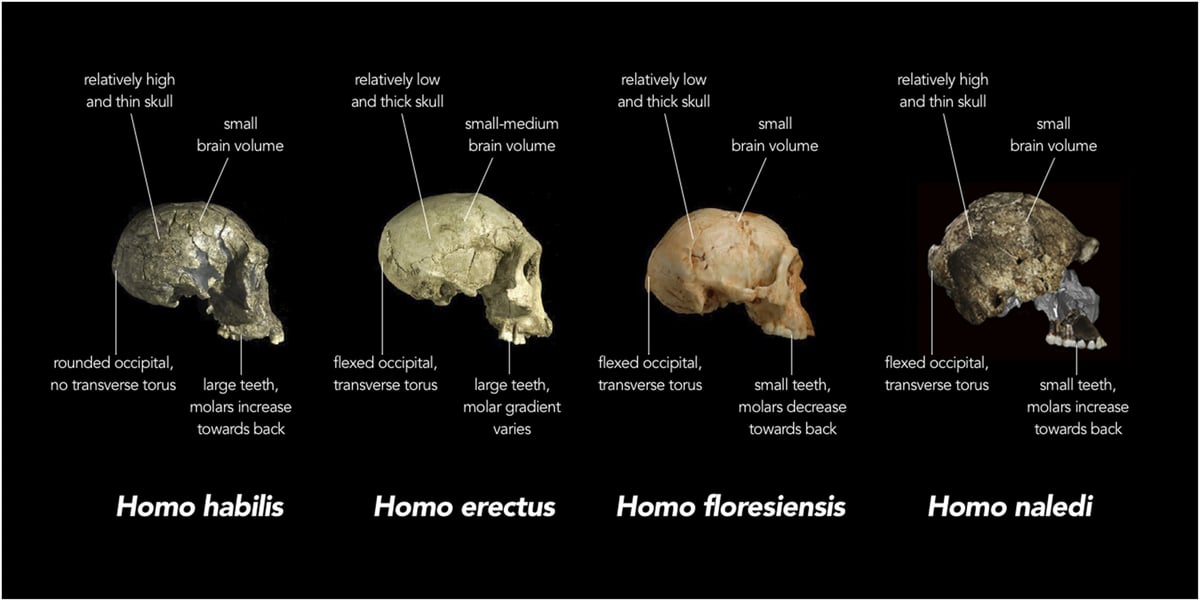
Basically, Homo naledi had humanlike hands, legs, and feet, but tiny little australopithecine skulls, i.e., brains.
And, there are a lot of them, fossil-wise: “Representing at least 15 individuals with most skeletal elements repeated multiple times, this is the largest assemblage of a single species of hominins yet discovered in Africa.”
But we don’t yet know exactly how long ago they lived: maybe two million years ago, when the Homo genus emerged, or as late as a hundred thousand years ago, when it contracted to, well, us. In an accompanying article, Chris Stringer gets a little testy about it.
Frustratingly, the rich and informative H. naledi material remains undated. Given that this hominin material could conceivably even date within the last 100,000 years, I am puzzled by the apparent lack of attempts to estimate its age. This could have been achieved directly via radiocarbon dating (even if only to test whether the material lies beyond the effective range of that method) or indirectly based on ancient DNA samples. For example, after ancient DNA was successfully recovered from the Sima de los Huesos fossils, it was used to date them to about 400,000 years old (Meyer et al., 2014). Moreover, tests on even small fragments of bone and tooth enamel could have narrowed down the possible age range and at least ruled out either a very ancient or very young age (Grün, 2006).
As Dan Cohen points out, this discovery is also unusual in that it didn’t make its splash at Science or Nature, but eLife, a free, open-access journal. Study leader Lee Berger tells Buzzfeed the article was rejected by Nature because the authors couldn’t meet the mag’s demands to squeeze the whole thing into 2500 words. Well, whatever the reason for going open-access, we of the science-following-but-not-institutional-password-having-audience approve.
Update: Ed Yong has a terrific account of the discovery, with a ripping narrative about the caving team’s expedition and an intelligent analysis of the new species and its implications. Well worth reading.
Up until very recently, humans were thought to be the only animals who made and used stone tools, an era in human development that began roughly 3.3 million years ago. But according to this piece at the BBC, some chimpanzees and monkeys in various places around the globe have been using primitive stone tools for hundreds or even thousands of years.
Boesch and his colleagues had previously studied modern chimpanzee stone tool culture in the region. This research revealed that the chimpanzees have an idiosyncratic way of choosing and using their tools.
For instance, chimpanzees will often deliberately opt for particularly large and heavy stone hammers, between 1kg and 9kg, while humans prefer to use stones that weigh 1kg or less. Many of the 4300-year-old stone tools weighed more than 1kg, suggesting they were used by chimpanzees.
Chimpanzees also use their stone tools to crack open certain types of nuts that humans don’t eat. Starch residues on some of the ancient tools came from these nuts.
Together, these findings led to an obvious conclusion: chimpanzees have been using stone tools in the rainforests of Ivory Coast for at least 4300 years.
My answer to that question, having read nothing about it beyond this article, is “it sounds like a bit of a stretch, but what an interesting thing to think about”. This theory about how humans and wolves (and later, dogs) teamed up to outcompete Neanderthals for food is being forwarded by anthropologist Pat Shipman, author of the new book, The Invaders: How Humans and Their Dogs Drove Neanderthals to Extinction.
Modern humans formed an alliance with wolves soon after we entered Europe, argues Shipman. We tamed some and the dogs we bred from them were then used to chase prey and to drive off rival carnivores, including lions and leopards, that tried to steal the meat.
“Early wolf-dogs would have tracked and harassed animals like elk and bison and would have hounded them until they tired,” said Shipman. “Then humans would have killed them with spears or bows and arrows.
“This meant the dogs did not need to approach these large cornered animals to finish them off — often the most dangerous part of a hunt — while humans didn’t have to expend energy in tracking and wearing down prey. Dogs would have done that. Then we shared the meat. It was a win-win situation.”
At that time, the European landscape was dominated by mammoths, rhinos, bison and several other large herbivores. Both Neanderthals and modern humans hunted them with spears and possibly bows and arrows. It would have been a tricky business made worse by competition from lions, leopards, hyenas, and other carnivores, including wolves.
“Even if you brought down a bison, within minutes other carnivores would have been lining up to attack you and steal your prey,” said Shipman. The answer, she argues, was the creation of the human-wolf alliance. Previously they separately hunted the same creatures, with mixed results. Once they joined forces, they dominated the food chain in prehistoric Europe — though this success came at a price for other species. First Neanderthals disappeared to be followed by lions, mammoths, hyenas and bison over the succeeding millennia. Humans and hunting dogs were, and still are, a deadly combination, says Shipman.
(via @robinsloan)

A shell found in the 1890s was recently found to have what scientists are calling the world’s oldest “abstract marking”, a 500,000-year-old etching made by Homo erectus, an extinct ancestor of modern humans.
Close inspection under the microscope suggested that the engraving was intentional. The weathering patterns of the grooves, each of which is about 1 centimetre long, show signs of significant ageing, and there are no gaps between turns, indicating that the maker paid attention to detail. He or she probably made the engraving on a fresh shell, and the newly made etching would have resembled white lines on a dark canvas, Joordens’ team notes. Sand grains still embedded in the shell were dated to around 500,000 years ago.
A new analysis of the genomes of two extinct human species (Neanderthals and Denisovans) shows more clearly that they interbred with our species of human, contributing 2-4% of our modern genomes in some cases.
“What it begins to suggest is that we’re looking at a Lord of the Rings-type world — that there were many hominid populations,” says Mark Thomas, an evolutionary geneticist at University College London who was at the meeting but was not involved in the work.
But, more interestingly, the analysis also detected the Denisovans also bred with an as-yet-unknown species of humans.
The Denisovan genome indicates that the population got around: Reich said at the meeting that as well as interbreeding with the ancestors of Oceanians, they also bred with Neanderthals and the ancestors of modern humans in China and other parts of East Asia. Most surprisingly, Reich said, the genomes indicate that Denisovans interbred with yet another extinct population of archaic humans that lived in Asia more than 30,000 years ago — one that is neither human nor Neanderthal.
Is this the first time a new human species has been discovered through DNA evidence alone?

Trevor Paglen speculates that human civilization’s longest lasting monuments will be the satellites in geostationary orbits around the Earth.
Humanity’s longest lasting remnants are found among the stars. Over the last fifty years, hundreds of satellites have been launched into geosynchronous orbits, forming a ring of machines 36,000 kilometers from earth. Thousands of times further away than most other satellites, geostationary spacecraft remain locked as man-made moons in perpetual orbit long after their operational lifetimes. Geosynchronous spacecraft will be among civilization’s most enduring remnants, quietly circling earth until the earth is no more.
Geoff Manaugh attended a lecture of Paglen’s, where Paglen suggested a possible discoverer of these artifacts:
Billions of years from now, he began to narrate, long after city lights and the humans who made them have disappeared from the Earth, other intelligent species might eventually begin to see traces of humanity’s long-since erased presence on the planet.
Consider deep-sea squid, Paglen suggested, who would have billions of years to continue developing and perfecting their incredible eyesight, a sensory skill perfect for peering through the otherwise impenetrable darkness of the oceans — yet also an eyesight that could let them gaze out at the stars in deep space.
Perhaps, Paglen speculated, these future deep-sea squid with their extraordinary powers of sight honed precisely for focusing on tiny points of light in the darkness might drift up to the surface of the ocean on calm nights to look upward at the stars, viewing a scene that will have rearranged into whole new constellations since the last time humans walked the Earth.
And, there, the squid might notice something.
Note: Illustration by Chris Piascik…prints & more are available.
The latest word on Homo floresiensis, the potential new species of hobbit-like humans discovered ten years ago in Indonesia, concerns a pair of papers which argue the single specimen found is actually a regular human with Down syndrome.
Now, the debate has reignited with two new papers published this week by a team of researchers from Penn State and other institutions. In one of those papers, they argue that the Flores skull is not a new species, but instead represents an ancient person with Down syndrome.
The researchers also point out, in the second paper, that the original report on the bones seemed to have exaggerated the skull’s diminutive size. Cranial measurements and features, along with shorter thigh bones, the team found, all correspond with modern manifestations of Down syndrome. “The difference is significant, and the revised figure falls in the range predicted for a modern human with Down syndrome from the same geographic region,” they say in a statement.
(via @daveg)
Recent discoveries in Brazil that humans were present in South America as early as 22,000 years ago has contributed to the growing belief that the Clovis First hypothesis is wrong.
Researchers here say they have unearthed stone tools proving that humans reached what is now northeast Brazil as early as 22,000 years ago. Their discovery adds to the growing body of research upending a prevailing belief of 20th-century archaeology in the United States known as the Clovis model, which holds that people first arrived in the Americas from Asia about 13,000 years ago.
“If they’re right, and there’s a great possibility that they are, that will change everything we know about the settlement of the Americas,” said Walter Neves, an evolutionary anthropologist at the University of Sao Paulo whose own analysis of an 11,000-year-old skull in Brazil implies that some ancient Americans resembled aboriginal Australians more than they did Asians.
Up and down the Americas, scholars say that the peopling of lands empty of humankind may have been far more complex than long believed. The radiocarbon dating of spear points found in the 1920s near Clovis, N.M., placed the arrival of big-game hunters across the Bering Strait about 13,000 years ago, long forming the basis of when humans were believed to have arrived in the Americas.
More recently, numerous findings have challenged that narrative. In Texas, archaeologists said in 2011 that they had found projectile points showing that hunter-gatherers had reached another site, known as Buttermilk Creek, as early as 15,500 years ago. Similarly, analysis of human DNA found at an Oregon cave determined that humans were there 14,000 years ago.
Older posts





Socials & More