Entries for November 2019
In the Guardian, former astrologer Felicity Carter writes about how fortune telling really works and why she had to quit.
I also learned that intelligence and education do not protect against superstition. Many customers were stockbrokers, advertising executives or politicians, dealing with issues whose outcomes couldn’t be controlled. It’s uncertainty that drives people into woo, not stupidity, so I’m not surprised millennials are into astrology. They grew up with Harry Potter and graduated into a precarious economy, making them the ideal customers.
What broke the spell for me was, oddly, people swearing by my gift. Some repeat customers claimed I’d made very specific predictions, of a kind I never made. It dawned on me that my readings were a co-creation — I would weave a story and, later, the customer’s memory would add new elements. I got to test this theory after a friend raved about a reading she’d had, full of astonishingly accurate predictions. She had a tape of the session, so I asked her to play it.
The clairvoyant had said none of the things my friend claimed. Not a single one. My friend’s imagination had done all the work.
The last paragraph, on VC-funded astrology apps, was particularly interesting. I’m reading Yuval Noah Harari’s 21 Lessons for the 21st Century right now and one of his main points is that AI + biotech will combine to produce an unprecedented revolution in human society.
For we are now at the confluence of two immense revolutions. Biologists are deciphering the mysteries of the human body, and in particular of the brain and human feelings. At the same time computer scientists are giving us unprecedented data-processing power. When the biotech revolution merges with the infotech revolution, it will produce Big Data algorithms that can monitor and understand my feelings much better than I can, and then authority will probably shift from humans to computers. My illusion of free will is likely to disintegrate as I daily encounter institutions, corporations, and government agencies that understand and manipulate what was until now my inaccessible inner realm.
I hadn’t thought that astrology apps could be a major pathway to AI’s control of humanity, but Carter’s assertion makes sense.
In The Role of the Artist in the Age of Trump, playwright Lin-Manuel Miranda reflects on how truth inherent in art means that “all art is political”.
At the end of the day, our job as artists is to tell the truth as we see it. If telling the truth is an inherently political act, so be it. Times may change and politics may change, but if we do our best to tell the truth as specifically as possible, time will reveal those truths and reverberate beyond the era in which we created them. We keep revisiting Shakespeare’s Macbeth because ruthless political ambition does not belong to any particular era. We keep listening to Public Enemy because systemic racism continues to rain tragedy on communities of color. We read Orwell’s 1984 and shiver at its diagnosis of doublethink, which we see coming out of the White House at this moment.
In a 1969 piece, Kurt Vonnegut asserted that art is an early warning system for society:
I sometimes wondered what the use of any of the arts was. The best thing I could come up with was what I call the canary in the coal mine theory of the arts. This theory says that artists are useful to society because they are so sensitive. They are super-sensitive. They keel over like canaries in poison coal mines long before more robust types realize that there is any danger whatsoever.
While not specifically about art, here’s a bit of what I wrote in a January 2017 post, How to Productive in Terrible Times.
I’ve always had difficulty believing that the work I do here is in some way important to the world and since the election, that feeling has blossomed into a profound guilt-ridden anxiety monster. I mean, who in the actual fuck cares about the new Blade Runner movie or how stamps are designed (or Jesus, the blurry ham) when our government is poised for a turn towards corruption and authoritarianism?
I have come up with some reasons why my work here does matter, at least to me, but I’m not sure they’re good ones. In the meantime, I’m pressing on because my family and I rely on my efforts here and because I hope that in some small way my work, as Webb writes, “is capable of enabling righteous acts”.
(via laura olin)
If you’re having withdrawals from Succession, perhaps this will help a little. A fan created these title sequences of iconic TV shows with the pulsing Succession theme song dubbed over them. The Wire, The Simpsons, and Mad Men are particular favorites of mine:
The Succession theme is to title sequences like what “Christ, what an asshole!” is to New Yorker cartoon captions — it even fits Happy Days (mostly):
If you’d like to try your hand at this, the theme song is available on Spotify. Its composer, Nicholas Britell, also scored Moonlight and If Beale Street Could Talk.
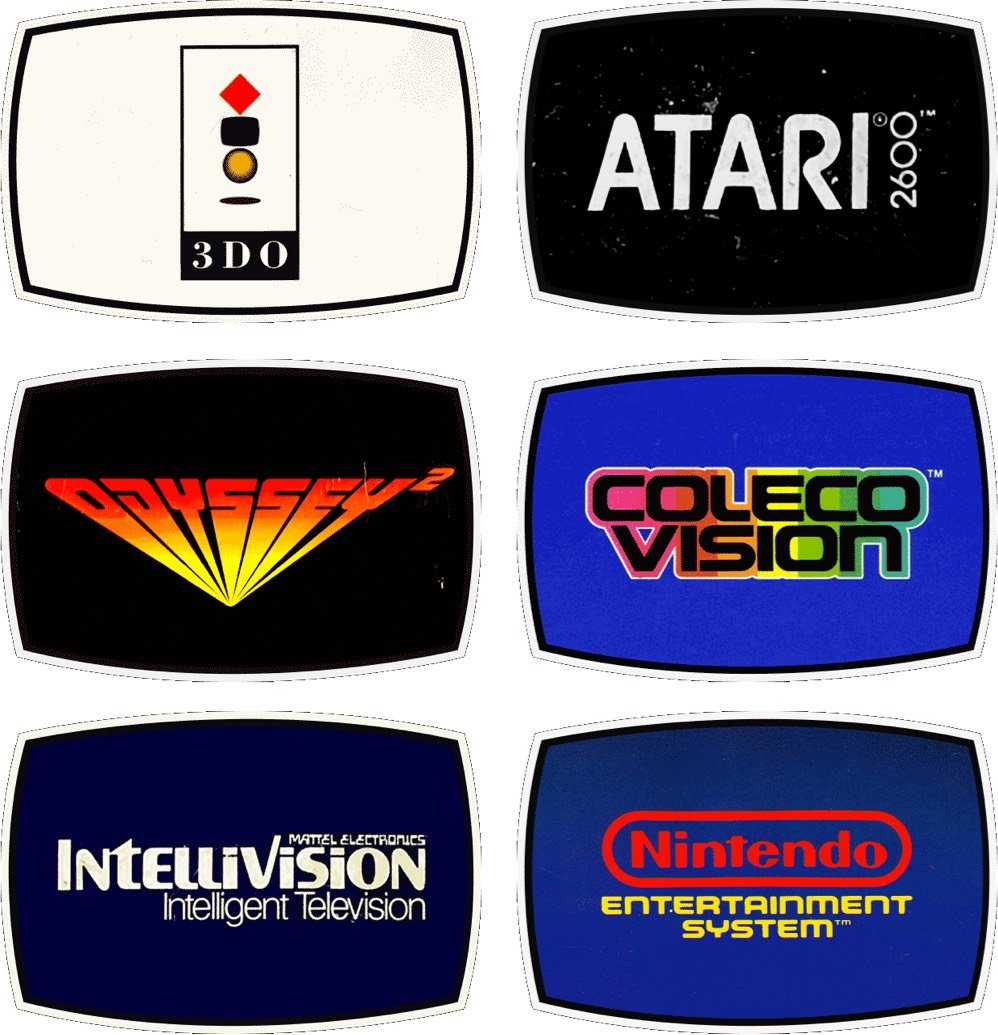
Reagan Ray has collected the logos of video game consoles from 1976 to the present. He ignores the first generation of consoles because there would have been too many to include. (Historical interlude: I didn’t know gaming consoles were broken down into generations. Apparently we’re in the 8th generation now — Wii U, PS4, Xbox One, and Switch.)
See also Ray’s collections of classic airline logos, record label logos, 80s action figure logos, American car logos, etc..
I love this. Bike retailer Vanmoof noticed that a lot of the bikes they shipped to customers in the US arrived damaged. Figuring that package handlers would be more gentle if they thought they were moving fragile electronics, they started printing an illustration of a flatscreen TV on their packages.

That small tweak had an outsized impact. Overnight our shipping damages dropped by 70-80%. We sell 80% of our bicycles online, which means we still print TVs on our boxes. More than 60,000 of them have now been shipped directly to our riders worldwide.
Super clever. (via why is this interesting?)
Bond film anagrams. “English Tutor Hoedown” from “The World Is Not Enough” made me LOL.
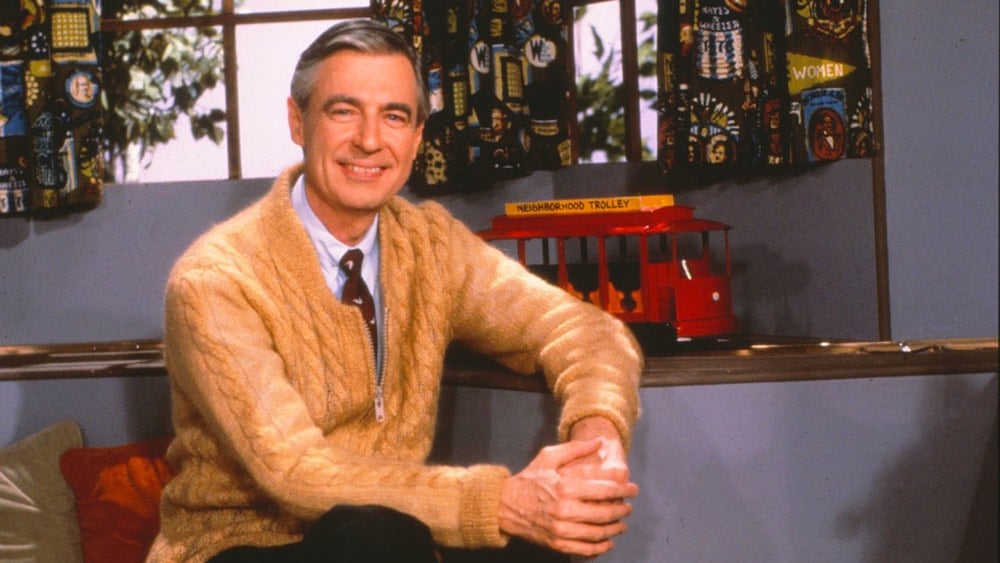
In 1998, Tom Junod wrote an article for Esquire about Fred Rogers. It is a particular favorite of mine and if you’ve never read it, I would recommend setting aside some time soon to do so.
Koko weighed 280 pounds because she is a gorilla, and Mister Rogers weighed 143 pounds because he has weighed 143 pounds as long as he has been Mister Rogers, because once upon a time, around thirty-one years ago, Mister Rogers stepped on a scale, and the scale told him that Mister Rogers weighs 143 pounds. No, not that he weighed 143 pounds, but that he weighs 143 pounds…. And so, every day, Mister Rogers refuses to do anything that would make his weight change — he neither drinks, nor smokes, nor eats flesh of any kind, nor goes to bed late at night, nor sleeps late in the morning, nor even watches television — and every morning, when he swims, he steps on a scale in his bathing suit and his bathing cap and his goggles, and the scale tells him that he weighs 143 pounds. This has happened so many times that Mister Rogers has come to see that number as a gift, as a destiny fulfilled, because, as he says, “the number 143 means ‘I love you.’ It takes one letter to say ‘I’ and four letters to say ‘love’ and three letters to say ‘you.’ One hundred and forty-three. ‘I love you.’ Isn’t that wonderful?”
The article has been adapted into a movie called A Beautiful Day in the Neighborhood; it stars Tom Hanks and will be out in two weeks time. Here’s a recently trailer — my skepticism about Tom Hanks playing Rogers is fading:
Junod recently wrote a piece about his friendship with the television icon, which began with the writing of the Esquire piece, continued until Rogers’ death in 2003, and clearly still reverberates in his life.
What would Fred Rogers — Mister Rogers — have made of El Paso and Dayton, of mass murder committed to fulfill the dictates of an 8chan manifesto? What, for that matter, would he have made of the anti-Semitic massacre that took place last fall in his real-life Pittsburgh neighborhood of Squirrel Hill? The easy answer is that it is impossible to know, because he was from a different world, one almost as alien to us now as our mob-driven world of performative slaughters would be to him. But actually, I think I do know, because when I met him, one of the early school shootings had just taken place, in West Paducah, Kentucky — eight students shot while they gathered in prayer. Though an indefatigably devout man, he did not attempt to characterize the shootings as an attack on the faithful; instead, he seized on the news that the 14-year-old shooter had gone to school telling his classmates that he was about to do something “really big,” and he asked, “Oh, wouldn’t the world be a different place if he had said, ‘I’m going to do something really little tomorrow’?” Fred decided to devote a whole week of his television show, Mister Rogers’ Neighborhood, to the theme of “little and big,” encouraging children to embrace the diminutive nature of their bodies and their endeavors — to understand that big has to start little.
The whole piece is great, but the latter half, where Junod writes about Rogers’ complicated legacy, the failure of his grand task, and how the people who idolize him today might nevertheless find it difficult to follow his example…well, I’m going to be thinking about that for awhile.
The U.S. Detained a Record 69,550 Migrant Children This Year. “The nearly 70,000 children who spent time in detention in the U.S. is more than anywhere else in the world.”
The latest video from Kurzgesagt is a short primer on neutron stars, the densest large objects in the universe.
The mind-boggling density of neutron stars is their most well-known attribute: the mass of all living humans would fit into a volume the size of a sugar cube at the same density. But I learned about a couple of new things that I’d like to highlight. The first is nuclear pasta, which might be the strongest material in the universe.
Astrophysicists have theorized that as a neutron star settles into its new configuration, densely packed neutrons are pushed and pulled in different ways, resulting in formation of various shapes below the surface. Many of the theorized shapes take on the names of pasta, because of the similarities. Some have been named gnocchi, for example, others spaghetti or lasagna.
Simulations have demonstrated that nuclear pasta might be some 10 billion times stronger than steel.
The second thing deals with neutron star mergers. When two neutron stars merge, they explode in a shower of matter that’s flung across space. Recent research suggests that many of the heavy elements present in the universe could be formed in these mergers.
But how elements heavier than iron, such as gold and uranium, were created has long been uncertain. Previous research suggested a key clue: For atoms to grow to massive sizes, they needed to quickly absorb neutrons. Such rapid neutron capture, known as the “r-process” for short, only happens in nature in extreme environments where atoms are bombarded by large numbers of neutrons.
If this pans out, it means that the Earth’s platinum, uranium, lead, and tin may have originated in exploding neutron stars. Neat!
Working from a variety of interviews and articles about the chef, writer, and TV star, the crew at Far Out magazine compiled a playlist of Anthony Bourdain’s favorite songs.
It’s well-known that Bourdain was a champion of New York’s punk movement, he was often cited as saying that both chefs and musicians worked in similar undulating patterns. They were nightwalkers, the working men of the dark streets of New York’s bubbling underbelly. It was a theory that Bourdain took with him wherever he went. Whether he was reviewing a restaurant, often commenting on the music being played in the dining room as much as the food, or speaking with the numerous musicians and icons that littered his show ‘Parts Unknown’, Bourdain was always a muso.
For the PBS show he produced, The Mind of a Chef, Bourdain shared a 25-song playlist called Anthony Bourdain’s Music to Cook By.
Musicians on these playlists include The Velvet Underground, Pretenders, Beastie Boys, and Bob Dylan. (thx, amy)
Update: Here are all the songs from both playlists in one Apple Music playlist. (thx, @billweye)
You may remember the Border Wall Seesaw implemented by activist architects Ronald Rael and Virginia San Fratello earlier this year; they installed seesaws through the US/Mexico border wall, enabling people from both countries to play together on them.
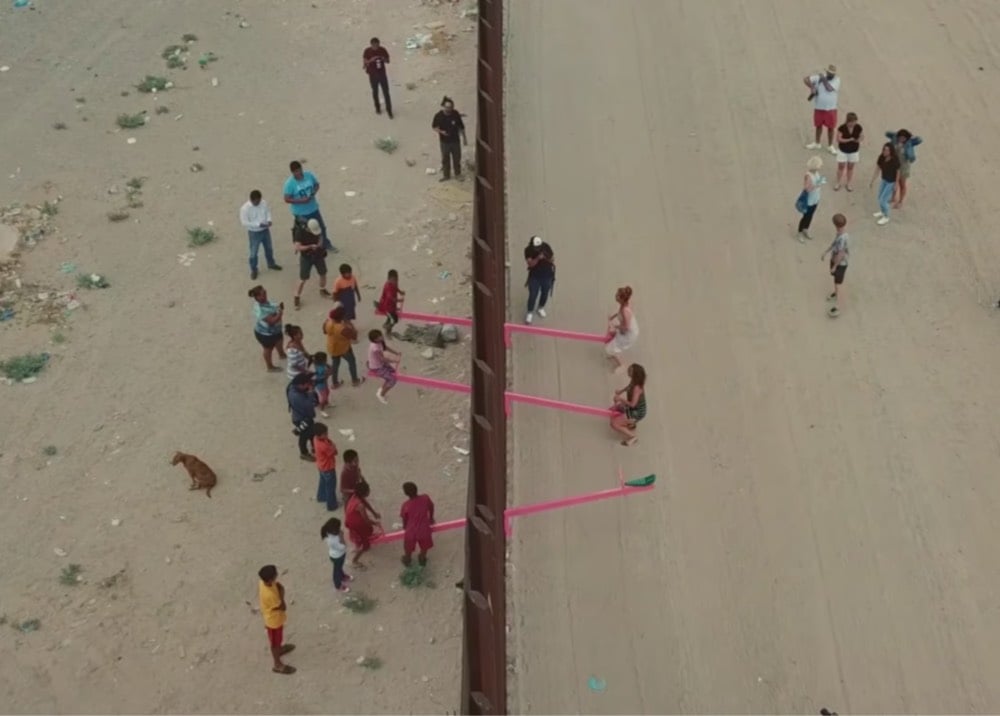
This short documentary called Borderlands follows Rael to three communities along the wall — San Diego & Tijuana, Brownsville & Matamoros, El Paso & Juárez (where he installed the seesaws) — where the connections between the US & Mexican sides persist and flourish despite their artificial separation.
Rael is well aware that, not too long ago, the boundary between the United States and Mexico, which is now delineated by more than seven hundred miles of fencing, was an open frontier, dotted with stone monuments. His book “Borderwall as Architecture” makes clear that the billions of dollars the U.S. government has spent on curbing migration and enhancing border security have done little to deter those intent on crossing by foot, using wooden ladders and ramps, or through tunnels. Decades of flawed policies suggest that the building of a grand wall is entirely divorced from the reality on the ground.
See also Best of Luck With the Wall, Josh Begley’s satellite image tour of the wall from the Pacific to the Gulf.
The Atlantic launched a new visual identity the other day, complete with a new logo, custom typeface, updated website, and iOS app. Here’s the first cover carrying the new look:
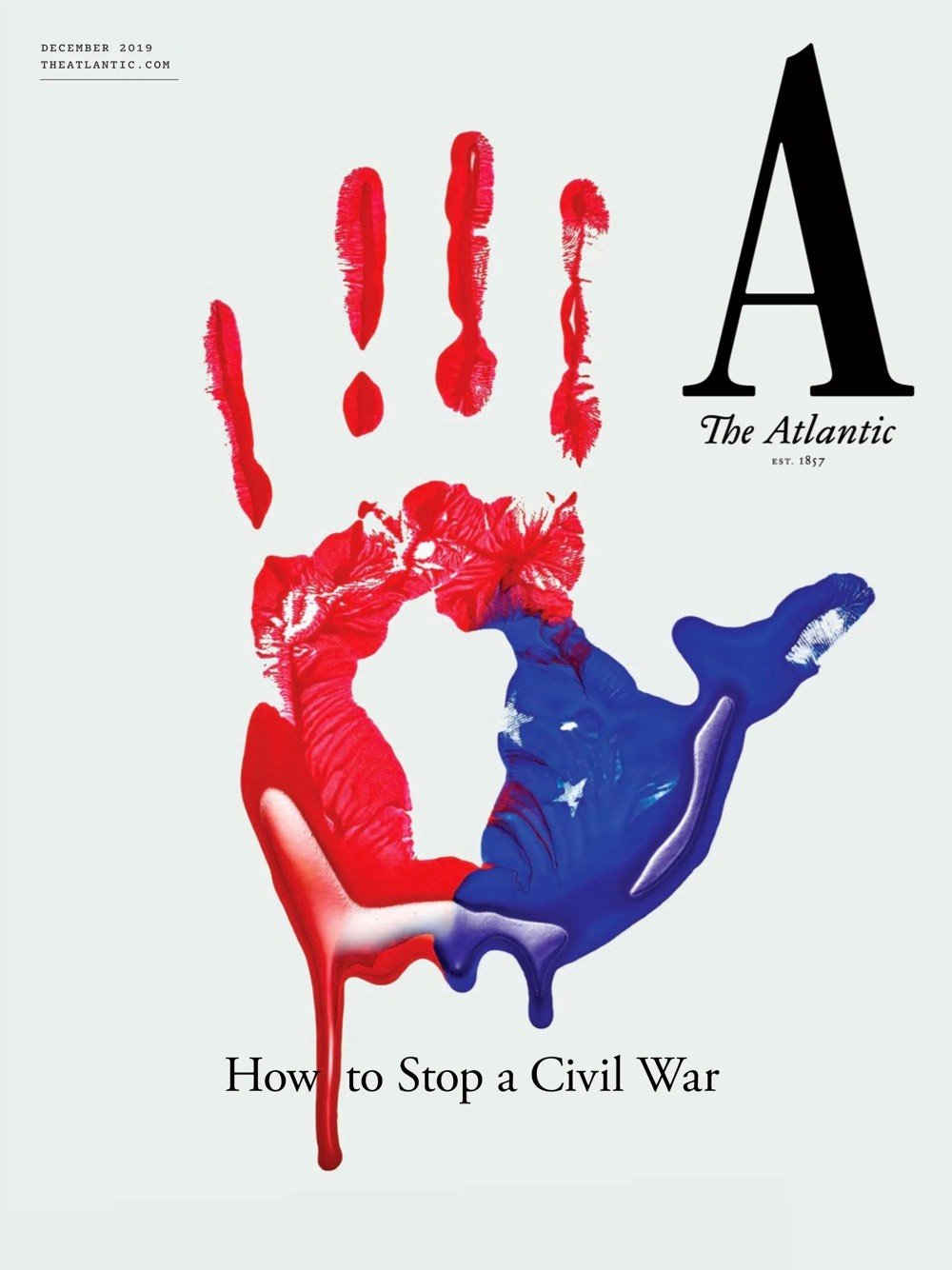
The effort was led by Peter Mendelsund and his senior art director Oliver Munday. You can hear the pair talk a bit about their process here:
And more from Mendelsund in this conversation with editor-in-chief Jeffrey Goldberg:
My favorite kind of design is a kind of time-released design, where you look at something and you have an immediate impression of it, and then you, upon further reflection, find something in the design that adds to or subverts that first impression.
Really nice work and methodology behind it. Hearing designers talk about how they approach their work always makes me miss practicing design on a daily basis, a former vocation of mine that seems very very far away these days.

That’s much of Manhattan, Brooklyn, and Queens captured by Maxar’s Worldview-3 satellite, but at an unusually low angle. Here’s a closer view of the southern tip of Manhattan:

Says Daily Overview of the shot:
This particular shot is made possible due to the focal length of the camera in this satellite that is roughly 32 times longer than that of a standard DSLR camera.
I don’t know what practical value low-angle satellite photos have, but they sure are beautiful.
See also a low-angle satellite photo of San Francisco.
Ok, this post doesn’t have anything to do with boy detective Encyclopedia Brown…I just needed him for the title. In the NY Times, art critic Jason Farago argues that in order to improve the visitor experience at the Louvre, the Mona Lisa and her smile have got to go.
Yet the Louvre is being held hostage by the Kim Kardashian of 16th-century Italian portraiture: the handsome but only moderately interesting Lisa Gherardini, better known (after her husband) as La Gioconda, whose renown so eclipses her importance that no one can even remember how she got famous in the first place.
Some 80 percent of visitors, according to the Louvre’s research, are here for the Mona Lisa — and most of them leave unhappy. Content in the 20th century to be merely famous, she has become, in this age of mass tourism and digital narcissism, a black hole of anti-art who has turned the museum inside out.
Enough!
I visited the Louvre back in 2017 and the Mona-driven crowds were very distracting. I wrote a short review for my media diet:
The best-known works are underwhelming and the rest of this massive museum is overwhelming. The massive crowds, constant photo-taking, and selfies make it difficult to actually look at the art. Should have skipped it.
The Louvre is actually not a good place to look at art and if moving the Mona Lisa to a dedicated gallery elsewhere can help solve that problem, they should do it. (via @fimoculous)
The London Review of Books is not normally where one turns for advice on how to cop, but Misha Glenny (author of DarkMarket: How Hackers Became the New Mafia and Callum Lang recently wrote a piece for them called How to Buy Drugs that summarizes how the the customer-facing segment of the global drug market presently functions, with a special emphasis on distribution via the dark web. The improvement in customer service driven by dark web markets is fascinating:
The internet has dramatically improved the experience of drug buyers. The market share of a dark web outlet depends almost entirely on its online reputation. Just as on Amazon or eBay, customer reviews will describe the quality of purchased products as well as reporting on shipping time and the responsiveness of vendors to queries or complaints. If drugs that a buyer has paid for don’t turn up — as once happened to Liam, the Manchester student — a savvy vendor will reship the items without asking for further payment, in the hope of securing the five-star customer reviews they depend on.
As a consequence, the drugs available to the informed buyer are of a higher quality than ever before. They are also safer. The administrators of DNStars.vip — a site on the open web which you don’t need Tor to visit — pose as ordinary users in order to buy samples of popular drugs from major vendors. They then have the drugs chemically tested to see whether they match the seller’s description.
The dark web demonstrates the promise and peril of technology (and capitalism tbh) in a nutshell: lower prices & better quality goods for some (or even many) people but all sorts of hidden nastiness behind the scenes doing real and often unacknowledged harm to society.
In an April 1953 newspaper article in the Tacoma News Tribune, Mark Sullivan made an uncannily accurate prediction about the future of the telephone.
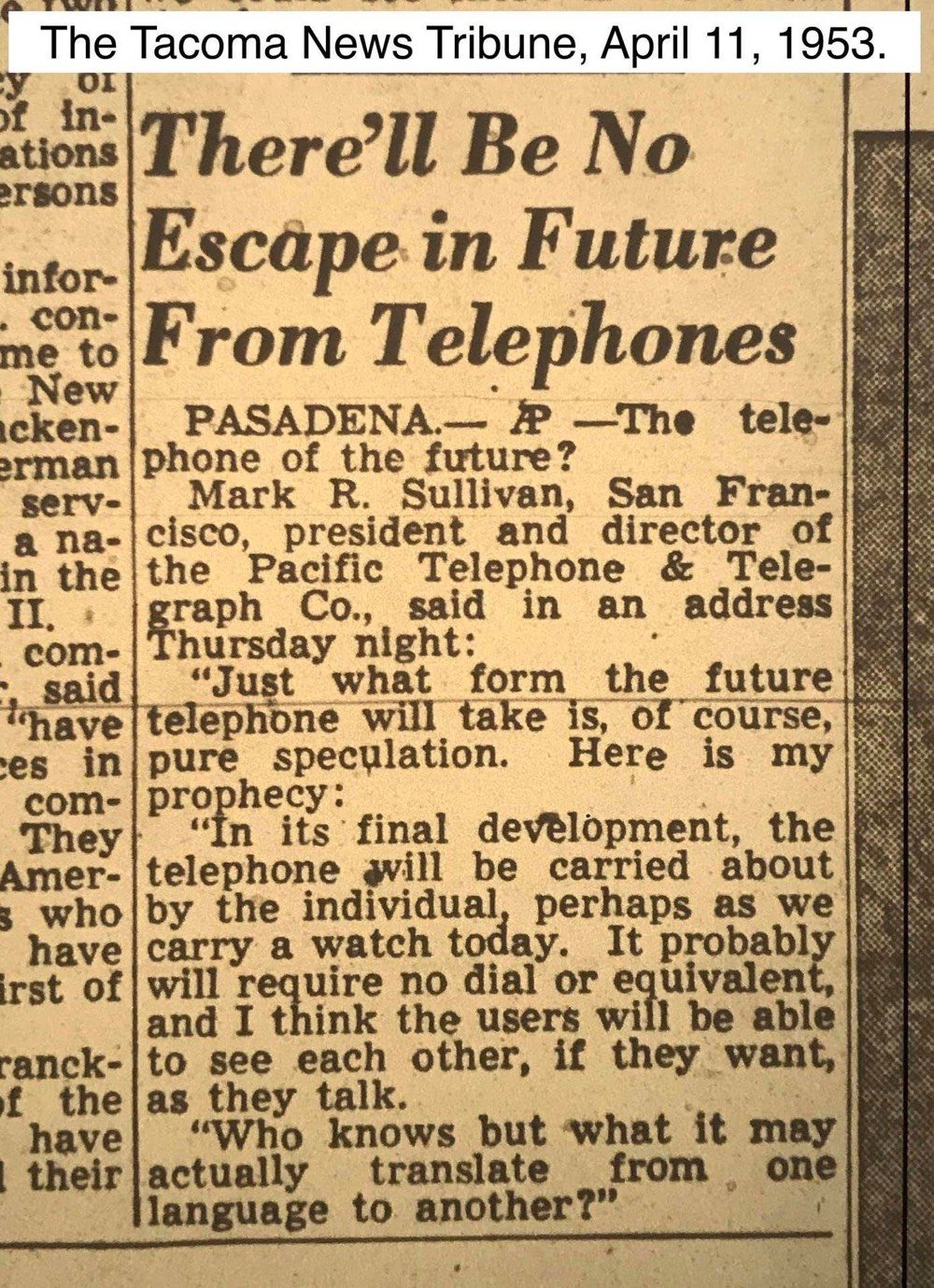
In its final development, the telephone will be carried about by the individual, perhaps as we carry a watch today. It probably will require no dial or equivalent, and I think the users will be able to see each other, if they want, as they talk.
The curious use of the word “users” made me think this was a hoax, but Snopes says it’s genuine. Anyway, Nikola Tesla beat Sullivan to the punch with his 1926 wireless vision of the world:
We shall be able to communicate with one another instantly, irrespective of distance. Not only this, but through television and telephony we shall see and hear one another as perfectly as though we were face to face, despite intervening distances of thousands of miles; and the instruments through which we shall be able to do his will be amazingly simple compared with our present telephone. A man will be able to carry one in his vest pocket.
(via @ma11en)
James Dean will star in a Vietnam-era war movie called Finding Jack. “Dean’s performance will be constructed via ‘full body’ CGI using actual footage and photos. Another actor will voice him.”
Han Solo with a hat is just a generic cowboy. “Sometimes good design is the act of not putting a hat on someone.”

This photo of Berlin, Germany at night was taken in 2012 from the International Space Station. Almost 25 years after the fall of the Berlin Wall, you can still see the division from space because of the colors of the different street lights used in the East and West.
Daniela Augenstine, of the city’s street furniture department, says: “In the eastern part there are sodium-vapour lamps with a yellower colour. And in the western parts there are fluorescent lamps — mercury arc lamps and gas lamps — which all produce a whiter colour.” The western Federal Republic of Germany long favoured non-sodium lamps on the grounds of cost, maintenance and carbon emissions, she says.
A night photo of Berlin from 2016 confirms that street light replacement is happening in the city, albeit slowly.
See also a photo of NYC from 2015 taken from the ISS, which shows the replacement of the city’s sodium vapor street lights with blue-glowing LEDs.
The new LEDs may be environmentally sensitive, but they are also optically harsh.
“The old lights made everybody look bad,” said Christopher Stoddard, an architect, who lives at the corner of Fuller Place. “But these are so cold and blue, it’s like ‘Night of the Living Dead’ out there.”
“We’re all for saving energy,” his wife, Aida Stoddard, also an architect, said, “but the city can do so much better.”
A few blocks away, Rose Gallitelli taped up black garbage bags on her bedroom windows so that she could sleep. “They’re the heavy-duty kind,” she said.
Brent Simmons celebrates 20 years of blogging. “The best time to start a blog is 20 years ago. The second-best time is today.”
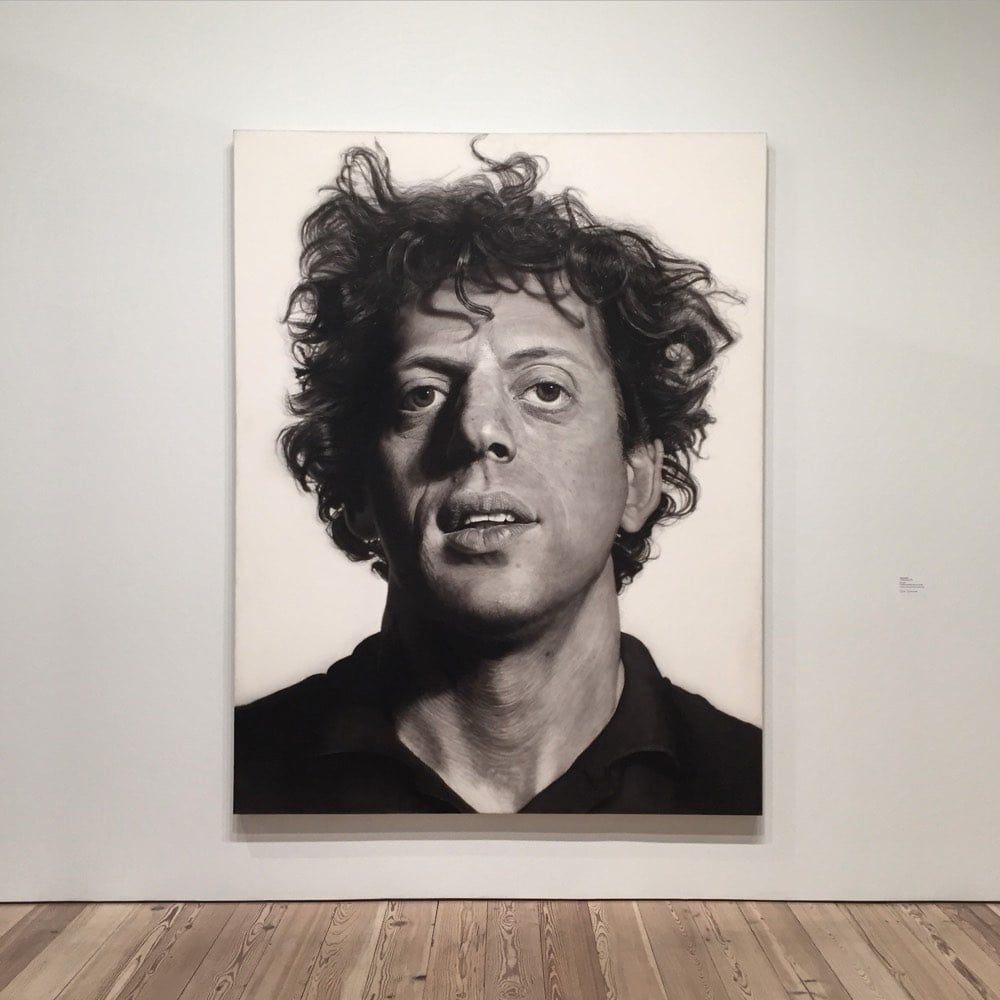
From the NY Times, Philip Glass Is Too Busy to Care About Legacy.
“I’m pragmatic,” Mr. Glass said. “I don’t know what’s going to happen in 10 years. We don’t even get to know what’s going to happen after someone dies. We need to wait until everyone who knew them is dead, too.”
If that’s true, it won’t be until nearly 2100 when a full measure of Mr. Glass’s footprint will be possible. But some weighing can start now. The most instantly recognizable voice in contemporary music, he opened a new chapter in operatic history, pushing the bounds of duration and abstraction. At a time when the most lauded composers disdained overproduction, Mr. Glass wrote unashamedly for everyone and everything — and all stubbornly in the distinctive style he created, establishing a model for serious artists moving from the opera house to the concert hall to the film studio, garnering both Met commissions and Academy Award nominations.
But if the question is whether, a century from now, his operas will get new productions, his symphonies will circulate more frequently, or pianists will take on his études, Mr. Glass couldn’t care less.
“I won’t be around for all that,” he said. “It doesn’t matter.”
Austin Kleon expanded on this piece with some thoughts about lineage vs legacy.
I like this idea of thinking about lineage vs. legacy, because it means you can sort of reframe any worrying about immortality and how you’re going to project yourself into the future, and think more about what you’re taking from the past and what you’re adding to it that creates a more interesting and helpful present.

Believe it or not, the image above was made using only HTML & CSS by developer Diana Smith. It’s coded by hand and built for Chrome — you can check it out here. The source code and accompanying CSS is not as extensive as you might think.
As Andy Baio notes, Smith’s creations render less well in other browsers. Who knew Internet Explorer 8 for Windows 7 was a Cubist master?
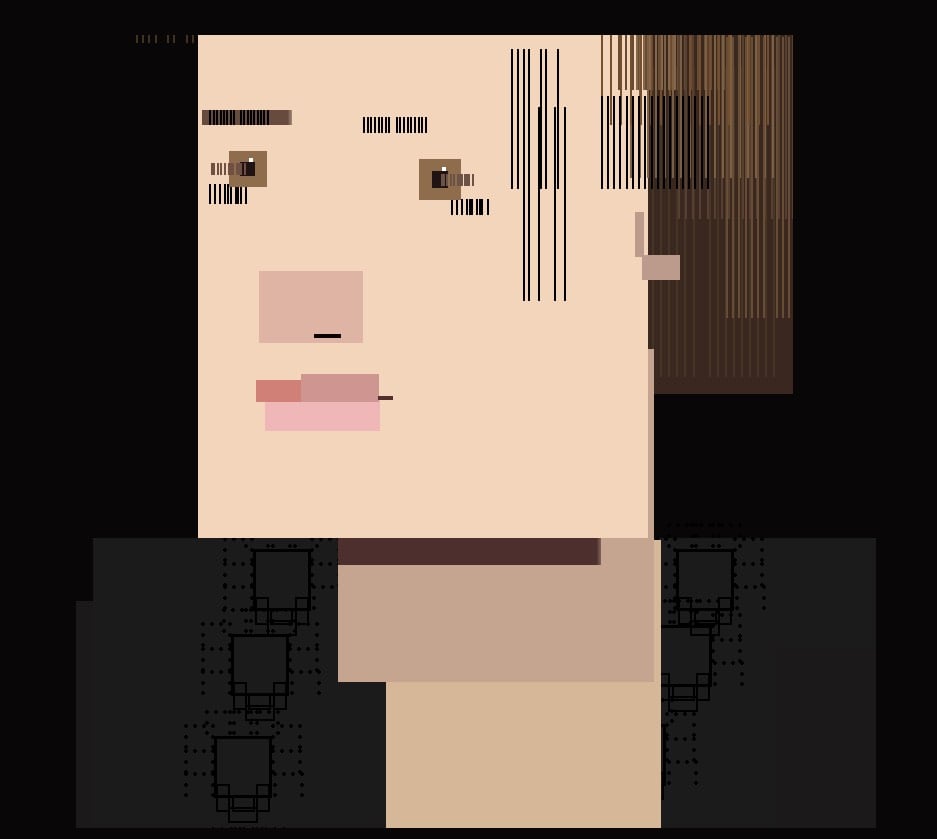
You can view several other of Smith’s creations here, here, and here.
See also Tatsuo Horiuchi, the Excel Spreadsheet Artist. (via waxy)
The Fifth Season is the first book in the Broken Earth trilogy of fantasy/science fiction novels by N.K. Jemisin. Each book in the trilogy won the Hugo Award for best novel the year after its release. It took me awhile to get into, but once I was hooked the book went pretty quickly. Here are the passages I highlighted on my Kindle for one reason or another. (See past book highlights.)
Note: This ebook didn’t have real page numbers, only Kindle location markers. Sorry about that.
Further note: I’ve been reading Kindle books checked out from my local library via Libby. It’s been challenging because the loan period is typically not long enough for how slowly I read. But I did discover that you can view your notes and highlights for all of your Kindle books, including expired ones, so I don’t need to worry about exporting them before my loan ends.
Location 52 (I like the obviousness of the opening lines):
Let’s start with the end of the world, why don’t we? Get it over with and move on to more interesting things.
Location 102:
There is an art to smiling in a way that others will believe. It is always important to include the eyes; otherwise, people will know you hate them.
Location 208 (see Addressing Climate Change Is Not About Saving the Planet):
When we say “the world has ended,” it’s usually a lie, because the planet is just fine.
Location 1,161:
The people we love are the ones who hurt us the most, after all.”
Location 1,488 (saving this for the next time someone argues about the “natural order of things” or similar bullshit):
Survival doesn’t mean rightness. I could kill you right now, but that wouldn’t make me a better person for doing so.”
Location 2,061 (on surviving in the immediate aftermath of loss):
So you must stay Essun, and Essun will have to make do with the broken bits of herself that Jija has left behind. You’ll jigsaw them together however you can, caulk in the odd bits with willpower wherever they don’t quite fit, ignore the occasional sounds of grinding and cracking. As long as nothing important breaks, right? You’ll get by. You have no choice.
Location 2,298 (emphasis mine):
Once Damaya would have protested the unfairness of such judgments. The children of the Fulcrum are all different: different ages, different colors, different shapes. Some speak Sanze-mat with different accents, having originated from different parts of the world. One girl has sharp teeth because it is her race’s custom to file them; another boy has no penis, though he stuffs a sock into his underwear after every shower; another girl has rarely had regular meals and wolfs down every one like she’s still starving. (The instructors keep finding food hidden in and around her bed. They make her eat it, all of it, in front of them, even if it makes her sick.) One cannot reasonably expect sameness out of so much difference, and it makes no sense for Damaya to be judged by the behavior of children who share nothing save the curse of orogeny with her.
Location 2,311:
The world is not fair, and sometimes it makes no sense.
Location 2,703:
“Home is people,” she says to Asael, softly. Asael blinks. “Home is what you take with you, not what you leave behind.”
Location 3,359 (the uncanny valley of hyper-graceful motion):
The stone eater’s arm rises, so steadily that the motion surpasses graceful and edges into unnatural.
Location 3,546:
Friends do not exist. The Fulcrum is not a school. Grits are not children. Orogenes are not people. Weapons have no need of friends.
Location 4,155 (out of context this is weird but it made me lol):
Did you need a dick — any dick, even my mediocre, boring one — that bad?”
Location 4,314:
We are creatures born of heat and pressure and grinding, ceaseless movement. To be still is to be… not alive.
Location 4,369:
She loves her son. But that doesn’t mean she wants to spend every hour of every rusting day in his presence.
Location 4,446 (ISO an affection dihedron):
They can’t stand sex with each other directly, but vicariously it’s amazing. And what do they even call this? It’s not a threesome, or a love triangle. It’s a two-and-a-half-some, an affection dihedron.
Fewer highlights than usual…lots of plot = fewer highlights, I think. I enjoyed reading this book, but it also didn’t propel me right into the next book in the series (unlike The Three-Body Problem). Maybe in a month or two?


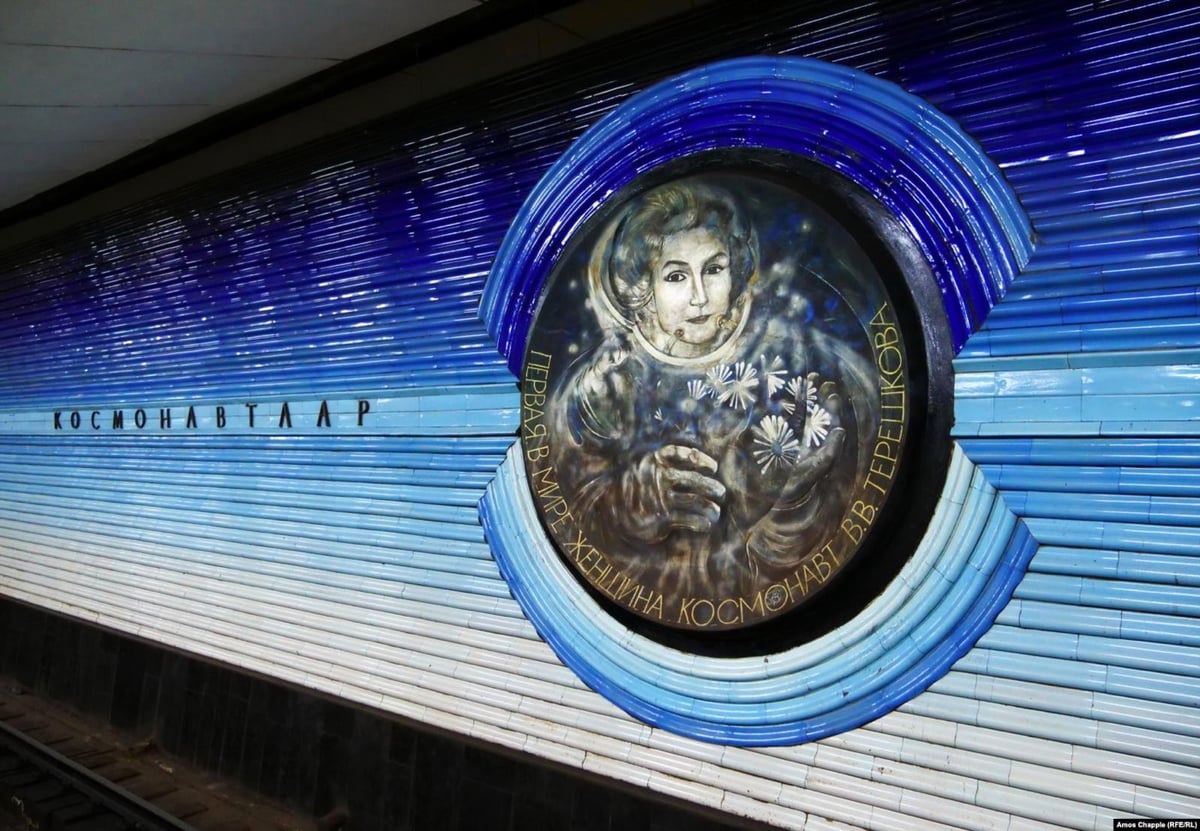
Once a stop along the Silk Roads from Europe to Asia, the city of Tashkent, Uzbekistan boasts many cultural treasures but perhaps the most unlikely is the city’s metro system and its colorful & artistic stations. In 2018, not long after a photography ban was lifted, Amos Chapple took a series of photos of Tashkent’s metro.
See also Photos of Grand Soviet-Era Subway Stations. (via @bennglazier)
For a BBC series called Earth from Space, the team at Sent Into Space attached a VR camera to a balloon and sent it up to an altitude of about 20 miles — high enough to see the blackness of space and Earth’s curvature — to take a 360° video of the total solar eclipse that occurred in August 2017. The video above is a hyperlapse of the event while this one from the BBC is slower, annotated, and in full 360° VR.
See also Patrick Cullis’ epic adventure in trying to snap a photo of the total solar eclipse from the edge of space. (via @alexkorn)
Mary Cain was on her way — and quickly. As detailed in a 2015 NY Times piece by Elizabeth Weil, Cain ran a mile in 5:03 as a 7th grader and by the time she was a high school sophomore, ran the 1,500 meters in 4:11.01. Her high school track coach didn’t know how to coach her properly, so when Nike called, she joined a legendary coach training a team of fellow track stars to see how far she could go. And according to Cain, that’s when everything fell apart.
A big part of this problem is that women and girls are being forced to meet athletic standards that are based on how men and boys develop. If you try to make a girl fit a boy’s development timeline, her body is at risk of breaking down. That is what happened to Cain.
After months of dieting and frustration, Cain found herself choosing between training with the best team in the world, or potentially developing osteoporosis or even infertility. She lost her period for three years and broke five bones. She went from being a once-in-a-generation Olympic hopeful to having suicidal thoughts.
This May, at the age of 23, Cain ran competitively for the first time in 2.5 years and won a four-mile race in NYC.
Update: Shannon Palus writing at Slate about Cain’s recent revelations:
Cain’s story might be superlatively horrifying, and her accusations go well beyond simple misunderstanding of female biology. (They include her coaches essentially ignoring her admission that she was depressed and cutting herself. The Oregon Project was shut down in October, after Salazar was banned from coaching for doping violations.) But the treatment of her weight, and the lack of understanding of how extreme workouts were affecting her body, is part of a much broader problem, and not just one that affects women with large brand partnerships. Many, if not most, female runners, from elite athletes to those training for their first 5Ks, will suffer at some point because of a lack of recognition of their physical needs, and how their bodies differ from men’s.
Update: In a Sports Illustrated article published today, eight other athletes corroborate Cain’s allegations of abuse.
Amid the fallout from Cain’s comments, Sports Illustrated contacted nine former Nike Oregon Project members, including Cain, about the culture under Salazar, and their accounts, extending back to 2008, validate her claims and paint a picture of a toxic culture where female athletes’ bodies were fair game to be demeaned publicly. Multiple authority figures appeared to lack certifications. Former team members now describe it, in retrospect, as “a cult.” Now leaders from the anti-doping world and even Salazar’s de facto successor as coach are calling for a third-party investigation of The Oregon Project.
I was talking with a friend about Cain’s story and how challenging the coach/athlete dynamic is. The nature of coaching is to help athletes to achieve things they cannot accomplish on their own, to push them past what they thought was their best. Pushing boundaries implies the need to be vulnerable, to embrace the unknown, to do things that you may not understand or want to do, and to trust your coach to have you do the correct uncomfortable & seemingly impossible things that will help you excel and not the wrong uncomfortable & seemingly impossible things that will damage your body and mind. From the outside or as an athlete in the midst of training, it can be tough to tell which is which. To have that trust betrayed must be devastating.
This “exit post” marks the end of my five days guest-editing this venerable and beloved blog, thanks to Jason for letting me play in this fantastic space for a third visit. It’s always quite a fun ride, and the best excuse for some internet wanderings.
I hope you enjoyed what I shared here. I encourage you to have a look at my newsletter Sentiers. Check out the archives and subscribe to keep up with where my curiosity takes me.
To recap and perhaps to give you a second chance at discovering them, here are some of my favourite posts. Every time I’m here I enjoy paying special attention to planes and space, as with Lifting bodies and the X-37B. There was something hopeful in Cleaning trash from rivers before it reaches the ocean. One of the most popular posts was The fantastic fungi pictures of Alison Pollack and it’s easy to see why, while Death Stranding’s world building intersects with fashion and design wasn’t as well shared but is a space I enjoyed looking at. I always end up writing about libraries, this time with Helsinki has a library to learn about the world, the city, and each other, and with another kind of library, The Internet Archive is now working to preserve vinyl LPs. Ok Google, cause some mischief and The Drone Chronicles 2001-2016 point to some interesting corners of technology.
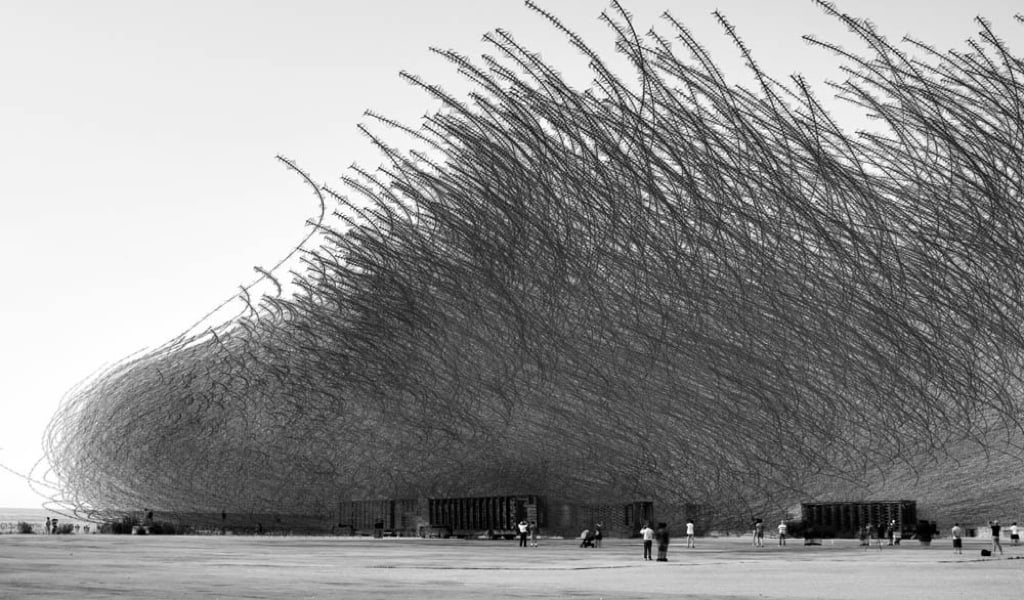
The header image is from Xavi Bou’s Ornitographies.
Is this the first salvo in the end of year barrage of reviews? Polygon are going all out anyway, with a review of the whole decade! “Looking back at the past 10 years in pop culture.” There’s lots to read and I can’t say I’ve gone over the whole thing yet but it’s a fun mix.
The second decade of the 21st century was marked by seismic shifts in media and entertainment — loot boxes, games as a service, esports, livestreaming, virtual reality, smartphones, streaming services, “binge” watching, cloud computing, corporate consolidation, and a blockbuster takeover of the box office. It’s tempting to dismiss those items as big-picture developments rather than changes that affect us personally. But as we increasingly rely on pop culture as the lens through which we process the world around us — and, as ever, a mirror that reflects that world back at us — it’s important to take a breath every so often to ponder how we got here and what it all means.
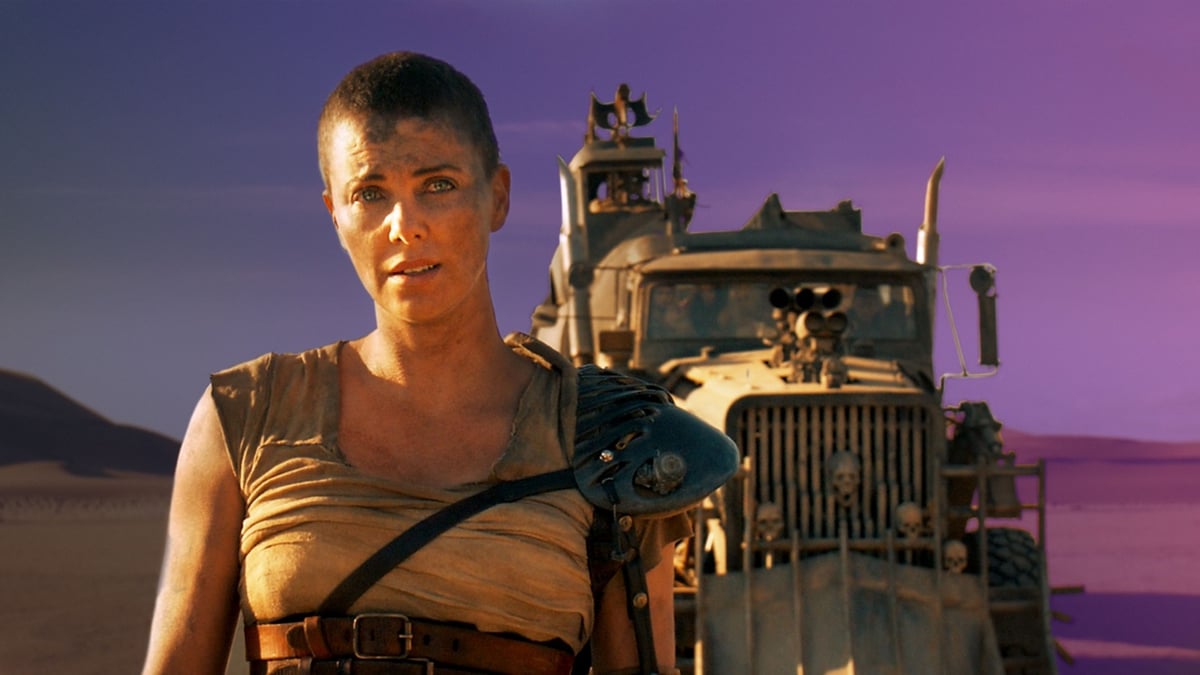
They’ve got a bunch of lists, some which are actually lists of lists by various team members, like The best movies of the 2010s (some surprising choices as well as some Fury Road and Spider-Man: Into the Spider-Verse), or doing one detailed selection like The best comics of the 2010s, and also some deeper dives in individual topics, like Why Minecraft is the most important game of the decade.
Counting Minecraft among the most influential games of the 2010s is a no-brainer. According to its developer, Mojang, Minecraft recently became the bestselling video game of all time, beating out Tetris by moving over 176 million units. Unlike Tetris, it hit that number in a single decade. (Emphasis mine.)
Communities facing relocation as they struggle with melting ground and a rising sea. “Pelly Island, a remote island about 100 kilometres west of Tuktoyaktuk, recede as much as 30-40 metres a year.”

An incredible 80 percent of the Louvre’s 10 million yearly visitors find their way to the Salle des États to catch a glimpse of the Mona Lisa. It’s so popular that it wasn’t included in the ongoing Leonardo da Vinci exhibition, for fear that the bustle to the painting would make it “practically unvisitable.” The curators used the opportunity to put together the museum’s first-ever virtual reality project, offering visitors a seven-minute experience of a work titled Mona Lisa: Beyond the Glass.
Visitors can strap themselves into the state-of-the-art headsets and learn snippets of information about Leonardo’s famous sitter, Lisa del Giocondo, as well as his artistic method and the history of the painting. It will immerse them in what could be the surroundings beyond the frame of what is depicted in Leonardo’s masterpiece, and, at the end, invite them to climb aboard an imagined version of Leonardo’s visionary flying machine—a sketch of which is also included in the exhibition—and soar across the landscape surrounding Mona Lisa’s luxuriant loggia.
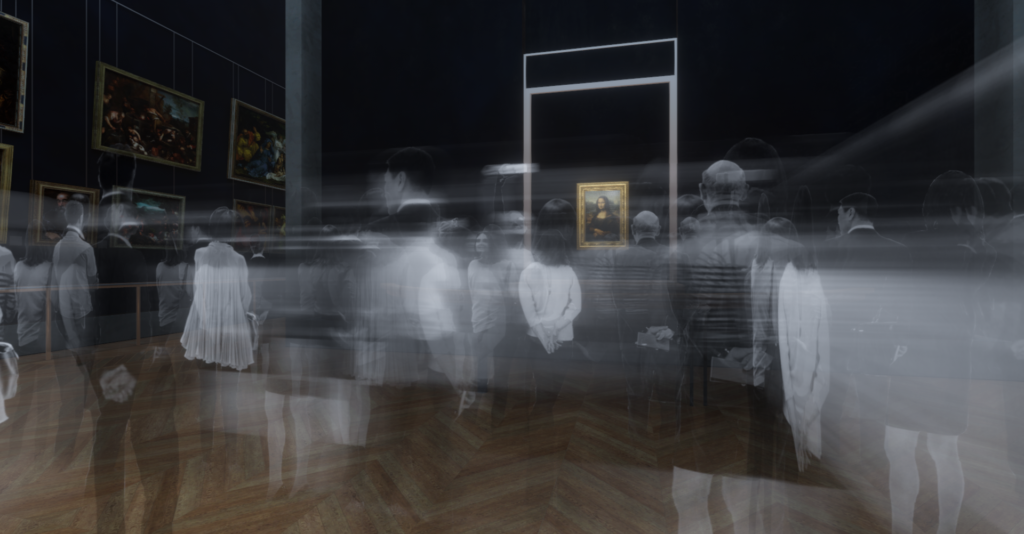
An interesting detail to this initiative is that although digital experiences like this are usually meant to broaden a museum’s public and draw more visitors, the Louvre definitely doesn’t need to be better known. They put this project together because “The museum still wants to amplify whatever it does beyond those who can actually set foot in the museum.”
The initiative is part of a broader plan to make culture accessible to a wider public. Efforts have been underway in France to redistribute some of its cultural resources around the country. The French culture minister Franck Riester plans to introduce a number of small-scale digital museums around France that will showcase high-resolution digital copies of works from the country’s 12 national public collections, including the Louvre, with people in remote regions. With more than $3 million invested in the plan, the small digital museums—dubbed “micro-folies”—are expected to number 1,000 within three years.

Sanjiangyuan in Qinghai is set to become China’s first national park, opening in 2020. It’s part of the Chinese government’s plan to follow the US model of national parks by replacing seven different departments with one, the National Park Administration.
Jonathan Jarvis, the Director of the United States National Park Service under President Obama, visited China to observe some of the past efforts and the new initiatives being put forth. Jarvis was interviewed by AJ Cortese at Pandaily.
Obviously China has had a high priority on economic development for a long time so it was actually refreshing to see them at least state politically, that they want conservation to be the priority. Because, frankly, if you’re going to have a real national park system it can’t just be about visitation or economical development and tourism it has to have a foundation in conservation and historical preservation as well.
We met with local mayors and provincial leaders and they clearly had gotten the message that they were now going to be evaluated in terms of their accomplishments and career status based on ecological conservation and not economic development. What’s interesting was they were asking us to help them figure out what that means because most of them had been trained professionally in economic development, which was to build something: a road, a hospital, a library or a school in these remote communities and now they were being challenged with ecological conservation at the same time as improving the lives of the local communities.
China has said politically that they want to have a complete national park system by 2030. Of course China is hosting the convention of biodiversity next year in October 2020, and I would anticipate that China will be announcing sometime in 2020, this sort of trajectory towards having a complete system with actual designation of at least the first slate, and then another slate and then another. They are trying to do what the US did over 100 years, starting in 1916, in just 10 years. This doesn’t surprise me because that’s kind of the way China does things.
(Emphasis mine.)
You’ve got to admire the dedication. A very, very detailed look at all the changes and additions to the emojis in iOS 13.2, including falafel, maté, and a gender-neutral zombie.
20 million people (a figure for the US I imagine) have uploaded their genetic profiles to consumer DNA sites like Ancestry.com, 23andMe, and GEDmatch. The first two have pledged to keep their users’ genetic information private and the third severely restricted access. But a warrant granted in Florida might supersede their good intentions.
Last week, however, a Florida detective announced at a police convention that he had obtained a warrant to penetrate GEDmatch and search its full database of nearly one million users. Legal experts said that this appeared to be the first time a judge had approved such a warrant, and that the development could have profound implications for genetic privacy.
Other agencies are sure to try to get similar warrants, so lets not forget that at the scale these services have reached, there are now implications for everyone, not just those who sent their DNA for analysis.
If that comes to pass, the Florida judge’s decision will affect not only the users of these sites but huge swaths of the population, including those who have never taken a DNA test. That’s because this emerging forensic technique makes it possible to identify a DNA profile even through distant family relationships.
In 2018, California police used GEDmatch data to identify a man they believe is the Golden State Killer, Joseph James DeAngelo. Since then, other police forces have followed suit, turning tools meant to find relatives, into ones that can be used to search family trees for criminals.
Because of the nature of DNA, every criminal is likely to have multiple relatives in every major genealogy database. Without an outcry, Professor Murphy and others said, warrants like the one obtained by Detective Fields could become the new norm, turning all genetic databases into law enforcement databases.
Newer posts
Older posts




Socials & More