kottke.org posts about Fred Rogers
The folks at Fred Rogers Productions have launched a YouTube channel dedicated to Mister Rogers’ Neighborhood. They plan to post compilations, clips, and full episodes, some of which haven’t been seen on PBS in years & years. One of the first complete episodes they’ve posted is the one about how crayons are made!
Other full episodes include A Visit with Officer Clemmons, The Very First Episode (from 1968), and Koko the Gorilla Meets Mister Rogers.
And there’s also this 30-minute compilation of fan-favorite factory visits.
Again, here’s the channel if you want to subscribe or explore more.

Every so often, the US Postal Service reissues old stamps. This time around, they polled the public about which past stamp they’d like to see reissued and the results were decisive: the people love Mister Rogers.
The Mister Rogers stamp, originally released in 2018, is new again in 2026!
In national Stamp Encore polling, the stamp honoring the television host beloved by generations rose to the top spot from a varied ballot of 25 previous stamp issuances. Americans were asked to celebrate 250 years of postal delivery by choosing among favorite stamps of the last few decades. By the deadline last fall, the Postal Service was flooded with nearly 600,000 total ballots.
The Mister Rogers stamps are out now — you can check out a list of the available purchases here. There’s even a set of Field Notes notebooks.


Mister Rogers is a natural fit for a postage stamp; he was a “prolific letter-writer”.
Fred Rogers had a great appreciation for communication by mail, so the popularity of his stamp in 2018 and the esteem reflected by Stamp Encore ballots seem especially fitting. A prolific letter-writer, sometimes replying to 100 letters per day, Rogers never resorted to form-letter responses. He expressed his sentiments in simple terms: “There is still a place for the written letter.”
In a book recalling mail he had received and sent, Rogers wrote, “One of the first things I do each day is to work on the letters that have arrived from the children and adults who have written to us. I care deeply about sending a personal response.” Rogers added, “It gives me a way to know my television neighbors as real people and to make a more personal connection with them. Just as our program is a ‘television visit,’ “the mail is a ‘letter visit.’ A personal note is still far more valuable than shooting off an email or text,” he said.
(thx, caroline)
Sesame Street has uploaded a bunch of classic episodes to YouTube that are free to watch, including the very first episode from 1969, the one where Mister Rogers visits, and the episode where Mr. Snuffulupagus is finally revealed. The most recent one was uploaded just a couple of days ago, so it appears to be an ongoing effort. (via open culture)
P.S. From Four Things About Mr. Snuffleupagus:
Snuffy was finally introduced to the main human cast mainly due to a string of high profile and sometimes graphic stories of pedophilia and sexual abuse of children that had been aired on shows such as 60 Minutes and 20/20. The writers felt that by having the adults refuse to believe Big Bird despite the fact that he was telling the truth, they were scaring children into thinking that their parents would not believe them if they had been sexually abused and that they would just be better off remaining silent.
In 1969, Fred Rogers appeared before the Senate to argue against cutting federal funding for public broadcasting. During his testimony, Rogers recited a song from his show, What Do You Do with the Mad That You Feel? In this short video, Jon Lefkovitz accompanies Mister Rogers’ words with some music and short scenes from movies like Moonlight, The 400 Blows, Do the Right Thing, Lady Bird, 2001, and Return of the Jedi.
On May 22, 1981, for the finale of the show’s 12th season, Mister Rogers visited Sesame Street. With apologies to the Avengers, this has to be the greatest crossover event in history.
In the episode, Rogers agrees to judge a race between Big Bird and Mr. Snuffleupagus, a character that no one on the show but Big Bird has seen. When BB tells his friends he met Mister Rogers, they don’t believe him, including Mr. Snuffleupagus! Later, BB & MR have a conversation about what’s real and what’s make-believe. Here’s more on the episode from the Neighborhood Archive and the Muppet Wiki.
Mr. Rogers comes to visit Big Bird at his nest. Big Bird wonders if Mr. Rogers is really here, because no one believed him before. Mr. Rogers observes that sometimes it’s hard to distinguish between fantasy and reality, and suggests that they both pretend some more. Big Bird imagines a teddy bear riding a race car, and realizes that he can’t touch him — except in his imagination. Mr. Rogers, on the other hand, is real. They both share a hug.
A couple of weeks later, Big Bird visited the Neighborhood of Make-Believe on Mister Rogers’ Neighborhood. There’s no good clip of this on YT, but you can see some of the footage here and the full episode on Mister Rogers’ official site.
Big Bird didn’t visit Mr. Rogers directly (in the real world) because of the two shows’ differing views on make-believe:
Caroll Spinney agreed to appear in the episode as Big Bird after some dialogue with Fred Rogers; when Spinney originally received the script for the show he saw it required him to remove the costume and discuss the inner-workings of the Big Bird puppet. Spinney protested, as he didn’t believe in ruining the illusion of Big Bird for the children. Rogers agreed, but only under the stipulation that Big Bird’s appearance was restricted to the fantasy segments of the “Neighborhood of Make-Believe,” as he didn’t believe in perpetuating the deceitful blur of real and pretend to children that occurred when presenting the character as real in the “real world.”
While Sesame Street Unpaved mentions that Rogers understood Spinney’s concern over showing the children how Big Bird works, Spinney said at some of his book signings (promoting his autobiography, The Wisdom of Big Bird) that he and Fred Rogers argued over the phone for roughly twenty minutes over whether or not to have him tell the kids how he performs Big Bird.
And then there’s this, included here because I ran across it on YouTube: Arsenio Hall gifts Fred Rogers a very fly jacket.
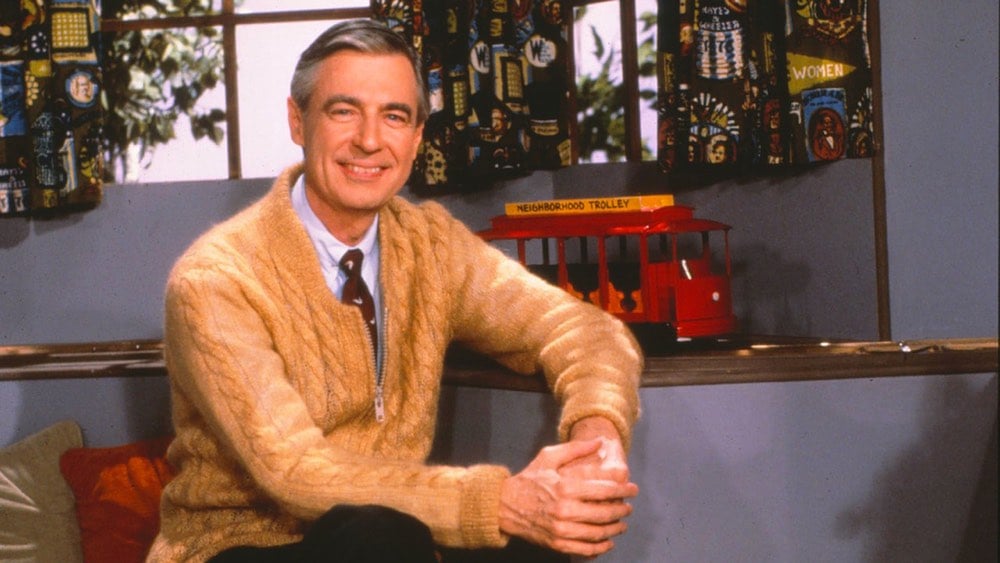
In 2002, Fred Rogers wrote a parenting book as a resource for caregivers of children aged two to six. One of the topics he covered was how to talk to children about tragic events in the news. Rogers begins by noting that even young children can pick up on when adults are feeling distressed:
In times of community or world-wide crisis, it’s easy to assume that young children don’t know what’s going on. But one thing’s for sure — children are very sensitive to how their parents feel. They’re keenly aware of the expressions on their parents’ faces and the tone of their voices. Children can sense when their parents are really worried, whether they’re watching the news or talking about it with others. No matter what children know about a “crisis,” it’s especially scary for children to realize that their parents are scared.
In times of crisis, kids need to feel safe:
In times of crisis, children want to know, “Who will take care of me?” They’re dependent on adults for their survival and security. They’re naturally self-centered. They need to hear very clearly that their parents are doing all they can to take care of them and to keep them safe. They also need to hear that people in the government and other grownups they don’t even know are working hard to keep them safe, too.
Parents need to step away from the news in order to be present for their kids and for their own well-being. The 2025 equivalent of limiting TV viewing would be “put down the phone”:
It’s easy to allow ourselves to get drawn into watching televised news of a crisis for hours and hours; however, exposing ourselves to so many tragedies can make us feel hopeless, insecure, and even depressed. We help our children and ourselves if we’re able to limit our own television viewing. Our children need us to spend time with them – away from the frightening images on the screen.
We need to let kids know that whatever they’re feeling is natural:
If we don’t let children know it’s okay to feel sad and scared, they may think something is wrong with them when they do feel that way. They certainly don’t need to hear all the details of what’s making us sad or scared, but if we can help them accept their own feelings as natural and normal, their feelings will be much more manageable for them.
Angry feelings are part of being human, especially when we feel powerless. One of the most important messages we can give our children is, “It’s okay to be angry, but it’s not okay to hurt ourselves or others.” Besides giving children the right to their anger, we can help them find constructive things to do with their feelings. This way, we’ll be giving them useful tools that will serve them all their life, and help them to become the worlds’ future peacemakers — the world’s future “helpers.”
And of course, we can urge kids to look for the helpers:
When I was a boy and I would see scary things in the news, my mother would say to me, “Look for the helpers. You will always find people who are helping.” To this day, especially in times of “disaster,” I remember my mother’s words and I am always comforted by realizing that there are still so many helpers — so many caring people in this world.
Update: On the first anniversary of 9/11, Fred Rogers recorded this brief message about tragic events in the news. Here’s the video followed by a full transcript:
Hello, I’m Fred Rogers. Some parents wonder how to handle world news with their young children. Well, we at Family Communications have discovered that when children bring up something frightening, it’s helpful right away to ask them what they know about it. We often find that their fantasies are very different from the actual truth. What children probably need to hear most from us adults is that they can talk with us about anything and that we will do all we can to keep them safe in any scary time. I’m always glad to be your neighbor.
This was one of Rogers’ last recordings before he died in early 2003.

This Beautiful Day: Daily Wisdom from Mister Rogers (Bookshop) is exactly what it says on the tin: a book of daily reflections from the writings, stories, and shows of Fred Rogers. I would be chuffed to find this under the tree on Xmas morning.
From Rabbi Danya Ruttenberg, a piece on the still-radical teachings of Fred Rogers, who emphasized the “love thy neighbor” part of the Bible rather than the twisted “persecute the other” version that has taken hold in so-called Christian communities in America over the past few decades.
Fred Rogers was a Presbyterian minister whose life’s work was, I believe, built almost entirely (if not entirely) around Leviticus 19:18: “Love your neighbor as yourself: I am God.” Hence… the neighborhood. In practice it that looked like this (all of these are his words): “To love someone is to strive to accept that person exactly the way [they are], right here and now.” and “Everyone longs to be loved. And the greatest thing we can do is to let people know that they are loved and capable of loving.”
Part of his philosophy was acknowledging that, because we loved them, we needed to have truthful, difficult conversations with our children.
When Bobby Kennedy was murdered that same year, he did something that’s pretty much impossible to our world today.
He had a puppet tiger ask an actor:
“What does ‘assassination’ mean?”
He knew that small children would be hearing this word, and that they would be aware that something major had happened. And that most of the time, when adults are preoccupied with communal tragedy and trauma, children get left out-to their own detriment.
Better they should know, in an age-appropriate way, and be given the tools to cope, than to be left out in the cold, as he put it, “at the mercy of their own imaginations.”
Again, naming true things and simply holding space to let children deal with them — rather than trying to hide or minimize or gaslight because it seems too hard.
That’s love.
(via @CultureDesk)

Beloved children’s book author Eric Carle died this past weekend at the age of 91 and this is one of the best openings to an obituary I can recall reading:
When a fictional caterpillar chomps through one apple, two pears, three plums, four strawberries, five oranges, one piece of chocolate cake, one ice cream cone, one pickle, one slice of Swiss cheese, one slice of salami, one lollipop, one piece of cherry pie, one sausage, one cupcake and one slice of watermelon, it might get a stomach ache.
But it might also become the star of one of the best-selling children’s books of all time.
Eric Carle, the artist and author who created that creature in his book “The Very Hungry Caterpillar,” a tale that has charmed generations of children and parents alike, died on Sunday at his summer studio in Northampton, Mass. He was 91.
I’ve written about Carle and his most famous creation, The Very Hungry Caterpillar, a couple of times here — I can still remember the first time my son read (or, more likely, recited from memory) the list of everything the caterpillar ate on Saturday, including all of his adorable pronunciations.
The Very Hungry Caterpillar was certainly one of my favorite books as a kid — along with Cloudy With a Chance of Meatballs, Richard Scarry’s Busy, Busy Town & Cars and Trucks and Things That Go, and the Frog & Toad books — and it was one of the first books we read to our kids. I remember very clearly loving the partial pages and the holes. Holes! In a book! Right in the middle of the page! It felt transgressive. Like, what else is possible in this world if you can do such a thing?
You can see Carle at work in his workshop from an episode of Mister Rogers’ Neighborhood in 1998. I particularly appreciated this short exchange:
Rogers: In this, there’s just no mistakes, is there?
Carle: No, you can’t make mistakes really.
Have you watched Ted Lasso? If not, you should — it’s probably my favorite TV thing of 2020. (It’s ok if you don’t care for sports. It’s not about sports.) Maureen Ryan’s excellent review of the series gets at why people are finding it so compelling.
A few weeks ago, I stumbled across this 2016 essay by Nora Samaran, who later expanded it into a slim but transfixing book called Turn This World Inside Out. It addresses a number of persistent questions I’ve had with lucid, thoughtful prose.
As Samaran puts it, “the men I know who are exceptionally nurturing lovers, fathers, coworkers, close friends to their friends, who know how to make people feel safe, have almost no outlets through which to learn or share this hardwon skill with other men…. Meanwhile, the men I know who are kind, goodhearted people, but who are earlier on in growing into their own models for self-love and learning how to comfort and nurture others, have no men to ask. … The answer to all of these difficulties is to openly discuss nurturance: how it looks, how it feels, how men can learn to practice it from the men who already know how.”
Ryan argues that Ted Lasso is an outlet that models the type of nurturing that Samaran is talking about.
Ted Lasso does a lot of things well — I adore the budding friendship between Rebecca and marketing whiz Keeley (Juno Temple) — but one of the things it explores wisely and well is what it looks like when men engage in (sorry for using these dreadful words) nurturing behaviors.
It’s a sprightly, well-constructed, enjoyable comedy about sports, sure, but it’s also about men who — like the many good men I have known (even in Hollywood!) — take responsibility for the example they set, for their emotions and for the actions they take. Ted Lasso will remain deeply valuable into next year and beyond, because it is also about a bunch of very different people who display fulfilling, conscientious confidence and leadership — not the bullying, toxic, arrogant, violent, condescending domination that has, in this country, has too often masqueraded as “leadership” and “confidence.” In evolving and supporting each other through those changes, these characters form friendships and communities that are truly meaningful.
Watching the show and reading this, I can’t help but think of another person who modeled kindness, goodheartedness, and nurturing male behaviors on TV for decades: Fred Rogers. (See, for instance, soaking in a kiddie pool with François Clemmons.) Ted Lasso co-creators & co-stars Jason Sudeikis and Brendan Hunt are right around my age; I’d be shocked if one or both of them didn’t watch a bunch of Mister Rogers’ Neighborhood growing up like I did. The two shows are obviously very different but Rogers’ brand of radical empathy is all over Ted Lasso. As I’ve grown more conscious over the past decade about the type of person I want to be in the world and the type of example I want to set for my kids, Rogers has been a guiding light and I’m happy to add Ted Lasso to the list as well.
Update: I forgot to add: another aspect I appreciate about the show is it demonstrates how you can be competitive without being toxic. Lasso is a very competitive guy who cares about winning, but he goes about it in a constructive way, not a destructive way. It’s the kind of energy their mom and I are always trying to impart to our kids, who are both competitive (albeit in pretty different ways).
See also Building Belonging at Summer Camp.

In Canada, “caremongering” groups are being organized to connect helpers with those in need during the COVID-19 pandemic.
The first “caremongering” group was set up by Mita Hans with the help of Valentina Harper and others. Valentina explained the meaning behind the name.
“Scaremongering is a big problem,” she tells the BBC. “We wanted to switch that around and get people to connect on a positive level, to connect with each other.
“It’s spread the opposite of panic in people, brought out community and camaraderie, and allowed us to tackle the needs of those who are at-risk all the time — now more than ever.”
During times of crisis, Mister Rogers urged children to “look for the helpers”. As adults, we need to step up and be those helpers, even though many of us are self-quarantined at home. (via jodi)
Free stock photo of hockey player on phone courtesy of Canada’s Internet Registration Authority.
Including special shows, Mister Rogers’ Neighborhood ran for 912 episodes and at the beginning of each one, Rogers sang “Won’t You Be My Neighbor?” while putting his sweater on and changing his shoes. In the video above, you can compare his rendition of the song from the first episode (February 19, 1968) and the final episode (August 31, 2001). It would take a significant effort (and might actually be impossible because he sings the song at a different pace each time), but I’d love to see someone cut together a version of this that features all 912 openings strung together chronologically, so you can see Rogers get older as he sings (a la Noah Kalina’s Everyday).
The same YouTube channel also edited together the first and last times Rogers sang “Good Feeling”:
(via open culture)
Fred Rogers and his Neighborhood may seem to belong to a bygone age of slow children’s media, but when Mary Pflum Peterson introduced the show to her four children, she found that they engaged with the show like kids back in the 70s and 80s did.
I asked my youngest two, as they obsessed over the fish, what was it about the show that appealed to them.
After a beat, they gave me that look that parents will readily recognize, the one that best translates to “Isn’t it obvious?”
“He likes kids, Mommy,” my daughter said. “Kids know when a grown-up likes them.”
“And he’s not too loud,” my son added. “When we watch him, there’s no noise. You don’t have to worry about anything.”
Kind and calm. So that explained everything. In a world of so much chaos and noise, kids liked calm sincerity.
In 1998, Tom Junod wrote an article for Esquire about Fred Rogers. It is a particular favorite of mine and if you’ve never read it, I would recommend setting aside some time soon to do so.
Koko weighed 280 pounds because she is a gorilla, and Mister Rogers weighed 143 pounds because he has weighed 143 pounds as long as he has been Mister Rogers, because once upon a time, around thirty-one years ago, Mister Rogers stepped on a scale, and the scale told him that Mister Rogers weighs 143 pounds. No, not that he weighed 143 pounds, but that he weighs 143 pounds…. And so, every day, Mister Rogers refuses to do anything that would make his weight change — he neither drinks, nor smokes, nor eats flesh of any kind, nor goes to bed late at night, nor sleeps late in the morning, nor even watches television — and every morning, when he swims, he steps on a scale in his bathing suit and his bathing cap and his goggles, and the scale tells him that he weighs 143 pounds. This has happened so many times that Mister Rogers has come to see that number as a gift, as a destiny fulfilled, because, as he says, “the number 143 means ‘I love you.’ It takes one letter to say ‘I’ and four letters to say ‘love’ and three letters to say ‘you.’ One hundred and forty-three. ‘I love you.’ Isn’t that wonderful?”
The article has been adapted into a movie called A Beautiful Day in the Neighborhood; it stars Tom Hanks and will be out in two weeks time. Here’s a recently trailer — my skepticism about Tom Hanks playing Rogers is fading:
Junod recently wrote a piece about his friendship with the television icon, which began with the writing of the Esquire piece, continued until Rogers’ death in 2003, and clearly still reverberates in his life.
What would Fred Rogers — Mister Rogers — have made of El Paso and Dayton, of mass murder committed to fulfill the dictates of an 8chan manifesto? What, for that matter, would he have made of the anti-Semitic massacre that took place last fall in his real-life Pittsburgh neighborhood of Squirrel Hill? The easy answer is that it is impossible to know, because he was from a different world, one almost as alien to us now as our mob-driven world of performative slaughters would be to him. But actually, I think I do know, because when I met him, one of the early school shootings had just taken place, in West Paducah, Kentucky — eight students shot while they gathered in prayer. Though an indefatigably devout man, he did not attempt to characterize the shootings as an attack on the faithful; instead, he seized on the news that the 14-year-old shooter had gone to school telling his classmates that he was about to do something “really big,” and he asked, “Oh, wouldn’t the world be a different place if he had said, ‘I’m going to do something really little tomorrow’?” Fred decided to devote a whole week of his television show, Mister Rogers’ Neighborhood, to the theme of “little and big,” encouraging children to embrace the diminutive nature of their bodies and their endeavors — to understand that big has to start little.
The whole piece is great, but the latter half, where Junod writes about Rogers’ complicated legacy, the failure of his grand task, and how the people who idolize him today might nevertheless find it difficult to follow his example…well, I’m going to be thinking about that for awhile.
From a 1972 episode of Mister Rogers’ Neighborhood, Mister Rogers demonstrates how to make a record using a machine called a record cutter (also referred to as a “record lathe”). Says Rogers, apparently living his best life: “When I was a little boy, I thought the greatest thing in the world would be to be able to make records.” (via open culture)
Older posts





Socials & More