kottke.org posts about Philip Glass
I’d missed that Philip Glass Solo (previously) came out in January, but I’ve been listening to it while I work this morning and it’s just lovely. He recorded the album in his home on his piano. Here’s a short video of Glass playing on that very piano:
This is my piano, the instrument on which most of the music was written. It’s also the same room where I have worked for decades in the middle of the energy which New York City itself has brought to me. The listener may hear the quiet hum of New York in the background or feel the influence of time and memory that this space affords. To the degree possible, I made this record to invite the listener in.
And here’s a video of him playing the album’s opening piece on his 87th birthday:
You can stream the album on Spotify, Apple Music, or Bandcamp.
You can buy the album at Bandcamp or on vinyl at Amazon.
Philip Glass is coming out with a new album early next year called Philip Glass Solo. It was recorded during the early days of the pandemic at Glass’s home on his piano.
This is my piano, the instrument on which most of the music was written. It’s also the same room where I have worked for decades in the middle of the energy which New York City itself has brought to me. The listener may hear the quiet hum of New York in the background or feel the influence of time and memory that this space affords. To the degree possible, I made this record to invite the listener in.
The video above is a lovely clip of him, in his home, playing one of the songs off the album.
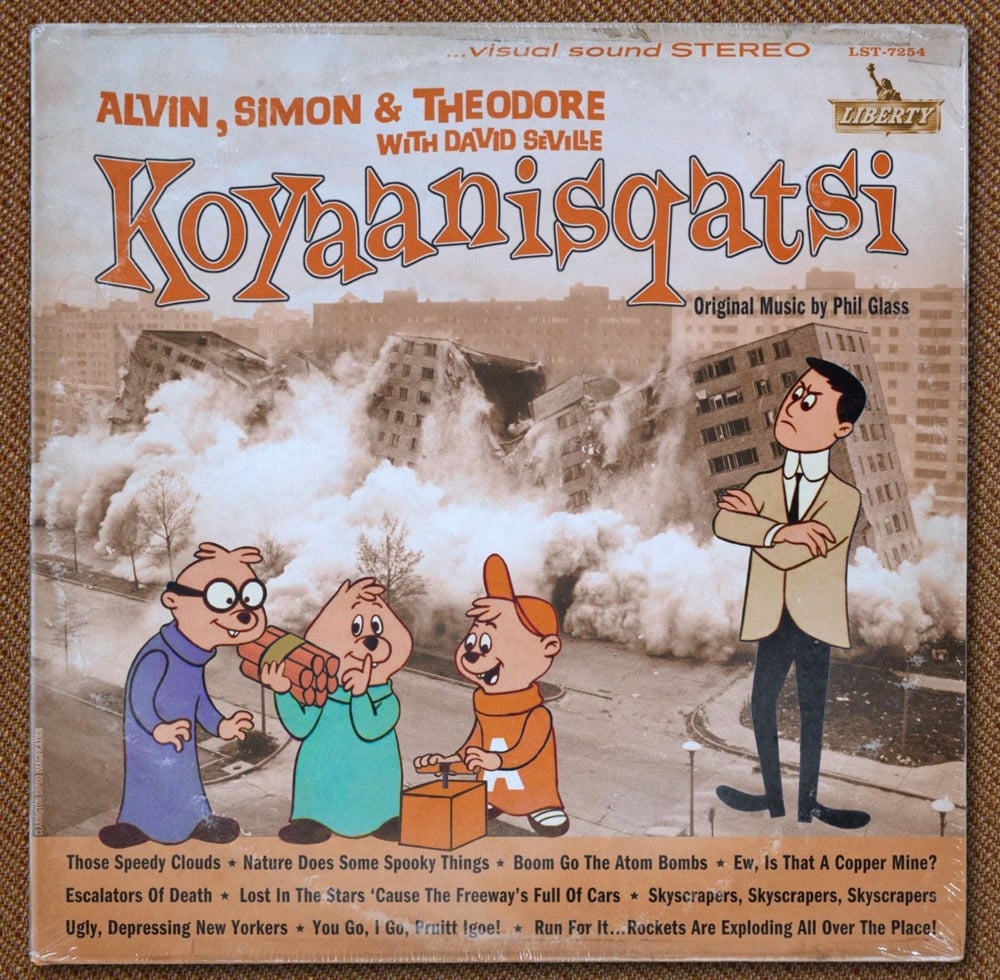
This album cover was tweeted out the other day by Philip Glass’s official account with no additional comment. What really makes it IMO is the song titles listed at the bottom of the cover: Those Speedy Clouds, Escalators of Death, Run For It…Rockets Are Exploding All Over the Place!
I tried to track down who made this, but the only other instance I could find online was on Philip Glass’s Instagram exactly one year ago. Koyaanisqatsi is a serious work of art — it’s refreshing to see how playful Glass is about its representation. You could imagine other artists/musicians not being so chill about it.
Update: Aha, designer Cris Shapan made this. (via @jdpbbank)
Update: Here’s a short snippet of what this album might sound like.

In 1970, right in the middle of his minimalist period, Philip Glass composed a work called Music in Eight Parts. It was performed a few times and then lost to the sands of time.
It’s theorized that after Glass’s 1975 opera Einstein on the Beach landed the composer in a fair amount of debt, Glass was forced to sell a number of scores. In Glass’s archive, only fragmentary sketches of MUSIC IN EIGHT PARTS remained as evidence of the piece’s existence. Glass “never intended this early music to last” and yet these pieces have ended up being some of his most appreciated. MUSIC IN EIGHT PARTS is immediately recognizable as being of Glass’s minimalist musical language in full stride and it is played with absolute mastery by the specialists of this repertoire.
The manuscript was rediscovered in 2017 and plans were made to perform the work in a series of European concerts. The pandemic intervened, so several members of the Philip Glass Ensemble each recorded their parts at home and they’ve released a recording online (Spotify, Apple Music).
You can see some of the individual recordings in the middle part of this video:
The cover art is by Sol LeWitt, who used to send Glass random $1000 checks. See also a writeup of the music in the NY Times, listen to a snippet of an archival performance of the piece from the 70s, and the manuscript itself, which sold at auction in 2017 for $43,750.

One of my favorite video series is Estelle Caswell’s Earworm for Vox — you can check out my posts about it here. It had been a few months since the last episode, so I went to see if she’d made any other videos in the meantime and, lo, Caswell produced a video about the Metropolitan Opera’s production of the opera Akhnaten by Philip Glass, one of my favorite composers.
The video above gives a behind-the-scenes look at the Metropolitan Opera’s production of Akhnaten. We follow Anthony Roth Costanzo, who plays Akhnaten, through the various phases of rehearsal, from working with his vocal coach in a Manhattan apartment to taking the stage for a dress rehearsal in a costume covered in doll heads.
I’ve only seen one opera at the Met (years ago) and was blown away by the production. I remember walking out of there thinking, “Do people know how good this is? Why isn’t opera a massive thing?” (Although I guess I answered my own question by not ever going back?)
From the NY Times, Philip Glass Is Too Busy to Care About Legacy.
“I’m pragmatic,” Mr. Glass said. “I don’t know what’s going to happen in 10 years. We don’t even get to know what’s going to happen after someone dies. We need to wait until everyone who knew them is dead, too.”
If that’s true, it won’t be until nearly 2100 when a full measure of Mr. Glass’s footprint will be possible. But some weighing can start now. The most instantly recognizable voice in contemporary music, he opened a new chapter in operatic history, pushing the bounds of duration and abstraction. At a time when the most lauded composers disdained overproduction, Mr. Glass wrote unashamedly for everyone and everything — and all stubbornly in the distinctive style he created, establishing a model for serious artists moving from the opera house to the concert hall to the film studio, garnering both Met commissions and Academy Award nominations.
But if the question is whether, a century from now, his operas will get new productions, his symphonies will circulate more frequently, or pianists will take on his études, Mr. Glass couldn’t care less.
“I won’t be around for all that,” he said. “It doesn’t matter.”
Austin Kleon expanded on this piece with some thoughts about lineage vs legacy.
I like this idea of thinking about lineage vs. legacy, because it means you can sort of reframe any worrying about immortality and how you’re going to project yourself into the future, and think more about what you’re taking from the past and what you’re adding to it that creates a more interesting and helpful present.
It turns out that the fourth track off of Philip Glass’ soundtrack for Koyaanisqatsi matches up pretty well to the dancers in this clip from Soul Train.
I don’t know whether to like this or hate it. Actually, I think I love it. See also Soul Train dancers backed by Daft Punk. (via @tedgioia)
Koyaanisqatsi is a 1982 experimental film by Godfrey Reggio with a soundtrack from Philip Glass. The movie has no dialogue or narrative and mainly features slow motion and time lapse footage of nature, technology, and cities.
Rico Monkeon has built a tool called Gifaanisqatsi that constructs the trailer for Koyaanisqatsi using a random assortment of slow motion and time lapse animated GIFs from Giphy. The trailer you get is different each time. You can compare it to the actual trailer.
I wondered how easy it would be to make an internet version using random Giphy ‘gifs’ which have been tagged as slow motion or time-lapse, playing them along with the Philip Glass soundtrack.
I *love* this and have watched at least 5 or 6 different trailers now…the slow motion cats and dogs are best. I recorded one of the trailers it generated for me:
I miiiiight just want to watch a feature-length version of this accompanied by the full soundtrack.
I enjoyed reading Lolade Fadulu’s interview with Philip Glass about the composer’s early life and how he made a living in NYC before being able to fully support himself with his music (which didn’t happen until he was in his early 40s). As a boy, his mother made sure he got a musical education and his job at his father’s record store exposed him to the idea that people paid money for art:
To this day, among my earliest memories was someone would give my father $5 and he’d hand them a record. So the exchange of money for art, I thought that was normal. I thought that’s what everybody did. I never thought there was anything wrong about making money.
As an adult, Glass worked odd jobs (plumber, mover, cab driver) to have the independence to work on his music:
I had an ensemble at the time. I would go out and play for three weeks. We would come back from the tour, and we usually had lost money so I had to make money immediately. I put an ad in the paper. My cousin and I ran the company, and I moved furniture for about three or four or five weeks. Then I went on tour again. Again, we lost money.
That went on for years. I thought it was going to go on for the rest of my life, actually. It never occurred to me that I would be able to make a living, really, from writing music. That happened kind of by accident.
I was interested in jobs that were part-time, where I had a lot of independence, where I could work when I wanted to. I wasn’t interested in working in an office where everything would be very regimented.
As his musical career took off, Glass continued to take his other work seriously. From a 2001 profile of Glass in The Guardian:
Throughout this period, Glass supported himself as a New York cabbie and as a plumber, occupations that often led to unusual encounters. “I had gone to install a dishwasher in a loft in SoHo,” he says. “While working, I suddenly heard a noise and looked up to find Robert Hughes, the art critic of Time magazine, staring at me in disbelief. ‘But you’re Philip Glass! What are you doing here?’ It was obvious that I was installing his dishwasher and I told him I would soon be finished. ‘But you are an artist,’ he protested. I explained that I was an artist but that I was sometimes a plumber as well and that he should go away and let me finish.”
But after Einstein on the Beach dazzled critics at the Metropolitan Opera, Glass’s days in the driver’s seat of a cab were limited:
The day after the performance, Glass was back driving his taxi: “I vividly remember the moment, shortly after the Met adventure,” he says, “when a well-dressed woman got into my cab. After noting the name of the driver, she leaned forward and said: ‘Young man, do you realise you have the same name as a very famous composer’.”
Glass is my favorite composer, but as much as I love his music, I might appreciate the way he has approached his work and career almost as much.
Despite the glowing reviews, I haven’t seen Jane, the National Geographic documentary about Jane Goodall…hopefully this week. But I discovered the soundtrack on Spotify this morning, composed by Philip Glass:
It’s also available on Amazon and iTunes.
As a young woman, Jane Goodall began a life-long study of wild chimpanzees that revolutionized our understanding of primate behavior. Jane, a documentary produced by National Geographic and directed by Brett Morgen (The Kids Stays in the Picture, Kurt Cobain: Montage of Heck), tells the story of Goodall’s life, especially her early forays into chimpanzee cultures in Tanzania. The backbone of the film is over 100 hours of 16mm footage that’s been locked away in the National Geographic archives for 50 years.
Philip Glass did the score and the early reviews are very positive. (thx, meg)
I’m currently listening to Philip Glass: Piano Works by Víkingur Ólafsson.
Compare with Glass’s own take on the Études. The NY Times recently interviewed Ólafsson about Glass and other things.
Mr. Olafsson’s version is often more atmospheric. Although the ‘Etude comprises a series of repeated phrases, he doesn’t settle into any patterns. He treats Mr. Glass’s music like a sculpture, worth studying from all angles in search of new interpretations and surprises.
“I came to the conclusion that it’s not a repetition,” Mr. Olafsson said of Mr. Glass’s music. “It’s a rebirth. It’s not treading the same path, but traveling in a spiral. That’s the image I have.”
From a new Kickstarter publication called The Creative Independent, Philip Glass was interviewed about the importance of artists owning their work and getting paid for it.
My personal position was that I had wonderful parents. Really wonderful people. But my mother was a school teacher. My father had a small record shop in Baltimore. They had no money to support my career. I began working early. You’re too young to know this, but when you get your first Social Security check, you get a list of every place you’ve worked since you began working. It’s fantastic! I discovered that I was working from the time I was 15 and putting money into the Social Security system from that age onward. I thought it was much later. No, I was actually paying money that early.
The point is that I spent most of my life supporting myself. And I own the music. I never gave it away. I am the publisher of everything I’ve written except for a handful of film scores that the big studios paid. I said, “Yeah, you can own it. You can have it, but you have to pay for it.” They did pay for it. They were not gifts.
A lot in this interview resonates, including this:
It’s never been easy for painters, or writers, or poets to make a living. One of the reasons is that we, I mean a big “We,” deny them an income for their work. As a society we do. Yet, these are the same people who supposedly we can’t live without. It’s curious, isn’t it?
And this bit about making work vs performing (italics mine):
What happens, is that the artists are in a position where they can no longer live on their work. They have to worry about that. They need to become performers. That’s another kind of work we do. I go out and play music. The big boom in performances is partly because of streaming, isn’t it? We know, for example, that there are big rock and roll bands that will give their records away free. You just have to buy the ticket to the concert. The cost of the record is rather small compared to the price of the ticket. It’s shifted around a little bit; they’re still paying, but they’re paying at the box office rather than at the record store. The money still will find its way.
Then you have to be the kind of person who goes out and plays, and some people don’t.
I’ve been thinking a lot about the economics of writing online. Making a comfortable living only by writing is tough and very few independents are able to do it. More successful are those who are able to get away from writing online by speaking at conferences, writing books, starting podcasts, selling merchandise,1 post sponsored tweets and Instagram photos, building apps, consulting for big companies, etc. This stuff is the equivalent of the band that tours, sells merch, composes music for TV commercials, etc. But as Glass said, what about those who just want to write? (And I count myself among that number.) How can we support those people? Anyway, more on this very soon (I hope).
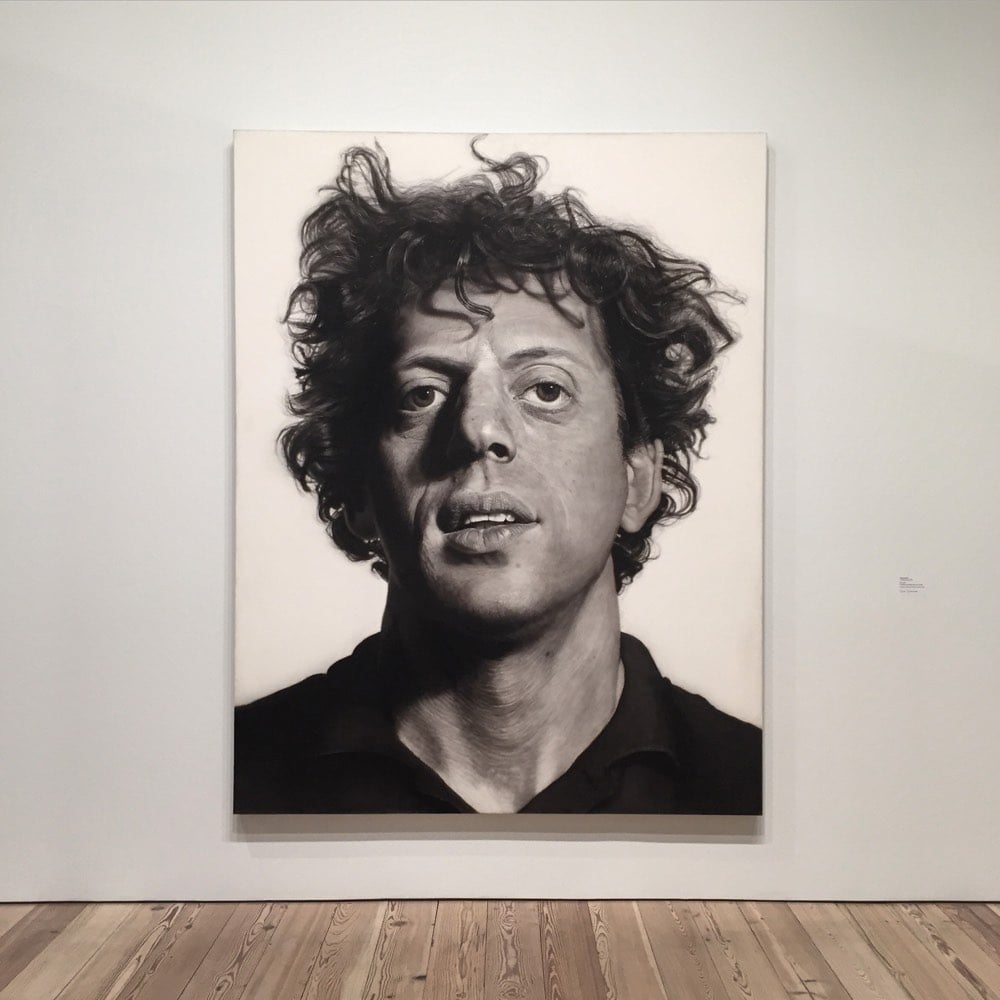
Photo is of a Chuck Close painting of Philip Glass taken by me at The Whitney.
The series of Marvel movies — X-Men, Avengers, Spider-Man, etc. — is the highest grossing film series of all time but the films’ music is largely forgettable and bland in a way that it isn’t in Star Wars, James Bond, or Harry Potter. In this video, the Every Frame a Painting gang explores why that is: partially a trend toward movie music not designed to be noticed and also the use by directors of temporary music that unduly influences the final score. All the Marvel movies run together for me (aside from Guardians of the Galaxy, which had distinctive music in it, I can’t recall a single scene from any one of the more recent films) and perhaps the music is one reason.
There’s a follow-up video to the one above composed of clips of movies played with their temp music followed by the same clips with the final music, which is nearly identical.
They’ve also started a Twitter account highlighting the influence of temp music on final scores.
These videos have me wondering…was Carter Burwell’s score for Carol influenced by temp music, specifically Philip Glass’ score for The Hours? This interview in Rolling Stone and the FAQ on his site suggest not:
It’s his ability to make music that compliments a scene rather than eclipse it that has made him an invaluable creative partner to filmmakers who work in such intense melodramatic registers, and Burwell is emphatic that his scores aren’t responsible for all of the emotional heavy-lifting. “As a listener, I do not like being instructed,” he says, emphatically. “It riles me when the music tells me something before I can figure it out for myself. In fact, I enjoy the discomfort of not being sure how to take something.” It’s the reason why he loathes listening to the temp music that directors often attach to rough cuts in order to point composers in the right direction.
But the similarities are there, so who knows?
Update: I forgot to mention that Stanley Kubrick ended up ditching the original score written for 2001 and sticking with the temp music, which were the classical compositions by Strauss et al. that we’re so familiar with today.
Update: In a video response, Dan Golding shows how temp music is not a recent Hollywood obsession…even the famous Star Wars theme was greatly influenced by temp music:
He questions that the pull of temp music by contemporary directors and composers is sufficient to explain why movie music is now so uninspiring:
Film music is an embrace of rampant unoriginality, and to think about how film music works, we need to think of new ways to talk about these questions, rather than just saying, “it’s a copy”.
Golding pins the blame primarily on technology but also on composers and filmmakers drawing from fewer and less diverse sources. Interestingly, this latter point was also made by Every Frame a Painting’s Tony Zhou in a recent chat with Anil Dash, albeit about originality in video essays. A lightly edited excerpt:
My advice to people has always been: copy old shit. For instance, the style of Every Frame a Painting is NOT original at all. I am blatantly ripping off two sources: the editing style of F for Fake, and the critical work of David Bordwell/Kristin Thompson, who wrote the introductory text on filmmaking called Film Art. I’ve run into quite a few video essays that are trying to be “like Every Frame a Painting” and I always tell people, please don’t do that because I’m ripping of someone else. You should go to the source. When any art form or medium becomes primarily about people imitating the dominant form, we get stifling art.
If you look at all of the great filmmakers, they’re all ripping someone off but it was someone 50 years ago. It rejuvenated the field to be reminded of the history of our medium. And I sincerely wish more video essayists would rip off the other great film essayists: Chris Marker, Godard, Agnès Varda, Thom Andersen. Or even rip off non-video essayists. I would kill to see someone make video essays the way Pauline Kael wrote criticism. That would be my jam!
ps. Also! Hans Zimmer — composer of film scores for Gladiator, Interstellar, Inception, The Dark Knight, etc. — was the keyboard player in the Buggles’ Video Killed the Radio Star music video. WHAT?!
In this clip from Koyaanisqatsi, Andy Kelly replaced Philip Glass’ score with music from the Wii Shop Channel. As he notes, the movie doesn’t seem quite as haunting now. (via @daveg)
Older posts



Socials & More