Entries for March 2014
vintage post from Mar 2014
· gift link
I don’t know exactly what my expectations were of how lettering is painted on city streets, but this was not it. The level of precision and artistry is surprising.
Reminds me of this video of a hand-lettering master at work.
Update: Sure, he’s using a vehicle, but this guy is pretty good at line painting as well.
A Clint Mansell soundtrack for a Darren Aronofsky film? Hell. Yes.
Mansell also did the soundtracks for Moon (my favorite of his, I think) and Requiem for a Dream. The Noah soundtrack is available for purchase on iTunes and Amazon.
Michael Lewis (The Big Short, Liar’s Poker) is back with another book about the financial markets: Flash Boys: A Wall Street Revolt. It’s the story of high-frequency trading and the traders who are fighting against it.
Flash Boys is about a small group of Wall Street guys who figure out that the U.S. stock market has been rigged for the benefit of insiders and that, post-financial crisis, the markets have become not more free but less, and more controlled by the big Wall Street banks. Working at different firms, they come to this realization separately; but after they discover one another, the flash boys band together and set out to reform the financial markets. This they do by creating an exchange in which high-frequency trading-source of the most intractable problems-will have no advantage whatsoever.
The characters in Flash Boys are fabulous, each completely different from what you think of when you think “Wall Street guy.” Several have walked away from jobs in the financial sector that paid them millions of dollars a year. From their new vantage point they investigate the big banks, the world’s stock exchanges, and high-frequency trading firms as they have never been investigated, and expose the many strange new ways that Wall Street generates profits.
From a Bloomberg article about the book:
His latest target, high-frequency trading, comprises a diverse set of software-driven strategies that have spread from U.S. equity markets to most developed countries as computer power grew and regulators tried to break the grip of centralized exchanges. While the tactics vary, they usually employ super-fast computers to post and cancel orders at rates measured in thousandths or even millionths of a second to capture price discrepancies on more than 50 public and private venues that make up the American equities market.
I don’t know too much about it but from what I’ve read, high-frequency trading seems to involve huge Wall Street banks using the Office Space/Richard-Pryor-in-Superman-III trick of shaving fractions of a penny off of trillions of trades every year, except that it’s perfectly legal. The NY Times has an excerpt of the book to further whet your appetite.
Recent discoveries in Brazil that humans were present in South America as early as 22,000 years ago has contributed to the growing belief that the Clovis First hypothesis is wrong.
Researchers here say they have unearthed stone tools proving that humans reached what is now northeast Brazil as early as 22,000 years ago. Their discovery adds to the growing body of research upending a prevailing belief of 20th-century archaeology in the United States known as the Clovis model, which holds that people first arrived in the Americas from Asia about 13,000 years ago.
“If they’re right, and there’s a great possibility that they are, that will change everything we know about the settlement of the Americas,” said Walter Neves, an evolutionary anthropologist at the University of Sao Paulo whose own analysis of an 11,000-year-old skull in Brazil implies that some ancient Americans resembled aboriginal Australians more than they did Asians.
Up and down the Americas, scholars say that the peopling of lands empty of humankind may have been far more complex than long believed. The radiocarbon dating of spear points found in the 1920s near Clovis, N.M., placed the arrival of big-game hunters across the Bering Strait about 13,000 years ago, long forming the basis of when humans were believed to have arrived in the Americas.
More recently, numerous findings have challenged that narrative. In Texas, archaeologists said in 2011 that they had found projectile points showing that hunter-gatherers had reached another site, known as Buttermilk Creek, as early as 15,500 years ago. Similarly, analysis of human DNA found at an Oregon cave determined that humans were there 14,000 years ago.
It’s Saturday Sunday Night Live! Here’s Louis C.K.’s monologue from last night’s SNL; it’s 8 minutes of his trademark stand-up.
Legendary designer Milton Glaser (of I❤NY fame) critiques craft beer labels.

(via @bn2b)
Well, I don’t even have the words to describe what this is; you just have to watch it. Preferably in fullscreen at full resolution. Takes about 30 seconds to get going but once it does………dang. Breathtaking is not a word I throw around after every TED Talk or Milky Way time lapse, but I will throw it here.
More on the hows and whys the video was made on Vimeo and the director’s site.
Errol Morris has directed a new series of Taco Bell commercials where a bunch of ordinary men named Ronald McDonald review Taco Bell’s new breakfast menu. Here’s one of the spots:
Looking forward to this one: a cocktail recipe book from Death & Co, an East Village cocktail joint.
Featuring hundreds of recipes for signature Death & Co creations as well as classic drink formulas,Death & Co is not only a comprehensive collection of the bar’s best, but also a complete cocktail education. With chapters on the theory and philosophy of drink-making; a complete guide to the spirits, tools, and other ingredients needed to make a great bar; and specs for nearly 500 iconic drinks, Death & Co is destined to become the go-to reference on craft cocktails.
For her Uncomfortable Project, Katerina Kamprani redesigned useful objects; they’re still technically functional but are a pain in the ass to use. Like this key:
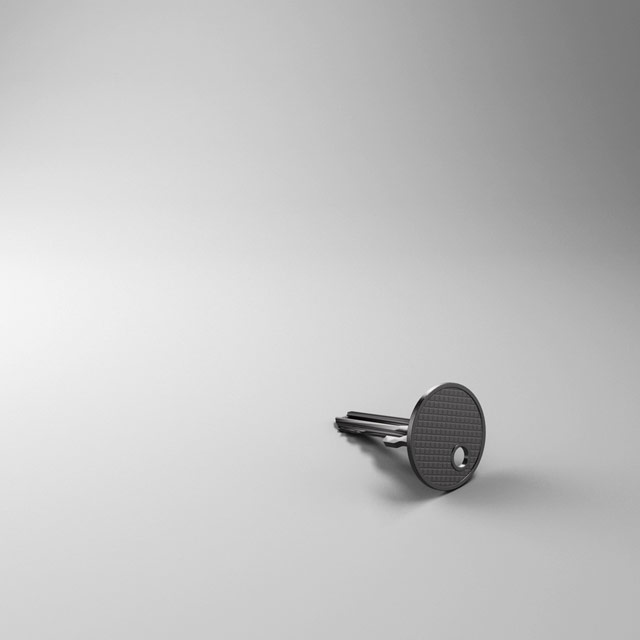
Or this awkward broom:

Errol Morris’ documentary about Donald Rumsfeld, The Unknown Known, comes out next month. The trailer:
In the first of a four-part companion series to the movie for the NY Times, Morris explores The Certainty of Donald Rumsfeld.
When I first met Donald Rumsfeld in his offices in Washington, D.C., one of the things I said to him was that if we could provide an answer to the American public about why we went to war in Iraq, we would be rendering an important service. He agreed. Unfortunately, after having spent 33 hours over the course of a year interviewing Mr. Rumsfeld, I fear I know less about the origins of the Iraq war than when I started. A question presents itself: How could that be? How could I know less rather than more? Was he hiding something? Or was there really little more than met the eye?
The Unknown Known has been referred to as a sequel of sorts to The Fog of War, but from this it seems more like its opposite. Morris got some substantive and honest answers to important questions from McNamara, whereas it sounds like he got bupkiss from Rumsfeld.
Update: Here’s part 2.
Fast Company talked to a number of ex-Pixar employees about how they are using lessons learned at Pixar in their new endeavors.
“Delight” may be an intangible concept, but it’s a useful term to describe Pixar’s relationship with its audience, and one that any company can strive for even if they don’t make heartwarming cartoons.
It seems counterintuitive that simple pleasure would be a core principle of something as elaborate as a Pixar production, but Suzanne Slatcher says she has translated this idea directly to her new career.
“Food is a bit like cartoons,” says Slatcher. “It’s not some high-minded thing that people will make themselves like because they think they ought to. The food has to work on that very simple level of just someone is watching TV and they’re shoving it in their mouths.”
The idea that “everybody deserves quality” is a fundamental Pixar concept that Slatcher applies equally to snack foods.
“Pixar makes amazing, beautiful, hilarious, deep, wise films for kids, and adults can watch them and everybody watches them 25 times if they’ve got kids, and it’s still funny. It’s really, really great quality, where most things made for kids are made very cheaply. A lot of time and money is spent making the most accessible thing possible, and that’s such an inspiration and so not what you learn at art school,” Slatcher says. “The Good Bean could choose to be the darlings of the foodie world, using obscure, exotic spices, trying to be clever, but we’d rather make affordable, accessible food.”
Photographer Ernest Goh documents chicken beauty pageants in Malaysia. Gorgeous photos, gorgeous animals.
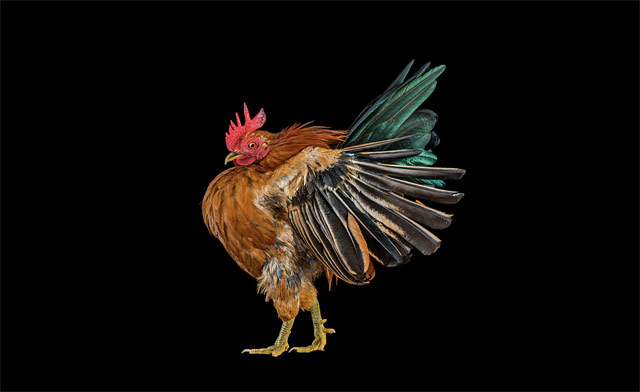
(via colossal)
In remote areas of Vietnam where there are no bridges across rivers, people are loaded into plastic bags and swum across by men strong enough to brave the current.
(via quora)
vintage post from Mar 2014
· gift link
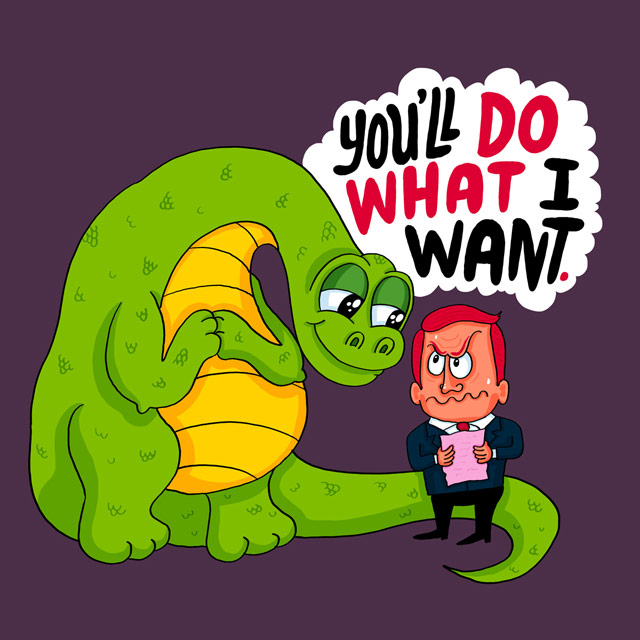
I read this piece by Jessica Winter a few months ago and it’s come in handy a few times so I thought I’d share. If you want something from someone, adopting the pose of the Kindly Brontosaurus might go a lot further than throwing a fit.
A practitioner, nay, an artist, of the Kindly Brontosaurus method would approach the gate agent as follows. You state your name and request. You make a clear and concise case. And then, after the gate agent informs you that your chances of making it onto this flight are on par with the possibility that a dinosaur will spontaneously reanimate and teach himself to fly an airplane, you nod empathically, say something like “Well, I’m sure we can find a way to work this out,” and step just to the side of the agent’s kiosk.
Here is where the Kindly Brontosaurus rears amiably into the frame. You must stand quietly and lean forward slightly, hands loosely clasped in a faintly prayerful arrangement. You will be in the gate agent’s peripheral vision-close enough that he can’t escape your presence, not so close that you’re crowding him-but you must keep your eyes fixed placidly on the agent’s face at all times. Assemble your features in an understanding, even beatific expression. Do not speak unless asked a question. Whenever the gate agent says anything, whether to you or other would-be passengers, you must nod empathically.
Continue as above until the gate agent gives you your seat number. The Kindly Brontosaurus always gets a seat number.
Note: Illustration by Chris Piascik.
Have you guys read the latest parenting study? The New Yorker Sarah Miller has the scoop: Parents have had enough of parenting studies.
Paul Nickman, forty-five, was taking a coffee break at his Visalia, California, law office when he began to leaf through an article about the importance of giving kids real challenges. “They mentioned this thing called grit, and I was like, ‘O.K, great. Grit.’ Then I started to think about how, last year, I’d read that parents were making kids do too much and strive too hard, and ever since then we’ve basically been letting our kids, who are ten and six, sit around and stare into space.” Nickman called his wife and started to shout, “Make the kids go outside and get them to build a giant wall out of dirt and lawn furniture and frozen peas!”
You have solar on your roof, a hybrid in your garage, and wind, water, nuclear, and natural gas all being pushed by various companies and interest groups. But, now, and for the foreseeable future, you’ve also got coal. And lots of it. Wired’s Charles C. Mann lays it out:
A lump of coal is a thoroughly ubiquitous 21st-century artifact, as much an emblem of our time as the iPhone. Today coal produces more than 40 percent of the world’s electricity, a foundation of modern life. And that percentage is going up.
That reality is bad news for the environment and climate change, and it leaves us with a big question: How do we minimize the damage?
People collect everything. Even old nail polish.
The objects of their desire — what they track on eBay, rhapsodize about on their blogs and search for in faraway lands — are bottles of old nail polish. More specifically, discontinued varieties that come in colors no longer available but that are still out there, sitting forgotten on the shelves of manicurists and out-of-the-way stores, just waiting to be found by some lucky lemming who will add them to her collection, cherish them and post them on Instagram for other members of this unlikely subculture.
One white whale for those in the know is Starry Starry Night by Essie, often abbreviated SSN. The navy blue pigment, spangled with silver glitter, is beloved for its “buildability,” meaning that in just a few coats one can achieve an alluring depth.
The vocabulary around nail polish collecting is as colorful as the polishes themselves: “lemmings”, “unicorn pee”, “frankensteining”, “lacquerhead”, “dusty hunting”.
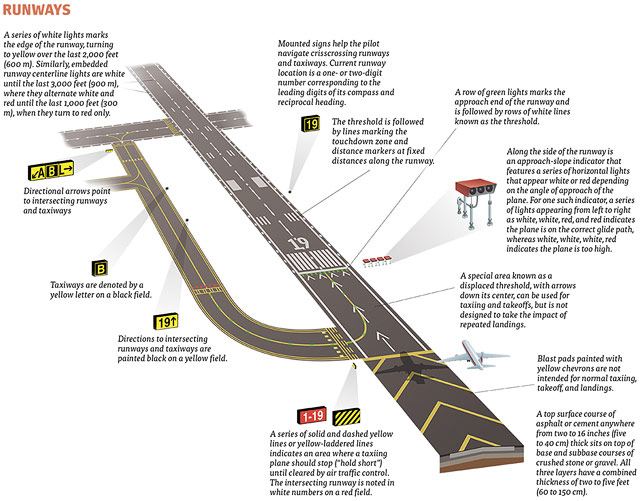
Kate Ascher, author of the great The Works: Anatomy of a City, has a new book out about transportation. The Way to Go explores how global transportation works, from how car engines work to the ocean routes travelled by huge cargo ships. Slate has an excerpt.
Focusing on the machines that underpin our lives, Ascher’s The Way to Go also introduces the systems that keep those machines in business — the emergency communication networks that connect ships at sea, the automated tolling mechanisms that maintain the flow of highway traffic, the air control network that keeps planes from colliding in the sky. Equally fascinating are the technologies behind these complex systems: baggage tag readers that make sure people’s bags go where they need to; automated streetlights that adjust their timing based on traffic flow; GPS devices that pinpoint where we are on earth at any second. Together these technologies move more people farther, faster, and more cheaply than at any other time in history.
Ordered. The kids are going to love this one…it’s like a more grown-up version of Richard Scarry’s Cars and Trucks and Things That Go.
Joe Sabia has built The Office Time Machine, which is a collection of video clips of every single cultural reference ever made in The Office, organized by year. For example, here is 1994:
Sabia built it to highlight how much artists and creators borrow from culture:
The Office is relatable (and hilarious) because it borrows so much from culture, and people get the references. Culture is society’s collected knowledge, art, and customs. It’s what surrounds us and unites us, and it allows us to collectively laugh at a joke in The Office about Ben Franklin or M. Night Shyamalan. Culture, simply put, is the seasoning in a meal.
(via waxy)
A cool short documentary about neon sign making, a dying industry in Hong Kong.
As Jonathan Hoefler notes, the letters are designed so that the designers don’t burn their hands while bending the glass over an 800°C flame.
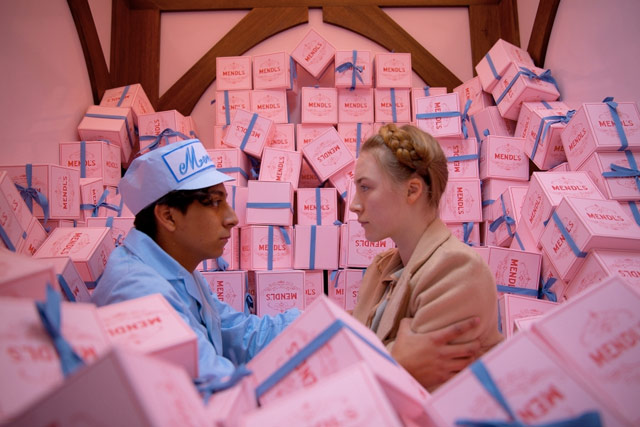
The Grand Budapest Hotel is Wes Anderson’s most design-y film, and that’s really saying something. Typography is present in almost every frame; at times, it was almost oppressive. Creative Review interviewed designer Annie Atkins, who was responsible for the film’s graphic design elements.
Oh my goodness, so many signs in the 1960s hotel lobby! I have to give credit to Liliana for this work, as she took care of nearly all of these. She had three sign-writers from Berlin painting non-stop for a week to get them all done in time for our first day of shoot, as that set was first up. Wes and Adam had seen so many examples of quite officious signage in what had been communist East Germany — don’t do this, don’t do that, do this but only like that! The signs really added to the claustrophobic feeling of that set, and Wes had asked for them all to be black with simple white hand-painted lettering — based on the style of the old sign at Yorckstrasse subway station in Berlin.
In 1988, India had over 200,000 cases of polio reported. For the past three years, they’ve had 0. At the end of this month, the WHO will announce the end of polio in India.
America experienced the height of polio in the 1940s and ’50s, when about 35,000 people became disabled every year. Fear and panic spread and parents were known to warn their children to not drink from public water fountains, avoid swimming pools and stay away from crowded public places like movie theaters. Perhaps the most famous case of polio in America was Franklin Delano Roosevelt, the first president with a significant physical disability.
The development of the Salk and Sabine vaccines helped lead to eradication of polio in the United States in 1979. In India, too, vaccination was critical.
“There were three keys to our success,” Kapur says. “Immunize, immunize and immunize.”
Vaccines. And now my kids don’t die.
The reboot of Cosmos has been solid but not spectacular so far, but the second episode contains as solid and clear an explanation of evolution as I’ve ever seen.
Even if evolution clashes with your world view, this is worth watching if only to understand what you’re aligned against (per Bret Victor’s advice). The third episode airs on Fox tonight and is about the creation of the scientific method.
Don’t do your kid’s homework. Try not to even help them that much. It’s better for their development. And it’s better for you not to have to relive your school years. That seems like sensible advice. Until all the other parents in the school start helping their kids on their homework. That’s when you’ll be tempted. But still, really, don’t.
What they found surprised them. Most measurable forms of parental involvement seem to yield few academic dividends for kids, or even to backfire-regardless of a parent’s race, class, or level of education.
Do you review your daughter’s homework every night? Robinson and Harris’s data, published in The Broken Compass: Parental Involvement With Children’s Education, show that this won’t help her score higher on standardized tests. Once kids enter middle school, parental help with homework can actually bring test scores down, an effect Robinson says could be caused by the fact that many parents may have forgotten, or never truly understood, the material their children learn in school.
Ed Catmull has written a book about Pixar’s creative process: Creativity, Inc.
Creativity, Inc. is a book for managers who want to lead their employees to new heights, a manual for anyone who strives for originality, and the first-ever, all-access trip into the nerve center of Pixar Animation — into the meetings, postmortems, and “Braintrust” sessions where some of the most successful films in history are made. It is, at heart, a book about how to build a creative culture — but it is also, as Pixar co-founder and president Ed Catmull writes, “an expression of the ideas that I believe make the best in us possible.”
For nearly twenty years, Pixar has dominated the world of animation, producing such beloved films as the Toy Story trilogy, Monsters, Inc., Finding Nemo, The Incredibles, Up, and WALL-E, which have gone on to set box-office records and garner thirty Academy Awards. The joyousness of the storytelling, the inventive plots, the emotional authenticity: In some ways, Pixar movies are an object lesson in what creativity really is. Here, in this book, Catmull reveals the ideals and techniques that have made Pixar so widely admired — and so profitable.
Catmull was a founder of Pixar and while he never got the press Jobs and Lasseter did, he was instrumental in the company’s success and is currently president of both Disney and Pixar’s animation studios. Fast Company has an excerpt of the book.
Candor could not be more crucial to our creative process. Why? Because early on, all of our movies suck. That’s a blunt assessment, I know, but I choose that phrasing because saying it in a softer way fails to convey how bad the first versions really are. I’m not trying to be modest or self-effacing. Pixar films are not good at first, and our job is to make them so — to go, as I say, “from suck to not-suck.”
Think about how easy it would be for a movie about talking toys to feel derivative, sappy, or overtly merchandise driven. Think about how off-putting a movie about rats preparing food could be, or how risky it must’ve seemed to start WALL-E with 39 dialogue-free minutes. We dare to attempt these stories, but we don’t get them right on the first pass. This is as it should be. Creativity has to start somewhere, and we are true believers in the power of bracing, candid feedback and the iterative process — reworking, reworking, and reworking again, until a flawed story finds its through line or a hollow character finds its soul.
On the reading list for this weekend is Hanna Rosin’s cover story in the most recent issue of The Atlantic: The Overprotected Kid.
I used to puzzle over a particular statistic that routinely comes up in articles about time use: even though women work vastly more hours now than they did in the 1970s, mothers — and fathers — of all income levels spend much more time with their children than they used to. This seemed impossible to me until recently, when I began to think about my own life. My mother didn’t work all that much when I was younger, but she didn’t spend vast amounts of time with me, either. She didn’t arrange my playdates or drive me to swimming lessons or introduce me to cool music she liked. On weekdays after school she just expected me to show up for dinner; on weekends I barely saw her at all. I, on the other hand, might easily spend every waking Saturday hour with one if not all three of my children, taking one to a soccer game, the second to a theater program, the third to a friend’s house, or just hanging out with them at home. When my daughter was about 10, my husband suddenly realized that in her whole life, she had probably not spent more than 10 minutes unsupervised by an adult. Not 10 minutes in 10 years.
It’s hard to absorb how much childhood norms have shifted in just one generation. Actions that would have been considered paranoid in the ’70s-walking third-graders to school, forbidding your kid to play ball in the street, going down the slide with your child in your lap-are now routine. In fact, they are the markers of good, responsible parenting. One very thorough study of “children’s independent mobility,” conducted in urban, suburban, and rural neighborhoods in the U.K., shows that in 1971, 80 percent of third-graders walked to school alone. By 1990, that measure had dropped to 9 percent, and now it’s even lower. When you ask parents why they are more protective than their parents were, they might answer that the world is more dangerous than it was when they were growing up. But this isn’t true, or at least not in the way that we think. For example, parents now routinely tell their children never to talk to strangers, even though all available evidence suggests that children have about the same (very slim) chance of being abducted by a stranger as they did a generation ago. Maybe the real question is, how did these fears come to have such a hold over us? And what have our children lost — and gained — as we’ve succumbed to them?
This is a slow motion video of a hawk flying through increasingly tiny holes in a wall.
Nature, you crazy. (via @dunstan)
Khoi Vinh tells us how he really feels about coffee.
In the West, and particularly in urban centers of the United States, we’ve turned coffee into not just a daily habit, but a totem of conspicuous consumption. They are “rituals of self-congratulation” (a choice phrase I believe I read from Sam Sifton, but which I can’t seem to source) wherein we continually obsess over certain coffee purveyors or certain methods of brewing coffee - each new one more complex, more Rube Goldbergian and more comically self-involved than the previous brewing fad.
I don’t drink coffee either (don’t even like the smell), but as someone who regularly indulges in other addictions and “rituals of self-congratulation”, I don’t take issue with other people’s enjoyment of coffee…as long as I’m out of earshot when the “perfect grinder for pulling a great shot” discussion starts.
Coffee, like almost everything else these days, is a sport. Everyone has a favorite team (or coffee making method or political affiliation or design style or TV drama or rapper or comic book), discusses techniques and relives great moments with other likeminded fans, and argues with fans of other teams. The proliferation and diversification of media over the past 35 years created thousands of new sports and billions of new teams. These people turned hard-to-find nail polish into a sport. These people support Apple in their battle against Microsoft and Samsung. This guy scouts fashion phenoms on city streets. Finding the best bowl of ramen in NYC is a sport. Design is a sport. Even hating sports is a sport; people compete for the funniest “what time is the sportsball match today? har har people who like sports are dumb jocks” joke on Twitter. Let people have their sports, I say. Liking coffee can’t be any worse than liking the Yankees, can it?
No matter who you are, this is pretty funny. But if you have kids, it’s very nearly transcendent.
(via @ginatrapani)
From Retronaut, a collection of maps dating from 1000-1300s.
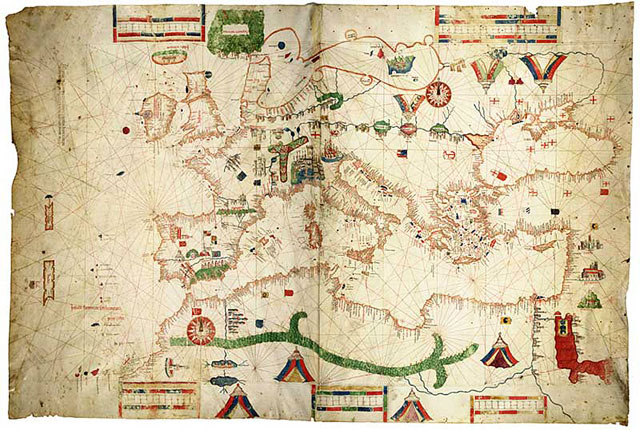
How were maps perceived 1000 years ago? Did they blow people’s minds with physically impossible views of cities, states, and continents? Could a circa-1200 scholar imagine himself looking down from several miles in the air and seeing the same thing he was seeing on a map?
I wrote a post the other day about how name-brand mattresses are a scam and lower-cost alternatives. In a 2009 interview with Terry Gross on Fresh Air, Josh Kosman provided one reason why mattresses are so expensive: private equity firms.
In the mattress industry, private equity firms bought Sealy and Simmons, the number one and number two brands by a mile. They stopped really competing against each other. They cut costs, and they raised the prices of the mattresses. They started focusing only on the top end and stopped even making mattresses really for middle-income people that cost less than $1,000. So basically simplifying this over time, as they bought Simmons and sold it to another PE firm three or four years later, and same with Sealy, the buyers — the sellers would make a lot of money, and the buyers felt, well, we can keep raising prices because there’s no competition. We own Sealy, and we own Simmons. It’s different firms, but they both have the same aim: to make a short-term profit, not to beat each other up on price. What happened over time was they couldn’t raise the prices anymore, and the prices were raised double the price of inflation, double the rate of inflation. They cut the beds in half, so you came up with no-flip mattresses. That cut their manufacturing costs, but it also…
…it also sent their earnings soaring, even though the beds don’t last as long. (thx, @gokari)
vintage post from Mar 2014
· gift link
You’ve probably seen instances of knolling without knowing there was a word for it. Knolling at the Apple Store:

Knolling the contents of your bag:

Knolling a recipe for a book:

Knolling the parts of a machine:

Knolling is the practice of organizing objects in parallel or at 90° angles. The term has been popularized by artist Tom Sachs; he picked it up from Andrew Kromelow when both were working at Frank Gehry’s furniture fabrication shop. Gehry was designing chairs for furniture company Knoll, and Kromelow would arrange unused tools in a manner similar to Knoll furniture. Hence, knolling.

Update: Things Organized Neatly is really something. Lots of knolling.
Maybe it doesn’t belong in the annals of great literature, but Seth Stevenson’s Slate piece on mattresses from November 2000 has been stuck in my brain for more than a decade. Mattresses are a scam, says Stevenson:
Is there a more maddening industry? They confuse us with silly product names (the Sealy Posturepedic Crown Jewel Fletcher Ultra Plush Pillowtop or the Sealy Posturepedic Crown Jewel Brookmere Plush?). They flummox us with bogus science (“pocketed coils”? “Microtek foundations”? “Fiberlux”?). And they weigh us down with useless features (silk damask ticking?). It’s like buying a used car, and almost as expensive — I’ve seen mattresses going for $7,000. What’s a consumer to do?
The secret to mattress shopping is that the product is basically a commodity. The mattress biz is 99-percent marketing. So just buy the cheapest thing you can stand and be done with it, because they’re pretty much all the same. And that’s all you need to know. But do read on — the world of sleep products is quite fascinating, and I’d like to share it with you.
So when I had to do some mattress shopping recently, I remembered reading a thread on Hacker News about Tuft & Needle. T&N is a start-up that, in the parlance of Silicon Valley VCs, is disrupting the mattress industry by offering products of similar quality at dramatically lower prices with an emphasis on customer service. Recode recently ran a piece on the company and their founders.
Park and Marino, who previously worked together at Los Angeles tech startup Mulu, turned to mattress-making in 2012 after Marino was disappointed by a $3,000-plus mattress. So the two posed as the owners of a small mattress store and called around to vendors to uncover the real cost of making Marino’s expensive purchase. The final calculation — a total of about $300 — confirmed their suspicions: There was significant opportunity to improve.
When I looked on Amazon, Tuft & Needle’s mattresses were, as billed, the top-rated mattresses on the site. So I bought one. (I also bought a DreamFoam bed, which is even cheaper than Tuft & Needle and also highly rated.) The beds from both companies come rolled up and vacuum packed. Once you puncture the thick plastic packaging, air comes whooshing back into the mattress, inflating to its proper size over a matter of hours. This process sounds exactly like the repressurization of an airlock from any number of sci-fi movies. As far as comfort goes, I can’t tell the difference between these beds and the $1700 memory foam mattress from Design Within Reach.
So yeah, if you’re in the market for a mattress, do some poking around…you might just save a few hundred dollars. (Note: these beds are memory foam beds, which are not everyone’s cup of tea. I switched to one several years ago and love it. YMMV.)
Update: Tuft & Needle is opening a retail location in SF. Not everyone is comfortable buying beds over the Internet I guess? (via @micahgoulart)
Update: Two months after I wrote this post, I asked people who had purchased memory-foam mattresses for their thoughts on them. The other day, Matt sent me a link to an online message board dedicated to mattresses called The Mattress Underground. One of the board’s admins did a long post comparing the choices in this category of mattress, which they referred to as “Simplified Choice Mattresses aka Disruptors, Bed In A Box, One Choice Fits All, Universal Comfort, Millennial Mattresses”. (via @mathowie)
An anonymous user of 4chan has come up with a brilliantly harebrained scheme for their personal banking. They use video game retailer GameStop as a bank.
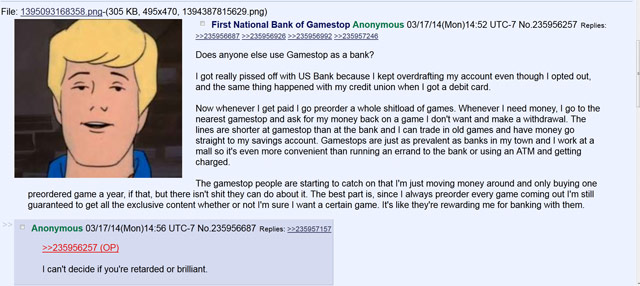
Here’s how it works: whenever a paycheck comes in, this person goes to GameStop and pre-orders a bunch of upcoming video games. Whenever they need money, they go to the GameStop and cancel a game or two to make a withdrawal. Here’s the entire scheme:
Does anyone else use Gamestop as a bank?
I got really pissed off with US Bank because I kept overdrafting my account even though I opted out, and the same thing happened with my credit union when I got a debit card.
Now whenever I get paid I go preorder a whole shitload of games. Whenever I need money, I go to the nearest gamestop and ask for my money back on a game I don’t want and make a withdrawal. The lines are shorter at gamestop than at the bank and I can trade in old games and have money go straight to my savings account. Gamestops are just as prevalent as banks in my town and I work at a mall so it’s even more convenient than running an errand to the bank or using an ATM and getting charged.
The gamestop people are starting to catch on that I’m just moving money around and only buying one preordered game a year, if that, but there isn’t shit they can do about it. The best part is, since I always preorder every game coming out I’m still guaranteed to get all the exclusive content whether or not I’m sure I want a certain game. It’s like they’re rewarding me for banking with them.
I love the bits about the trade-ins and the rewards. (via @caseyjohnston)

That is a bespoke running shoe made by a small company started by Hitoshi Mimura, who is considered one of the top shoe designers in the world. Mimura had great success at Asics, outfitting Olympic gold medal runners with shoes lighter, grippier, and more breathable than those worn by competitors, but now he has struck out on his own.
“I take 13 measurements of the foot, each foot has to be measured separately,” explains the sensei of shoemaking. “I only trust hand-measuring. Currently, each shoe takes about three weeks to make, mainly due to determining which materials to use.” Preparation is also key. “For a world championships or Olympics I check the course once or twice. I went to Beijing three times.”
A NY Times feature on Mimura written before the 2008 Olympic Games in Beijing emphasized the designer’s reliance on rice husks in the soles for grippiness. Mimura takes his job and his responsibility to the runners very seriously:
Surreptitiously, Mimura made soles of two slightly different thicknesses, to compensate for the fact that Takahashi’s left leg was eight millimeters — about a third of an inch — longer than her right leg. She had tried a pair of the uneven soles before the Sydney Olympics, but felt uncomfortable.
Still, Mimura felt Takahashi needed such shoes to win and to avoid a recurrence of pain caused by the disparity in her legs. Without Takahashi’s knowledge, Mimura gave her the uneven soles, then wrote a letter of resignation, in case she failed to win gold.
“I decided to take full responsibility because I made this pair against her wishes,” Mimura said of the letter. “I didn’t have to hand it over. It’s still in my desk.”
That is belief in yourself and in your craft. Many people believe in “giving people not what they want but what they need” but how many of them will put their livelihood on the line for it?
I love this video. Love love love. Chao-Lin Kuo surprises Andrei Linde and his wife with the news that gravitational waves were detected, proving Linde’s theory of an inflationary universe.
Love love love. (via @stevenstrogatz)
Update: Many people have asked what Kuo is saying to Linde on the doorstep. Let’s start with “5 sigma”. The statistical measure of standard deviation (represented by the Greek letter sigma) is an indication of how sure scientists are of their results. (It has a more technical meaning than that, but we’re not taking a statistics course here.) A “5 sigma” level of standard deviation indicates 99.99994% certainty of the result…or a 0.00006% chance of a statistical fluctuation. That’s a 1 in 3.5 million chance. This is the standard particle physicists use for declaring the discovery of a new particle.
The “point-2” is a bit more difficult to explain. Sean Carroll defines r as “the ratio of gravitational waves to density perturbations” as measured by the BICEP2 experiment, the telescope used to make these measurements. What BICEP2 found was an r value of 0.2:

From the brief explanation of the science behind the BICEP2 experiment:
According to the theory of Inflation, the Universe underwent a violent and rapid expansion at only 10^-35 seconds after the Big Bang, making the horizon size much larger, and allowing the space to become flat. Confirmation of Inflation would be an amazing feat in observational Cosmology. Inflation during the first moments of time produced a Cosmic Gravitational-Wave Background (CGB), which in turn imprinted a faint but unique signature in the polarization of the CMB. Since gravitational waves are by nature tensor fluctuations, the polarization signature that the CGB stamps onto the CMB has a curl component (called “B-mode” polarization). In contrast, scalar density fluctuations at the surface of last scattering only contribute a curl-free (or “E-mode”) polarization component to the CMB which was first detected by the DASI experiment at the South Pole.
The big deal with BICEP2 is the ability to accurately detect the B-mode polarization for the first time. r is the ratio between these two different types of polarization, E-mode & B-mode. Any result for r > 0 indicates the presence of B-mode polarization, which, according to the theory, was caused by gravitational waves at the time of inflation. So, that’s basically what Kuo is on about.
Update: The Atlantic’s Megan Garber spoke to Stanford’s science information officer about how the video came about.
We didn’t do any re-takes. The goal was for it to be a really natural thing. We did ask him to tell us what he was feeling and what the research means. But what you see in the video is just very off-the-cuff and raw. Part of it was, we went there not even knowing if we’d be able to use or keep anything that we did. It was just as likely that he would have been emotional in a way that he didn’t want us to share, or that his wife didn’t. So we went into it with no guarantee-we knew we’d be able to shoot, but didn’t know if we’d be able use it. So we’re thankful that they agreed to let us do that.
Finally a viral video that’s genuine and not staged or reality TV’d.
I love this rendering of an abandoned Paris Metro station reimagined as a swimming pool:

This and several other renderings were created by OXO Associates for Nathalie Kosciusko-Morizet’s Paris mayoral race. The others imagine subway stations turned into theaters, nightclubs, and underground parks.
Good advice from Mary Phillips-Sandy on what to do if you love New York but it’s bringing you down.
Avoid the following: gourmet cupcake shoppes, Times Square unless you’re on a side street and there’s a light summer rain falling, Pilates classes, H&M, any place with bottle service, Port Authority, any place where you are likely to feel self-conscious about your outfit, high-end boutiques, people whose default mode of conversation is complaints about New York, people whose default mode of conversation is industry gossip or negativity about other people’s career paths or start-ups or book deals or record deals.
Spend as much time as you can with people who are inclined (or willing) to avoid talking about how awful New York is, how hard it is, how much it costs, how it used to be better, how there are no good jobs, how it must be better someplace else. Spend time with the people you moved here to meet.
John Arlidge scores a very rare sit-down interview with Apple design chief Jony Ive for Time magazine.
He spent “months and months and months” working out the exact shape of the stand of the desktop iMac computer because “it’s very hard to design something that you almost do not see because it just seems so obvious, natural and inevitable”. When he has finished a product, even one as fresh and iconic as the white headphones that came with the first iPod, he is haunted by the idea: could I have done it better? “It’s an affliction designers are cursed with,” Ive frowns.
It was an affliction he shared with Jobs, although he seemed to apply it to everything, with — almost — funny consequences. Ive recalls traveling with Jobs. “We’d get to the hotel where we were going, we’d check in and I’d go up to my room. I’d leave my bags by the door. I wouldn’t unpack. I’d go and sit on the bed and wait for the inevitable call from Steve: ‘Hey Jony, this hotel sucks. let’s go.’”
Would have preferred more of the actual interview — lots of biographical filler in this to make it accessible for the general public — but there are good bits here and there.

This is huge: physicists have detected gravitational waves that harken back to the beginning of the universe, when it was “a trillionth of a trillionth of a trillionth of a second old”. The discovery goes a long way toward proving the inflation theory of how the universe formed.
Reaching back across 13.8 billion years to the first sliver of cosmic time with telescopes at the South Pole, a team of astronomers led by John M. Kovac of the Harvard-Smithsonian Center for Astrophysics detected ripples in the fabric of space-time — so-called gravitational waves — the signature of a universe being wrenched violently apart when it was roughly a trillionth of a trillionth of a trillionth of a second old. They are the long-sought smoking-gun evidence of inflation, proof, Dr. Kovac and his colleagues say, that Dr. Guth was correct.
Inflation has been the workhorse of cosmology for 35 years, though many, including Dr. Guth, wondered whether it could ever be proved.
If corroborated, Dr. Kovac’s work will stand as a landmark in science comparable to the recent discovery of dark energy pushing the universe apart, or of the Big Bang itself. It would open vast realms of time and space and energy to science and speculation.
Confirming inflation would mean that the universe we see, extending 14 billion light-years in space with its hundreds of billions of galaxies, is only an infinitesimal patch in a larger cosmos whose extent, architecture and fate are unknowable. Moreover, beyond our own universe there might be an endless number of other universes bubbling into frothy eternity, like a pot of pasta water boiling over.
If the results are confirmed, Guth will undoubtably win the Nobel in Physics for this soon. Phil Plait at Bad Astronomy has more on the discovery.
Update: This video of Chao-Lin Kuo (one of the principle investigators on this experiment) telling physicist Andrei Linde (a leading inflation theorist) about the result is just outstanding.
Update: Upon further review, it turns out the evidence for the gravitational waves is inconclusive. The problem? Dust on the lens, basically:
The problem comes in when the astronomers looked at things that might mimic the signal they were looking for. For example, dust (long, complex carbon-molecules that are much like fireplace soot) floating in space can look very much like the signal BICEP2 was seeking. The astronomers knew this, and used data from the ESA mission Planck to investigate it. Planck measured the amount of dust lying along the direction BICEP2 was looking, and the astronomers concluded the amount of dust in their line-of-sight was low. The signal they saw, therefore, must be from inflation.
And here’s the bummer part: They were using preliminary Planck data. When better data from Planck were released, the astronomers used that, and found that the amount of galactic dust in their view was much higher than they previously thought. That weakens their case considerably.
I don’t want to see the video of someone telling Linde “whoops!”
The very first of Marcel Duchamp’s readymades — ordinary manufactured objects that became art through a minimal artistic process — was called Bottle Rack. This is a replica housed at the Philadelphia Museum of Art:

The original piece was purchased by Duchamp at BHV, a historic Parisian department store in the 4th arrondissement. It was sold as a rack for drying bottles. Duchamp intended to finish the piece by signing his name on it, but his sister had already thrown it out.
Legend has it that Duchamp’s second readymade didn’t fare so well either. “En prévision du bras cassé” (“In advance of the broken arm”) was a snow shovel on which its title was painted. A replica of the piece was allegedly mistaken for an actual shovel at a show in Chicago and used to clear sidewalks. But perhaps Duchamp wasn’t very much put out by the mistake because the snow-clearing artist inadvertently turned the shovel into what Duchamp called a “readymade réciproque” or “reciprocal readymade”.
He said that this would be a work of art used as an everyday, readymade object, such as “using a Rembrandt as an ironing board.” The readymade took an everyday mass-produced object and treated it as art. The assisted readymade took a mass-produced reproduction of a work of art and made it into a unique commentary on that work. The reciprocal readymade took a unique work of art and treated it like a mass-produced utilitarian object.
Ah, the circle of life.
How this quad-copter shooting HD footage of a volcano erupting in Vanuatu manages to escape the flying chunks of lava is beyond me.
(via @DavidGrann)
Interviewly presents interesting Reddit AMAs in a more readable format. Compare Bill Murray’s thread on Reddit to the one on Interviewly.
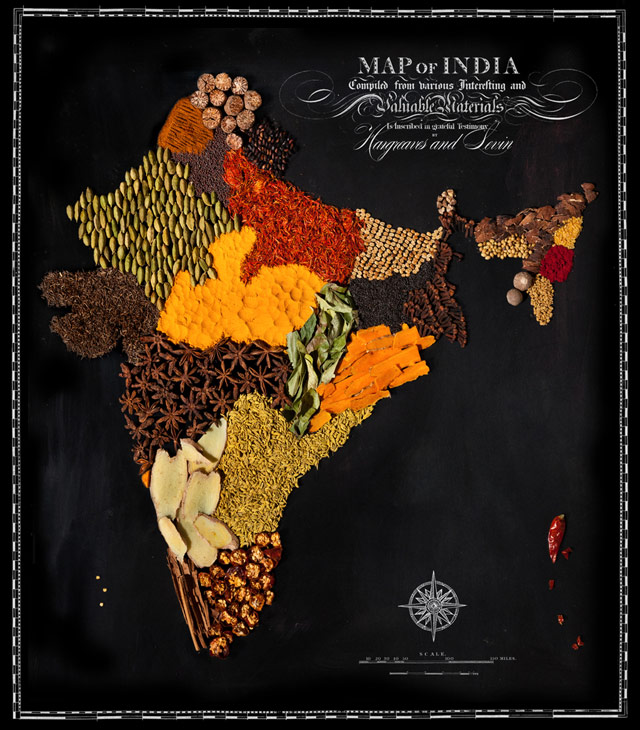
Henry Hargreaves and Caitlin Levin favor food as a medium for creating art. Their country maps made from native foods were cute at first glance, but in many cases the maps also reveal a link between a country’s food and its culture that I’d never really thought about before. For instance, the maps of India and British Isles feel very representative of their respective cultures to me:

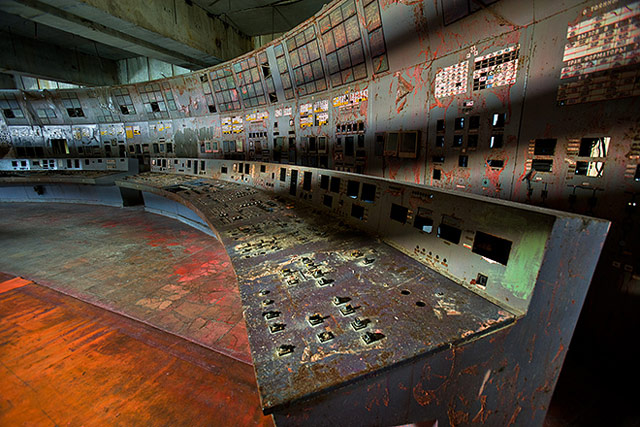
National Geographic photographer Gerd Ludwig has visited Chernobyl nine times over the past twenty years. The Long Shadow of Chernobyl is a forthcoming book collecting Ludwig’s photos, which includes an essay by Mikhail Gorbachev. The publication of the book is being funded via Kickstarter. There is also an iOS app.
Aw man, the International Center of Photography is closing its museum on 6th Ave. The good news is they’re planning on reopening in another location.
At our request for an interview, Lubell issued the following statement. “The International Center of Photography has been and continues to be at the center, both nationally and internationally, of the conversation regarding photography and the explosive growth of visual communications. In advancing this conversation, ICP has decided to move its current museum to a new space. This decision reflects the evolution of photography and our role in setting the agenda for visual communications for the 21st century. ICP will announce our future sites this spring. The school will remain at 1114 Avenue of the Americas in Midtown Manhattan.”
I’m long overdue for a visit…the Capa in Color exhibition looks promising, perhaps I’ll stop in this weekend. (via @akuban)
I’ve got a soft spot for Photoshopped architecture photos, so Zacharie Gaudrillot-Roy’s Façades series is right up my alley. Gaudrillot-Roy removes the volume of buildings until they’re left with just their façades.

(via colossal)
Mini Metro is an upcoming game in the style of Sim City, except you’re only building subway lines.
Mini Metro is an upcoming minimalistic subway layout game. Your small city starts with only three unconnected stations. Your task is to draw routes between the stations to connect them with subway lines. Everything but the line layout is handled automatically; trains run along the lines as quickly as they can, and the commuters decide which trains to board and where to make transfers.
However the city is constantly growing, along with the transport needs of its population. How long can you keep the subway system running before it grinds to a halt?
Oh man, this is great fun for transportation nerds. Site says it’ll be out in “early 2014” for PC, Mac, Linux, iPad, and Android. You can play an early version on the site or d/l an alpha version for OS X, Windows, or Linux.
Update: A public transit planning consultant evaluates Mini Metro, which because of its simplicity, simulates the experience of transit network design quite well in some cases.
We have discovered the most realistic thing about Mini Metro: If you want to win, think of these “trains” as buses.
In real rail transit systems, you cannot simply abandon a rail line and build a new one — certainly not just to handle an overcrowding problem. But to do well in Mini Metro you must revise the network repeatedly, and the last phase of the game you’ll deploy lots of one-time-only temporary lines In fact, for best results, make sure you also have a spare tunnel, so that if you have to get a train quickly to a station on an island, you can build a temporary line to a destination across the water, deleting it after use.
To a rail engineer, all this is ridiculous, but to a transit network designer, it’s the game’s most realistic feature.
Build a subway line to run one train once, then tear it out? No, this is not how rail transit works, but it’s very much how buses work, and it’s good thing, too. That’s why buses provide a much better sandbox for network design thinking. When you build powerful networks with buses, mistakes cost thousands rather than billions, so they’re more likely to be repaired. Real-life transit networks do need to evolve, usually from radial beginnings to more gridlike structures.
(via @spavis)
Shane Parrish’s excerpt and exploration of Paul Tough’s How Children Succeed: Grit, Curiosity, and the Hidden Power of Character made me want to stop everything and read the book all the way through.
“Tell me about your game,” Spiegel said. Sebastian flopped into the chair and handed her his notepad, where he’d recorded all the moves for both players in the game.
Sebastian explained that the other guy was simply better. “He had good skills,” he said. “Good strategies.”
And this is the point where many of us would simply say something along the lines of “did you do your best?,” in which case the likely response is “Yes.” Everyone is at least let off the hook. The teacher for ensuring students try their best, the student for having lost to someone better. Spiegel did not take this approach.
You may remember Tough’s 2011 piece on grit in the NY Times Magazine.
The most critical missing piece, Randolph explained as we sat in his office last fall, is character — those essential traits of mind and habit that were drilled into him at boarding school in England and that also have deep roots in American history. “Whether it’s the pioneer in the Conestoga wagon or someone coming here in the 1920s from southern Italy, there was this idea in America that if you worked hard and you showed real grit, that you could be successful,” he said. “Strangely, we’ve now forgotten that. People who have an easy time of things, who get 800s on their SAT’s, I worry that those people get feedback that everything they’re doing is great. And I think as a result, we are actually setting them up for long-term failure. When that person suddenly has to face up to a difficult moment, then I think they’re screwed, to be honest. I don’t think they’ve grown the capacities to be able to handle that.”
Older posts





Socials & More