Living in a big city, you get to hear other people’s conversations all the time. These are private conversations meant for the benefit of the participants but it’s no big deal if they’re overheard on the subway. And you know what people talk about most of the time? In no particular order:
1. What they had or are going to have for breakfast/lunch/dinner.
2. Last night’s TV or sports.
3. How things are going at work.
4. The weather.
5. Personal gossip.
6. Celebrity gossip.
Of course you’d like to think that most of your daily conversation is weighty and witty but instead everyone chats about pedestrian nonsense with their pals. In fact, that ephemeral chit-chat is the stuff that holds human social groups together.
Ever since the web hit the mainstream sometime in the 90s, people have asked of each new conversational publishing technology — newsgroups, message boards, online journals, weblogs, social networking sites, and now Twitter — the same question: “but why would anyone want to hear about what some random person is eating for breakfast?” The answer applies equally well for both offline conversation and online “social media”: almost no one…except for their family and friends.
So when you run across a Twitter message like “we had chicken sandwitches & pepsi for breakfast” from someone who has around 30 followers, what’s really so odd about it? It’s just someone telling a few friends on Twitter what she might normally tell them on the phone, via email, in person, or in a telegram. If you aren’t one of the 30 followers, you never see the message…and if you do, you’re like the guy standing next to a conversing couple on the subway platform.
P.S. And anyway, the whole breakfast question is a huge straw man periodically pushed across the tracks in front of speeding internet technology. There is much that happens on Twitter or on blogs or on Facebook that has nothing to do with small groups of people communicating about seemingly nothing. Can we just retire this stupid line of questioning once and for all?
Again, I fail to see any clear distinction between someone’s boring Twitter feed - considered only semi-literate and very much bad — and someone else’s equally boring, paper-based diary — considered both pro-humanist and unquestionably good. Kafka would have had a Twitter feed! And so would have Hemingway, and so would have Virgil, and so would have Sappho. It’s a tool for writing. Heraclitus would have had a f***ing Twitter feed.
Living with friends and colleagues would be a cheap alternative to living alone. People generally don’t do it because it’s not a good thing for humans to do. We are genetically predisposed to need time in solitude occasionally. So instead of living with your friends and colleagues, try living with their disembodied thoughts floating around on your computer and popping up on your desktop every fifteen, thirty, sixty, (manual refresh), minutes. Fellowship exists to provide us with relief from solitude and our individual pursuits. Living in a state of constant fellowship with hundreds, if not thousands of people who have known you (or not) across various stages of your life becomes an insurmountable problem the longer you try to do it.
To Tweet or Not To Tweet by Maureen Dowd of the NY Times, the essay that finally set me off in the first place:
Do you ever think “I don’t care that my friend is having a hamburger?”
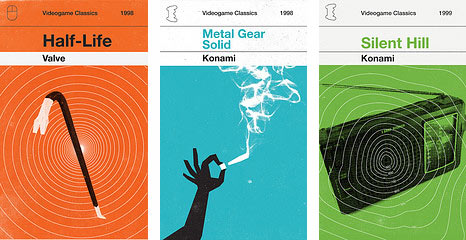
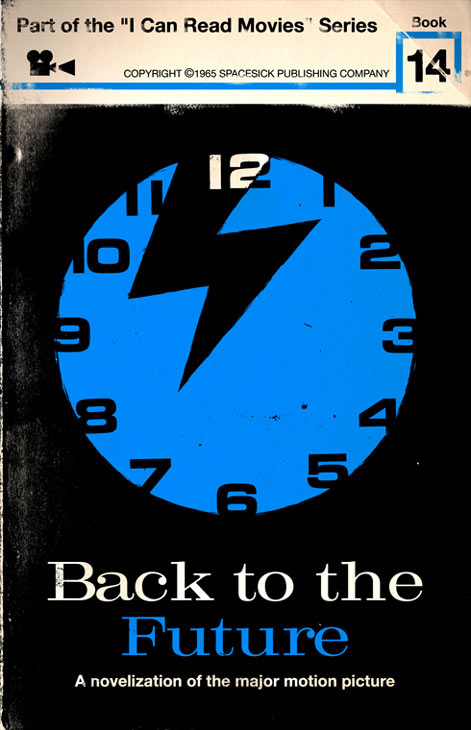
Recently a number of efforts have been made at re-imagining the packaging for movies, books, video games, and other media, mostly mashups and in the illustration style of typical of Saul Bass’ movie posters or Penguin Classics book covers. I’ve collected several examples below.
In his I Can Read Movies series, spacesick imagines Penguin-like book covers for movies like Close Encounters of the Third Kind, Sixteen Candles, and Back to the Future.
Sometimes I link to stuff only because it justifies my organizational laziness. See: Ready, aim…fail.
A few management scholars are now looking deeper into the effects of goals, and finding that goals have a dangerous side. Individuals, governments, and companies like GM show ample ability to hurt themselves by setting and blindly following goals, even those that seem to make sense at the time.
I’ll continue stumbling towards the light at the end of the tunnel, thank you very much.
The Economist is leading the charge on expensive subscriptions, and its success is one reason publishers are rethinking their approaches. It is a news magazine with an extraordinarily high cover price — raised to $6.99 late last year — and subscription price, about $100 a year on average.
Even though The Economist is relatively expensive, its circulation has increased sharply in the last four years. Subscriptions are up 60 percent since 2004, and newsstand sales have risen 50 percent, according to the audit bureau.
I’m always amazed that something as great as The New Yorker can be had for a buck an issue when people routinely pay $4 for burnt coffee, $10 for crappy movies, and $12 for -tini drinks.
Katie Kirkpatrick, 21, held off cancer to celebrate the happiest day of her life. […] Her organs were shutting down but it would not stop her from marrying Nick Godwin, 23, who was in love with Katie since 11th grade.
The last photo is just heartbreaking. (via cup of jo)
The New Yorker is being sued for $10 million over a story written by Jared Diamond. The fascinating story, Vengeance Is Ours, tells of blood feuds in New Guinea and now two of the men described in the article as participating in those feuds say they have been falsely accused of “serious criminal activity” and “murder”.
When foreigners come to our culture, we tell stories as entertainment. Daniel’s stories were not serious narrative, and Daniel had no idea he was being interviewed for publication. He has never killed anyone or raped a woman. He certainly has never stolen a pig.
I get the impression that Diamond has spent a lot of time in Papua New Guinea and, as a result, might not be taken in so easily by locals telling tall tales. Indeed, a fact-checking research team was told by one of the men in question that “the stories he told Diamond were in fact true”.
As economist Tyler Cowen boldly shows in Create Your Own Economy, the way we think now is changing more rapidly than it has in a very long time. Not since the Industrial Revolution has a man-made creation — in this case, the World Wide Web — so greatly influenced the way our minds work and our human potential. Cowen argues brilliantly that we are breaking down cultural information into ever-smaller tidbits, ordering and reordering them in our minds (and our computers) to meet our own specific needs.
Create Your Own Economy explains why the coming world of Web 3.0 is good for us; why social networking sites such as Facebook are so necessary; what’s so great about “Tweeting” and texting; how education will get better; and why politics, literature, and philosophy will become richer. This is a revolutionary guide to life in the new world.
I never properly reviewed Cowen’s last book (sorry!), but I found it as enlightening and entertaining as Marginal Revolution is. (via david archer)
His 18-year NBA career ended Tuesday night with a gruesome knee injury midway through his 1,297th game. He left the floor on a stretcher after every single teammate had surrounded him on the floor. That gesture spoke volumes about what they thought of him. He’s the funniest, smartest professional athlete you will ever meet.
Aside from the finger wagging, I always liked Mutombo. Back when I still watched college ball, Georgetown was my team and it was a lot of fun seeing Alonzo Mourning and Mutombo block all those shots. (via truehoop)
The rules are simple. Clock the racer through a measured mile, turn around and do it again, then average the two speeds. Mr. Shadle said Eagle would need 11 miles for each run: a mile to warm up to 250 miles per hour; four miles to light off the afterburner and get up to record speed; a mile in the speed trap; and five miles to stop. The vehicle must have at least four wheels - two of them steerable — and be back at the original start line within 60 minutes. And that’s it.
In America today, there are almost as many people making their living as bloggers as there are lawyers.
Understandably, Penn’s catching a bit of flack for that and statements and the numbers he uses to back them up. From Waldo Jaquith at VQR:
Penn’s thesis is that average American citizens are becoming professional bloggers, offsetting the loss in journalists, with millions enjoying a revenue stream from blogging and nearly half a million making a living at it. That’s wrong on its face. There’s simply no way there there’s more than, say, 10,000 Americans are paying for their basic life expenses purely through blogging.
Scott Rosenberg, who has done all sorts of research about blogging for his forthcoming book, reacted similarly:
Technorati’s are the longest-running and most valuable, and consistent, series of blogging studies over time, but like any study’s numbers, they can be easily misrepresented: here, Penn relies on them for the datum that bloggers who reach 100,000 uniques a month can earn $75K a year. But if you read the source, you find this:
“The average income was $75,000 for those who had 100,000 or more unique visitors per month (some of whom had more than one million visitors each month). The median annual income for this group is significantly lower - $22,000.”
In other words, the $75K average is skewed by a handful of outlier successes, but the great majority of bloggers who get 100,000 uniques/month earn more like $22,000. Here, the median is far more relevant than the average. Penn, of all people, knows this.
From my perspective as someone who does make a living blogging, Penn’s numbers, especially this 100,000 uniques —> $75K business, are misleading at best and a complete fucking lie at worst.
The Norwegian study looked at almost 2,000 online music users, all over the age of 15. Researchers found that those who downloaded “free” music — whether from lawful or seedy sources — were also 10 times more likely to pay for music. This would make music pirates the industry’s largest audience for digital sales.
Not surprising that some people are so crazy for music that they’ll *pay* for it. Crazy!
Schools are finally taking the end of print media seriously. Professor Robert Lanham is offering a class called Writing for Nonreaders in the Postprint Era that will be graded on the “Raised by Boomers, Everyone’s a Winner” system.
Throughout the course, a further paring down of the Hemingway/Stein school of minimalism will be emphasized, limiting the superfluous use of nouns, verbs, adverbs, adjectives, conjunctions, gerunds, and other literary pitfalls.
OMG, this class is totes HFACTDEWARIUCSMNUWKIASLAMB.
I need to make more time to read Bill Simmons’ column each week. His NBA MVP picks are an informative hoot. (Informative Hoot happens to be on the shortlist of possible alternate names for kottke.org.)
Wait, Steven Soderbergh is directing the film adaptation of Michael Lewis’ Moneyball? When did this wonderfulness happen?!! Last I heard, the director was the guy who did Marley & Me. Perhaps Pitt put the kibosh on that and lobbied for Soderbergh? (via fimoculous)
From a promotional email sent out by Wired Magazine:
For a limited-time, subscribe to WIRED and get the Mystery Issue guaranteed!* Edited by J.J. Abrams, co-creator of Lost and director of the new Star Trek movie, this issue is sure to be like no other.
So, as Mr. Bevacqua wrote on his blog, he spent the next several days following the hidden clues he believed he’d found, using Morse code, alternative computer keyboard layouts and even electrician’s wiring codes to solve the covert brainteasers. Finally he was directed to a hidden Web site, from which he sent an e-mail message to a secret account. A short while later he learned that he was the first Wired reader to solve an extensive hidden puzzle embedded throughout the magazine.
The Lost Symbol, Dan Brown’s follow-up to The Da Vinci Code, is available for pre-order on Amazon and will be released in September. The Da Vinci Code, which spent 24,498 weeks on the NY Times bestseller list, was both awesome and horrible at once.
With books becoming part of this universe, “booklogs” will prosper, with readers taking inspiring or infuriating passages out of books and commenting on them in public. Google will begin indexing and ranking individual pages and paragraphs from books based on the online chatter about them. (As the writer and futurist Kevin Kelly says, “In the new world of books, every bit informs another; every page reads all the other pages.”) You’ll read a puzzling passage from a novel and then instantly browse through dozens of comments from readers around the world, annotating, explaining or debating the passage’s true meaning.
I recently used a Kindle for the first time and was really underwhelmed. I’d kind of wanted one but using it for few minutes turned me right off. The potential is definitely there, but the actual device is a bummer: too small, too slow, and too closed. Maybe using one for two weeks would change my mind…but I don’t know. I’m skeptical of the future that Johnson sketches out for the ebook, and it’s not just the Kindle.
When the web and the first browsers were built — mostly by scientists, not by billion-dollar retailers or publishing conglomerates — the openess that Johnson talks about as a metaphor for how ebooks will work was baked in: viewing source, copy/paste of text, the ability to download images, etc. All of the early web’s content was also free (as in beer).
Aside from some notable exceptions like Project Gutenberg, e-books are currently only as open and free as the publishing companies (and Amazon and Google) want them to be. I think those two initial conditions change the playing field. Copy/paste/publish to your booklog without significant restrictions or payment? Sharing a passage of a book with someone who doesn’t own that book, as verified through a third-party DRM system? Good luck! Readers will have to fight for those kinds of features. And perhaps we’ll eventually win. But for right now, the bookloggers that Johnson speaks of are only two letters away from how the publishing industry might label them: bootleggers.
Early in Obama’s presidency, one of the more encouraging signs that things were heading in a positive direction was that his daily briefing included ten letters that average Americans had sent to the White House. The NY Times has a special feature on these letters and how they reach Obama’s desk. The President’s director of correspondance chooses the letters carefully.
I send him letters that are uncomfortable messages.
But I wonder about the gatekeeper effect…Obama is really only reading what this guy wants him to read. To go further, I think Obama should wade through the pile himself once a month for an hour or so, if only to evaluate the caliber of the letters that he does see.
I researched different types of construction methods involving pile systems and realised that injection piles could probably be used to get the bacteria down into the sand — a procedure that would be analogous to using an oversized 3D printer, solidifying parts of the dune as needed. The piles would be pushed through the dune surface and a first layer of bacteria spread out, solidifying an initial surface within the dune. They would then be pulled up, creating almost any conceivable (structurally sound) surface along their way, with the loose sand acting as a jig before being excavated to create the necessary voids.
This sounds more like sculpting or baking than architecture.
I’m fascinated by The Buzz Board on The Daily Beast. It’s basically famous people recommending things: movies, books, music. The recommendations aren’t all that useful except in the aggregate as a lens into what celebrities think about the culture they help create.
Chloe Sevigny really enjoyed Let the Right One In. “Vampire pictures are one of my favorite genres.”
Peter Sarsgaard: “Gomorrah. It’s just the best fucking movie.”
Sienna Miller: “Frost/Nixon is great. It’s well-directed and well-acted.”
Michael Caine: “30 Rock is the smartest show on television. Tina [Fey] is absolutely brilliant.”
Heather Matarazzo: “My girlfriend and I love Jennifer Garner; she’s gorgeous. There is no hotter woman on TV.”
Sean Connery: “I am a big fan of action movies and I really enjoyed the last couple of Bond Films. Quantum of Solace in particular was very good and had excellent cinematography to keep up with the pace.”
Harvey Weinstein: “Monsters vs. Aliens […] was a lot of fun and a great story.”
Scarlett Johansson: “I love the Road Food website […] I was surprised to see my close proximity to one of the best turkey clubs I’ve ever had!”
Martha Stewart: “I’m looking forward to the second season of The Tudors.”
And still my favorite, from Natalie Portman: “Ilili is the best Middle Eastern food in New York. I dream about their Brussels sprouts.”
You know, newspapers are gonna say, “We already let the horse out of the barn door. How can you charge for content? Information wants to be free.” All that bullshit. As I remember, there wasn’t an American in America 30 thirty years ago who paid for their television. Television was free 30 years ago. Now everybody’s paying 16 bucks a month, 17 bucks a month, 70 dollars a month.
We’re pluralists at McSweeney’s. We publish anything of great quality, whether that’s experimental or very traditional or somewhere in between. There is and should always be room for all approaches to writing, and whenever anyone closes the door on one — by saying, for example, that experimentation might someday “exhaust itself” (not to put you on the hotseat), it’s very saddening. And of course it ignores the entire history of all art in every form ,which is a history of constant innovation, experimentation and evolution. The person who says “Enough innovation, let’s stick with what we have and never change” is pretty much the sworn enemy of all art. Not to overstate it, of course.
While you’re there, gape at the odd choice of JPGs for pages instead of, you know, HTML. (via fimoculous)
Mr. Gruber intended for the texts to be delivered in a kind of speech-song, complete with nasal squawks and patter. You do not need a proper singing voice to perform the part, but you do have to be uninhibited. Mr. Robertson’s performance was a tour de force of uninhibition.
Science magazines seem to write this list about once a year but they are always fun to read: thirteen things that science cannot explain. This version of the list includes the Kuiper cliff, tetraneutrons, cold fusion, and our old friend the Pioneer anomaly.
There’s a short interview with me about what I do on kottke.org on this week’s Spark radio show on CBC. There’s also an uncut version of the interview that runs about 20 minutes which includes many delightful false starts and ahs and ums. What can I say, I’ve got a face for radio and a voice for print.
How to construct a build-as-you-grow potato bin. Start with a base and some potatoes planted within it and then just keep building up and dumping in dirt. Come harvest time, the box will be full of potatoes.
I’m told a rule of thumb for potato harvests is 10 pounds per pound of seed. I got 25 pounds for my one pound, so I guess I shouldn’t be too disappointed about the results of my first year planting potatoes. Still it’s nowhere near the 60 pound average that Greg Lutovsky’s customer’s experienced. In hindsight I think I got lazy in hilling my potato plants as they were growing. Sometimes I would let them get to be 8 or so inches tall and jungle-like before dumping more dirt in and covering the stems.
When western music was played to members of the Mafa people from Cameroon who have never been exposed to western music, movies, or art, they were able to recognize the emotions conveyed by the music, even though the Mafa don’t associate emotions with their own music.
On one level design is horribly inarticulate word - it has no real meaning nor way of encompassing all the things that are classed as “design”. This weakness however means that the discipline is kind of without boundaries. I think design allows you to engage with the contemporary world and engage in shaping the world: we’re living in a golden age of products/services as technology matures and people integrate it into their lives.
You may have picked up on this by reading kottke.org over the years, but I think that designers, architects, entrepreneurs, filmmakers, writers, scientists, et al. are all engaged in doing the same kind of thing, more or less, and that working “without boundaries” and borrowing the best aspects of many disciplines is one of the keys to maximizing your creative potential. (thx matt)
Imagine Finding Me is a project by Chino Otsuka where she inserts her adult self into photos taken of her as a child. More examples at Wallpaper. See also Ze Frank’s Youngme / Nowme and those neat half-kid, half-adult photos that I can’t find a link to right now…little help? (via waxy)
I was up waaay too early this morning watching some trending topics on Twitter Search and John Madden’s name suddenly appeared. When you see a boldface name pop up on Twitter Search like that, it usually means they’ve died. I’m glad Madden’s not dead but I’m sad that he’s retiring from calling football games. I know he wasn’t everyone’s cup of tea, but I loved listening to him.
But the real gem is a document dated September 6, 2000 that appears to be David Simon’s pitch to HBO for the show. The document starts with a description of the show.
Simon had the show nailed from the beginning. Near the end of the overview, he says:
But more than an exercise is realism for its own sake, the verisimilitude of The Wire exists to serve something larger. In the first story-arc, the episodes begin what would seem to be the straight-forward, albeit protracted, pursuit of a violent drug crew that controls a high-rise housing project. But within a brief span of time, the officers who undertake the pursuit are forced to acknowledge truths about their department, their role, the drug war and the city as a whole. In the end, the cost to all sides begins to suggest not so much the dogged police pursuit of the bad guys, but rather a Greek tragedy. At the end of thirteen episodes, the reward for the viewer — who has been lured all this way by a well-constructed police show — is not the simple gratification of hearing handcuffs click. Instead, the conclusion is something that Euripides or O’Neill might recognize: an America, at every level at war with itself.
The list of main characters contains a few surprises. McNulty was originally going to be named McCardle, Aaron Barksdale became Avon Barksdale, and the Stringer Bell character changed quite a bit.
STRINGY BELL - black, early forties, he is BARKSDALE’s most trusted lieutenant, supervising virtually every aspect of the organization. He is older than BARKSDALE, and much more direct in his way, but nonetheless he is the No. 2. He has BARKSDALE’s brutal sense of the world but not his polish. BELL is bright, but clearly a child of the projects he now controls.
The final section is entitled “BIBLE” and contains draft outlines of a nine-episode season. I didn’t read it all, but the main story line is there, as are many plot details that made it into the actual first season. (thx, greg)
The shocking theft of the Mona Lisa, in August 1911, appeared to have been solved 28 months later, when the painting was recovered. In an excerpt from their new book, the authors suggest that the audacious heist concealed a perfect — and far more lucrative — crime.
Expecting new revelations, I read on but it was the same story told in previous books. Regardless, it’s a great story and worth the read but nothing new if you’ve heard it before.
Deep space. One of the other defining features of outer space is its essential emptiness. In science fiction, this phrase most commonly refers to a region of empty space between stars or that is remote from the home world. E. E. “Doc” Smith seems to have coined this phrase in 1934. The more common use in the sciences refers to the region of space outside of the Earth’s atmosphere.
It will be high, it will be long, and it will be outdoors in a very recognizable location that he does not want revealed quite yet — arrangements are not final.
Also, the New Yorker has a story in this week’s issue (subscribers only) about Alain Robert, another Frenchman with a thing for tall buildings.
Robert is a vertical tourist. He has traversed the planet on a dogged, gutsy tour of the world’s high-rises and, then, its jail cells and holding pens. Of the world’s ten tallest buildings, he has climbed five. Most of the remaining half are in China, which he has been banned from entering since 2007, when he climbed the Jin Mao Tower.
Matt Zoller Seitz has completed his five-part look at Wes Anderson’s influences.
Part 1: Bill Melendez, Orson Welles, and Francois Truffaut Part 2: Martin Scorsese, Richard Lester, and Mike Nichols Part 3: Hal Ashby Part 4: J.D. Salinger Part 5: The Royal Tenenbaums, annotated
Seek out the video links in the right sidebar; they’re better than just reading the text. From the Salinger segment:
Detractors say Anderson’s dense production design (courtesy of regular collaborator David Wasco) overwhelms his stories and characters. This complaint presumes that in real life our grooming and style choices aren’t a kind of uniform — visual shorthand for who we are or who we want others to think we are. This is a key strength of both Anderson and Salinger’s work. Both artists have a knack for what might be called “material synecdoche” — showcasing objects, locations, or articles of clothing that define whole personalities, relationships, or conflicts.
The fifth part, where Seitz annotates the beginning segment of The Royal Tenenbaums with text, images, and video, is particularly fun to watch.
Jim Griffioen took photos of every house on a block in Detroit where most of the houses are abandoned and stitched them into panoramas.
If you were to compare the current international housing crisis to a black hole sucking the equity out of our homes, this one-way street near the northern border of Detroit might just be the singularity: the point where the density of the problem defies anyone’s ability to comprehend it. These homes started emptying in 2006.
Not that Johnny was bad company-it’s just that the things we had in common were all so depressing. Unemployment, for instance. My last job had been as an elf at Macy’s.
“Personal assistant” was how I phrased it, hoping he wouldn’t ask for whom.
“Uh-Santa?”
If you’ve been following his work/life at all, the last paragraph will probably make you smile.
Keith Starky’s blog examines tweets as “part of his ongoing research in humor propagation and fluid reputation dynamics”.
The central conceit of the “tweet” in this case is the idea that Ninjas, which are black-clad martial artists who employ tactics of stealth to both defeat their opponents and avoid waking people up at night when they go to the bathroom, could partake in some of the worldy pleasures of the non-Ninja world (e.g., crunchy snacks) if that non-Ninja world consisted entirely of people wearing noise-canceling headphones. Henceforth we refer to this world as Headphone-World.
Sorry for the two “explains Twitter” posts in a row. I’ll make the next two extra special (i.e. “explains Facebook”). (via jim ray)
Note: If you are a member and tried to log in, it didn't work, and now you're stuck in a neverending login loop of death, try disabling any ad blockers or extensions. Or try logging out and then back in. Still having trouble? Email me!










Socials & More