Twitter seems to be, first and foremost, an online haven where teenagers making drugs can telegraph secret code words to arrange gang fights and orgies. It also functions as a vehicle for teasing peers until they commit suicide.
[Ed note: This is a piece by Matt Bucher, written a few years ago for the now-defunct andbutso.com. Reprinted with permission.]
The Royal Tenenbaums (RT) opens with a shot of a book, titled The Royal Tenenbaums, and immediately a narrator (Alec Baldwin) begins to read the opening paragraph of the book. Throughout the film, we are led to believe that this narrator is reading us the story of the book The Royal Tenenbaums. While that prose-form screenplay serves as the narration, I believe that another book, Infinite Jest (IJ), manages to influence the film in a number of general and specific parallels. In no way could I substantiate the claim that Wes Anderson and Owen Wilson have read Infinite Jest or that they are in any way aware of the specific connections between their film and Wallace’s book (or even that Anderson and Wilson are the exclusive authors of the RT screenplay). {However, Anderson and Wilson are natives of Austin, TX and DFW wrote in a postcard to Rachel Andre [2001] that he loves Austin — “especially the bat caves at sunset”.} Taken piece-by-piece, it seems clear that any correlation between IJ and RT is coincidental at best. However, considered as a whole, the resemblances between the two reach the heights of the uncanny.
Rather than provide a close reading of all 1,079 pages of Infinite Jest, I will look here only at those sections pertaining to the mirror-image of the Tenenbaum family, mostly the Incandenza family.
“The Royal Tenenbaums” is the story of a family, and, as the movie opens, we are introduced to its members. The children — all prodigies in their own right — are Margot, the adopted, but award-winning playwright; Richie, the tennis champion; and Chas, the real-estate and business tycoon. The patriarch of the family, Royal, and his wife, Etheline, separated immediately after the children were born and two decades of betrayal, deceit, and failure, erased the brilliance of the young Tenenbaums.
In IJ, the parallel family of the Tenenbaums is the Incandenzas. When we meet the Incandenza family we learn matriarch and patriarch are no longer married, but unlike Royal and Etheline, who split for obvious personality differences, James O. Incandenza (JOI) and Avril M. Incandenza (AMI) are no longer married because JOI is dead. Like the Tenenbaums, the Incandenzas produced three offspring: Orin, the womanizing tennis-prodigy turned football punter; Hal, eidetic tennis prodigy; and Mario, kind-hearted, bradykinetic, homodontic dwarf. There are qualities of each Incandenza that correspond to qualities and traits found in the Tenenbaums, but also the correspondence falls outside of the two families to the extended families of in-laws and friends (Eli Cash, Dudley, Raleigh St. Claire, Pagoda, etc.). Here is a quick run-down.
Marlon Bain is a regular fixture at the Incandenza residence as a child, just as Eli Cash, as a child, is a regular fixture at the Tenenbaum residence. Eli admits that he always wanted to be a Tenenbaum, but one gets the feeling that Marlon Bain got away from the Incandenzas as soon as possible. Eli sleeps with Margot (Richie’s sister and object of Richie’s affections), but in IJ, Orin sleeps with Bain’s sister (without there being any apparent affection involved — witnessed by Orin’s classification of her as just another “Subject”). Eli is eccentric at the very least, but Bain suffered from “the kind of OCD you need treatment for” (similar to Avril’s compulsions).
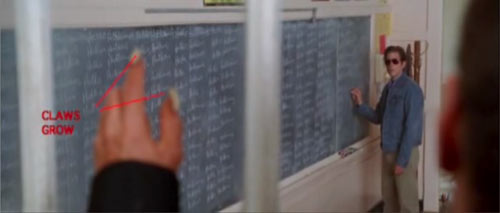
Margot Tenenbaum loses a finger to an axe, just as Trevor Axford loses a finger (or two) to a fireworks incident.
Margot Tenenbaum is a long-term smoker, who hides this from everyone, just as Hal Incandenza is a regular pot smoker who hides this fact from almost everyone.
Richie Tenenbaum is a tennis prodigy, just as Hal and Orin Incandenza were; and Richie’s on-court breakdown could be compared to Hal’s near loss to Stice or Pemulis’s dosing of his opponent or pretty much any other breakdown in the book.
One child in each family produces a drama: Margot Tenenbaum and Mario Incandenza.
The suicide attempt of Richie Tenenbaum seems reminiscent of Joelle Van Dyne’s, as both take place alone in a bathroom.
Both JOI and Royal Tenenbaum have rival suitors (Tavis, for one, and Mr. Henry for Etheline) and both patriarchs die in the course of the book / movie.
Eli Cash is a drug addict of the highest type, much like Gately, Hal, and the varied addicts of IJ. Eli is nonchalant about his drug use, but also feels the need to hide it from those closest to him.
The Incandenzas have a dog loved primarily by a family member (S. Johnson and Avril) as do the Tenenbaums (Buckley by Ari and Uzi). Both dogs die.
Chas subjects Ari and Uzi to Schtitt-like physical-education routines. The sight of Ari and Uzi in their jogging suits, doing endless calisthenics, brings to mind the ETA students pushed to their limits during star drills.
There is incest (Richie and Margot Tennenbaum; Avril and Tavis). Although Royal would be quick to point out that Richie and Margot are not technically blood related since Margot is adopted, Richie feels the incest taboo. Avril’s taboo is more Gertrude than Margot, one gets the feeling that Avril would find Etheline Tenenbaum to be a kindred spirit. Avril’s misdeeds with John NR Wayne (off-screen except one illicit interruption) seem similar to Margot’s being caught with Eli Cash in her bedroom. Although Avril isn’t Wayne’s teacher, Anderson did address that subject in “Rushmore.”
The first article to address the relationship between The Royal Tenenbaums and IJ is this one. While Sidney Moody plays up some of the basic similarities, I take issue with his/her assumption that Avril “fends off many suitors after Dr. Incandenza’s death” (and there is little evidence that Royal Tenenbaum was a “once-brilliant litigator”). Moody also equates Eli Cash to Don Gately because they both have drug problems and Cash’s friends try to force him into rehab, but I see a closer comparison to be Eli Cash and Marlon Bain, despite Bain not having as prominent of a role in IJ as Cash does in RT.
Especially the selection of the images gives away that we are dealing with a book that has a long-term purpose. People gathered everything somber, oppressive, from poor neighbourhoods, or primitive they could find. It seems apparent that color was intentionally omitted, because only black and white reproduction stresses the supposedly gray, bleak and dismal reality of East Berlin.
It’s interesting to hear the charge of propaganda coming from the secret police of a Communist dictatorship.
No socialisation of losses and privatisation of gains. Whatever may need to be bailed out should be nationalised; whatever does not need a bail-out should be free, small and risk-bearing. We have managed to combine the worst of capitalism and socialism. In France in the 1980s, the socialists took over the banks. In the US in the 2000s, the banks took over the government. This is surreal.
It was difficult to choose just one of Taleb’s points to excerpt; they’re all worth considering. BTW, a Black Swan is an event that is rare, has a large impact, and is deemed predictable after the fact. I might have to push Taleb’s book of the same name to the top of my reading list.
I am hoping that Moon will be awesome and not just a mashup of 2001 and Solaris. The score is by Clint Mansell, who has scored all of Darren Aronofsky’s movies, most notably Requiem for a Dream. Moon opens on June 12 in NYC and LA. (via sarahnomics)
Earlier this year, Bryony and I made the decision to close Speak Up. Seeing weeks and weeks go by where we have only two or three posts (and one of them being the Quipsologies round-up) has become too painful for us. It’s also like watching Ozzy Ozbourne today, still holding on to that rock glory but he can’t really rock no more, not like he used to.
If the glass Heinz ketchup bottle were introduced today, it would likely be disparaged because it doesn’t work very well as a ketchup dispenser. But since it’s been around so long, people love it.
Like the Apple iPod, a Rawlings baseball and 3M’s Post-it Notes, Heinz Ketchup is a rare example of a best-selling brand that is also generally considered to be best in class. It would seem silly to splash out on a more expensive alternative, especially as the glass bottle affirms its stellar status.
That is why Heinz Tomato Ketchup is one of the very few branded products you see in its original packaging in expensive restaurants. “Sometimes we have to accept that we can’t better something that already exists,” said Jeremy King, who co-owns The Wolseley in London and is now re-opening The Monkey Bar in New York. “When a customer asks for ketchup they generally want Heinz. The iconic glass bottle reassures them that they are getting it.” Quite a coup for something that does not really do its job properly.
Joe liked the idea of measuring how long this number would be if it were set in type, which immediately called into question the choice of font. The number’s length would depend chiefly on the width of the font selected, and even listener-friendly choices like Times Roman and Helvetica would produce dramatically different outcomes. Small eccentricities in the design of a particular number, such as Times Roman’s inexplicably scrawny figure one, would have huge consequences when multiplied out to this length. But even this isn’t the hairy part. Where things get difficult, as always, is in the kerning.
In some cases, properly kerning the number resulted in a difference of more than 1000 feet for 12 pt. text.
In addition, the article said that Klein was working with graduate students at Cornell University and Binghamton University to study how wild crows make use of his machine, which does exist. Klein did get a professor at Binghamton to help him try it out twice in Ithaca, with assistance from a Binghamton graduate student, and it was not a success. Corvid experts who have since been interviewed have said that Klein’s machine is unlikely to work as intended.
How to look at billboards, a commentary on outdoor advertising by advertising man Howard Gossage from Harpers magazine in 1960. Gossage thought of billboards as an invasion of people’s privacy.
Outdoor advertising is peddling a commodity it does not own and without the owner’s permission: your field of vision. Possibly you have never thought to consider your rights in the matter. Nations put the utmost importance on unintentional violations of their air space. The individual’s air space is intentionally violated by billboards every day of the year.
Erika La Tour Eiffel, betrothed two years ago to the pointy Parisian landmark, is an objectophiliac, someone who feels intense sexual desire toward inanimate objects.
Emma (not her real name), 43, the only British member of the community, suffers from Asperger syndrome — a condition which seems to be shared by around half of OS people. Asperger sufferers often have difficulties forming relationships with other people, and Emma’s fixations are radios and hi fis. When I met her, she was in love with a hi-fi system which she called Jake. Jake, she says, is “solid, reliable and beautiful”. She repairs “him” when he goes wrong, and “makes love” to him on average twice a day. “This is the way I communicate with him.”
Almost all of us, for example, are “loss averse” — it hurts more to lose £50 than it feels good to win £50. We also value money in relative rather than absolute terms — we consider £10 irrelevant when buying a house but not when paying for a meal. Similarly, finding £100 will give many people more pleasure than having a heating bill cut from £950 to £835, even though this gains them more in real terms.
Ann Wark tries to summarise it: “Here, you go out every night. You’d never do that back home. You see people all the time. It’s great. You have lots of free time. You have maids and staff so you don’t have to do all that stuff. You party!” They have been in Dubai for 20 years, and they are happy to explain how the city works. “You’ve got a hierarchy, haven’t you?” Ann says. “It’s the Emiratis at the top, then I’d say the British and other Westerners. Then I suppose it’s the Filipinos, because they’ve got a bit more brains than the Indians. Then at the bottom you’ve got the Indians and all them lot.”
As for “all them lot”? Not so much.
Sahinal Monir, a slim 24-year-old from the deltas of Bangladesh. “To get you here, they tell you Dubai is heaven. Then you get here and realise it is hell,” he says. Four years ago, an employment agent arrived in Sahinal’s village in Southern Bangladesh. He told the men of the village that there was a place where they could earn 40,000 takka a month (£400) just for working nine-to-five on construction projects. It was a place where they would be given great accommodation, great food, and treated well. All they had to do was pay an up-front fee of 220,000 takka (£2,300) for the work visa - a fee they’d pay off in the first six months, easy. So Sahinal sold his family land, and took out a loan from the local lender, to head to this paradise.
As soon as he arrived at Dubai airport, his passport was taken from him by his construction company. He has not seen it since. He was told brusquely that from now on he would be working 14-hour days in the desert heat - where western tourists are advised not to stay outside for even five minutes in summer, when it hits 55 degrees - for 500 dirhams a month (£90), less than a quarter of the wage he was promised. If you don’t like it, the company told him, go home. “But how can I go home? You have my passport, and I have no money for the ticket,” he said. “Well, then you’d better get to work,” they replied.
- Rob Walker, who writes the Consumed column for the NY Times Magazine, was my favorite person in the movie. I particularly liked his idea for a million-dollar marketing campaign for the stuff we already own. Paraphrasing from memory: “You already own all these wonderful things. Enjoy them today.”
- The best comment during the Q&A after the film was from a man who said that the film made him feel physically sick. Not that the movie was bad but that it was powerful. The man was a product designer and the film raised a lot of issues for him with regard to the waste — both physical trash and human energy, if I was catching his drift correctly — produced during the course of making these billions of mass produced items, most of which end up in landfills in pretty short order. He seemed to be asking himself and the audience: how can we, as designers, in good conscience, keep doing this to ourselves?
- The film addressed that question a bit at the end as did the panelists during the Q&A. Dan Formosa of Smart Design, echoing Walker’s marketing idea, said that some designers in the future will shift from designing new products and start to design experiences for people to make better decisions about the objects they introduce into their lives or to better utilize the products they already have. The sales and support process at many many product companies are ripe for a designer’s guiding hand. It’s mind-boggling to me that companies spend billions and billions of dollars designing and building products and then leave the selling of those products to sales people who are largely untrained and unmotivated and the support to a call center in Bangalore. Zappos, Apple, Amazon, and similar companies have realized this with spectacular results.
- What didn’t work for me: 1) The IDEO stuff. They had 12 people brainstorming about how to build a better toothbrush that people won’t throw away and in addition to all of the time they’re spending talking about it, they went through dozens of Post-It notes, and had purchased what looked like hundreds of toothbrushes for research purposes that were likely to get thrown away as well. The whole thing seemed super wasteful (and maybe that was the point of showing it). 2) Karim Rashid. He said a lot of things that sounded good but when you look at his work, I don’t know that he actually believes any of it. 3) Marc Newson. What the hell was he on about?
I am offering large printable files to anyone interested at no cost. Computer files are the most easily reproducible information on the planet. In this particular case I see no reason to imbue a false sense of preciousness on the work. The information I gathered to create the collages is publicly availaibe, and the collages themselves are no different.
Two competitors will swap a file back and forth in real-time, adding to and embellishing the work. Each artist gets fifteen minutes to complete a “volley” and then we post it to the site live. A third participant, a writer, provides play-by-play commentary on the action, as it happens. A match lasts for ten volleys.
In 1704, playright John Dennis invented a new method of producing the sound of thunder during a play. Dennis’ play was unsuccessful, but his thunder technique was soon borrowed by another production, leading Dennis to exclaim:
Damn them! They will not let my play run, but they steal my thunder.
8. Self aware, including weaknesses. This is the kicker. Great leaders know what they suck at, and either work on those skills or hire people they know make up for their own weaknesses, and empower them to do so. This tiny little bit of self-awareness makes them open to feedback and criticism to new areas they need to work on, and creates an example for movement in how people should be growing and learning about new things.
Banh Mi Saigon Bakery, one of my favorite places to get my lunch on, gets a shout-out in the NY Times. The bread is really fantastic. I’m intrigued by the sandwich at Silent H called the Greenpoint:
Elsewhere in Brooklyn, where authenticity is not as strictly enforced, Vinh Nguyen has created a succulent banh mi at Silent H called the Greenpoint: a tribute to the area’s many traditional Polish butcher shops. Instead of cha lua, smooth pork terrine, he lays on Krakowska kielbasa, a smoked sausage. “That smokiness and pepperiness makes perfect sense on a banh mi,” he said. “I would be a fool to ignore these great traditional products being made in my neighborhood.”
In the past week, both Joshua Schachter and Matt Haughey published articles that were excerpted in the Voices section of All Things Digital, a web site owned by Dow Jones and run by Kara Swisher and Walt Mossberg of the WSJ. Each excerpt was accompanied by a link to the original articles. Schachter and Haughey both reacted negatively to All Things Digital’s posting of their work. Andy Baio has collected responses from Schachter, Haughey, All Things Digital’s Kara Swisher, other writers whose stuff has been excerpted in the Voices section, and a couple other long-time online writers. Merlin Mann’s comment on Twitter sums up what the independent writers seem to be irritated with:
Republishing online work without consent and wrapping it in ads is often called “feed scraping.” At AllThingsD, it’s called “a compliment.”
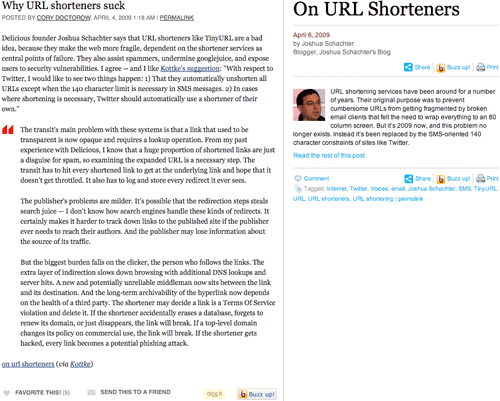
It does suck that ATD’s linking technique makes it appear as though Schachter and Haughey are in the employ of Dow Jones and that DJ has the copyright on what they wrote. ATD should make the lack of affiliation more clear. Other than that, is the ATD post really that bad? In many ways, All Things Digital’s linking technique is more respectful of the author of the original piece than that of a typical contemporary blog. For comparison purposes, here are screenshots of Schachter’s original article as linked to from a typical blog (in this case, Boing Boing) and by All Things Digital.
Go read both posts (ATD, BB) and then come back. With its short excerpt and explicit authorship (i.e. there’s no doubt that Joshua Schachter wrote those words), the ATD post is clearly just an enticement for the reader to go read the original post. On the other hand, BB’s post summarizes most of Schachter’s argument and includes an extensive excerpt of the juiciest part of the original piece. The post is clearly marked as being “posted by Cory Doctorow” so a less-than-careful reader might assume that those are Doctorow’s thoughts about URL shorteners.
[Metaphorically speaking, the ATD post is like showing the first 3 minutes of a movie and then prodding the viewer to go see the rest of it in a theater while BB’s post is like the movie trailer that gives so much of the story away (including the ending) that you don’t really need to watch the actual movie.]
What ends up happening is that blogs like Boing Boing — and I’m very much not picking on BB here…this is a very common and accepted practice in the blogosphere — provide so much of the gist and actual text of the thing they’re pointing to that readers often don’t end up clicking through to the original. To make matters worse, some readers will pass along BB’s post instead of Schachter’s post…it becomes, “hey, did you see what Boing Boing said about URL shortening services?” And occassionally (but more often than you might think) someone will write a post about something interesting, it’ll get linked by a big blog that summarizes and excerpts extensively, and then the big blog’s post will appear on the front page of Digg and generally get linked around a lot while the original post and its author get screwed.
So I guess my question is: why is All Things Digital getting put through the wringer receiving scrutiny here for something that seems a lot more innocuous than what thousands of blogs are doing every day? Shouldn’t we be just as or more critical of sites like Huffington Post, Gawker, Apartment Therapy, Engadget, Boing Boing, Buzzfeed, Lifehacker, etc. etc. etc. that extensively excerpt and summarize?
Update: I’m pulling a couple of quotes up from the comments so that the opinions of the people involved aren’t misrepresented.
Joshua Schachter:
I really just objected to the byline on the ATD thing. It made it appear that there was a relationship when there wasn’t. If there is curation, the curator should be the one noted as making the choices.
Andy Baio:
All the complaints stem from the affiliation issue. Running ads and having comments on an excerpt are only an issue if it’s presented as original content, instead of curation. Put an editor’s name on there, remove the author photos, throw it in a blockquote, and all these complaints go away.
The House Next Door is on a roll lately. Today they’re featuring an interview with Glenn Kenny, a film writer who edited the three articles that David Foster Wallace wrote for Premiere magazine.
Dave would often be commissioned to do pieces at 5,000-7,500 words so he understood that at a certain point in the process it was quite possible this would happen, but in a way he was constitutionally incapable of keeping to a word length. It was a tacit agreement you had with him when you commissioned a piece that you were going to get something long. But if you can run a piece that long, he’s one of the cheapest first rate literary writers out there-you pay him X amount of dollars per word, but you get five times the words.
7. Do you feel protons decaying? Grand Unification may be occurring near your vital organs. However, this may be caused by far less elegant X bosons — the poor man’s Higgs, as it were. We shall not deal with these “country cousins” here. Still, you must not use electroweak force in this situation. You must at least attempt to curb the force of your nuclei to delay Grand Unification. You would be wise to begin a preventive training regimen for your nuclei right away — Fermion My Wayward Son (Bloomsbury, 1996) contains the internationally accepted techniques.
Imagine in, say, 2059 looking up a location on Google Maps and being able to dial the view back fifty years to see what that building looked like in 2009. Zoom back and forth in time to see how the place changed as decades flip by. That will be amazing.
How to Take a Beloved Children’s Classic Book and Screw It All Up, Exhibit A: based on the trailer, Cloudy With a Chance of Meatballs. Except for the food falling from the sky, they changed everything else. But it’s IN 3-D!!! *pffft*
Some may argue that the true window to win a title began when Jerry Sloan took over as head coach [of the Utah Jazz] during the 1988-89 season, and while Karl Malone and John Stockton had been paired up since the 1985-86 season, the Jazz did not make it to the Western Conference Finals until 1992. That’s when they became title contenders. As we all know, Stockton’s career consisted of dishing out over 15,800 assists, which is over 5,000 assists more than Mark Jackson, who is 2nd on the NBA’s all-time assists list. Karl Malone, meanwhile, went on to finish 2nd on the NBA’s all-time scoring list. To have that kind of talent for so long and not come away with a title is almost unimaginable, if not crushing to a franchise. The window came to an abrupt close in 2003, when Stockton retired and Malone went to the Lakers in a last-ditch effort to win a title. The ultimate kicker? Between 1991 and 2003, Utah’s 632 wins were the most in the NBA.
Trying to suggest that a lack of explanation is evidence that supernatural powers are at work is actually a contradiction. In effect what it’s saying is, “I can’t explain something, therefore I can explain it.”
The A.V. Club picks 25 albums that work best when listened to from start to finish. +1 for In The Aeroplane Over The Sea. I tend to listen to albums more than individual songs…Sigur Ros or Boards of Canada doesn’t make any sense on shuffle.
My selections are movies featuring fairly large herds of individuals who clash or collude directly, whose lives intersect or intertwine, who sustain the illusion of continuing to lead their lives beyond the frame, long after the credits roll.
The initial selections include Gosford Park and LA Confidential with the commenters adding many more excellent suggestions like Ocean’s Eleven, Glengarry Glen Ross, Big Night, and Do the Right Thing.
The original producer, Brendan O’Brien, remixed and remastered the tracks and the result is remarkable. It sounds like it was recorded yesterday, instead of on the muddy banks of 1990s grunge. […] The remixes confirm what I’ve always thought about Pearl Jam. The label of “grunge” described a new variation of modern (at the time) rock music. Nirvana was grunge, Soundgarden was grunge. Pearl Jam was always just plain old Rock ‘n Roll®.
This may be the big blockbuster film of 2009, and one we really need right now. It’s miles easier to understand than “The Dark Knight,” and tremendously more emotional. Hood simply did an outstanding job bringing Wolverine’s early life to the screen.
Fox News is owned by News Corp. 20th Century Fox, the company putting out Wolverine, is also owned by News Corp. You can see where this is heading. Friedman is now out of a job and a large media company has once again made its priorities clear:
We’ve just been made aware that Roger Friedman, a freelance columnist who writes Fox 411 on Foxnews.com — an entirely separate company from 20th Century Fox — watched on the Internet and reviewed a stolen and unfinished version of ‘X-Men Origins: Wolverine.’ This behavior is reprehensible and we condemn this act categorically — whether the review is good or bad.
Translation: we’re more concerned with piracy than with the quality of the film as perceived by the audience. I bet the filmmakers are happy that someone really liked the film.
By the time your kid is 2 or 3 years old, you’ve likely read her favorite book more than 50,000 times. Luckily, says Tim Bray, you can switch it up after awhile.
In this scenario, you change the words: “I do not like blue eggs and ham”, then once again the pregnant pause, and the toddler leaps in with the correction; maybe in a sort of disturbed and urgent tone. You respond “Oh, right, green eggs…”. After a couple of times she realizes it’s a joke and you get giggles with each correction.
We’re well into stage one with Ollie, although stage two is likely just around the corner. We’ve been playing a game recently where we ask him whether different objects have wheels or not.
Note: If you are a member and tried to log in, it didn't work, and now you're stuck in a neverending login loop of death, try disabling any ad blockers or extensions. Or try logging out and then back in. Still having trouble? Email me!













Socials & More