kottke.org posts about gender
This piece by Lydia Polgreen on The Strange Report Fueling the War on Trans Kids is so good — straightforward and informative, especially when compared to the incoherent nonsense that the NY Times has run about trans people over the past few years. The piece is about, in Polgreen’s words, “the sneaky effort to use what looks like science to justify broad intrusions in our personal freedom”.
I usually don’t do this, but I’ve excerpted the article’s conclusion here because it just gets right to the heart of an urgent concern: the freedom to control our own bodies.
Imagine that your health care required objective justification, if access to birth control or erectile dysfunction medications required proving that you were having monogamous sex, or good sex, or sex at all. Or if fertility care was provided only if you could prove that becoming a parent would make you happy, or you would be a good parent. Or that abortion would be available only if you could prove that it would improve your life.
In a free society we agree that these are private matters, decided by individuals and their families, with the support of doctors using mainstream medical science as a guide, even when they involve children. We invite politicians and judges into them at great peril to our freedom.
I encourage you to read the whole thing — it’s interesting throughout.
In a TEDx Talk from 2017, LB Hannahs talks about their experience as a transgender dad, comfort vs authenticity, and the collision of theoretical gender roles & identities with the practicalities of parenthood.
Now, for most people, what their child will call them is not something that they give much thought to outside of culturally specific words or variations on a gendered theme like “mama,” “mommy,” or “daddy,” “papa.” But for me, the possibility is what this child, who will grow to be a teenager and then a real-life adult, will call me for the rest of our lives, was both extremely scary and exciting. And I spent nine months wrestling with the reality that being called “mama” or something like it didn’t feel like me at all. And no matter how many times or versions of “mom” I tried, it always felt forced and deeply uncomfortable. I knew being called “mom” or “mommy” would be easier to digest for most people. The idea of having two moms is not super novel, especially where we live.
So I tried other words. And when I played around with “daddy,” it felt better. Better, but not perfect. It felt like a pair of shoes that you really liked but you needed to wear and break in. And I knew the idea of being a female-born person being called “daddy” was going to be a harder road with a lot more uncomfortable moments. But, before I knew it, the time had come and Elliot came screaming into the world, like most babies do, and my new identity as a parent began. I decided on becoming a daddy, and our new family faced the world.
(thx, megan)
In this short film from Alex Mallis, we meet a Bronx couple who are raising their child Grey in a gender-neutral way until they make a decision for themselves. No single gender wardrobes or toy collections and they/them pronouns.
Really the goal here is, it’s not about me trying to force anything on Grey, it’s actually the exact opposite. And we don’t know their gender yet, and when they tell us, they’ll tell us. And it might change over time and that’s okay too.
Crispin Long wrote an accompanying piece for the New Yorker on the film.
Watching Grey’s parents navigate this terrain inspires questions about how Grey might one day respond to being brought up this way. Of course, it’s impossible to parent without error, and society does its share of damage, to many of us, without the help of parents. Asking a child to inhabit such a complex and politicized position is demanding, but so is asking a child to perform femininity or masculinity. I get the sense that many trans people would unambivalently prefer to have been raised without the gender they were assigned at birth and its attendant expectations. For me, it’s less clear. If my parents had made every effort to free me from the strictures of the gender binary, I might have rebelled against their liberal piety or appreciated their efforts — or maybe both.
For The Atlantic, Sarah Rich writes about how stifling masculinity can be for some children and their parents.
As much as feminism has worked to rebalance the power and privilege between the sexes, the dominant approach to launching young women into positions that garner greater respect, higher status, and better pay still mostly maintains the association between those gains and masculine qualities. Girls’ empowerment programs teach assertiveness, strength, and courage — and they must to equip young women for a world that still overwhelmingly favors men.
Last year, when the Boys Scouts of America announced that they would begin admitting girls into their dens, young women saw a wall come down around a territory that was now theirs to occupy. Parents across the country had argued that girls should have equal access to the activities and pursuits of boys’ scouting, saying that Girl Scouts is not a good fit for girls who are “more rough and tumble.” But the converse proposition was essentially non-existent: Not a single article that I could find mentioned the idea that boys might not find Boy Scouts to be a good fit — or, even more unspeakable, that they would want to join the Girl Scouts.
If it’s difficult to imagine a boy aspiring to the Girl Scouts’ merit badges (oriented far more than the boys’ toward friendship, caretaking, and community), what does that say about how American culture regards these traditionally feminine arenas? And what does it say to boys who think joining the Girl Scouts sounds fun? Even preschool-age boys know they’d be teased or shamed for disclosing such a dream.
While society is chipping away at giving girls broader access to life’s possibilities, it isn’t presenting boys with a full continuum of how they can be in the world. To carve out a masculine identity requires whittling away everything that falls outside the norms of boyhood. At the earliest ages, it’s about external signifiers like favorite colors, TV shows, and clothes. But later, the paring knife cuts away intimate friendships, emotional range, and open communication.
Rich talks about her young son’s current penchant for wearing dresses and wishes there was room in society for activity like that.
What I want for him, and for all boys, is for the process of becoming men to be expansive, not reductive.
Reading this, I thought about the amazing one-step process for getting a bikini body I read recently: “Put a bikini on your body.” It’s not perfect and this is a lot to ask of society, but perhaps an analogous definition for masculinity is that when a man or boy does something, that’s masculine.1 Chugging a beer is masculine. Wearing a dress is masculine. Being brave is masculine. Crying is masculine. Playing sports is masculine. Not playing sports is masculine. Comforting a friend whose team lost before celebrating with his team is masculine. Anything and everything is masculine. You might argue that broadening the definition of the word to this degree diminishes its power to denote anything meaningful. And you’d be right, that’s the point.
In a 2013 piece, Christie Aschwanden suggested a test in the spirit of the Bechdel test for avoiding gender bias in profiles written about scientists who are women.
To pass the Finkbeiner test, the story cannot mention:
- The fact that she’s a woman
- Her husband’s job
- Her child care arrangements
- How she nurtures her underlings
- How she was taken aback by the competitiveness in her field
- How she’s such a role model for other women
- How she’s the “first woman to…”
Aschwanden named the test after her colleague Ann Finkbeiner, who wrote that she was going to write a piece about an astronomer without mentioning that she, the astronomer, was a woman.
Meanwhile I’m sick of writing about [gender bias in science]; I’m bored silly with it. So I’m going to cut to the chase, close my eyes, and pretend the problem is solved; we’ve made a great cultural leap forward and the whole issue is over with.
And I’m going to write the profile of an impressive astronomer and not once mention that she’s a woman. I’m not going to mention her husband’s job or her child care arrangements or how she nurtures her students or how she was taken aback by the competitiveness in her field. I’m not going to interview her women students and elicit raves about her as a role model. I’m going to be blindly, aggressively, egregiously ignorant of her gender.
I’m going to pretend she’s just an astronomer.
(via @john_overholt)
For her Gender Shades project, MIT researcher Joy Buolamwini fed over 1000 faces of different genders and skin tones into three AI-powered facial recognition systems from Microsoft, IBM, and Face++ to see how well they could recognize different kinds of faces.
The systems all performed well overall, but recognized male faces more readily than female faces and performed better on lighter skinned subjects than darker skinned subjects. For instance, 93.6% of gender misclassification errors by Microsoft’s system were of darker skinned people.
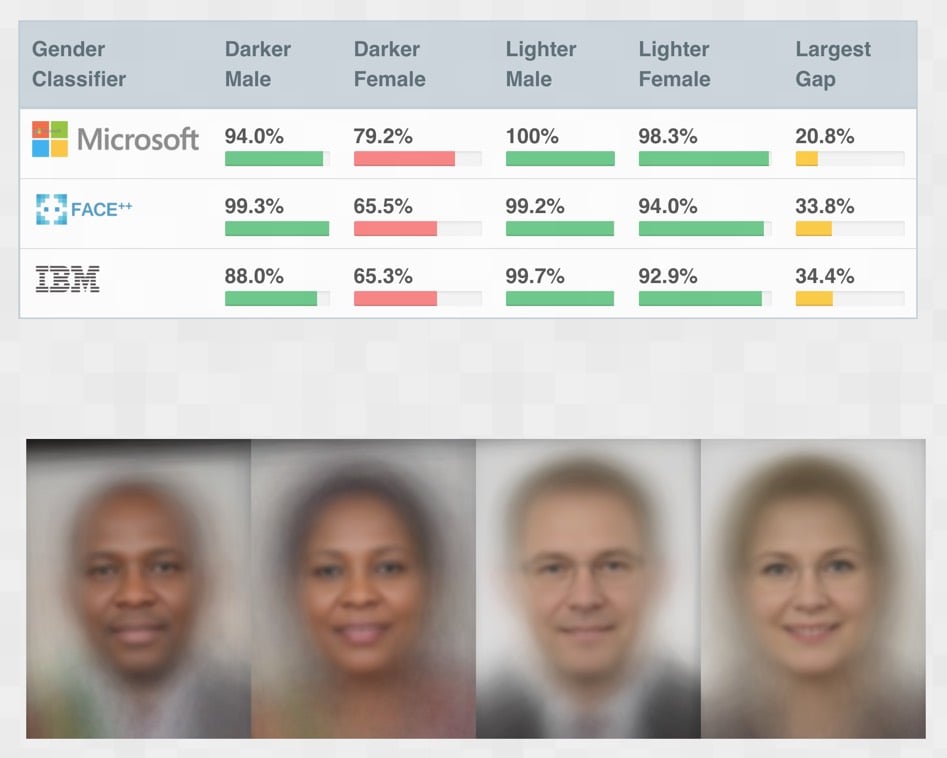
Her message near the end of the video is worth heeding:
We have entered the age of automation overconfident yet underprepared. If we fail to make ethical and inclusive artificial intelligence, we risk losing gains made in civil rights and gender equity under the guise of machine neutrality.
Dr. Stacy Smith, one of the creators of the inclusion rider, spoke at TEDWomen in 2016 about the epidemic of invisibility in Hollywood. She uses hard data to break down how women and minorities are not just underrepresented in film, they’re erased, and just how pernicious this is for all of us.
Storytelling is so important. Stories tell us what societies value, they offer us lessons, they share and preserve our history. Stories are amazing. But stories don’t give everyone the same opportunity to appear within them, particularly not stories compartmentalized in the form of American movies.
Dr. Smith and her team have done more than 30 investigations over the past ten years on diversity in entertainment. Follow the Annenberg Inclusion Initiative at @inclusionists.
This is a fascinating thread by Milena Popova about the differing performances of male and female athletes at the Winter Olympics. As they point out, humans are sexually dimorphic but the story doesn’t end there. Bodies are also socially constructed.
Physiology is a thing, but physiology is shaped and mediated by our social context.
Look back at those pictures of “women”. Those petite, delicate bodies, those faces we process as “beautiful”. Those are the qualities that globally dominant Western cultures associate with “femininity”.
And sport is one of the institutions that fiercely guards and reproduces dominant ideas about gender, masculinity and femininity. This plays out differently in different sports.
Generally, men and women compete separately. And for the purposes of sport “men” and “women” are defined as people whose bodies were assigned male or female at birth and whose gender matches that assignment.
The obvious example here is South African runner Caster Semenya. But Popova continues with a more subtle (and admittedly speculative) situation:
Now, what really gets me is snowboarding. Because on the face of it that’s not a sport that’s judged on the same gendered criteria of artistry and aesthetics as figure skating or gymnastics.
You’d think under all the skiing gear, helmets, scarves and goggles, it would be quite hard to perform femininity.
And still, as my friend whom I made watch slope style and half pipe for the first time in her life last night pointed out, the body types of the men and women riders are really rather different. You can tell even under all the gear.
And that translates to performance. Women get an amplitude of about 3m above the half pipe, men about 4-5m. The best women do 1080s (three revolutions), the best men 1440s (four revolutions).
…
But much like any other subculture snowboarding reproduces hierarchical structures. Moves are named after people, some people find it easier to access than others (hint: it’s a massively expensive sport), some people set trends.
One of the structures it reproduces is a gendered hierarchy. It’s a very masculine culture. Women find it harder to access the sport, find it harder to be taken seriously as athletes in their own right rather than “just hangers-on”.
And I have the sneaky suspicion that because the people with the most subcultural capital tend to be men and they decide whom they will admit and accept to the community, there are certain looks and body types of women who find it less hard (not easy!) to gain access.
And those happen to be the body types that may find it harder to do 1440s and to get 5m amplitude above the half pipe.
Another example from figure skating is Surya Bonaly, a French figure skater who landed a backflip on one skate in a performance at the 1998 Olympics. While backflips weren’t banned because of Bonaly’s relative ease in performing them (as claimed here), her athletic style was outside the norm in women’s figure skating, in which traditional femininity is baked right into the rules & judging. This was also a factor in Tonya Harding’s career (as depicted in I, Tonya).
Anyway, super interesting to think about.
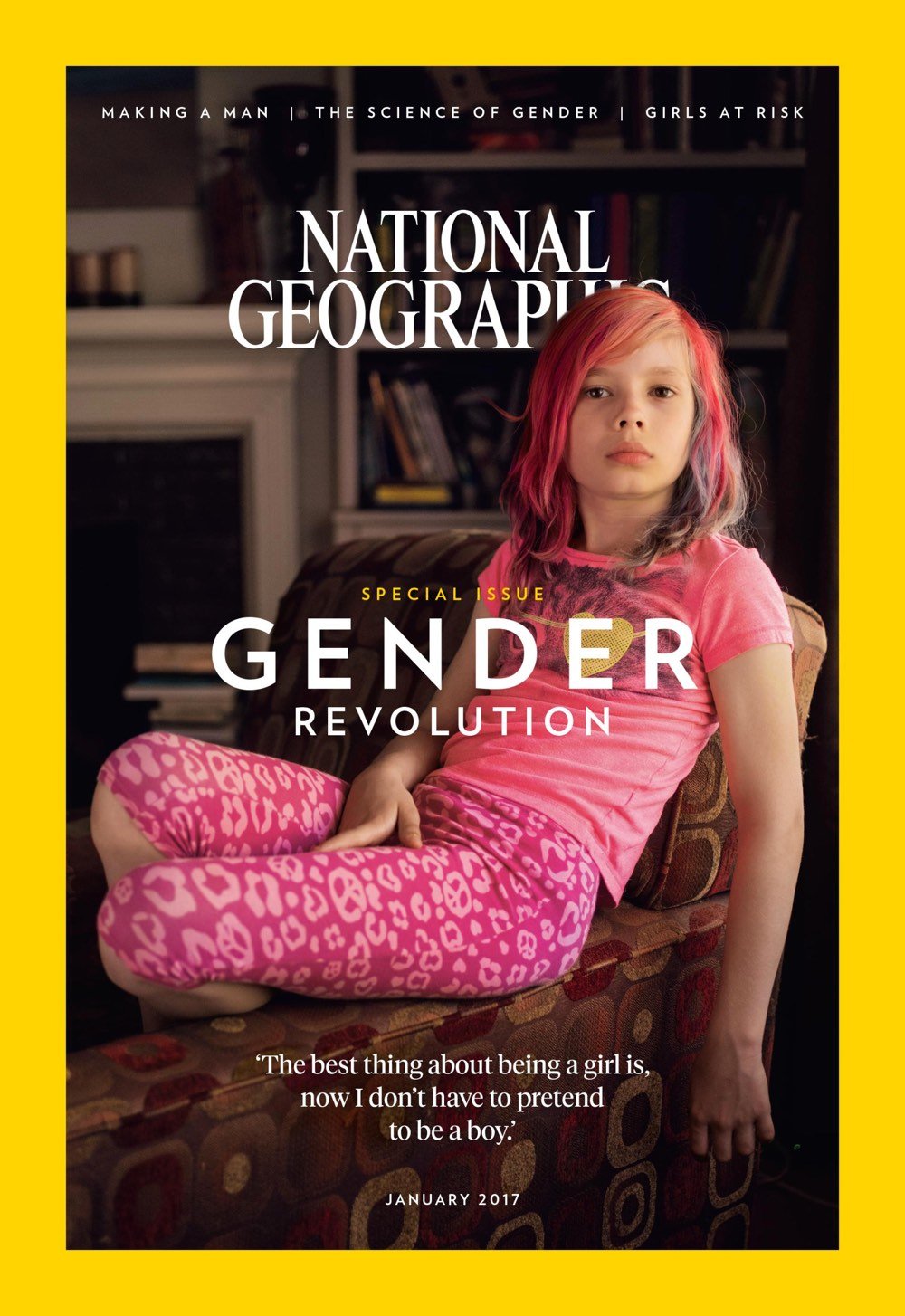
Bravo to National Geographic for putting a transgender girl on the cover of the magazine. Editor-in-chief Susan Goldberg explains why:
Today that and other beliefs about gender are shifting rapidly and radically. That’s why we’re exploring the subject this month, looking at it through the lens of science, social systems, and civilizations throughout history.
In a story from our issue, Robin Marantz Henig writes that we are surrounded by “evolving notions about what it means to be a woman or a man and the meanings of transgender, cisgender, gender nonconforming, genderqueer, agender, or any of the more than 50 terms Facebook offers users for their profiles. At the same time, scientists are uncovering new complexities in the biological understanding of sex. Many of us learned in high school biology that sex chromosomes determine a baby’s sex, full stop: XX means it’s a girl; XY means it’s a boy. But on occasion, XX and XY don’t tell the whole story.”
As part of their coverage, the magazine went out, asked kids from around the world their thoughts about being boys and girls, and came back with this video.
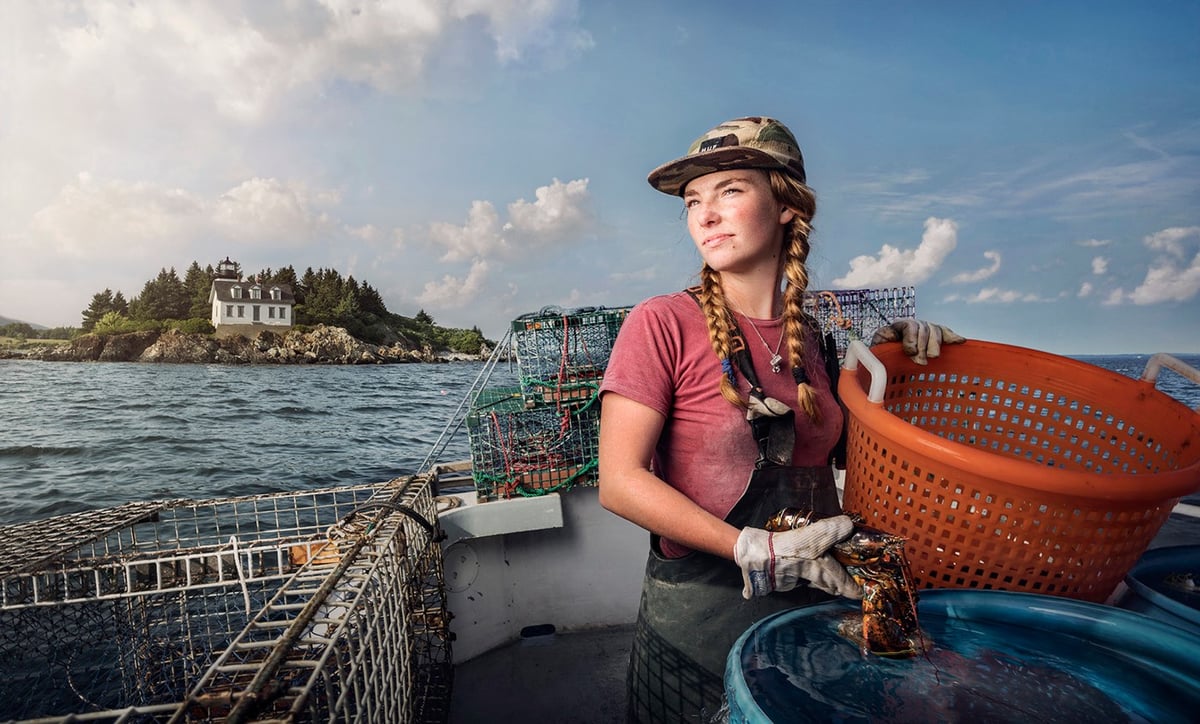
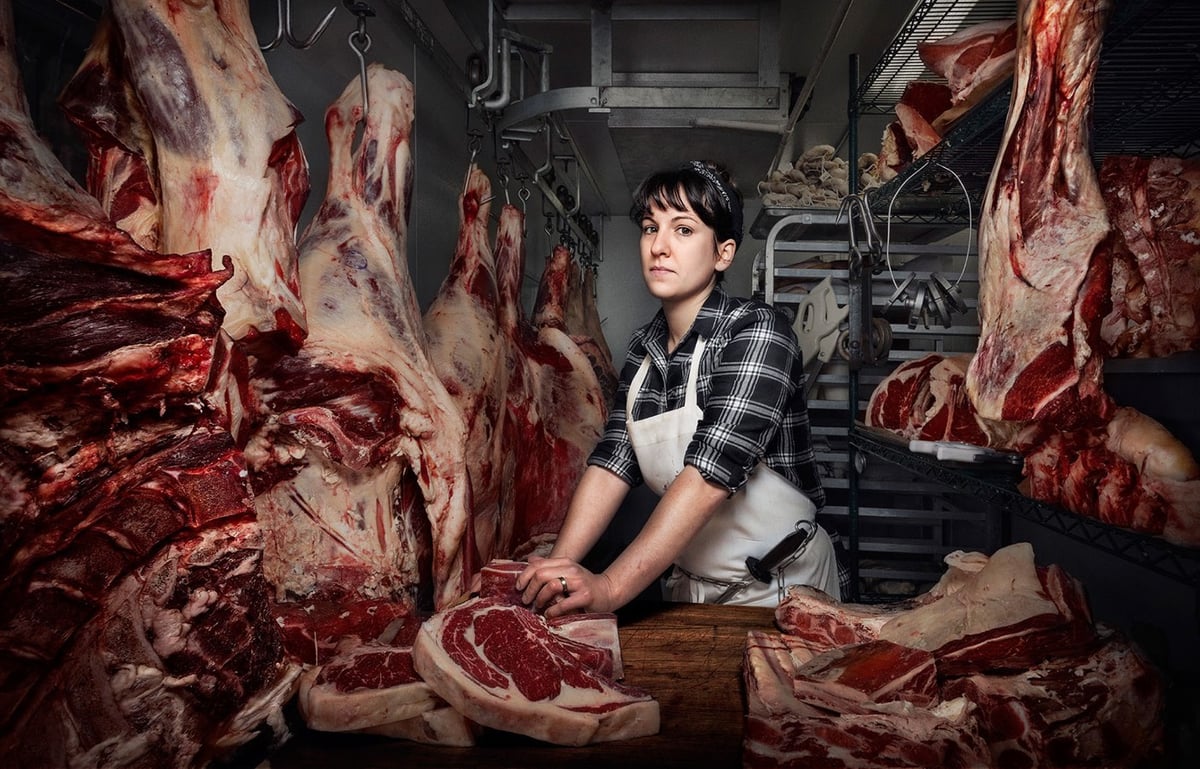
For a photo project called Women’s Work, Chris Crisman made portraits of women who have jobs not typically done by women in the US. In an interview at aPhotoEditor, Crisman explained the why he did the project:
I am a father of two — a 4 year old boy and a 2 year old girl. I was raised to believe that I could do whatever I wanted to when I grew up. I want pass down a similar message to my children and without caveats. I want to raise my children knowing that their dreams have no limits and that they have parents supporting them to dive into anything they feel passionate about.
Crisman shot a short film of Sadie Samuels, the Maine lobster fisherman1 pictured in the photograph above.
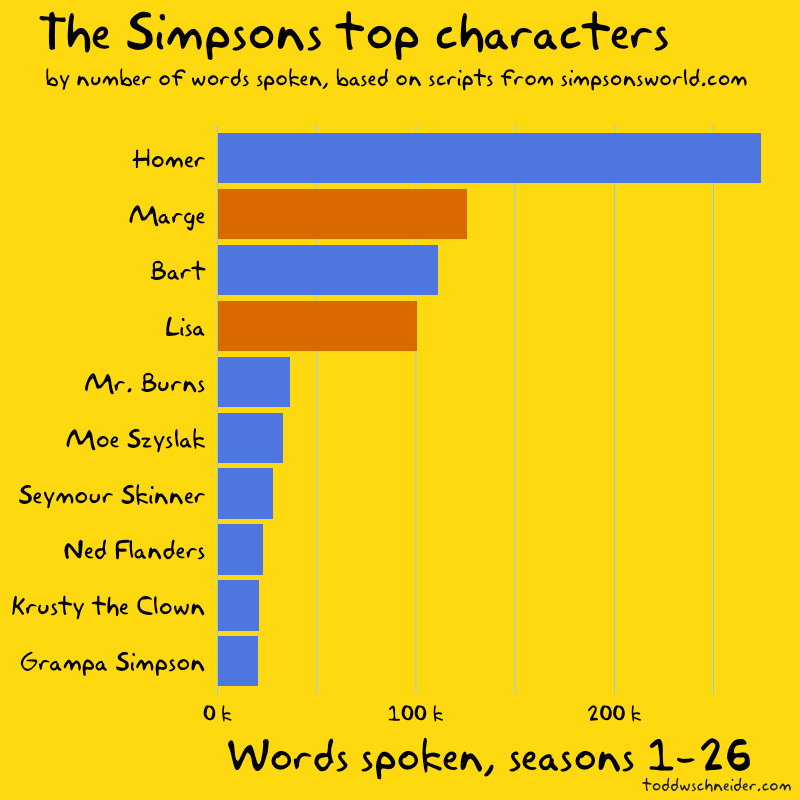
The Simpsons is the longest-running series in primetime TV history. The show’s 27 seasons hold much potential treasure for data scientists. Todd Schneider downloaded the scripts from every show and analyzed which characters spoke the most and where. The results reveal a heavy focus on Homer and a large gender imbalance in terms of dialogue.
The colors of the bars in the above graphs represent gender: blue for male characters, red for female. If we look at the supporting cast, the 14 most prominent characters are all male before we get to the first woman, Mrs. Krabappel, and only 5 of the top 50 supporting cast members are women.
Women account for 25% of the dialogue on The Simpsons, including Marge and Lisa, two of the show’s main characters. If we remove the Simpson nuclear family, things look even more lopsided: women account for less than 10% of the supporting cast’s dialogue.
See also Film Dialogue from 2000 screenplays, Broken Down by Gender and Age.
Jeet Heer writing for The New Republic: Clinton Proved Trump Is a Man You Can Bait in a Debate.
In her acceptance speech at the Democratic convention, Hillary Clinton called out Donald Trump memorably, saying, “A man you can bait with a tweet is not a man we can trust with nuclear weapons.” The insight that Trump is easy to provoke formed the core of Clinton’s successful strategy in the first debate on Monday, as she repeatedly incited the Republican nominee to both adopt an off-putting aggressive tone and to make a series of damaging self-admissions.
This reminded me of poker player Annie Duke’s explanation of how she used the gender stereotypes of her male opponents against them.
I figured it was part of the game that if somebody was at the table who was so emotionally invested in the fact that I was a woman, that they could treat me that way, that probably, that person wasn’t going to make good decisions at the table against me. So I really tried to sort of separate that out and think about it from a strategic place of, how can I come up with the best strategy to take their money because I guess, in the end, isn’t that the best revenge?
Trump sounds like he’s a combination of the angry and disrespecting chauvinists:
VEDANTAM: She says she divided the men who had stereotypes about her into three categories.
DUKE: One was the flirting chauvinists, and that person was really viewing me in a way that was sexual.
VEDANTAM: With the guys who were like that, Annie could make nice.
DUKE: I never did go out on a date with any of them, but you know, it was kind of flirtatious at the table. And I could use that to my advantage.
VEDANTAM: And then there was the disrespecting chauvinist. Annie says these players thought women weren’t creative.
DUKE: There are strategies that you can use against them. Mainly, you can bluff those people a lot.
VEDANTAM: And then there’s a third kind of guy, perhaps the most reckless.
DUKE: The angry chauvinist.
VEDANTAM: This is a guy who would do anything to avoid being beaten by a woman. Annie says you can’t bluff an angry chauvinist. You just have to wait.
DUKE: What I say is, until they would impale themselves on your chips.
Although I suspect his chauvinism is only part of his poor debate showing…his insecurity is off the charts as well.
From the nonbinary.org wiki, a list of gender identities that aren’t male or female.
transgender is an umbrella term for all genders that go beyond society’s ideas of gender, which includes some kinds of binary gender people. Some call their gender identity simply “transgender,” as a nonbinary identity itself.
genderfuzz. Coined by lolzmelmel in 2014. “having multiple genders that are fuzzy and blurred together, making it impossible to identify each one individually or separate one from the rest. alternative names: blurgender (not to be confused with genderblur)
cosmicgender. Coined by dragon-friker in 2014. “A gender so vast and complex that you are only able to process a small bit of it at a time. like viewing the night sky through a telescope you cannot hope to see all of it at once however you may gain more knowledge about parts of it the longer you focus on one part. may contain any number of sub genders within it that may present themselves to you. it is infinite in its possibility. name from the vast reaches of space filled with things we cannot begin to imagine.”
hijra. In south Asian countries including India, Pakistan, and Bangladesh, the Hijra are people assigned male at birth who have a feminine gender expression. This is a very ancient tradition. Today, Hijra are legally recognized as a gender other than female or male.
nocturnalgender. Coined by passengender in 2014. Any gender that feels more intense during the night, “but weak/nonexistent when it is light out.” Syn. batgender, owlgender, moongender. Counterpart: flowergender.
Fascinating.
Update: Sam Escobar answers some frequently asked questions about non-binary gender.
The gender binary separates those who identify as male or female, simple as that. Non-binary genders, however, don’t fit neatly within these two-they can be a combination of male and female, a fluid back-and-forth, or totally outside of the binary. Cisgender people, on the other hand, are folks whose identities align with the gender they were assigned at birth.
(via @djacobs)
As you can tell from whatever “outfit” I’ve extracted from my closet and placed on my body each morning, I know close to nothing about fashion. But I love reading about it. This piece about circa-2016 fashion trends in Tokyo neighborhood of Harajuku is interesting in many ways. Take the first section on Genderless Kei and Kawaii Boys.
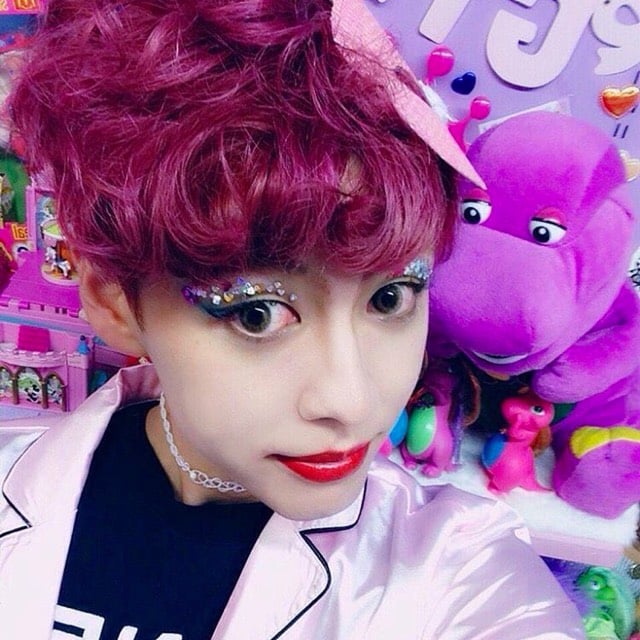
Though the Kawaii Boys’ styles vary, the most popular look is childlike rather than traditionally feminine. These are not crossdressers, most of them are not gay, and they are not trying to look like — or pass as — women. They are specifically aiming for a happy fun Genderless style. That said, none of these new generation of Kawaii Boys are afraid of incorporating traditionally female fashion elements and makeup into their looks.
When I typically think of genderless fashion, I think of someone dressing “in between” the two dominant genders in relatively nondescript drab clothing that leans masculine. So it’s interesting to see the different approach described here…men wearing traditionally feminine clothes to average out as genderless.
As odd as it sounds, Japanese-ness is also making a comeback in Japanese fashion:
Fashion designers may have finally gotten his message, as we’ve never seen as many Japanese characters in street fashion as we did in 2015. The kanji print boom was just one of the many signs that young Japanese creatives are looking inward as well as outward for inspiration.
The classic Japanese sukajan (souvenir jacket) has been ubiquitous on the streets of Harajuku and in vintage shops since the end of summer. As Spring approaches, the low cost trend shops are well stocked with souvenir jackets as well. Influential indie boutique and underground Japanese brands are offering t-shirts, bags, dresses, and accessories printed with messages in kanji, hiragana, and katakana.
The post also delves into economic and city planning territory with sections on tourism and gentrification. (via @moth)
I love this piece from NPR about how poker player Annie Duke uses her male opponents’ stereotypical views of women against them.
I figured it was part of the game that if somebody was at the table who was so emotionally invested in the fact that I was a woman, that they could treat me that way, that probably, that person wasn’t going to make good decisions at the table against me. So I really tried to sort of separate that out and think about it from a strategic place of, how can I come up with the best strategy to take their money because I guess, in the end, isn’t that the best revenge?
She noticed there were three types of chauvinist players and approached each with a different strategy.
VEDANTAM: She says she divided the men who had stereotypes about her into three categories.
DUKE: One was the flirting chauvinists, and that person was really viewing me in a way that was sexual.
VEDANTAM: With the guys who were like that, Annie could make nice.
DUKE: I never did go out on a date with any of them, but you know, it was kind of flirtatious at the table. And I could use that to my advantage.
VEDANTAM: And then there was the disrespecting chauvinist. Annie says these players thought women weren’t creative.
DUKE: There are strategies that you can use against them. Mainly, you can bluff those people a lot.
VEDANTAM: And then there’s a third kind of guy, perhaps the most reckless.
DUKE: The angry chauvinist.
VEDANTAM: This is a guy who would do anything to avoid being beaten by a woman. Annie says you can’t bluff an angry chauvinist. You just have to wait.
DUKE: What I say is, until they would impale themselves on your chips.
I got this link from Andy Baio, who also linked to the video of the specific match referenced in the NPR piece and noted “Phil Hellmuth attributes all of Annie’s wins to luck, all of his own to skill”.
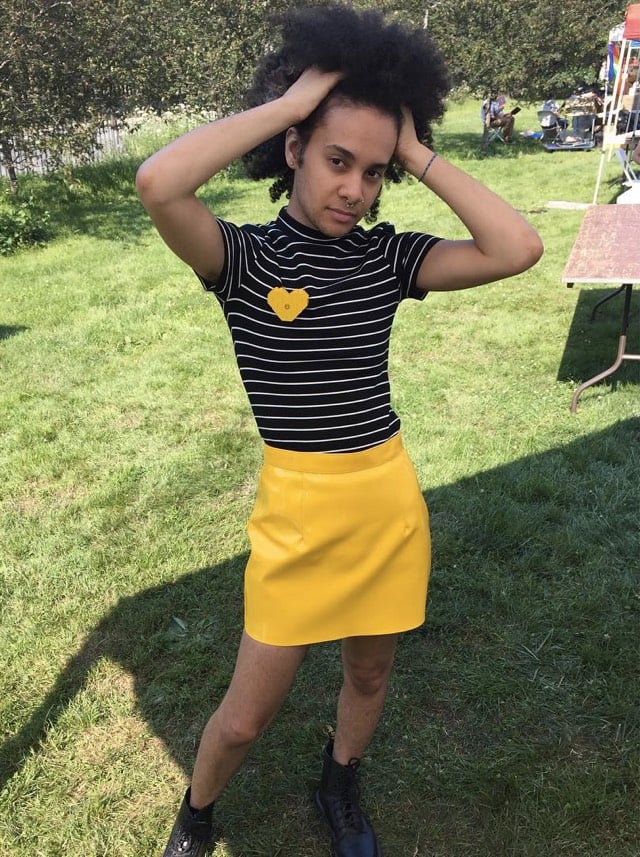
Tyler Ford was born a girl, transitioned to being a man in college, but now identifies as an agender person.
I have been out as an agender, or genderless, person for about a year now. To me, this simply means having the freedom to exist as a person without being confined by the limits of the western gender binary. I wear what I want to wear, and do what I want to do, because it is absurd to limit myself to certain activities, behaviours or expressions based on gender. People don’t know what to make of me when they see me, because they feel my features contradict one another. They see no room for the curve of my hips to coexist with my facial hair; they desperately want me to be someone they can easily categorise. My existence causes people to question everything they have been taught about gender, which in turn inspires them to question what they know about themselves, and that scares them. Strangers are often desperate to figure out what genitalia I have, in the hope that my body holds the key to some great secret and unavoidable truth about myself and my gender. It doesn’t. My words hold my truth. My body is simply the vehicle that gives me the opportunity to express myself.
Ford uses the “they”, “them”, and “their” pronouns to refer to themselves. (Is it themselves? Or would it be themself? English is a relatively young and fluid language but even it can’t keep up.)
According to a friend of someone on Amazon’s taxonomy team, Amazon has removed the gender taxonomy of toys and games. Here’s the before and after:
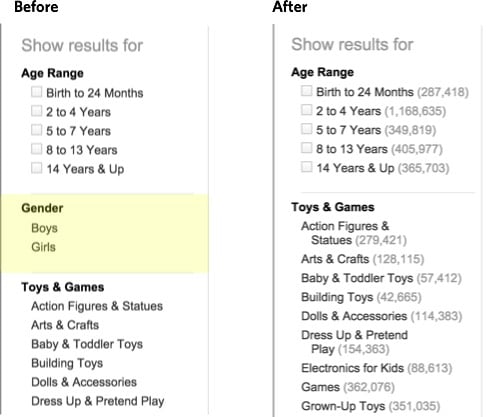
That’s not to say you still can’t shop for boys and girls toys on Amazon (jeez, those pages bum me out), but taking it out of the standard list of categories is a nice first step.
Now, how about you do something about this Amazon Mom thing? What’s wrong with Amazon Family?
For years, one of the knocks on Pixar was the lack of main characters who are women in their movies. 2012’s Brave and this summer’s Inside Out have addressed this criticism to an extent1. But Alex of every flavored bean noticed that, in contrast to the diversity of male faces, female characters in Disney/Pixar’s recent movies all have the same face.
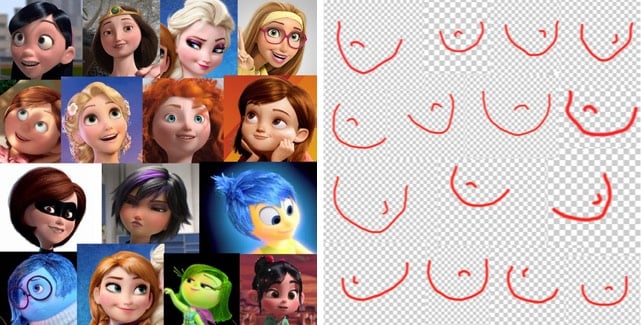
Boys in animated movies have faces that are square, round, skinny, fat, alien-looking, handsome, and ugly. The only face that girls get to have is some round snub-nosed baby face. That’s not right.
Great observation.
Update: This piece has generated some interesting comments on Good, including this one from Dan Povenmire, co-creator of Phineas and Ferb.
This is idiotic and obviously written by someone who (A) can’t draw and (B) has an axe to grind. The female characters they show have very varied faces. Yes the face shapes are all softer feminine shapes, but they purposely didn’t include female characters from those same movies with less feminine faces, like Edna Mode in The Incredibles, or the Witch or the Cook in Brave, or any of the older female characters, like the fairy godmother, or… whatever. All the princes and male romantic leads in these movies have the same face shape as well but NO, she takes old men and villains and comedy relief characters to “prove” how sexist animation is. This is just stupid.
If you want literally dozens of examples of other characters omitted from the list see the other comments below.
(via @ckoerner)
A woman recently took to the streets of NYC and walked around for 10 hours. She walked behind someone wearing a hidden camera that captured all of the catcalls and harassment directed toward her during that time…108 incidents in all. This is what it’s like being a woman in public:
At The Awl, John Herrman notes the parallels between a woman on the streets of NYC and a woman spending time on the internet.
But the video works in two ways: It’s also a neat portrayal of what it is like to be a woman talking about gender on the mainstream internet. This became apparent within minutes of publication, at which point the video’s comment section was flooded with furious responses.
A typical post in the YouTube comments thread:
are you fucking kidding me “verbal harassment”? most of all the guys called that woman “beautiful” or said to “have a good day”….it would be harassment if the guys called that woman a “hoe” or “bitch”…you are a fucktard.
On Tumblr, Alex Alvarez neatly dispenses with that sort of “logic”:
To anchor this more concretely, consider the behavior of the men in the video. Take a look at how they seek the woman out to wish her a good morning, despite her not having made eye contact or shown any interest in talking to them. Take a look at how they’re not wishing a good morning to any other person, particularly male people, also walking around. The woman is walking directly behind the man filming her (the camera is hidden in his backpack), and not one of the men shown in the video are seen to be greeting him and wishing him a good day. Just her.
Why is this?
It’s because they don’t care, really whether she has a good day or not. What they care about is letting her know that they have noticed her — her hair, her face, her body, her outfit. They want her to notice that they’ve noticed, and they want her to notice them, however fleetingly.
Linda Holmes writes about the gender roles of the main characters in the Hunger Games movies and how unusual they are for a mainstream blockbuster film.
But one of the most unusual things about Katniss isn’t the way she defies typical gender roles for heroines, but the way Peeta, her arena partner and one of her two love interests, defies typical Hollywood versions of gender roles for boyfriends.
Consider the evidence: Peeta’s family runs a bakery. He can literally bake a cherry pie, as the old song says.
He is physically tough, but markedly less so than she is. He’s got a good firm spine, but he lacks her disconnected approach to killing. Over and over, she finds herself screaming “PEETA!”, not calling for help but going to help, and then running, because he’s gone and done some damn fool thing like gotten himself electrocuted.
Mimi Schippers, riffing on Holmes’ piece, argues that Katniss is such an interesting character because she’s not tied to a particular gender…she’s the “movie boyfriend” with Peeta and the “movie girlfriend” with Gale.
Forcing Katniss to choose is forcing Katniss into monogamy, and as I suggested above, into doing gender to complement her partner. Victoria Robinson points out in her article, “My Baby Just Cares for Me,” that monogamy compels women to invest too much time, energy, and resources into an individual man and limits their autonomy and relationships with others. What Robinson doesn’t talk about is how it also limits women’s range of how they might do gender in relationship to others.
It also limits men’s range of doing gender in relationships. Wouldn’t it be nice if Peeta and Gale never felt the pressure to be something they are not? Imagine how Peeta’s and Gale’s masculinities would have to be reconfigured to accommodate and accept each other?
Maybe this is why the end of Catching Fire (minor spoilers!) — Katniss as the cliched irrational hysterical woman who can’t be trusted with information — felt so out of place compared to her gender fluidity throughout the rest of the movie.
Prolific and celebrated writer William T. Vollmann is a “devoted” cross-dresser.
Mr. Vollmann is 54, heterosexual and married with a daughter in high school. He began cross-dressing seriously about five years ago. Sometimes he transforms himself into a woman as part of a strange vision quest, aided by drugs or alcohol, to mind-meld with a female character in a book he’s writing. Other times it’s just because he likes the “smooth and slippery” feel of women’s lingerie.
He said his wife, who is an oncologist, is not thrilled with his outré experiments and keeps her distance. “Probably when the book comes out, it’ll be the first she’s heard of it,” he said. “I always try to keep my wife and child out of what I do. I don’t want to cause them any embarrassment.” He asked that his wife not be interviewed for this article.
Vollmann has collected self-portraits of himself as his female alter ego in The Book of Dolores. (via @DavidGrann)
Matt Duron is a self-proclaimed “guy’s guy” who has a son who is “gender creative” (love that phrase) and wants to be treated like a girl.
My wife also gets a load of emails from people asking where our son’s father is, as though I couldn’t possibly be around and still allow a male son to display female behavior. To those people I say, I’m right here fathering my son. I want to love him, not change him. My son skipping and twirling in a dress isn’t a sign that a strong male figure is missing from his life, to me it’s a sign that a strong male figure is fully vested in his life and committed to protecting him and allowing him to grow into the person who he was created to be.
I may be a “guy’s guy,” but that doesn’t mean that my son has to be.
More parents like this please.
A study of 14,000 Twitter users was published recently (pdf) by a trio of linguists and computer scientists (Bamman, Eisenstein, Schnoebelen) that looks at the gendered expression of language online.
Female markers include a relatively large number of emotion-related terms like sad, love, glad, sick, proud, happy, scared, annoyed, excited, and jealous. All of the emoticons that appear as gender markers are associated with female authors, including some that the prior literature found to be neutral or male: :) :D and ;). […] Computer mediated communication (CMC) terms like lol and omg appear as female markers, as do ellipses, expressive lengthening (e.g., coooooool), exclamation marks, question marks, and backchannel sounds like ah, hmmm, ugh, and grr.
Swears and other taboo words are more often associated with male authors: bullshit, damn, dick, fuck, fucked, fucking, hell, pussy, shit, shitty are male markers; the anti-swear darn appears in the list as a female marker. This gendered distinction between strong swear words and mild swear words follows that seen by McEnry 2006 in the BNC. Thelwall 2008, a study of the social networking site MySpace produced more mixed results: among American young adults, men used more swears than women, but in Britain there was no gender difference
I don’t want to draw too many conclusions from a single study especially one that, in my opinion, makes some questionable methodology choices (people who follow or are followed by more than 100 people are excluded from the study?) but the results point to an interesting evolution in conversational, public speech.
Update 2: Tyler Schnoebelen, one of the study’s authors reached out to clarify. The study says “we selected only those users with between four and 100 friends”, with friends being defined not as people you follow, people who follow you, or even mutual follow backs. They poll accounts and if you and someone else mention each other with a separation of at least two weeks (to eliminate one-off convos with strangers), then for the purposes of the study you and the other person are defined as friends. And they’re looking to isolate people who have between 4 and 100 of those friend connections.
Now that that’s clarified, that seems a really reasonable way to try to determine friendships on Twitter.
Update 1: David Friedman reminded me of a post he did on telegraph operators in 1890 and how female operators have a different and identifiable transmission style.
It is a peculiar fact also that an experienced operator can almost invariably distinguish a woman’s sending from a man’s. There is nearly always some peculiarity about a woman’s style of transmission. it is not necessarily a fault. Many women send very clearly and make their dots and dashes precisely as they were intended to be made. It is impossible to describe the peculiarity, but there is no doubt of its existence. Nearly all women have a habit of rattling off a lot of meaningless dots before they say anything. But some men do that too. A woman’s touch is lighter than a man’s, and her dots and dashes will not carry so well on a very long circuit. That is presumably the reason why in all large offices the women are usually assigned to work the wires running to various parts of the cities.
By now, you’ve seen a billion instances of people taking daily pictures of themselves and editing them into time lapse movies set to music. Well, this one is a bit different. It features an unhappy young man who, over the course of three years, transitions into a more confident and happy young woman.
This video makes me happy. And there are dozens of other examples and tutorials on YouTube of people switching sexes. What a boon for those who struggle with their sex/gender to be able to see other people who are going through and have gone through similar situations.
Sworn Virgins of Albania is a project by photographer Jill Peters documenting Albanian women who have chosen to live as men for cultural reasons.
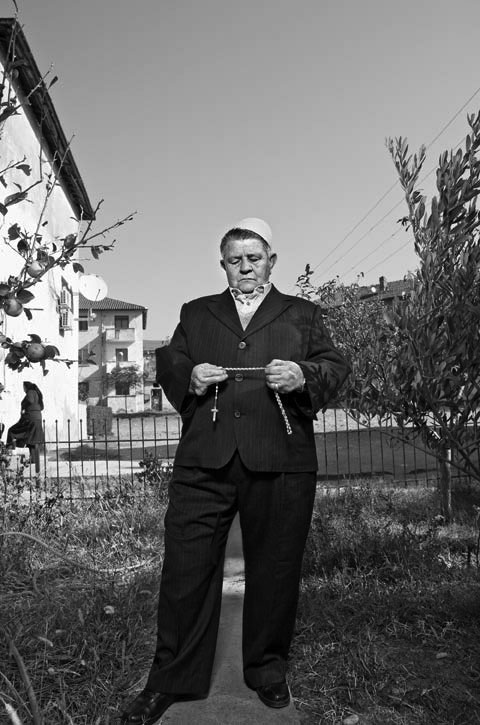
As a tradition dating back hundreds of years, this was necessary in societies that lived within tribal clans, followed the Kanun, an archaic code of law, and maintained an oppressive rule over the female gender.The Kanun states that women are considered to be the property of their husbands. The freedom to vote, drive, conduct business, earn money, drink, smoke, swear, own a gun or wear pants was traditionally the exclusive province of men. Young girls were commonly forced into arranged marriages, often with much older men in distant villages.
As an alternative, becoming a Sworn Virgin, or ‘burnesha” elevated a woman to the status of a man and granted her all the rights and privileges of the male population. In order to manifest the transition such a woman cut her hair, donned male clothing and sometimes even changed her name. Male gestures and swaggers were practiced until they became second nature. Most importantly of all, she took a vow of celibacy to remain chaste for life. She became a “he”.
(thx, tiffany)
From Slate, some speculation that Caster Semenya sandbagged the 800 meter final in order to avoid further gender-related scrutiny.
After the race, track and field aficionados questioned her tactics. The BBC’s David Ornstein said it appeared that Semenya “had more left in the tank.” His story quoted BBC commentator Kelly Holmes, who won this event in the 2004 Olympics, suggesting that Semenya hadn’t made her best effort: “She looked very strong, she didn’t look like she went up a gear, she wasn’t grimacing at all. I don’t know if her head was in it, when she crossed the line she didn’t look affected.” Meanwhile, Sports Illustrated senior writer Tim Layden tweeted that Semenya “seemed oddly disengaged most of race and not tired at end.”
I watched the race and Semenya’s finish was odd…she made her move super-late and was moving at a tremendous pace when she crossed the line. Had she worked her way up to the front before the final turn, she may have beaten the field by several lengths.
Update: Here is a more nuanced analysis of Semenya’s effort in the 800 meter final.
Perhaps there is nothing to her performance other than that she runs a more even pace than her rivals.
A comparison between her semi-final and this race is interesting in this regard. In that semi, she went through 400m in just over 58 seconds, 600m in about 1:28 and then closed the final 200m in 29.5s, looking like she had something in reserve.
Tonight, she went through 400m in 57.69s, then through 600m in about 1:27.1, and then closed in a touch over 30 seconds. My point is, her performance in the final was slightly faster at every stage than the semi, until she closed slower over the final 200m. To finish SLOWER than she did in the semi implies that she has little reserve and that she is closer to the limit than she looks. She wasn’t actually that fast over the final 200m, it’s just that everyone else was very slow!
(via @andrewsmit)
Persephone Magazine’s Stefan on “The Fall Of The Female Protagonist In Kids’ Movies,” specifically the last fifteen years of CGI animated film:
Think of all the female protagonists in Disney musicals. There are quite a number, almost as many as there are males—Cinderella, Belle, Ariel, Pocahontas, Mulan… the list goes on. Now think of female protagonists in Pixar movies.
There aren’t any. Not a single one.
This claim’s hedged a little bit, pointing to The Incredibles’ Elastigirl and Wall-E’s Eve as “strong, memorable female characters.” I’d say these two definitely count as protagonists, but there does seem to be something of a two-to-one rule: Finding Nemo’s Dory is a great protagonist, but she has to be paired with Marlin and Nemo (and Gill, and Crush…) The Incredibles is almost balanced. Almost.
Note that Stefan is far from the first person to point this out: these are just the links from the kottke.org archives:
Stefan thinks it has to do with the shift in animation from human characters (and their attendant romance plots) to the animals, toys, and robots that dominate Pixar and co. There’s something to that — a new research paper shows that not just in movies but in children’s books, animal characters are much more likely to be male than female:
The tendency of readers to interpret even gender-neutral animal characters as male exaggerates the pattern of female underrepresentation. The authors note that mothers frequently label gender-neutral animal characters as male when reading with their children, and that children assign gender to gender-neutral animal characters.
Here’s a different interpretation. Pixar’s movies are usually not just focused on men, but specifically on dads. Finding Nemo and The Incredibles are the best examples of this, but even Up and Ratatouille traffic pretty heavily in father issues, if not fatherhood outright.
Traditional Disney movies were really kids’ fantasies, even the ones seemingly targeted for boys, like The Jungle Book or Robin Hood. Pixar seems to have realized that if you can get the dad to come to the movie and love the movie, the whole family will come. Maybe more than once. And they’ll probably buy the DVD and the video game, too. That’s the formula.
And of course, it doesn’t hurt that the people making the movies are largely dads and young men who seem to probably be working out some issues with their dads. Pixar’s John Lasseter has five children, all boys.
They’re great movies. I love them. But I can’t deny that’s partly because they’re made for me.
(Via @araqueltrubek)
Update: As many people have pointed out, Pixar has a forthcoming full-length movie, Brave, about a Scottish warrior-princess. It was slated to be directed by Brenda Chapman (Pixar’s first female director), then was replaced by Mark Andrews, with Chapman as co-director.
Also, my friend (and former student) Kaitlin Welborn nails me: I used “protagonist” in its debased modern meaning of “sympathetic character”/”agent for good,” not its original sense as the first/primary character of the drama — which is also just a better definition. In this sense, the protagonist of Finding Nemo is definitely Marlin, The Incredibles Mr Incredible, Wall-E Wall-E, and so forth.
I also agree with Kaitlin that Stefan also overstates how much of a substantive change there’s been from the hand-drawn Disney animated films, and Pixar/Dreamworks’ computer-animated films.
First, there’s the obvious point that the older Disney movies were pretty ideologically screwed-up. I think this is well-known. And well before Pixar came along, Disney was already moving towards male protagonists: Aladdin, The Lion King, Hercules, The Emperor’s New Groove.
I’ll stick by my main point, which is that 1) an overwhelming number of Pixar movies focus on dads and fatherhood (biological or symbolic) and 2) this is not an accident.
After sitting out 11 months awaiting the results of gender testing, runner Caster Semenya has been cleared to compete in IAAF-sanctioned competitions. For some background, check out this New Yorker piece on Semenya from last November.
A great article on gender and children and the tough choices parents have to make when their children show signs of being transgender.
A recent medical innovation holds out the promise that this might be the first generation of transsexuals who can live inconspicuously. About three years ago, physicians in the U.S. started treating transgender children with puberty blockers, drugs originally intended to halt precocious puberty. The blockers put teens in a state of suspended development. They prevent boys from growing facial and body hair and an Adam’s apple, or developing a deep voice or any of the other physical characteristics that a male-to-female transsexual would later spend tens of thousands of dollars to reverse. They allow girls to grow taller, and prevent them from getting breasts or a period.
Ariel Levy did a piece on runner Caster Semenya for the New Yorker this week. Semenya’s competition eligibility is up in the air because the IAAF (the worldwide governing body for track and field) can’t decide whether she is a woman or a man.
She didn’t look like an eighteen-year-old girl, or an eighteen-year-old boy. She looked like something else, something magnificent.
Love that quote.
Older posts





Socials & More