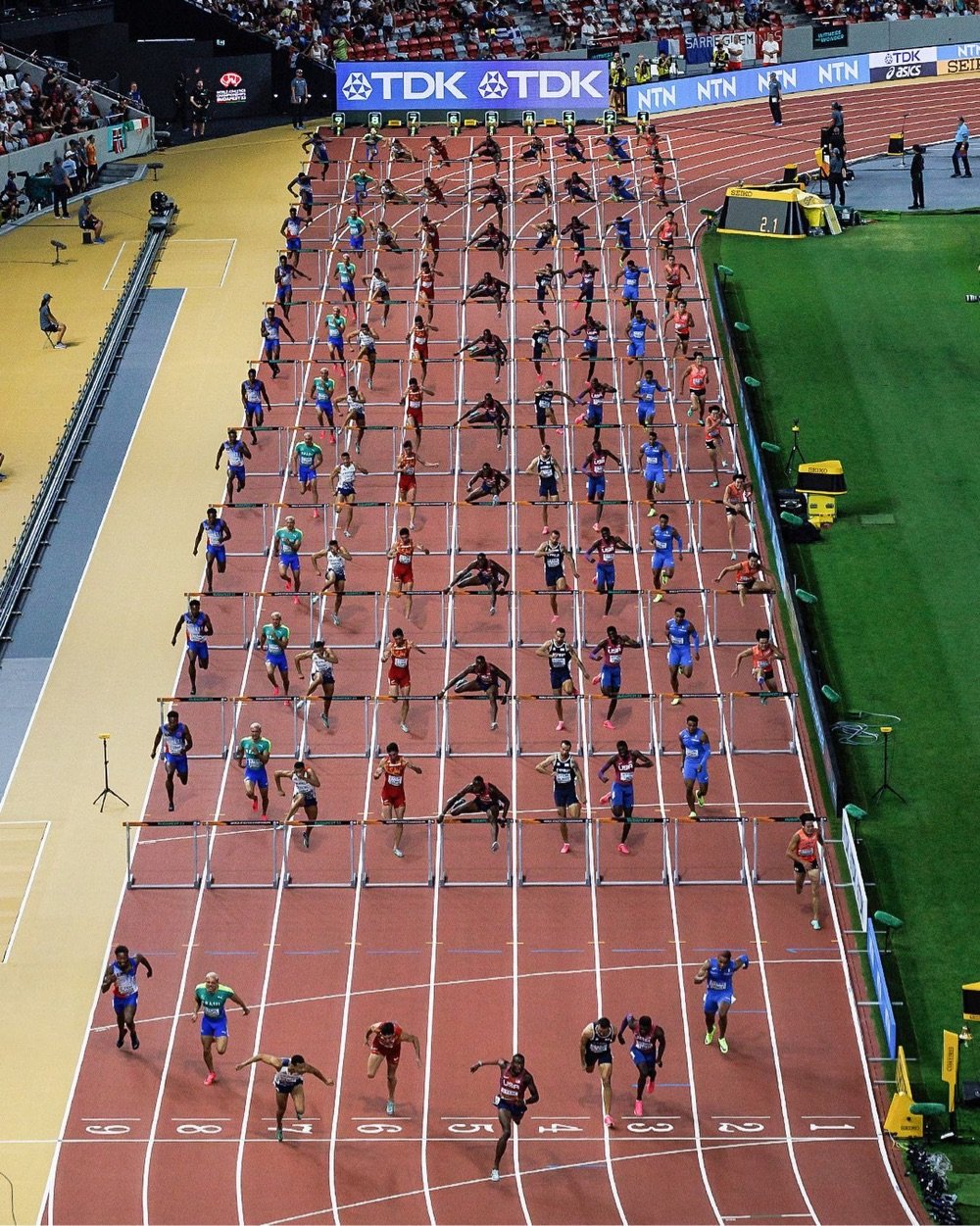
What an amazing, info-dense composite photograph taken by Casey Sims of the semi-finals of the men’s 110-meter hurdles at the 2023 World Athletics Championships in Budapest from last month. You can see and analyze the entire race, just from this one image. Eventual finals winner Grant Holloway is in lane 5 and led from start to finish.
People running “unconventional miles” is a thing now (see the beer mile) and during the pandemic, when meets and other usual track activities were cancelled, running a mile while dribbling a basketball became part of the human competitive story.
What started out as a curiosity-driven gimmick on YouTube eventually transpired into a competitive record among plenty of athletes, to the point where very experienced milers are now the only candidates that can pull this off.
The record for the basketball mile is 4:28, which also happens to be the current record for the aforementioned beer mile. It’s interesting that dribbling a basketball while running is equally as time-consuming as stopping to chug four beers and then running; I would have guessed the beer mile would take longer.
This is a video of world champion Grant Holloway doing the 110-meter hurdles that’s been modified to keep his head right in the middle of the video. While champion hurdlers don’t keep their heads as still as birds dowhen hunting, Holloway’s relative lack of motion is incredible.
In this view, you can clearly see how expert hurdlers don’t jump their whole bodies over the hurdle (like Super Mario or something) — it’s more that they just bring their lower bodies up over the hurdles while their heads & shoulders remain more or less the same height from the ground. There’s hardly any lateral motion either — very little wasted energy here.
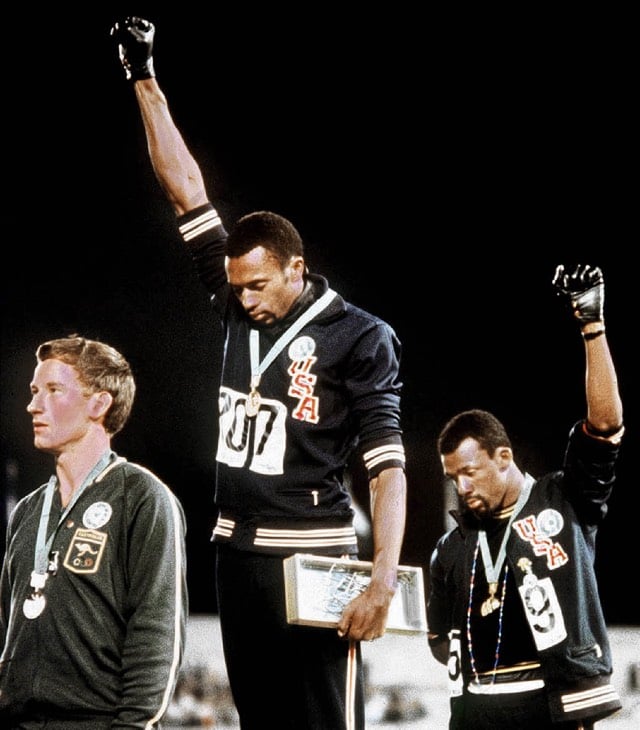
You’ve probably seen the photograph: Tommie Smith and John Carlos each raising a black-gloved fist during the playing of the US nation anthem during the medals ceremony at the 1968 Summer Olympic Games in Mexico City. But as this video explains, their protest was a part of a larger effort to use the Olympics to highlight racial inequality in American sports and society.
After watching the video, you might be interested in reading about the aftermath of the protest. Smith and Carlos were both suspended from the US team and expelled from the Games. They were both subject to abuse from the American press and received death threats. Australian Peter Norman, who had come in second and supported the protest, was ostracized in his own country. But when Norman died in 2006, both Smith and Carlos were pallbearers at this funeral.
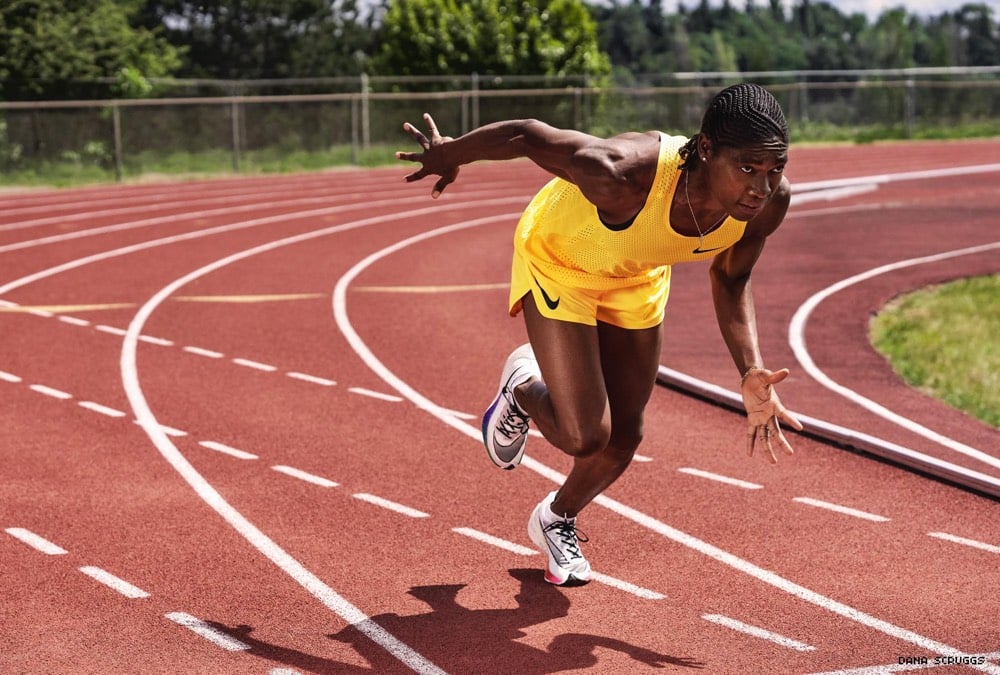
Immediately after that mind-blowing 800-meter final at the 2009 World Championships, some of Semenya’s fellow competitors went for the jugular. Italy’s Elisa Cusma Piccione (sixth place) insisted she was a man. Russia’s Mariya Savinova (fifth place) urged journalists to “just look at her.” Other athletes whispered, stared, and laughed at her. Then came the IAAF.
Initially, the questions about her drastic improvement were linked to suspicions of doping. When those tests came back negative, she was subjected to rounds of gender testing, reportedly involving analysis by an endocrinologist, a psychologist, a gender expert, an internist; most humiliating was a gynecological exam that included photographing her genitals while her feet were in stirrups. Eventually she was cleared to compete on the international circuit again but not before she missed nearly a year of competition during the IAAF’s deliberation over her test results.
The dirty secret here is that gender testing is common for women athletes — and yes, only women athletes.
I get why this is happening to Semenya — sexism, racism, bureaucracy — but it’s just so fucking ridiculous. Fundamentally, elite athletes are physically and mentally gifted outliers. Like, that’s the definition. They are amazing & marvelous freaks of nature. Their minds and muscles and chemicals and limbs are just hooked up differently from the rest of us. But you didn’t see Michael Phelps being sanctioned for his long arms, Usain Bolt for his height, Bjørn Dæhlie for his VO2 Max, or any number of championship male athletes for their abundant natural testosterone. Semenya is essentially being banned for being better than everyone else…as if that isn’t the goal of athletics.
During the medals ceremony for the 200 meter race the 1968 Olympics, gold medalist Tommie Smith and bronze medalist John Carlos, both standing shoeless on the podium, each raised one black-gloved fist in the air during the playing of the US national anthem as a gesture in support of the fight of better treatment of African Americans in the US. It was an historic moment immortalized in photos like the one above.
Norman was a white man from Australia, a country that had strict apartheid laws, almost as strict as South Africa. There was tension and protests in the streets of Australia following heavy restrictions on non-white immigration and discriminatory laws against aboriginal people, some of which consisted of forced adoptions of native children to white families.
The two Americans had asked Norman if he believed in human rights. Norman said he did. They asked him if he believed in God, and he, who had been in the Salvation Army, said he believed strongly in God. “We knew that what we were going to do was far greater than any athletic feat, and he said “I’ll stand with you” — remembers John Carlos — “I expected to see fear in Norman’s eyes, but instead we saw love.”
Update: In 2011, Democracy Now! interviewed Carlos about the salute and the aftermath. He was joined by sportwriter Dave Zirin and the pair told a story about why Norman didn’t want to be represented alongside Carlos and Smith with a statue on the San Jose State campus:
DAVE ZIRIN: OK, just checking. Well, they made the decision to make this amazing work of art, these statues on campus. And they were just going to have Tommie Smith and John Carlos, with a blank space where Peter Norman stood. And when John heard about that, he said, “Oh, no, no. I don’t want to be a part of this. And I don’t even want this statue if Peter Norman’s not going to be on it.” And the people at San Jose State said, “Well, Peter said he didn’t want to be on it.” And John said, “OK, let’s go to the president’s office and get him on the phone.” So they called Peter Norman from the president’s office at San Jose State, and sure enough, they got Peter on the phone. I believe Peter said — what did he say? “Blimey, John”? What did he say?
JOHN CARLOS: Yeah, “Blimey, John. You’re calling me with these blimey questions here?” And I said to him, I said, “Pete, I have a concern, man. What’s this about you don’t want to have your statue there? What, are you backing away from me? Are you ashamed of us?” And he laughed, and he said, “No, John.” He said — you know, the deep thing is, he said, “Man, I didn’t do what you guys did.” He said, “But I was there in heart and soul to support what you did. I feel it’s only fair that you guys go on and have your statues built there, and I would like to have a blank spot there and have a commemorative plaque stating that I was in that spot. But anyone that comes thereafter from around the world and going to San Jose State that support the movement, what you guys had in ‘68, they could stand in my spot and take the picture.” And I think that’s the largest thing any man would ever do. And as I said, I don’t think that my co-partner, my co-heart, Tommie Smith, would have done what Peter Norman done in that regards. He was just a tremendous individual.
In the 100m dash at this year’s Olympics, Andre De Grasse finished third behind Usain Bolt and Justin Gatlin with a time of 9.91 seconds. Jesse Owens, running on a cinder track with heavier, stiffer leather shoes, won the gold at the 1936 Olympics with a time of 10.3 seconds. CBC took De Grasse to a dirt track, gave him a replica pair of Owens’ shoes, and timed him. I won’t give away the result, but Owens looks pretty good in comparison. As David Epstein said in his TED talk, perhaps technology is responsible for much of the improvement of athletic achievement:
Consider that Usain Bolt started by propelling himself out of blocks down a specially fabricated carpet designed to allow him to travel as fast as humanly possible. Jesse Owens, on the other hand, ran on cinders, the ash from burnt wood, and that soft surface stole far more energy from his legs as he ran. Rather than blocks, Jesse Owens had a gardening trowel that he had to use to dig holes in the cinders to start from. Biomechanical analysis of the speed of Owens’ joints shows that had been running on the same surface as Bolt, he wouldn’t have been 14 feet behind, he would have been within one stride.
In De Grasse’s defense, he was running on dirt, not cinders and didn’t have much of a chance to train on the surface or with the shoes. But still.
This is a video of a pair of Kenyan high schoolers competing in a high jump contest, skillfully using a throwback technique rarely seen these days.
Cool, right? They’re using a scissors-jump technique that was popular in international competitions prior to the early 1900s, when landing areas were sand pits rather than the huge foam pads you typically see today. Various techniques followed the scissors-jump, with each making higher jumps possible until Dick Fosbury invented his Flop in 1968. All international competitors use the Flop today.
Interestingly though, the Fosbury Flop is not the instantly disruptive innovation I’d always thought it was. Fosbury started sailing over the bar backwards as a senior in high school in the mid-1960s. He refined his invention for years until his gold medal at the 1968 Mexico City Olympics attracted the attention of other jumpers, who recognized the potential of the technique. But if you look at the progression of high jump world records, there was no huge jump (sorry) in record heights because of the Flop. Ten years after the Flop’s big-stage debut at the Mexico City Games, the world record holder Vladimir Yashchenko still used the straddle technique. And in the 1980 Olympics, three high jump finalists didn’t use the Flop. Like most new promising technologies, the Flop took time to catch on, even though 45 years on, it’s the clearly superior technique. (via @dunstan)
If you need a little pick-me-up, try this video of two nonagenarians racing each other in the 100-meter dash. Seems like there’s gonna be a clear winner from the start but…
Both men were born in 1918; if the video were filmed this year, that would make them 95. (via @gavinpurcell)
Or rather, just an amazing performance, full stop. I was alerted to this video by Dunstan Orchard who tweeted “this must be the most remarkable track race I’ve ever seen”. I don’t want to spoil it too much but pay attention to the guy in last place coming out of the curve.
Like a freight train! I’ve watched this race about 8 times now and it never gets old. The runner, Richard Whitehead, set the world record in the race. He also owns the world record in the marathon, which, amazing! Oh, and this table tennis shot is pretty great too.
After the race, track and field aficionados questioned her tactics. The BBC’s David Ornstein said it appeared that Semenya “had more left in the tank.” His story quoted BBC commentator Kelly Holmes, who won this event in the 2004 Olympics, suggesting that Semenya hadn’t made her best effort: “She looked very strong, she didn’t look like she went up a gear, she wasn’t grimacing at all. I don’t know if her head was in it, when she crossed the line she didn’t look affected.” Meanwhile, Sports Illustrated senior writer Tim Layden tweeted that Semenya “seemed oddly disengaged most of race and not tired at end.”
I watched the race and Semenya’s finish was odd…she made her move super-late and was moving at a tremendous pace when she crossed the line. Had she worked her way up to the front before the final turn, she may have beaten the field by several lengths.
Perhaps there is nothing to her performance other than that she runs a more even pace than her rivals.
A comparison between her semi-final and this race is interesting in this regard. In that semi, she went through 400m in just over 58 seconds, 600m in about 1:28 and then closed the final 200m in 29.5s, looking like she had something in reserve.
Tonight, she went through 400m in 57.69s, then through 600m in about 1:27.1, and then closed in a touch over 30 seconds. My point is, her performance in the final was slightly faster at every stage than the semi, until she closed slower over the final 200m. To finish SLOWER than she did in the semi implies that she has little reserve and that she is closer to the limit than she looks. She wasn’t actually that fast over the final 200m, it’s just that everyone else was very slow!
Jesse Owens’ medal-winning exploits against the Aryan backdrop of the 1936 Olympics are well known, but I had never heard the story of his friendship with his German rival in the long jump. Owens explained in a 1960 Reader’s Digest piece:
Walking a few yards from the pit, I kicked disgustedly at the dirt. Suddenly I felt a hand on my shoulder. I turned to look into the friendly blue eyes of the tall German broad jumper. He had easily qualified for the finals on his first attempt. He offered me a firm handshake.
“Jesse Owens, I’m Luz Long. I don’t think we’ve met.” He spoke English well, though with a German twist to it.
“Glad to meet you,” I said. Then, trying to hide my nervousness, I added, “How are you?”
“I’m fine. The question is: How are you?”
“What do you mean?” I asked.
“Something must be eating you,” he said-proud the way foreigners are when they’ve mastered a bit of American slang. “You should be able to qualify with your eyes closed.”
“Believe me, I know it,” I told him — and it felt good to say that to someone.
The shoes are fabricated using a selective laser sintering process that uses precise 3-D scans of an athlete’s foot to achieve maximum fit. The really tantalizing (but unfortunately uncited) bit about Fusaro’s design is that by fitting shoes to a sprinter’s feet so precisely, significant performance improvements might result:
Scientific investigations have shown that tuning the mechanical properties of a sprint shoe to the physical abilities of an athlete can improve performance by up to 3.5%.
For 100-meter world record holder Usain Bolt, a performance improvement of 3.5% could lower his world record to 9.24…just by wearing different shoes. That seems insane but Speedo’s LZR Racer suit that was responsible for dozens of world records falling in 2008 were shown to lower racing times by 1.9 to 2.2 percent so that sort of improvement is certainly possible. (via @curiousoctopus)
Scientists are studying older athletes, like 91-year-old track star Olga Kotelko, to see how their bodies react to exercise. There is emerging evidence that a key to staying healthier longer is not just exercise but intense training.
You don’t have to be an athlete to notice how ruthlessly age hunts and how programmed the toll seems to be. We start losing wind in our 40s and muscle tone in our 50s. Things go downhill slowly until around age 75, when something alarming tends to happen.
“There’s a slide I show in my physical-activity-and-aging class,” Taivassalo says. “You see a shirtless fellow holding barbells, but I cover his face. I ask the students how old they think he is. I mean, he could be 25. He’s just ripped. Turns out he’s 67. And then in the next slide there’s the same man at 78, in the same pose. It’s very clear he’s lost almost half of his muscle mass, even though he’s continued to work out. So there’s something going on.” But no one knows exactly what. Muscle fibers ought in theory to keep responding to training. But they don’t. Something is applying the brakes.
And then there is Olga Kotelko, who further complicates the picture, but in a scientifically productive way. She seems not to be aging all that quickly. “Given her rather impressive retention of muscle mass,” says Russ Hepple, a University of Calgary physiologist and an expert in aging muscle, “one would guess that she has some kind of resistance.” In investigating that resistance, the researchers are hoping to better understand how to stall the natural processes of aging.
After sitting out 11 months awaiting the results of gender testing, runner Caster Semenya has been cleared to compete in IAAF-sanctioned competitions. For some background, check out this New Yorker piece on Semenya from last November.
It’s worth keeping in mind that there is a significant difference between the final seconds of Usain Bolt’s gold-medal run in Beijing in 2008 and the final seconds of his victory this afternoon in Call of Duty. In the video game, right up until the moment Sadiki took out the final terrorist, Bolt was on edge, nervous, uncertain. It taxed him. He almost lost.
Beating the video game was a challenge for him. Executing the most dominant and effortless performance in the history of the Olympic Games was not.
Ethan Siegel, a theoretical astrophysicist at Lewis & Clark College, recently charted a graph to demonstrate that, judging by the incremental progression of the 100-meter world record over the past hundred years, Bolt appears to be operating at a level approximately thirty years beyond that of the expected capabilities of modern man. Mathematically, Bolt belonged not in the 2008 Olympics but the 2040 Olympics. Michael Johnson, the hero of the 1996 Olympic summer games, has made the same point in a different way: A runner capable of beating Bolt, he says, “hasn’t been born yet.”
That 100-meter final at the Beijing Olympics still gives me goosebumps when I think about it. But all this business about no one being able to touch Bolt’s pace for another 30 years, that’s just bunk. The mark is out there. People are going to go for it. My prediction: Bolt will continue to break his own mark but someone else will approach or equal Bolt’s current record in fewer than five years, if not three.
Ariel Levy did a piece on runner Caster Semenya for the New Yorker this week. Semenya’s competition eligibility is up in the air because the IAAF (the worldwide governing body for track and field) can’t decide whether she is a woman or a man.
She didn’t look like an eighteen-year-old girl, or an eighteen-year-old boy. She looked like something else, something magnificent.
At the track and field world championships in Germany this evening, Usain Bolt set another world record in the 100-meters: 9.58 seconds, besting his previous record of 9.69. Can he go under 9.5?
Update:Here’s the race in HD. It’s a lot closer than the Olympic final…Gay was really hauling as well. The Times reports that the 0.11 seconds Bolt shaved off the record was the largest difference since the advent of electronic timing in 1977.
But second off, you can also see that Usain Bolt is running much faster than humans ought to be running right now. This should give you an inkling of just how special these performances we’re seeing from him are. We shouldn’t be seeing times like this until the 2030s. Which means, honestly, that it ought to take around 30 years for someone else to come along and break his record.
Yesterday, Usain Bolt broke the unofficial record at the rarely contested distance of 150 meters, running it in 14.35 seconds on a temporary surface set up in Manchester’s city center. This sounds made up, but here’s the video.
Some physicists have worked out what Usain Bolt’s time in the 100 meters in Beijing would have been if he hadn’t started celebrating before the finish line: 9.55 seconds. The original paper is here. I tried doing this the day after the race but even the HD footage wasn’t good enough to see the tick marks on the track and I didn’t want to mess around with all the angles. (via justin blanton)
With a Russian athlete leading the javelin competition, Czech thrower Barbora Spotakova stepped up for her final throw and thought about the Soviet invasion of Czechoslovakia forty years ago that day. After her victory, she described her goal with that throw in a wonderful turn of phrase:
I was wondering if I could turn the date.
I don’t know if that’s a translation or what, but non-native speakers of English often express ideas more beautifully than native speakers do (Nabokov for example).
Somewhat related…how perfect is the name of the US women’s soccer team goalkeeper: Hope Solo.
Update: I need a do-over on this one. First of all, Nabokov is a native English speaker; in fact, he could read and write English before he could Russian. Second, the NY Times modified the quote in that article! When I read it, the selection above was a direct quote attributed to Spotakova. Now the passage reads:
“Aug. 21 is a very special day for the Czech Republic — it’s the 40th anniversary of the Soviet invasion in 1968,” she said afterward. “I of course had a Russian competitor against me. She was winning with such a long throw,” she added, and said she wondered if she’d be able to turn the date to her advantage.
That’s much less poetic…I wonder if there was a translation misunderstanding or something. (thx, dan & nivan)
Eyeballing the chart would suggest that the cutting edge of human achievement in the 200m is anything sub-19.7. A 19.59 at Beijing would be phenomenal. Then you scroll down — way down — and you hit Johnson’s 19.32.
Johnson has stated that he’s fully prepared for Usain Bolt to break his record.
Runners in lane eight got off the mark on average about 150 milliseconds after runners in lane one, Dapena found. A time delay of that magnitude translates to about a metre’s difference at the finish line.







Stay Connected