


Updates on previous entries for Dec 12, 2011*
Rare Steve Jobs speech from 1980 orig. from Dec 12, 2011
* Q: Wha? A: These previously published entries have been updated with new information in the last 24 hours. You can find past updates here.

This site is made possible by member support. 💞
Big thanks to Arcustech for hosting the site and offering amazing tech support.
When you buy through links on kottke.org, I may earn an affiliate commission. Thanks for supporting the site!
kottke.org. home of fine hypertext products since 1998.
Beloved by 86.47% of the web.
Rare Steve Jobs speech from 1980 orig. from Dec 12, 2011
* Q: Wha? A: These previously published entries have been updated with new information in the last 24 hours. You can find past updates here.
Dress like your favorite nerdy folk: Nerd Girlfriend is a companion site to the excellent Nerd Boyfriend.
There’s no gameplay asside from firing the gun and moving around, but it’s still disturbing to walk around within Google Street View with an assault rifle. (thx, job)
When this came on right before the season finale of Boardwalk Empire, I shushed my talking wife so hard I nearly threw out my back.
April! April is coming!
Video of a Steve Jobs speech circa 1980. This was just recently donated and presented by the Computer History Museum.
(via @itscolossal)
Update: Well, that didn’t last long..the Vimeo embed ist kaputt. But it’s still available on the Computer History Museum’s site. Perhaps we can persuade them to throw it up on their YouTube channel?
The second season of Sherlock returns to the BBC on January 1st with A Scandal In Belgravia:
In episode one of this new series, compromising photographs and a case of blackmail threaten the very heart of the British establishment but, for Sherlock and John, the game is on in more ways than one as they find themselves battling international terrorism, rogue CIA agents and a secret conspiracy involving the British government. But this case will cast a darker shadow over their lives than they could ever imagine, as the great detective begins a long duel of wits with an antagonist as cold and ruthless and brilliant as himself: to Sherlock Holmes, Irene Adler will always be THE woman.
The series will likely show in the US on TV at some point after that or via torrent quite a bit sooner.
Thanks to Aziz Ansari and Matthew Shawver, there is now an emoji version of Kanye and Jay-Z’s N***as in Paris.

(via @beaucolburn)
Literally, this literally had my mouth literally hanging open this afternoon. Literally.
Some thoughts:
1. It’s finally the future…our jet packs are here.
2. Waterworld reboot as superhero movie a la Iron Man.
3. Literally.
(via ★warrenellis)
I can’t imagine this is going to be up for much longer, so grab it while you can: Pulp Fiction presented in chronological order.
(via ★interesting)
Some good thoughts about the new version of Twitter from Dan Frommer.
This is the beginning of Jack Dorsey’s real vision for Twitter combined with Dick Costolo’s vision for a real-time social advertising product. The main components: writing and Tweets, obviously; having conversations with other people; discovering what’s happening in the world through Twitter; and seeing a promoted message from brands here and there.
Ice Cube opines on Charles and Ray Eames orig. from Dec 08, 2011
Shigeru Miyamoto to step down at Nintendo orig. from Dec 07, 2011
* Q: Wha? A: These previously published entries have been updated with new information in the last 24 hours. You can find past updates here.
Speaking of the Eames, the recent documentry on the pair is going to be on American Masters on PBS.
American Masters presents the first film made about America’s most important and influential designers, Charles and Ray Eames, since their deaths in 1978 and 1988, respectively — and the only film that explores the link between their artistic collaboration and sometimes tortured marriage. Jason Cohn and Bill Jersey’s definitive documentary delves into the private world the Eameses created in their Renaissance-style, Venice Beach, California studio, where design history was born. Narrated by James Franco, Charles & Ray Eames: The Architect and the Painter premieres nationally Monday, December 19 from 10-11:30 p.m. (ET/PT) on PBS (check local listings) as the 25th anniversary season finale of American Masters.
Before Ice Cube became a rapper, he studied architectural drafting at the Phoenix Institute of Technology, so he has some interesting things to say in this short appreciation of Charles and Ray Eames.
They was doing mashups before mashups even existed. It’s not about the pieces, it’s how the pieces work together. You know, taking something that already exist and making it something special. You know, kinda like sampling.
(via ★interesting)
Update: The NY Times has an interview with Ice Cube about the video.
Q: How are your drafting skills these days?
A: You don’t want to live in nothing I draw. I got a certificate. For a year. In ‘88. I don’t think I picked up a T-square since.
Miyamoto, who is responsible for creating or overseeing the creation of Mario Bros, Donkey Kong, The Legend of Zelda, and many other games, is stepping down from his role as manager of Nintendo’s Entertainment Analysis and Development branch to work with a smaller team on smaller games with much shorter timelines.
“What I really want to do is be in the forefront of game development once again myself,” Miyamoto said. “Probably working on a smaller project with even younger developers. Or I might be interested in making something that I can make myself, by myself. Something really small.”
Miyamoto was profiled in the New Yorker last December. (via @shauninman)
Update: Nintendo says it was a misunderstanding.
“This is absolutely not true,” said a spokeswoman for Nintendo. “There seems to have been a misunderstanding. He has said all along that he wants to train the younger generation. “He has no intention of stepping down. Please do not be concerned.”
Rumor has it that the LHC at CERN has found the Higgs boson. The news runs contrary to some earlier speculation.
The teams are sworn to secrecy, but various physics blogs, and the canteens at Cern, are alive with talk of a possible sighting of the Higgs, and with a mass inline with what many physicists would expect.
Since the Higgs’ nickname is the God particle, does this count as the Second Coming? (@gavinpurcell)
Gothamist has some photos of the new Apple Store in NYC’s Grand Central Terminal.
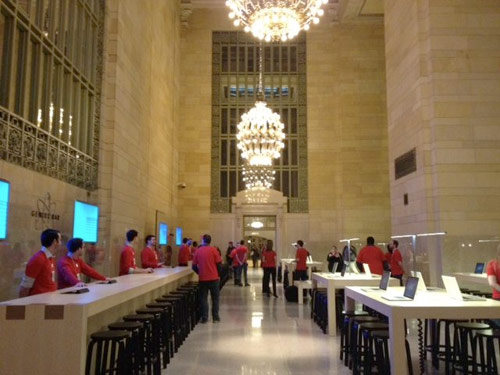
The company was obviously under tight constraints as to what they could do with the store (they would have loved to encase the whole thing in plexiglass probably), but from the looks of things, they did a marvelous job. There’s so little styling — the whole store is just tables and screens mostly — that it looks like the Apple Store not only belongs there, but that it’s been there forever, like Grand Central was designed with the Apple Store in mind. If you walk around Grand Central, not a lot of the other retail locations can say that, if any. (photo by katie sokoler)
Just in time for the holiday shopping season, a list of science fiction books for the little ones.
In a recent appearance on Charlie Rose, John Lasseter revealed the rough premise of an upcoming-but-untitled Pixar film:
Pete Docter, from Monsters, Inc. and Up, is doing a new film that takes place inside of a girl’s mind and it is about her emotions as characters, and that is unlike anything you’ve ever seen.
With Brave and now this, it looks like Pixar is finally taking their lack of female lead characters seriously.
In Focus delivers part one of an eventual three-part look at 2011 in photography. 2011 was a remarkably eventful year.

Here’s part two. See also Buzzfeed’s list of the 45 most powerful images of 2011.
Woo, a new compilation from The Hood Internet just “dropped”. I am picking it up right now. (Am I doing this right? Yo?) Anyway, free music that’s good! Clicky clicky.
If you were thinking that all of H&M’s clothing models are looking pretty much the same these days, that’s because the bodies are computer generated with heads pasted on in post-production.
But man, isn’t looking at the four identical bodies with different heads so uncanny? Duly noted that H&M made one of the fake bodies black. You can’t say that the fictional, Photoshopped, mismatched-head future of catalog modeling isn’t racially diverse.
From Sean Carroll at Cosmic Variance, a list of facts and very strong opinions about the nature of time.
4. You live in the past. About 80 milliseconds in the past, to be precise. Use one hand to touch your nose, and the other to touch one of your feet, at exactly the same time. You will experience them as simultaneous acts. But that’s mysterious - clearly it takes more time for the signal to travel up your nerves from your feet to your brain than from your nose. The reconciliation is simple: our conscious experience takes time to assemble, and your brain waits for all the relevant input before it experiences the “now.” Experiments have shown that the lag between things happening and us experiencing them is about 80 milliseconds.
5. Your memory isn’t as good as you think. When you remember an event in the past, your brain uses a very similar technique to imagining the future. The process is less like “replaying a video” than “putting on a play from a script.” If the script is wrong for whatever reason, you can have a false memory that is just as vivid as a true one. Eyewitness testimony, it turns out, is one of the least reliable forms of evidence allowed into courtrooms.
In an outtake from his 2001 book Word Freak, author Stefan Fatsis introduces us to Nigel Richards, perhaps the best Scrabble player in the world.
If Nigel has a weakness, it’s that his wide-open, high-scoring style often leaves him vulnerable to counterattack by opponents who also have prodigious word knowledge. And Nigel is regarded as having a less-than-proficient endgame, which is variously attributed to his lack of interest in strategic play or his reluctance to study board positions. Indeed, Nigel doesn’t record his racks, doesn’t review games, rarely kibitzes about particular plays. The other top experts, particularly the Americans, talk disdainfully about this gap in Nigel’s ability, how it makes him an incomplete player. Naturally, Nigel doesn’t care.
According to Wikipedia, Richards has continued his winning ways since 2001…he’s a two-time World Championship winner and has won the U.S. National Scrabble Championship three out of the last four years.
Before he made movies, Stanley Kubrick was a photographer for Look magazine. Here are a selection of Kubrick’s photos of New York City life in the 1940s, even then displaying his keen cinematic eye.
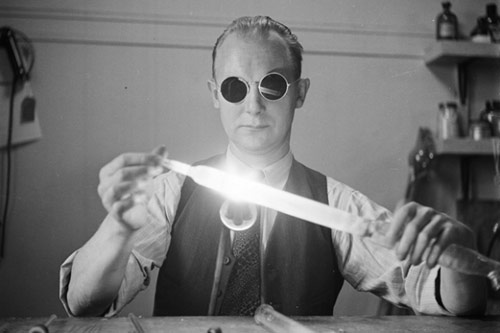
Prints are available. (thx, mark)
In recent years, authors have claimed that many seemingly boring things have changed the world but a particularly strong case can be made for the potato and Charles C. Mann makes it.
The effects of this transformation were so striking that any general history of Europe without an entry in its index for S. tuberosum should be ignored. Hunger was a familiar presence in 17th- and 18th-century Europe. Cities were provisioned reasonably well in most years, their granaries carefully monitored, but country people teetered on a precipice. France, the historian Fernand Braudel once calculated, had 40 nationwide famines between 1500 and 1800, more than one per decade. This appalling figure is an underestimate, he wrote, “because it omits the hundreds and hundreds of local famines.” France was not exceptional; England had 17 national and big regional famines between 1523 and 1623. The continent simply could not reliably feed itself.
The potato changed all that. Every year, many farmers left fallow as much as half of their grain land, to rest the soil and fight weeds (which were plowed under in summer). Now smallholders could grow potatoes on the fallow land, controlling weeds by hoeing. Because potatoes were so productive, the effective result, in terms of calories, was to double Europe’s food supply.
Mann talks more about the potato in his excellent 1493: Uncovering the New World Columbus Created.
An excellent 26-minute talk by Jonathan Hoefler of the Hoefler & Frere-Jones about how they think about designing typefaces and webfonts in particular.
Today, as webfonts are buoyed by a wave of early-adopter enthusiasm, they’re marred by a similar unevenness in quality, and it’s not just a matter of browsers and rasterizers, or the eternal shortage of good fonts and preponderance of bad ones. There are compelling questions about what it means to be fitted to the technology, how foundries can offer designers an expressive medium (and readers a rich one), and what it means for typography to be visually, mechanically, and culturally appropriate to the web. This is an exploration of this side of web fonts, and a discussion of where the needs of designers meet the needs of readers.
I love Typekit, but I am very much looking forward to switching Stellar over to Whitney or somesuch when H&FJ’s webfonts are released (if the price and performance are right).
Over at Edible Geography, Nicola Twilley documents the banana ripening process at a facility in the Bronx.
During our visit, Paul Rosenblatt told us that he aims to ripen fruit in five days at 62 degrees, but, to schedule fruit readiness in accordance with supply and demand, he can push a room in four days at 64 degrees, or extend the process to seven days at 58 degrees.
“The energy coming off a box of ripening bananas could heat a small apartment,” Rosenblatt explains, which means that heavy-duty refrigeration is required to keep each room temperature-controlled to within a half a degree. In the past, Banana Distributors of New York has even experimented with heating parts of the building on captured heat from the ripening process.
To add to the complexity, customers can choose from different degrees of ripeness, ranging from 1 (all green) to 7 (all yellow with brown sugar spots). Banana Distributors of New York proudly promise that they have “Every Color, Every Day,” although Rosenblatt gets nervous if he has more than 2000 boxes of any particular shade.
In thinking about making meals completely from scratch, Waldo Jaquith realizes that making a simple cheeseburger would have been nearly impossible before the twentieth century.
Tomatoes are in season in the late summer. Lettuce is in season in in the fall. Mammals are slaughtered in early winter. The process of making such a burger would take nearly a year, and would inherently involve omitting some core cheeseburger ingredients. It would be wildly expensive-requiring a trio of cows-and demand many acres of land. There’s just no sense in it.
A cheeseburger cannot exist outside of a highly developed, post-agrarian society. It requires a complex interaction between a handful of vendors-in all likelihood, a couple of dozen-and the ability to ship ingredients vast distances while keeping them fresh.
(via stellar)
This has been happening for awhile but I hadn’t heard about it before: some coma patients are being awoken by Ativan and Ambien and paradoxically so…both are sedative drugs used for treating insomnia.
The first report of a zolpidem [aka Ambien] awakening came from South Africa, in 1999. A patient named Louis Viljoen, who, three years before, was declared vegetative after he was hit by a truck, had taken to clawing at his mattress during the night. Thinking he was suffering from insomnia, his family doctor suggested zolpidem to help him sleep. But 20 minutes after his mother ground the tablet up and fed it to him through a straw, Viljoen began to stir. His eyes, which normally wandered the room, vacant and unfocused, flickered with the light of consciousness. And then he began to talk (his first words were “Hello, Mummy”), and move (he could control his limbs and facial muscles). A few hours later he became unresponsive. But the next day, and for many days after that, zolpidem revived him, a few hours at a time.
Here was a case worthy of Hollywood: three years was well past the point at which doctors would expect any sort of spontaneous recovery. Viljoen awoke with the ability to speak in complete sentences. Not only did he recognize his mother, but he also recognized the voices of people who had spoken to him only when he was apparently vegetative. He remembered nothing of the mysterious realm he kept receding back into. When doctors asked him what it was like to slip away, he said he felt no changes at all. But he could recall conversations from the previous day’s awakening, along with bits and pieces of his former life: his favorite rugby team, specific matches he attended, players that he rooted for and against. As time passed, his cognition improved. He could laugh at jokes, and his awakenings stretched from a few hours to entire days. Eventually, he no longer needed zolpidem.
(thx, meg)
Trent Reznor’s and Atticus Ross’ soundtrack for The Girl with the Dragon Tattoo is in the can and will be released in one week. For now, you can pre-order the soundtrack or download a free six-song sampler. Reznor and Ross won an Oscar for their The Social Network soundtrack.
A recently discovered species of crab grows gardens of bacteria on its claws on which to feed.
The bristles that cover the crab’s claws and body are coated in gardens of symbiotic bacteria, which derive energy from the inorganic gases of the seeps. The crab eats the bacteria, using comb-like mouthparts to harvest them from its bristles. […] Thurber thinks that K. puravida waves its claws to actively farm its bacterial gardens: movements stir up the water around the bacteria, ensuring that fresh supplies of oxygen and sulphide wash over them and helping them to grow. “This ‘dance’ is extraordinary and comical,” says Van Dover. “We’ve never seen this strategy before.”
(via @noahwg)
Occupy Wall Street went up to protest at Lincoln Center last night during a performance of Philip Glass’ opera Satyagraha. New Yorker music critic Alex Ross was there and captured the protest on video, which included Glass himself reading the closing lines from the opera, amplified to the crowd by the people’s mic. It is an amazing scene.
When the Satyagraha listeners emerged from the Met, police directed them to leave via side exits, but protesters began encouraging them to disregard the police, walk down the steps, and listen to Glass speak. Hesitantly at first, then in a wave, they did so. The composer proceeded to recite the closing lines of Satyagraha, which come from the Bhagavad-Gita (after 3:00 in the video above): “When righteousness withers away and evil rules the land, we come into being, age after age, and take visible shape, and move, a man among men, for the protection of good, thrusting back evil and setting virtue on her seat again.” True to form, he said it several times, with the “human microphone” repeating after him. Lou Reed and Laurie Anderson were in attendance, and at one point Reed helped someone crawl over the barricade that had been set up along the sidewalk.
(via stellar)
The NFL regards the “All-22” footage of their games — the zoomed-out view of the game that includes the movements of all 22 players on the field — as proprietary and releases it to very few people. But it’s difficult to fully understand the game without it.
For decades, NFL TV broadcasts have relied most heavily on one view: the shot from a sideline camera that follows the progress of the ball. Anyone who wants to analyze the game, however, prefers to see the pulled-back camera angle known as the “All 22.”
While this shot makes the players look like stick figures, it allows students of the game to see things that are invisible to TV watchers: like what routes the receivers ran, how the defense aligned itself and who made blocks past the line of scrimmage.
By distributing this footage only to NFL teams, and rationing it out carefully to its TV partners and on its web site, the NFL has created a paradox. The most-watched sport in the U.S. is also arguably the least understood. “I don’t think you can get a full understanding without watching the entirety of the game,” says former head coach Bill Parcells. The zoomed-in footage on TV broadcasts, he says, only shows a “fragment” of what happens on the field.
Update: The NFL is making the All-22 footage from next season’s games available on its website for $70. (thx, stef)
The Olympic Games used to include competitions in painting, sculpture, literature, architecture, and music.
From 1912 to 1948 rules of the art competition varied, but the core of the rules remained the same. All of the entered works had to be inspired by sport, and had to be original (that is, not be published before the competition). Like in the athletic events at the Olympics, gold, silver, and bronze medals were awarded to the highest ranked artists, although not all medals were awarded in each competition. On a few occasions, in fact, no medals were presented at all.
(via @itscolossal)
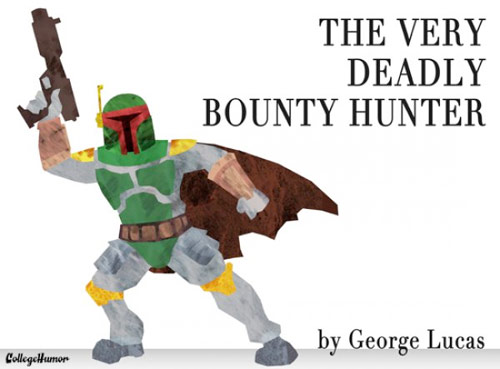
Adam Koford drew an illustration of the seven deadly sins at Jabba’s palace on Tatooine:
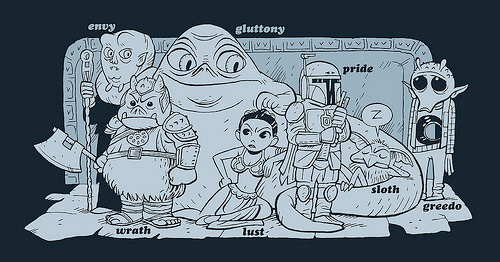
That got me thinking…what were George Lucas’ seven sins related to the Star Wars movies? Here’s my crack at an answer:
1. Greedo shoots first. The obvious #1. In the original theatrical release, Han shot Greedo without any return fire. In subsequent releases, the sequence was sanitized by Lucas for younger viewers: Greedo shoots at Han first and Han kills him in retaliation.
2. Jar Jar Binks. Or perhaps this should be #1?
3. Digital Jabba talking to Han outside the Falcon in Episode IV (and many of the other digital alterations Lucas made starting in 1997). Fake fake fake.
4. Young Anakin. Jake Lloyd and Hayden Christensen were both horrible.
5. Ewoks. Not as bad as Jar Jar, but…man. You know, for kids.
6. Natalie Portman. She can be a really good actress but needs strong direction. Guess who sucks at directing actors? Lucas!
7. Midiclorians. No one needed a scientific explanation of The Force. Just do a bunch of hand-waving about “the Force is strong with this one” and leave it at that.
Did I miss anything big? (I mean, aside from Episodes I-III?)
Over the past two days, I’ve seen this clever riff on the “give a man a fish” parable pop up over and over again on various social sites, primarily Twitter and Stellar:
Give a man a gun and he can rob a bank. Give a man a bank and he can rob the world.
The earliest instance of this text I could find on Twitter was posted by @Bonoboism on Nov 28. Because it was an @reply, the original post was not widely retweeted but over the next day or so, it was posted by dozens of other people without attribution and some of those knock-off posts got hundreds and even thousands of retweets. Without looking too hard, I found tweets by @ilegal, @MrsSelfDestrukt, @owenderby, @sickipediabot, @HipstaGangsta, @ladydebidebz, @tickly, and @yourrhighness_. Tweets like this have a tendency to get appropriated by others without attribution…the temptation to appear that pithy is just too great, I guess.
Ted Sabarese shot a photo series of people and the fish they look like.

(via ★swissmiss)
Socials & More