kottke.org posts about video
From 1969, this is the video that Saul Bass made to pitch AT&T on a new corporate identity. What a time capsule. Here’s the logo, which remained in use until 1983, when Bass designed the “Death Star” logo to replace it.

The Auralnauts provide an alternate soundtrack and dialogue for Star Wars.
(via @waxpancake)
[This is NSFW.] Artist Hilde Krohn Huse needed a minute or two of film of herself hanging naked upside down from a tree branch for a project she was working on. But when the rope tightened around her ankle too much, things went a little wrong.
My first thought was, “OK, you’ve fucked up, Hilde, but let’s try to get you out of this so nobody needs to know.” I hauled myself up, hand over hand, until I was swinging horizontally, just below the branch, and tried to yank my foot free.
It was hopeless. Righting myself, I put my free foot back on the ground to rest for a moment, then tried again, pulling myself up and fighting, puppet-like, against my bonds. My left foot, taking my weight in the lowest noose, started to spasm and I knew my strength wouldn’t hold out. But my pride was still uppermost — the idea of having to draw the attention of others to my humiliating plight still seemed unthinkable. I was losing strength, but full of adrenaline, my face dragging along the woodland floor, leaving me spitting twigs.
As any good artist would, Huse turned her ordeal into an art piece in the form of the 11 minutes of video shot before her camera shut off:
From 2003, a 25-minute documentary (plus a few extras) on how Pixar made Finding Nemo.
How far does Pixar go to get a movie made correctly? Far. For instance, everyone on the Nemo team got certified in scuba diving. (via @drwave)
The Danish Girl is an upcoming film starring Eddie Redmayne as transgender pioneer Lili Elbe, who was one of the first people to undergo gender reassignment surgery. It’s based on a novel of the same name which presents a fictionalized account of Elbe’s life.
The film may well net Redmayne another Oscar nomination, but I don’t know how the transgender community will react. From a quick look on Twitter and the past reception of Oscar-hopeful films dealing with similar issues (see The Imitation Game’s portrayal of Alan Turing’s sexuality), I’m guessing it may not be so well-received.
The Whitney Plantation in Louisiana is the only US museum and memorial to slavery. The Atlantic has a video about the museum and its founder, John Cummings, who spent 16 years and $8 million of his own money on it.
The Wolfpack is a documentary that follows the six Angulo brothers, whose father kept them sequestered (along with their sister and mother) inside a four-bedroom apartment on the Lower East Side of Manhattan for fourteen years because he thought the city unsafe, allowing only annual or semi-annual trips outside. The boys’ only access to the outside world was through movies, which they recreated in their tiny apartment. The trailer:
With no friends and living on welfare, they feed their curiosity, creativity, and imagination with film, which allows them to escape from their feelings of isolation and loneliness. Everything changes when one of the brothers escapes, and the power dynamics in the house are transformed. The Wolfpack must learn how to integrate into society without disbanding the brotherhood.
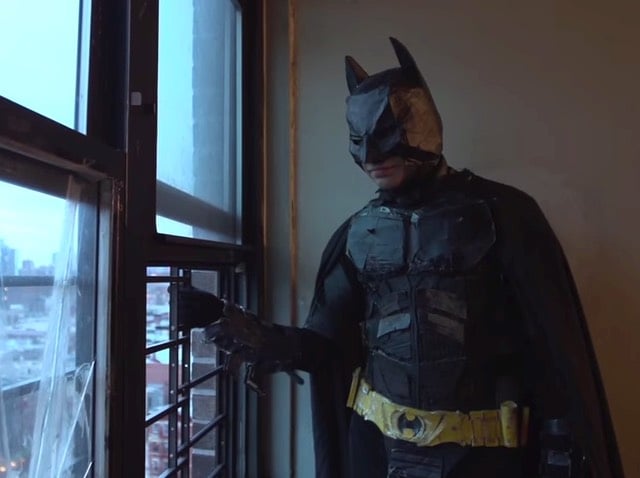
They did not mess around when it came to their filmmaking…this is a surprisingly realistic Batman costume made out of cereal boxes and yoga mats:
The Wolfpack won the Grand Jury Prize at Sundance this year, and the brothers made a few videos to thank the festival for their prize. Here are the Clerks and The Usual Suspects thank yous:
They also filmed a scene from one of their favorite movies of 2014, The Grand Budapest Hotel:
The Wolfpack was out in US theaters earlier this summer and is now on Amazon Instant…I think I’m going to watch this tonight. (via @quinto_quarto)
If you recut the scenes from seasons seven & eight of Seinfeld to emphasize certain aspects of Susan’s death-by-envelope, you get a feel-good TV movie about George Costanza, a man who finds triumph in the midst of tragedy.
Her death takes place in the shadow of new life; she’s not really dead if we find a way to remember her.
Nicole Frýbortová can do things on a bicycle that will make your eyes pop out of your head, including a no-hands, one-foot, backwards wheelie.
(via @atenni)

….and it still looks like a middlebrow kids clothing brand logo.
So why are we doing this now? Once upon a time, Google was one destination that you reached from one device: a desktop PC. These days, people interact with Google products across many different platforms, apps and devices-sometimes all in a single day. You expect Google to help you whenever and wherever you need it, whether it’s on your mobile phone, TV, watch, the dashboard in your car, and yes, even a desktop!
Today we’re introducing a new logo and identity family that reflects this reality and shows you when the Google magic is working for you, even on the tiniest screens. As you’ll see, we’ve taken the Google logo and branding, which were originally built for a single desktop browser page, and updated them for a world of seamless computing across an endless number of devices and different kinds of inputs (such as tap, type and talk).
Update: The design team shares how they came up with the new logo.
Update: When I said that Google’s new logo “still looks like a middlebrow kids clothing brand logo”, this is pretty much what I meant.
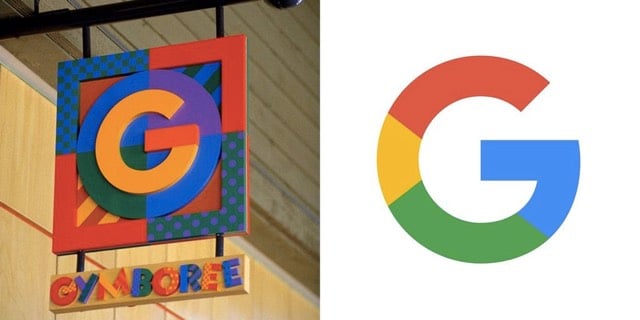
Gymboree’s identity (1993-2000) vs. Google’s new identity (Sep 01, 2015)
(via @buzz)
BuzzFeed’s Tom Chivers asked several atheists How They Find Meaning In A Purposeless Universe.
The way I find meaning is the way that most people find meaning, even religious ones, which is to get pleasure and significance from your job, from your loved ones, from your avocation, art, literature, music. People like me don’t worry about what it’s all about in a cosmic sense, because we know it isn’t about anything. It’s what we make of this transitory existence that matters.
These kinds of questions always make me think of Richard Feynman on beauty, science, and belief.
Ville-Matias Heikkilä pointed a neural network at the opening title sequence for Star Trek: The Next Generation to see how many objects it could identify.
But the system hadn’t seen much space imagery before,1 so it didn’t do such a great job. For the red ringed planet, it guessed “HAIR SLIDE, CHOCOLATE SAUCE, WAFFLE IRON” and the Enterprise was initially “COMBINATION LOCK, ODOMETER, MAGNETIC COMPASS” before it finally made a halfway decent guess with “SUBMARINE, AIRCRAFT CARRIER, OCEAN LINER”. (via prosthetic knowledge)
Larry Lessig is raising funds for running for President in the 2016 election. Lessig would run as a “referendum president”, whose single task would be to pass a package of reforms called the Citizens Equality Act of 2017, and then resign to allow his Vice President to take over.
The Citizens Equality Act of 2017 consists of three parts: make it as easy as possible to vote, end the gerrymandering of political districts, and base campaign funding on all eligible voters, not just corporations or the wealthy.
Four years ago, Cenk Uygur of The Young Turks told Netroots Nation, “There is only one issue in this country,” and he was referring to the corrupt funding of public elections.
That corruption is part of a more fundamental inequality that we’ve allowed the politicians to create: we don’t have a Congress that represents us equally.
Every issue - from climate change to gun safety, from Wall Street reform to defense spending - is tied to this “one issue.” Achieving citizens equality in America is our one mission.
Read why he wants to run and watch his pitch:
This is a long shot (and he likely knows it), but I wish him well…it’s a worthy and important goal.
Update: Lessig has dropped the resignation option from his campaign. He is all in on running for President.
Bjorn Jonsson used the photos taken by NASA’s New Horizons spacecraft to make an animation of the probe’s flyby of Pluto.
The time covered is 09:35 to 13:35 (closest approach occurred near 11:50). Pluto’s atmosphere is included and should be fairly realistic from about 10 seconds into the animation and to the end. Earlier it is largely just guesswork that can be improved in the future once all data has been downlinked from the spacecraft. Light from Pluto’s satellite Charon illuminates Pluto’s night side but is exaggerated here, in reality it would be only barely visible or not visible at all.
Fantastic…and Pluto’s moons flying about in the background is the cherry on the top. (via @BadAstronomer)
One man invented both the Aerobie Flying Disc and the AeroPress coffee maker. In this short video documentary by David Friedman, inventor Alan Adler tells the story of how those products came to be.
I still remember the first time I threw an Aerobie. The week-long science camp 1 I attended in northern Wisconsin the summer after middle school had one, and I was astounded at how far it flew compared to a Frisbee. As Adler notes in the video, an Aerobie was once thrown 1333 feet (that’s over a quarter of a mile) and stayed aloft for 30 seconds. (No word on far an AeroPress can be thrown.)
Everyone knows that The Karate Kid is the story of Daniel LaRusso, an undersized new-kid-in-school who, with the help of a wise mentor and unconventional training in the martial arts, is able to triumph over a gang of bullies picking on him. What this video presupposes is, maybe Daniel is the real bully?
To no one’s surprise, Johnny advances to the final round and karma catches up with Daniel when his leg is injured by the boy he wantonly attacked on the soccer field. However, just as Johnny is about to be awarded his trophy, Daniel is granted unnatural strength by the demon sorcerer Miyagi, enabling him to defeat Johnny and win the tournament in an upset.
See also more revisionist history of beloved media: Hermione Granger as the real hero of the Harry Potter books and Tim Carmody’s The Iceman List, which is about “classic movie antagonists who were actually pretty much right all along”.
Update: Another one to add to the list: Ross Geller is the hero of Friends, an intellectual and romantic man who is brought low by his so-called friends:
But the characters of the show were pitted against him from the beginning (consider episode 1, when Joey says of Ross: “This guy says hello, I wanna kill myself.”) In fact, any time Ross would say anything about his interests, his studies, his ideas, whenever he was mid-sentence, one of his “friends” was sure to groan and say how boring Ross was, how stupid it is to be smart, and that nobody cares. Cue the laughter of the live studio audience. This gag went on, pretty much every episode, for 10 seasons. Can you blame Ross for going crazy?
And like a Greek tragedy, our hero is caught in a prophecy that cannot be avoided. The show’s producers, akin to the immutable voice of the gods, declared that Ross must end up with Rachel, the one who shops. Honestly, I think he could’ve done better.
I hadn’t realized there was so much cussing swearing in Wes Anderson’s movies. Here are some damn examples:
Just realized what the world is missing: the “fuck fuck fuck” scene from the first season of The Wire, but done in the style of (“cuss cuss mothercusser”) and with the characters from Fantastic Mr. Fox.
This is a guide to the famous Lorne of the Rings trilogy of movies. All your favorite characters are here, from Samsclub Gunjeans to Starman to Flowbee the Haddock to Aerosmith, daughter of Lord Efron to Gumball, son of Groin.
This is one of those that goes from “oh how can this predictable thing actually be funny” to “oh my pants are wet because I peed in them because laughing” very quickly. (via waxy)
After 11 years, the WireTap radio show is coming to an end. As a farewell, they put together a video of people giving advice to their younger counterparts.
Dear 6-year-old,
Training wheels are for babies. Just let go already.
Regards,
A 7-year-old.
Dear 7-year-old,
Stay weird.
Signed,
An 8-year-old.
This video is magical…give it 20 seconds and you can’t help but watch the whole thing. (via a cup of jo)
From the developer of Crossy Road (aka Infinite Frogger) comes Pac-Man 256, a Pac-Man game with an infinite board that gets eaten from below by the kill screen glitch from the 256th level of the original game. I love riffs on old school video games like this, and the infinite board is a particularly clever one.1 Here’s what the gameplay looks like:
I’m sure everyone is used to this by now (which is sad) but be warned that Pac-Man 256 is one of those games that encourages you to watch ads to level up more quickly or to continue when you’re out of credits…and then to buy more credits as an IAP when you’re out of ads to watch. There’s an option to buy unlimited credits for $7.99, but still. I understand the economics of the situation and why they do it this way, but it just feels so hostile to the player. I want to wholeheartedly recommend this game because the gameplay is so fun, but it feels like you’re constantly wading through a little bit of raw sewage to play it. Which, apparently I don’t mind doing, wading through sewage. :(
Update: Echoing several similar comments on Twitter, John Gruber writes:
Unlike Kottke, I think the option to buy unlimited “credits” with a one-time $7.99 in-app purchase is a fair deal. Think of it as an $8 game that you can optionally play for free if you’re willing to watch ads. That’s a good price for a great game.
$8 is a more than fair price. But the option to buy unlimited credits is difficult to find in the game (you need to run out of credits first and then click the “Play” button anyway) and it doesn’t tell you exactly what you’re getting for your $8. What I want is never to see an ad ever in the game, but I don’t actually think that’s what it is. Paying full price for a game shouldn’t involve hide n’ seek.
But the bigger issue for me is how the game, and many many others in the App Store, feels: icky. Like used car salesman icky. Drug dealer icky. Depressing casino icky. The way the game presents itself, the developers seemingly want one thing: your money. Do they want me to have a good time playing the game? Eh, maybe? I don’t know, it just seems really cynical to me, like a game built by a bank instead of people that love gaming or Pac-Man.
I really *really* wish the App Store had a trial period option available for apps. 20 minutes into Pac-Man 256 and I would have ponied up $8-10, no problem. I suspect App Store users would love this feature but game developers would hate it because using ads and casino tactics to upsell in your app makes a lot more money than straight sales.
Polari was a secret slang language spoken by gay men in England so that they could converse together in public without fear of arrest. It fell into disuse in the 1960s, but this short film by Brian Fairbairn and Karl Eccleston features a conversation conducted entirely in Polari.
This Slate article has more on the film and Polari.
Of all the cultural forms that gay men have created and elaborated since coalescing into a social group around the late 19th century, Polari, a full-fledged gay English dialect with roots among circus folk, sailors, and prostitutes, has to be one of the most fascinating-not least since it has faded along with the need for discretion and secrecy. While some words remain in common use-zhush or zhoosh (to adjust or embellish something to make it more pleasing) and trade (highly masculine or straight-acting sex partners) come to mind — the richness that we know once defined Polari is difficult to capture in 2015.

Banksy has opened an apocalyptic theme park called Dismaland in an abandoned resort in an English coastal town, Weston-super-Mare.
Are you looking for an alternative to the sugar-coated tedium of the average family day out? Or just somewhere a lot cheaper? Then this is the place for you. Bring the whole family to come and enjoy the latest addition to our chronic leisure surplus…
The entrance fee is £3 and the park will be open for five weeks. Colossal has the scoop, including a list of artists who contributed art to the park, er, show.
A demented assortment of bizarre and macabre artworks from no less than 50 artists from around the world including Damien Hirst, Bill Barminski, Caitlin Cherry, Polly Morgan, Josh Keyes, Mike Ross, David Shrigley, Bäst, and Espo. In addition, Banksy is showing 10 artworks of his own.
Colossal’s own Christopher Jobson curated the park’s short film program. Congrats! (Also, super jealous!)
Update: For a closer look at the park, check out the trailer:
The newest app from Tinybop (The Human Body, Homes, and The Robot Factory apps) is called The Everything Machine. A small sampling of what you can do with it:
Use a simple programming language to connect, control, and play with all the sensors and tools. Put the camera, microphone, speaker, screen, gyroscope, and light to work for you.
Playing around with the app with Minna for 30 minutes this evening (she loved it) reminded me of my college electronics classes + Scratch + LabVIEW. Super fun.
Two weeks ago, 99% Invisible broadcast an audio documentary from 1998 about one of the last remaining flophouses on The Bowery in NYC called The Sunshine Hotel. It is an amazing time capsule from a Manhattan that just doesn’t exist anymore.
The Sunshine Hotel opened in 1922. Rooms — or really, cubicles — were 10 cents a night. The Sunshine, like other flop houses, was always a men-only establishment. In 1998, the hotel had raised it’s rates to 10 dollars a night and it was managed by resident Nathan Smith. He sat behind a metal cage at the front desk, answering the phone and doling out toilet paper to residents for 35 cents. Smith had once worked in a bank until he was injured, and then fired. His wife left him and he ended up in the Bowery, and eventually at the Sunshine Hotel.
The interviewees sound like they’re characters in a play, not real people. It’s so good. There is also a documentary film released in 2001 about The Sunshine Hotel which is available on Amazon Instant; here’s a trailer:
I can’t decide if this video of an ouroboros model train is soothing, menacing, or just kinda boring.
Wait for the Law & Order-esque twist at the 2:00 mark. chung chung
From Orbital Mechanics, a visualization of the 2153 nuclear weapons exploded on Earth since 1945.
2153! I had no idea there had been that much testing. According to Wikipedia, the number is 2119 tests, with most of those coming from the US (1032) and the USSR (727). The largest device ever detonated was Tsar Bomba, a 50-megaton hydrogen bomb set off in the atmosphere above an island in the Barents Sea in 1961. Tsar Bomba had more than three times the yield of the largest bomb tested by the US. The result was spectacular.
The fireball reached nearly as high as the altitude of the release plane and was visible at almost 1,000 kilometres (620 mi) away from where it ascended. The subsequent mushroom cloud was about 64 kilometres (40 mi) high (over seven times the height of Mount Everest), which meant that the cloud was above the stratosphere and well inside the mesosphere when it peaked. The cap of the mushroom cloud had a peak width of 95 kilometres (59 mi) and its base was 40 kilometres (25 mi) wide.
All buildings in the village of Severny (both wooden and brick), located 55 kilometres (34 mi) from ground zero within the Sukhoy Nos test range, were destroyed. In districts hundreds of kilometers from ground zero wooden houses were destroyed, stone ones lost their roofs, windows and doors; and radio communications were interrupted for almost one hour. One participant in the test saw a bright flash through dark goggles and felt the effects of a thermal pulse even at a distance of 270 kilometres (170 mi). The heat from the explosion could have caused third-degree burns 100 km (62 mi) away from ground zero. A shock wave was observed in the air at Dikson settlement 700 kilometres (430 mi) away; windowpanes were partially broken to distances of 900 kilometres (560 mi). Atmospheric focusing caused blast damage at even greater distances, breaking windows in Norway and Finland. The seismic shock created by the detonation was measurable even on its third passage around the Earth.
The Soviets did not give a fuck, man…what are a few thousand destroyed homes compared to scaring the shit out of the capitalist Amerikanskis with a comically large explosion? Speaking of bonkers Communist dictatorships, the last nuclear test conducted on Earth was in 2013, by North Korea.
Update: Since this post was published, North Korea has tested a few more nuclear devices, the last one in 2017.
This is an epic display of top-notch lip syncing and world-class shade throwing. I smiled the whole way through this.
Songs performed include Wannabe by The Spice Girls, The Sign by Ace of Base, Thong Song by Sisqo, and Orinoco Flow by Enya.
Update: A playlist of the songs sung in the video are now available on Rdio and Apple Music.
(via @jemaleddin & @murtaugh)
Are your palms dry? Do you wish they were soaked with sweat right now? Then you should definitely watch Spencer Seabrooke walk on a slack line across a 210-foot gap almost 1000 feet in the air without any ropes or safety harnesses.
I mean, Jesus. (via devour)
Drunk Stoned Brilliant Dead is a documentary about National Lampoon coming out this fall. Here’s the trailer:
From the 1970s thru the 1990s, there was no hipper, no more outrageous comedy in print than The National Lampoon, the groundbreaking humor magazine that pushed the limits of taste and acceptability — and then pushed them even harder. Parodying everything from politics, religion, entertainment and the whole of American lifestyle, the Lampoon eventually went on to branch into successful radio shows, record albums, live stage revues and movies, including Animal House and National Lampoon’s Vacation. The publication launched the careers of legends like John Belushi, Bill Murray, Chevy Chase, Christopher Guest and Gilda Radner, who went on to gigs at Saturday Night Live and stardom.
Director Douglas Tirola’s documentary about the Lampoon, DRUNK STONED BRILLIANT DEAD: THE STORY OF THE NATIONAL LAMPOON, cleverly chronicles its founding by two former Harvard students, its growth, demise and everything in between. Told thru fresh, candid interviews with its key staff, and illustrated with hundreds of outrageous images from the mag itself (along with never-seen interview footage from the magazine’s prime), the film gives fans of the Lampoon a unique inside look at what made the magazine tick, who were its key players, and why it was so outrageously successful: a magazine that dared to think what no one was thinking, but wished they had.
(via subtraction)
Newer posts
Older posts




.svg)
Socials & More