kottke.org posts about video
PBS is airing a documentary in September about Muppets creator Jim Henson called In Their Own Words: Jim Henson.
I had never really noticed before that Henson’s natural speaking voice obviously sounds a lot like Kermit. (via @khoi)
Mark Reay is a former model, actor, and fashion photographer who was homeless in NYC for six years. Homme Less is a documentary on Reay; here’s a trailer:
So began a period of my life sleeping rough. It was pretty tiring, and I didn’t have much luck with the photos, but I stuck it out. I’ve never let the lack of money stop me having a good time, and I still had (dwindling) savings from my modelling. It was a happy time. At night I would always treat myself to a rotisserie chicken, but I always wanted a chilled rosé with it. So, in the afternoon, I would sneak into a minimarket, get the cheapest one from the shelf and hide it under the frozen peas. Then, at night, I would put on a fresh shirt and go to one of the fancy bars with my wine in my bag. Again, maybe because I had a certain look, no one ever checked my bag. I’d just go in, nick a glass off the counter and drink my wine surrounded my millionaires.
You can get away with anything if you’re confident. Oh, and male, white, and good looking.
Here’s the teaser trailer for Quentin Tarantino’s The Hateful Eight. (This one was certainly not the trailer.)
Update: A second longer trailer is out:
Larch Wood Enterprises is a Nova Scotian company specializing in the manufacture of cutting boards from end grain wood…that is, the top surface of the board shows the rings of the tree. Not only that, but each row on the board is cut from the same stick of wood so you can see how the grain changes through the tree. It’s tough to explain…just watch how they make ‘em.
End Grain is when the individual boards of wood are arranged so that the grain of the wood (the growth rings) runs vertically (up and down). This puts one end of each board up so that the cutting surface is actually the end of many individual pieces of wood. With the grain aligned in this manner (up and down), when the knife strikes the surface during cutting, the grain of the wood actually separates and then closes when the knife is removed. This accounts for the self-healing aspect of the end-grain surface. The wood itself is not cut, but instead you are cutting between the fibers.
A medium sized board costs $220 but if you can pass it on to your grandkids, perhaps it’s worth the price to upgrade yourself. (via devour)
As if you needed more proof that dolphins are cool: they enjoy surfing.
Justin Hall has been sharing his life online for over 20 years at links.net. Justin’s Links from the Underground was one of the first sites I found and read regularly, back in the mid 90s. Now Hall has made a documentary about his time online, overshare: the links.net story.
Starting in 1994, my personal web site Justin’s Links from the Underground has documented family secrets, romantic relationships, and my experiments with sex and drugs.
overshare: the links.net story is a documentary about fumbling to foster intimacy between strangers online. Through interviews, analysis and graphic animations, I share my motivations, my joys and my sorrows from pioneering personal sharing for the 21st century. In 2004 the New York Times referred to me as “perhaps the founding father of personal weblogging.” I hope this documentary reveals that I was a privileged white male with access to technology who worked to invite as many people as possible to join him in co-creating an internet where we have a chance to honestly share of our humanity.
The movie is available in various formats, including as a digital download with extra footage from VHX for $11.99.
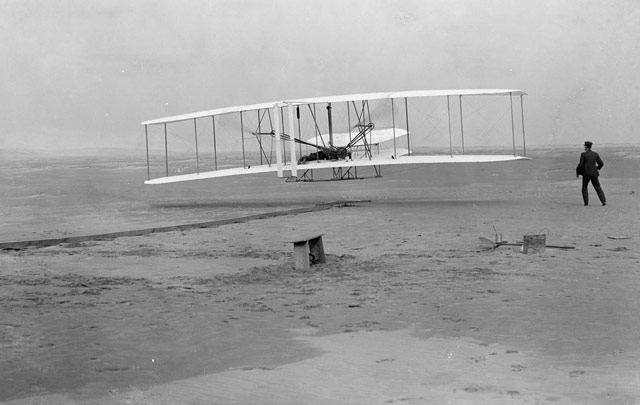
David McCullough (Truman, John Adams, Pulitzer Prize, National Book Award) recently published a new book on The Wright Brothers. James Salter has a nice review in the New York Review of Books.
They knew exactly the importance of what they had accomplished. They knew they had solved the problem of flight and more. They had acquired the knowledge and the skill to fly. They could soar, they could float, they could dive and rise, circle and glide and land, all with assurance.
Now they had only to build a motor.
Update: British Pathe has footage of a flight by the Wright Brothers:
It’s labelled “First Flight” but the footage is actually from much later…that is clearly not Kitty Hawk and the first two-person flights did not occur until 1908. It is also unclear whether Orville and Wilbur were flying together in the video. From Salter’s piece:
He and Wilbur had never flown together so that if there were ever a fatal accident it would not involve both of them, and one of them would live to continue the work. On that one occasion, they took off to fly together, with Orville at the controls, side by side.
If the footage is from the flight Salter describes, that would make it from 1910. (via @SavageReader)
The walls of the elevator to the observatory at the top of 1 World Trade Center are covered with screens and when you ride it to the top, you see a time lapse of NYC’s development, from 1500 to the present.
The observatory is open daily from 9am to 8pm.
That time in Latvia when some folks cut a huge circle of ice out of a frozen lake, attached an outboard motor to it, and made an ice carousel.
(via devour)
In the future, when time travel is a totally normal thing to do, people will use it to do stuff like tell their 10-year-old selves to learn the guitar so their adult selves can impress women.
(via @mouser_nerdbot)
Are computer generated special effects ruining movies? Freddie Wong says no; CG is so good these days that we only notice it when it’s bad and in bad movies.
My biggest concern with CG is with unrealistic camera movements, e.g. like when the camera is following Spider-Man swooping all over NYC. I can’t not notice it and it almost always takes me out of the experience, which is the opposite of what I want. (via @tonyszhou)
Walter Chang saved up, quit his job, travelled around the world for three years, and made this video.
I went to South America and trekked through Patagonia. In Zimbabwe, hippos, lions, and elephants roamed through our camping ground. When I got to South Korea, my relatives treated me as one of their own, despite having last seen them 18 years prior.
It was in China, the third country of my trip, when I realized that what I was doing wasn’t totally crazy. I had already met a multitude of other backpackers taking extended trips ranging from several months to four years. Young people from abroad were prioritizing travel over hurrying into careers.
This video makes me happy. And sad…I am clearly not grabbing enough tiger by the tail in life currently. Chang is doing a Kickstarter campaign for a book of photos from the trip.
This four-minute bit by Louis CK puts me on the floor every time I watch it and then makes me feel really horrible.
Everybody has a competition in their brain of good thoughts and bad thoughts. Hopefully, the good thoughts win. For me, I always have both. I have like the thing I believe, the good thing, that’s the thing I believe and than there’s this thing. And I don’t believe it, but it is there. It’s always this thing and then this thing. It’s become a category in my brain that I call “of course, but maybe”.
I love his gestures throughout this bit…the material is great but the physical comedy really sells it. So so good. (And, of course, terrible.)
Photographer Clayton Cubitt started a project in 2012 called Hysterical Literature. In each of the project’s resulting videos, a female participant is filmed from the waist up reading a story of her choosing while she is stimulated to orgasm with a vibrator by Cubitt’s partner, Katie James. His first subject was adult film star Stoya; her thoughts on the experience are here.
Vanity Fair recently sent writer Tony Bentley to participate in an HL session. Her reading choice? The Portrait of a Lady by Henry James.
With Katie now in position under the table, takeoff is imminent and the stakes are high: the sessions are a one-shot deal, no retakes, and no editing of the footage after the fact. It was not lost on me that a perfect triangulation between Clayton (auteur, cameraman), Katie (Hitachi artist), and me (the canvas) was in play, and it mirrored my internal mixture of curiosity, exhilaration, and stage fright. I couldn’t help wondering if this adventure qualified as having a threesome with two strangers. But soon enough such intellectualizing sexualizing was rendered naught.
“Rolling,” says Clayton, and everything instantly disappeared except the book in my hands and the words on the page. The world was out and I was on.
By the time I’d read two pages, I was struggling mightily to keep my countenance. “She spent half her time in thinking of beauty, bravery and mag-nan-nnn-im-im-ity…”
There’s no nudity in the videos, but you might still find them NSFW.
Each year, using traditional Incan techniques, communities along a canyon in Peru rebuild a rope bridge that has been in continuous use for hundreds of years.
That you can take thousands of thin grass stalks and, through the careful application of engineering and hard work, make them strong enough to hold the weight of several people over a canyon still seems magical. (via cynical-c)
This video from the MTA shows some of the vintage technologies that are still in use to control many of the NYC’s subway lines and how they are upgrading (ve. ry. slow. ly.) to safer and more reliable computerized systems. Some of control systems are more than 80 years old.
Whoa, after watching that, I’m shocked that the trains ever get anywhere at all. (via the kid should see this)
Update: The NY Times has a look at the political and logistical challenges related to upgrading the NYC subway’s antiquated infrastructure.
A computerized signal system like C.B.T.C. is also safer because trains can be stopped automatically. New York’s quest to install the new system began in 1991, after a subway derailment at Union Square in Manhattan killed five people. The train operator was speeding after he had been drinking.
More than 25 years later, the authority has little to show for its effort to install modern signals. The L line began using computerized signals in 2009 after about a decade of work. A second line, the No. 7, should have received new signals last year, but the project was delayed until the end of this year.
The process is complicated. It requires installing transponders every 500 feet on the tracks, along with radios and zone controllers, and buying new trains or upgrading them with onboard computers, radios and speed sensors. The authority also had to develop a design and software that was tailored to New York’s subway.
Over the years, the authority has kept pushing back the timeline for replacing signals. In 1997, officials said that every line would be computerized by this year. By 2005, they had pushed the deadline to 2045, and now even that target seems unrealistic.
40 years to upgrade the entire system? Embarrassing.
In 1981, ABC’s news program 20/20 aired a segment on the rising phenomenon of rap music called Rappin’ to the Beat. It is painful to watch in parts, but ultimately worth it for the footage of street scenes and artist performances.
Here is part 2. (via open culture)
I had no idea Ol’ Dirty Bastard and medieval paintings had something in common. One of ODB’s AKAs was also the reason why babies in medieval paintings looked like ugly middle-aged men: Big Baby Jesus.
I mean, this baby looks like he wants to tell you that a boat is just a money pit.
How many times have you seen a car parked in the bike lane and wanted to somehow move it out of the way? Well, this very large cyclist felt that way and lifted this small car right out of his way.
I would love to see someone do this to an NYPD cruiser.1
From Zerega Pasta, a video that shows, in slow motion, how farfalle (aka bow-tie pasta) is made at their factory.
Incredible combination of precision and quickness.
Using images found on the internet through Google’s visually similar images feature, NASA, U.S. Geological Survey, and various mapping services, Kelli Anderson recreated part of the Eames’ iconic Powers of Ten as a flipbook. Watch a video here:
Or play around with a virtual flipbook at Anderson’s site. This could not possibly be anymore in my wheelhouse. Here’s the nitty gritty on how she made it happen.
The inspiration for making discontinuous-bits-of-culture into something continuous goes back to 2011. Some of my friends camped out on a sidewalk to see Christian Marclay’s The Clock. Like a loser with a deadline, I missed out-only catching it years later at MoMA. In the day-long film, Marclay recreates each minute of the 24-hour day using clips from films featuring the current time-on a clock or watch. It runs in perfect synchronization with the audience’s day (so: while a museum crowd slumps sleepily in their chairs at 6am, starlets hit snooze on the clocks onscreen.)
There’s a documentary on Steve Jobs coming out called Steve Jobs: The Man in the Machine. The director is Alex Gibney, who directed the excellent Going Clear (about Scientology), We Steal Secrets (about Wikileaks), and Enron: The Smartest Guys in the Room. The trailer:
While the members of On A Friday, the band that later became Radiohead, were on a break as they attended college, Thom Yorke was a member of a band called Headless Chickens. This is a video of a circa-1989 performance by the band of “High and Dry”, a song that later on Radiohead’s second album, The Bends, released in 1995.
Casper Christensen cut together footage from dozens of movie car chases into one big coherent chase. Well, as coherent as you can get when you’re dealing with car chases.
There’s some fun and clever editing in here…I particularly enjoyed the stitching together of Indiana Jones and Axel Foley. And I loved the brief clip of C’était un rendez-vous, which if you haven’t seen it, is a quick and thrilling watch.
Artist Sam Van Aken is using grafting to create trees that bear 40 different kinds of fruit. National Geographic recently featured Van Aken’s Tree of 40 Fruit project:
The grafting process involves slicing a bit of a branch with a bud from a tree of one of the varieties and inserting it into a slit in a branch on the “working tree,” then wrapping the wound with tape until it heals and the bud starts to grow into a new branch. Over several years he adds slices of branches from other varieties to the working tree. In the spring the “Tree of 40 Fruit” has blossoms in many hues of pink and purple, and in the summer it begins to bear the fruits in sequence — Van Aken says it’s both a work of art and a time line of the varieties’ blossoming and fruiting. He’s created more than a dozen of the trees that have been planted at sites such as museums around the U.S., which he sees as a way to spread diversity on a small scale.
(via colossal)
If you are a fan of Raiders of the Lost Ark — and who isn’t? — then this is your holy grail: a feature-length commentary on the movie by Jamie Benning that includes seemingly every tidbit related to the film, including deleted scenes, audio commentary from the cast and crew, behind the scenes video, and much more. An incredible resource in understanding the film.
Benning has also done similarly excellent commentaries for Jaws, Star Wars, Empire Strikes Back, and Return of the Jedi. (via @drwave)
The Associated Press and British Movietone are uploading 17,000 hours of archival news footage, some of dating back to the late 19th century. The videos can be found on the AP Archive and British Movietone channels. Some notable videos from the collection follow. Coverage of the Hindenberg disaster:
The celebration of VE Day in London:
Coco Chanel fashion show from 1932:
Martin Luther King Jr. and marchers being arrested in Selma:
See also British Pathe.
Every day, a program written by Julien Deswaef selects a war-related news item from the NY Times, formats it in the style of the infamous Star Wars opening crawl (complete with John Williams’ score), and posts the results to YouTube.
Published yesterday, the crawl for Episode XXVII was taken from a NY Times article about an Obama speech about the Iranian nuclear deal.
Here’s how the project was made and if you’d like to try it yourself, grab the source code. (via prosthetic knowledge)

Clothing retailer Forever 21 hired product and prototyping company Breakfast to build them a giant screen made out of spools of thread to “print” people’s Instagram photos. The screen, which Breakfast bills as “one of the most complex machines ever built for a brand”, weighs 2000 pounds, measures 11 ft high, 9 ft wide, and 3 ft deep, and has a resolution of 80x80 spool pixels. Here’s how they made it:
If you want to give it a try, just tag an Instagram photo with #F21ThreadScreen and it’ll print it out for you (watch the live stream). Prior art alert: the first time I remember seeing something like this was Daniel Rozin’s Wooden Mirror (1999) at ITP (video here).
This video was shot in NYC on July 18, 1990, mostly in Times Square and Central Park.
The first 30 seconds of the video (stumbling drunk, trash digger, overheating car) is pretty much a perfect representation of how NYC felt to many at the time. A squeegee man can also been seen at work near the end of the video.
Newer posts
Older posts




Socials & More