

New bill could finally get rid of paperless voting machines. “The bill reads like a computer security expert’s wish list.”

Advertise here with Carbon Ads
This site is made possible by member support. 💞
Big thanks to Arcustech for hosting the site and offering amazing tech support.
When you buy through links on kottke.org, I may earn an affiliate commission. Thanks for supporting the site!
kottke.org. home of fine hypertext products since 1998.
Beloved by 86.47% of the web.
Entries for January 2018
The top 5 sequels, adaptations, remakes, and original movies of all time
Lately, Cinefix has been examining movies based on their sources. First they chose the top five remakes of all time, including the expansion of La Jetée into 12 Monkeys:
They looked at sequels, including The Godfather Part 2, Logan, and Creed:
Then they chose their favorite adaptations, including Adaptation (from The Orchid Thief), Apocalypse Now (from Heart of Darkness), and O Brother Where Art Thou (from The Odyssey):
And finally, their top five most original movies of all time, including Holy Motors and Enter the Void:
I love watching these Cinefix videos. They don’t always pick the most obvious choices for these lists and I’m always so jazzed to watch more films afterwards.
Warren Buffett’s daily breakfast allowance
Warren Buffett’s net worth is right around $84 billion. Each morning before he drives himself to work, he tells his wife how much his McDonald’s breakfast is going to cost — $2.61, $2.95, or $3.17 — and she puts the exact change in the cup holder for him to pay with. No, really:
That’s a clip from the HBO documentary, Becoming Warren Buffett. The full documentary is here.
On Medium, Daniel Bourke shared some things he learned from watching Becoming Warren Buffett.
Bill Gates and Warren Buffett are two of the richest men in the world.
One time Warren was at Bill’s house for dinner and Bills dad asked them to write down on a piece of paper what was one word to describe their success.
Focus.
They both wrote down the exact same word.
(via gruber)
Up and Above, a gorgeous drone video of Romania
On New Year’s Eve, Bogdan Teodorescu uploaded a video of drone footage he shot of different locations around Romania over the course of 2017. Here is last year’s video:
What a beautiful country…I want to go to there.
How this simple intersection creates dangerous blind spots
I’m a (very) amateur traffic enthusiast (see here and here for recent posts) who is fascinated by how different kinds of intersections are better than others for safety, traffic flow rates, etc. There’s a fairly normal-looking four-way intersection near Southampton that’s been the site of the deaths of two cyclists, and it turns out that geometry likely played a factor. The road is oriented such that a cyclist and a motorist approaching the intersection on the crossing roads could possibly not see each other until they collided.
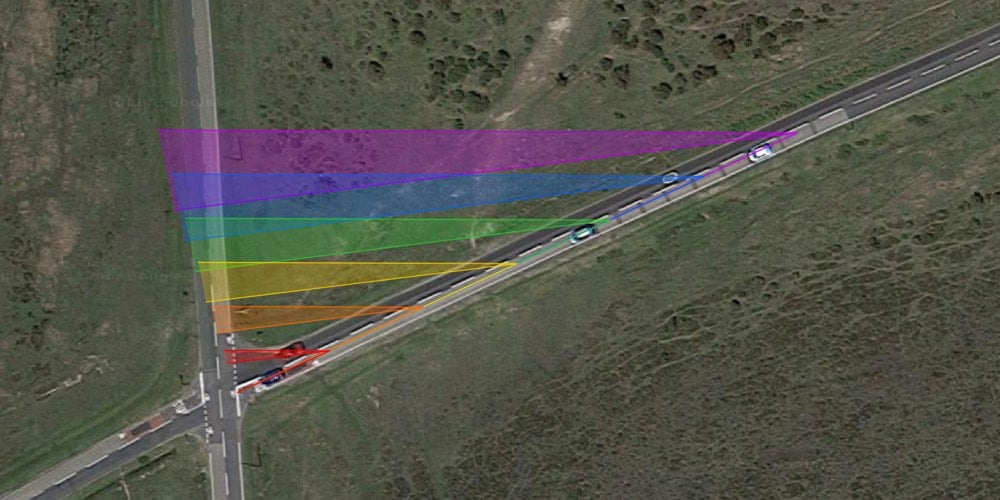
Ipley Cross is constructed in such a way that not only is it possible for a careless driver to drive straight into a cyclist without seeing them until a fraction of a second before impact, but under the exact same circumstances it is also possible for that cyclist not to see the car that hits them until the same moment.
If anyone were to take a highway engineer to a wide open space and ask them to design a junction which would readily enable two road users to collide with neither of them ever seeing each other, I doubt any would be able to manage it.
Yet this is precisely what exists.
When I watch other people drive, I’m amazed at how many of them don’t take the time to look around the pillar in the front of the car…it’s such a massive blind spot. I don’t know if it’s all the driving in NYC — the right pillar perfectly obscures pedestrians stepping off the curb on a right turn — but I always check that blind spot. And a related tip for pedestrians: if you can’t see a driver’s eyes, they might not be able to see you.
Update: This intersection is going to be fixed — at a cost of £450,000. (via @genmon)
Imaginary soundscapes composed by AI
A Japanese group trained a deep learning algorithm to compose soundscapes for locations on Google Street View. Try it out for yourself.
For a stadium, it correctly concocted crowd noise from a ball game but also Gregorian chanting (because presumably it mistook the stadium’s dome for a church’s vaulted ceiling). A view outside the Notre Dame in Paris had seagulls and waves crashing…but if you turned around to look into the church, you could hear a faint choir in the background.
A guide to the musical leitmotifs in Star Wars
In the New Yorker, Alex Ross points to Frank Lehman’s Complete Catalogue of the Motivic Material in ‘Star Wars,’ Episodes I-VIII, which has been updated to include The Last Jedi. Ross goes on to note that composer John Williams did some of his strongest work for the film, deftly employing musical themes called leitmotifs to supplement (and sometimes subvert) the on-screen action. (Spoilers, ho!)
In early scenes set at a remote, ruined Jedi temple, we keep hearing an attenuated, beclouded version of the Force motto: this evokes Luke’s embittered renunciation of the Jedi project. As the young heroine Rey begins to coax him out of his funk, the Force stretches out and is unfurled at length. Sometimes, the music does all of the work of explaining what is going on. In one scene, Leia, Luke’s Force-capable sister, communicates telepathically with her son Kylo Ren, who has gone over to the dark side and is training his guns on her vessel. Leia’s theme is briefly heard against a dissonant cluster chord. Earlier in the saga, we might have been subjected to dialogue along the lines of “Don’t do this! I’m your mother!” Williams’s musical paraphrase is more elegant.
If you’re looking for a primer/refresher for the use of leitmotif in film, Evan Puschak’s video on Howard Shore’s music for the Lord of the Rings films is a good place to start. (via anil dash)
Permanent Redirect: digital art that moves to a new URL when someone views it
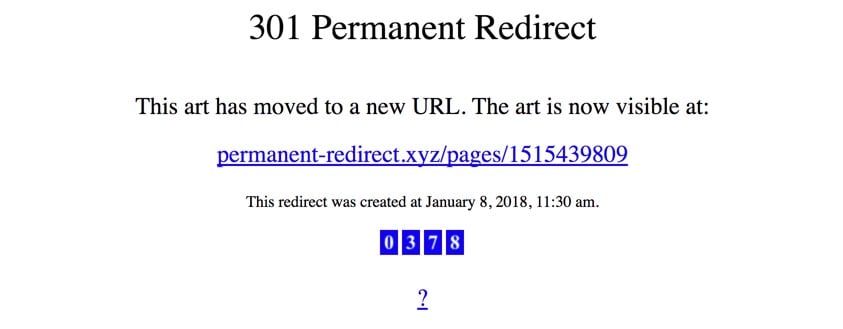
Donald Hanson has created a digital art piece called Permanent Redirect that moves to a new URL every time someone views it.
A net art piece that moves to a new URL whenever someone views it. It is not possible to link to the art piece. Over time the art piece will become very hard to view. This is an experiment in introducing artificial scarcity into digital work.
So, it was here and then here but now it’s not, so good luck tracking it down. Or, ok, it’s not really the point, but you can cheat a little and find a screenshot on Twitter. (via @nickbaum)
DNA evidence is changing the understanding of how the Americas were settled
DNA analysis of remains found at archaeological sites is changing the story of how humans populated the Americas. Analysis of a pair of infants found in Alaska suggests that only one wave of humans settled the Americas around 20,900 years ago.
Genetic evidence published today in Nature is the first to show that all Native Americans can trace their ancestry back to a single migration event that happened at the tail-end of the last Ice Age. The evidence — gleaned from the full genomic profile of the six-week-old girl and the partial genomic remains of another infant — suggests the continent’s first settlers arrived in a single migratory wave around 20,900 years ago. But this population then split into two groups — one group that would go on to become the ancestors of all Native North Americans, and another that would venture no further than Alaska — a previously unknown population of ancient North Americans now dubbed the “Ancient Beringians.”
(via clive thompson)
The soundtrack for Jane by Philip Glass
Despite the glowing reviews, I haven’t seen Jane, the National Geographic documentary about Jane Goodall…hopefully this week. But I discovered the soundtrack on Spotify this morning, composed by Philip Glass:
21st Century Landscapes



The turn of the century doesn’t seem all that long ago, but here we are starting our 18th year of the 21st century already.1 The pace of human activity since the Renaissance is itself increasing. For instance, David Wallace-Wells pointed out:
Whatever you may think about the pace of climate change, it is happening mind-bendingly fast, almost in real time. It is not just that December wildfires were unheard of just three decades ago. We have now emitted more carbon into the atmosphere since Al Gore wrote his first book on climate than in the entire preceding history of humanity, which means that we have engineered most of the climate chaos that now terrifies us in that brief span.
Likewise, the pace at which humans have visibly altered the Earth has been growing as well. Planet Labs has collected a bunch of satellite photos of landscapes that have been transformed by humans in this century.
Numbered decades, centuries, and millennia all start on years ending in “1”. This is because the first century AD starts on Jan 1, 1…there was no year 0. So, the first day of the 21st century is Jan 1, 2001, not Jan 1, 2000 like the article states. This is confusing because the 1800s and the 19th century are almost, but not exactly, the same thing.↩
Radiohead is suing Lana Del Rey for copying Creep. Copyright claims on music have gotten out of control, but for LDR to say that her song that sounds remarkably like Creep “wasn’t inspired by Creep” seems weird.
Oprah Winfrey is ‘actively thinking’ about running for president. I’d vote for her in a second.
My Next Guest Needs No Introduction, David Letterman’s new Netflix show
David Letterman is returning to TV with a Netflix series called My Next Guest Needs No Introduction. There will be six 60-minute shows in the series and he’ll interview only one guest per show. The guests will be George Clooney, Malala Yousafzai, Jay-Z, Tina Fey, Howard Stern and President Barack Obama. The Obama show is first up on January 12, with an additional show following each month after that.
This is a big departure from how Netflix normally releases shows. Usually they put all the episodes of a series out there at once. Is this the first instance of them releasing episodes one at a time?
My other big question: do any of his guests play the drums?
Update: This isn’t the first time Netflix has episodes of a show one-at-a-time: Chelsea Handler’s show and Riverdale have also been released that way.
Oh, and here’s the story behind “Are those your drums?” (thx @t_w_t, @ShaneMBailey, @inayali)
Update: Here’s a short clip from Letterman’s interview of Obama; they’re discussing Obama dancing onstage with Prince.
Smells Like Teen Spirit in a major key is an upbeat pop-punk song
This bent my brain a little: if you re-tune Nirvana’s Smells Like Teen Spirit in a major key, it sounds like an upbeat pop-punk song. Like, Kurt Cobain actually sounds happy when he says “oh yeah, I guess it makes me smile” and the pre-chorus — “Hello, hello, hello, how low” — is downright joyous. Although I guess it shouldn’t be super surprising…in a 1994 interview with Rolling Stone, Cobain admits that the song was meant to be poppy.
I was trying to write the ultimate pop song. I was basically trying to rip off the Pixies. I have to admit it [smiles]. When I heard the Pixies for the first time, I connected with that band so heavily I should have been in that band — or at least in a Pixies cover band. We used their sense of dynamics, being soft and quiet and then loud and hard.
“Teen Spirit” was such a clichéd riff. It was so close to a Boston riff or “Louie, Louie.” When I came up with the guitar part, Krist looked at me and said, “That is so ridiculous.” I made the band play it for an hour and a half.
Like me, if you don’t know a whole lot about music, here’s the difference between major and minor chords & scales.
The difference between major and minor chords and scales boils down to a difference of one essential note — the third. The third is what gives major-sounding scales and chords their brighter, cheerier sound, and what gives minor scales and chords their darker, sadder sound.
You can also listen to the song on Soundcloud.
See also this falling shovel sounds exactly like Smells Like Teen Spirit.
Update: I heard from a few people that the changes made to the song aren’t as straightforward as shifting from minor to major. See this series of tweets by Jesse Appelman.
This is fun and well-executed, but it’s not just Smells Like Teen Spirit transposed as-is from minor to major. They changed the chord progression (from 1-IV-bIII-bVI to I-V-vi-IV) and altered the melody to better fit the chords…
If they had just switched all the minor stuff to major it would sound, well, pretty hilarious but less like a radio-ready pop song. This is not to take away from the joy of this clever reimagining…
…but it’s not quite as simple and miraculous as “change from minor to major and voila!” It’s more like “write new changes and melody while preserving the rhythmic phrasing and general contours/directionality of the original.” Still great stuff and sorry if I un-blew your mind.
And to appreciate the difference between major and minor keys, this six-minute video of Chilly Gonzalez is highly entertaining and worth your time. (via @karolzyk)
Update: On his YouTube channel, Oleg Berg has reworked dozens of songs from major-to-minor or from minor-to-major, including Don’t Worry, Be Happy in a minor key, Louis Armstrong’s What A Wonderful World in a minor key, and the Game of Thrones theme in a major key. Surprisingly, the comments of the GoT theme are pretty good:
Meet Brienne, the beautiful maid of Tarth. Meet Jon, the legitimate son of Ned Stark. Meet Cersei, the queen of hearts. All these characters meet at the Blue Wedding and vow eternal friendship.
Spring is coming
If the plot ran backwards, this would be the theme.
You know everything, Jon Snow.
(via @volapuk)
Both cold winters and hot summers are terrible…*in cities*. If you don’t live somewhere with easy access to appropriate outdoor activities, of course it’s gonna suck.
Twitter pretty much says that they won’t ban elected officials from their service. Maybe there’s a good reason not to ban elected officials from Twitter, but this rationale is awful.
Music video for Jay-Z’s Family Feud, directed by Ava DuVernay
The latest video from Jay-Z’s 4:44 is for Family Feud, directed by Ava DuVernay (Selma, 13th, A Wrinkle in Time).
The Ava DuVernay-directed short film spans more than 400 years, beginning in the year 2444 with a Shakespearean tale of infidelity, politics and murder before working its way backwards through different generations. The video, scored by Flying Lotus, finishes in a church in 2018, with Blue Ivy Carter watching parents Jay Z and Beyonce perform in confessional booths and pulpits.
Besides Jay-Z and his daughter Blue Ivy, the video features Beyonce, Jessica Chastain, Michael B. Jordan, Thandie Newton, Brie Larson, Rosario Dawson, Rashida Jones, and Mindy Kaling.
Some helpful new phone security options. “If the phone is stolen, erase data and play an earsplitting siren until the battery dies or is removed.”
Necessary Corrections and Beautiful Pictures: An Excerpt from Noticing, Jan 05, 2018
The first public edition of Noticing, a brand-new kottke.org newsletter, went out this afternoon. Here’s a short excerpt of the last two sections, “Necessary Corrections” and “Beautiful Pictures.” We hope you’ll subscribe.

Necessary Corrections
Economist Peter Temin reminded us that escaping poverty is nearly impossible — it requires an almost twenty year stretch of nothing going wrong. Google Maps, that most spectacular marvel of Google’s mid-2000s heroic phase, now has a lead in mapping that seems almost impossible for competitors to match.
We didn’t know we needed custom LEGO minifigs of Star Trek: The Next Generation characters — but we did. We didn’t know we needed Dunkirk re-edited as a short silent film, or Kylo Ren fighting Luke Skywalker as a 16-bit video game, but we did. We didn’t know that Obi-Wan was maybe kinda pretty racist in the first Star Wars movie, but the signs are clearer than a Tattooine sunset. We didn’t know that rectangular US road grids had to correct for the Earth’s curvature, but in retrospect, that makes a ton of sense.
Beautiful Pictures
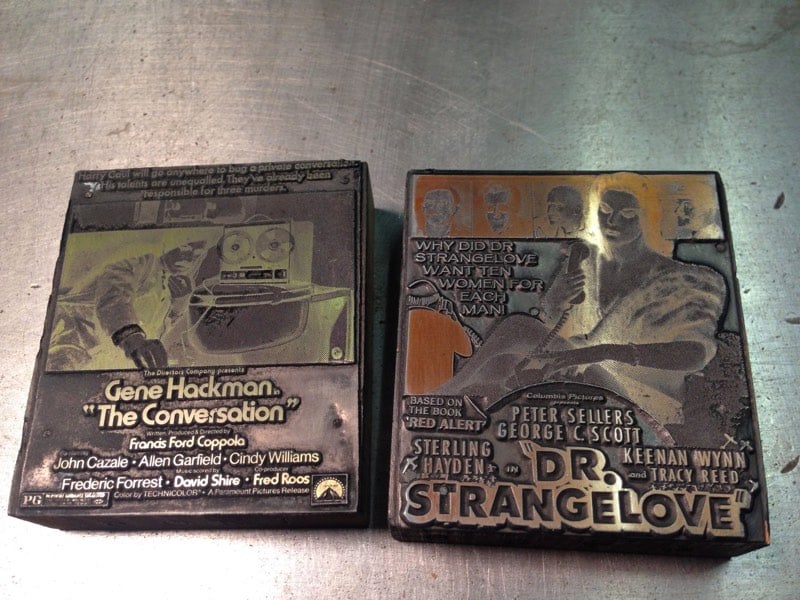
Maybe you didn’t know you wanted to know everything about these amazing printing plates and wood blocks made for film advertisements, but I, the dissertation-writer with a special interest in the relationship between material texts and early cinema in the 20th century, absolutely knew I wanted to eat this mugs up. The movies are visual, the movies are aural, the movies are an experience, but they are 100 percent an experience mediated by text and reading. And these paratexts? (that is, the texts outside the texts?) Woooooo do they shape how we experience both the moment of film and its history. I tell you, I wish I had millions of dollars just once. I would start my own damn museum. (And then I would run out of money.)
Likewise, maybe you didn’t know you needed these surreptitious street photos from fin-de-siecle Oslo, but a flaneur recognizes a flaneur, you know what I’m saying?

I think what I love about the end of the nineteenth and the beginning of the twentieth century is the enormous weight placed on noticing those ephemeral details in the swirling impressions of the suddenly overwhelming city streets, and taking those luminous particulars and transforming them into art.
The history of New Jack Swing, from Keith Sweat to Mary J. Blige
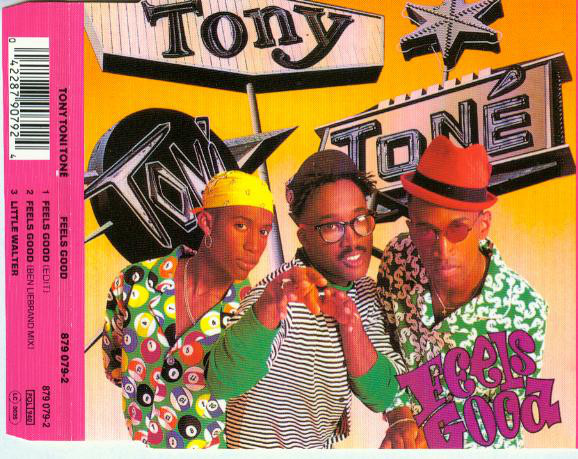
Bruno Mars is amazing: a shapeshifting artist seemingly engineered to synthesize the history of pop music and overcome all critical resistance. His latest single with Cardi B, “Finesse,” is a perfect pastiche of the aesthetics of early 1990s pop radio R&B, from TLC videos to In Living Color’s Fly Girls and that Bell Biv Devoe snare drum.
I should say, it’s a pastiche of a particular subgenre of R&B — remember when R&B was dominant enough to have subgenres? — and hip-hop, one called New Jack Swing. New Jack Swing sort of emerged from the Minneapolis sound of Prince and Janet Jackson in the late 1980s, borrowing turntable scratching, stop-start percussive beats, and especially dancing and dance beats from hip-hop.
New Jack Swing helped break R&B out of its respectability ethos — think Whitney Houston, Anita Baker, etc. — and its reliance on tropes from soul, funk, and gospel music. It also had a transformative effect on hip-hop, helping it find a place on R&B radio, then dance shows, MTV, and the Top 40 charts. It was arguably even more successful at changing pop music in that period than alternative and grunge music were. And it’s some of the best pop music you’ve ever heard, music that turned producers like Teddy Riley and Bernard Belle, Babyface and LA Reid, and Jimmy Jam and Terry Lewis into stars.
Inspired by Mars’s callback, MacArthur genius Lin-Manuel Miranda and Prince superfan Anil Dash teamed up to create a short primer to New Jack Swing. It’s a Spotify playlist, and despite its overlooking the later Teddy Riley work with Wreckz-n-Effect and Blackstreet, it’s magnificent. It certainly gives you all the tools to properly appreciate / hate on Mars’s appropriation of the genre.
Ask Dr. Time: Orality and Literacy from Homer to Twitter
Dr. Time is a nickname some friends gave me within the last couple of years. Its origin is silly, as nicknames’ often are: “Tim” autocorrects to “Time,” so hasty typing in a private Slack turns into a pseudo-persona. I also like that it’s a slant rhyme on Doctor Doom, my favorite supervillain. And in case you haven’t noticed, I have a pretty strong interest in time.
When Jason and I started talking about different ways we could collaborate on the site, the wildest was his suggestion that I write an advice column called “Ask Dr. Time.” I laughed out loud. The proposition was absurd. I don’t want to wade into the disaster that is my life, but the idea that anyone would ask me for personal advice, and that I would be foolish enough to give it, was laughable. Let’s just say I’ve made some poor choices and had some sad circumstances, and leave it at that.
One of those poor choices, however, was spending a lot of time studying philosophy, literature, mathematics, history, and metaphysics. Jason eventually got me to see that “Ask Dr. Time” didn’t have to be an advice column in a conventional sense. What if readers had problems that didn’t require common sense or finely honed interpersonal skills, but an ability to make sense of abstruse reasoning? What if they didn’t need a fancy Watson but an armchair Wittgenstein? What if kottke.org hosted the first metaphysical advice columnist? That proposition is still absurd, but it’s absurd in an interesting way. And “absurd in an interesting way” is what Dr. Time is all about. Not practical solutions, but philosophical entanglements and disentanglings. That I could do.
So on Fridays, from time to time. Dr. Time is going to appear, to answer reader questions that admit of no answer — sometimes here on Kottke.org, and sometimes at the Kottke newsletter I write, Noticing. For this particular entry, the blog seemed more appropriate — and besides, the newsletter was full.
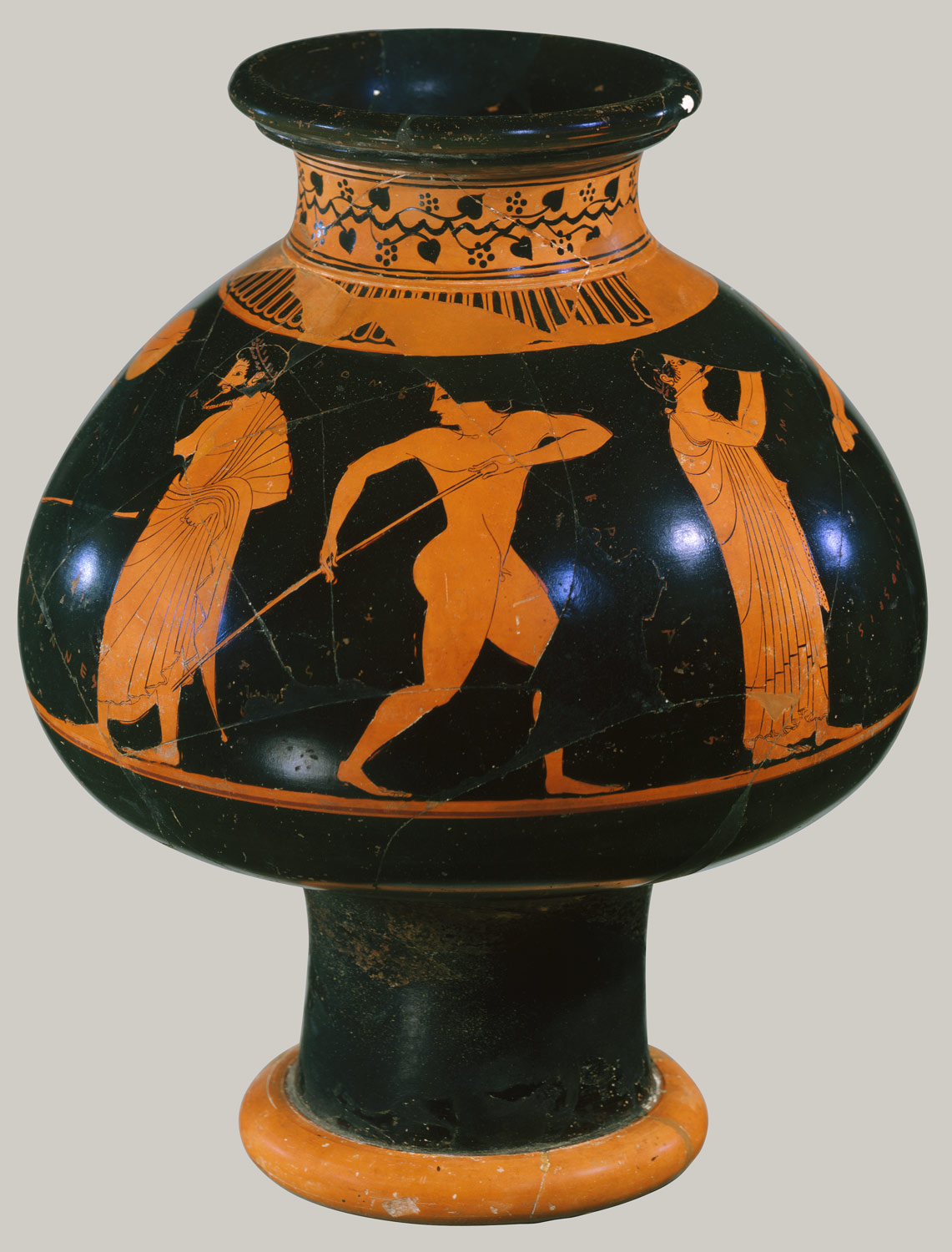
Our first question actually comes from Jason, who, like many of us, is enjoying Emily Wilson’s magnificent contemporary translation of Homer’s The Odyssey.
Jason was struck by this passage in the introduction, on the oral roots and possible oral composition of the Homeric epics:
The state of Homeric scholarship changed radically and permanently in the early 1930s, when a young American classicist named Milman Parry traveled to the then-Yugoslavia with recording equipment and began to study the living oral tradition of illiterate and semiliterate Serbo-Croat bards, who told poetic folk tales about the mythical and semihistorical events of the Serbian past. Parry died at the age of thirty-three from an accidental gunshot, and research was further interrupted by the Second World War. But Parry’s student Albert Lord continued his work on Homer, and published his findings in 1960, under the title The Singer of Tales. Lord and Parry proved definitively that the Homeric poems show the mark of oral composition.
The “Parry-Lord hypothesis” was that oral poetry, from every culture where it exists, has certain distinctive features, and that we can see these features in the Homeric poems—specifically, in the use of formulae, which enable the oral poet to compose at the speed of speech. A writer can pause for as long as she or he wants, to ponder the most fitting adjective for a particular scene; she can also go back and change it afterwards, on further reflection—as in the famous anecdote about Oscar Wilde, who labored all morning to add a comma, and worked all afternoon taking it out. Oral performers do not use commas, and do not have the luxury of time to ponder their choice of words. They need to be able to maintain fluency, and formulaic features make this possible.
Subsequent studies, building on the work of Parry and Lord, have shown that there are marked differences in the ways that oral and literate cultures think about memory, originality, and repetition. In highly literate cultures, there is a tendency to dismiss repetitive or formulaic discourse as cliche; we think of it as boring or lazy writing. In primarily oral cultures, repetition tends to be much more highly valued. Repeated phrases, stories, or tropes can be preserved to some extent over many generations without the use of writing, allowing people in an oral culture to remember their own past. In Greek mythology, Memory (Mnemosyne) is said to be the mother of the Muses, because poetry, music, and storytelling are all imagined as modes by which people remember the times before they were born.
Wilson goes on to consider the implications of the poem’s origins in orality for trying to figure out if there really was an historical Homer, a single author of the great poems — and if so, whether and how we could tell. She also rightly gives some of the Homeric critics a shot in the ribs for their assumptions about oral cultures, which tended not to be drawn from very many historical sources: if Parry had visited with Somali bards rather than singers from the Balkans, he may have come away with very different conclusions.
Orality, even primary orality, before any writing whatsoever, exists in rich and wide varieties. And Homeric orality was probably not so primary as all that: it’s exciting and accessible to us exactly because it’s on that seam between a dominant oral culture and an emerging written one.
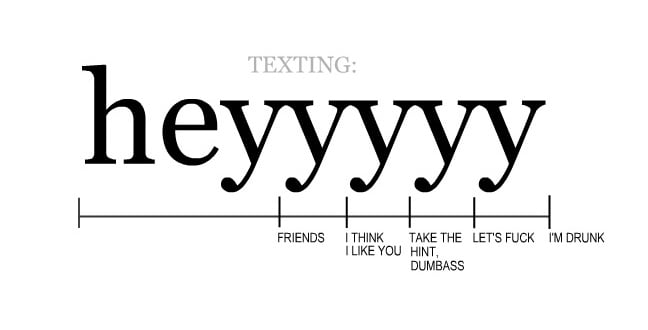
Jason’s question is a little bit different. Since I don’t quite remember what he originally asked, I’ll do a very oral-to-literate thing and paraphrase. What do we make of digital media forms like Twitter that are highly interactive and speechlike? Is this a kind of return to orality? Is there a little bit of the Homeric world in our smartphones, where we both “chat” with our mouths and our thumbs?
The answer to this last question is Yes — but in a different way from how it might first appear. We’re a little Homeric because we’re also on the cusp of multiple media regimes, making a great transformation of great civilizations. However, with some exceptions, we’re not especially oral. We’re exceedingly literate. We’re making written language and literacy do things even our grandparents, raised in the age of industrial print, wouldn’t quite recognize.
I used the phrase “primary orality” earlier, and it’s one I borrow from Walter Ong. Ong was a Jesuit priest and influential scholar of language and literature. He was very much in this Milman Parry tradition of thinking about the relationship of orality and literacy to forms of thought and shared culture. You can draw a line from Parry to Eric Havelock, who wrote the influential Preface to Plato, and to communications scholars Harold Innis and Marshall McLuhan, and from there to Ong, Hugh Kenner, Northrop Frye, and a number of the more dominant media thinkers of the twentieth century in the English language.
What Ong helped conceptualize and popularize, especially in his book Orality and Literacy, was that in cultures with no tradition of literacy, orality had a fundamentally different character from those where literacy was dominant. It’s different again in cultures where literacy is known but scarce.
For instance, we tend to associate writing with official culture. We ask for papers, and papers are official. An official record has an official written form that unofficial forms of writing or any form of speech are considered less proper. Literacy and paper are also widespread enough that we expect everyone to have some paper.
A nonliterate culture, for obvious reasons, doesn’t work that way. You need an entirely different system of conventions to differentiate formal from informal, permanent from ephemeral — those concepts might not have even hold the same relationships to each other. One of those conventions, so common that it even exists outside the species, is song. And the songs we attribute to Homer are, for us, who exist in their shadow, the best songs ever written.
In the Romantic version of the Parry-Lord thesis, the oral world of Homer is a lost paradise, and our post-literate one, a fallen world of lesser creatures. This probably borrows too much from how Homeric poets feigned to feel about themselves relative to the Mycenaean civilizations that preceded them, and how the classical Greeks appeared to feel about Homer. It’s all representation of lost paradises all the way down.
Ong dodges more of this nostalgia than he’s usually given credit for, but there’s still an element of it, one that he sometimes seems to regret. (Regret for Nostalgia would make a good biography title for Ong.) In his case, it’s conflated with a methodological problem — how do we talk about primary orality (the orality of cultures with no knowledge of writing) in a culture that’s saturated with writing, whose entire intellectual edifice is premised on writing? In fact, oral culture never goes away: it persists in its own logic and suborns the existence of writing to its own ends.
Ong’s great example is classical and medieval rhetoric, which used books, book-based scholarly culture, and book-based modes of training to elevate oral argument to exquisite sophistication. You might also look at hip-hop, which seamlessly blends freestyle vocals, dance, graffiti, and turntable manipulation to create new forms of recording and improvisation. It’s never an either-or, but a constant restructuring.

So, as to the original question: are Twitter and texting new forms of orality? I have a simple answer and a complex one, but they’re both really the same.
The first answer is so lucid and common-sense, you can hardly believe that it’s coming from Dr. Time: if it’s written, it ain’t oral. Orality requires speech, or song, or sound. Writing is visual. If it’s visual and only visual, it’s not oral.
The only form of genuine speech that’s genuinely visual and not auditory is sign language. And sign language is speech-like in pretty much every way imaginable: it’s ephemeral, it’s interactive, there’s no record, the signs are fluid. But even most sign language is at least in part chirographic, i.e., dependent on writing and written symbols. At least, the sign languages we use today: although our spoken/vocal languages are pretty chirographic too.
Writing, especially writing in a hyperliterate society, involves a transformation of the sensorium that privileges vision at the expense of hearing, and privileges reading (especially alphabetic reading) over other forms of visual interpretation and experience. It makes it possible to take in huge troves of information in a limited amount of time. We can read teleprompters and ticker-tape, street signs and medicine bottles, tweets and texts. We can read things without even being aware we’re reading them. We read language on the move all day long: social media is not all that different.
Now, for a more complicated explanation of that same idea, we go back to Father Ong himself. For Ong, there’s a primary orality and a secondary orality. The primary orality, we’ve covered; secondary orality is a little more complicated. It’s not just the oral culture of people who’ve got lots of experience with writing, but of people who’ve developed technologies that allow them to create new forms of oral communication that are enabled by writing.
The great media forms of secondary orality are the movies, television, radio, and the telephone. All of these are oral, but they’re also modern media, which means the media reshapes it in its own image: they squeeze your toothpaste through its tube. But they’re also transformative forms of media in a world that’s dominated by writing and print, because they make it possible to get information in new ways, according to new conventions, and along different sensory channels.

Walter Ong died in 2003, so he never got to see social media at its full flower, but he definitely was able to see where electronic communications was headed. Even in the 1990s, people were beginning to wonder whether interactive chats on computers fell under Ong’s heading of “secondary orality.” He gave an interview where he tried to explain how he saw things — as far as I know, relatively few people have paid attention to it (and the original online source has sadly linkrotted away)1:
“When I first used the term ‘secondary orality,’ I was thinking of the kind of orality you get on radio and television, where oral performance produces effects somewhat like those of ‘primary orality,’ the orality using the unprocessed human voice, particularly in addressing groups, but where the creation of orality is of a new sort. Orality here is produced by technology. Radio and television are ‘secondary’ in the sense that they are technologically powered, demanding the use of writing and other technologies in designing and manufacturing the machines which reproduce voice. They are thus unlike primary orality, which uses no tools or technology at all. Radio and television provide technologized orality. This is what I originally referred to by the term ‘secondary orality.’
I have also heard the term ‘secondary orality’ lately applied by some to other sorts of electronic verbalization which are really not oral at all—to the Internet and similar computerized creations for text. There is a reason for this usage of the term. In nontechnologized oral interchange, as we have noted earlier, there is no perceptible interval between the utterance of the speaker and the hearer’s reception of what is uttered. Oral communication is all immediate, in the present. Writing, chirographic or typed, on the other hand, comes out of the past. Even if you write a memo to yourself, when you refer to it, it’s a memo which you wrote a few minutes ago, or maybe two weeks ago. But on a computer network, the recipient can receive what is communicated with no such interval. Although it is not exactly the same as oral communication, the network message from one person to another or others is very rapid and can in effect be in the present. Computerized communication can thus suggest the immediate experience of direct sound. I believe that is why computerized verbalization has been assimilated to secondary ‘orality,’ even when it comes not in oral-aural format but through the eye, and thus is not directly oral at all. Here textualized verbal exchange registers psychologically as having the temporal immediacy of oral exchange. To handle [page break] such technologizing of the textualized word, I have tried occasionally to introduce the term ‘secondary literacy.’ We are not considering here the production of sounded words on the computer, which of course are even more readily assimilated to ‘secondary orality’” (80-81).
So tweets and text messages aren’t oral. They’re secondarily literate. Wait, that sounds horrible! How’s this: they’re artifacts and examples of secondary literacy. They’re what literacy looks like after television, the telephone, and the application of computing technologies to those communication forms. Just as orality isn’t the same after you’ve introduced writing, and manuscript isn’t the same after you’ve produced print, literacy isn’t the same once you have networked orality. In this sense, Twitter is the necessary byproduct of television.
Now, where this gets really complicated is with stuff like Siri and Alexa, and other AI-driven, natural-language computing interfaces. This is almost a tertiary orality, voice after texting, and certainly voice after interactive search. I’d be inclined to lump it in with secondary orality in that broader sense of technologically-mediated orality. But it really does depend how transformative you think client- and cloud-side computing, up to and including AI, really are. I’m inclined to say that they are, and that Alexa is doing something pretty different from what the radio did in the 1920s and 30s.
But we have to remember that we’re always much more able to make fine distinctions about technology deployed in our own lifetime, rather than what develops over epochs of human culture. Compared to that collision of oral and literate cultures in the Eastern Mediterranean that gave us poetry, philosophy, drama, and rhetoric in the classical period, or the nexus of troubadours, scholastics, printers, scientific meddlers and explorers that gave us the Renaissance, our own collision of multiple media cultures is probably quite small.
But it is genuinely transformative, and it is ours. And some days it’s as charming to think about all the ways in which our heirs will find us completely unintelligible as it is to imagine the complex legacy we’re bequeathing them.
Thank the Internet Archive for the save! See also here.↩
Medieval illustrations of what Europeans thought elephants looked like
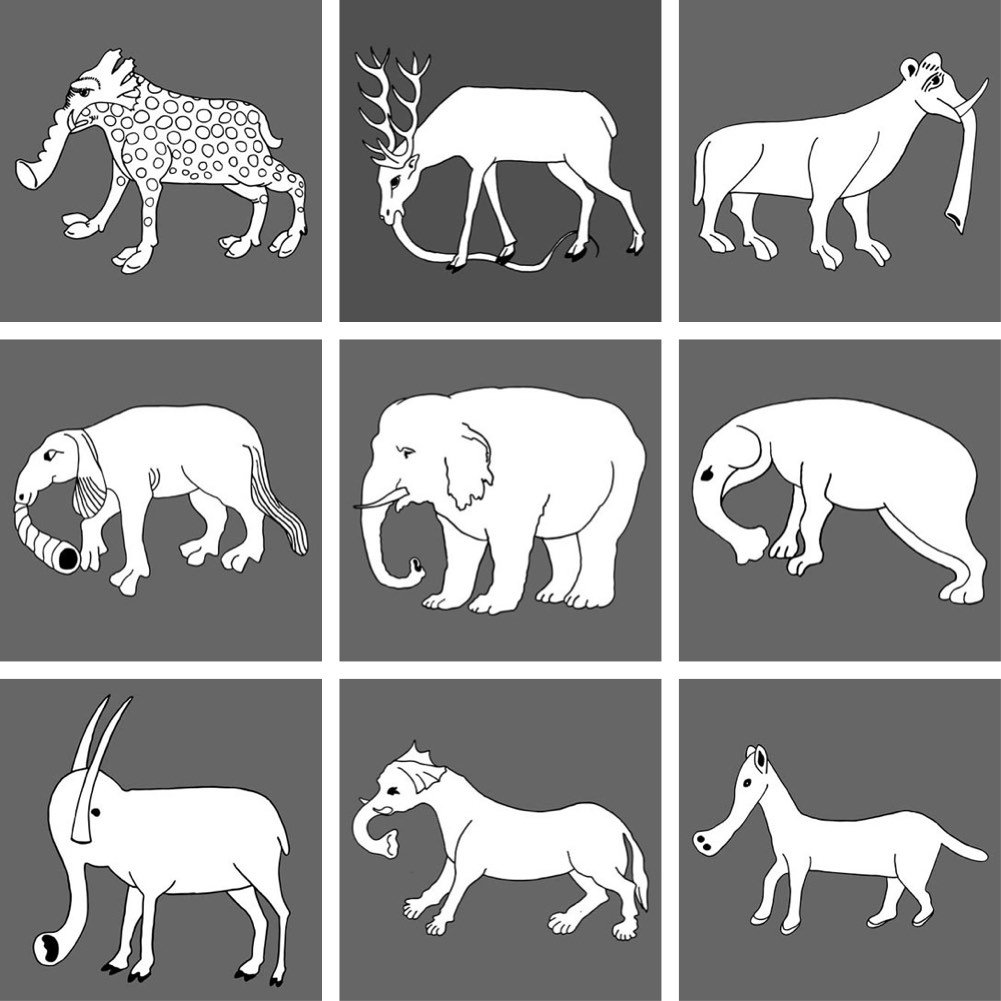
For his Elephas Anthropogenus project, Uli Westphal collected European illustrations of elephants dating from the fall of Rome to the end of the Renaissance, a period of time when very few people actually knew what an elephant looked like.
After the fall of the Roman Empire, elephants virtually disappeared from Western Europe. Since there was no real knowledge of how this animal actually looked, illustrators had to rely on oral and written transmissions to morphologically reconstruct the elephant, thus reinventing an actual existing creature. This tree diagram traces the evolution of the elephant depiction throughout the middle ages up to the age of enlightenment.
See also famous logos drawn from memory and drawing all 50 states from memory.
Ten new principles for good design
In the 1970s, legendary industrial designer Dieter Rams formulated his now-famous ten principles for good design.
5. Good design is unobtrusive. Products fulfilling a purpose are like tools. They are neither decorative objects nor works of art. Their design should therefore be both neutral and restrained, to leave room for the user’s self-expression.
6. Good design is honest. It does not make a product more innovative, powerful or valuable than it really is. It does not attempt to manipulate the consumer with promises that cannot be kept.
Suzanne LaBarre of Co.Design has come up with an update of Rams’ list for 2018: 10 New Principles Of Good Design.
Good design is slow. For the past 20 years, tech has embraced a “move fast and break things” mantra. That was fine when software had a relatively small impact on the world. But today, it shapes nearly every aspect of our lives, from what we read to whom we date to how we spend money-and it’s largely optimized to benefit corporations, not users. The stakes have changed, the methods haven’t.
Good design is good writing. In his “2017 Design in Tech Report,” author John Maeda anointed writing as design’s newest unicorn skill. It’s easy to see why. With the rise of chatbots and conversational UI, writing is often the primary interface through which users interact with a product or service. (Siri’s dad jokes had to be written by someone.) But even designers who don’t work on interface copy should be able to articulate themselves clearly. The better their writing, the better their chances of selling an idea.
See also the tongue-in-cheek list of design principles updated for the tech industry, e.g. “Good design is pleasing your shareholders”.
The Mars Generation is giving up to 16 scholarships for kids to attend a week of Space Camp. Application details here.
Why is Twitter still good? Because two NYC museums are trying to best each other with olde tyme NYC snow photos.
Presidential murder as a deterrent to nuclear war
In an article titled “Preventing nuclear war” published in the March 1981 issue of The Bulletin of Atomic Scientists, Roger Fisher suggested that before the President could launch nuclear weapons against another nation, they would first have to kill a person with their bare hands, as a prelude to killing perhaps tens of millions.
An early arms control proposal dealt with the problem of distancing that the President would have in the circumstances facing a decision about nuclear war. There is a young man, probably a Navy officer, who accompanies the President. This young man has a black attache case which contains the codes that are needed to fire nuclear weapons. I could see the President at a staff meeting considering nuclear war as an abstract question. He might conclude: “On SIOP Plan One, the decision is affirmative. Communicate the Alpha line XYZ.” Such jargon holds what is involved at a distance.
My suggestion was quite simple: Put that needed code number in a little capsule, and then implant that capsule right next to the heart of a volunteer. The volunteer would carry with him a big, heavy butcher knife as he accompanied the President. If the President ever wanted to fire nuclear weapons, the only way he could do so would be for him first, with his own hands, to kill one human being. The President says, “George, I’m sorry but tens of millions must die.” He has to look at someone and realize what death is — what innocent death is. Blood on the White House carpet. It’s reality brought home.
As it stands, the President can choose to use nuclear weapons pretty much on a personal whim. It would seem that the 80s are back, both in movies/TV and also in the daily existential dread of the Cold War. Yay. (via clive thompson)
The top 50 most popular Wikipedia entries from 2017. Death, Trump, Queen Elizabeth, Bitcoin, Wonder Woman, and The Rock all feature.
The delight and challenge of true solitude
Many of us feel alone from time to time or spend a day or two holed away working or worrying without seeing another person. But true solitude is difficult to come by these days. For the past 19 years, Alexandra de Steiguer has been the off-season caretaker for the Oceanic Hotel, located 10 miles off the coast of New Hampshire. During the winter months, she’s the only person on the island. Brian Bolster’s meditative short film looks at de Steiguer’s life on the island and her embrace of solitude.
Winter’s Watch explores de Steiguer’s relationship to extreme isolation. Its meditative imagery contemplates the beauty of absence, while de Steiguer reflects on the unique challenges and rewards of solitude. “There are no other distractions,” she says. “You have to decide how to fill your days….and yet it is peaceful, and I can use my imagination.”
The hulking-and possibly haunted-hotel bears a striking resemblance to The Shining, but de Steiguer maintains that “if there are ghosts out here, they are being extremely kind to me.” Rather, she has embraced what she calls “the great waiting of winter.”
See also how to be alone. (via @ifyoucantwell)
Candid street photos from the 1890s
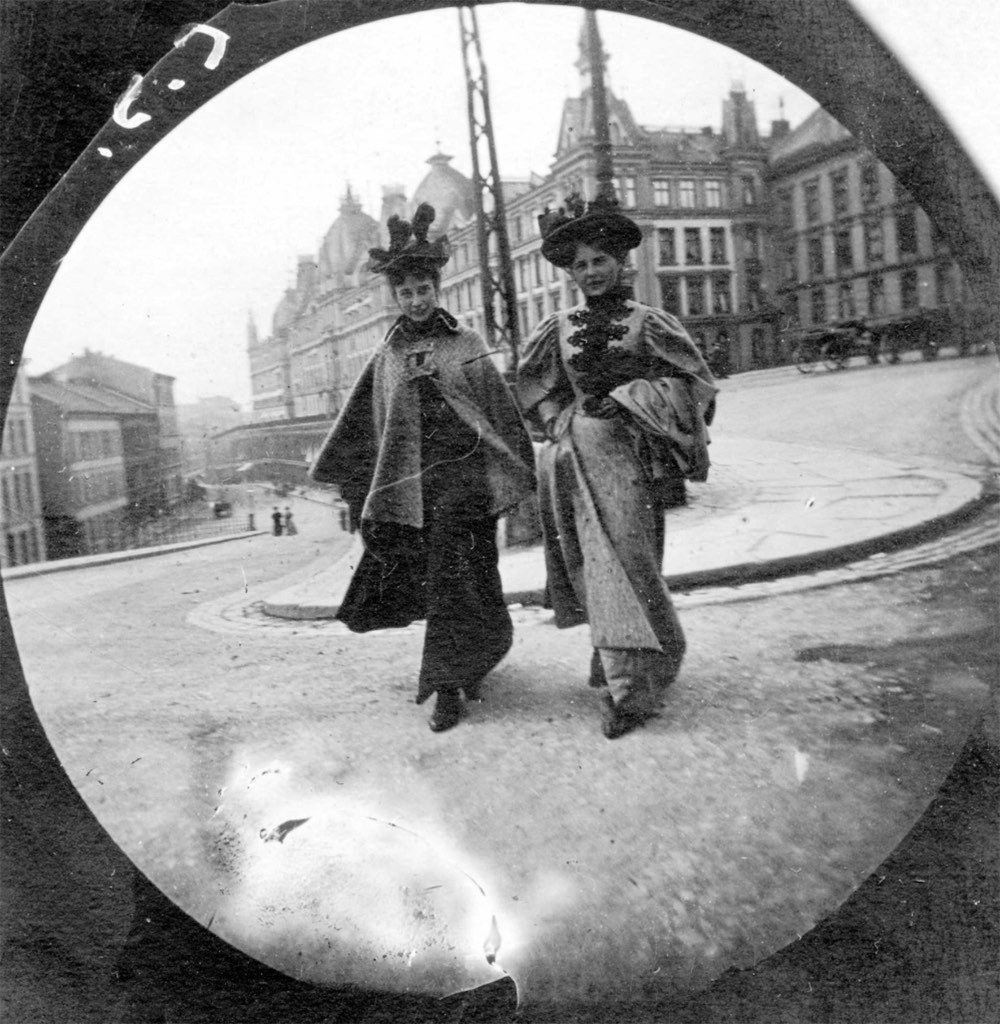
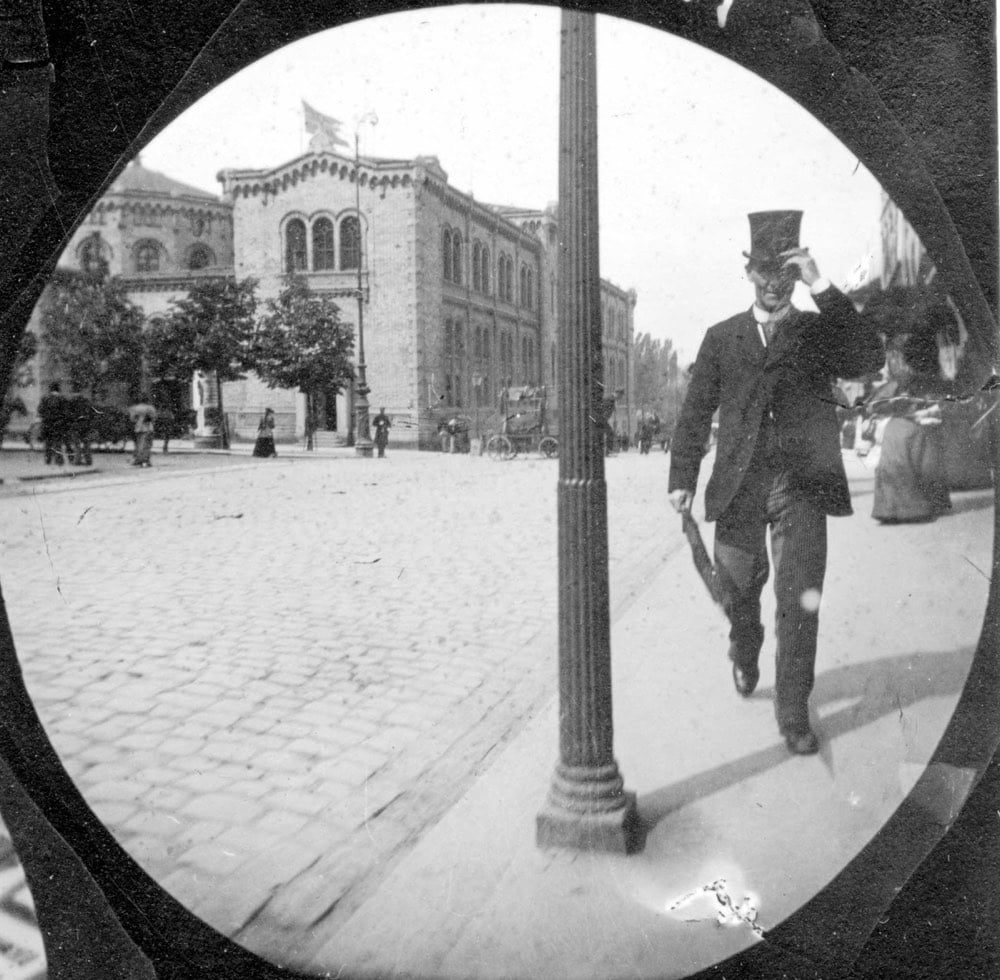
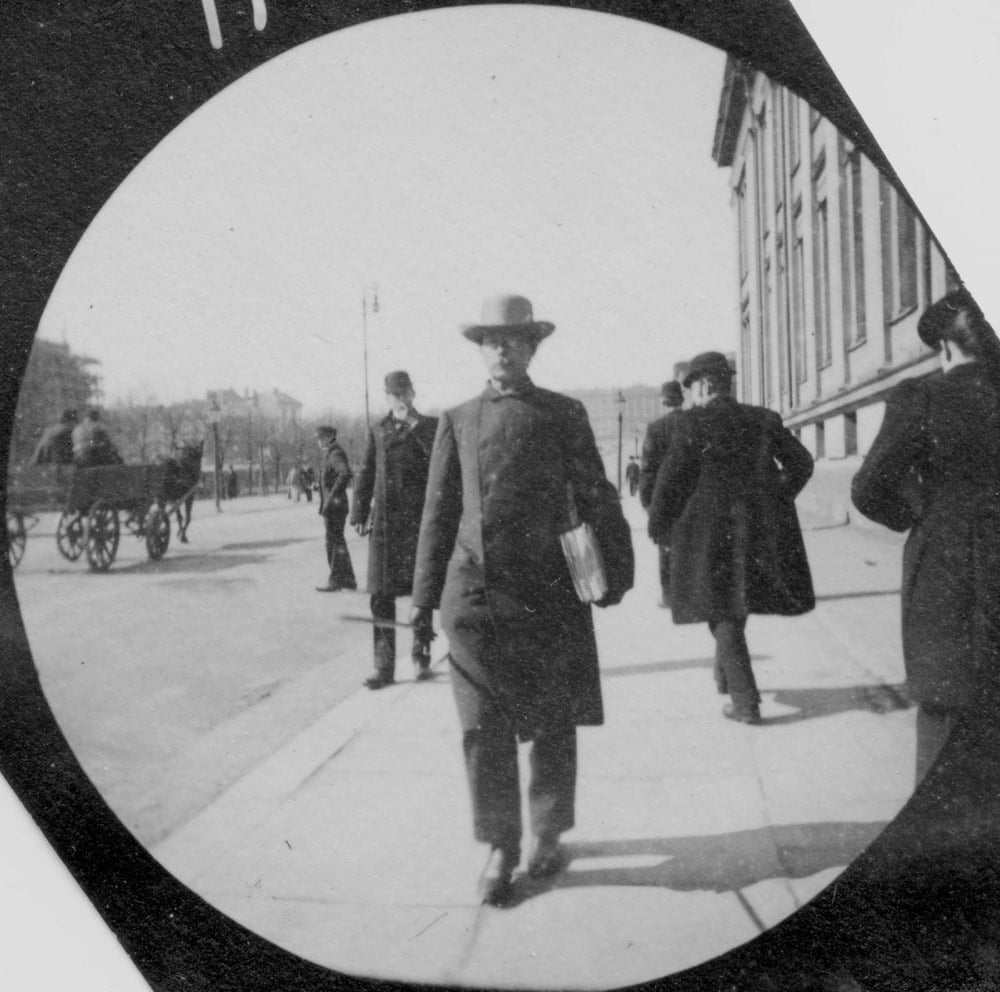
As a young mathematics student in Oslo in the 1890s, Carl Størmer bought a Concealed Vest Camera manufactured by C.P. Stirn — “No Tourist, Artist or Student, Amateur or Professional, should be without this Camera” — and walked the streets of the city, taking surreptitious photos of people he met. Størmer operated the shutter of his buttonhole camera with a string in the pocket of his trousers. (via colossal)
Mark Zuckerberg’s personal challenge this year is to fix Facebook. “We won’t prevent all mistakes or abuse, but we currently make too many errors enforcing our policies and preventing misuse of our tools.”
New Jack Swing 101. This Spotify playlist compiled by @anildash and @lin_manuel is gonna be on repeat all day for me.
Custom minifigs of Star Trek: The Next Generation characters
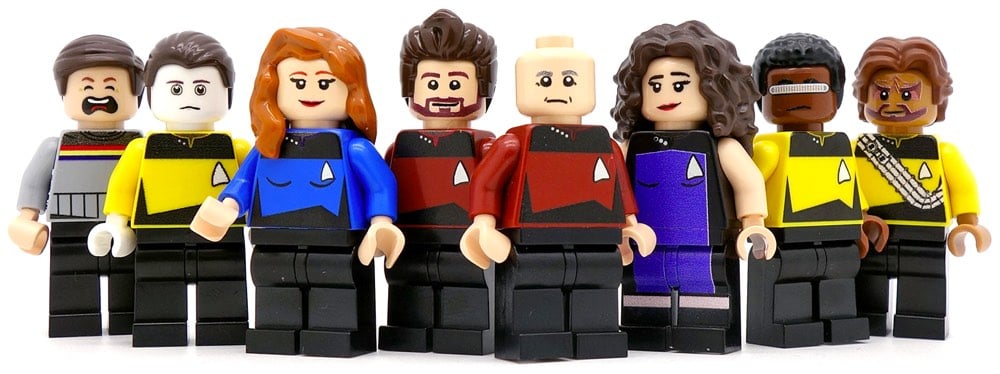
Oh these are cool: custom-made minifigs of all your favorite Star Trek:TNG characters. The Wesley Crusher one is kinda funny, but Wil Wheaton makes a good case as to why it’s unfair to the character. And it turns out, you can get custom minifigs for just about everything, from LeBron James to Game of Thrones to yourself. (via io9)
Currency blankets from Hiller Dry Goods
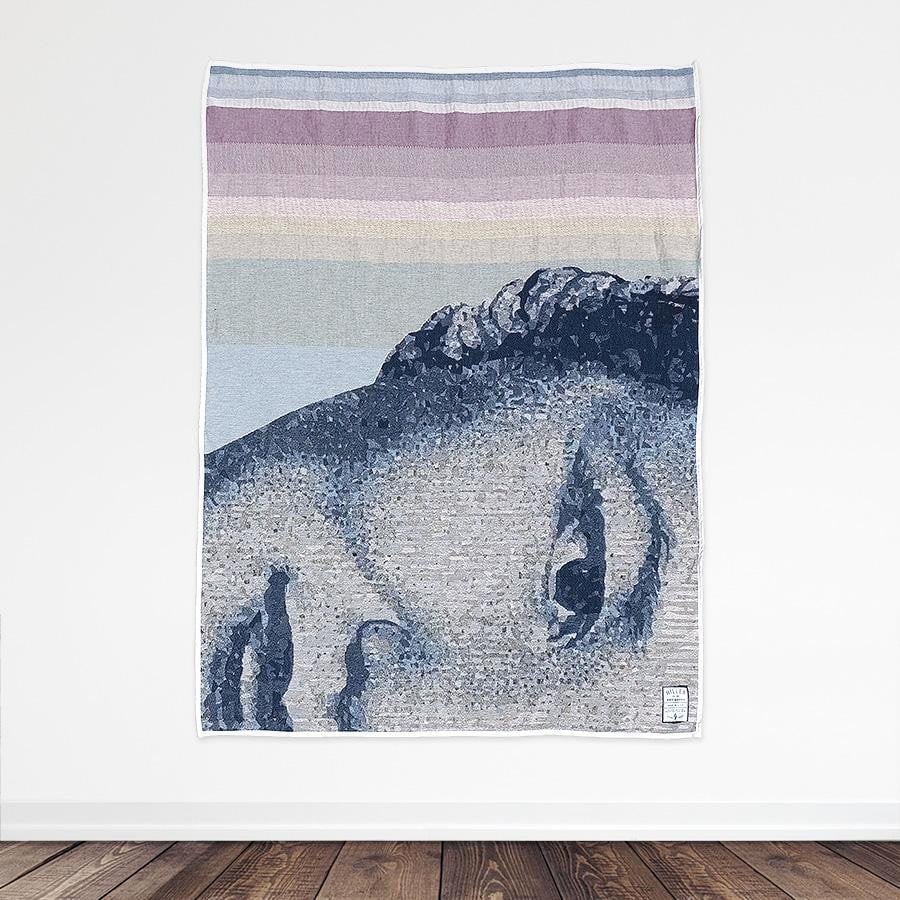
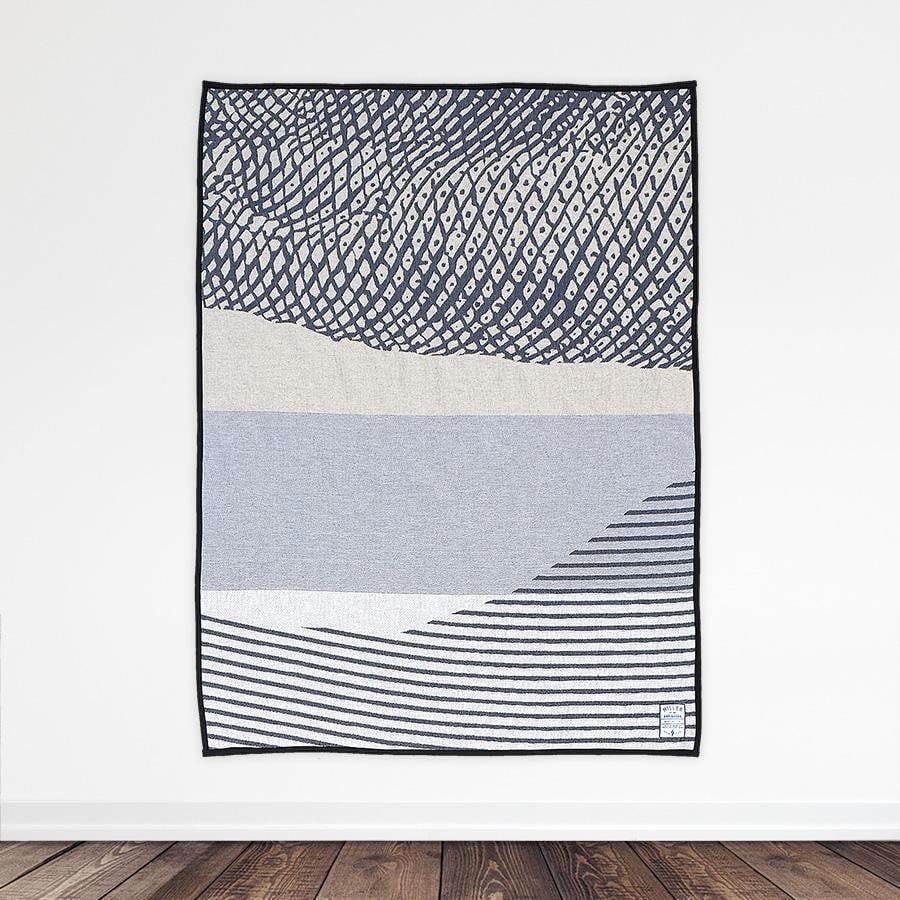
Nick Hiller has rebooted his great-great-grandfather’s textiles & dry goods store (established in Detroit in 1904) as an online shop. The first collection is called the Currency Blankets Collection, and features lovely blankets inspired by patterns on banknotes from around the world.
For thousands of years, textiles were so basic to survival that they functioned as a form of currency. In Mesoamerica, the Zapotecs paid tribute in woven rugs to the ruling Aztecs; in North America, the Navajos transacted in Pendleton blankets with European settlers; in West Africa, the Wolof in Gambia used “cloth money” in standardized strips that could be torn to make change; in medieval Iceland, a woolen fabric called wadmal (Old Norse for “legal cloth”) was the official currency for over 600 years. Even the Silk Road, civilization’s first global trade network, was named after the route’s dominant form of currency.
The blankets in the collection are manufactured in the US and reflect banknotes from France, the US (the pattern is a super zoom of Ben Franklin’s cheek on the $100 bill), Romania, Sierra Leone, Switzerland, Argentina, and several others.
A short film about a one-of-a-kind collection of letterpress plates for printing film advertisements
In 1999, two friends went into a Nebraska antique shop and found a massive collection of letterpress blocks and plates that were used to make advertisements for movies in newspapers. They bought the whole shebang for $2000 and have spent the last 17 years cataloging and cleaning the 60,000 plates & blocks (here is just a partial inventory). The collection, which spans nearly the entire history of the film industry from the silent era to 1984, was recently appraised at ~$10 million and is available for acquisition.
The short film embedded above is a must-see for design/movie nerds…my jaw hit the floor when these pristine posters for movies that were 50, 60, 70 years old started rolling off of the letterpress. I mean, look at this stuff!
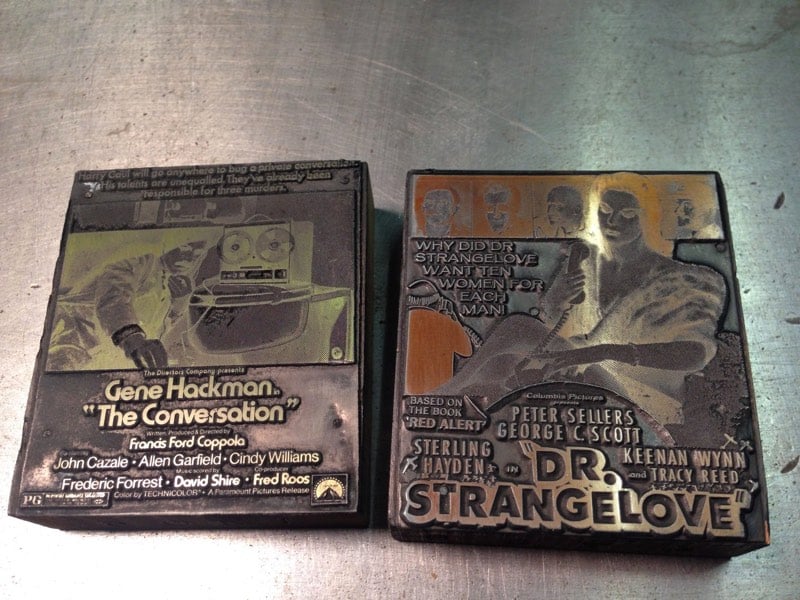
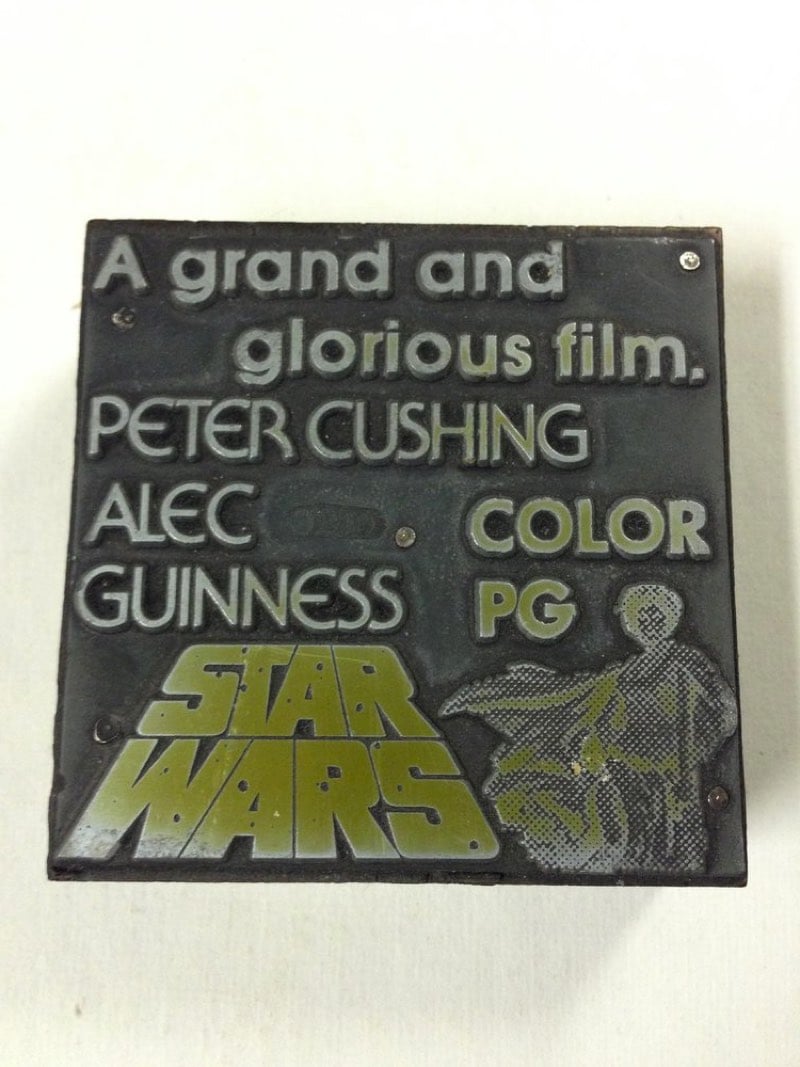
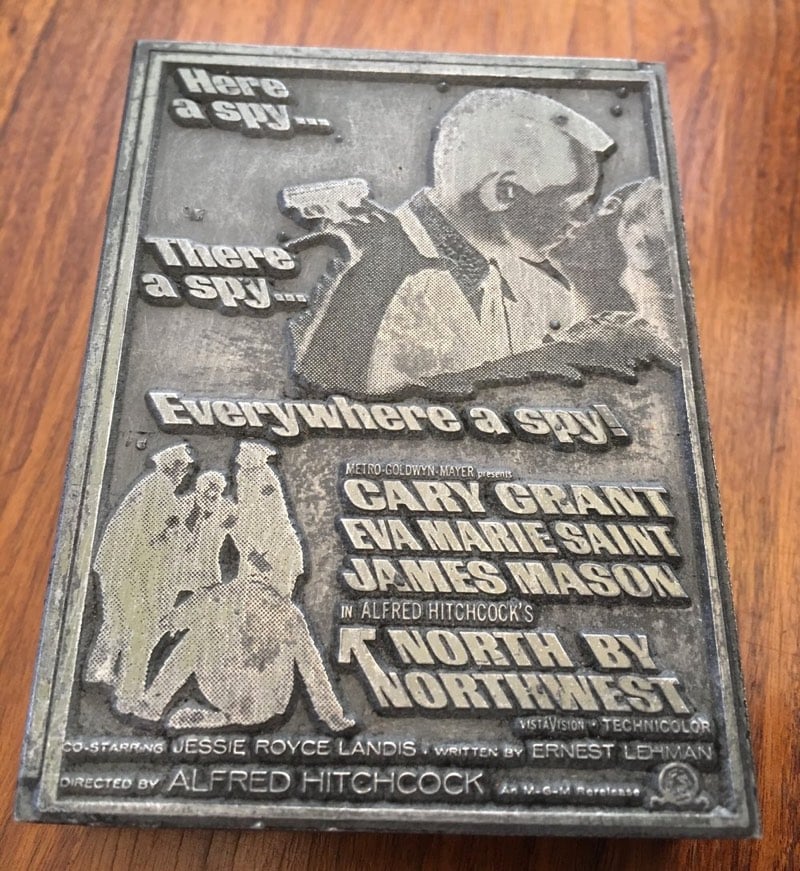
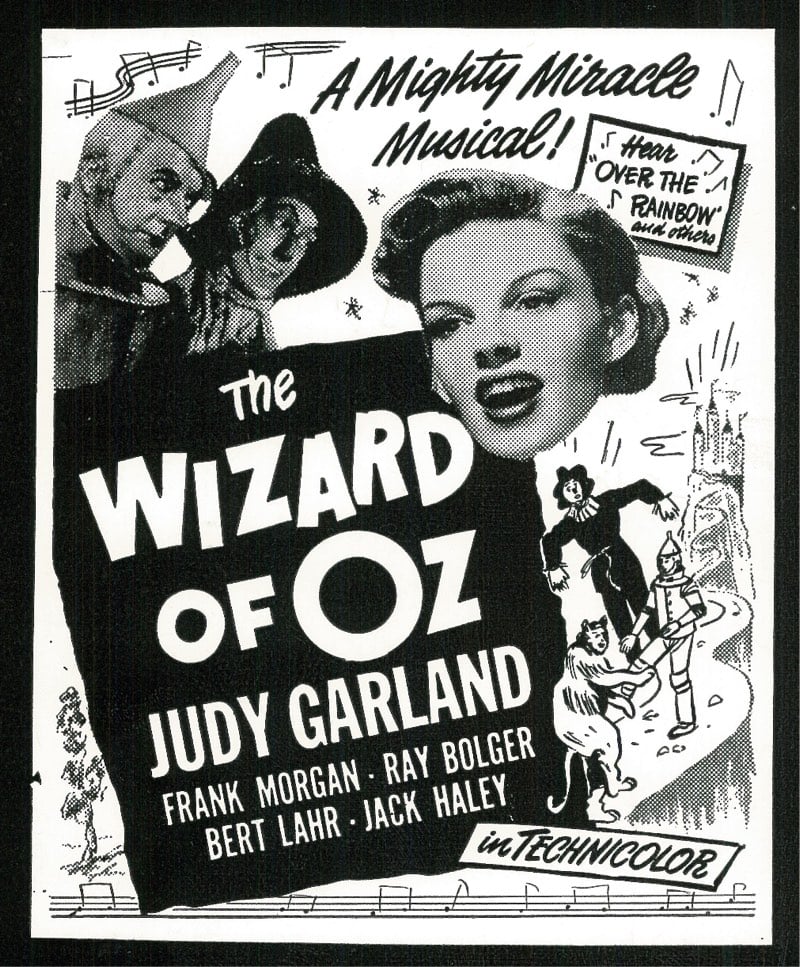
Note: I flipped the images of the plates so they would be readable. The actual plates are mirror images of the printed advertisements. Here’s what a print made from a plate looks like:
Socials & More