[ As a tease for the first issue of the just-announced Noticing newsletter coming up on Friday, here is last week’s newsletter that we previewed for kottke.org members. It’s a review of the best kottke.org posts and links from 2017. You can sign up for Noticing if you find this kind of thing appealing. Ok, I’ll let Tim take it from here. -jason ]
2017 Through the Lens of Kottke.org
If 2016 was chaos, then 2017 was catastrophe. In the middle of an ongoing disaster, the world reckoned with bills long overdue. Kottke.org has never been a terribly political blog, but it’s always been one that’s grappled with history, the problems of art and media, self-reflection, and the long trajectory into the future. The site couldn’t help but reflect that catastrophe back to its readers. At the same time, it continued to offer some small oasis by selecting and presenting the best of the World Wide Web.
Messages in Bottles
One of the most exciting weeks of 2017 for me was when I asked Kottke.org readers to help me build a time capsule for the World Wide Web. It felt particularly important this year to try to save the best parts of the things we loved. We had to have something to show the future, despite all this destruction and heartache, that we were still capable of making things that surprised and delighted.
The entire “best of the web” series paid homage to the 20th century technologies that have defined so much of the 21st. It also showcased the deep knowledge and generosity of Kottke readers, who contributed and helped curate all of the entries. If you missed it, or are looking to refresh yourself, the web’s best hidden gems and the web’s funniest stories are good places to start.

Jason as gas station patron on Halt and Catch Fire. Photo courtesy of AMC.
One of the most exciting weeks of 2017 for me on Jason’s behalf was his appearance on Halt and Catch Fire. Jason wrote this wonderful love letter to the show and the moment it tries to capture:
When I was a kid, there was nothing I was more interested in than computers. My dad bought one of the first available IBM PC-compatibles on the market. I’ve read and watched a ton about the PC revolution. I used online services like Prodigy. And the web, well, I’ve gotten to experience that up close and personal. One of the reasons I love Halt and Catch Fire so much is that it so lovingly and accurately depicts this world that I’ve been keenly interested in for the past 35 years of my life. Someone made a TV show about my thing and it was great, a successor to Mad Men great. Getting to be a microscopically tiny part of that? Hell yeah, it was worth it.
Recently, I saw The Farthest, a wonderful documentary about the Voyager missions. In it, Timothy Ferris, producer of the famous Golden Record, laments the fact that so much wonderful music was left off, but says something like, “who would want to live in a civilization that only ever produced 90 minutes of great music?” It made me feel better about leaving off so many wonderful parts of the web in my time capsule; who would want to honor a technology whose entire set of great achievements could be documented in a week of blog posts?
In Search of Deep Time
In 2014, it was easier to believe in the future. For The Future Library, an art project by Katie Paterson, a thousand trees were planted. In a century, the trees will become part of an anthology of books, written by Margaret Atwood and David Mitchell, among others.
Between now and then, one writer every year will contribute a text, with the writings held in trust, unpublished, until the year 2114. Tending the forest and ensuring its preservation for the one hundred year duration of the artwork finds a conceptual counterpoint in the invitation extended to each writer: to conceive and produce a work in the hopes of finding a receptive reader in an unknown future.
Deep Time, conceptualized in the eighteenth century but coined in the twentieth by John McPhee, is bigger than centuries; it’s really about time on the geologic scale. Even the time of human civilizations (Stone, Bronze, Iron, etc.) is too small. Deep time is deep.
Something like “The Earth’s five energy revolutions” gets us closer to it: all life on earth begins with geochemical energy, then augmented by sunlight, and finally, oxygen, flesh, and fire. The life and death of entire forests of trees, of entire species and kingdoms, is dwarfed by the history of an entire planet and all the life that’s ever been on it. This point of view has always been a powerful perspective, but in 2017, the cosmic telescope of time was almost a comfort. Even if nations fall and species fail, this too will pass.

Coleman’s Cafe in Greensboro, Ala., in 1971. By William Christenberry
But deep time has its own human counterparts. Consider Teju Cole’s essay “The Image of Time,” on photographer William Christenberry. Christenberry photographed buildings in small towns in the American south over time: seemingly the same photograph, of the same object, from the same distance, with the same framing, shows the object’s subtle or radical transformations, its non-identity.
Time is photography’s illusion. Almost every photograph appears instantaneous. But of course, there’s no such thing as “instantaneous”: All fragments of time have a length. In a photograph, the time during which the light is refracted by the lens, enters the aperture and is allowed to rest on the photosensitive surface could be 1/125th of a second, one-eighth of a second, half a second, a whole minute, much more or much less. What is intriguing about a practice like Christenberry’s is that it employs time elsewhere in the photograph too: as a source of narrative.
Or look at Jon Bois’s magnificent “17776: What Football Will Look Like in the Future,” which dives right into the familiar — maps, calendars, printer readouts — and estranges it, exactly to make the reader experience time. (I can’t even blockquote or screenshot it. It’s one piece you have to read for yourself.)
Time Collapsed
In 17776, the angel of history is a far-flung space probe that’s absorbed all of human culture, emotions, and sports statistics through radio transmissions. For Walter Benjamin in 1940, the Angel of History was a thought-experiment to try to understand all of history as an ongoing catastrophe.
These are chaotic times. But to the angel of history, it’s not a sudden eruption of chaos, but a manifestation of an ongoing vortex of chaos that stretches back indefinitely, without any unique origin. When we’re thrust into danger, in a flash we get a more truthful glimpse of history than the simple narratives that suffice in moments of safety. As Benjamin puts it, “the tradition of the oppressed teaches us that the ‘state of emergency’ in which we live is not the exception but the rule.”
For James Baldwin, there were no angels, and no robots; only fallen, imperfect beings who’d likewise absorbed the surrounding culture, but hadn’t necessarily been humanized by it. “People who shut their eyes to reality simply invite their own destruction,” writes Baldwin, “and anyone who insists on remaining in a state of innocence long after that innocence is dead turns himself into a monster.”
Baldwin and Benjamin were the two writers that best helped me understand this year, because they’d already seen how fascism and Jim Crow could fold time over on itself. Had he not been murdered, Emmett Till would have turned 76 in 2017; instead, a new book revealed what was long known, that he died because of a lie.
And in 2017, in a different sort of lie, Rachel Dolezal, a white woman who self-identifies as black, changed her name to Nkechi Amare Diallo. When Baldwin wrote “the world is white no longer, and it will never be white again,” I don’t think this is what he was talking about.
It was not the first time that the curiously stagnant nature of time made me wonder if we were all dead and in Hell. It would not be the last.
The New Callousness
In 2017, knowing how to apologize properly is an essential skill. (You might even call it a new kind of liberal art.) The essential components of a genuine apology, according to Beth Polin:
1. An expression of regret — this, usually, is the actual “I’m sorry.”
2. An explanation (but, importantly, not a justification).
3. An acknowledgment of responsibility.
4. A declaration of repentance.
5. An offer of repair.
6. A request for forgiveness.
Most of 2017’s public apologies whiffed on one or more of these. It was a year filled with soul-searching, but also much rejection of any real contrition. We might remember individual acts of selflessness, but the year was fueled by selfishness.
This photo by Kristi McCluer of wildfires in the Pacific Northwest became a metaphor for the summer, and the whole year.

A man golfs with a wildfire raging behind him. One of the defining images of 2017.
The New Callousness, swept into power in the United States and elsewhere, led to widespread physical and political fatigue: Kayla Chadwick’s “I Don’t Know How to Explain to You That You Should Care About Other People” reflects the prevailing mood of exhausted incredulity.
It is probably fair to say that in every direction, 2017 involved a lot of human beings writing off other human beings. But pushing back against this were great technologist-humanists like the legendary Ellen Ullman, explaining why hackers need the humanities:
Algorithms surround us, determining how we get mortgages or apartment rentals, or whether we get hired. It is crucial that we open up those algorithms and take them apart, and then either put them back together or scrap and rewrite them. Algorithms may run our lives, but I really believe people make the future.
Sharp as Possible
Trying to figure out how to live through this year, I often thought about Thelonious Monk’s advice on how to play a gig:
Just because you’re not a drummer, doesn’t mean you don’t have to keep time.
Don’t play the piano part. I’m playing that.
Don’t play everything (or every time). Let some things go by.
Some music just imagined. What you don’t play can be more important than what you do play.
Whatever you think can’t be done, somebody will come along and do it. A genius is the one most like himself.
What should we wear tonight? Sharp as possible!
I also tried to remember Richard Feynman’s advice that if you can’t explain something simply, you probably don’t really understand it. I admire complexity, but whenever it’s possible, simplicity is better.
The best of all things may be to be able to ratchet the explanation’s complexity up or down depending on who your audience is: neuroscientist Bobby Kashturi explaining a connectome to a five-year-old, teenager, college student, grad student, and scholarly peer is a great example of that.
It all builds from the foundation. As Richard Hamming observed, knowledge and productivity are like compound interest. You grow from work you put in over time, simple things repeated until they become (or appear to become) complex. Learning effects, network effects, path dependence — over time, they all roll up, and who you’re becoming overtakes who you are.
The Great Eclipse
In August, after a jab step into Nebraska, Jason drove to Rayville, Missouri to witness and photograph the solar eclipse.
As totality approached, the sky got darker, our shadows sharpened, insects started making noise, and disoriented birds quieted. The air cooled and it even started to get a little foggy because of the rapid temperature change.
We saw the Baily’s beads and the diamond ring effect… When the Moon finally slipped completely in front of the Sun and the sky went dark, I don’t even know how to describe it. The world stopped and time with it. During totality, Mouser took the photo at the top of the page. I’d seen photos like that before but had assumed that the beautifully wispy corona had been enhanced with filters in Photoshop. But no…that is actually what it looks like in the sky when viewing it with the naked eye (albeit smaller). Hands down, it was the most incredible natural event I’ve ever seen.

A view of the eclipse from Rayville, MO. Photo by Mouser.
Jason also collected the best photos and videos of the eclipse, this NASA map showing the eclipse’s path across the continental United States. and eclipse maps of the United States from 2000 BC until 2117 AD. Even for those of us who just sat under a tree and watched the shadows turn into scallops, it was a special experience this year.
Did Someone Say Maps?
Talk about visualizing deep time! Here we go:
A Tapestry of Time and Terrain shows the ages of rock in different parts of the continental US.
Another map shows the hometown of nearly all of the warriors from Homer’s The Iliad.
This map of the Roman Empire c. 125 AD shows the major Roman roads as if they were London’s tube.
A collection of miniature metro maps shows world cities with smaller systems, from Bangalore to Tblisi.
There’s a timeline map of US immigration since 1820, a set of hand-drawn infographics made by W.E.B. Du Bois and his students at Atlanta University, auto-generated maps of fantasy worlds, a topographical map of Venus (with geographic features named for historical and mythological women), and even an interactive map of personal debt.
There’s also The Atlas for the End of the World, which looks at critically endangered bioregions worldwide, and NASA’s striking nighttime map of the world, complete with a patch of void separating China from South Korea; the one nation, that, light-wise, may as well be open ocean.
So What Was Good?
There were so many essays and features and pop-up op-eds and shameless resistance grifters and rust belt whisperers that all tried to explain what was really happening in 2017. Almost always reporting either from a small red-state town or the comforts of one’s own imagination. And almost always thoroughly ignoring what was happening in the wider world in favor of warmed-over anecdotes and armchair realpolitik. All that noise nearly drowned out a few moments genuine insight. That’s always the case, but it all felt sharper this year.
I’ve already listed a lot of what I loved about this year — and everything I’ve mentioned appeared as a blog post or a Quick Link on Kottke.org. But two pieces of documentary art stand out for having a different set of ambitions, in search of a different kind of truth about 2017.

A flock of flamingos in Planet Earth II.
The first is Planet Earth 2. We already know that when the BBC breaks out Sir David Attenborough, they deliver the goods: a respite from our overweening humanity, with cutting-edge photography and cogent commentary. But PE2 went further, because it was just so goddamned beautiful.
The tracking shot of a lemur jumping from tree to tree is one of the first things you see in the first episode and it put my jaw right on the floor. It’s so close and fluid, how did they do that? Going into the series, I thought it was going to be more of the same — Planet Earth but with new stories, different animals, etc. - but this is really some next-level shit.
The second is Whitman, Alabama. Jennifer Crandall’s serial documentary benefits enormously from the fact that it didn’t set out to explain what happened politically in 2016 or 2017. The filmmaking began much earlier as a meditation on the longstanding problems of democracy and diversity in America.
It’s a very different kind of film from Planet Earth 2. It’s not state of the art. It’s relentlessly human. It manifests the spirit of Walt Whitman: his generosity, his capaciousness, his gentle but insistent concern on the public and private lives of his fellow Americans.
The first time Crandall read “Song of Myself,” it was 1990, and she was sixteen, standing in a bookstore in McLean, Virginia, having just moved back to the United States. Because of her father’s job, with U.S.A.I.D., she had spent most of her childhood in Bangladesh, Haiti, and Pakistan. “My mom is Chinese, from Vietnam, and my dad’s a white dude from Denver, and at that moment I just felt that I did not understand America,” she said. She pulled a paperback anthology of poetry off the shelf, and Whitman stuck out right away. “Though I wouldn’t have articulated it then, what I responded to was this idea that everyone embodies diversity, not just the country. That many people are negotiating multiple social contracts, the way I’d been doing since I was born.”
Somewhere between those two, between the whole planet and just one town, between the deep time of the age of fire and the quickfire moments of the post-web internet, between the human and the indifference to humans, is where we are. It’s where we’ve been in 2017 and will be again in 2018, no matter what comes. It’s where we’ve always been, careening between catastrophe and epiphany, callousness and generosity, the divine and the mundane. With luck, we will not destroy ourselves. With luck, and grace, and hope, and because we have no choice, we will find a way to make it through.
As kottke.org enters its 21st calendar year of activity (!!!!), it’s time for something new. And old. Email was invented in 1972, the year before I was born, but is still going strong. The email newsletter has re-emerged in recent years as a unique way to connect with readers, distinct from social media or publishing on the web. So Tim Carmody and I have teamed up to launch Noticing, a free email newsletter. You can subscribe here.
Written by Tim Carmody and published by me every Friday, Noticing will contain a curated roundup of the week’s posts from kottke.org as well as some extra stuff that we’ll be introducing in the weeks to come. It most definitely won’t be a replacement for kottke.org…more like something to read alongside it.
Initial funding for the newsletter comes from two sources: the bulk of it from kottke.org (made possible through the support of members) but also from Tim’s supporters on Patreon. Noticing is an experiment in unlocking the commons.
The most economically powerful thing you can do is to buy something for your own enjoyment that also improves the world. This has always been the value proposition of journalism and art. It’s a nonexclusive good that’s best enjoyed nonexclusively.
The newsletter is very much a work in progress and a departure from the way I usually do things around here. For one thing, it’s a collaboration…almost everything else I’ve done on the site was just me. We’ve previewed it over the last two weeks just for members, but it’s still more “unfinished” than I’m comfortable with. The design hasn’t been nailed down, the logo will likely change, and Tim & I are still trying to figure out the voice and length. But launching it unfinished feels right…we aren’t wasting time on optimization and there’s more opportunity to experiment and move toward what works as time goes on. We hope you’ll join us by subscribing and letting us know your thoughts and feedback as we get this thing moving.
P.S. A quick note on the name. I thought of it while listening to the last part of Walter Isaacson’s Leonardo da Vinci on audiobook on the drive home from NYC last week. One of Isaacson’s main points in the book was that Leonardo’s accomplishments were due in no small part to his extraordinary powers of observation. By observing things closely and from all possible angles, he was able to make connections and find details that other people didn’t and express them in his work. Isaacson argues that Leonardo’s observational powers were not innate and that with sufficient practice, we can all observe as he did. People talk in a precious way about genius, creativity, and curiosity as superpowers that people are born with but noticing is a more humble pursuit. Noticing is something we can all do.
I also thought about one of my favorite scenes from Greta Gerwig’s Lady Bird. From A.O. Scott’s review:
Sister Sarah Joan (Lois Smith), the principal, has read Lady Bird’s college application essay. “It’s clear how much you love Sacramento,” Sister Sarah remarks. This comes as a surprise, both to Lady Bird and the viewer, who is by now aware of Lady Bird’s frustration with her hometown.
“I guess I pay attention,” she says, not wanting to be contrary.
“Don’t you think they’re the same thing?” the wise sister asks.
The idea that attention is a form of love (and vice versa) is a beautiful insight.
I agree. Drawing honest & straightforward attention to things I love is much of what I do here on kottke.org, so I thought Noticing was a natural name for its newsletter extension.
P.P.S. An additional programming note. In addition to doing the newsletter, Tim is also taking over the posting duties on kottke.org most Fridays. This will free me up to work on other site-related things that I haven’t been able to tackle due to the daily scramble. Again, thanks to member support for making this possible!
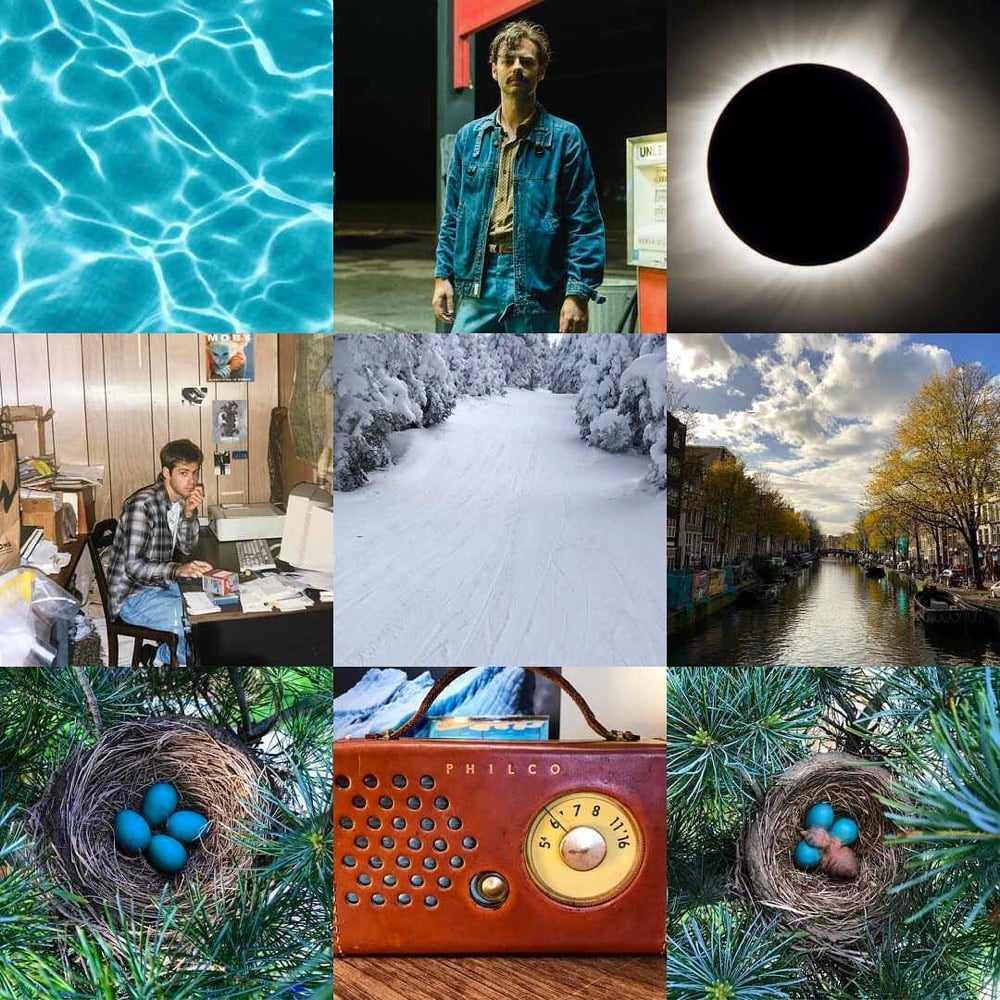
In 2017, I kept track of almost everything I read, listened to, watched, and experienced. I don’t know about “the best”, but as the year draws to a close, these are the things that I thought about the most, that made me see things in a slightly different way, or taught me a little something about myself. I marked my very favorites with a (*). (Above, my #bestnine images of 2017 from Instagram.)
Books. I don’t know how many books I read this year, but it was fewer than I wanted. My work demands a lot of reading online, so when I’ve finished with that most days, reading for leisure or enrichment is often not enticing.
The Underground Railroad by Colson Whitehead and Killers of the Flower Moon by David Grann were perhaps the best books I read…you’ll hardly find anyone who speaks ill of either one.
Wonderland by Steven Johnson pulls together technology, culture, and science in a way that I aspire to.
I enjoyed Cixin Liu’s The Three-Body Problem when I read it early on in 2017 but it grew in my esteem as the year went on. Crazy, but I might reread soon?
The Devil in the White City. A masterful dual tale of two men who seized the opportunity due to cultural and technological changes in late 1800s America, told through the events of the World’s Columbian Exposition held in Chicago in 1893.
I reread Oliver Burkeman’s The Antidote…no recent book has helped me more in figuring out a path forward in life.
Karl Ove Knausgaard’s My Struggle: Book 2 blew my doors off. I have never felt so uncannily like a writer has been rummaging around in my brain. *
Television. What even is television anymore? To paraphrase US Supreme Court Justice Potter Stewart, I know it when I see it. And I saw a lot of it this year. And much of it was excellent.
The Crown (season two). I kept expecting this to falter as it went on, but it never did. A keen portrait of changing times and a dying empire.
Mad Men. Rewatched it all the way through for the first time since it aired. One of the all-time great TV shows.
Halt and Catch Fire (season four). Very strong finish to a great series. I kind of want a season five in about 5 or 6 years that’s set in 2002. Still can’t believe I got to be on the show for like 2 seconds.
The Vietnam War. I feel like this didn’t get the attention it deserved. Along with OJ: Made in America, one of the best documentaries of recent years in terms of understanding the United States culturally and politically.
Wormwood. What the hell is even a documentary anyway? Errol Morris is at the top of his game with this one.
The Handmaid’s Tale. My favorite drama series of the year. So hard to watch but also essential and so well done. *
Planet Earth II and Blue Planet II. Incredible. Aside from the eclipse, these are the best things on this list. *
Honorable mentions: I anticipated Game of Thrones more than anything each week, but I’ve already forgotten most of what happened. There were dragons? Big Little Lies was very solid and enjoyable, but the last episode was some of the best television I’ve ever seen. Zoom out a little, and The Defiant Ones was actually about creativity, collaboration, and management.
Movies: Though I haven’t seen many of the end-of-the-year movies yet, I felt like this was a strong-ish movie year. But only four films stuck with me.
The Handmaiden. I don’t even know how to classify this film, but I wish they’d make more like it.
Maybe Blade Runner 2049 wasn’t great, but I saw it twice and have thought about it often since. Amazing visual experience.
Paths of the Soul. A window into the lives of people very unlike mine. Underscores how much living “the simple life” in wealthy countries is made possible by good infrastructure, social safety nets, and privilege. The simple life in most of the world is neither a choice nor easy.
Dunkirk. Absolutely thrilling. My favorite movie of the year. *
Music. Let’s be honest, Lemonade was probably the album of the year. But I guess some good music came out in 2017 as well. Oh, and I’m old so I still listen to albums.
Big Fish Theory by Vince Staples got the most airplay in my car this summer and fall. Early fave track was Crabs in a Bucket but BagBak came on strong later in the year.
DAMN. by Kendrick Lamar. Probably my favorite album of the year…every track hits the mark. *
4:44 by Jay-Z. The contrast between his last album (lazy, full of swagger) and this one (introspective, urgent) could not be more stark. This wasn’t the best or even my favorite album of the year, but I thought about it more than any of the others I listened to this year. Worth noting this album was only possible because of Beyonce’s superior Lemonade…imagine the hypothetical Jay-Z album had she not slammed him to the wall with that.
Experiences, etc. As I said on Instagram, I prioritized experiences over things this year. But because things like books, movies, and TV shows are easier to summarize and review, I kept most of the experiences for myself. You have to hold some things back or you lose your edges.
Van Gogh Museum. Van Gogh is one of my favorite artists and I’m grateful I got to spend a few hours witnessing how his career came together and his life fell apart. One of the best museums I’ve ever been to.
D3 Traveller. I travelled quite a bit this year, and it would have been more difficult without this bag. Worth the huge splurge.
Sainte-Chapelle. I am not religious at all, but you can’t help but feel something in this wonderful building.
iPhone X. A remarkable machine.
Rijksmuseum. I keep going back to two works I saw here: Vermeer’s The Milkmaid (I spent a good 15 minutes with this one) and this early self-portrait by Rembrandt (the lighting! the curls!).
The total solar eclipse. By far the best thing that I witnessed this year…or maybe in my life. It still gives me chills just thinking about it. *

Socials & More