Entries for May 2007
Big-seed marketing. Instead of relying purely on viral marketing or mass media marketing alone, big-seed marketing combines the two approaches so that a large initial audience spreads the marketing message to a secondary audience, yielding more overall interest than either approach would have by itself, even if the message isn’t that contagious. “Because big-seed marketing harnesses the power of large numbers of ordinary people, its success does not depend on influentials or on any other special individuals; thus, managers can dispense with the probably fruitless exercise of predicting how, or through whom, contagious ideas will spread.”
Update: Full paper with data is here. (via atomiq)
Matt Haughey’s seven tips on how to run a successful community, based on his experiences with MetaFilter. “It takes great care and patience to create a space others will share and you have to nurture it and reward your best contributors. It’s a decidedly human endeavor with few, if any, technical shortcuts.”
Heather Armstrong, on meeting her new neighbors and having to explain what she does for a living:
Over the last few weeks several neighbors have stopped by to introduce themselves, and invariably they are older than we are, more established, and have careers in medicine or law. And when they ask what we do, both Jon and I sort of flinch and exchange a quick look that says IT’S YOUR TURN TO LIE. We’re web developers, we say, and that is never enough, they just can’t leave it alone, and one of us will try to explain that I have a website. This thing. That I do. And because we’re being all coy about it I just know, from the very worried expressions on their faces, that these neighbors think that we run a porn site.
This is the exact interaction I have with most people that I’ve met in the past couple of years, right down to the “we’re web developers, we say, and that is never enough, they just can’t leave it alone” part. I imagine professional mimes, phone sex operators, and people who make a living selling other people’s stuff on eBay have the same sorts of awkward conversations with their new neighbors.
Global warming + evolution = species explosion!!!
Curious story of what’s up with JPG Magazine, a photography mag founded by Heather Champ and Derek Powazek. Derek formed a new company (8020 Publishing) with a friend (Paul Cloutier) and that company bought JPG. Then, says Derek, “Paul informed me that we were inventing a new story about how JPG came to be that was all about 8020. He told me not to speak of that walk in Buena Vista, my wife, or anything that came before 8020.” The founding and the first 6 issues of JPG were removed from the site and Derek left his company. More from Heather and on MetaFilter, including this nice sentiment: “The great thing about a labour of love is the love, not the labour.”
Remember the guys humping the ottoman video from Friday? There’s a sequel of sorts: how to blog. (via dens)
The price of a bottle of Coca-Cola remained a nickel for more than 70 years, until 1959. “The price of sugar tripled after World War I before falling back somewhat; over the past six decades, the price of coffee has gone up eightfold. Coke itself was taxed first as a medicine, then as a soft drink, and survived sugar rationing. All the while, the price stayed at a nickel.”
The new postal price restrictions on thickness and whether the envelope is “flat-machinable” or not seem like the USPS passing along internal problems to their customers, the same crappy stuff that banks and the airlines do. Keep the process simple…we don’t care about your technology can and can’t do. Figure it out.
On the battlefields of Iraq and Afghanistan, robots are fast becoming part of the US military family. “The colonel just could not stand the pathos of watching the burned, scarred and crippled machine drag itself forward on its last leg. This test, he charged, was inhumane.” (via cd)
Beyond Chron: “In San Francisco, neighborhoods that have defeated gentrification have been treated as ‘containment zones,’ meaning that unreasonable levels of crime, violence and drugs are tolerated so that such activities do not spread to upscale areas. The Tenderloin has long been one of the city’s leading containment zones, but those days are over.” Sounds a bit like Hamsterdam from season three of The Wire.
Why are most artists liberal? “In conclusion, then, you don’t have to be a liberal to be a good storyteller. But the better your story is, the more of a liberal you are.” (via 3qd)
Clive Thompson on the new way to make it big in the music biz: spend hours a day communicating with your fans via the web. “Virtually everyone bemoaned the relentless and often boring slog of keyboarding. It is, of course, precisely the sort of administrative toil that people join rock bands to avoid.”
Update: Related: How to Be a Star in a YouTube World.
Michael Bierut’s 13 reasons to choose a particular typeface for a project. “Once I saw a project in a student portfolio that undertook the dubious challenge of redesigning the Tiffany’s identity. I particularly disliked the font that was used, and I politely asked what it was. ‘Oh,’ came the enthusiastic response, ‘that’s the best part! It’s called Tiffany!’”
Gangster’s holiday: “Mother’s Day was the most important Sunday on the organized crime calendar, when homicide took a holiday and racketeering gave way to reminiscing.”
There are almost no words for this video. “When that stool pops out an ottoman 9 months from now, there is no way in hell y’all are gonna be able to tell who the baby daddy is….” Potentially NSFW. (via todd at bingbong.com, who says that he “would be totally happy if this video was the World Wide Web’s grand finale, and then the Internet just went dark and we all went back to making candles and reading the bible and stuff.”)
Update: The video was made for a contest held by Pretty Ricky, a hip-hop group. Here’s the contest announcement. That still doesn’t explain why those young men were having outercourse with that ottoman. (thx, travis)
Update: This one’s good too. Furniture sex + rubber gloves and surgical masks.
Update: One last word on this…the video is not an entry in Push It contest, it’s just set to a Pretty Ricky song. (thx, todd)
An analysis of how populations are growing and shifting around the US, with a focus on the policital consequences. He splits the country into four main areas: Coastal Megalopolises, Interior Boomtowns, Rust Belt, and Static Cities. “The bad news for them is that the Coastal Megalopolises grew only 4% in 2000-06, while the nation grew 6%. […] You see an entirely different picture in the 16 metro areas I call the Interior Boomtowns (none touches the Atlantic or Pacific coasts). Their population has grown 18% in six years.”
The content of the O’Reilly Factor was recently analyzed and compared against “rhetorical techniques identified as elements of propaganda by the now-defunct research group Institute for Propaganda Analysis”. The findings indicate that host Bill O’Reilly called someone a name almost 9 times a minute.
Street artist Banksy gets the New Yorker treatment with a profile in this week’s issue. “The graffitist’s impulse is akin to a blogger’s: write some stuff, quickly, which people may or may not read. Both mediums demand wit and nimbleness. They arouse many of the same fears about the lowering of the public discourse and the taking of undeserved liberties.” Complex tracked down the alleged photos of Banksy mentioned in the article. Print magazine recently wrote a piece on Banksy as well.
Regarding the Twitter vs. Blogger thing from earlier in the week, I took another stab at the faulty Twitter data. Using some educated guesses and fitting some curves, I’m 80-90% sure that this is what the Twitter message growth looks like:
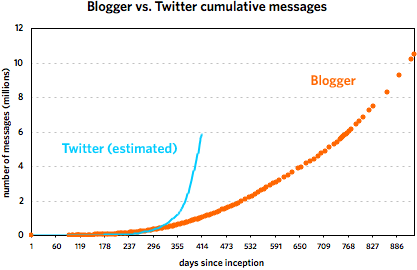
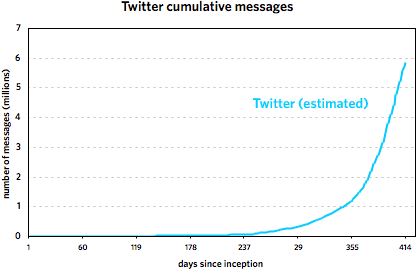
These graphs cover the following time periods: 8/23/1999 - 3/7/2002 for Blogger and 3/21/2006 - 5/7/2007 for Twitter. It’s important to note that the Twitter trend is not comprised of actual data points but is rather a best-guess line, an estimate based on the data. Take it as fact at your own risk. (More specifically, I’m more sure of the general shape of the curve than with the steepness. My gut tells me that the curve is probably a little flatter than depicted rather than steeper.)
That said, most of what I wrote in the original post still holds, as do the comments in subsequent thread. Twitter did not grow as fast as the faulty data indicated, but it did get to ~6,000,000 messages in about half the time of Blogger. Here are the reasons I offered for the difference in growth:
1. Twitter is easier to use than Blogger was and had a lower barrier to entry.
2. Twitter has more ways to update (web, phone, IM, Twitterific) than did Blogger.
3. Blogger’s growth was limited by a lack of funding.
4. Twitter had a larger pool of potential users to draw on.
5. Twitter has a built-in social aspect that Blogger did not.
And commenters in the thread noted that:
6. Twitter’s 140-character limit encourages more messages.
7. More people are using Twitter for conversations than was the case with Blogger.
What’s interesting is that these seeming advantages (in terms of message growth potential) for Twitter didn’t result in higher message growth than Blogger over the first 9-10 months. But then the social and network effects (#5 and #7 above) kicked in and Twitter took off.
What a group of copy editors thought of the best headline ever (Skywalkers in Korea cross Han solo). “For the the Han solo hed to work, there’d have to be a reason for the allusion to Star Wars. Since there isn’t, it’s a forced attempt to be clever. Your average rap artist has a far better grasp of cleverness than whoever wrote that headline.” (thx, braulio)
A brief history of the tshirt, specifically the ironic tee. “Whether you choose to admit it or not, chances are a critical reserve of self-esteem rests somewhere near the middle of your T-shirt drawer. For within this darkened, hidden quarter lies dormant a secret weapon so witty, so elusively allusive, or just so damn hip it finds itself swathing your chest on only the most important occasions.”
Photos from a meal at L’Enclume in the UK, where chef Simon Rogan is practicing molecular gastronomy at a high level. “I don’t think there’s a more exciting meal than this anywhere in the whole world, even [at El Bulli]. This was 24 flawless brilliant courses by a chef who is not just ‘at the top of his game’, but somewhere out in front of his rivals.” More photos and information at L’Enclume’s web site.
Profile by Ken Auletta of Walt Mossberg, the WSJ’s technology columnist. It was interesting reading Mossberg’s opinion of the Sprint/Samsung UpStage. A couple friends of mine were testing this phone before it came out and it was one of the most poorly designed technology products that I’ve ever held in my hand. Who knows if the iPhone will actually be worth a crap, but Steve Jobs must rub his hands together with glee when he sees his competitors come out with stuff like this. Mossberg was too easy on it. Auletta has previously profiled Barry Diller, Pointcast, Andy Grove, and Nathan Myhrvold for the New Yorker.
Harry Potter = Luke Skywalker. Also, entire industries created by Harry Potter are due to come to an end with the publication of the final book.
Analysis of a recent New Yorker cover, the one with the guy and girl standing in front of an abstract expressionist painting. “Rather than a couple in love with each other, with art, and with technological possibility, I see a boy with a toy, and a girl with patience. He is much more engaged with the devise; she curves demurely away.” The phrase “boy with a toy, and a girl with patience” describes many American relationships, I think. (thx, david)
Update: The NYer cover is a reference to this Jan 1962 Saturday Evening Post cover by Norman Rockwell. (thx, maciej)
A short remembrance of what it was like to work for Bill Gates at Microsoft in the early 90s. “Even in conversation, btw, people at Microsoft were known by their email names. I didn’t report directly to billg; but, during much of the time I was there, I worked for mikemap (Mike Maples), who reported to billg, had responsibility for all the products, and was part of the boop. Boop stood for billg plus the office of the president (real presidents didn’t last very long there). The oop consisted of steveb (Steve Ballmer) and mikemap. Major decisions were sometimes made by the boop.” Boop. Boop!
Since swearing off Technorati a couple of years ago, I’ve been checking back every few months to see if the situation has improved. The site is definitely more responsive but their data problems seemingly remain, at least with regard to kottke.org; Google Blog Search gives consistently better results and easy access to RSS feeds of searches.
Technorati recently introduced something called the Technorati Authority number, which is a fancy name for the number of blogs linking to a site in the last six months. Curious as to where kottke.org fell on the authority scale, I checked out the top 100 blogs list. Not there, so I proceeded to the “Everything in the known universe about kottke.org” page where a portion of that huge cache of kottke.org knowledge was the authority number: 5,094. Looking at the top 100 list, that should put the site at #47, nestled between The Superficial and fishki.net, but it’s not there. Technorati also currently states that kottke.org hasn’t been updated in the last day, despite several updates since then and my copy of MT pinging Technorati after each update.
Maybe kottke.org has been intentionally excluded because I’ve been so hard on them in the past. Or maybe it’s just a glitch (or two) in their system. Or maybe it’s an indication of larger problems with their service. Either way, as the company is attempting to offer an authentic picture of the blogosphere, this doesn’t seem like the type of rigor and accuracy that should send reputable media sources like the BBC, Washington Post, NY Times, and the Wall Street Journal scurrying to their door looking for reliable data about blogs.
Update: As of 3:45pm EST, the top 100 list has been updated to include kottke.org. The site also picked up this post right away, but failed to note a subsequent post published a few minutes later..
Ten minute clip from the movie Baraka. From Wikipedia: “Often compared to Koyaanisqatsi, Baraka’s subject matter has some similarities — including footage of various landscapes, churches, ruins, religious ceremonies, and cities thrumming with life, filmed using time-lapse photography in order to capture the great pulse of humanity as it flocks and swarms in daily activity.” (via long now)
Photo gallery of heavy metal bands from the early 80s. These aren’t glossy magazine photos…they’re snapshots from the crowd, backstage, and at the afterparties.
Stephen Dubner and Steven Levitt (aka the Freakonomics guys) on the first-world phenomenon of doing menial labor as a hobby. Examples: knitting, cooking, gardening, lawn care. More on the Freakonomics site.
Amazon’s running a contest to see which town in the US orders the most copies of the final book in the Harry Potter series. Towns in Virginia, Washington, Pennsylvania, and Georgia seem to dominate the rankings so far.
Clive Thompson on the invention of new sports. “Why don’t more people invent new sports? After all, we live in a golden age of play. The video-game industry is bristling with innovation.” When I was in the Caribbean a few months ago, some folks on the beach were playing this newish game that they called Golf Toss. It’s also called Ladder Ball and is kind of like horseshoes except your throw two golf balls on a rope instead of a horseshoe.
I know it’s only 2007, but this is the headline of the decade. For a story about people crossing a tightrope strung across the Han River in South Korea, AP came up with this masterpiece: Skywalkers in Korea cross Han solo.
Diacetyl, a chemical used in artificial butter flavor, has been linked to “popcorn workers lung” after several instances of lung disease at microwave popcorn factories. “Even less is known about the health effects of eating diacetyl in butter-flavored popcorn, or breathing the fumes after the bag is microwaved.”
Hilariously crude review of the third Lord of the Rings movie. “The ring is also evil but you keep thinking, while you watch it, that someone should put it on and check out some boobs. I have a feeling those scenes will be in the DVDs.” (via clusterflock)
Tiger Woods is playing the best golf of his career (and possibly anyone’s career) and he’s not getting credit for it because he’s not winning huge against a vastly improved field. “Woods of the ’90s played against great talent hindered by a lack serious training; today, Woods plays against great talent enhanced by serious training. The slack is largely gone, as is the reasonable expectation of double-digit victory.” He’s also come back after slumps due to swing tinkering, marriage, and the death of his father.
Why has Apple’s focus on industrial design been so successful? “The most fundamental thing about Apple that’s interesting to me is that they’re just as smart about what they don’t do. Great products can be made more beautiful by omitting things.” (via justin)
MadLibs-style template for writing general interest news stories about “weird” subcultures. “[Bizarre pseudonym], otherwise known as [male person’s name #1] a [number between 15 and 75]-year-old software engineer, was dressed in [costume or armor piece] as he waited in line to pay the $[your age + 50] fee to carouse, enjoy [exotic or fictional food], and discuss [oddball topic] with others drawn to this, the greatest spectacle in the tri-state region involving [entertainment franchise].”
Jeff Veen: “Today, a completely redesigned version of Google Analytics is launching, bringing a lot of the simplicity and data visualization techniques we learned building Measure Map to a whole new scale.” They aren’t switching everyone right away (no love for me yet) but you can read this post and get an idea of what to expect. Also: sparklines!
Graphs of the US minimum wage from 1938 to the present. If you take inflation into account, it’s been falling pretty steadily since 1968. But also note that number of people directly affected by the minimum wage has declined as well to just over 2% of workers. (via rb)
Newer posts
Older posts







Socials & More