Swift Justice is a short documentary that, perhaps for the first time, takes viewers inside a rural Afghan courtroom operated by the Taliban, whose arbiters decide cases using Sharia law. [Content warning: a man is visibly beaten in the courtroom to make him “speak the truth”.]
To Westerners, the term “Sharia law” may call to mind sword-wielding fanatics with Old Testament sensibilities. Traditionally, though, less than ten per cent of the Sharia—Arabic for “religious law”—relates to criminal injury like murder, rape, or theft. The rest concerns family and marital relations and prosaic matters of commercial transactions and ritual. Sharia courts have existed in Afghanistan for centuries, and during the U.S. occupation they formed one of three distinct legal systems. There were also the official courts of the U.S.-backed Afghan government that were notoriously corrupt and inefficient. Bribery was this system’s lubricant; murderers often walked free, while the innocent languished in prisons rife with torture and other abuses. And there was the tribal system, an informal and sometimes ad-hoc approach to dispute resolution based on rural Pashtun practices. Few rural Pashtuns miss the old Afghan government courts; instead, today the central tension is between tribal and religious law.
Perhaps the silence of life under the Taliban sits with me more than anything. There were very few cars, no music, no television, no telephones, and no idle conversation on the sidewalks. The dusty streets were crowded with widows who had lost their husbands in the protracted war; banned from working, their only means of survival was to beg. People were scared, indoors and out. Those who were brave enough to venture out spoke in hushed voices, for fear of provoking a Taliban beating for anything as simple as not having a long-enough beard (for a man) or a long-enough burka (for a woman), or sometimes for nothing at all. Shiny brown cassette tape fluttered from the trees and wires and signs and poles everywhere-a warning to those who dared to play music in private. Matches in Kabul’s Ghazi Stadium had been replaced with public executions on Fridays after prayer. Taliban officials used bulldozers or tanks to topple walls onto men accused of being gay. People who stole had their hand sliced off; accused adulterers were stoned to death.
After the Taliban fell in 2001, Addario observed women returning to public life:
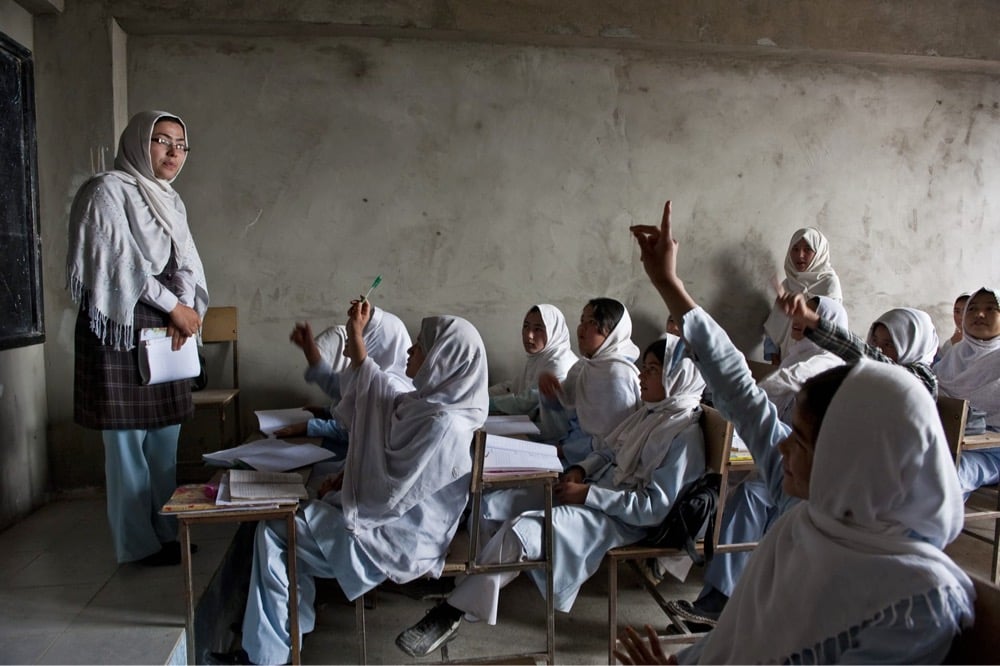
I photographed the defeat of the Taliban in Kandahar in late 2001, and returned to the country with my camera at least a dozen times in the subsequent two decades. From Kabul to Kandahar to Herat to Badakhshan, I photographed women attending schools, graduating from universities, training as surgeons, delivering babies, working as midwives, running for Parliament and serving in government, driving, training to be police officers, acting in films, working — as journalists, translators, television presenters, for international organizations. Many of them were dealing with the impossible balancing act of working outside the home while raising children; of being a wife, a mother, a sister, or a daughter in a place where women were cracking glass ceilings daily, and often at great peril.
Now those women, especially those involved in politics or activism, are in danger now that the Taliban have seized power in Afghanistan again.
Update: The video on Vimeo was erased for some reason, so I switched the embed to one at YouTube.
Also, the Kabul skatepark profiled in the video is looking for donations of equipment (paging @tonyhawk, @tonyhawk to the front counter, please) and money and/or assistance with shipping (shipping to Afghanistan is challenging). They’re also selling these fetching Skateistan t-shirts (and tote bags) in a variety of styles and colors.
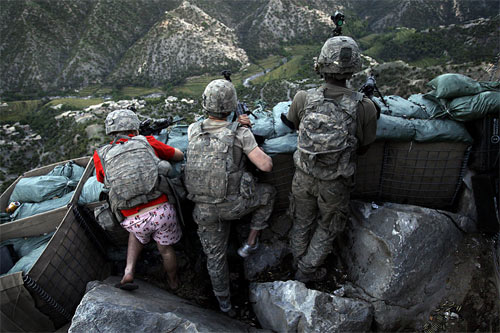
Yesterday’s Pictures of the Day at the WSJ were particularly fine, including a US soldier in Afghanistan who didn’t have time to put on his uniform and gets caught by the camera taking up a defensive position in pink I [heart] NY boxers and flip flops.
On the battlefields of Iraq and Afghanistan, robots are fast becoming part of the US military family. “The colonel just could not stand the pathos of watching the burned, scarred and crippled machine drag itself forward on its last leg. This test, he charged, was inhumane.” (via cd)
Note: If you are a member and tried to log in, it didn't work, and now you're stuck in a neverending login loop of death, try disabling any ad blockers or extensions. Or try logging out and then back in. Still having trouble? Email me!





Socials & More