Advertise here with Carbon Ads

This site is made possible by member support. 💞

Big thanks to Arcustech for hosting the site and offering amazing tech support.

When you buy through links on kottke.org, I may earn an affiliate commission. Thanks for supporting the site!

kottke.org. home of fine hypertext products since 1998.

Beloved by 86.47% of the web.

🍔  💀  📸  😭  🕳️  🤠  🎬  🥔

Entries for May 2007

Out to dinner with friends: split the

Out to dinner with friends: split the check evenly or not? “I find if you don’t split it evenly, and everyone pays ‘what they owe’ many people will pay much less than they owe, forgetting tax and tip. Then they avert their eyes while the generous ones pony up the extra bucks.”


Directory of the earliest Blogger users from 1999.

Directory of the earliest Blogger users from 1999. A surprising number of those blogs are still regularly published, although few of them still use Blogger.


Twitter’s not growing so fast after all

This morning I posted a comparison of the growth in messages with both Blogger and Twitter. The Twitter data was based on information collected by Andy Baio in a post that was widely read in the blogosphere. In the course of looking at the Twitter data, neither of us noticed that from Nov 21, 2006 to Feb 4, 2007 and March 9, 2007 to the present, the Twitter post IDs had the same last digit, indicating that the data is not strictly sequential. If you look at Twitter’s public timeline, the Twitter post IDs skip around by multiples of 10.

Anil suggested via email that could be an artifact of database sharding and lo and behold, if you take off the last digit of the post ID, they seem to become sequential again, more or less. He’s going to ask the Twitter gang about it.

For right now though, the parts of this morning’s post that rely on Twitter data from the above dates is incorrect. Basically, all of it. Here it is in all caps: WRONG WRONG WRONG ERROR ERROR, F——-, WOULD NOT BUY DATA ANALYSIS FROM AGAIN. In hindsight, it seems obvious that the data was incorrect…that sort of growth seems impossible, especially when Twitter was having all sorts of scaling problems. Anyway, good thing this is just a blog and not a refereed journal, eh? Big thanks to the commenters in the other post for pointing me toward the error. More as I have it.

Update: Email from Biz Stone, who works for Twitter. He says:

There’s truth in the essence of what you’re talking about here — Twitter updates *are* coming in faster and furiouser than Blogger updates. However, the way we number Twitter updates has switched back and forth a few times which pretty much screws up the exactness of your analysis.

We have been doubling the number of active users about every three weeks for a sustained period of months now which is definitely contributing significantly to more and more updates. Also, active users of Twitter a measured by how many times they update per day (at Blogger it was per month). So activity in general at Twitter is crazy by comparison.

We’re going to start digging in to more data visualization, user patterns, etc in the coming weeks so if there’s anything you think we should be looking at specifically please let us know!

So we’ll have to wait a few weeks for an accurate look at this stuff. (thx, biz)

Important update: I’ve re-evaluated the Twitter data and came up with what I think is a much more accurate representation of what’s going on.


Growth of Twitter vs. Blogger

Important update: I’ve re-evaluated the Twitter data and came up with what I think is a much more accurate representation of what’s going on.

Further update: The Twitter data is bad, bad, bad, rendering Andy’s post and most of this here post useless. Both jumps in Twitter activity in Nov 2006 and March 2007 are artificial in nature. See here for an update.

Update: A commenter noted that sometime in mid-March, Twitter stopped using sequential IDs. So that big upswing that the below graphs currently show is partially artificial. I’m attempting to correct now. This is the danger of doing this type of analysis with “data” instead of data.

In mid-March, Andy Baio noted that Twitter uses publicly available sequential message IDs and employed Twitter co-founder Evan Williams’ messages to graph the growth of the service over the first year of its existence. Williams co-founded Blogger back in 1999, a service that, as it happens, also exposed its sequential post IDs to the public. Itching to compare the growth of the two services from their inception, I emailed Matt Webb about a script he’d written a few years ago that tracked the daily growth of Blogger. His stats didn’t go back far enough so I borrowed Andy’s idea and used Williams’ own blog to get his Blogger post IDs and corresponding dates. Here are the resulting graphs of that data.1

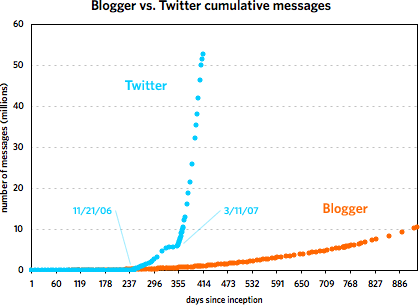
The first one covers the first 253 days of each service. The second graph shows the Twitter data through May 7, 2007 and the Blogger data through March 7, 2002. [Some notes about the data are contained in this footnote.]
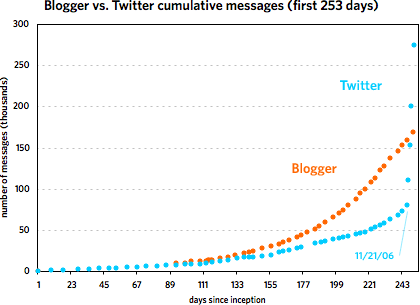
Blogger vs. Twitter cumulative messages (first 253 days)

Blogger vs. Twitter cumulative messages

As you can see, the two services grew at a similar pace until around 240 days in, with Blogger posts increasing faster than Twitter messages. Then around November 21, 2006, Twitter took off and never looked back. At last count, Twitter has amassed five times the number of messages than Blogger did in just under half the time period. But Blogger was not the slouch that the graph makes it out to be. Plotting the service by itself reveals a healthy growth curve:
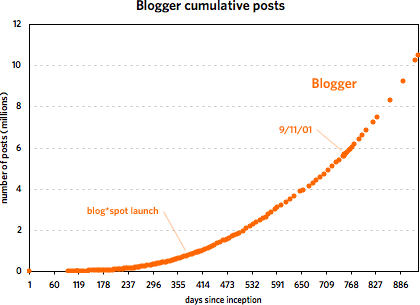
Blogger cumulative posts

From late 2001 to early 2002, Blogger doubled the number of messages in its database from 5M to 10M in under 200 days. Of course, it took Twitter just over 40 days to do the same and under 20 days to double again to 20M. The curious thing about Blogger’s message growth is that large events like 9/11, SXSW 2000 & 2001, new versions of Blogger, and the launch of blog*spot didn’t affect the growth at all. I expected to see a huge message spike on 9/11/01 but there was barely a blip.

The second graph also shows that Twitter’s post-SXSW 2007 growth is real and not just a temporary bump…a bunch of people came to check it out, stayed on, and everyone messaged like crazy. However, it does look like growth is slowing just a bit if you look at the data on a logarithmic scale:
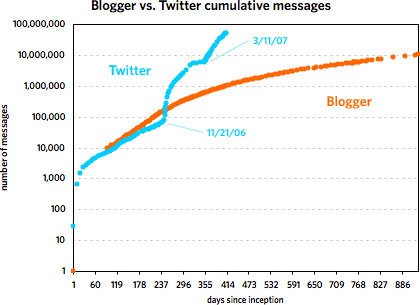
Blogger vs. Twitter cumulative messages, log scale

Actually, as the graph shows, the biggest rate of growth for Twitter didn’t occur following SXSW 2007 but after November 21.

As for why Twitter took off so much faster than Blogger, I came up with five possible reasons (there are likely more):

1. Twitter is easier to use than Blogger was. All you need is a web browser or mobile phone. Before blog*spot came along in August 2000, you needed web space with FTP access to set up a Blogger blog, not something that everyone had.

2. Twitter has more ways to create a new message than Blogger did at that point. With Blogger, you needed to use the form on the web site to create a post. To post to Twitter, you can use the web, your phone, an IM client, Twitterrific, etc. It’s also far easier to send data to Twitter programatically…the NY Times account alone sends a couple dozen new messages into the Twitter database every day without anyone having to sit there and type them in.

3. Blogger was more strapped for cash and resources than Twitter is. The company that built Blogger ran out of money in early 2001 and nearly out of employees shortly after that. Hard to say how Blogger might have grown if the dot com crash and other factors hadn’t led to the severe limitation of its resources for several key months.

4. Twitter has a much larger pool of available users than Blogger did. Blogger launched in August 1999 and Twitter almost 7 years later in March 2006. In the intervening time, hundreds of millions of people, the media, and technology & media companies have become familiar and comfortable with services like YouTube, Friendster, MySpace, Typepad, Blogger, Facebook, and GMail. Hundreds of millions more now have internet access and mobile phones. The potential user base for the two probably differed by an order of magnitude or two, if not more.

5. But the biggest factor is that the social aspect of Twitter is built in and that’s where the super-fast growth comes from. With Blogger, reading, writing, and creating social ties were decoupled from each other but they’re all integrated into Twitter. Essentially, the top graph shows the difference between a site with social networking and one largely without. Those steep parts of the Twitter trend on Nov 21 and mid-March? That’s crazy insane viral growth2, very contagious, users attracting more users, messages resulting in more messages, multiplying rapidly. With the way Blogger worked, it just didn’t have the capability for that kind of growth.

A few miscellaneous thoughts:

It’s important to keep in mind that these graphs depict the growth in messages, not users or web traffic. It would be great to have user growth data, but that’s not publicly available in either case (I don’t think). It’s tempting to look at the growth and think of it in terms of new users because the two are obviously related. More users = more messages. But that’s not a static relationship…perhaps Twitter’s userbase is not increasing all that much and the message growth is due to the existing users increasing their messaging output. So, grain of salt and all that.

What impact does Twitter’s API have on its message growth? As I said above, the NY Times is pumping dozens of messages into Twitter daily and hundreds of other sites do the same. This is where it would be nice to have data for the number of active users and/or readers. The usual caveats apply, but if you look at the Alexa trends for Twitter, pageviews and traffic seem to leveling out. Compete, which only offers data as recently as March 2007, still shows traffic growing quickly for Twitter.

Just for comparison, here’s a graph showing the adoption of various technologies ranging from the automobile to the internet. Here’s another graph showing the adoption of four internet-based applications: Skype, Hotmail, ICQ, and Kazaa (source: a Tim Draper presentation from April 2006).

[Thanks to Andy, Matt, Anil, Meg, and Jonah for their data and thoughts.]

[1] Some notes and caveats about the data. The Blogger post IDs were taken from archived versions of Evhead and Anil Dash’s site stored at the Internet Archive and from a short-lived early collaborative blog called Mezzazine. For posts prior to the introduction of the permalink in March 2000, most pages output by Blogger didn’t publish the post IDs. Luckily, both Ev and Anil republished their old archives with permalinks at a later time, which allowed me to record the IDs.

The earliest Blogger post ID I could find was 9871 on November 23, 1999. Posts from before that date had higher post IDs because they were re-imported into the database at a later time so an accurate trend from before 11/23/99 is impossible. According to an archived version of the Blogger site, Blogger was released to the public on August 23, 1999, so for the purposes of the graph, I assumed that post #1 happened on that day. (As you can see, Anil was one of the first 2-3 users of Blogger who didn’t work at Pyra. That’s some old school flavor right there.)

Regarding the re-importing of the early posts, that happened right around mid-December 1999…the post ID numbers jumped from ~13,000 to ~25,000 in one day. In addition to the early posts, I imagine some other posts were imported from various Pyra weblogs that weren’t published with Blogger at the time. I adjusted the numbers subsequent to this discontinuity and the resulting numbers are not precise but are within 100-200 of the actual values, an error of less than 1% at that point and becoming significantly smaller as the number of posts grows large. The last usable Blogger post ID is from March 7, 2002. After that, the database numbering scheme changed and I was unable to correct for it. A few months later, Blogger switched to a post numbering system that wasn’t strictly sequential.

The data for Twitter from March 21, 2006 to March 15, 2007 is from Andy Baio. Twitter data subsequent to 3/15/07 was collected by me.

[2] “Crazy insane viral growth” is a very technical epidemiological term. I don’t expect you to understand its precise meaning.


No matter how many times I see

No matter how many times I see the photos, the proximity of the runway to the beach at the St. Maarten airport amazes me. (via gulfstream)


A list of plans that worked too

A list of plans that worked too well. For instance, a sunscreen campaign in Australia resulted in vitamin D deficiencies.


Mystery graph

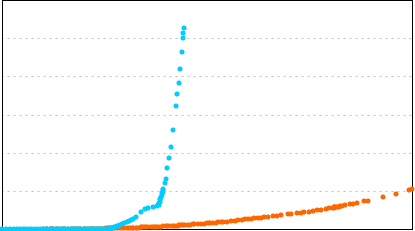
I’m working on a longish post for later today (or early tomorrow) about this graph:

Teaser

More soon.

Update: The long post is done…the above graph is (roughly) the growth of Blogger (in orange) to the growth of Twitter (in blue).


Video comparing sequences from Family Guy that

Video comparing sequences from Family Guy that mirror earlier sequences from The Simpsons. (via cyn-c)


Full Metal Jacket game for the Wii. (via df)

Full Metal Jacket game for the Wii. (via df)


For decades, Robert Caro’s The Power Broker

For decades, Robert Caro’s The Power Broker has been the definitive account of Robert Moses and how contemporary NYC got built. The portrait Caro painted of Moses was less than flattering. Now folks are thinking that, hey, maybe the guy wasn’t so bad after all. “That Moses was highhanded, racist and contemptuous of the poor draws no argument even from the most ardent revisionists. But his grand vision and iron will, they say, seeded New York with highways, parks, swimming pools and cultural halls, from the Belt Parkway to Lincoln Center, and thus allowed the modern city to flower.”


Japanese retailer Uniqlo has opened a store

Japanese retailer Uniqlo has opened a store in Tokyo that is essentially a giant vending machine for tshirts.


I was telling a friend this weekend

I was telling a friend this weekend about an article I’d read long ago about Larry Wall approaching the development of Perl as if it were a natural language. I think this is the article in question. Perl, the first postmodern computer language and a conversation with Larry Wall also touch on Perl and linguistics.

Update: Here’s the original post to comp.lang.perl.misc by Wall. (thx, marc)


Mayor Bloomberg’s plan for a “greener” and “

Mayor Bloomberg’s plan for a “greener” and “greater” New York City includes congestion pricing for Manhattan south of 86th Street. “It’s naive to suppose that congestion isn’t itself costly. Sitting in traffic, a plumber can’t plumb and a deliveryman can’t deliver. The value of time lost to congestion delays in the city has been put at five billion dollars annually.”


Turns out that the story about the

Turns out that the story about the Chinese manufacturing fake eggs out of chemicals is itself fake. A reader contacted the founder of ispub.com, the site that originally ran the article, and he says they yanked the article and replaced the editor who accepted the story. (thx, jeff)


Three of the candidates in the recent

Three of the candidates in the recent Republican presidential debate said they don’t believe in evolution: Colorado Representative Tom Tancredo, Kansas Senator Sam Brownback, and former Arkansas governor Mike Huckabee. Hard to believe that this is 2007 and not 1807. John McCain said he did believe in evolution but that “I also believe, when I hike the Grand Canyon and see it at sunset, that the hand of God is there also”.

Update: An earlier version of this post wrongly stated that Mitt Romney raised his hand when asked about disbelieving evolution…Tom Tancredo was the third person. (thx to several who wrote in about this)


The first photo of Earth from space

The first photo of Earth from space was taken by a V-2 missile in 1946. Large panoramic shot of a 1948 photo is here.


Helmut by June


A small grocery store in Emo, Ontario

A small grocery store in Emo, Ontario is competing with a nearby Wal-Mart by purchasing goods from Sam’s Club and reselling them at lower prices than the Wal-Mart offers. (via girlhacker)


Clever technique for pinching the colors from

Clever technique for pinching the colors from famous paintings using the Match Color tool in Photoshop. “The Old Masters of painting spent years of their lives learning about color. Why let all their effort go to waste on the walls of some museum when it could be used to give you a hand with color correction?”


Are the Chinese manufacturing fake chicken eggs

Are the Chinese manufacturing fake chicken eggs and passing them off as real? “Although the faked eggs looked practically the same as real ones, the consumer smelled chemicals when cooking the eggs. The egg yolk dispersed quickly when it was mixed with the egg white, and the colour was pale. No flavour could be tasted after cooking. According to the officials of the National Bureau of Industry and Commerce, the faked eggs were made from chemicals.” (via cyn-c)

Update: Turns out the story is a fake. (thx, jeff)


Costco is selling Mexican Coke

Costco is selling Mexican Coke made with sugar instead of high-fructose corn syrup, at least in the San Francisco area. “Costco has conformed to CA and U.S. rules, such as CRV (the sort-of deposit you pay for the bottle) and ‘nutrition’ labeling, so everything appears to be nice and legal.” (via serious eats)


Email bankruptcy: “choosing to delete, archive, or

Email bankruptcy: “choosing to delete, archive, or ignore a very large number of email messages without ever reading them, replying to each with a unique response, or otherwise acting individually on them”.


Best-player discussions are commonplace, but who’s the

Best-player discussions are commonplace, but who’s the worst player in the NBA? I’d vote Antoine Walker as well…I’ve always felt his game was crap. (via truehoop)


An animated version of the Bayeux Tapestry,

An animated version of the Bayeux Tapestry, which tells the story of the Norman invasion of England in 1066. Wikipedia has more info on the tapestry and VSL has more on the video.


The top-ten 8-bit games. Can’t argue with

The top-ten 8-bit games. Can’t argue with the top 5 too much, but the other selections might be a bit off. Whither Metroid? And Tetris?


I suppose I am contractually obligated to

I suppose I am contractually obligated to tell you that Malcolm Gladwell was on the Colbert Report the other night.


An online Condiment Packet Museum. Exhibits include

An online Condiment Packet Museum. Exhibits include ketchup, relish, honey, and jam.


The White Glove Tracking site needs your

The White Glove Tracking site needs your help in finding Michael Jackson’s white glove in all 10,060 frames of Jackson’s performance of Billy Jean. “Rather then write unnecessarily complex code to find the glove in every frame of the video I am asking for the assistance of 10,060 individual internet users to simply click and drag a box around the glove in one frame.” Don’t stop ‘til you get enough (white gloves located).


Timelapse of a boat going through the

Timelapse of a boat going through the Panama Canal. How the boat moves reminds me of Doom or Quake. This couple’s vacation write-up includes a trip through the canal. “The never to be forgotten trip lasted ten hours and cost Princess Cruise Lines more than $150,000 in tolls.”


Colors that have stood for things for

Colors that have stood for things for a long time, like red for stop, green for money, and white for surrender.


Ferrari gives out a limited number of

Ferrari gives out a limited number of passports to VIPs, which “gives its bearer entrance to the factory, unrestricted access to all the restricted areas, and no-questions-asked carte blanche to borrow any of the cars in the factory’s fleet”. (via clusterflock)


The pace of global cities is speeding

The pace of global cities is speeding up…people are walking 10% more quickly than they did 10 years ago. Singapore is the fastest city and I’m surprised NYC isn’t in the top 5.


Fun headline of the day: Erectile dysfunction

Fun headline of the day: Erectile dysfunction probed with engineering tool. Heh, they said “tool”.


Noah Kalina is selling signed and numbered

Noah Kalina is selling signed and numbered prints of individual frames of his seminal everyday movie.


Darren Aronofsky is working on a screenplay

Darren Aronofsky is working on a screenplay for a film about Noah. You know, the dude with the Ark. “Noah was the first person to plant vineyards and drink wine and get drunk. It’s there in the Bible — it was one of the first things he did when he reached land. There was some real survivor’s guilt going on there. He’s a dark, complicated character.”


A man buys a bag of Cape

A man buys a bag of Cape Cod potato chips containing a few chips and a whole potato. Correspondence with the company and hilarity ensues.


A map of online communities. Notable features

A map of online communities. Notable features include the Blogipeligo, the Bay of Trolls, the Sea of Memes, and the Viral Straits. (thx, kayhan)


Roger Federer and Rafael Nadal are playing

Roger Federer and Rafael Nadal are playing a match today on a specially designed tennis court that’s half grass (Federer’s specialty) and half clay (Nadal’s preferred surface). Story includes a photo of the kooky court. (thx, dalben)


There’s no permalink, but if you go

There’s no permalink, but if you go to the Disney home page, they’re playing 9 minutes of Ratatouille, the new Pixar movie. There’s two clips…one takes place pretty close to the start of the movie and the other a bit later.

Update: For those of you outside of the US, here’s the YouTube version of the 9-minute Ratatouille clip.

Update: A more permanent and higher quality version is up on the Apple site.


HotelChatter lists their picks for hotels with

HotelChatter lists their picks for hotels with the best Wifi experiences. (via bb)


Matt Haughey recently launched a new blog

Matt Haughey recently launched a new blog about “doing business online” called fortuitous. In his introductory post, Matt describes his job as “professionally screwing around on the web”, which is an accurate description of my current vocation as well.


A voxel is smallest unit of volume

A voxel is smallest unit of volume in a 3D image. Voxel = volumetric + pixel. (via best thing)


A father and son team have deciphered

A father and son team have deciphered a 600-year-old code hidden in a church featured in The Da Vinci Code. “The music has been frozen in time by symbolism. It was only a matter of time before the symbolism began to thaw out and begin to make sense to scientific and musical perception.” Whoa, that’s bad enough to be worthy of Dan Brown himself.


Ariel Levy tells us about her lesbian

Ariel Levy tells us about her lesbian wedding that wasn’t really a wedding (it was “a party about love”) and her struggle to find something she could wear for it. “I also didn’t feel okay about spending all my free time on the phone with the flower guy and the tent man, or about making little checklists of who was coming, and who was not coming, and who was staying at the Goodstone Inn. And I definitely did not feel okay about telling the sales staff of half the better clothing retailers in New York City that I needed something fetching to wear to my big fat gay wedding.”


Play dress-up with the Gucci spring 2007 collection.

Play dress-up with the Gucci spring 2007 collection. Drag and drop dresses, shoes, and handbags onto the model. Many other collections are available as well.


The Cooper Hewitt Design Museum has announced

The Cooper Hewitt Design Museum has announced plans for expansion. I was up there this weekend checking out the Design Triennial and found the exhibition a bit small; a similar show at the expansive MoMA might have run to twice the size and would have included larger items. I hope they don’t do too much to the building though…in many rooms, the building is just as much of an attraction as the items on display.


Noctilucent clouds (really high whispy clouds) were

Noctilucent clouds (really high whispy clouds) were so common where I grew up in WI that I thought they were normal. Turns out they only appear in higher latitudes, at least until recently when global warming has caused them to appear more frequently and further south.