



Blogs are so new in Saudi Arabia
Blogs are so new in Saudi Arabia that the local term for blogging, tadween, was just coined earlier this year. Pretty soon the Saudi kids will be weening on their weens and forming a weenosphere.

This site is made possible by member support. 💞
Big thanks to Arcustech for hosting the site and offering amazing tech support.
When you buy through links on kottke.org, I may earn an affiliate commission. Thanks for supporting the site!
kottke.org. home of fine hypertext products since 1998.
Beloved by 86.47% of the web.
Blogs are so new in Saudi Arabia that the local term for blogging, tadween, was just coined earlier this year. Pretty soon the Saudi kids will be weening on their weens and forming a weenosphere.
Daniel McQuade tells us that officiating a rock, paper, scissors contest is not as easy as it sounds.
Interview with novelist James Ellroy. “I do not follow contemporary politics. I live in a vacuum. I don’t read books. I don’t read newspapers. I do not own a TV set or a cellphone or a computer. I spend my evenings alone, usually lying in the dark talking to women who aren’t in the room with me.” Ellroy also knows his place in the world: “I am a master of fiction. I am also the greatest crime writer who ever lived. I am to the crime novel in specific what Tolstoy is to the Russian novel and what Beethoven is to music.”
Discussion of movies where the main character dies at the end. Caution, all sorts of possible spoilers.
A new paperback version of David Foster Wallace’s Infinite Jest is out. You get 1104 pages of Wallacian goodness for $10 (it’s only $8 on Amazon) and I’ve heard it’s physically a lot thinner than the previous paperback.
The Time-Gun Map of Edinburgh “was produced in 1861 to show the time taken for the sound of the one o’clock gun to travel from Edinburgh Castle to different parts of Edinburgh and Leith”. (via moon river)
Philipp Lenssen recently asked some bloggers what their most popular post was:
I asked several bloggers about their most popular, or one of their most popular, blog posts — the kind that made an impact on people, had skyrocketing traffic numbers, or triggered a meme or changes.
I was asked to answer the question, but didn’t get my response in on time. Here’s what I would have answered. In terms of pure traffic, it wasn’t the biggest, but my 9/11 post and the resulting 2-3 weeks of posts subsequent to that probably had the biggest relative impact on the site. My traffic immediately doubled and didn’t go back down after things settled down a little. You might say that those two weeks made kottke.org, just like they gave birth to the war/political blogs. That day opened a lot of bloggers’ eyes to the cynical truth that the traditional news media already knew: other people’s tragedy and pain sells.
I don’t regret covering 9/11 the way that I did because it came from the heart and I got so much email from people, even weeks and months afterward, who genuinely appreciated my small contribution. But following 9/11, I’ve been increasingly wary of covering similar situations in the same way because, knowing that cynical truth, a part of me would be doing it for selfish reasons: writing for hits, attention, and glory. I posted a few things early on about the Indonesian tsunami and the London Tube bombings, and hardly anything about Katrina (I took a week off instead, writing about anything else during that time seemed trivial and ridiculous). In some ways, 9/11 was the defining editorial moment for kottke.org. After that experience, I took more care in why I was writing about certain topics and when the answer was “to get attention” or “because it’s a hot issue” or “if I piss off [big blogger], he’ll link back to me in rebuttal and boost traffic” or “if I kiss [big blogger’s] ass, he’ll link to me” or “I need to cover this issue for kottke.org to remain relevant in the global news conversat-blah-blah-blah”, I usually take a pass. That editorial stance has probably cost kottke.org a lot of traffic over the years, but that’s a trade-off I’m completely comfortable with.
Oxford University Press has announced their word of the year for 2006: carbon neutral. Runners up included DRM, ghostriding, CSA, and Islamofascism.
Human beatbox Lasse Gjertsen has taken his skills to the next level. His new video, Amateur, is a clever bit of video sampling: Gjertsen builds an entire song out of tiny video soundbytes of him playing the drums and piano. It’s hard to explain, just watch the damn thing. Cameron says the video “feels like what DJ Shadow would produce if he made videos”.
Ironic Sans has an interview with one of NYC’s quirkiest characters, Louis Klein, a man who has seen over 500 tapings of Saturday Night Live in person, including the very first show. “In the last 27 years I’ve missed 36 shows.”
New version of MAME for OS X that works natively on the Intel machines. MAME is an arcade emulator that lets you play arcade games on your computer. (via df)
Artist Bob Dob has some nice video game-related oil paintings, including mugshots of Mario & Luigi and Mario & Donkey Kong hanging out, having a beer. (thx, chris)
Google Earth recently added some maps from the David Rumsey Historical Map Collection to their software, so you can just click them on and off on the globe. Included are a US map from 1833, a 1680 map of Tokyo, Paris from 1716, and a world map from 1790. I spent some time exploring the map of New York from 1836. Here’s a screenshot of the southern tip of Manhattan with the present-day buildings turned on:

A larger version is available on Flickr. Google Earth continues to be a fantastic software product. It’s almost more of a game than an atlas or educational program…so much fun.
Related: I did a project using Google Earth called Manhattan Elsewhere and made a scrollable, zoomable version of Viele’s Map of Manhattan.
Interesting speculation that the 2006 election was the last 20th-century election. “The era of baby-boomer politics — with its culture wars, its racial subtext, its archaic divisions between hawks and doves and between big government and no government at all — is coming to a merciful close. Our elections may become increasingly generational rather than ideological — and not a moment too soon.”
Before YouTube and Google Video came along, video on the web often suffered from taking too many cues from the production values of traditional media. Even in the early days of YouTube, a typical video made by someone for an audience was like a mini-movie: 15 seconds of titles, followed by 10 seconds of the actual content of the video, and then 10 seconds of closing credits. Eventually, many people came to realize that all that crap at the beginning and end was unecessary…it’s OK not to have a 40 second video if you only have 10 seconds of something to say. Ze Frank took this notion to the extreme; he often launches right into something at the beginning, eschews transitions, and he just stops at the end. If an episode of The Show is 2 minutes long, it’s because he has 2 minutes of something to say.
Podcasters have been slower to break out of the mold provided by talk radio. The playing of music before segments and as transitions between segments makes some sense on the radio, where it’s used in some cases to fill airtime. But for podcasts, there’s no need to fill airtime with anything but content. 30 seconds of music before the actual podcast begins is the audio equivalent of Flash splash pages on web sites. For instance, the Diggnation podcast has 10 seconds of ads and 30 seconds of theme music before the hosts start talking and even then it’s more than a minute before there’s any new information. It’s important to set expectations and the mood (also know as branding), but it’s possible to do that in a much more economical way — something more akin to the Windows startup sound + “hi this is [name] from [name of show] and let’s get started” — or at other times during the podcast.
Interestingly, when I was looking around for examples of this wasted airtime, the folks making the most economical use of the listener’s time in producing podcasts were from the mainstream media. That is, the people innovating on the form are not the same as those who are innovating on production. Perhaps in an attempt to seem more credible, native podcasters have embraced more traditional forms while those with experience producing audio content for other media are more free to tailor their content to the new medium.
Yet another tale of one of the mobile companies screwing their customers. This time it’s Sprint: “After some wrangling, I am assured that the service will be terminated and no fee will be assessed. I even call back later that afternoon to make sure that I have understood the earlier call correctly and that I will not be charged…. I get the bill today, and guess what? A $380 early termination charge (two phones).”
Update: A somewhat happy ending: “After…three hours on the phone with Sprint today, the issue has finally been resolved.”
A Florida voter sent in their absentee ballot with an extremely rare stamp, the 1918 Inverted Jenny. Two other stamps from the 30s and 40s were on the envelope as well. It looks like the stamps are sealed away with other voting ballots by law for 22 months.
Update: My skeptical friend David says this almost certainly has to be a hoax. “They used stamps.com or something to print these counterfeit images, knowing the votes would be locked up by law. What are even the mathematical chances that those three stamps are in the same place, and that the person who used them (all three) didn’t know how valuable they were?” I am eagerly awaiting the follow-up to this in 22 months…I put an item in my calendar for September 5, 2008 reminding me to poke around for news at that time.
The NY Times asks a bunch of comedians: Which five comedies would you want to take with you if you were stranded alone on a desert island? My list: Dr. Strangelove, Zoolander, Office Space, Election, and Ace Ventura: Pet Detective.
Trailer for The Simpsons Movie. At this point, is there any reason to believe that this is going to be any good? (via fimonculosusis (sp?))
Alright, anyone using the term Web 3.0 gets poked in the eye. Cripes.
The folks at Alibi Network have developed a consultancy framework that helps their clients with alibis and excused absences with privacy and discretion. “We invent, create and provide customized alibis and excuses for attached adults involved in discreet relationships.”
Great little interview with professional rock, paper, scissors player, Jason Simmons. “The game started long before we actually threw the first throw.” (via sippey)
Item of note included in the announcement of Luke Hayman’s addition to the NYC Pentagram office: he and Paula Scher are completely redesigning Time magazine, due to launch in January 2007. Hayman was formerly design director at New York magazine.
According to Michael Madsen, Quentin Tarantino is thinking about making a sequel to Pulp Fiction/Reservoir Dogs that focuses on the Vega Bros.
Five great fight scenes from movies. I’m not a connoisseur of movie fight scenes, so I don’t have much to add to this list, but I’m glad Jackie Chan made the cut.
Who loves you? I love you and JPG Magazine loves you. For a limited time, if you use the KOTTKED code, you get $5 off a year’s subscription to JPG Magazine, “The Magazine of Brave New Photography”.
Zadie Smith on the distinction between reading like you passively watch TV and reading like you actively interprete a musical piece at the piano. “When you practice reading, and you work at a text, it can only give you what you put into it.”
Trailer for Office Space reimagined as a thriller. (via cyn-c)
Merlin Mann recently wrote two posts about managing your music library using iTunes Smart Playlists. His suggestions for making music-only playlists (for those that have a lot of podcasts & audiobooks in their libraries) and the “sure you really like that?” playlist are especially helpful. One of my recent favorite Smart Playlists is helpful for discovering good stuff that I haven’t listened to in awhile:
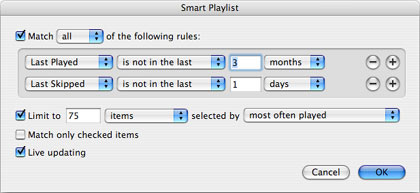
The Last Skipped bit is in there because while listening to this playlist, I found myself skipping stuff I didn’t want to hear and that rule gets it out there so that it doesn’t come up again. An item on my Smart Playlist wishlist is the ability to measure popularity acceleration (basically, something like “gimme the most played over the last week”), but there’s no way (that I can find) to ask iTunes how many times a song has been played in the last x days.
Several more Smart Playlist suggestions are available at smartplaylists.com and Andy Budd.
The brand new Brand New blog identifies and critiques new logos and other brand identity work.
Comedian Aries Spears does awesome impressions of LL Cool J, Snoop Dogg, DMX, and Jay-Z. Here’s a shorter bit of him doing Michael Jordan and Shaq. (via zach)
Slashdot recently crossed 16,777,216 (that’s 2^24) comments, after which no more could be added because of a database misconfiguration. (via waxy)
Play Commander Keen online. Keen was the first game that id Software made (before Doom made them a household name among gamers).
Is this mess of a painting bought at a thrift shop for $5 a Jackson Pollock worth $50 million? I wonder if Richard Taylor has been contacted to examine the painting.
A list of faux pas from different cultures around the world. “In German business dealings, scooting your chair closer to the host is considered an insult.”
$2 bills are growing in popularity in the US…$1 bills just don’t cut it for bartender’s tips and lapdance gratuities anymore. Peter Morici, professor of business at some long-named school, says that the $1 coin is taking off as well, but when my wife tried to pay at a store using one of them the other day, the cashier looked at her like she was trying to use Monopoly money.
From a blog critical of typographic faux pas comes this handy rhyme for remembering the difference between apostrophes/quotation marks and foot/inch marks: “Straight up and down you’re in foot mark town! / A contraction you say? Use apostrophes every day! / You want to say ‘Hi!’ to a chum or a neighbour? / Use inch marks and everyone will think you’re an idiot!” Guilty as charged.
From Strange Maps, a great new blog I stumbled across the other day, comes a map originally done by the Boston Globe of the 10 regions of American politics.
How the fizzle did I miss this? Mountain Man Dance Moves is a compilation of some of the best McSweeney’s Lists.
The entry for calling shotgun on Wikipedia. There are almost 60 special amendments to the “official” rules, including “Amendment IX: Australian Shotgun. Originally from Australia, if two people tie for shotgun, then the first person to put their thumb on their head is awarded shotgun. If they both do this at the same time, then an immediate pissbolt (race) to the car is required.” (via zach, who says “best Wikipedia entry ever?”)
James Gleick on how the Oxford English Dictionary staff is dealing with the proliferation of words on the internet. “New words weren’t proliferating at quite the rate they have done in the last 10 years. Not just the Internet, but text messaging and so on has created lots and lots of new vocabulary.”
Greg Allen gives us the scoop on how big art auctions work. “People come to me and want to bid with a signal that they don’t want anyone else to see. He may hold his pencil in his mouth, or say, ‘I’m bidding as long as I have my legs crossed.’ And I’ve got their number, and they never show a paddle. That’s the way it’s done.”
How to be interesting. “The way to be interesting is to be interested” and “interesting people are good at sharing”. (via spurgeonblog)
I’ve got mixed feelings about NYC’s bikers. On the one hand, I wish there were bike lanes and secure, affordable bike garages everywhere in the city. On the other hand, bikers (especially the hard core ones) can be the biggest assholes on the streets, as much of a problem to pedestrians as cars are to them.
It’s like happy happy joy joy day in liberal land today….first the election stuff and now Rumsfeld is “resigning”.
Socials & More