Entries for November 2006
There’s evidence that the dot com bubble wasn’t all that bad. A study found that “the attrition rate for dot-com companies was roughly 20% a year, which is no different from what occurred during many other industries, such as automobiles, during their early boom periods” and that the market could have supported more smaller niche companies during that time. Also of note: the Business Plan Archive “collects and preserves business plans and related planning documents from the Birth of the Dot Com Era so that future generations will be able to learn from this remarkable episode in the history of technology and entrepreneurship”.
A couple of days ago, I pointed to a patent filed by the Flickr folks for the concept of interestingness. I should have poked around a bit more because there’s a related patent filed by the Flickr and Josh Schachter of del.icio.us concerning “media object metadata association and ranking”. I’m not a big fan of software patents, but even so, I can’t see the new, useful, nonobvious invention here. I also find it odd that these patents reference exactly zero prior inventions on which they are based…compare with Larry Page’s patent for PageRank.
Profile of economist Kevin Murphy, who none other than Steven Levitt calls “the smartest guy in the field”.
The USS Intrepid stubbornly remains in its Manhattan berth at Pier 86, stuck in the mud, four tugboats unable to pull it free. “The hulking Intrepid, which survived five kamikaze attacks in World War II, looked like a mule resisting the force of several farmhands.”
Frito-Lay Angrily Introduces Line Of Healthy Snacks. “Weren’t Sun Chips healthy enough for you, you goddamn hippie bastards?”
“It is with mounting nausea that we watch poets race to cast their liberal votes for candidates more conservative than the Republicans they found beyond revulsion twenty years ago — and indeed not just to feed at this trough but serve the slop.”
Genealogy of Influence: “a graph of biographical entries at Wikipedia with connections denoting creative influence between philosophers, social scientists, writers, artists, scientists, mathematicians”. Reminds me peripherally of Simon Patterson’s The Great Bear (a print of which is hanging behind me right now).
At PopTech a few weeks ago, Lester Brown, who has been a leading advocate of environmentally sustainable development for almost 30 years, spoke about the impact of the increasing production of ethanol. As more corn gets used for making automotive fuel, that reduces the amount of grain available for food production. As demand rises, so will the price…no matter what people are using the corn for, be it fuel or food. The countries that will really suffer in this scenario are those that import lots of grain for food.
When Brown said this, I immediately thought of Mexico. When you consider the food culture of Mexico, one of the first things to mind is corn. Corn (maize) was likely first domesticated in Mexico and remains the cornerstone of Mexican cuisine; in short, corn is far more Mexican than apple pie is American. In 1491, his excellent book on the pre-Columbian Americas, Charles Mann tells us that despite corn’s high status, Mexico is increasingly importing corn from the United States because it’s cheaper than local corn:
Modern hybrids are so productive that despite the distances involved US corporations can sell maize for less in Oaxaca than can [local farmer] Diaz Castellano. Landrace maize, he said, tastes better, but it is hard to find a way to make the quality pay off.
Those great tortillas you had at some local place while on vacation in Mexico? There’s an increasing chance they’re made from US corn. Mmm, globalizious! Of course, Mexican farmers are getting out of the farming business because they can’t compete with the heavily subsidized US corn and Mexico is losing control over one of their strongest cultural customs. Now that ethanol is changing the rules, there’s a bidding war brewing between Americans who want to fill their gas tanks and Mexicans who want to feed their children. Odds are the tanks stay fuller than the stomachs.
For reference, here’s what increasing ethanol production has done to the price of corn over the past three months:
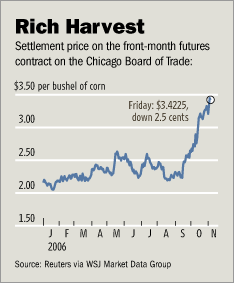
And that’s despite a fantastic US corn harvest. The graph is from this article in the WSJ, which contains a quick overview of the effects that the growing ethanol industry might have.
Watch democracy in action: the “ivoted” tag on Flickr.
The New Yorker has a piece this week on Nicholas Stern’s 700-page report on global warming for the British government. Stern says, “Our emissions affect the lives of others. When people do not pay for the consequences of their actions, we have market failure. This is the greatest market failure the world has seen.” The BBC has a nice series on it as well (look for related links in the sidebar). If you want to hear it straight from the horse’s mouth, the entire report (and related documents) is available courtesy of the British government.
Grist Magazine: How to talk to a climate skeptic. Looks pretty comprehensive.
If you’re registered, get out and vote today. Have questions about voting? Are you registered to vote? Try the Smart Voter site (FAQs).
Grand Theft Mario = Super Mario Bros + Grand Theft Auto.
Quote of the day, from a friend who ran the marathon: “I feel like I’m rolling a katamari of happiness and can no longer distinguish its parts.”
Cockney rhyming slang meets celebrity namedropping. “I left my Clare Rayners down the Fatboy Slim so I was late for the Basil Fawlty. The Andy McNab cost me an Ayrton Senna but it didn’t stop me getting the Britney Spears in. Next thing you know it turned into a Gary Player and I was off my Chevy Chase.”
Hong Kong architect Gary Chang travels so often that he’s become an expert hotel enthusiast. I spoke with Gary at Ars Electronica this year; he showed me some of his drawings and photos (he extensively documents his hotel stays in the form of photos and hand-drawn floor plans)…really cool. Chang’s Suitcase House is also worth a look.
Commerical for a game called Gears of War featuring a cover of Tears for Fears’ Mad World by Gary Jules (which you might remember from Donnie Darko). The ultraviolence and poignance is an interesting juxtaposition.
Update: Greg Allen uncovers the original music video for the aforementioned Mad World cover, directed by Michel Gondry.
Update: So, the long GoW video posted above was created by a fan using the original version (also at YouTube) directed by Joseph Kosinski (David Fincher consulted on it as well, I guess). (thx, chris)
An oldie but a goodie: Bruce Mau’s Incomplete Manifesto for Growth. “Ask stupid questions. Growth is fueled by desire and innocence. Assess the answer, not the question. Imagine learning throughout your life at the rate of an infant.”
Update: Also old but good: Dean Allen’s Annotated Manifesto for Growth. (thx, oscar)
As many of you don’t know, I’ve been working less-than-diligently1 on a project with the eventual goal of adding tags to kottke.org. I posted some early results back in August of 2005. The other day, I started thinking about how tags could help people get a sense of what’s been talked about recently on the site, like Flickr’s listing of hot tags. I started by compiling a list of tags from the last 200 entries and ordering them by how many times they were used over that period. Here is the top 20 (with # of instances in parentheses)
photography (33), books (26), art (26), science (22), tv (21), movies (21), lists (20), video (17), nyc (16), weblogs (15), design (14), interviews (13), bestof (13), business (12), thewire (12), food (11), sports (11), games (10), language (10), music (9)
The items in bold also appear in the top 50 of the all-time popular tags, so obviously this list isn’t telling us anything new about what’s going on around here. To weed those always-popular tags from the list, I compared the recent frequency of each tag with its all-time frequency and came up with a list of tags that are freakishly popular right now compared to how popular they usually are. Call this list a measure of the popularity acceleration of each tag. The top 20:
blindside (3), pablopicasso (3), ghostmap (3), davidsimon (5), poptech2006 (4), thewire (12), andywarhol (3), michaellewis (4), education (4), youtube (4), richarddawkins (5), realestate (3), crime (8), working (8), school (3), dvd (4), georgewbush (4), stevenjohnson (5), writing (4), photoshop (3)
(Note: I also removed tags with less than three instances from this list and the ones below.) Now we’re getting somewhere. None of these appear in the top 50 all-time list. But it’s still not that accurate a list of what’s been going on here recently. I’ve posted 3 times about Photoshop, but you can’t discount entirely the 33 posts about photography. What’s needed is a mix of the two lists: generally popular tags that are also popular right now (first list) + generally unpopular tags that are popular right now (second list). So I blended the two lists together in different proportions:
75% recent / 25% all-time:
davidsimon (5), poptech2006 (4), ghostmap (3), pablopicasso (3), blindside (3), thewire (12), andywarhol (3), michaellewis (4), education (4), photography (33), art (26), youtube (4), tv (21), richarddawkins (5), books (26), crime (8), video (17), working (8), realestate (3), science (22)
67% recent / 33% all-time:
davidsimon (5), poptech2006 (4), pablopicasso (3), ghostmap (3), blindside (3), thewire (12), andywarhol (3), photography (33), art (26), michaellewis (4), education (4), tv (21), books (26), youtube (4), video (17), science (22), richarddawkins (5), crime (8), movies (21), lists (20)
50% recent / 50% all-time:
thewire (12), davidsimon (5), photography (33), poptech2006 (4), blindside (3), ghostmap (3), pablopicasso (3), art (26), books (26), tv (21), science (22), movies (21), lists (20), andywarhol (3), video (17), michaellewis (4), education (4), nyc (16), weblogs (15), crime (8)
25% recent / 75% all-time:
photography (33), art (26), books (26), tv (21), science (22), movies (21), lists (20), thewire (12), video (17), nyc (16), weblogs (15), davidsimon (5), poptech2006 (4), design (14), interviews (13), bestof (13), blindside (3), ghostmap (3), pablopicasso (3), business (12)
The 75%-66% recent lists look like a nice mix of the newly & perenially popular and a fairly accurate representation of the last 3 weeks of posts on kottke.org.
Digression for programmers and math enthusiastists only: I’m curious to know how others would have handled this issue. I approached the problem in the most straighforward manner I could think of (using simple algebra) and the results are pretty good, but it seems like an approach that makes use an equation that approximates the distribution of the popularity of the tags (which roughly follows a power law curve) would work better. Here’s what I did for each tag (using the nyc tag as an example):
# of recent entries: 300
# of total entries: 3399
# of recent instances of the nyc tag: 16
# of total instances of the nyc tag: 247
# of instances of the most frequent recent tag: 33
# of instances of the most frequent tag, all-time: 272
Calculate the recent and all-time frequencies of the nyc tag:
16/300 = 0.0533
247/3399 = 0.0726
Then divide the recent frequency by the all-time frequency to get the popularity acceleration:
0.0533/0.0726 = 0.7342
That’s how much more popular the nyc tag is now than it has been all-time. In other words, the nyc tag is 0.7342 times as popular over the last 300 entries as it has been overall…~1/4 less popular than it usually is. To get the third list with the 75% emphasis on population acceleration and 25% on all-time popularity, I stated by normalizing the popularity acceleration and all-time frequency by dividing the nyc tag values by the top value of the group in each case (11.33 is the popularity acceleration of the blindside tag and 0.11 is the recent frequency of the photography tag (33/300)):
0.7342/11.33 = 0.0647
0.0533/0.11 = 0.4845
So, the nyc tag has a popularity acceleration of 0.0647 times that of the blindside tag and has a recent frequency that is 0.4845 times that of the most popular recent tag. Then:
0.0647*0.75 + 0.4845*0.25 = 0.1696
Calculate this number for each recent tag, rank them from highest to lowest, and you get the third list above. Now, it seems to me that I may have fudged something in the last two steps, but I’m not exactly sure. And if I did, I don’t know what got fudged. Any help or insight would be appreciated.
[1] Great artists ship. Mediocre artists ship slowly. ↩
Benjamin Franklin’s Advice to a Young Man on the Choice of a Mistress, in which he lists the many reasons that old women are much preferable to have affairs with than younger women.
The recent New Yorker piece on Will Wright is a thorough profile of the game designer, but also functions as a bibliography of sorts for the games he’s created over the past 20 years. Bibliographies are something normally reserved for books, but Wright draws much of the inspiration for his games from articles, books, papers, and other games that a list of further reading/playing in the instruction booklet for SimCity wouldn’t feel out of place. Because I like utilizing bibliographies — they allow you to get into the head of an author and see how they sampled & remixed the original ideas to create something new — I’ve created one for Will Wright. Sources are grouped by game; general influences are listed seperately.
SimCity
The Game of Life, John Conway.
Montessori school. “It’s all about learning on your terms, rather than a teacher explaining stuff to you. SimCity comes right out of Montessori — if you give people this model for building cities, they will abstract from it principles of urban design.”
Urban Dynamics - Jay Wright Forrester. “This study of urban dynamics was undertaken principally because of discoveries made in modeling the growth process of corporations. It has become clear that complex systems are counterintuitive. That is, they give indications that suggest corrective action which will often be ineffective or even adverse in its results. Very often one finds that the policies that have been adopted for correcting a difficulty are actually intensifying it rather than producing a solution.”
World Dynamics - Jay Wright Forrester.
The Sims
A Pattern Language - Christopher Alexander. “By understanding recurrent design problems in our environment, readers can identify extant patterns in their own design projects and use these patterns to create a language of their own. Extraordinarily thorough, coherent, and accessible, this book has become a bible for homebuilders, contractors, and developers who care about creating healthy, high-level design.”
A Theory of Human Motivation - Abraham Maslow. Paper on human behavior and motivation.
Maps of the Mind - Charles Hampden-Turner.
Other Sim Games
Gaia hypothesis - James Lovelock. “The Gaia hypothesis is an ecological theory that proposes that the living matter of planet Earth functions like a single organism.”
The Ants - E.O. Wilson. “This is the definitive scientific study of one of the most diverse animal groups on earth; pretty well everything that is known about ants is in this massive work.”
Spore
Powers of Ten - Charles and Ray Eames. “The film starts on a picnic blanket in Chicago and zooms out 10x every 10 seconds until the entire universe (more or less) is visible. And then they zoom all the way back down into the nucleus of an atom. A timeless classic.”
Drake Equation - Frank Drake. “Dr. Frank Drake conceived a means to mathematically estimate the number of worlds that might harbor beings with technology sufficient to communicate across the vast gulfs of interstellar space.”
SETI. “The mission of the SETI Institute is to explore, understand and explain the origin, nature and prevalence of life in the universe.”
2001: A Space Odyssey - Stanley Kubrick.
Panspermia - Freeman Dyson. “This approach was directly inspired by Freeman Dyson’s notion of Panspermia - the idea that life on earth may have been seeded via meteors carrying microscopic “spores” of life from other planets. (Dyson’s concept is also the origin of the game’s title.)”
The Life of the Cosmos - Lee Smolin. “[Smolin’s] theory of cosmic evolution by the natural selection of black-hole universes makes what we can experience into an infinitesimal, yet crucial, part of an ever-larger whole.”
The Anthropic Cosmological Principle - John Barrow, Frank Tipler, and John Wheeler. “Is there any connection between the vastness of the universes of stars and galaxies and the existence of life on a small planet out in the suburbs of the Milky Way?”
The demoscene. “The demoscene was originally limited by the hardware and storage capabilities of their target machines (16/32 bit micros such as the Atari and the Amiga ran on floppy disks), they developed intricate algorithms to produce large amounts of content from very little initial data.”
General influences
PanzerBlitz - Avalon Hill. “PanzerBlitz is a tactical-scale board wargame of tank, artillery, and infantry combat set in the Eastern Front of the Second World War.”
Super Mario Bros. - Shigeru Miyamoto. “[SMB] encouraged exploration for its own sake; in this regard, it was less like a competitive game than a ‘software toy’ — a concept that influenced Will Wright’s notion of possibility space. ‘The breadth and the scope of the game really blew me away,’ Wright told me. ‘It was made out of these simple elements, and it worked according to simple rules, but it added up to this very complex design.”
Go. “[Go] is a strategic, zero-sum, deterministic board game of perfect information.”
—
Sources: Game Master, The Long Zoom, Master of the Universe, Interview: Suzuki and Wright, Spore entry at Wikipedia, Will Wright entry at SporeWiki, Will Wright Interview.
Update: This interview with Wright at Game Studies contains a list of references from the conversation, many of which have influenced Wright’s body of work. (thx, phil)
“Wans sup pawn at I’m their worth reel ladle pegs hole eft tome deuce seethe a whirled.” Listen to the audio file and it’ll all make sense. (thx, azrael)
Update: See also Ladle Rat Rotten Hut. (thx, carol)
The Malthusian trap is “a return to subsistence-level conditions as a result of agricultural production being eventually outstripped by growth in population”.
Man tries to jump the mile-wide St. Lawrence River in a rocket-powered Lincoln Continental. I don’t want to spoil the result for you, but the concepts of gravity, force, and aerodynamics are fairly well established and understood, so why did anyone involved ever think that this jump was even close to possible?
Worldchanging: A User’s Guide for the 21st Century is out today. “[The book] is a groundbreaking compendium of the most innovative solutions, ideas and inventions emerging today for building a sustainable, livable, prosperous future.” The authors came up with a clever stunt to promote the book: have everyone buy the book on Amazon today at 11:11am PT to drive up the sales rank and let the “rich get richer” effect take over from there. The book is currently at #13.
At one of the few chain restaurants in Chinatown today, I witnessed a Spanish-speaking cashier taking an order from a Cantonese-speaking customer off of an English-only menu. It took awhile, but the woman seemed satisfied as she left with her food.
The problem with the axiom “live each day as if it was your last”: “it can’t possibly be healthy for my body or mind to spend each day sobbing uncontrollably and trying to eat as many Carl’s Jr. Western Bacon Cheeseburgers as I can before nightfall.”
“The Polling Place Photo Project is a nationwide experiment in citizen journalism that seeks to empower citizens to capture, post and share photographs of democracy in action. By documenting their local voting experience on November 7, voters can contribute to an archive of photographs that captures the richness and complexity of voting in America.”
A comparison: London’s Tate Modern versus the MoMA. The MoMA is a stuffy, inaccesible place, while the “Tate Modern is an enormously user-friendly place, physically comfortable and hospitable, with inexpensive places to eat and frequent opportunities to sit.”
Opening tonight at Jen Bekman’s gallery: James Deavin’s Photographs from the New World, a selection of photos he took in the online game, Second Life.
Wired profile of Darren Aronofsky and his new film, The Fountain, which will finally be coming out on November 22. The special effects in the film are non-CGI: “No matter how good CGI looks at first, it dates quickly. But 2001 really holds up. So I set the ridiculous goal of making a film that would reinvent space without using CGI.” Trailer is here.
Newer posts
Older posts






Socials & More