Amazon has a bunch of stuff on sale today & tomorrow for an “event” they’re calling Prime Big Deal Days. I’m not going to do a big roundup here, but here are a few things you might be interested in if you’re an Amazon shopper:
Apple AirPods Pro (2nd Gen) with Lightning connector for $189 (24% off). This is the lowest price I’ve seen on these; they’re the best headphones I’ve ever owned. Apple just released a newer version of these (nearly the same product except for a USB-C connector on the case) and the low price is probably to clear out inventory. Both versions charge just fine with a MagSafe or Qi-certified charger, so why not get the cheaper one if you charge that way and don’t care about the small differences? Update: Both versions are the same price (I don’t think they were this morning). So get the newer ones!
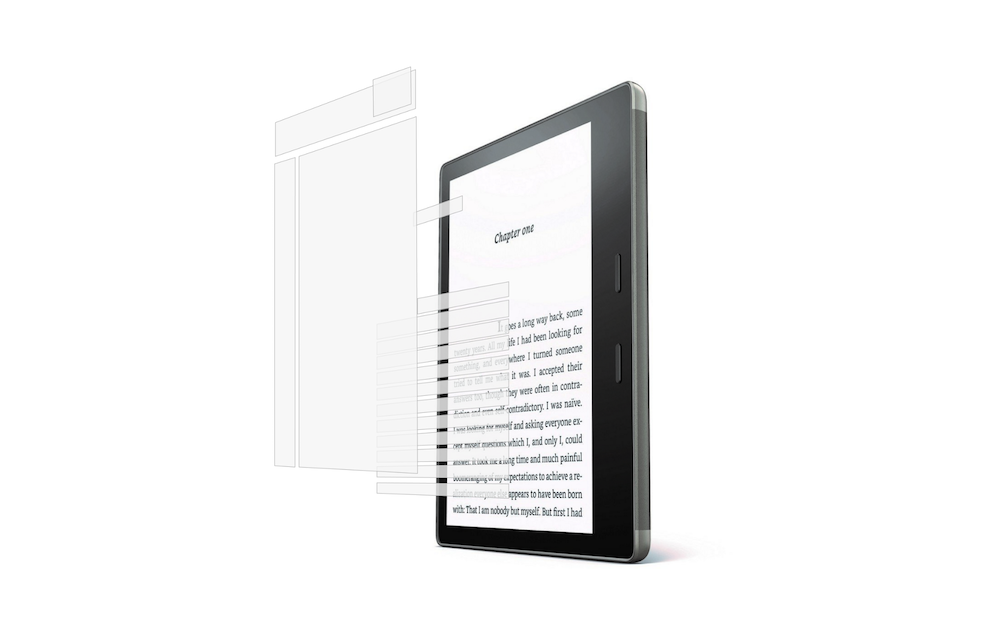
Amazon Kindle Paperwhite for $95 (32% off). I read all my books on this. Lightweight and the battery lasts forever. And it charges with USB-3 so that’s one less cable to haul around.
For the last few years, Amazon has spent a couple of summer days putting a bunch of their most popular items on sale for their Prime members. This year, Prime Day runs from July 11-12 and includes a number of things that I can personally recommend (or are currently coveting). Keep in mind that you need to be an Amazon Prime member to take advantage of these deals: here’s where you sign up for Prime if you’re interested (there’s a free 30-day trial).
The 13” M1 Macbook Air is on sale for for $750…that’s 25% off the list price. This is the exact computer I’m using right now and I love it. Still feels super quick and powerful, even a few years after it was released.
Moving on from Apple to Play-Doh. You heard me! 24 cans of Play-Doh for $14.49, who can resist? That smell still takes me right back to when I was a kid…
I have too many plants to take care of these days, but this hydroponic indoor garden (70% off!) sure is tempting. (I am almost positive your weed plant needs more light than this? And actual soil? But do some research…maybe it’ll work? 🤪)
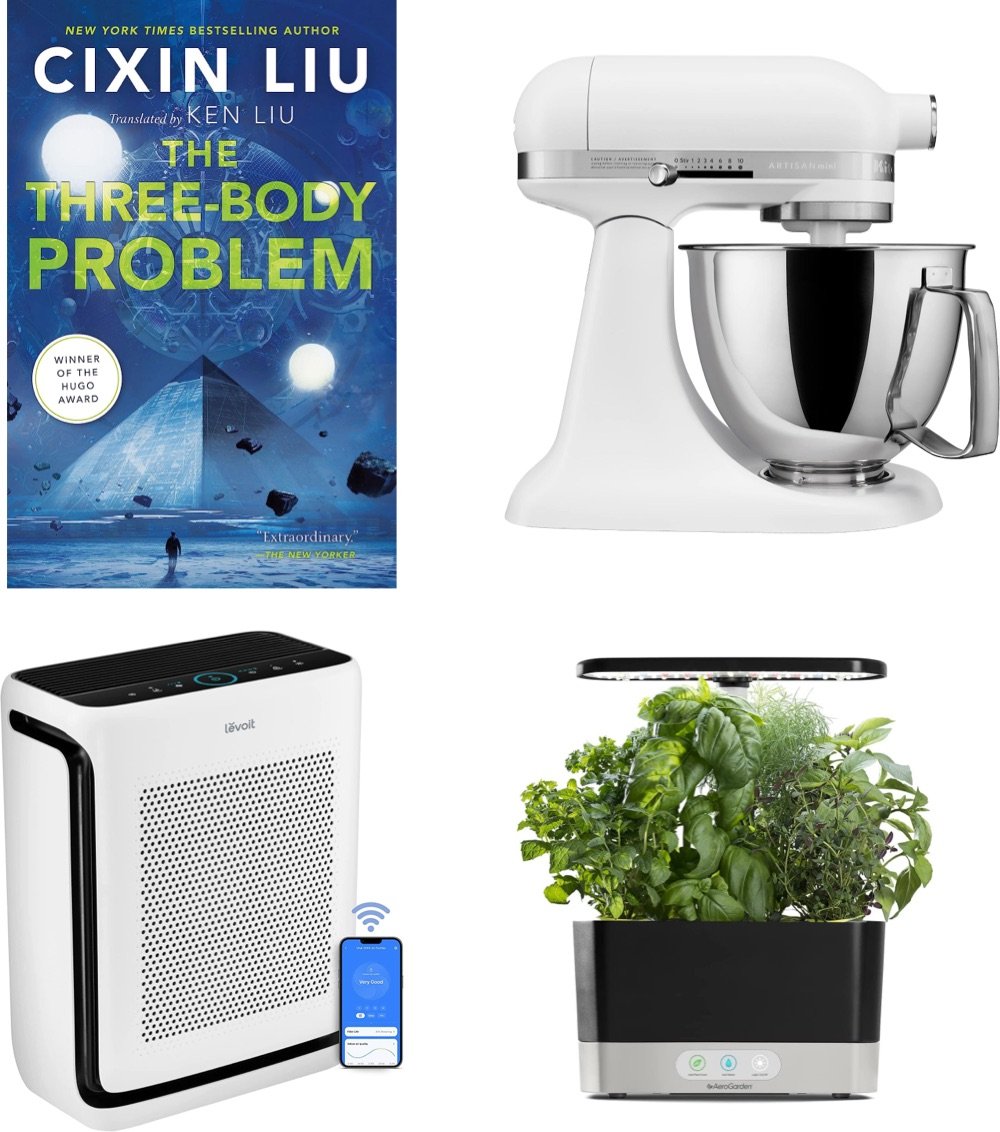
KitchenAid’s smaller 3.5 Qt. Stand Mixer, which is lighter and takes up less counter space in smaller kitchens, is on sale for $260 (32% off).
Ok that’s all I’ve got, but if you don’t see anything here that interests you, your best bet is to head over to Amazon’s Prime Day page and start digging around. I know there’s a bunch more deals on things like kitchen items, TVs, fashion, tech products, and beauty products. Good luck!
When you buy through links on kottke.org, I may earn an affiliate commission. Thanks for supporting the site!
This piece by Cory Doctorow on TikTok’s enshittification (also available at Wired) contains some of the best and simplest descriptions of how online platforms like Amazon, Facebook, Uber, TikTok, Twitter, etc. evolve as they grow and then eventually die.
Here is how platforms die: First, they are good to their users; then they abuse their users to make things better for their business customers; finally, they abuse those business customers to claw back all the value for themselves. Then, they die.
…
This is enshittification: Surpluses are first directed to users; then, once they’re locked in, surpluses go to suppliers; then once they’re locked in, the surplus is handed to shareholders and the platform becomes a useless pile of shit. From mobile app stores to Steam, from Facebook to Twitter, this is the enshittification lifecycle.
The Amazon example he uses is really easy to follow. Early in the company’s history, the site used to be a great place to shop; their customers loved Amazon. But then Amazon’s sellers became their real customers and the user experience started to suffer. And now, much of the value generated by the users and customers goes to the shareholders (which, functionally speaking these days, means several dozen people who run hedge funds or large investment funds).
This strategy meant that it became progressively harder for shoppers to find things anywhere except Amazon, which meant that they only searched on Amazon, which meant that sellers had to sell on Amazon. That’s when Amazon started to harvest the surplus from its business customers and send it to Amazon’s shareholders. Today, Marketplace sellers are handing more than 45 percent of the sale price to Amazon in junk fees. The company’s $31 billion “advertising” program is really a payola scheme that pits sellers against each other, forcing them to bid on the chance to be at the top of your search.
Over at Techdirt, Mike Masnick riffed on Doctorow’s piece, arguing that enshittification, this playing of various parties against each other while siphoning off the value, is bad business because it focuses too much on short term gains.
Because maximizing revenue in the short term (i.e., in the 3 month window that Wall Street requires) often means sacrificing long term sustainability and long term profits. That’s because if you’re only looking at the next quarter (or, perhaps, the next two to four quarters if we’re being generous) then you’re going to be tempted to squeeze more of the value out of your customers, to “maximize revenue” or “maximize profits for shareholders.”
He uses early Amazon as an example of long-term thinking:
Once you go public, and you have that quarterly drumbeat from Wall Street where pretty much all that matters is revenue and profit growth. Indeed, it’s long forgotten now, but Jeff Bezos and Amazon actually were a rare company that kind of bucked that trend, and for a while at least, told Wall Street not to expect such things, as it was going to invest more and more deeply in serving its customers, and Wall Street punished Bezos for it. It’s long forgotten now, but Wall Street absolutely hated Amazon Prime, which locked in customer loyalty, but which they thought was a huge waste of money. The same was true of Amazon Web Services, which has become a huge revenue driver for the company.
They created a tremendous amount of value for their shareholders by playing the long game, which for whatever reason they aren’t willing to do anymore.
This short sketch from Saturday Night Live highlights how Amazon Go’s “grab-and-go” shopping experience (where you walk out of the store with your items without having to check out first) doesn’t work that well for all shoppers.
White people who have never been “randomly” followed around at a Walgreens may have no problem walking into a store, grabbing an item and leaving — like this guy in the Amazon Go promo video.
But shoppers of color, who already see enough unwanted attention, may have their doubts. Especially in a store where the employees are mostly there for customer service, as Amazon’s promo video suggests. They roam the store, stock shelves and hang out near shoppers.
Jeff Bezos is not only the richest man in the world, he has built a business that is without precedent in the history of American capitalism. His power to shape everything from the future of work to the future of commerce to the future of technology is unrivaled. As politicians and regulators around the world start to consider the global impact of Amazon — and how to rein in Bezos’ power — FRONTLINE investigates how he executed a plan to build one of the most influential economic and cultural forces in the world.
One of the 10 key takeaways from the film is how deliberately Amazon attacked the publishing industry:
“Amazon took over a large market share of the publishing industry very, very fast,” James Marcus, a former senior Amazon.com editor, tells FRONTLINE — a situation that he says prompted publishers to realize, “‘Oh, wait a minute, they’re our partner, but they now have the beginnings of a boot on our windpipe’.” Inside the company, the team had launched a strategy that some called “the Gazelle Project,” because they’d heard Bezos wanted them to pursue publishers the way a cheetah pursues a sickly gazelle. “Well, you don’t go after the strongest,” Randy Miller, who ran the European book team, says of the strategy. “He’s like, ‘The cheetah. The cheetah looks for the weak, looks for the sick, looks for the small.’” That way, by the time it comes to take on the publishers at the top, “the noise has gotten back to them. They’re going to know this is coming, and chances are you may be able to settle that without a full-on war.”
River was simply a prominent part of just about every “Christmas songs” playlist curated by Amazon themselves, a default choice for everyone muttering “Alexa, play Christmas songs” as they basted the turkey and cursed the sprouts. People have been spoon-fed a contemporary hit single like no other before it, and the result of that has been to propel it almost by accident to the top of the charts.
This is a fitting choice for the final chart topper in the 2010s because it encapsulates a number of trends in media that have played out over the past decade. To wit:
The song is a remake. Remakes and sequels dominate our viewing and listening.
It is exclusive to a single platform. The entire media world seems to be headed in this direction.
The platform is operated by one of the handful of tech behemoths that took control of more and more of the media landscape as the decade wore on.
Amazon. Arguably the company of the decade. Led by the world’s richest man, a symbol of the decade’s growth in inequality.
Ok, the song is exclusive to Amazon but is also on YouTube. YT has simply grown so popular for young people listening to music that media companies can’t ignore it, even when they’re direct Google competitors (and who isn’t these days).
Voice assistant devices were instrumental in making the song popular. Since Siri was first released in 2011, voice assistants have become increasingly embedded in our homes and pockets.
Amazon’s editorial team added the exclusive song to several of their Christmas playlists. Amazon has access to the song, compiles the playlists, and sells the devices to play them. This sort of BigCo “synergy” became standard operating procedure in the 2010s.
There was an algorithm involved (Billboard’s). They increasingly determine what we read, watch, and listen to.
And that algorithm was gamed. See also the role of Facebook’s algorithms in the 2016 US Presidential election (and many many other examples of “impartial” algos being manipulated).
It is tough to imagine a more perfect example of how media functions (or doesn’t) today. (via @tedgioia)
We already knew voice assistants were problematic and “spying” on their users, sending audio samples that contractors listen to to “validate” speech recognition and associated errors but now some researchers have found a way to speak to the speakers using light. Fascinating phenomenon, potentially a security issue.
They can now use lasers to silently “speak” to any computer that receives voice commands—including smartphones, Amazon Echo speakers, Google Homes, and Facebook’s Portal video chat devices. That spy trick lets them send “light commands” from hundreds of feet away; they can open garages, make online purchases, and cause all manner of mischief or malevolence. The attack can easily pass through a window, when the device’s owner isn’t home to notice a telltale flashing speck of light or the target device’s responses.
“It’s coming from outside the house.”
When they used a 60 milliwatt laser to “speak” commands to 16 different smart speakers, smartphones, and other voice activated devices, they found that almost all of the smart speakers registered the commands from 164 feet away, the maximum distance they tested.
Perhaps the best part in all of this; the researchers don’t really know how it works!
When it comes to the actual physics of a microphone interpreting light as sound, the researchers had a surprising answer: They don’t know. In fact, in the interest of scientific rigor, they refused to even speculate about what photoacoustic mechanics caused their light-as-speech effect. (Emphasis mine.)
I recently had to put my Amazon newsletter, The Amazon Chronicles, on a two-month hiatus because I’m going to have surgery to replace my shoulder. So what should happen the day after I make my announcement? One of the very best Amazon reporters, Recode’s Jason Del Rey, comes out with an oral history of Amazon Prime, the membership program that covers free fast shipping, digital media, and more — and arguably, the innovation that pushed Amazon past eBay and Walmart to become the retailer of first resort.
Charlie Ward (former Amazon principal engineer; current Amazon VP, technology)
I’m a one-click addict. I hate having to go through the order pipeline and choose everything again and again and again. And … I couldn’t use one click with Super Saver Free Shipping.
I kind of have a perfectionist type of mentality. Things kind of irritate me and get more and more irritating over time and it was just really confirmed to me that I couldn’t make it better. So I threw out this problem to the group: “Wouldn’t it be great if customers just gave us a chunk of change at the beginning of the year and we calculated zero for their shipping charges the rest of that year?”
And we kind of had a small pause, a moment where we all looked at it as like, “Is Charlie crazy?”
See also this digital media pullquote which Peter Kafka pointed out on Twitter.
Bill Carr (former Amazon VP of digital music and video)
Netflix had a budget which — and you’re going to laugh when I tell you the scary number — was $35 million dollars a year on video content. These were fixed costs. This meant they’d go and buy the rights to movies and TV shows from the studios for $35 million a year and it didn’t matter whether they had one viewer or 100 million viewers, that’s what they’re going to pay. Well, that’s not the business Amazon was in.
We were giving much more than $35 million a year to the motion-picture studios at the time. But it was a daunting thing to commit to it on a fixed-fee basis with no knowledge of how we’re going to actually get any subscribers. In the 2008, ‘09, ‘10 era, that was a scary amount of money.
And I remember then Jeff finally goes, “I’ve got an idea.” And in typical Jeff fashion he picked something that was not on the list at all and he said, “Let’s make it part of Amazon Prime.” And we looked at him like there are arms and legs growing out of his head. Like, “What are you talking about? Amazon Prime? That’s the free shipping program.”
And the principle that Jeff realized was that we need to do actually exactly what Netflix did when they first launched their digital service. Everyone scoffed at that, too. Like, “you’re offering digital plus DVDs and you’re not charging more?”
Netflix was able to get away with the fact that the content was not great at the beginning because it was free. It was like, “Oh, by the way, here you go, here’s some movies along with it.” And we were going to take a page out of their book.
I remember Jeff used those exact words — It’s an, “Oh, by the way.” “Yeah, Prime is $79 a year. Oh, by the way, there’s free movies and TV shows with it.” And how much could consumers complain about the quality of movies and TV shows if it’s free?
There’s no shortage of good Amazon stories, and good Amazon coverage. I loved Kashmir Hill’s story for Gizmodo about trying (somewhat unsuccessfully) to block Amazon from her life. I loved John Herrman’s exposé on Vine reviewers. I think stories like this are just as important and just as interesting (more so, actually) as the latest on Jeff Bezos’s sex life or speculation about Amazon’s earnings and stock price. I like stories that help me see how a company like Amazon, with its tangled web of services and products, entwines itself into our lives, both consumer and commercial.
But who is going to gather stories like these and help put them into context? Who, really, is able to take the time to get the big picture when it comes to what’s intermittently the biggest and most influential company in the world?
Tim has been covering the Amazon beat from all angles since before the company became one of the most valuable in the world (includingrecentlyonkottke.org), so he’s well-positioned to take up this gathering challenge.1 Tim is also applying the Unlocking the Commons approach that has worked well for the kottke.org membership program with a slight wrinkle:
So, here’s the deal. This newsletter — which I’m calling The Amazon Chronicles — will sell paid memberships. These will be $5/month, or $50/year. It will also offer free subscriptions. These will cost nothing.
As long as I get at least 200 paid subscribers (let’s call them “members”), free subscribers will get all the same newsletters members get (give or take housekeeping emails that will only make sense to folks who are paying money).
Essentially, the whole site will be free to anyone who signs up. That will be a newsletter a week, rounding up the biggest and best Amazon coverage, plus original reporting and analysis. The same newsletter, for everybody.
If you’ve been following his work on kottke.org and on Noticing, you know that this gathering will come with a heaping side helping of fresh and razor-sharp analysis about the company and media in general. In fact, the gathering will likely turn into the side helping over time as the newsletter gathers steam.
(I also find it hilarious that Tim is currently writing two newsletters: one that aggregates the activities of one of the largest companies in the world and the other that aggregates the activities of a tiny independent media concern.)↩
Kashmir Hill is a remarkable and inventive reporter. She came up with a great concept called “Goodbye Big Five”: one by one, she’d try to cut out the biggest digital companies in the world from her life (Amazon, Apple, Facebook, Google, and Microsoft). She started with the toughest: Amazon.
Amazon is not just an online store—that’s not even the hardest thing to cut out of my life. Its global empire also includes Amazon Web Services (AWS), the vast server network that provides the backbone for much of the internet, as well as Twitch.tv, the broadcasting behemoth that is the backbone of the online gaming industry, and Whole Foods, the organic backbone of the yuppie diet.
Keeping myself from walking into a Whole Foods is easy enough, but I also want to stop using any of Amazon’s digital services, from Amazon.com (and its damn app) to any other websites or apps that use AWS to host their content. To do that, I enlist the help of a technologist, Dhruv Mehrotra, who built me a custom VPN through which to route my internet requests. The VPN blocks any traffic to or from an IP address controlled by Amazon. I connect my computers and my phone to the VPN at all times, as well as all the connected devices in my home; it’s supposed to weed out every single digital thing that Amazon touches.
How’d it work? Well, things got rough.
On the second morning of the block, I hear my daughter in the living room with my husband screaming “Alessa, Alessa!” They forgot that the voice of the Amazon Echo, Alexa, has been banished from the house. The block is especially tough on my one-year-old daughter, Ellev, both because the Echo provides the sole source of music in our household and because Ellev is obsessed with three movies (Coco, Monsters Inc., and The Incredibles), all of which we usually watch either through Netflix or through videos purchased via Amazon.
Ellev is not happy about my experiment particularly because my long-winded explanations about why she can’t listen to “E-I-E-I-O” or watch “Incwedibles” make zero sense to her. The low point of the week is when she cries for the Incredibles for a solid five minutes one afternoon, though I manage to distract her, eventually, with puzzle pieces.
It’s not just entertainment, though; a good deal of fundamental communications tools run on AWS, including Signal and Slack. Hill soon discovers, though, that there are some benefits to being less online.
My husband and I break our habit of watching shows on Netflix at the end of the day, opting to read instead or indulge our newfound obsession with cribbage, a card game I had assumed was boring until I started playing it. Also, since we mostly use Signal to text each other, I find myself sending him fewer texts and instead talk to him about things IRL.
We also wean our daughter from much of her screen time, which means quality time playing with her or taking her to a playground rather than giving her a “movie treat.” I go running outside rather than doing my three miles on a treadmill watching Netflix. In general, having access to fewer parts of the internet makes me use technology less, which is increasingly my goal in life.
Less internet also means less surveillance—from coworkers (via Slack and other tools) and from Amazon itself, which could be mining the sheer amount of data it manages for insights into consumer and commercial usage, both individually and in the aggregate. In short, Hill concludes, Amazon’s indispensability is itself tremendously troubling.
The Future Book was meant to be interactive, moving, alive. Its pages were supposed to be lush with whirling doodads, responsive, hands-on. The old paperback Zork choose-your-own-adventures were just the start. The Future Book would change depending on where you were, how you were feeling. It would incorporate your very environment into its story—the name of the coffee shop you were sitting at, your best friend’s birthday. It would be sly, maybe a little creepy. Definitely programmable. Ulysses would extend indefinitely in any direction you wanted to explore; just tap and some unique, mega-mind-blowing sui generis path of Joycean machine-learned words would wend itself out before your very eyes.
Prognostications about how technology would affect the form of paper books have been with us for centuries. Each new medium was poised to deform or murder the book: newspapers, photography, radio, movies, television, videogames, the internet.
That isn’t what happened. The book was neither murdered nor fundamentally transformed in its appearance, its networked quality, or its multimedia status. But the people and technologies around the book all did fundamentally change, and arguably, changed for the better.
Our Future Book is composed of email, tweets, YouTube videos, mailing lists, crowdfunding campaigns, PDF to .mobi converters, Amazon warehouses, and a surge of hyper-affordable offset printers in places like Hong Kong.
For a “book” is just the endpoint of a latticework of complex infrastructure, made increasingly accessible. Even if the endpoint stays stubbornly the same—either as an unchanging Kindle edition or simple paperback—the universe that produces, breathes life into, and supports books is changing in positive, inclusive ways, year by year. The Future Book is here and continues to evolve. You’re holding it. It’s exciting. It’s boring. It’s more important than it has ever been.
This is all clever, sharply observed, and best of all, true. But Craig is a very smart man, so I want to push him a little bit.
What he’s describing is the present book. The present book is an instantiation of the future book, in St. Augustine’s sense of the interconnectedness and unreality of the past, future, and eternity in the ephemerality of the present, sure. But what motivated discussions of the future book throughout the 20th and in the early 21st century was the animating force of the idea that the book had a future that was different from the present, whose seeds we could locate in the present but whose tree was yet to flourish. Craig Mod gives us a mature forest and says, “behold, the future.” But the present state of the book and discussions around the book feel as if that future has been foreclosed on; that all the moves that were left to be made have already been made, with Amazon the dominant inertial force locking the entire ecosystem into place.
But, in the entire history of the book, these moments of inertia have always been temporary. The ecosystem doesn’t remain locked in forever. So right now, Amazon, YouTube, and Kickstarter are the dominant players. Mailchimp being joined by Substack feels a little like Coke being joined by Pepsi; sure, it’s great to have the choice of a new generation, but the flavor is basically the same. So where is the next disruption going to come from?
I think the utopian moment for the future of the book ended not when Amazon routed its vendors and competitors, although the Obama DOJ deserves some blame in retrospect for handing them that win. I think it ended when the Google Books settlement died, leading to Google Books becoming, basically abandonware, when it was initially supposed to be the true Library of Babel. I think that project, the digitization of all printed matter, available for full-text search and full-image browsing on any device, and possible conversion to audio formats and chopped up into newsletters, and whatever way you want to re-imagine these old and new books, remains the gold standard for the future of the book.
There are many people and institutions still working on making this approach reality. The Library of Congress’s new digital-first, user-focused mission statement is inspiring. The Internet Archive continues to do the Lord’s work in digitizing and making available our digital heritage. HathiTrust is still one of the best ideas I’ve ever heard. The retrenchment of the Digital Public Library of America is a huge blow. But the basic idea of linking together libraries and cultural institutions into an enormous network with the goal of making their collections available in common is an idea that will never die.
I think there’s a huge commercial future for the book, and for reading more broadly, rooted in the institutions of the present that Craig identifies: crowdfunding, self-publishing, Amazon as a portal, email newsletters, etc. etc. But the noncommercial future of the book is where all the messianic energy still remains. It’s still the greatest opportunity and the hardest problem we have before us. It’s the problem that our generation has to solve. And at the moment, we’re nowhere.
It’s Prime Day! Or is it tomorrow? Prime Day, a holiday invented by Amazon to sell stuff in the lull between Memorial Day and Labor Day, now stretches a full 36 hours, so…Happy Prime Day And A Half? Doesn’t quite roll off the tongue. Anyway, if you are an Amazon Prime member (or want to sign up for a 30-trial), there are some good deals to be had if your life doesn’t have enough stuff in it.
- This 50-inch 4K TV with built-in Fire TV (voice control via Alexa & access to Netflix, Prime Video, Hulu, HBO, etc. w/ subscriptions) is an absurd $290. I wish the economics of healthcare worked like that of consumer electronics…having a baby would cost about $5.
- The Anova sous vide cooker is $109 (45% off). I’ve been using my Anova more and more over the past few months and it’s really upped my game. The last round of steaks I cooked (and then finished on the grill) were right up there with any I’ve had at a restaurant.
Amazon workers primarily in German, Poland, and Spain are participating, with union representatives alleging Amazon has been working to freeze salaries, reduce medical leave pay rates, and strip other rights from its warehouse workforce.
The always pertinent Ben Thompson considers Apple and Amazon (plus Facebook and Google) and how they each focus on customers. He starts by wondering which of these companies has the best chance at hitting the one trillion market cap first. Focusing on the first two, he offers this interesting comparison.
I mean it when I say these companies are the complete opposite: Apple sells products it makes; Amazon sells products made by anyone and everyone. Apple brags about focus; Amazon calls itself “The Everything Store.” Apple is a product company that struggles at services; Amazon is a services company that struggles at product. Apple has the highest margins and profits in the world; Amazon brags that other’s margin is their opportunity, and until recently, barely registered any profits at all. And, underlying all of this, Apple is an extreme example of a functional organization, and Amazon an extreme example of a divisional one.
Two very different business operating in very different ways.
Both, taken together, are a reminder that there is no one right organizational structure, product focus, or development cycle: what matters is that they all fit together, with a business model to match. That is where Apple and Amazon are arguable more alike than not: both are incredibly aligned in all aspects of their business. What makes them truly similar, though, is the end goal of that alignment: the customer experience.
I’ll skip over much of his section on disruption and Clayton Christensen but if you don’t already know about his take on the matter, have a look at his thorough analysis of Apple vs the disruption theory. Basically, the theory doesn’t account for user experience and Apple manages to not overshoot the price customers want to pay because it understands the value its superior user experience provides.
Apple seems to have mostly saturated the high end, slowly adding switchers even as existing iPhone users hold on to their phones longer; what is not happening, though, is what disruption predicts: Apple isn’t losing customers to low-cost competitors for having “overshot” and overpriced its phones. It seems my thesis was right: a superior experience can never be too good — or perhaps I didn’t go far enough. (Emphasis mine.)
Thompson then looks at Amazon’s focus on custom experience, including an important aspect which Bezos explained in his most recent letter to shareholders.
One thing I love about customers is that they are divinely discontent. Their expectations are never static — they go up. It’s human nature. We didn’t ascend from our hunter-gatherer days by being satisfied. People have a voracious appetite for a better way, and yesterday’s ‘wow’ quickly becomes today’s ‘ordinary’. […] (Emphasis mine.)
What is amazing today is table stakes tomorrow, and, perhaps surprisingly, that makes for a tremendous business opportunity: if your company is predicated on delivering the best possible experience for consumers, then your company will never achieve its goal.
By focusing on user experience, Amazon is constantly aiming higher and never overshooting what customers want to pay, thus making itself very hard to disrupt.
He closes with Facebook and Google who are focused on advertisers, which makes them less (end)user focused and less popular.
Both, though, are disadvantaged to an extent because their means of making money operate orthogonally to a great user experience; both are protected by the fact would-be competitors inevitably have the same business model.
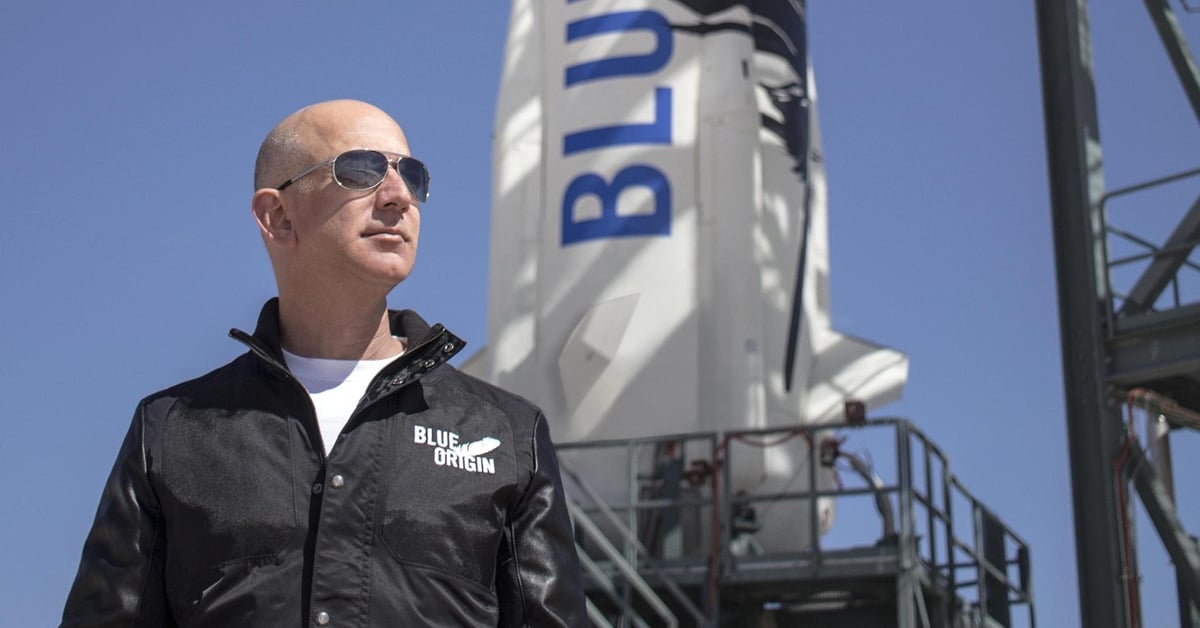
Jeff Bezos is super rich, $131 billion kind of rich. Business wise, an admirable drive, some incredible ideas, and a very forward looking mind, playing three dimensional chess some might say. And yet, when considering what he might do with his fortune, he was a bit disappointing.
The only way that I can see to deploy this much financial resource is by converting my Amazon winnings into space travel. That is basically it, […] the most important work that I’m doing.
Blue Origin is expensive enough to be able to use that fortune, I am currently liquidating about $1 billion a year of Amazon stock to fund Blue Origin. And I plan to continue to do that for a long time. Because you’re right, you’re not going to spend it on a second dinner out.
Going to space is a great dream but I’m not sure it’s the only thing worth spending billions on. And I’m not the only one.
This is just depressing. Whatever people want to say about the Pierre Omidyar, the Gates couple and Warren Buffett, at least they are able to see issues & problems larger than themselves to solve for the vast bulk of humanity. Not for a tiny sliver for their entertainment. https://t.co/3UPMNG5YRQ
On a planet in crisis, with civilization itself at stake, a man with a $131 billion fortune decides glorified space tourism is the best way to spend his whole fortune.
“Converting my Amazon winnings into space travel. That is basically it.”https://t.co/LJs3EKfueW
Great discoveries have come out of our space dreams and accomplishments, I’m sure many more will. Just look at what Elon Musk has done in a few years. Bezos’ comment was, at the very least, tone deaf. If he’s such a great leader, he should also lead for the greater good now, not just for far away dreams of space.
Do you ever read something that feels like it was written just for you? That’s how I feel whenever Craig Mod writes about digital reading. His latest essay, “Reconsidering the Hardware Kindle Interface,” doesn’t have a title that pops unless you 1) love reading; 2) know that Craig is really good at making design talk exciting and accessible.
The big, simple, so obvious that it seems trite to point it out statement here is that hardware buttons on e-readers are good and important. When your primary mode of interaction is to do one or two things over and over again, hardware buttons are really smart and valuable. I’ll let Craig explain why:
Hardware buttons inextricably tie you to a specific interaction model. So for the iPhone to be a flexible container into which anything can be poured it makes most sense to have (almost) no hardware controls.
But the hardware Kindle? Oh, what a wonderful gift for Amazon designers. The Kindle is predictable! We know what we’re getting on almost every page. And the actions of the user are so strictly defined — turn page, highlight, go back to library — that you can build in hardware buttons to do a lot of heavy lifting. And yet! Amazon seems to ignore (to lesser and greater degrees depending on the device) how predictable a hardware Kindle is.
Specifically, dedicated hardware buttons mean that you can remove the amount of unpredictability that happens when you touch the screen. Touching the screen now means “I’m going to interact with the content.”
What benefit comes of making the content of the book a first class object? It removes the brittleness of the current interaction model. Currently —when you tap — you might invoke a menu, a page turn, a bookmark, or a highlight. Meta actions are on a layer above content interactions. A Kindle is just a content container. And so this feels upside down.
Touchscreens work best when they allow direct and explicit engagement with the objects on the screen.
If the content of the book was the only screen object, a tap on a word would instantly bring up the dictionary. A drag would highlight. A single tap on an image would zoom in. Suddenly the text is alive and present. Your interaction with it? Thoughtless. Confident. No false taps. No accidental page turns. No accidental bookmarks. This further simplifies the logic of the touch engine watching for taps in the background, making these interactions faster, programmatic logic simpler.
From Evan Puschak, a quick video on dark patterns, UI design that tricks users into doing things they might not want to do. For instance, as he shows in the video, the hoops you need to jump through to delete your Amazon account are astounding; it’s buried levels deep in a place no one would ever think to look. This dark pattern is called a roach motel — users check in but they don’t check out. I wonder how much this single pattern has added to Jeff Bezos’ personal net worth?
For a decade, Amazon’s relentlessly offered new ways for people to read books. But even as platforms change, books haven’t, and the incompatibility is beginning to show. Phones and tablets contain nothing of what makes a paperback wonderful. They’re full of distractions, eye-wrecking backlights, and batteries that die in a few hours. They also open up massive new opportunities. On a tablet, books don’t have to consist only of hundreds of pages set in a row. They can be easily navigable, endlessly searchable, and constantly updated. They can use images, video, even games to augment the experience….
The next phase for the digital book seems likely to not resemble print at all. Instead, the next step is for authors, publishers, and readers to take advantage of all the tools now at their disposal and figure out how to reinvent longform reading. Just as filmmakers like Steven Soderbergh are experimenting with what it means to make a “movie” that’s really an app on a totally interactive device with a smaller screen, Amazon and the book world are beginning to figure out what’s possible when you’re not dealing with paper anymore.
Except… not really.
Very few people have held out more hope for the digital transformation of the book than me. I used to run a website called Bookfuturism. I wrote, at length, in The Atlantic, at Wired, at The Verge, at any magazine or website that would have me, about the possibility of a new reading avant-garde. And it just never happened. For reasons.
For one thing, almost every kind of forward-looking reading technology can be put to more lucrative uses than making e-books. Facebook will buy your company. Google will buy your company. Some games publisher will buy your company. You will not be making books any more. You will be making something else. It might be cool! But it won’t be books.
Second, and more importantly, the main way that the Kindle and other digital devices have transformed books is to make them as liquid as possible. By liquid, I mean, they take the shape of their container, rather than dictating the container’s shape. You need a single book to read in much the same way on a Kindle as on an iPhone, a full-sized tablet, a PC, and on whatever device you’re using to read your audiobook. Plus, you know-printed books, which are still huge. And part of the value of the digital book is that it’s a reasonable facsimile of the printed book.
While all of these devices are more multimedia-capable than an analog printed book, the differences between their capabilities is vast, and designing around those differences is no easy task. So Amazon has done what I think any of us might do given those requirements, and basically de-formed the book, deemphasizing page design and anything else that might not cross over to devices with different screen sizes, media capabilities, and affordances.
Getting wild with digital design in 2018 means getting wild in 2018 with responsive design that’s agnostic to the kind of device you’re rocking. That’s doable, probably, but it’s really, really hard.
“If Amazon wanted to, it could with a single act bring a new form of book into being,” Pierce writes. It’s true that Amazon is probably the only company that could do so. But it has good reasons, not least the overall conservative nature of the book market writ large, to move exceedingly slowly.
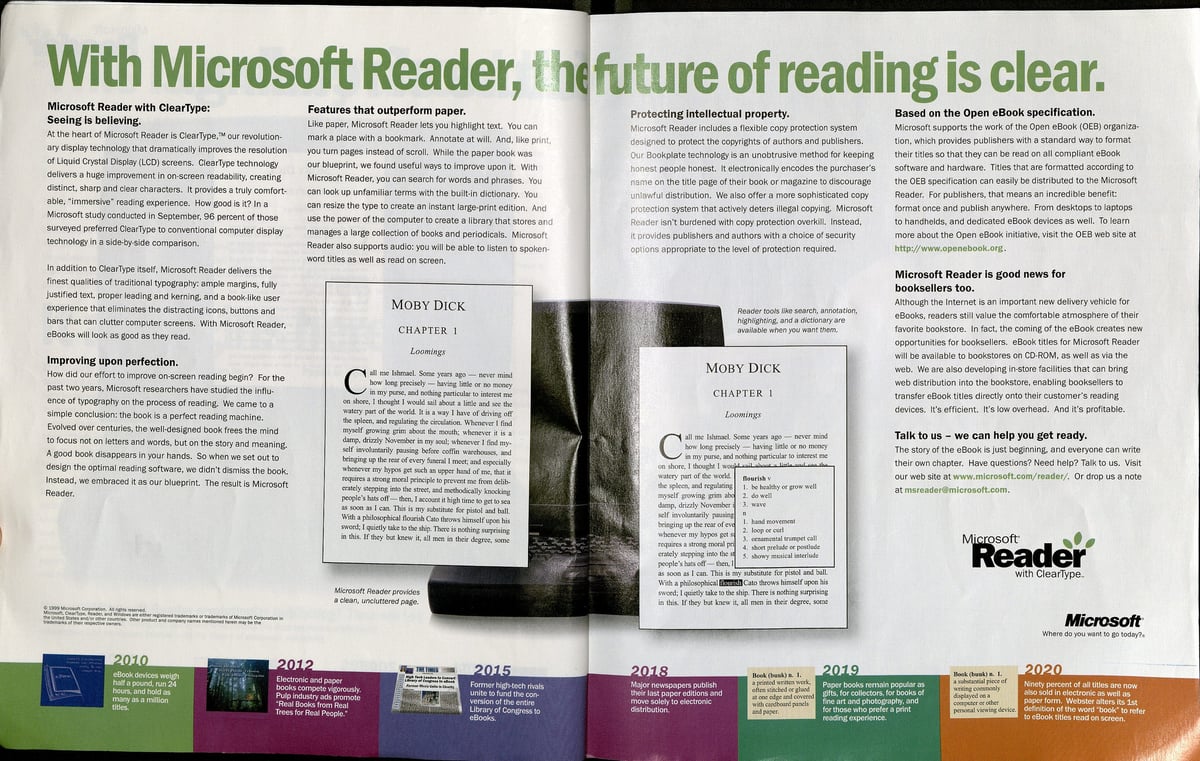
Every generation deserves to have its own dreams for the future of the book dashed against the wall. For reference, here is a timeline Microsoft-nice, safe, Word-and-Office Microsoft!-put forward back in 1999.
2003- eBook devices weigh less than a pound and run for eight hours on a charge. Costs run from $99 for a simple black and white device to about $899 for the most powerful, color magazine-sized machine.
2005- eBook title and ePeriodical sales top $1 billion. Many serial publications are given away free with advertising support that now also totals more than $1 billion. An estimated 250 million people regularly read books and newspapers on their PCs, laptops, and palm machines.
2006- eNewstands (kiosks) proliferate on street corners, airports, etc. As usual, airlines offer customers old magazines on the flight, but the magazines are now downloaded to eBook devices.
2009- Several top authors now publish directly to their audiences, many of whom subscribe to their favorite authors rather than buy book-by-book. Some authors join genre cooperatives, in which they hold an ownership stake, to cover the costs of marketing, handle group advertising sales and sell “ancillary” (that is, non-electronic) rights, including “paper rights.” Major publishing houses survive and prosper by offering authors editing and marketing services, rather than arranging for book printing. Printing firms diversify into eBook preparation and converting old paper titles to electronic formats.
2011- Advances in non-volatile chip storage, including Hitachi’s Single Electron terabit chip, allow eBooks to store 4 million books - more than many university libraries - or every newspaper ever printed in America.
2012- The pulp industry mounts its pro-paper “Real Books” ad campaign, featuring a friendly logger who urges consumers to “Buy the real thing - real books printed on real paper.”
2018- In common parlance, eBook titles are simply called “books.” The old kinds are increasingly called “paper books.”
2020- Ninety percent of all titles are now sold in electronic rather than paper form. Webster alters its First Definition of “book” to mean, “a substantial piece of writing commonly displayed on a computer or other personal viewing device.”.
The technology has never been the issue. The willingness of big players in the industry to move quickly has never been the issue. I never thought Kindles were going to be wildly experimental, but I thought they might start doing everything that text does, or that paper does. But people don’t really want to even do Sudoku on their Kindles. What they seem to want to do is read (and in some cases, listen to) books. Books, and the enormous and enormously complex interconnected nature of the book market and book readership, seem to be the issue. You just can’t make that barge turn on a hairpin.
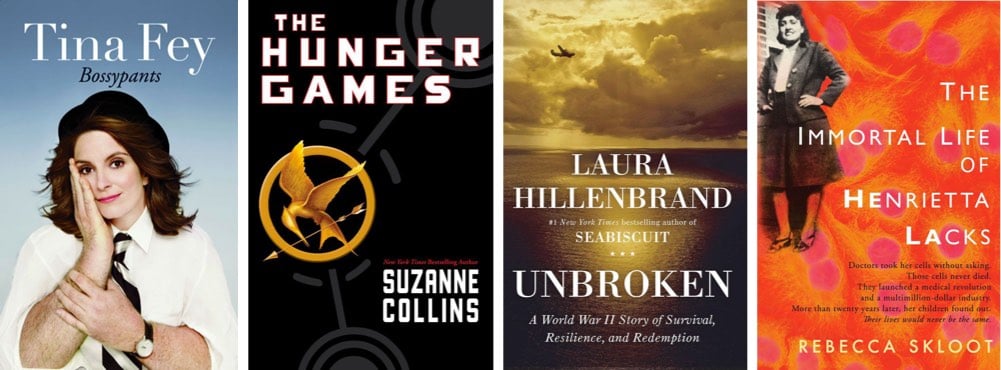
The Kindle debuted 10 years ago this month and Amazon marked its anniversary with top 10 lists of the bestselling fiction and nonfiction books for the device. The fiction list is fairly predictable (I’ll get to it in a moment), but the nonfiction list is a little more interesting in spots:
It’s really nice to see The Immortal Life of Henrietta Lacks on there…I would not have guessed that one, although with HBO and Oprah involved, perhaps I should have. Here’s the fiction list, dominated by Shades of Grey and Katniss Everdeen.
Voracious reader Tyler Cowen recently visited an Amazon Store for the first time and posted some impressions.
1. It is a poorly designed store for me, most of all because it does not emphasize new releases. I feel I am familiar with a lot of older titles, or I went through a more or less rational process of deciding not to become familiar with them. Their current popularity, as measured say by Amazon rankings, does not cause me to reassess those judgments. For me, aggregate Amazon popularity has no real predictive power, except perhaps I don’t want to buy books everyone liked. “A really smart person says to consider this again,” however, would revise my prior estimates.
6. I consider myself quite pro-Amazon, still to me it feels dystopic when an attractive young saleswoman says so cheerily to (some) customers: “Thank you for being Prime!”
Some of his observations match those of other reviewers from when the store opened back in May. On my last trip to NYC, I visited the same store as Cowen (also for the first time) and it didn’t change my opinion about the visibility of the data in the store:
Other bookstores have books arranged according to best-seller lists, store-specific best-sellers, and staff recommendations, but I’ve never seen any store layout so extensively informed by data and where they tell you so much about why you’re seeing each item. Grocery store item placement is very data driven, but they don’t tell you why you’re seeing a display of Coke at the end of the aisle or why the produce is typically right at the entrance. It’ll be interesting to see if Amazon’s approach works or if people will be turned off by shopping inside a product database, a dehumanizing feeling Frommer hints at with “a collection of books that feels blandly standard” when compared to human curated selections at smaller bookstores.
Walking around, I half-expected to see SQL queries accompanying some of the displays — “SELECT * FROM books WHERE rating > 4.8 AND pub_year = 2017 ORDER BY number_sold”. Amazon definitely needs to figure out how to get a little weird into their stores, a little of the human touch. Toning down the data talk would help. A more casual typeface might work too — not Comic Sans but perhaps something at least approaching handwritten? They’ve got so so much data about how people buy books…they just need to be more clever about how they slice and dice it. Maybe look for books that exhibit the Napoleon Dynamite Problem? Find people with interesting wishlists?
Many of the Echo/Alexa devices are available at their lowest prices ever. The flagship Echo is $90 (50% off), the Dot is $35, and the Tap is $80. (I actually have no idea what those last two things are.) The Dash Wand (which I have and have used sparingly so far…the kids use it mainly to hear jokes) is back in stock and is still essentially free (it’s $20 with a $20 credit after activation).
You laugh at me calling this a holiday, but someday Prime Day will be a bank holiday and members will have the day off. As my pal Matt Webb tweeted recently: “It’s 2047. Amazon Prime membership is now paid as a percentage of your income and includes healthcare”.↩
If kottke.org ran a store, what would that look like? (Like this, but hold that thought for a second.)
Lots of things on kottke.org happen by accident. When I started writing here in 1998, it wasn’t supposed to be a blog. An offhand comment by a friend led me to turn a hobby into a job that I’m still doing 12 years later. A lunch conversation last summer with someone I’d never met before saved the site from financial ruin. kottke.org was never supposed to host fan sites for Wes Anderson and Jane Jacobs or vertical blogs about sports, politics, and climate change.
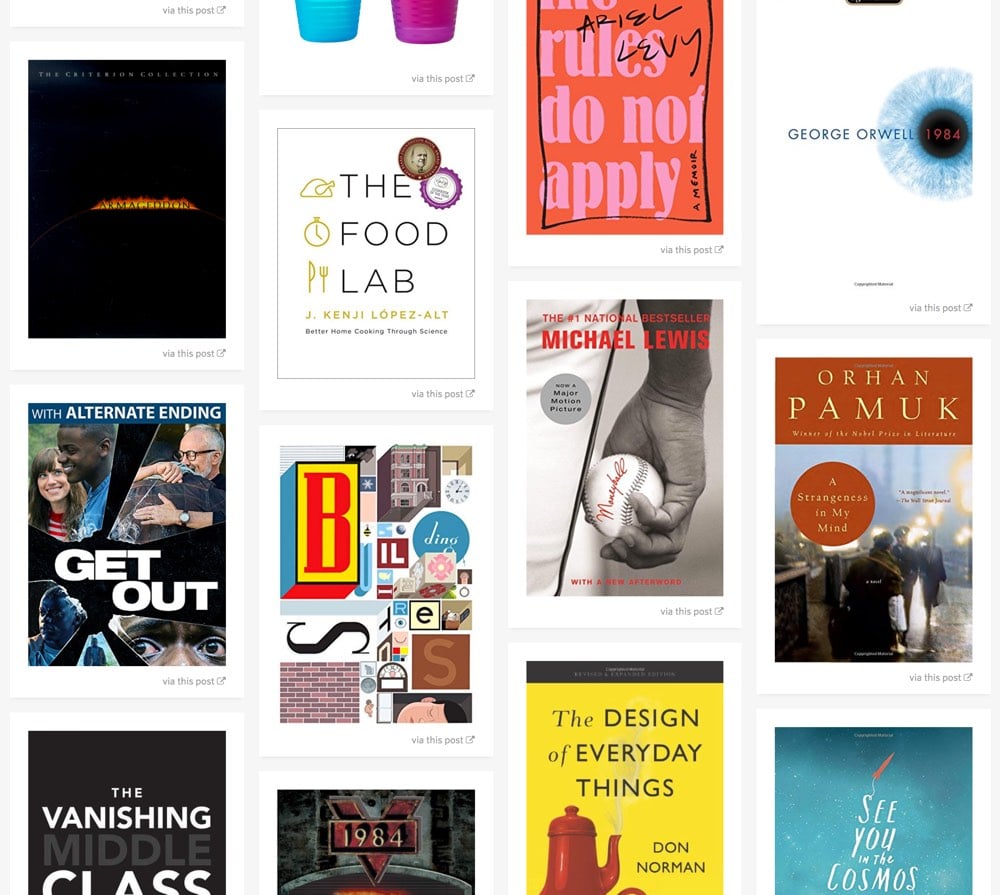
kottke.org was also never supposed to be a store. But as the years piled on, so did the links to all sorts of interesting books, movies, music, and other products that people could buy. I’ve collected many of those products into The Accidental Shop. The shop contains over 2000 items from 19+ years of posts. You can dip into it by filtering by the most recent items mentioned on the site, my top picks, and with a random selection of items. The default view is a weighted combination of recent, top picks, and random which tries to achieve a blend of recency, serendipity, and relevance. Clicking on the item image will take you to the Amazon page for that product. Most of the items are accompanied by a link to the most recent kottke.org post mentioning that item, so the shop also functions as an alternate way of browsing through the kottke.org’s extensive archive.
This is very much a first version of the shop. Right now, all of the items are from Amazon (if you buy something via the shop, I get a small affiliate fee), but I will be adding non-Amazon items to the shop in the near future — stuff like Tattly, 20x200 prints, pastrami from Katz’s, and kottke.org memberships. I will also be adding a localization feature so readers in Canada and the UK will see links to their respective Amazon stores.
P.S. Thanks to kottke.org members for their help with The Accidental Shop. I shared an in-progress version with them on my members-only mailing list a couple of months ago and received lots of great feedback and encouragement. If you’d like to help out on future projects or just lurk on the newsletter, become a member today.
Update: How about a little behind-the-scenes info? I’ve been doing web design since 1995, and I’ve always wanted to design and build an online store but never had the chance. So this was pretty fun. To build the shop’s catalog, I went through and scraped all ~25,000 posts I’ve done over the past 19 years, looking for product links to Amazon. The script found almost 2300 distinct items and put them into a database, noting the dates of the initial & most recent mentions and the # of mentions for each item. Then I used Amazon’s Product Advertising API to retrieve all sorts of information about each item, including title, type (book, eBook, kitchen, DVD, etc.), price, image, and the creator (a book’s author, a movie’s director).
Once that was done, I built the shop interface with an admin function for rating each item on a scale of 1 to 4 (or 0, which excludes the item from the public shop altogether). I used the admin interface to rate every single item in the database — it only took a few hours while watching reruns of ST:TNG on Netflix. Then I wrote a script to assign a “score” to each item based on: my rating, how recently it was mentioned, the frequency of mentions, and a couple other factors. The highest scoring items are an eerily accurate reflection of what I am interested in and what I talk about on the site. FYI, the current highest scoring items: Infinite Jest, The Death and Life of Great American Cities, the Kindle Paperwhite, The Victorian Internet, the Harry Potter books, 1491, and The Making of the Atomic Bomb, all of which I’ve mentioned on the site 10+ times.
The layout is pure CSS…I’m using the column feature to create a quick & dirty Pinterest-style layout. Each of the store filters (recent, top picks, random) is randomized to give you a slightly different product assortment with each page refresh. The scoring and rating system, combined with the semi-randomized output, makes for a lively and ever-changing store interface without me having to constantly pick which items go where in the layout. A high-maintenance, just-so layout that’s updated daily would undoubtedly work better — but probably not way better and as a one-person operation, I don’t have that kind of time anyway. This is pretty much the approach I use for all my projects: do the most I can with the least possible effort. Make it appear complex but work simply. As Milton Glaser said: “Just enough is more.”
Amazon’s New Customer is a really great analysis by Ben Thompson of Amazon’s strategy and why Amazon bought Whole Foods: they purchased a new customer for Amazon infrastructure, not a retailer. Early on in the piece, Thompson lays this one on us:
Amazon’s goal is to take a cut of all economic activity.
No qualifiers. All economic activity. In the world. Sort of a Dutch East India Company for the internet age. Thompson explains how they’re going to do it and why fresh food is such a strategic hole for them.
As you might expect, given a goal as audacious as “taking a cut of all economic activity”, Amazon has several different strategies. The key to the enterprise is AWS: if it is better to build an Internet-enabled business on the public cloud, and if all businesses will soon be Internet-enabled businesses, it follows that AWS is well-placed to take a cut of all business activity.
On the consumer side the key is Prime. While Amazon has long pursued a dominant strategy in retail — superior cost and superior selection — it is difficult to build sustainable differentiation on these factors alone. After all, another retailer is only a click away.
This, though, is the brilliance of Prime: thanks to its reliability and convenience (two days shipping, sometimes faster!), plus human fallibility when it comes to considering sunk costs (you’ve already paid $99!), why even bother looking anywhere else? With Prime Amazon has created a powerful moat around consumer goods that does not depend on simply having the lowest price, because Prime customers don’t even bother to check.
This, though, is why groceries is a strategic hole: not only is it the largest retail category, it is the most persistent opportunity for other retailers to gain access to Prime members and remind them there are alternatives. That is why Amazon has been so determined in the space: AmazonFresh launched a decade ago, and unlike other Amazon experiments, has continued to receive funding along with other rumored initiatives like convenience store and grocery pick-ups. Amazon simply hasn’t been able to figure out the right tactics.
When I heard about the Whole Foods deal, the first thing I thought about was Amazon Go. The company has been trying to experiment with different retail environments, but without the proper scale, it doesn’t make a lot of sense. Whole Foods gives them a chance to develop their fresh food delivery infrastructure at scale…so that they can offer it to other customers just like they do with AWS.
Update: I am an idiot. All this Ikea stuff on Amazon is from resellers…the same stuff that’s been available for years on the site. (Same deal with all the Muji items on Amazon.) I mean, they are still genuine Ikea products and some of it isn’t even available from Ikea’s online store. Anyway, not such a huge deal. I was wondering why Ikea would be adopting such a if-you-can’t-beat-‘em-join-‘em attitude towards Amazon; turns out they’re still just trying to beat ‘em.
“I leave unsaid on which (platforms), but we will test and pilot, to see ‘what does this mean, what does digital shopping look like in future and what do digital shopping centers mean?’,” he said.
IKEA, known for its warehouse-like stores, has recently restructured to give its retail arm more freedom. The Swedish firm has never sold its goods through another company and is also trying new smaller store formats and stepping up integration of stores and online to adapt to new ways of shopping.
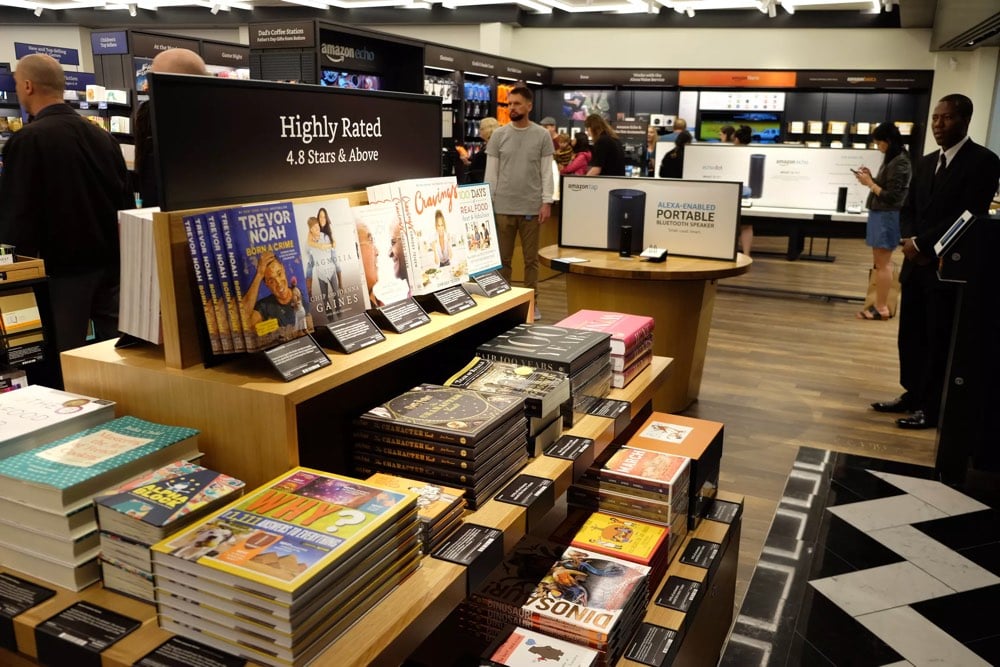
Over at Recode, Dan Frommer has a look inside Amazon’s first NYC bookstore, opening Thursday in the mall in the Time Warner Center. I haven’t visited any of Amazon’s stores yet (they’ve got several around the country), but what I find interesting from the photos is how up-front they are about the shopping experience being data driven. There are signs for books rated “4.8 Stars & Above”, a shelf of “Books Kindle Readers Finish in 3 Days or Less”, a section of “If You Like [this book], You’ll Love [these other books]”, and each book’s shelf label lists the star rating and number of reviews on Amazon.com. Another sign near the checkout reads “Over 7950 Goodreads members like this quote from Cassandra Clare’s Clockwork Prince: ‘We live and breathe words.’”
Other bookstores have books arranged according to best-seller lists, store-specific best-sellers, and staff recommendations, but I’ve never seen any store layout so extensively informed by data and where they tell you so much about why you’re seeing each item. Grocery store item placement is very data driven, but they don’t tell you why you’re seeing a display of Coke at the end of the aisle or why the produce is typically right at the entrance. It’ll be interesting to see if Amazon’s approach works or if people will be turned off by shopping inside a product database, a dehumanizing feeling Frommer hints at with “a collection of books that feels blandly standard” when compared to human curated selections at smaller bookstores.
P.S. So weird that there’s no prices on items…you have to scan them with a store scanner or a phone app. Overall, the store feels less oriented towards its book-buying customers and more towards driving Prime memberships, Amazon app downloads, and Kindle & Echo sales (which might be Amazon’s objective).
The store’s biggest shortcoming, though, is that it is so clearly not intended for people who read regularly. I normally walk into a bookstore and shop the way a person might shop for clothes: I know what I like, what generally works for me, what new styles I might be ready to try. It was a strange feeling, on Thursday, to do laps around a bookstore without feeling a single unexpected thrill. There were no wild cards, no deep cuts, no oddballs — just books that were already best-sellers, pieces of clothing I knew wouldn’t fit me or that I already owned.
Tolentino also notes that the fiction section in the NYC store contains fewer than 200 different titles.
Back in 2000, Amazon ran a poll asking their customers what they thought were the best books, music, and movies of the past 1000 years. The results, archived by the Internet Archive, are a time capsule not only of recently popular works (Braveheart, Millennium by the Backstreet Boys, Harry Potter and the Sorcerer’s Stone by J.K. Rowling) but also of who was on the internet at that time. It’s interesting that Harry Potter made the list; the first book had only been out in the US for less than a year and a half and the 2nd and 3rd books had been out for less than 6 months.
The winners in each category were The Lord of the Rings by J.R.R. Tolkien, Sgt. Pepper’s Lonely Hearts Club Band by The Beatles, and Star Wars. The author of the millennium was J.R.R. Tolkien (runner-up: Ayn Rand), The Beatles and Pink Floyd were the top musical artists, and the directors were Steven Spielberg and George Lucas. Here are the full top 10 lists:
French company Parrot has had a rough year and missed its sales expectations. That’s why the company will lay off 290 employees who were working on drones. In total, Parrot currently has 840 employees on the drone team and more than a thousand employees in total.
While the company isn’t just selling drones, it represents a good chunk of the business. But it looks like other companies, such as DJI, are doing better in this market. Parrot expected to report $105.9 million in sales for 2016. It reported $90 million instead (€85 million vs. €100 million expected).
Even though the company is still selling quite a few drones, Parrot says that it doesn’t generate healthy margins. So here’s the new plan: focusing on commercial drones.
Well, this explains my holiday shopping difficulties with Parrot. Ollie asked for a drone for Christmas and after doing some research, I decided on the Parrot Swing. Amazon was out of stock, so I decided to buy directly from Parrot. They had stock and the site said they’d ship in plenty of time for Xmas. So I ordered one. The next day, I get a call from Parrot saying I need to “verify my order”. So, I call them back, give them some info about my order and where it’s being shipped and the very nice woman on the phone tells me that I’m all set and they’re shipping it out.
Two days go by, no shipping confirmation email in sight. I get another voicemail: you need to call us to verify your order. I call back, give them the same info and tell them, oh by the way I’ve already done this once. Profuse apologies were offered, that was a mistake, and the very nice woman on the phone tells me she’s going to tell the shipping people to send out my order “right away”. It will still arrive in time for Xmas. The next day I get an email from Parrot:
Hello! We have refunded your order No. XXXXX-XXXXX placed 12/15/2016. We are sorry that your order did not meet your expectations and hope that you will visit us again.
Obviously, I am done with them at this point but still need that drone. Amazon is still out of stock, but Walmart has them. I order one, it arrives two days later (with free shipping), and on Christmas morning, after some reflection, Ollie says it was the best present Santa has ever gotten him.
I did quite a bit of holiday shopping this year…went a bit nuts making up for some not-so-great efforts the past two years. The kids and I shopped for Toys for Tots (twice), I bought gifts for them from me and from Santa, I bought non-holiday stuff like clothes for myself,1 and I shopped virtually for the gift guide. I shopped every which way: small, locally, at big box stores, and online at 4-5 different retailers. My main takeaway from that experience? Amazon is miles and miles and miles ahead of everyone else. It is not even close.
Sure, Walmart had the drone in stock, but when I’d tried shopping with them earlier in the month, the product page threw a 404 error. I switched to Safari and was able to put the item into my cart, but then a form in the ordering flow wouldn’t work, so I had to get that item elsewhere. (When I did finally create an account while ordering the drone, Walmart thought my name was “Ashley”?!)
Target’s site was so slow that it was nearly unusable (like 30-40 seconds for a product page to start loading). But I persevered because they had an item I really wanted that no one else had in stock. I got an email two days before Xmas saying they were out of stock and couldn’t ship until Jan 4 at the earliest, but that if I still wanted the item, I would have to log in to my account to verify the new shipping date. I didn’t want the item later, so I did nothing. Guess what arrived on my doorstep last week?
My troubles with Parrot I shared above. The local toy stores are expensive (Lego sets are $5-10 more than if you buy online) and ran out of popular items 2-3 weeks before Xmas. Very few online stores outside Amazon, Walmart, etc. had clear holiday shipping policies, so relying on them more than a week or two out was risky. Zappos was great (Amazon owns them) and Patagonia was pretty good, although their shipping estimates aren’t that great and returns aren’t free.
And Amazon? The site is always fast, I have never seen a 404’d product page, the URLs for their products haven’t changed in almost 20 years,1 each product page was clearly marked with holiday shipping information, they showed the number of items in stock if they were running low, shipping was free (b/c I’m a Prime member), returns are often free, and the items arrived on time as promised. More than 20 years after the invention of online retailing, how is it that Amazon seems to be the only one that’s figured all this out? How come massive companies like Walmart and Target, whose very businesses are under immense pressure from Amazon, can’t get this stuff right despite having spent hundreds of millions on it? I’m not a financial analyst, but unless something changes drastically, Amazon is just going to continue to eat more and more of the US retail pie and at this point, with all these advantages they’ve accrued and their razor-sharp focus on low pricing, it’s difficult to see how anyone is going to compete.1
After freezing my ass off wearing improper clothing the last few years (because, to be clear, I am an idiot), I made myself a promise this year that I was not going to be cold this winter. So in November and December, I spent a bunch of energy outfitting myself with the proper gear: sweaters, thermal layers, coats, mittens, boots, etc. I am both warm and happy now.↩
I linked to the Office Space DVD on kottke.org in 1999 and the link still works. What’s the percentage of URLs from 1999 that still work? 5%? 2%? 0.1%?↩
Just for fun, let’s take a quick stab. Stripe and Shopify are arguably better than Amazon in some ways and when the one-click patent expires this year, those payment flows will get even easier. And anyone can use them to sell anything. So the problem becomes stocking and shipping. Who’s going to build/provide the third-party fulfillment infrastructure so that shipping and returns are cheap and reliable…like Amazon’s fulfillment warehouses but for anyone to use? UPS? FedEx? The USPS? (Hahaha.) Uber? Can that company offer a Prime-like or Costco-like shipping membership? What is the rationale for everyone involved (the retailers, the payment company, the online store service, the fulfillment company) to keep prices as relentlessly low as Amazon does? There are a lot of different reasons why a collection of interchangeable third-party services could succeed against a fully integrated solution, but price does not seem like one of them…there’s just too much margin lost because of the friction between services.
(And we haven’t even talked about AWS here. It’s profitable by itself but is also turning out to be a massive competitive advantage. The likes of Walmart and Target can’t use it even if it would be better than their home-grown infrastructure because that’s like the Trojans paying the Greeks to invade. AWS also potentially insulates Amazon against competitors like Shopify and Stripe. Imagine if Amazon got serious about integrating AWS with their payment and fulfillment systems…a low-cost, bulletproof, integrated system that almost anyone could use to sell almost anything would put an enormous amount of pressure on every other retail experience, particularly if they continue to ramp up their real-world retail offerings.)↩
Some interesting speculation from Evan Puschak on what Amazon is up to with Amazon Go. Basically, Puschak thinks Amazon Go is Amazon Web Services but for retail stores. In the same way that AWS provides hosting for sites like Netflix and Reddit, Amazon Go will provide patent-protected technology infrastructure for “self-shopping” supermarkets and retail stores. But it remains to be seen whether it’s more like their one-click patent, which was licensed by a few others (notably Apple) but everyone else was able to do without it.
Amazon Go grocery stores will let you walk in by swiping an app, grab whatever you need, and just walk right out the door again.
Our checkout-free shopping experience is made possible by the same types of technologies used in self-driving cars: computer vision, sensor fusion, and deep learning. Our Just Walk Out technology automatically detects when products are taken from or returned to the shelves and keeps track of them in a virtual cart. When you’re done shopping, you can just leave the store. Shortly after, we’ll charge your Amazon account and send you a receipt.
I guess that makes these self-shopping stores? Lame jokes aside, this is a pretty cool idea. Not entirely revolutionary though…Apple’s EasyPay service has allowed shoppers to self-checkout with the Apple Store app since 2011. I used the self-checkout at an Apple Store once and it felt *really* weird, like I was shoplifting. New commercial transactions are always tricky. Things like one-click ordering, contactless payments (e.g. Apple Pay), and Uber-style payments feel strange at first, but you get used to them after awhile. Something like Square’s odd “put it on Jack” system — where instead of swiping a card or scanning a QR code on an app, you need to negotiate with a person about who you are — don’t catch on. It’ll be interesting to see where something like Amazon Go falls on that spectrum.
Update: This is an IBM commercial from the 90s that showed Just Walk Out shopping.
Shel Kaphan was the first person Jeff Bezos hired to work on Amazon. In an interview with Craig Cannon, he talked about how he met Bezos, the early days of the site, and how he feels about the experience now.
At the time I thought, “Okay, I’m going to be building this website to run a bookstore and I haven’t done that before but it doesn’t sound so hard. When I’m done with that I’m not sure what I’ll do.” At that point there was no idea of doing anything but a bookstore. I thought maybe I would be able to go back to Santa Cruz and monitor it from there. I was pretty wrong about how the business would develop and how ambitious Jeff was. I didn’t know him at the time. We had just met.
I had forgotten that Amazon’s IPO happened less than two years after the site went live…can’t imagine something like that happening today.
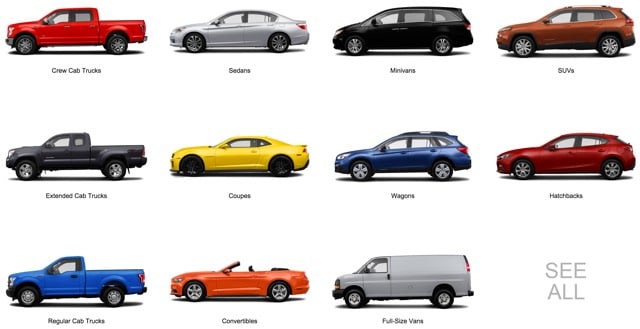
Having purchased a car in the last six months, I can see the appeal of being able to browse through all the different brands and makes of cars in a familiar interface. This will be a full-fledged store before too long, yes?






Stay Connected