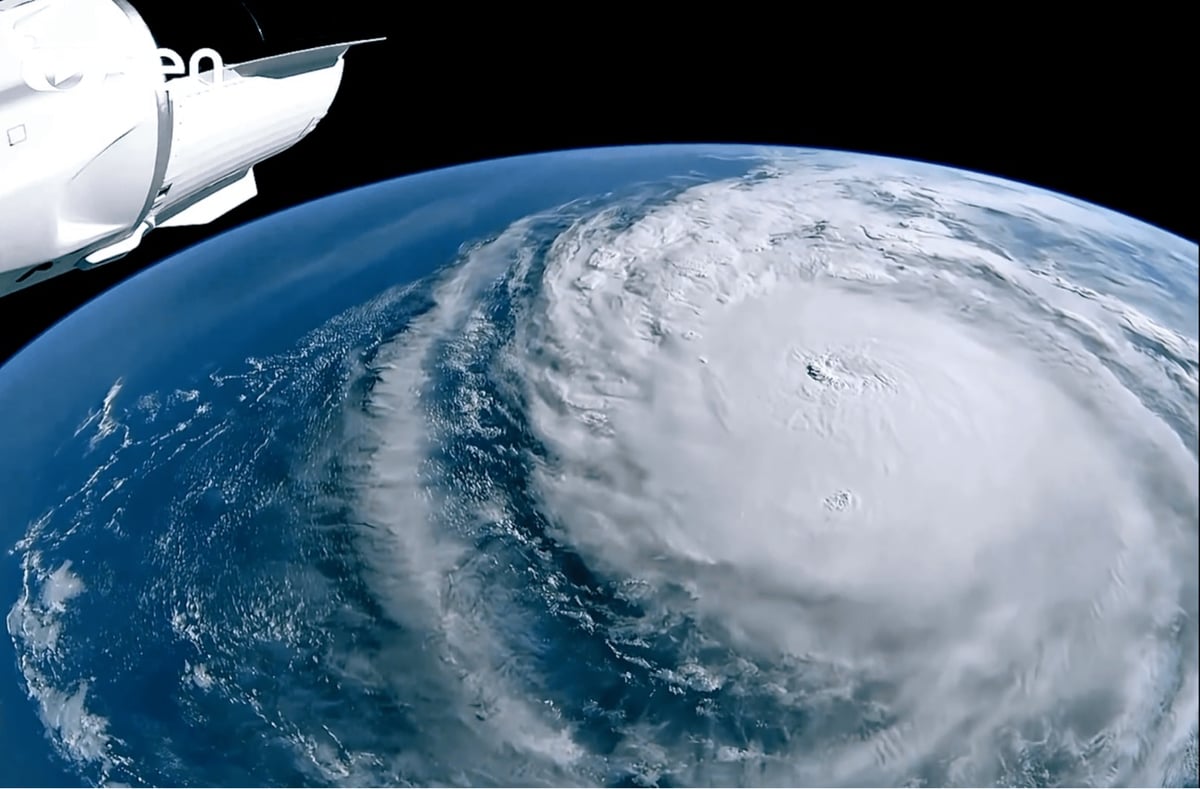
As Hurricane Milton exploded from a Category 1 storm into a Category 5 storm over the course of 12 hours yesterday, climate scientists and meteorologists were stunned. NBC6’s John Morales, a veteran TV meteorologist in South Florida, choked up on air while describing how quickly and dramatically the storm had intensified. To most people, a drop in pressure of 50 millibars means nothing; a weatherman understands, as Morales said mid-broadcast, that “this is just horrific.” Florida is still cleaning up from Helene; this storm is spinning much faster, and it’s more compact and organized.
In a way, Milton is exactly the type of storm that scientists have been warning could happen; Michael Wehner, a climate scientist at Lawrence Berkeley National Laboratory, in California, called it shocking but not surprising. “One of the things we know is that, in a warmer world, the most intense storms are more intense,” he told me. Milton might have been a significant hurricane regardless, but every aspect of the storm that could have been dialed up has been.
My thoughts are with everyone in Milton’s path and also with those still recovering & cleaning up from Helene. Please stay safe, everyone.
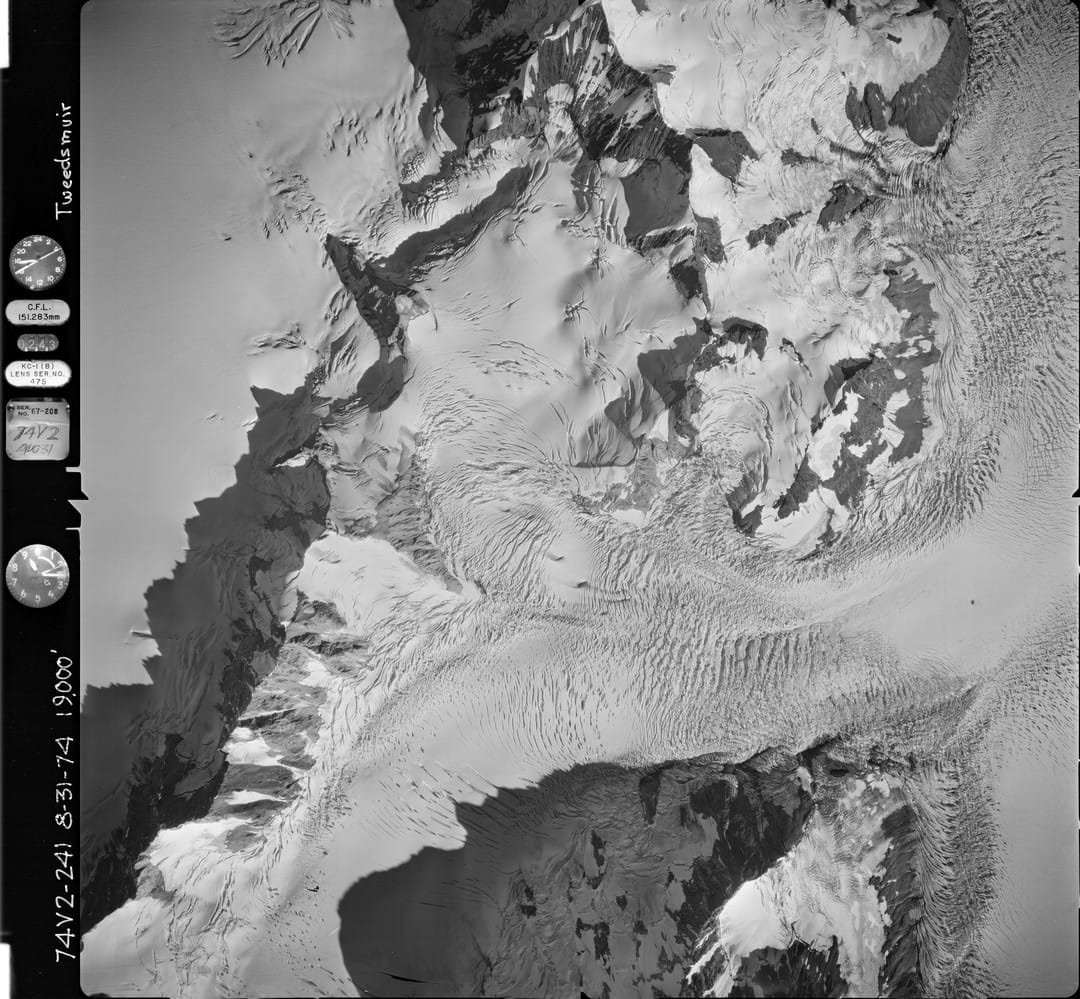
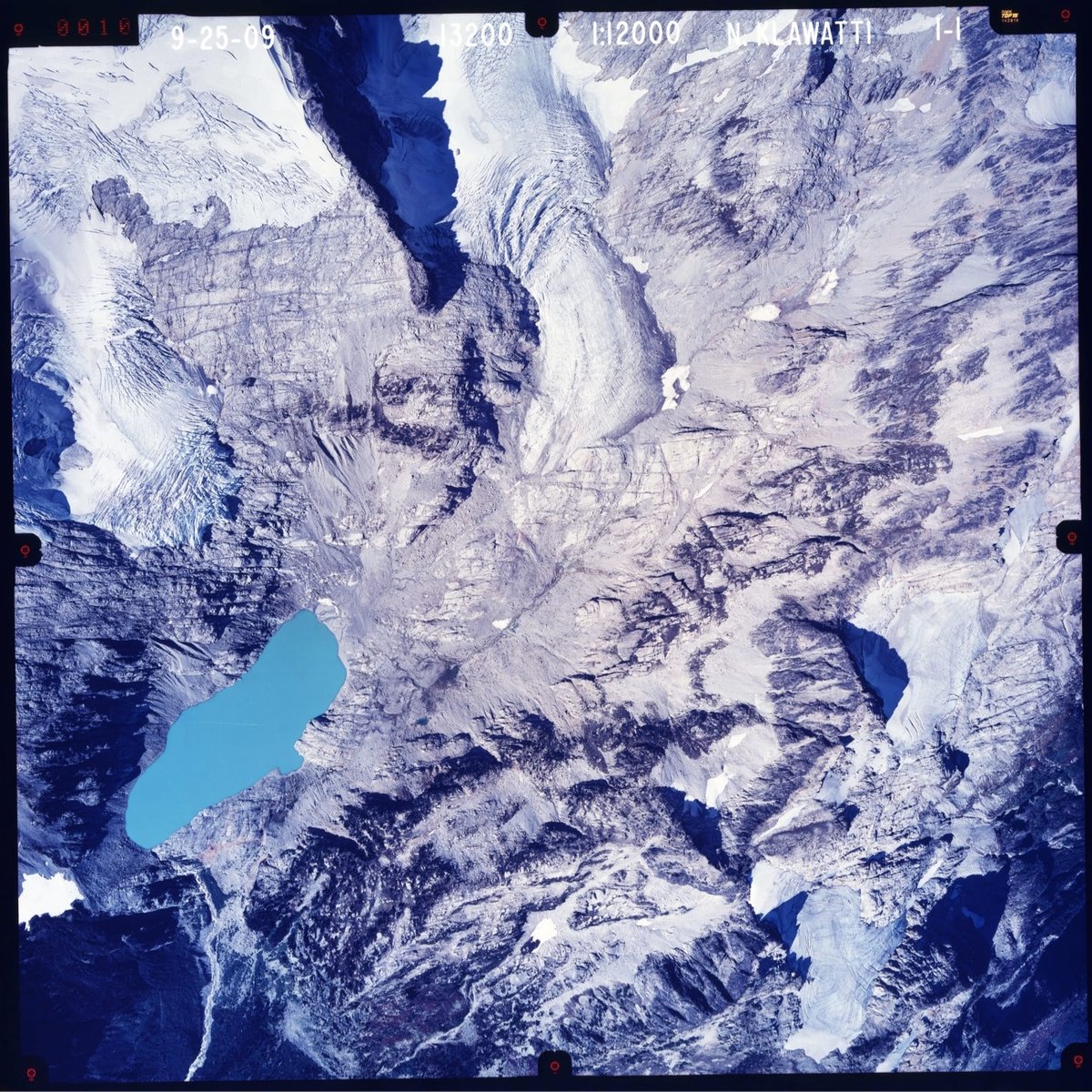
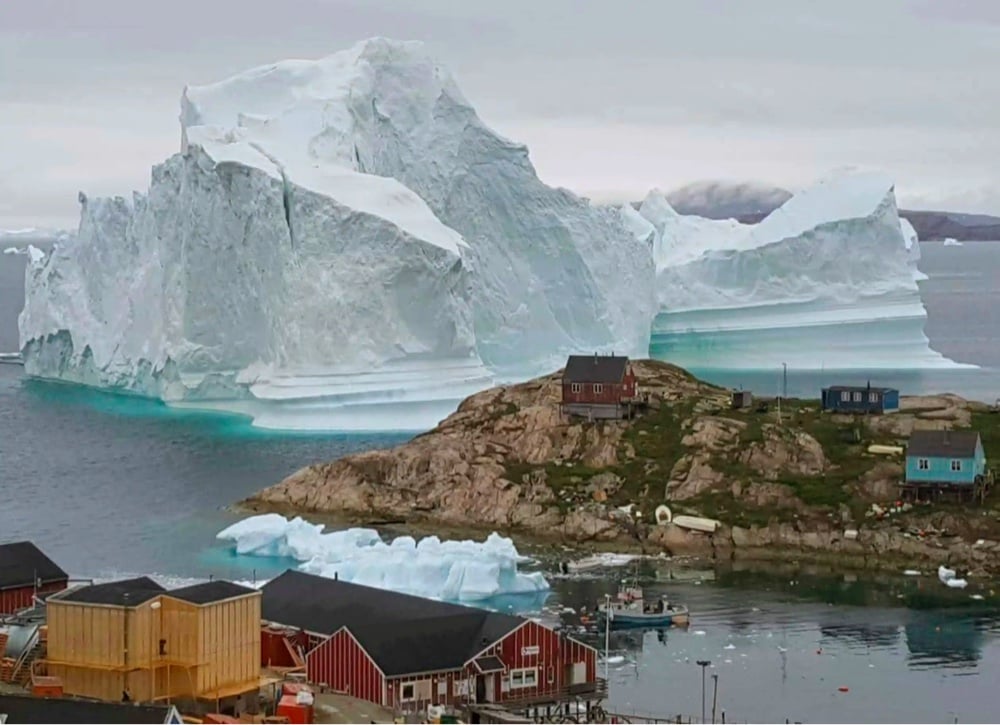
As scientists study the effects of global warming, one of the most visible and alarming indicators is the rapid shrinking of glaciers. Government scientists have been documenting the size, shape, and movement of glaciers since the 1950s employing techniques ranging from direct field observations to aerial photography.
The United States Geological Survey (USGS) has one of the largest collections of aerial glacier photographs. Over 40 years, the USGS’ North American Glacier Aerial Photography (NAGAP) project captured thousands of striking high-resolution photos of glaciers and their surroundings.
From 1960 to 1983, self-taught glaciologist Austin Post used a 63-pound World War II-era Fairchild K-17 aerial reconnaissance camera to shoot over 100,000 glacier photos in the western US and Alaska. One of the bush pilots Post teamed up with was William R. Fairchild, who flew a Beech 18 twin engine airplane equipped with five K-17 cameras-one mounted on the nose, two in the belly of the plane, and one on each side.
A family of beavers in Canada has built a dam that’s twice as wide as the Hoover Dam. This huge dam is kind of a click-baity promotion (it worked!) but the essence of the video is how beavers can help make landscapes more resilient to effects of climate change.
It’s so big it can be seen from outer space. But that’s not the only reason NASA is interested in this architecturally minded species… Increasing diversity and resilience, not to mention creating wetlands, are just some of the impacts beavers can have on their surroundings. What does this mean for the wider environment? And how can we humans learn from it?
Let’s say the countries of the world most responsible for the changing climate continue to drag their feet on doing something about it. What is the world going to look like in 20 or 30 or 80 years? This TED-Ed video describes that bleak potential future.
Reports on heatwaves and wildfires regularly fill the evening news. Summer days exceed 40 degrees in London and 45 degrees in Delhi, as extreme heat waves are now 8 to 9 times more common. These high temperatures prompt widespread blackouts, as power grids struggle to keep up with the energy demands needed to properly cool homes. Ambulance sirens blare through the night, carrying patients suffering from heatstroke, dehydration, and exhaustion. The southwestern United States, southern Africa, and eastern Australia experience longer, more frequent, and more severe droughts.
Meanwhile, the Philippines, Indonesia, and Japan face more frequent heavy rainfall as rising temperatures cause water to evaporate faster, and trap more water in the atmosphere. As the weather becomes more erratic, some communities are unable to keep pace with rebuilding what’s constantly destroyed.
This is a fascinating article by Kathleen DuVal about how climate change (including the Little Ice Age) affected social and political structures in North America in the 13th and 14th centuries.
But then the climate reversed itself. In response, Native North American societies developed a deep distrust of the centralization, hierarchy, and inequality of the previous era, which they blamed for the famines and disruptions that had hit cities hard. They turned away from omnipotent leaders and the cities they ruled, and built new, smaller-scale ways of living, probably based in part on how their distant ancestors lived.
While Europeans reacted to the Little Ice Age by centralizing and militarizing under hereditary absolute monarchs, Native Americans went in a decidedly different direction:
The cities that Native Americans left behind during the Little Ice Age-ruins such as those at Chaco Canyon and Cahokia-led European explorers and modern archaeologists alike to imagine societal collapse and the tragic loss of a golden age. But oral histories from the generations that followed the cities’ demise generally described what came later as better. Smaller communities allowed for more sustainable economies. Determined not to depend on one source of sustenance, people supplemented their farming with increased hunting, fishing, and gathering. They expanded existing networks of trade, carrying large amounts of goods all across the continent in dugout canoes and on trading roads; these routes provided a variety of products in good times and a safety net when drought or other disasters stressed supplies. They developed societies that encouraged balance and consensus, in part to mitigate the problems caused by their changing climate.
Being an adult in the 21st century is the continual discovery of things you never learned in school — how climate change has altered the course of history and changed our societies was not adequately represented in my history classes. (See, for example, how climate change played a role in Brexit.)
A millennium ago, North American cities rivaled urban centers around the world in size. Then, following a period of climate change and instability, numerous smaller nations emerged, moving away from rather than toward urbanization. From this urban past, egalitarian government structures, diplomacy, and complex economies spread across North America. So, when Europeans showed up in the sixteenth century, they encountered societies they did not understand-those having developed differently from their own-and whose power they often underestimated.
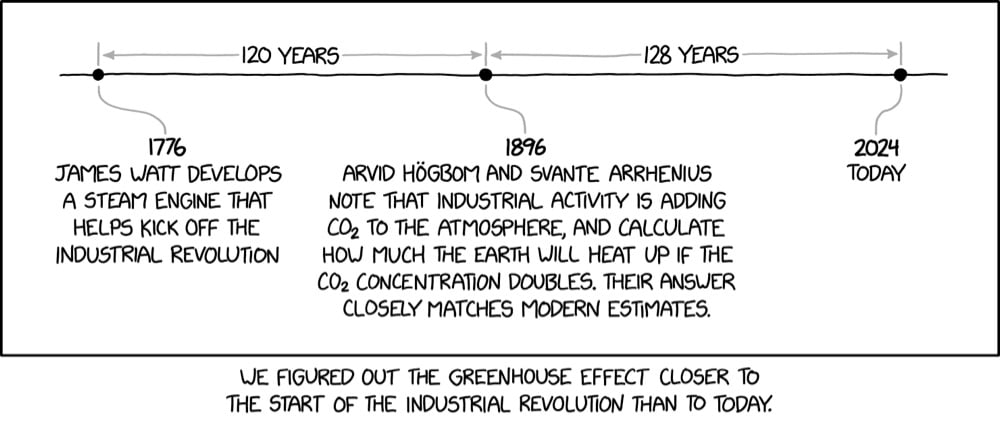
The warming effect of sunlight on different gases was examined in 1856 by Eunice Newton Foote, who described her experiments using glass tubes exposed to sunlight. The warming effect of the sun was greater for compressed air than for an evacuated tube and greater for moist air than dry air. “Thirdly, the highest effect of the sun’s rays I have found to be in carbonic acid gas.” (carbon dioxide) She continued: “An atmosphere of that gas would give to our earth a high temperature; and if, as some suppose, at one period of its history, the air had mixed with it a larger proportion than at present, an increased temperature from its action, as well as from an increased weight, must have necessarily resulted.”
Foote’s paper went largely unnoticed until it was rediscovered in the last decade. If you’re interested, the best thing I’ve read on the history of climate change is the 7th chapter of Charles Mann’s The Wizard and the Prophet.
The way to think about climate change now is through two interlinked concepts. The first is nonlinearity, the idea that change will happen by factors of multiplication, rather than addition. The second is the idea of “gray swan” events, which are both predictable and unprecedented. Together, these two ideas explain how we will face a rush of extremes, all scientifically imaginable but utterly new to human experience.
It’s the nonlinearity that’s always worried me about the climate crisis — and is the main source of my skepticism that it’s “fixable” at this point. Think about another nonlinear grey swan event: the Covid-19 pandemic. When was it possible to stop the whole thing in its tracks? When 10 people were infected? 50? 500? With a disease that spreads linearly, let’s say that stopping the spread when 20 people are infected is twice as hard as when 10 are infected — with nonlinear spread, it’s maybe 4x or 10x or 20x harder. When you reach a number like 20,000 or 100,000 infected over a wide area, it becomes nearly impossible to stop without extraordinary effort.
In thinking about the climate crisis, whatever time, effort, and expense halting global warming (and the myriad knock-on effects) may have required in 1990, let’s say it doubled by 2000. And then it didn’t just double again in the next ten years, it tripled. And then from 2010 to 2020, it quadrupled. An intact glacier in 1990 is waaaaay easier and cheaper to save than one in 2010 that’s 30% melted into the ocean; when it’s 75% melted in 2020, there’s really no way to get that fresh water back out of the ocean and into ice form.
It’s like the compounding interest on your student loans when you’re not making the minimum payments — not only does the amount you owe increase each month, the increase increases. And at a certain point, the balance is actually impossible to pay off at your current resource level.1 It’s hard to say where we are exactly on our climate repayment curve (and what the interest rate is), but we’ve not been making the minimum payments for awhile now and the ocean’s repossessing our glaciers and ice shelves and…
Think also of the story of the inventor of chess asking for a reward of a single rice grain on the first square of a chess board and double the amount on each successive square. After a week, he’s got only 127 grains. After four weeks, he’s got himself several thousand pounds of rice. Another week or two after that, he owns the whole kingdom. (And if the multiplication factor is only 1.2, he still gets the kingdom in fewer than 2 chess boards.)↩
I’ve found in my twenty-something years of messing about with Buddhism is that what it has to teach is pretty simple; you could read up on the essentials in a day, probably in an hour, possibly in a quarter of an hour. But the point is to somehow so deeply embed those values, perspectives, and insights in yourself that they become reflexive, your operating equipment, how you assess and react to the world around you. That’s the work of a lifetime — or of many, if you’re inclined to believe in reincarnation.
Most truths are like that, easy to hear or recite, hard to live in the sense that slowness is hard for most of us, requiring commitment, perseverance, and return after you stray. Because the job is not to know; it’s to become. A sociopath knows what kindness is and how to weaponize it; a saint becomes it.
You see things happen “gradually, then suddenly” in all sorts of places, including, as Solnit notes, both the climate and the fight for climate justice.
The climate movement needs you. In this pamphlet, we outline some of the ways you can join it, and we share examples of how ordinary people have found their role, their power, their impactful projects, and their climate community. There’s a place for you in the crucial work of speeding the transition away from destruction and toward thriving. Figuring out where your skills are useful and what you can stick with is important. Identifying whom to work with and what to work on is crucial. Some of us are good at staying with a legislative issue for a season or a year or a decade. Some of us are good campaigners. Some like protests and are ready to blockade and risk arrest. Some of us are homebound but can make calls and write letters. It all matters.
One of the best and most challenging things about the climate crisis is that there is no one solution. That is, the solution is a mosaic of many changes. The way we get to a world that doesn’t run on fossil fuel and instead centers justice, sustainability, and community is happening in hundreds of thousands of ways — this coal plant shutdown, that methane-gas ban, these electric schoolbuses and bike lanes, that solar rooftop, these offshore turbines, that grasslands protection. These need to be sped up and amplified. National legislation and international treaties matter, but so do the countless small pieces that add up. It’s not just about what we need to stop but also about the rejuvenating work of building the world we want.
The reason is that now, we have a better story to tell. The evidence is clear: Responding to climate change will not only create a better world for our children and grandchildren, but it will also make the world better for us right now.
Eliminating the sources of greenhouse gas emissions will make our air and water cleaner, our economy stronger and our quality of life better. It could save hundreds of thousands or even millions of lives across the country through air quality benefits alone. Using land more wisely can both limit climate change and protect biodiversity. Climate change most strongly affects communities that get a raw deal in our society: people with low incomes, people of color, children and the elderly. And climate action can be an opportunity to redress legacies of racism, neglect and injustice.
I could still tell you scary stories about a future ravaged by climate change, and they’d be true, at least on the trajectory we’re currently on. But it’s also true that we have a once-in-human-history chance not only to prevent the worst effects but also to make the world better right now. It would be a shame to squander this opportunity. So I don’t just want to talk about the problems anymore. I want to talk about the solutions. Consider this your last warning from me.
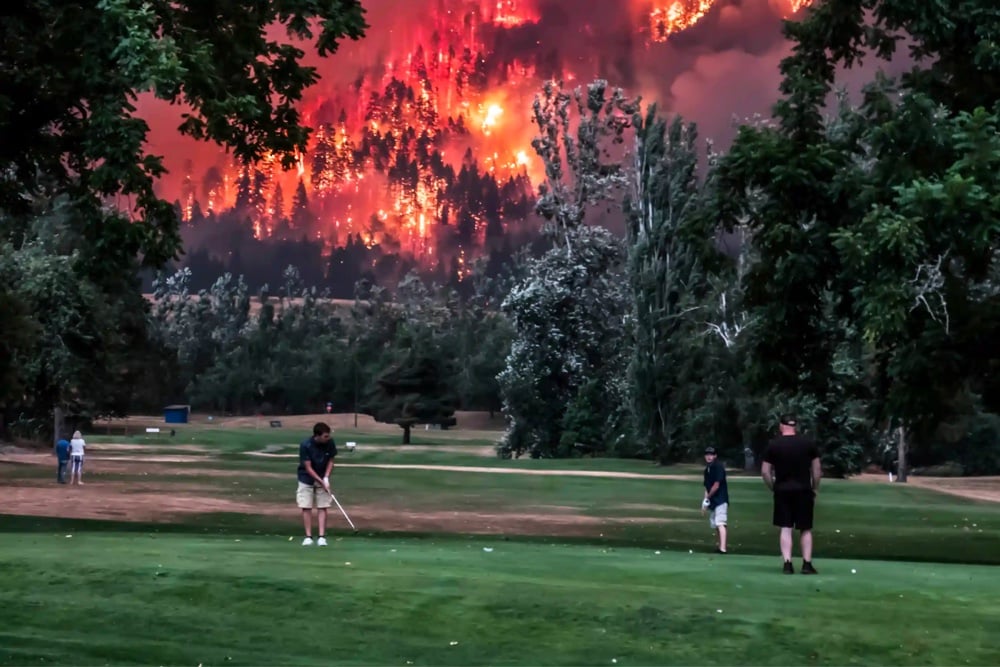
Many things that were once true — that we didn’t have adequate solutions, that the general public wasn’t aware or engaged — no longer are. Outdated information is misinformation, and the climate situation has changed a lot in recent years. The physical condition of the planet — as this summer’s unprecedented extreme heat and flooding and Canada’s and Greece’s colossal fires demonstrate — has continued to get worse; the solutions have continued to get better; the public is far more engaged; the climate movement has grown, though of course it needs to grow far more; and there have been some significant victories as well as the incremental change of a shifting energy landscape.
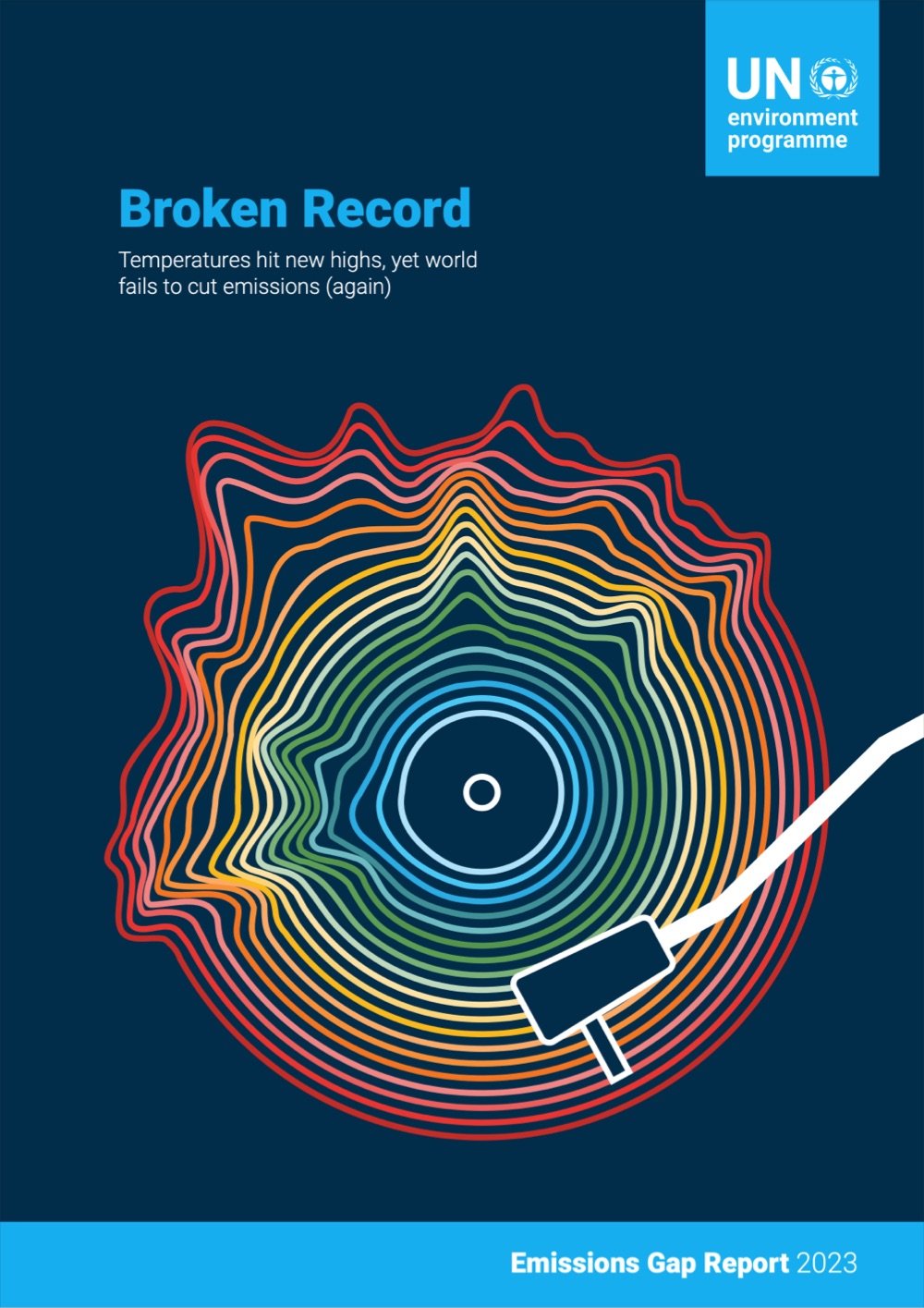
Amazing that an official UN climate report has this much biting personality. You can just sense the no-fucks-givenness of the people who put this together. After all:
Humanity is breaking all the wrong records when it comes to climate change. Greenhouse gas emissions reached a new high in 2022. In September 2023, global average temperatures were 1.8°C above pre-industrial levels. When this year is over, according to the European Union’s Copernicus Climate Change Service, it is almost certain to be the warmest year on record.
The 2023 edition of the Emissions Gap Report tells us that the world must change track, or we will be saying the same thing next year — and the year after, and the year after, like a broken record. The report finds that fully implementing and continuing mitigation efforts of unconditional nationally determined contributions (NDCs) made under the Paris Agreement for 2030 would put the world on course for limiting temperature rise to 2.9°C this century. Fully implementing conditional NDCs would lower this to 2.5°C. Given the intense climate impacts we are already seeing, neither outcome is desirable.
The report credits Beverley McDonald with the cover design — her website is here.
The climate crisis has hit home this year for many Americans — its effects have been nearly inescapable in most parts of the country. With that, writes Bill McKibben, has come a sense of unease about the future, particularly about the places we live and will be able to live.
Drawing on his experience as a Vermonter, McKibben argues that no place is truly safe from the effects of the climate crisis, but we can find protection from it by rebuilding our sense of community and social trust. Those things can provide the resilience we’re going to need to get though this.
We’ve come through 75 years where having neighbors was essentially optional: if you had a credit card, you could get everything you needed to survive dropped off at your front door. But the next 75 years aren’t going to be like that; we’re going to need to return to the basic human experience of relying on the people around you. We’re going to need to rediscover that we’re a social species, which for Americans will be hard — at least since Reagan we’ve been told to think of ourselves first and foremost (it was his pal Margaret Thatcher who insisted ‘there is no such thing as society, only individual men and women.”) And in the Musk/Trump age we’re constantly instructed to distrust everyone and everything, a corrosion that erodes the social fabric as surely as a rampaging river erodes a highway.
Update:Here’s an example of what McKibben is talking about w/r/t Vermont’s sense of community:
Someone called Susan from Hollister Hill brought them sandwiches and brownies every day for two weeks after the flood. Bill from East Montpelier showed up and turned out to be a kind of one-man construction crew, and he’s been coming for weeks, pushing river sediment around and clearing out barns.
Over 50 people came to help. And at the end of these days, there were bonfires and pizza.
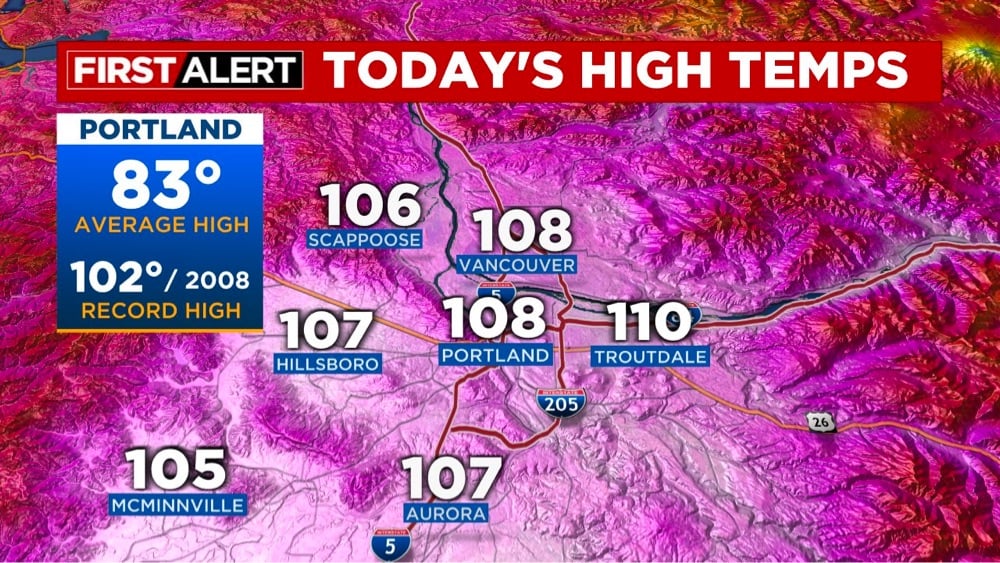
Obviously, I’m naming heatwaves to highlight this worsening climate problem and perhaps save lives by getting the public to focus on this weather threat. This year I’m naming major heatwaves after oil companies to shame them in the process and to identify culprits that are exacerbating these deadly systems.
And several more as needed. Here’s Walton’s criteria for choosing what constitutes a nameable heatwave (mirroring the scale for hurricanes):
CAT 3: A major level heatwave severe enough such that a few fatalities are reported. A city in a CAT 3 heat wave would be under a heat emergency for a few days. Many heat records would be either tied or broken.
A CAT3 or higher heatwave would be considered to be a major heatwave and would get a fossil fuel corporation name.
The highest category of heatwave is CAT5:
CAT 5. Catastrophic heat wave. Many all-time temperature records would be shattered with thousands of deaths reported. Remember the European heat wave of 2003 in which there were well in excess of 10,000 fatalities? This event would certainly fit my CAT 5 category.
The media should actually start using these more widely. (via @dens)
Let me give you an example of a tiny impact that I just heard about. My wife told me about a new group of members at her gym: active 70-ish-year-olds who used to go on walks around their neighborhood. Due to the unbearable heat in Texas, though, they joined a gym and now walk indoors on treadmills. This story embodies several aspects of climate impacts that everyone should understand.
First, this is an example of non-linear climate impacts. Although temperatures have been rising gradually over the last century, it was only recently that they crossed a critical threshold that made outdoor walks literally unbearable for these people.
Second, this is what adaptation to climate change looks like. Contrary to how it is typically portrayed by climate dismissives, adaptation is not free. These people are paying $50 per month for the gym membership that is an inferior replacement for something they used to get for free: an environment cool enough to walk in.
So these people are worse off financially and not getting as good of an experience as they used to. And they’re the lucky ones — they have the opportunity and resources to do this.
There’s also the non-monetary costs of adaptation. When it’s too hot to go outside during the day, you are a prisoner of air conditioning instead of going outside and getting fresh air and exercise. We’ve lost something valuable but difficult to quantify.
Some great points here. Reading it made me think of the gun problem here in the US. The focus is often on the immediate damage that guns do (mass shootings, suicides) but there are hundreds of other ways, large and small, in which guns make Americans’ lives worse. For many people, the number of guns in this country and the hard-line views held by those who own them add up to a general vibe of feeling unsafe and under threat. For me, it definitely seems like “we’ve lost something valuable but difficult to quantify” by allowing so many guns to exist in our communities.
Many things that were once true — that we didn’t have adequate solutions, that the general public wasn’t aware or engaged — no longer are. Outdated information is misinformation, and the climate situation has changed a lot in recent years. The physical condition of the planet — as this summer’s unprecedented extreme heat and flooding and Canada’s and Greece’s colossal fires demonstrate — has continued to get worse; the solutions have continued to get better; the public is far more engaged; the climate movement has grown, though of course it needs to grow far more; and there have been some significant victories as well as the incremental change of a shifting energy landscape.
I don’t think of myself as a climate doomer, but I certainly feel less hopeful about the situation than Solnit does. She asserts that the main obstacles to meaningful action on the climate crisis in the West are politics and capitalism, which is supposed to make readers feel hopeful. But that’s the part that often fills me with despair. The unpopular extremist party that controls more than half of the political apparatus in the country with the biggest responsibility to fix the planet is not only not interested in doing so, they are actively working against it. And they’ve built up such a wall against public accountability that I don’t know if protest (which they will make illegal if they can) or even voting (which they’ve fought to make more difficult) are meaningful levers with which to try and change the situation.
Climate anxiety differs from many forms of anxiety a person might discuss in therapy — anxiety about crowds, or public speaking, or insufficiently washing one’s hands — because the goal is not to resolve the intrusive feeling and put it away. “It’s not a keep-calm-and-carry-on approach,” Davenport told me. When it comes to climate change, the brain’s desire to resolve anxiety and distress often leads either to denial or fatalism: some people convince themselves that climate change is not a big deal, or that someone else will take care of it; others conclude that all is lost and there’s nothing to be done. Davenport pushes her clients to aim for a middle ground of sustainable distress. We must, she says, become more comfortable in uncertainty, and remain present and active in the midst of fear and grief. Her clients usually struggle with this task in one of two ways, she said: they tend to be activists who can’t acknowledge their feelings or people so aware of their feelings that they fail to act.
Hey folks. I’m sure you’ve read about the heavy rains and the flooding in the Northeast, particularly in New York and Vermont. My town here in central VT did not flood last night (though some area fields may have) and appears to be out of danger but other places around me were not so lucky.
In particular, I’m stunned by the several feet of water that are currently covering Montpelier, the capital of Vermont and a place that I know pretty well. This is a video from late last night and early this morning of someone paddling around downtown Montpelier, surveying the flooding and interviewing locals:
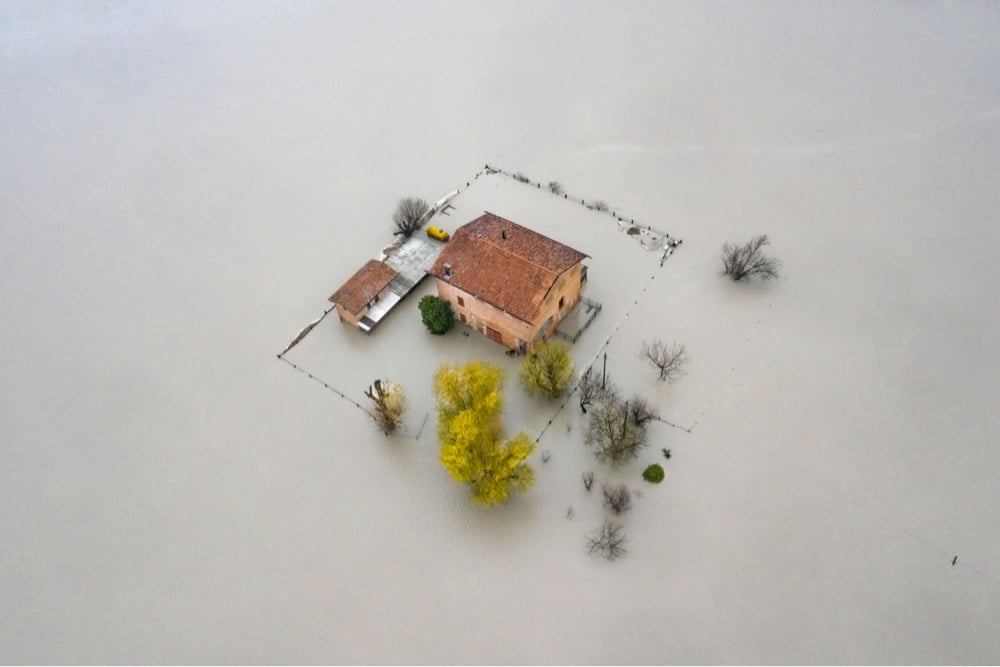
The water is not rushing, just standing, and there is almost no one around — there’s an eerie quiet that’s punctuated by the sounds of alarms going off all around. And there’s just so much water. Here’s a drone view of Montpelier (photo) from this morning:
“This has never happened since the dam was built so there is no precedent for potential damage,” City Manager William Fraser wrote in a statement posted to Montpelier’s Facebook page at 3:53 a.m. “There would be a large amount of water coming into Montpelier which would drastically add to the existing flood damage.”
People who live along the north branch and in downtown Montpelier are at greatest risk, he said. The dam, located on the border of Middlesex and Montpelier, is located about three miles north of the city center.
With “few evacuation options remaining,” Fraser wrote, “People in at risk areas may wish to go to upper floors in their houses.”
I’ve walked those streets a lot. Been to many of those shops. Eaten in those restaurants. Watched dozens of films in those movie theaters. I cannot believe how much water there is. So many people are going to be displaced from their homes for weeks and months. Businesses will be closed for weeks? Months? Some may never reopen. I’m not sure what else to say here.
One of the things I’ve been doing this morning is trying to figure out why some places (Montpelier) got hit hard while other low-lying areas less than 15-20 miles away didn’t. And I’ve come to the conclusion that water does not give a fuck. Not about logic or human life or property. It just flows where it wants. There’s more rain over here than there is over there — because a butterfly’s wing flapped halfway across the world.
Climate disasters, fueled by large-scale, human-driven changes in the global climate, are becoming more frequent. In the past few weeks in Vermont, we’ve had wildfire smoke from Canada forcing people to stay inside, a heat wave, and now this flooding. And Vermont is a place that is supposedly safer for climate refugees to go. But that’s the thing about a global climate crisis: it’s going to affect absolutely everyone absolutely everywhere.
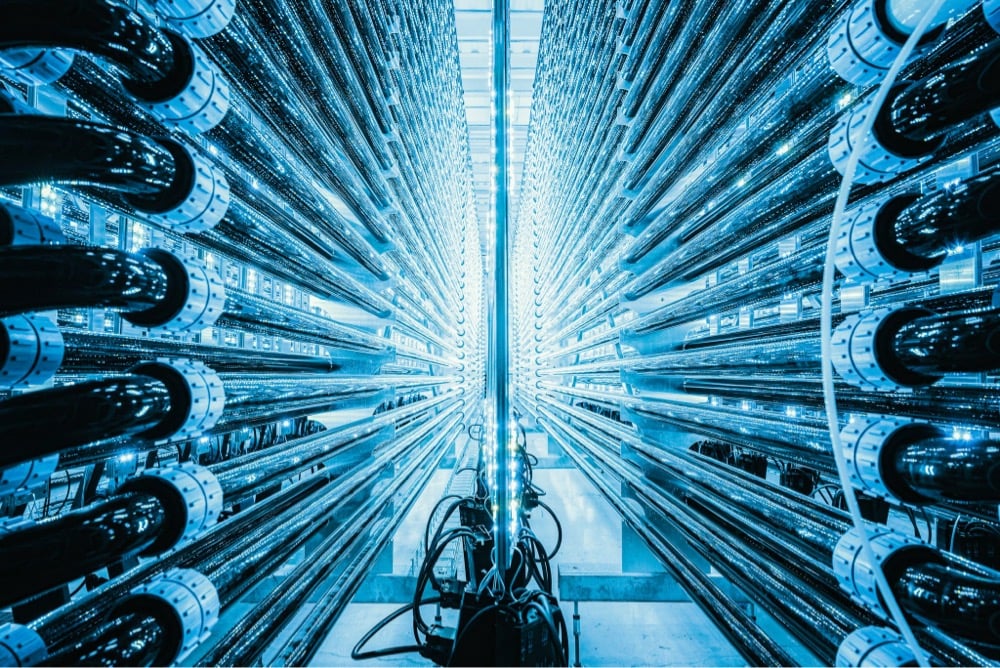
To effectively combat the climate crisis, we’re going to need to remove carbon from the atmosphere. But what’s the best way to do it? Two of the main solutions being considered are direct carbon capture technology and growing trees and each approach has its pros and cons.
Carbon removal is a catch-all term for anything that people do that pulls CO2 out of the air and stores it somewhere else. To meet the world’s climate goals, we would need to do this on a massive scale — anywhere from 440 billion to 1.1 trillion metric tons before the end of the century. That’s more carbon than the U.S. has emitted in its entire history.
So how do we remove all that carbon? There are two carbon removal ideas that have really captured the conversation. One is direct air capture, which involves big factories that suck in tons of CO2 from the atmosphere, chemically concentrate it, and store it deep in the ground. The other idea is to simply plant trees! After all, trees have naturally sequestered carbon for millions of years.
This is sobering: in an ad for the United Nations Global Compact, the words of Carl Sagan from nearly 40 years ago warn us of the necessity for urgent action on climate change, deforestation, and extinction.
Life is something rare and precious. There is something extraordinary about the planet that we are privileged to live on. The human species is destroying forests and we’re doing it at a rate of one acre of forest every second. We’re doing something immensely stupid.
Eternal Spring is a short timelapse film by Christopher Dormoy featuring beautiful shots of melting snow and ice. Watching this, it is difficult not to think of the climate crisis, which is of course the whole point.
Ice is a beautiful element I love to work with in my video projects. I wanted to feature the ice melting aspect in timelapse process to illustrate the phenomenon of global warming. Melting ice is beautiful and symbolizes spring, but it can also symbolize a problematic aspect of our climate.
And wow, that shot of the Moon at the halfway point… (via colossal)
The climate change crisis has become so dire that we’re being forced not only to think of ways to curb emissions and mitigate greenhouse gases, but of ways to adapt to our current situation to buy ourselves more time.
One of those technologies is called solar geoengineering. It happens in nature when huge volcanic eruptions cover the stratosphere with ash: That ash forms a layer that reflects sunlight and cools the planet underneath. Solar geoengineering takes advantage of that principle, using different scientific methods to make the planet more reflective overall. The problem is, deploying it would require messing with our very complicated climate on a massive scale, and many scientists don’t think the risks are worth it.
In 1976, the price per watt of energy generated by solar photovoltaic was over $100. In 2019, it was less than 50 cents per watt, a price decline of 99.6%. Even since 2009, solar has declined 90% in price. So what’s behind that incredible drop? Industry played a part but the main driver was forward-thinking government policy and subsidy of solar by countries like the US, Japan, Germany, and China:
In the course of a single lifetime, solar energy has transformed from a niche technology to the cheapest way to bring clean, reliable power to billions of people around the world. But the markets that brought us these lower prices didn’t just magically appear by some invisible hand. Political leaders in countries all over the world created these markets, then subsidized them for decades to the tune of billions of dollars. “By investing that money, you got the solar to come down in costs to the point where you don’t need to subsidize it anymore.”
The first few sentences of the abstract for this paper from the scientific journal Renewable Energy contain a twist in the middle that’s worthy of M. Night Shyamalan:
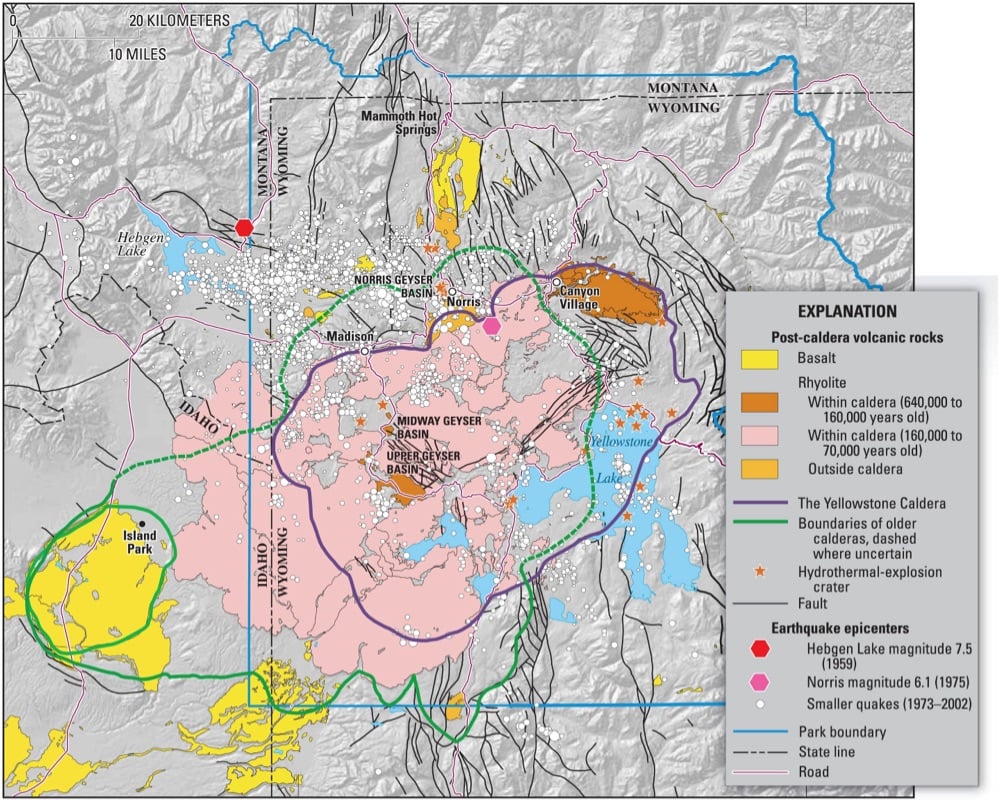
The USA is confronted with three epic-size problems: (1) the need for production of energy on a scale that meets the current and future needs of the nation, (2) the need to confront the climate crisis head-on by only producing renewable, green energy, that is 100% emission-free, and (3) the need to forever forestall the eruption of the Yellowstone Supervolcano. This paper offers both a provable practical, novel solution, and a thought experiment, to simultaneously solve all of the above stated problems.
Yellowstone, it turns out, is a supervolcano. It sits on top of an enormous hot spot, a reservoir of molten rock that rises from at least 125 miles down in the Earth. The heat from the hot spot is what powers all of Yellowstone’s vents, geysers, hot springs, and popping mud pots. Beneath the surface is a magma chamber that is about forty-five miles across — roughly the same dimensions as the park — and about eight miles thick at its thickest point. Imagine a pile of TNT about the size of Rhode Island and reaching eight miles into the sky, to about the height of the highest cirrus clouds, and you have some idea of what visitors to Yellowstone are shuffling around on top of. The pressure that such a pool of magma exerts on the crust above has lifted Yellowstone and about three hundred miles of surrounding territory about 1,700 feet higher than they would otherwise be. If it blew, the cataclysm is pretty well beyond imagining. According to Professor Bill McGuire of University College London, “you wouldn’t be able to get within a thousand kilometers of it” while it was erupting. The consequences that followed would be even worse.
Back to the paper. The authors are proposing to generate massive amounts of energy from the supervolcano — “well over 11 Quadrillion Watt hours of electrical energy” per year:
Through a new copper-based engineering approach on an unprecedented scale, this paper proposes a safe means to draw up the mighty energy reserve of the Yellowstone Supervolcano from within the Earth, to superheat steam for spinning turbines at sufficient speed and on a sufficient scale, in order to power the entire USA. The proposed, single, multi-redundant facility utilizes the star topology in a grid array pattern to accomplish this. Over time, bleed-off of sufficient energy could potentially forestall this Supervolcano from ever erupting again.
I mean, this actually sounds like a great idea if it could be done safely, without ruining the park and, you know, accidentally blowing shit up. As of 2016, Iceland generated 65% of its energy from geothermal sources — the US could certainly stand to lean more on geothermal.
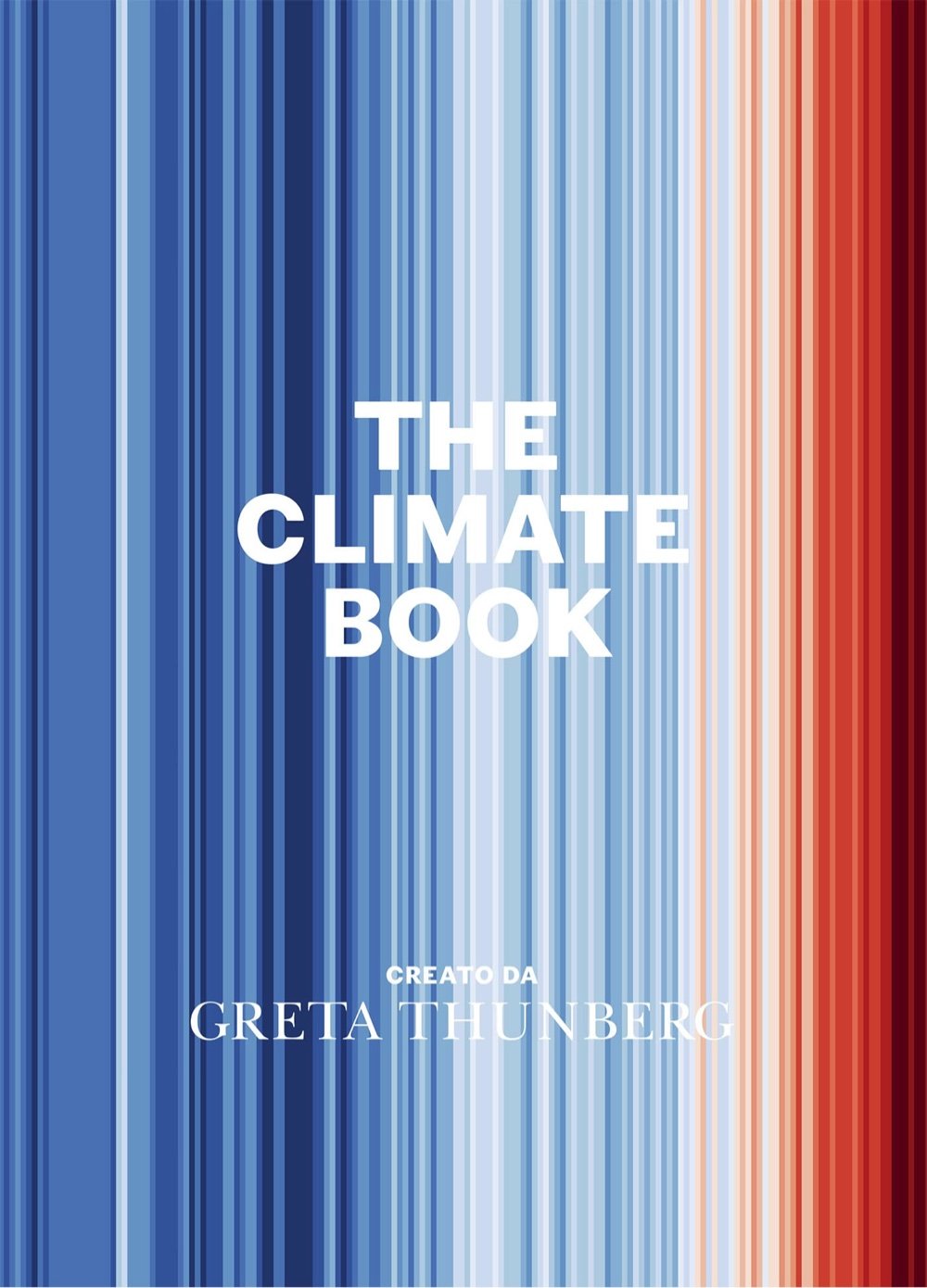
In The Climate Book, Greta Thunberg has gathered the wisdom of over one hundred experts — geophysicists, oceanographers and meteorologists; engineers, economists and mathematicians; historians, philosophers and indigenous leaders — to equip us all with the knowledge we need to combat climate disaster. Alongside them, she shares her own stories of demonstrating and uncovering greenwashing around the world, revealing how much we have been kept in the dark. This is one of our biggest challenges, she shows, but also our greatest source of hope. Once we are given the full picture, how can we not act? And if a schoolchild’s strike could ignite a global protest, what could we do collectively if we tried?
The book is already out in Europe (I actually included the European cover above because, unsurprisingly, it’s better than the US cover), but will be released in the US in February.
A Colorado man who set himself on fire in front of the Supreme Court on Friday in an apparent Earth Day protest against climate change has died, police said.
The Metropolitan Police Department of Washington, D.C., said that Wynn Bruce, 50, of Boulder, Colo., had died on Saturday from his injuries after being airlifted to a hospital following the incident. Members of his family could not be reached immediately for comment.
Kritee Kanko, a climate scientist at the Environmental Defense Fund and a Zen Buddhist priest in Boulder, said that she is a friend of Mr. Bruce and that the self-immolation was a planned act of protest.
“This act is not suicide,” Dr. Kritee wrote on Twitter early Sunday morning. “This is a deeply fearless act of compassion to bring attention to climate crisis.”
It’s shocking and sad but perhaps not surprising how little media attention this has gotten. Bruce, a Buddhist, seems to have planned this action for several weeks or even months, leaving clues in a repeatedly edited comment on Facebook. His action mirrors that of Thích Quảng Đức in 1963, who self-immolated in Saigon in 1963 to protest the persecution of Buddhists in South Vietnam. Rest in peace, Wynn Bruce.
Another oft-heard complaint is “nobody is doing anything about this”. But this is said by people who are not looking at what so many others are doing so passionately and often effectively. The climate movement has grown in power, sophistication and inclusiveness, and has won many battles. I have been around long enough to remember when the movement against what was then called “global warming” was small and mild-mannered, preaching the gospel of Priuses and compact fluorescent lightbulbs, and mostly being ignored.
One of the victories of climate activism — and consequences of dire climate events — is that a lot more people are concerned about climate than they were even a few years years ago, from ordinary citizens to powerful politicians. The climate movement — which is really thousands of movements with thousands of campaigns around the world - has had enormous impact.
A new video from Kurzgesagt is designed to provide a little hope that humans can figure a way out of the climate crisis, without being overly pollyannish.
And so for many the future looks grim and hopeless. Young people feel particularly anxious and depressed. Instead of looking ahead to a lifetime of opportunity they wonder if they will even have a future or if they should bring kids into this world. It’s an age of doom and hopelessness and giving up seems the only sensible thing to do.
But that’s not true. You are not doomed. Humanity is not doomed.
There’s been progress in the last decade, in terms of economics, technology, policy, and social mores. It’s not happening fast enough to limit warming to 1.5°C, but if progress continues, gains accumulate, people keep pushing, and politicians start to figure out where the momentum is heading, we can get things under control before there’s a global apocalypse.
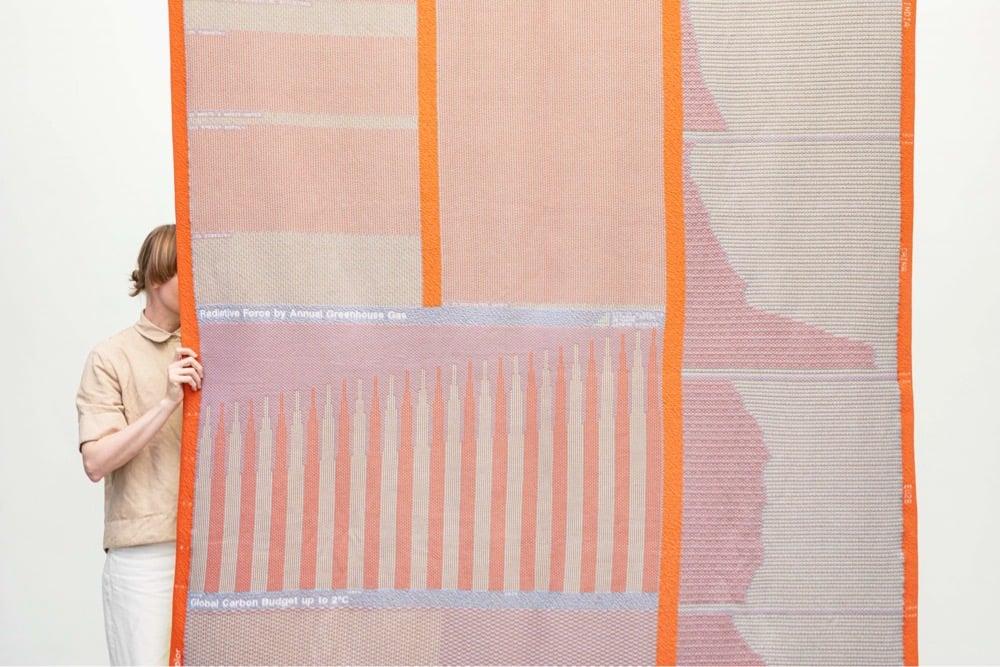
Temperature Textiles are knitted textiles like blankets, scarves, and socks with patterns drawn from climate crisis indicators like temperature, sea level rise, and CO2 emissions. See also Global Warming Blankets. (via colossal)





Stay Connected