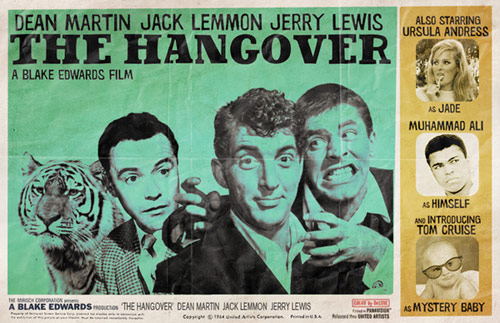
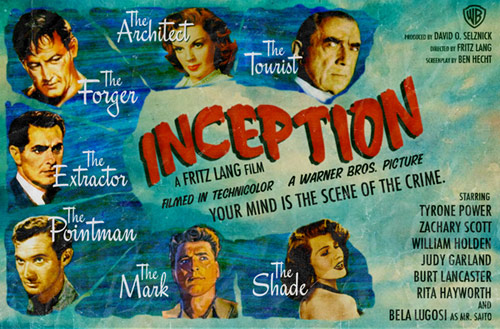
If recent movies like The Hangover, Drive, Inception, and Rushmore had been made in an earlier era, who would have starred in and directed these premakes? How about Dean Martin, Jack Lemmon, and Jerry Lewis in The Hangover?
Type designer Matthew Butterick sent a letter to director Brad Bird about the use of Verdana in captions and subtitles in the latest Mission Impossible movie.
Second, it’s not stylistically suitable. Verdana is a built-in font on nearly every Windows and Mac computer. It’s used on zillions of web pages. It’s ubiquitous. Therefore, the person who uses Verdana suggests to readers “I couldn’t be bothered to pick anything better.” It’s also well-known as the corporate font of IKEA — probably not the association you’re going for.
Lucas has decided to devote the rest of his life to what cineastes in the 1970s used to call personal films. They’ll be small in scope, esoteric in subject and screened mostly in art houses. They’ll be like the experimental movies Lucas made in the 1960s, around the time he was at U.S.C. film school, when he recorded clouds moving over the desert and made a movie based on an E. E. Cummings poem. During that period, Lucas assumed he would spend his career on the fringes. Then “Star Wars” happened — and though Lucas often mused about it, he never committed himself to the uncommercial world until now.
Sitting in a sun-drenched office, his voice boyish, Lucas talked about himself as if he were a character in one of his movies. He’s at the end of an epic saga; he’s embracing a new destiny (“Make the art films, George”); he’s battling former acolytes who have become his sworn enemies; and George Lucas is — no kidding — in love. Before he takes his digital camera with him into obscurity, though, Lucas has one last mission. He wants to prove that with “Red Tails,” he can still make the kind of movie everyone in the world will want to see.
This article, about how gender is manipulated in South Asia, is very difficult to read.
It’s a girl, a film being released this year, documents the practice of killing unwanted baby girls in South Asia. The trailer’s most chilling scene is one with an Indian woman who, unable to contain her laughter, confesses to having killed eight infant daughters.
The statistics are sickening. The UN reports approximately 200 million girls in the world today are ‘missing’. India and China are said to eliminate more female infants than the number of girls born in the US each year. Lianyungang in China has the worst infant gender ratio on record with 163 boys born for every 100 girls. Taiwan, South Korea and Pakistan are also countries in which unwanted female babies are aborted, killed or abandoned.
Clockwork would be shown in standard cinemas as a quality platform release, which meant there were many options per city. I knew that Don Rugoff’s Cinema 1, the most prestigious cinema in New York, had to be the New York theater, but how to be sure that the film would be booked into the best cinema in Indianapolis or Cleveland or Atlanta? To choose the right theater in each city, we needed to know which cinema sold the most tickets to the most interesting pictures. But while a studio would know what its own films grossed, detailed box-office figures of competitive films were closely held secrets. There was no comparative information, and that is exactly what Stanley wanted.
Influenced by Kubrick’s system, Variety released their first nation box office rankings chart a few months later. (via df)
Set on an island off the coast of New England in the summer of 1965, MOONRISE KINGDOM tells the story of two twelve-year-olds who fall in love, make a secret pact, and run away together into the wilderness. As various authorities try to hunt them down, a violent storm is brewing off-shore — and the peaceful island community is turned upside down in more ways than anyone can handle.
The sound and picture are poor, but the entirety of Errol Morris’ A Brief History of Time is available on YouTube.
Featuring music from Philip Glass, the film is a documentary about Stephen Hawking and his ideas about the universe. Morris recently stated on Twitter:
Yes. I plan to re-release [A Brief History of Time]. (It was never properly color corrected and is one of my best films.)
The film is difficult, if not impossible, to find on DVD and isn’t available on Netflix, Amazon Instant Video, or iTunes. And as far as I can tell, the soundtrack was never released either.
In a piece for Vanity Fair, Kurt Andersen argues that for the first time in recent history, American pop culture (fashion, art, music, design, entertainment) hasn’t changed dramatically in the past 20 years.
Since 1992, as the technological miracles and wonders have propagated and the political economy has transformed, the world has become radically and profoundly new. (And then there’s the miraculous drop in violent crime in the United States, by half.) Here is what’s odd: during these same 20 years, the appearance of the world (computers, TVs, telephones, and music players aside) has changed hardly at all, less than it did during any 20-year period for at least a century. The past is a foreign country, but the recent past — the 00s, the 90s, even a lot of the 80s — looks almost identical to the present. This is the First Great Paradox of Contemporary Cultural History.
Think about it. Picture it. Rewind any other 20-year chunk of 20th-century time. There’s no chance you would mistake a photograph or movie of Americans or an American city from 1972-giant sideburns, collars, and bell-bottoms, leisure suits and cigarettes, AMC Javelins and Matadors and Gremlins alongside Dodge Demons, Swingers, Plymouth Dusters, and Scamps-with images from 1992. Time-travel back another 20 years, before rock ‘n’ roll and the Pill and Vietnam, when both sexes wore hats and cars were big and bulbous with late-moderne fenders and fins-again, unmistakably different, 1952 from 1972. You can keep doing it and see that the characteristic surfaces and sounds of each historical moment are absolutely distinct from those of 20 years earlier or later: the clothes, the hair, the cars, the advertising — all of it. It’s even true of the 19th century: practically no respectable American man wore a beard before the 1850s, for instance, but beards were almost obligatory in the 1870s, and then disappeared again by 1900. The modern sensibility has been defined by brief stylistic shelf lives, our minds trained to register the recent past as old-fashioned.
One of the great charms of the Tin Tin movie (besides its solid story, and uplifting sensibility) is the incredible degree of detail, texture, lighting, and drama that infuses every scene. Because the whole movie is synthetic, every scene can be composed perfectly, lit perfectly, arranged perfectly, and captured perfectly. There is a painterly perfection that the original Tin Tin comics had that this movie captures. This means that the stupendous detail found in say TinTin’s room, or in a back alley, or on the ship’s deck can be highlighted beyond what it could in reality. You SEE EVERYTHING. When TinTin’s motorcycle is chasing the bad guy and begins to fall apart, nothing is obscured. Every realistic mechanical part is illuminated realistically. This technique gives a heightened sense of reality because every corner of the entire scene is heightened realistically, which cannot happen in real life, yet you only see real-looking things. This trick lends the movie a hyperreality. Its artificial world looks realer than real.
The uncanny valley issue has been less noticeable lately, but what really snaps me out of being immersed in movies lately is the Impossible Camera™. In 100% CGI shots, when cameras move quickly with sharp changes in direction over long distances, something that actual cameras can’t do, it snaps me right out of the action because it’s so obviously fake. For instance, any scene in the Tobey Maguire Spider-Man movies where Spidey is flying through Manhattan. Fay, fay, fake.
The Social Network (2010): “You don’t get scripts like that every day. You don’t get a studio coming to you saying, ‘We just fucking love this script. Let’s make it into a movie.’ So often people are mitigating against the disaster or trying to cover the downside and saying, ‘Well, OK, look, the script is great, but…’ [‘Can you make something out of it?’] Yeah.
I have given Fincher shit about the films he’s chosen to make but it turns out that he’s better at spotting good material than I am. Go figure. (via @khoi)
The message I get is that Americans love the movies as much as ever. It’s the theaters that are losing their charm. Proof: theaters thrive that police their audiences, show a variety of titles and emphasize value-added features. The rest of the industry can’t depend forever on blockbusters to bail it out.
Starting today and continuing for the next four weeks, IFC Center in NYC is showing a “comprehensive retrospective” of films (Princess Mononoke, Spirited Away, My Neighbor Totoro) made by Studio Ghibli. Most of the films are new 35mm prints and some will be screened in dubbed and subtitled Japanese versions.
Q: It seems that the script is sometimes an after-thought on huge productions.
A: ‘Yes and you swear that you’ll never get involved with shit like that, and it happens. On “Quantum”, we were fucked. We had the bare bones of a script and then there was a writers’ strike and there was nothing we could do. We couldn’t employ a writer to finish it. I say to myself, “Never again”, but who knows? There was me trying to rewrite scenes - and a writer I am not.’
Q: You had to rewrite scenes yourself?
A: ‘Me and the director [Marc Forster] were the ones allowed to do it. The rules were that you couldn’t employ anyone as a writer, but the actor and director could work on scenes together. We were stuffed. We got away with it, but only just. It was never meant to be as much of a sequel as it was, but it ended up being a sequel, starting where the last one finished.’
I wonder how many other movies that happened with? io9 and Screenrant speculated on this very question after the strike ended. (via df)
American Masters presents the first film made about America’s most important and influential designers, Charles and Ray Eames, since their deaths in 1978 and 1988, respectively — and the only film that explores the link between their artistic collaboration and sometimes tortured marriage. Jason Cohn and Bill Jersey’s definitive documentary delves into the private world the Eameses created in their Renaissance-style, Venice Beach, California studio, where design history was born. Narrated by James Franco, Charles & Ray Eames: The Architect and the Painter premieres nationally Monday, December 19 from 10-11:30 p.m. (ET/PT) on PBS (check local listings) as the 25th anniversary season finale of American Masters.
Pete Docter, from Monsters, Inc. and Up, is doing a new film that takes place inside of a girl’s mind and it is about her emotions as characters, and that is unlike anything you’ve ever seen.
Girl Walk // All Day is a feature-length dance music video set in NYC…the soundtrack is Girl Talk’s All Day. Kickstarter is hosting a premiere for the film (+ dance party) on December 8 at the Brooklyn Masonic Temple…and it’s free (you just need to RSVP). Here’s the trailer:
This is Arnold Schwarzenegger doing the DVD commentary for Total Recall. Instead of adding any context to the film, he simply describes exactly what was happening in each scene.
I have three guesses as to what’s going on here:
1. It’s a fake from a really good impersonator.
2. Arnold is dumb and he’s unaware of how dumb he is.
3. But my money’s on this one: Arnold was contractually obligated to do the DVD commentary but when it came to it, he didn’t really want to. So he torpedoed the whole thing and had some fun in the meantime. (via stellar)
For nearly three decades, Landis has visited museums across the US in various guises and tried to donate paintings he has forged. As well as Father Scott, he has posed as “Steven Gardiner” among other aliases. He never asks for money, although museums have often hosted meals for him and made small gifts. His only stipulation is that he is donating in his parents’ names — often his actual father, Lieutenant Commander Arthur Landis Jr, a former US Navy officer.
Landis has been prolific and amazingly persistent. A few weeks before he came to Lafayette, “Father Scott” arrived at the Nelson-Atkins Museum of Art in Kansas City, Missouri, with a forgery of Head of a Sioux by Alfred Jacob Miller that he said he was giving in memory of his mother, “Helen Mitchell Scott”. Landis has so far offered copies of that work to five other museums. Yet in all this time, although curators speculate about his motives, no one has found out why he is doing it.
Update: Landis is the subject of a documentary film called Art and Craft.
Mark Landis has been called one of the most prolific art forgers in US history. His impressive body of work spans thirty years, covering a wide range of painting styles and periods that includes 15th Century Icons, Picasso, and even Walt Disney. And while the copies could fetch impressive sums on the open market, Landis isn’t in it for money. Posing as a philanthropic donor, a grieving executor of a family member’s will, and most recently as a Jesuit priest, Landis has given away hundreds of works over the years to a staggering list of institutions across the United States.
Collections of Stanley Kubrick’s movies are on sale at Amazon today only: on DVD for $31.50 and on Blu-ray for $63…both collections are 58% off retail.
SPARTACUS (1960) The genre-defining epic tale of a bold gladiator (Kirk Douglas) who leads a triumphant Roman slave revolt.
LOLITA (1962) Academic Humbert Humbert (James Mason) is obsessed with a blithe teen (Sue Lyon) in a dark comedy from Vladimir Nabokov’s novel.
DR. STRANGELOVE (1964) “Accidental” nuclear apocalypse, anyone? Peter Sellers heads the cast of one of the most blazingly hilarious movies of all time.
2001: A SPACE ODYSSEY (1968) “The most awesome, beautiful and mentally stimulating science-fiction film of all time” (Danny Peary, Guide for the Film Fanatic).
A CLOCKWORK ORANGE: 40th Anniversary Edition (2-Discs) (1971) Future world neo-punk Malcolm McDowell becomes the guinea pig for a government cure of his tendency toward “the old ultraviolence.”
BARRY LYNDON (1975) The visually spellbinding tale of an 18th-century Irish rogue’s (Ryan O’Neal) climb to wealth and privilege.
THE SHINING (1980) In a macabre masterpiece adapted from Stephen King’s novel, Jack Nicholson falls prey to forces haunting a snowbound mountain resort.
FULL METAL JACKET (1987) Marine recruits endure basic training under a leather-lunged D.I., then plunge into the hell of Vietnam.
EYES WIDE SHUT (1999) A wife’s admission of unfulfilled longing plunges a Manhattan doctor into a bizarre erotic odyssey. Tom Cruise and Nicole Kidman star.
KOYAANISQATSI, [Godfrey] Reggio’s debut as a film director and producer, is the first film of the QATSI trilogy. The title is a Hopi Indian word meaning “life out of balance.” Created between 1975 and 1982, the film is an apocalyptic vision of the collision of two different worlds — urban life and technology versus the environment. The musical score was composed by Philip Glass.
The entire film is available on both YouTube and Hulu.
Why not the same thing [as Newsstand] for TV channels? We’re seeing the beginnings of this, with iPhone and iPad apps like HBO Go, Watch ESPN, and the aforementioned Bloomberg TV+. Letting each TV network do their own app allows them the flexibility that writing software provides. News networks can combine their written and video news into an integrated layout. Networks with contractual obligations to cable operators, like HBO and ESPN, can write code that requires users to log in to verify their status as an eligible subscriber.
This smells right to me…it’s a very Apple-y way of approaching the TV/movie problem. Rather than fight with the studios and networks over content sold through the iTunes Store (where the studios control the licensing rights), just provide a platform (iPhone + iPad + iTV + App Store) controlled by Apple and if the studios/networks want to reach those customers, they need to provide an app…with Apple taking a 30% cut of the App *and* content sales.
The husband-and-wife team of Charles and Ray Eames are widely regarded as America’s most important designers. Perhaps best remembered for their mid-century plywood and fiberglass furniture, the Eames Office also created a mind-bending variety of other products, from splints for wounded military during World War II, to photography, interiors, multi-media exhibits, graphics, games, films and toys. But their personal lives and influence on significant events in American life — from the development of modernism, to the rise of the computer age — has been less widely understood. Narrated by James Franco, Eames: The Architect and the Painter is the first film dedicated to these creative geniuses and their work.
Note: If you are a member and tried to log in, it didn't work, and now you're stuck in a neverending login loop of death, try disabling any ad blockers or extensions. Or try logging out and then back in. Still having trouble? Email me!





Socials & More