



The sounds of Aronofsky
The person who made Wes Anderson From Above and Tarantino From Below has put together a supercut of distinct sounds from Darren Aronofsky’s films.
(via ★interesting)

This site is made possible by member support. 💞
Big thanks to Arcustech for hosting the site and offering amazing tech support.
When you buy through links on kottke.org, I may earn an affiliate commission. Thanks for supporting the site!
kottke.org. home of fine hypertext products since 1998.
Beloved by 86.47% of the web.
The person who made Wes Anderson From Above and Tarantino From Below has put together a supercut of distinct sounds from Darren Aronofsky’s films.
(via ★interesting)
Taken from the Studio Stories series included on the Blu-ray versions of Toy Story 1 & 2, here’s a short story about how Toy Story 2 was almost erased before the film could be rendered for theaters.
Woody’s hat disappeared. And then his boots disappeared. And then as we kept checking, he disappeared entirely. Woody’s gone.
(via tested)
Update: Over at Quora, Oren Jacob (the guy in the video) explains in more detail what happened.
First, it wasn’t multiple terabytes of information. Neither all the rendered frames, nor all the data necessary to render those frames in animation, model, shaders, set, and lighting data files was that size back then.
A week prior to driving across the bridge in a last ditch attempt to recover the show (depicted pretty accurately in the video above) we had restored the film from backups within 48 hours of the /bin/rm -r -f *, run some validation tests, rendered frames, somehow got good pictures back and no errors, and invited the crew back to start working. It took another several days of the entire crew working on that initial restoral to really understand that the restoral was, in fact, incomplete and corrupt. Ack. At that point, we sent everyone home again and had the come-to-Jesus meeting where we all collectively realized that our backup software wasn’t dishing up errors properly (a full disk situation was masking them, if my memory serves), our validation software also wasn’t dishing up errors properly (that was written very hastily, and without a clean state to start from, was missing several important error conditions), and several other factors were compounding our lack of concrete, verifiable information.
The only prospect then was to roll back about 2 months to the last full backup that we thought might work. In that meeting, Galyn mentioned she might have a copy at her house. So we went home to get that machine, and you can watch the video for how that went…
Taxi Driver reimagineered to portray Travis Bickle as obsessed with Mickey Mouse.
(via waxy)
A group photograph of MGM’s stars and starlets under contract, taken for the studio’s 20th anniversary in 1943.
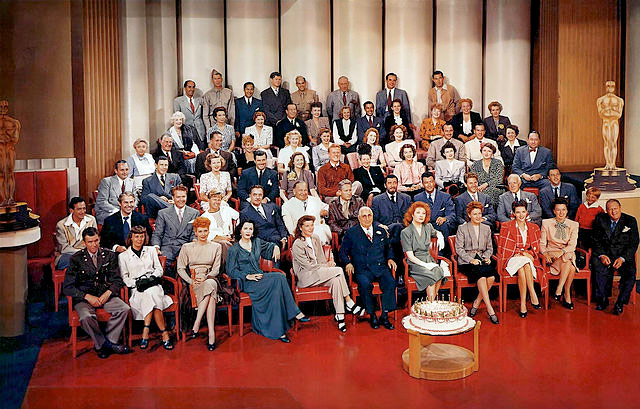
The full-size photo is available at Mlkshk or at Wikipedia for stargazing. Here’s who’s in the photo:
Front Row: James Stewart, Margaret Sullavan, Lucille Ball, Hedy Lamarr, Katharine Hepburn, Louis B Mayer, Greer Garson, Irene Dunne, Susan Peters, Ginny Simms, Lionel Barrymore
Second Row: Harry James, Brian Donlevy, Red Skelton, Mickey Rooney, William Powell, Wallace Beery, Spencer Tracy, Walter Pidgeon, Robert Taylor, Pierre Aumont, Lewis Stone, Gene Kelly, Jackie Jenkins
Third Row: Tommy Dorsey, George Murphy, Jean Rogers, James Craig, Donna Reed, Van Johnson, Fay Bainter, Marsha Hunt, Ruth Hussey, Marjorie Main, Robert Benchley
Fourth Row: Dame May Whitty, Reginald Owen, Keenan Wynn, Diana Lewis, Marilyn Maxwell, Esther Williams, Ann Richards, Marta Linden, Lee Bowman, Richard Carlson, Mary Astor
Fifth Row: Blanche Ring, Sara Haden, Fay Holden, Bert Lahr, Frances Gifford, June Allyson, Richard Whorf, Frances Rafferty, Spring Byington, Connie Gilchrist, Gladys Cooper
Sixth Row:
Ben Blue, Chill Wills, Keye Luke, Barry Nelson, Desi Arnaz, Henry O’Neill, Bob Crosby, Rags Ragland
From twenty years ago, Stephen Hawking reviews the film version of A Brief History of Time.
I have been fortunate in the director of the film, Errol Morris. He is a man of integrity, with a feeling for the issues. It would have been all too easy to have someone who would have concentrated on the more sensational aspects of my private life, and my medical condition, and who would have treated the science in a superficial way. A friend of mine, who has had several television programmes based on his work, was envious of how the scientific ideas came through on the film.
(via @errolmorris)
For Sight & Sound magazine, Roger Ebert came up with his picks for ten best films ever.
“Citizen Kane” speaks for itself. “2001: A Space Odyssey” is likewise a stand-along monument, a great visionary leap, unsurpassed in its vision of man and the universe. It was a statement that came at a time which now looks something like the peak of humanity’s technological optimism. Many would choose “Taxi Driver” as Scorsese’s greatest film, but I believe “Raging Bull” is his best and most personal, a film he says in some ways saved his life. It is the greatest cinematic expression of the torture of jealousy — his “Othello.”
(via df)
Hyman Strachman is one of the biggest bootleggers of Hollywood movies. He’s also 92 years old, a WWII veteran, and gives his movies away to American troops serving overseas.
“Big Hy” — his handle among many loyal customers — would almost certainly be cast as Hollywood Enemy No. 1 but for a few details. He is actually Hyman Strachman, a 92-year-old, 5-foot-5 World War II veteran trying to stay busy after the death of his wife. And he has sent every one of his copied DVDs, almost 4,000 boxes of them to date, free to American soldiers in Iraq and Afghanistan.
With the United States military presence in those regions dwindling, Big Hy Strachman will live on in many soldiers’ hearts as one of the war’s more shadowy heroes.
“It’s not the right thing to do, but I did it,” Mr. Strachman said, acknowledging that his actions violated copyright law.
From PBS Off Book, a quick look at the thinking behind the opening titles for TV shows and movies, including Zombieland, Mad Men, and Se7en.
See also Art of the Title and A Brief History of Title Design. (via devour)
As Allen Fuqua travels around, he looks for movie locations and attempts to duplicate scenes from them. For instance, here’s Allen and a friend reenacting a scene from Drive:
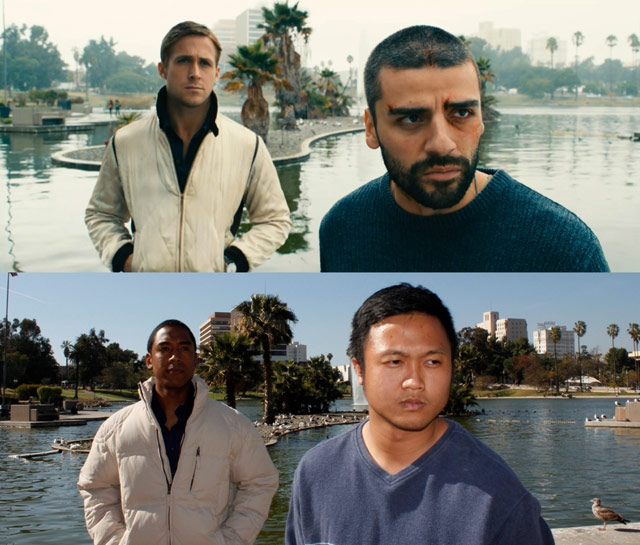
(thx, stephen)
Journalist William Zinsser played a bit part in Stardust Memories, one of Woody Allen’s early films. He’d interviewed Allen early in the director’s career, ran into him in NYC, and got a call a week later from his assistant.
“Bill, honey?” said a young woman’s voice. “This is Sandra from Woody Allen’s office. Woody wondered if you’d like to be in his new movie.”
That was something new in phone calls. I had never done any acting or dreamed any theatrical dreams. But who didn’t want to be in a Woody Allen movie? I knew that he often cast ordinary people in small roles. What small plum did he have for me? I hesitated for a decently modest moment and then told Sandra I’d like to do it.
“Good,” she said. “Woody will be very pleased.” She said that someone else would be calling me with further details.
(via @coudal)
Remember the Netflix Prize, the $1 million challenge cooked up by Netflix to improve their movie recommendation engine by 10%? Turns out they never implemented the winning algorithm, in part because their movie streaming service changed the game.
One of the reasons our focus in the recommendation algorithms has changed is because Netflix as a whole has changed dramatically in the last few years. Netflix launched an instant streaming service in 2007, one year after the Netflix Prize began. Streaming has not only changed the way our members interact with the service, but also the type of data available to use in our algorithms. For DVDs our goal is to help people fill their queue with titles to receive in the mail over the coming days and weeks; selection is distant in time from viewing, people select carefully because exchanging a DVD for another takes more than a day, and we get no feedback during viewing. For streaming members are looking for something great to watch right now; they can sample a few videos before settling on one, they can consume several in one session, and we can observe viewing statistics such as whether a video was watched fully or only partially.
(via waxy)
The latest installment of the Up Series of documentary films is due out in the UK in May. The films have followed the development of fourteen British children since 1964 with a new film appearing every seven years…the participants are now 56. A few details about the new film are revealed in this interview with one of the participants.
One of the issues that Apted reflects on in 56 Up is the way Britain has changed. “Michael asked us about how education had changed, because people are borrowing money to go to university now,” Mr Hitchon said. “In our day, none of us paid for our education. England’s also changed a lot. For instance, no one is farming the Dales any more and there are all these multimillion-pound houses. I don’t know what England’s like any more. I’ve been away for 30 years.”
Apted also revisits the theme of success. “If you’re still hanging in there and swinging punches then you’re a success,” said Mr Hitchon. “Does that apply to me? Sure, why not? I’m working all the time to solve problems that I think are important. I’m hanging in there despite the fact that it doesn’t all go the way you hope.”
This may be the last film in the series…director Michael Apted will be 78 when the next film is due and he’s unwilling to pass it off to someone else to finish. (thx, raynor)
Primer is one of my favorite films of the past ten years and is available on YouTube in its entirety.
Directed by Ice-T, Something From Nothing: The Art of Rap is a documentary about the birth and evolution of rap and hip hop music.
Ice-T takes us on an intimate journey into the heart and soul of hip-hop with the legends of rap music. This performance documentary goes beyond the stardom and the bling to explore what goes on inside the minds, and erupts from the lips, of the grandmasters of rap. Recognized as the godfather of Gangsta rap, Ice-T is granted unparalleled access to the personal lives of the masters of this artform that he credits for saving his life. Interspersed with the performers’ insightful, touching, and often funny revelations are classic raps, freestyle rhymes, and never before heard a cappellas straight from the mouths of the creators. What emerges is a better understanding of, and a tribute to, an original American art form that brought poetry to a new generation.
(via @gavinpurcell)
Alive Inside is a documentary that follows social worker Dan Cohen as he discovers that music can “awaken” people suffering from degenerative memory loss (Alzheimer’s, etc.). Here’s a clip in which a man goes from a near-coma state to talking about his favorite songs after listening to music for awhile on headphones.
(via ★swissmiss)
A collection of scenes featuring movie stars before they were stars…like Nicolas Cage in Fast Times at Ridgemont High and Renee Zellweger in Dazed and Confused.
They missed one of my favorites…James Earl Jones as Lieutenant Zogg in Dr. Strangelove. (via devour)
This is expertly done…a panoramic time lapse view out the rear window in Rear Window, stitched together from scenes in the film.
More information on how it was made. (via ★interesting)
OK, Internet, shut it down. We’ve had enough for the day. I recognize this news will be relevant and interesting to only a small percent of the Kottke population, but to those people, it is extremely and earthshatteringly relevant. Personally, my ears started ringing while reading the headline. Michael K Williams, best known for his role as Omar on The Wire, will play Ol’ Dirty Bastard in an upcoming movie.
Titled Dirty White Boy, the film focuses on the offbeat friendship between the Wu-Tang Clan co-founder and Jarred Weisfeld, a 22-year-old VH1 production assistant who through a lot of hustle (and the occasional lie) talked his way into becoming the rapper’s manager when Jones was serving a three-year stint in prison in the early 2000s.
(via @mikenizza)
According to Peter Sciretta at Slashfilm, Topher Grace has made an 85-minute cut of Star Wars episodes I, II, and III where Jar Jar appears only briefly, midichlorians are not mentioned, and Jake Lloyd is not seen or heard from.
Whats most shocking is that with only 85 minutes of footage, Topher was able to completely tell the main narrative of Anakin Skywalker’s road from Jedi to the Sith. While I know the missing pieces and could even fill in the blanks in my head as the film raced past, none of those points were really needed. Whats better is that the character motivations are even more clear and identifiable, a real character arc not bogged down by podraces, galactic senates, Jar Jar Binks, politics or most of the needless parts of the Star Wars prequels. It not only clarifies the story, but makes the film a lot more action-packed.
Sadly, it was a one-time screening for friends. (via ★interesting links)
The Art of the Title has an interview with David Fincher, creative director Tim Miller, and designer Neil Kellerhouse about the opening title sequence of The Girl with the Dragon Tattoo.
We were exploring things like, ‘How shiny should the skin be? How visceral and uncomfortable can we make it? How abstract can we get? Is that a flower? Is it a vagina?’ — that sort of thing.
During David’s visits to the studio we would brace for impact, because he has a reputation for being incredibly picky. The first time I met him, I asked one of his friends, ‘How picky is David?’ And he said, ‘You’ve heard of pixel fuckers? Well David breaks each pixel down to its separate RGB components and fucks them one at a time.’ So there was some fear every time we would send something in, but 99% of the time we were just told to keep going.
(via @capndesign)
Fast Company recently interviewed Martin Scorsese and jotted down all 85 movies he mentioned.
The Player: “In the years before this movie, the age of the director who had a free hand came to an end. And yet Altman kept experimenting with different kinds of actor, different approaches to narrative, different equipment, until finally he hit it with this movie, which took him off onto a whole other level.”
I caught most of Indiana Jones and the Last Crusade (which might be my favorite Indy movie…I know, the blasphemy!) on TV the other night and was surprised to see how much the movie zeppelin’s interior resembles the interior of the Hindenburg.
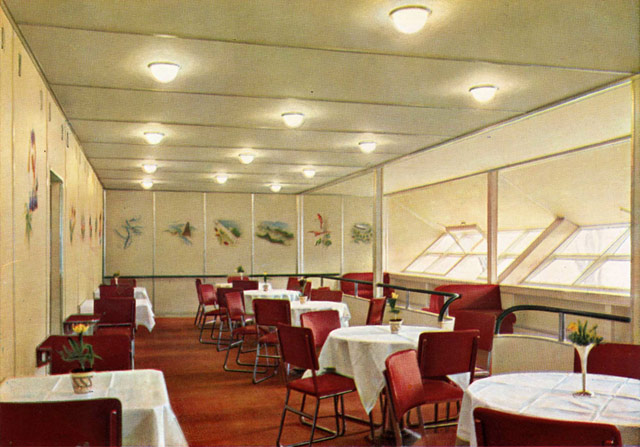
They did their homework, I guess. Also of note regarding the Hindenburg: the ship was originally designed to use helium but was retooled to use extremely flammable hydrogen when the US banned exports of then-rare helium to Germany.
Despite the danger of using flammable hydrogen, no alternative gases that could provide sufficient lift could be produced in adequate quantities. One beneficial side effect of employing hydrogen was that more passenger cabins could be added. The Germans’ long history of flying hydrogen-filled passenger airships without a single injury or fatality engendered a widely held belief they had mastered the safe use of hydrogen. The Hindenburg’s first season performance appeared to demonstrate this.
(thx, @katiealender & someone else whose name I misplaced)
Over at the Centives economic blog, they figured out how much it would cost to build the Death Star in 2012 dollars. Spoiler: A lot. It would cost a lot.
We began by looking at how big the Death Star is. The first one is reported to be 140km in diameter and it sure looks like it’s made of steel. But how much steel? We decided to model the Death Star as having a similar density in steel as a modern warship. After all, they’re both essentially floating weapons platforms so that seems reasonable.
(via marginalrevolution)
Travis Pitts outlines the six rules of modern movie poster design. Here are three examples:

Best viewed large for easy reading of fine print.
This is so perfectly in the kottke.org wheelhouse that I can’t even tell if it’s any good or not: a mashup of Jay-Z and Kanye’s N***as in Paris and Woody Allen’s Midnight in Paris.
(via ★davidfg)
From MUBI notebook, a selection of great movies posters from 2011, including Chris Ware’s lovely one for Uncle Boonmee.
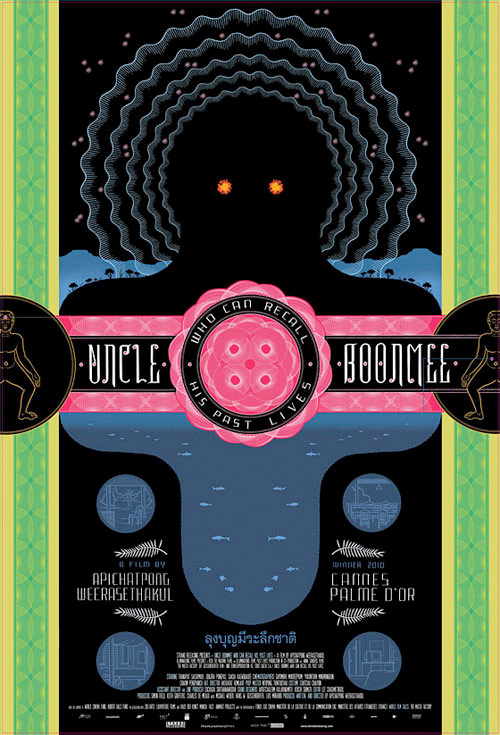
(via dooce)
Wyatt Hodgson took Koyaanisqatsi and sped it up 1552% so you can watch the whole movie in about five minutes.
Reggio uses time lapse in the film to great effect — you notice different things at different playback speeds — and Hodgson’s clever use of the same technique reveals the overall structure of the film much more than watching it in realtime…but the emotion of the film is completely removed. (via the candler blog)
BLDGBLOG is running a distributed film festival called Breaking Out and Breaking In that will explore the architecture of escapes and break-ins in movies.
Breaking Out and Breaking In is an exploration of the use and misuse of space in escapes and heists, where architecture is the obstacle between you and what you’re looking for.
Watch the films at home-or anywhere you may be-and then come back to discuss the films here on BLDGBLOG. It’s a “distributed” film fest; there is no central venue, just a curated list of films and a list of days on which to watch them. There’s no set time, no geographic exclusion, and no limit to the food breaks or repeated scenes you might require. And it all leads up to a public discussion at Studio-X NYC on Tuesday, April 24.
The overall idea is to discuss breaking out and breaking in as spatial scenarios that operate as mirror images of one another, each process with its own tools, techniques, and unique forms of unexpected architectural expertise.
It started on Friday, but there’s still plenty of time and opportunity to join in.
Monty Python member Terry Jones is set to direct a sci-fi comedy that will feature other Python members “voicing key roles”. Gilliam, Cleese, and Palin have all signed on and they’re working on getting Eric Idle.
Members of Monty Python’s Flying Circus are reteaming for “Absolutely Anything,” a sci-fi farce combining CGI and live action, with Terry Jones to direct and Mike Medavoy to produce.
Plans are for filming to begin in the U.K. this spring, with the Pythons voicing key roles as a a group of aliens who endow an earthling with the power to do “absolutely anything” to see what a mess he’ll make of things — which is precisely what happens. There’s also a talking dog named Dennis who seems to understand more about the mayhem that ensues than anyone else does. Robin Williams will voice the character.
“It’s not a Monty Python picture, but it certainly has that sensibility,” Jones told Variety.
(via ★vuokko)
Posters for Oscar nominated movies that maybe tell the truth of each movie a bit more than the conventional posters. For instance, Iron Lady becomes Total Bitch, Tree of Life becomes Wuh?, and The Girl with the Dragon Tattoo becomes All the Rape, No Subtitles.
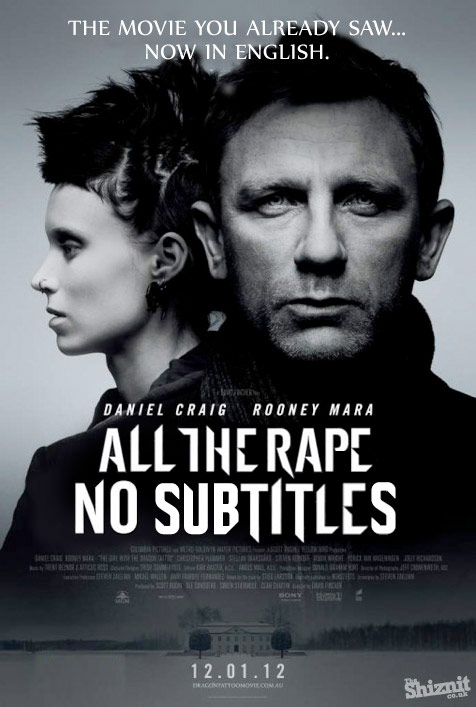
(via ★vuokko)

Socials & More