

This site is made possible by member support. 💞
Big thanks to Arcustech for hosting the site and offering amazing tech support.
When you buy through links on kottke.org, I may earn an affiliate commission. Thanks for supporting the site!
kottke.org. home of fine hypertext products since 1998.
Beloved by 86.47% of the web.
Entries for March 2019
Boeing 737 Max safety features as in-app purchases. I don’t know what’s more disturbing: that Boeing charges extra for safety systems or that some airlines don’t purchase them.
The Last Days of Walter Benjamin’s Life
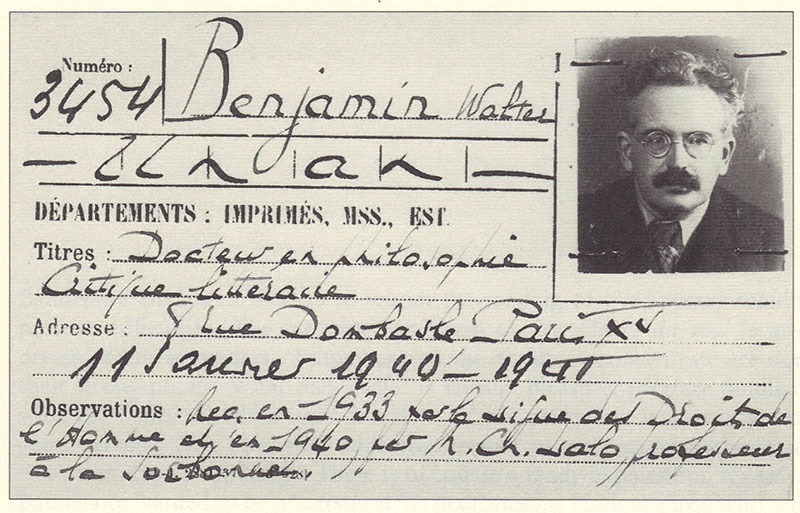
This Aeon essay by Giorgio van Straten, “Lost in Migration,” is excerpted from a book titled In Search of Lost Books, which explains its fascination with a book that’s fascinated many people, a manuscript carried in a briefcase by Walter Benjamin at the end of his life which has never been identified or located and probably did not survive him.
I’ve always been a little turned off by the obsession with this manuscript among Benjamin fans and readers. There’s something so shattering to me about the end of Benjamin’s life, and how he died, that it feels not just trivial, but almost profane to geek out over the imaginary contents of a book he might have left behind. I feel the same way about dead musicians. It’s all just bad news.
Luckily, though, this essay does contain a compelling and concise account of the end of Benjamin’s life.
First Benjamin fled Paris, which had been bombed and was nearly about to be invaded by the German army, for Marseilles:
Benjamin was not an old man - he was only 48 years old - even if the years weighed more heavily at the time than they do now. But he was tired and unwell (his friends called him ‘Old Benj’); he suffered from asthma, had already had one heart attack, and had always been unsuited to much physical activity, accustomed as he was to spending his time either with his books or in erudite conversation. For him, every move, every physical undertaking represented a kind of trauma, yet his vicissitudes had over the years necessitated some 28 changes of address. And in addition he was bad at coping with the mundane aspects of life, the prosaic necessities of everyday living.
Hannah Arendt repeated with reference to Benjamin remarks made by Jacques Rivière about Proust:
He died of the same inexperience that permitted him to write his works. He died of ignorance of the world, because he did not know how to make a fire or open a window.
before adding to them a remark of her own:
With a precision suggesting a sleepwalker his clumsiness invariably guided him to the very centre of a misfortune.
Now this man seemingly inept in the everyday business of living found himself having to move in the midst of war, in a country on the verge of collapse, in hopeless confusion.
From Marseilles he hoped to reach Spain, since, as a German refugee, he did not have the proper exit papers.
The next morning he was joined soon after daybreak by his travelling companions. The path they took climbed ever higher, and at times it was almost impossible to follow amid rocks and gorges. Benjamin began to feel increasingly fatigued, and he adopted a strategy to make the most of his energy: walking for 10 minutes and then resting for one, timing these intervals precisely with his pocket-watch. Ten minutes of walking and one of rest. As the path became progressively steeper, the two women and the boy were obliged to help him, since he could not manage by himself to carry the black suitcase he refused to abandon, insisting that it was more important that the manuscript inside it should reach America than that he should.
A tremendous physical effort was required, and though the group found themselves frequently on the point of giving up, they eventually reached a ridge from which vantage point the sea appeared, illuminated by the sun. Not much further off was the town of Portbou: against all odds they had made it.
Spain had changed its policy on refugees just the day before:
[A]nyone arriving ‘illegally’ would be sent back to France. For Benjamin this meant being handed over to the Germans. The only concession they obtained, on account of their exhaustion and the lateness of the hour, was to spend the night in Portbou: they would be allowed to stay in the Hotel Franca. Benjamin was given room number 3. They would be expelled the next day.
For Benjamin that day never came. He killed himself by swallowing the 15 morphine tablets he had carried with him in case his cardiac problems recurred.
This is how one of the greatest writers and thinkers of the twentieth century was lost to us, forever.
A 30th anniversary oral history of Bonnie Raitt’s fantastic “comeback” album Nick of Time. Great insights by Raitt, producer Don Was, and manager Danny Goldberg, among others.
Orson Welles as a Graphic Artist
There are so many sides to Orson Welles that one of them is bound to get overlooked. Welles was a groundbreaking screen and voice actor, screenwriter, film director, radio producer, etc., etc. He was also a remarkable visual artist, which comes through in his films but is often attributed away to his great collaborators like cinematographer Gregg Toland. Even as a child, teen, and very young man, Welles was almost ruined by the fact that everything he did, he seemed to do so much better than the people around him. He was an undiscriminating prodigy, which is a very dangerous thing to be.
A new documentary by Mark Cousins, The Eyes of Orson Welles, focuses on Welles’s output in drawing, sketching, painting. It tries to recenter visual art as an essential, not accidental part of Welles’s work, and at the same time use it as a pathway to try to understand him as a person and artist.
I haven’t seen this documentary, but I’m very excited about it. Welles is one of those figures whose genius in his work almost obscures him; any new route in is welcome. It also doesn’t feel like a typical hagiographic documentary; it feels appropriately irreverent and experimental, two things which Welles almost was.
A Map of Fairyland (c. 1920)
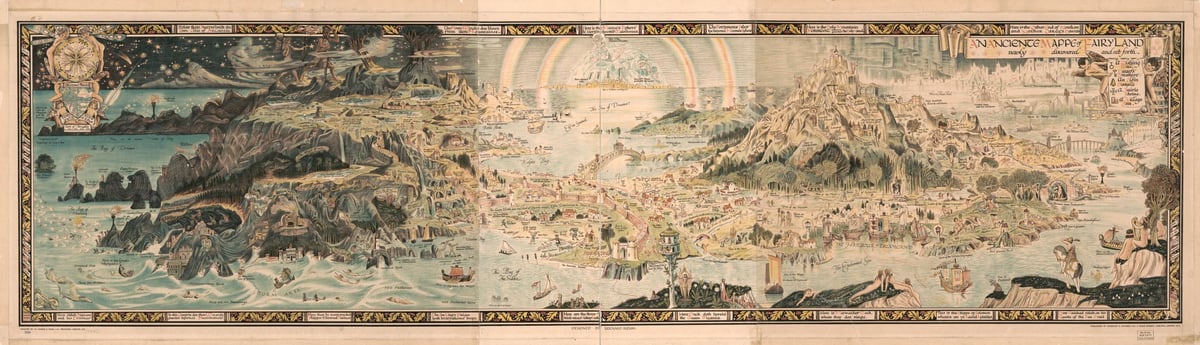
The Library of Congress has a remarkable digitized work in its collection titled “An anciente mappe of Fairyland : newly discovered and set forth,” by Bernard Sleigh, published in London around 1920. Here’s the high-resolution image so you can see some of the detail:
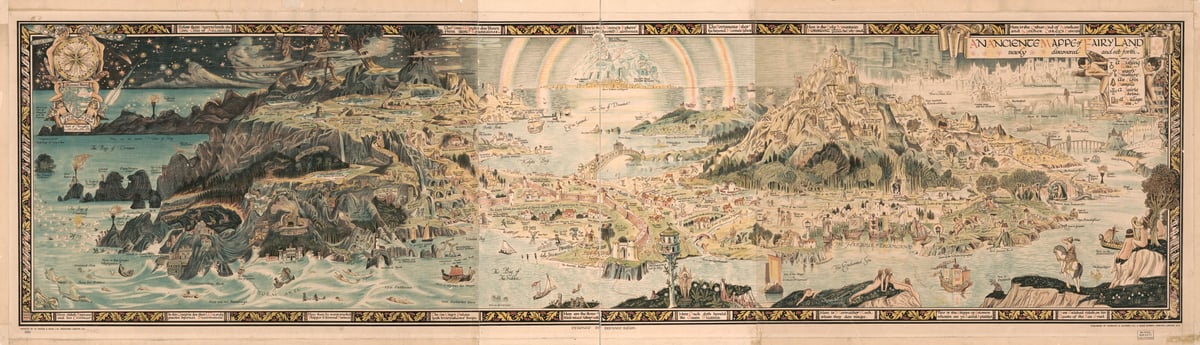
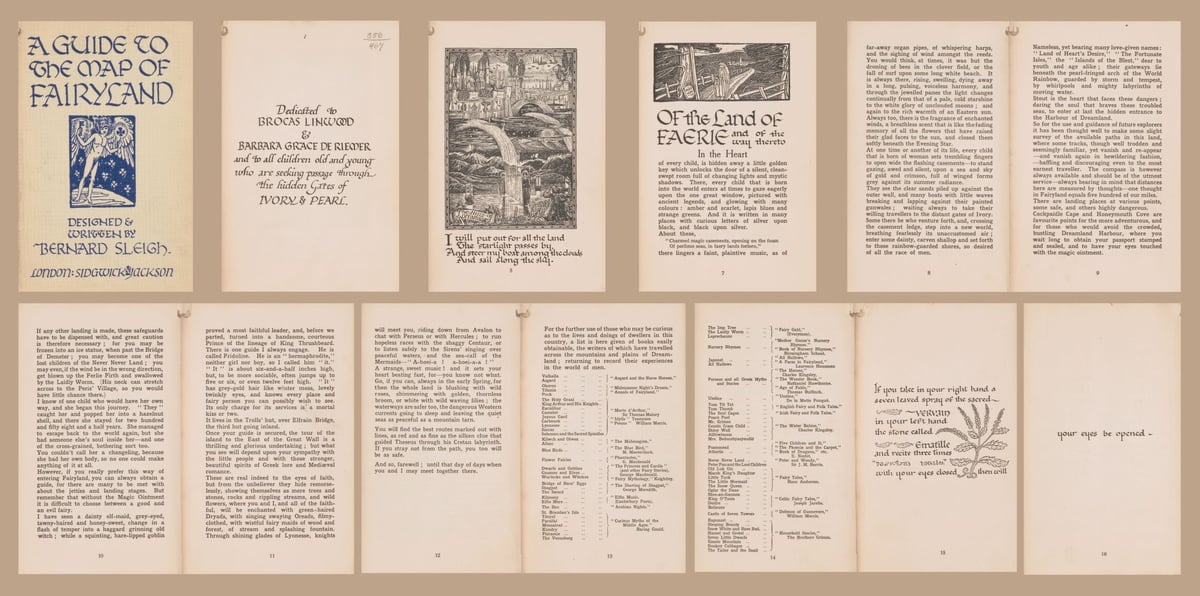
The map aims to be a nearly comprehensive atlas of the world of common English fairy tales, with a few of its own twists and turns. The accompanying guidebook lays out the map’s unique, ontological take on folktales and faerie stories, with the following introductory paragraph (with a quote from Keats’s “Ode to a Nightingale”):
Of the Land of Faerie and of the way thereto
In the Heart of every child, is hidden away a golden key which unlocks the door of a silent, clean-swept room full of changing lights and mystic shadows. There, every child that is born into the world enters at times to gaze eagerly upon the one great window, pictured with ancient legends, and glowing with many colours: amber and scarlet, lapis blues and strange greens. And it is written in many places with curious letters of silver upon black and black upon silver.
About these,
“Charmed magic casements, opening on the foam
Of perilous seas, in faery lands forlorn,”there lingers a faint, plaintive music, as of far-away organ pipes, of whispering harps, and the sighing of wind amongst the reeds. You would think, at times, it was but the droning of bees in the clover field, or the fall of surf upon some long white beach. It is always there, rising, swelling, dying away in a long, pulsing, voiceless harmony, and through the jewelled panes the light changes continually from that of a pale, cold starshine to the white glory of unclouded moons; and again to the rich warmth of an Eastern sun. Always too, there is the fragrance of enchanted winds, a breathless scent that is like the fading memory of all the flowers that have raised their glad faces to the sun, and closed them softly beneath the Evening Star.
At one time or another of its life, every child that is born of woman sets trembling fingers to open wide the flashing casements — to stand gazing, awed and silent, upon a sea and sky of gold and crimson, full of winged forms grey against its summer radiance.
It goes on like this. I hope you find it charming. (I do.)
One of the many things this is useful for, besides its own right, is in understanding the cultural mentality in which works like The Lord of the Rings, CS Lewis’s writings, Walt Disney’s films, and the like were shaped. There was a real grappling with European folk stories, from the 19th century onwards, but the 20th century added a metaphysical dimension, a desire to make these stories real, to fix them in a place, to give them their own world. I find that desire fascinating, especially coming out of the horrors of World War I, and the destruction of so much of what had been the old Europe.
A Phonetic Map of the Human Mouth
This infographic from Language Base Camp shows where the sounds that English speakers use are produced in the mouth and throat.

I’ve had zero voice training in my life, so it was really illuminating to speak all of the different sounds while paying close attention to where in my mouth they were happening. Try it!
Update: And after pronouncing the sounds yourself, take a few minutes to play around with Pink Trombone. Fun! (via @pixelcult)
Emilia Clarke, who plays Daenerys Targaryen on Game of Thrones, writes about a harrowing pair of aneurysms she suffered soon after she started on the show. “At some level, I knew what was happening: my brain was damaged.”
The trailer for The Last Black Man in San Francisco. This is Joe Talbot’s feature-length debut for which he won best director at Sundance.
The Global Architect Card says in 14 different languages: “I am an architect. I am here to see this significant building.” You show it to building staff who are not used to dealing with curious “foreigners with funky glasses”.
How Ian McKellen Acts With His Eyes
In the latest episode of Nerdwriter, Evan Puschak examines how Ian McKellen does a lot of heavy lifting with his eyes, especially in the Lord of the Rings trilogy. On his way there, I really liked Puschak’s lovely description of the physical craft of acting:
Part of that craft is understanding and gaining control of all the involuntary things we do when we communicate — the inflection of the voice, the gestures of the body, and the expressions of the face.
P.S. Speaking of actors being able to control their faces, have you ever seen Jim Carrey do wordless impressions of other actors? Check this out:
The Jack Nicholson is impressive enough but his Clint Eastwood (at ~1:15) is really off the charts. Look at how many different parts of his face are moving independently from each other as that jiggling Jello mold eventually gather into Eastwood’s grimace. Both McKellen and Carrey are athletic af in terms of their body control in front of an audience or camera.
Deadwood: The Movie
Open the canned peaches because Al Swearengen, Seth Bullock, and the rest of your Deadwood favorites are back on May 31 in Deadwood: The Movie. Here’s a tease:
Swearengen: You ever think, Bullock, of not going straight at a thing?
…
Bullock: No.
I’m in 1000%. For more on the movie’s action/plot, read Tim’s post from December.
From Emily Wilson, a pronunciation guide to some of the place and character names in The Odyssey. I was pronouncing Telemachus incorrectly for at least half the book.
What’s Eating Dan?
From America’s Test Kitchen and Dan Souza, the editor-in-chief of Cook’s Illustrated, a YouTube series called What’s Eating Dan? In each episode, Souza picks a different food — pizza, rice, salmon — shares some of the science involved, and then shows us the best way to cook it. For starters, I’d suggest the first episode on burgers and a more recent one on mushrooms:
Kinetic Alphabet
From London motion design studio Mr. Kaplin, an animated alphabet where the animation for each letter is a experiment that was completed in a single day.
See also The ABCs in Motion.
Actually, Mercury Is Our Closest Planetary Neighbor
If you look at the orbits of the planets adjacent to the Earth’s orbit (Venus & Mars), you’ll see that Venus’s orbit is closest to our own. That is, at its closest approach, Venus gets closer to Earth than any other planet. But what about the average distance?
According to this article in Physics Today by Tom Stockman, Gabriel Monroe, and Samuel Cordner, if you run a simulation and do a proper calculation, you’ll find that Mercury, and not Venus or Mars, is Earth’s closest neighbor on average (and spends more time as Earth’s closest neighbor than any other planet):
Although it feels intuitive that the average distance between every point on two concentric ellipses would be the difference in their radii, in reality that difference determines only the average distance of the ellipses’ closest points. Indeed, when Earth and Venus are at their closest approach, their separation is roughly 0.28 AU — no other planet gets nearer to Earth. But just as often, the two planets are at their most distant, when Venus is on the side of the Sun opposite Earth, 1.72 AU away. We can improve the flawed calculation by averaging the distances of closest and farthest approach (resulting in an average distance of 1 AU between Earth and Venus), but finding the true solution requires a bit more effort.
What the calculation also shows is that Mercury is the closest planetary neighbor to every planet, on average. Also, the authors of the paper don’t explicitly mention this, but the Sun (at 1 AU) is closer on average to the Earth than even Mercury (1.04 AU).
Beautiful Hand-Colored Photographs of Flowers from 19th-Century Japan
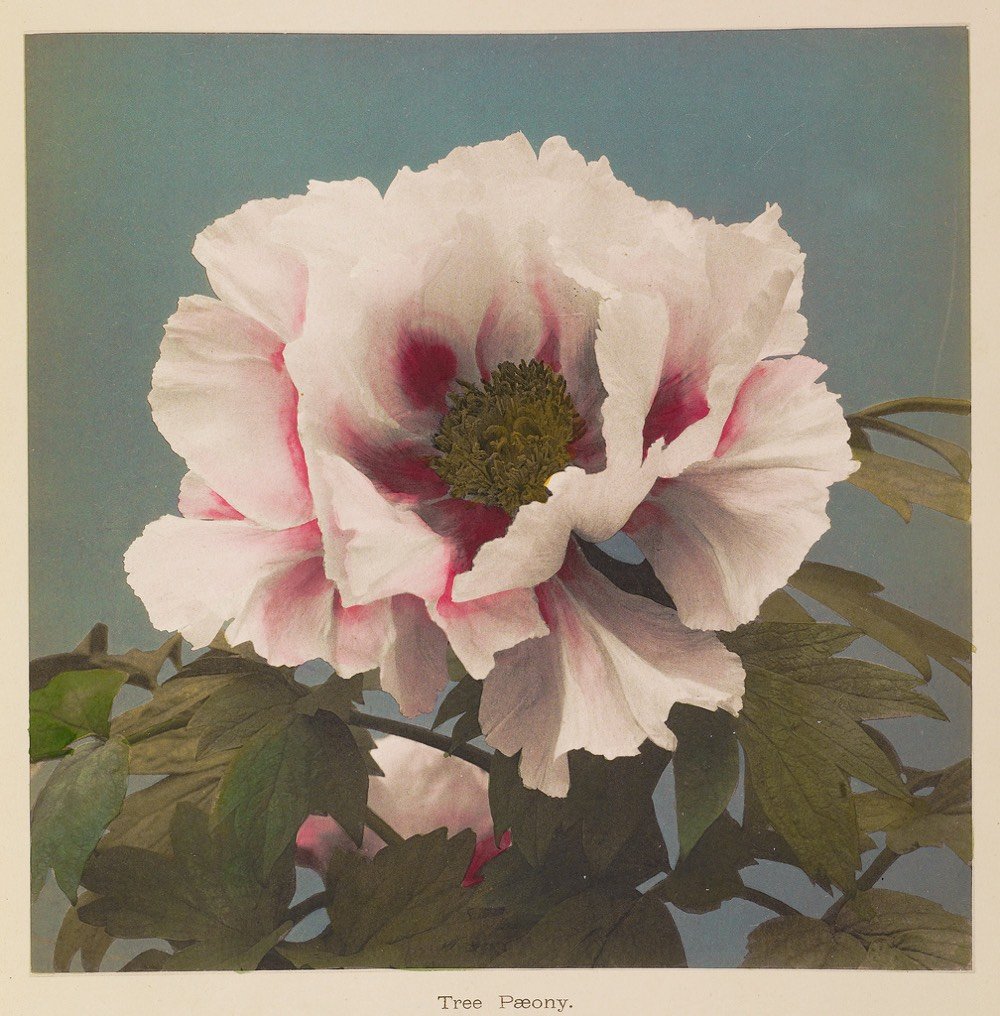

From The Public Domain Review, Ogawa Kazumasa’s Hand-Coloured Photographs of Flowers.
The stunning floral images featured here are the work of Ogawa Kazumasa, a Japanese photographer, printer, and publisher known for his pioneering work in photomechanical printing and photography in the Meiji era.
A reprinted book containing these images by Kazumasa is available as are prints. (via @john_overholt)
Brilliant Papercraft Typographic Creations

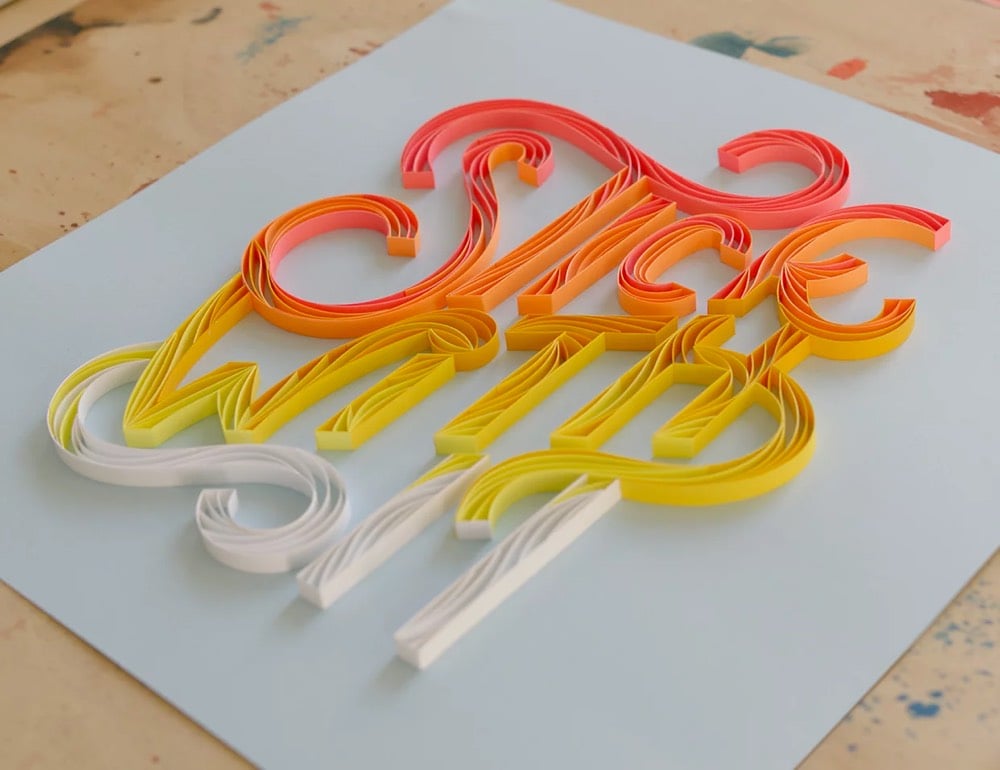
Paper artist Alia Bright combines papercraft and typography to make these colorful, um, sculptures? Texts? They’re super-cool, whatever you call them. Here’s a close-up of one of the pieces, all made by hand of course:

You can keep up with Bright’s newest work on Instagram. (via swissmiss)
The Wasabi Farmer
By some accounts, 99% of the wasabi consumed in the world is not actually wasabi — it’s horseradish + green food coloring. Real wasabi is difficult to grow:
Authentic wasabi, known as Wasabia japonica, is the most expensive crop to grow in the world. The temperamental semiaquatic herb, native to the mountain streams of central Japan, is notoriously difficult to cultivate. Once planted, it takes several years to harvest; even then, it doesn’t germinate unless conditions are perfect. Grated wasabi root loses its flavor within 15 minutes.
Profiled in the short film above, 75-year old Shigeo Iida is the 8th generation owner of a wasabi farm in Japan, where he’s been painstakingly growing the herb in a beautiful valley for decades. He loves his work, but like other aging Japanese responsible for long-lived family businesses, there’s uncertainty about the future. (via craig mod)
The trailer for Stranger Things season 3. Man, this show does 80s nostalgia so so well. Not what the 80s were actually like but what they felt like (from the vantage point of 30 years later).
Quentin Tarantino’s Once Upon a Time in Hollywood
Quentin Tarantino brings back two of his biggest stars, Brad Pitt and Leonardo DiCaprio, in his new film Once Upon a Time in Hollywood. The teaser trailer is low on details, but we do know that Pitt plays stunt double to DiCaprio’s aging film star, the plot involves the murder of Sharon Tate by members of the Manson Family, and it opens on July 26. The film is also the last movie that Luke Perry made before he died.
Update: The full-length trailer is out:
Ancient History Family Trees Poster, “a wallchart displaying the genealogy of Ancient Egypt, Assyria, Persia, Greece, Rome, India, China, and more”. It’s by Matt Baker, who did the viral Evolution of the Alphabet chart.
Vibrant Oil Paintings of Clouds
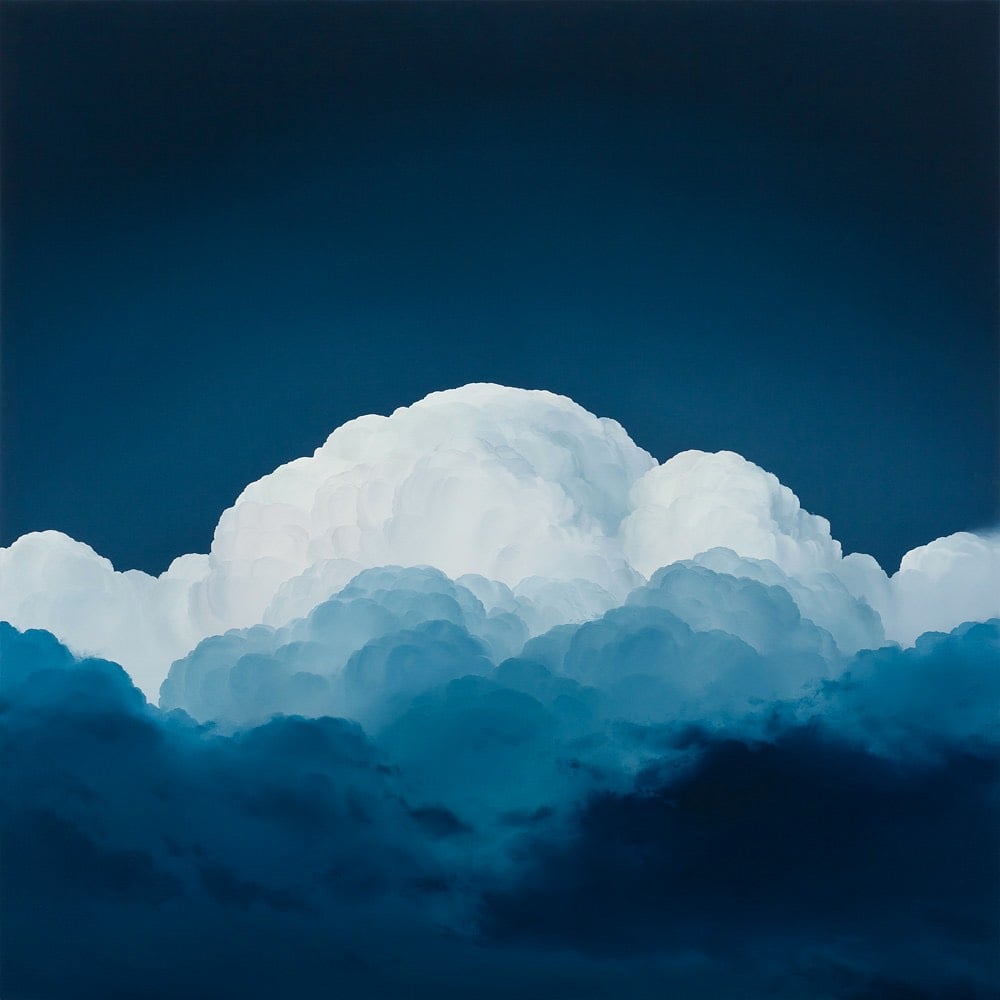
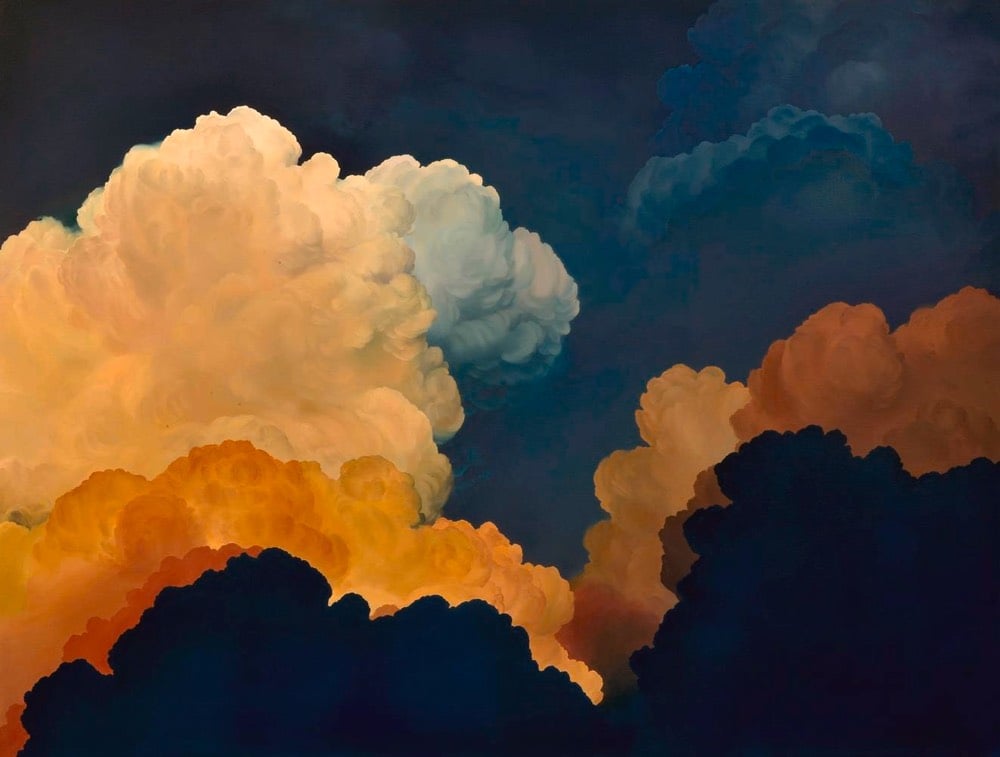
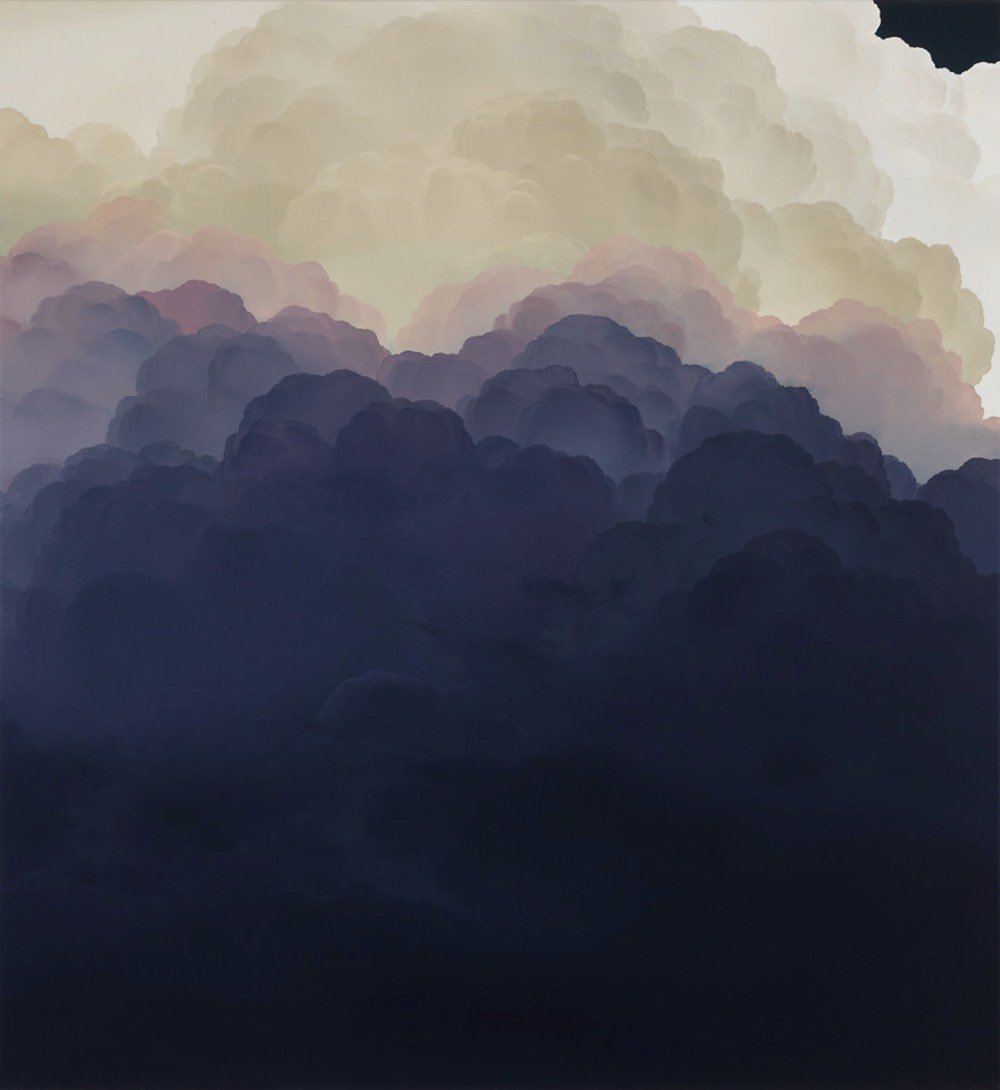
Ian Fisher’s paintings of clouds are surprisingly lifelike. If you scroll through the paintings on his site, you can see his representation of them improve…his most recent ones are difficult to distinguish from photographs of actual clouds.
A site of “endlessly unique ambient music”. Each piece is generated using a unique system and played infinitely without repetition.
The Legend of Nixon, a Data-Driven NES Soundscape
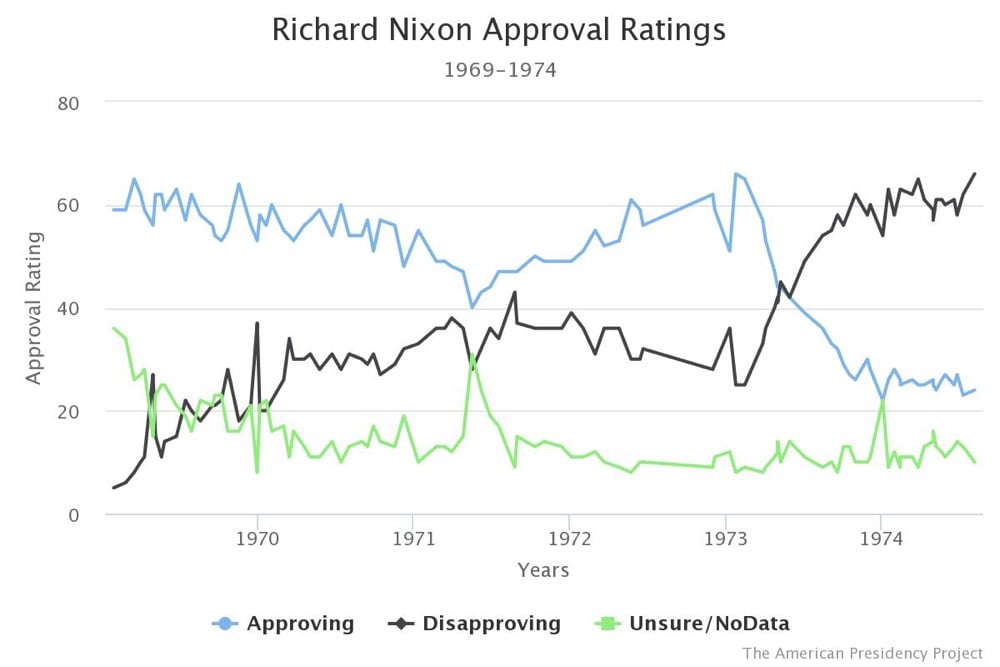
Brian Chirls took the approval ratings for Richard Nixon’s presidency and using sounds from The Legend of Zelda’s classic Dungeon Theme, he made a data-driven soundscape of the public perception of Nixon’s tenure in the White House. Here’s what his approval rating looked like:
And here’s the resulting audio track:
The sound effects mostly represent actions the protagonist Link takes like the “sword slash”, things that happen to him like a grunt when he gets hurt, or the status of the game like the low health alarm that beeps when Link has only half a “heart container” left and can only take one or two more hits before he dies and the game is over. The goal of this project is to create a piece of audio that sounds like a typical playthrough of the game and also accurately tells the story of Nixon’s fall as represented by the data.
What a cool example of using the familiar to explain or illustrate the unfamiliar. If you’ve ever played Zelda, you can clearly hear Nixon doing more and more poorly as the track goes on — he’s taking damage, the dungeon boss sound chimes in right around when Watergate is ramping up, and he’s gaining fewer hearts. It’s like he’s a novice player armed only with the wooden sword trying to defeat the level 3 dungeon without a potion…the end comes pretty quickly.
A Huge Collection of Apollo 11 Press Kits
When Apollo 11 landed two men on the Moon and returned them safely to Earth, thousands of people at NASA were joined in the effort by dozens of companies that did everything from building the spacecraft to providing the cameras for the mission. Each of those companies was understandably proud of their involvement and wanted to use the mission to drum up interest in their products and services. Marketing strategist David Meerman Scott has been collecting the press kits produced by the Apollo contractors and has made them available online for free download in PDF format.
What a trove! Here are a few of my favorites. First is the kit from Fisher, who provided the pens that Armstrong, Aldrin, and Collins wrote with during the voyage.
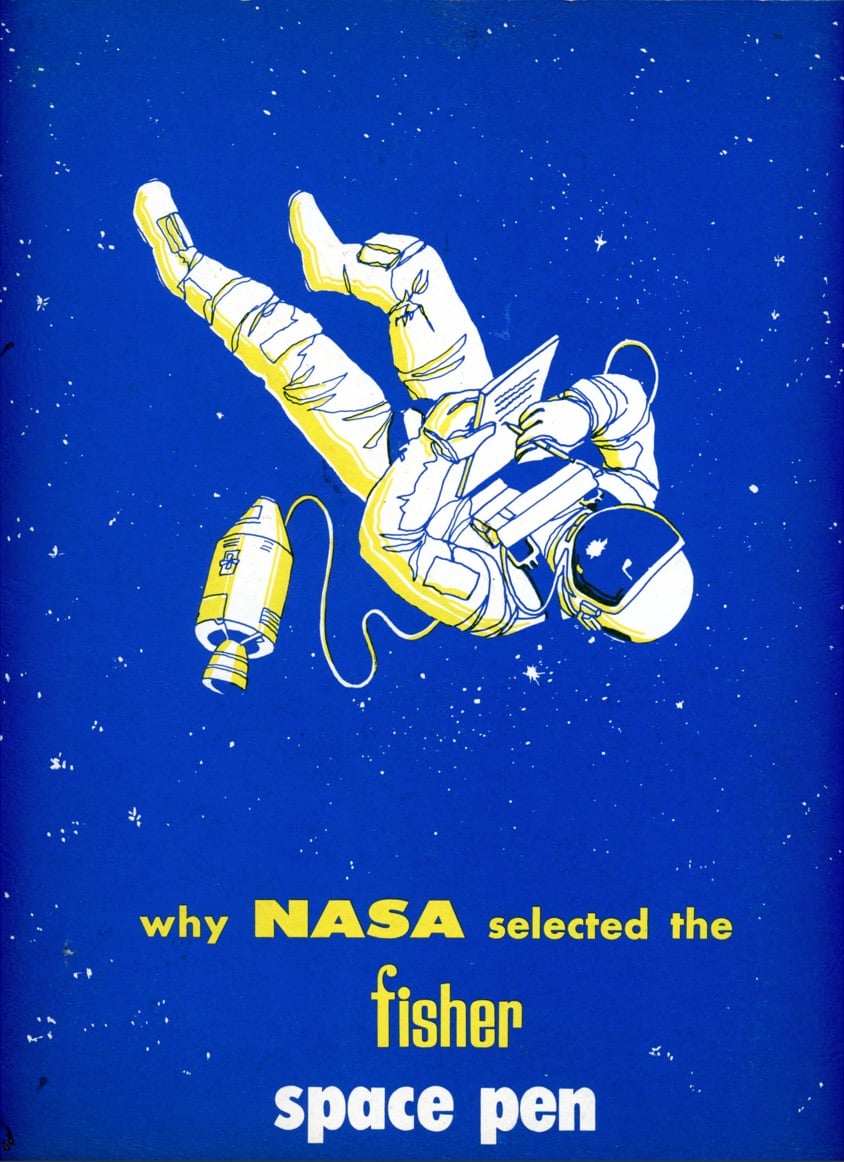
The final requirement was to see if the pen could still write after all that torture. NASA required that each pen write 1,653 feet of continuous traces, or for about 4 1/2 hours. The three pens were placed in an automatic writing machine and far out passed the qualifications. The first pen wrote for 54 hours and 50 minutes and 15,346 feet. The second finished after 18,303 feet. The third, writing on a new, highly absorbent paper, still wrote for 7,484 feet.
Fisher still sells a version of the original Apollo 11 space pen.
After the astronauts came back from the Moon, they were quarantined for 21 days to ensure that the crew had not returned with any harmful Moon germs. Stouffer’s, the frozen foods company, was contracted by NASA to provide some of the astronauts’ meals in quarantine.

A typical astronaut dinner will consist of short ribs of beef, potatoes au gratin and tossed green salad. Stouffer’s has been selected to provide from its retail line a major portion of the entrees and side dishes for the astronauts. Ease of preparation, purity, quality and variety as well as taste and appearance were the main reasons for NASA’s selection of Stouffer’s foods.
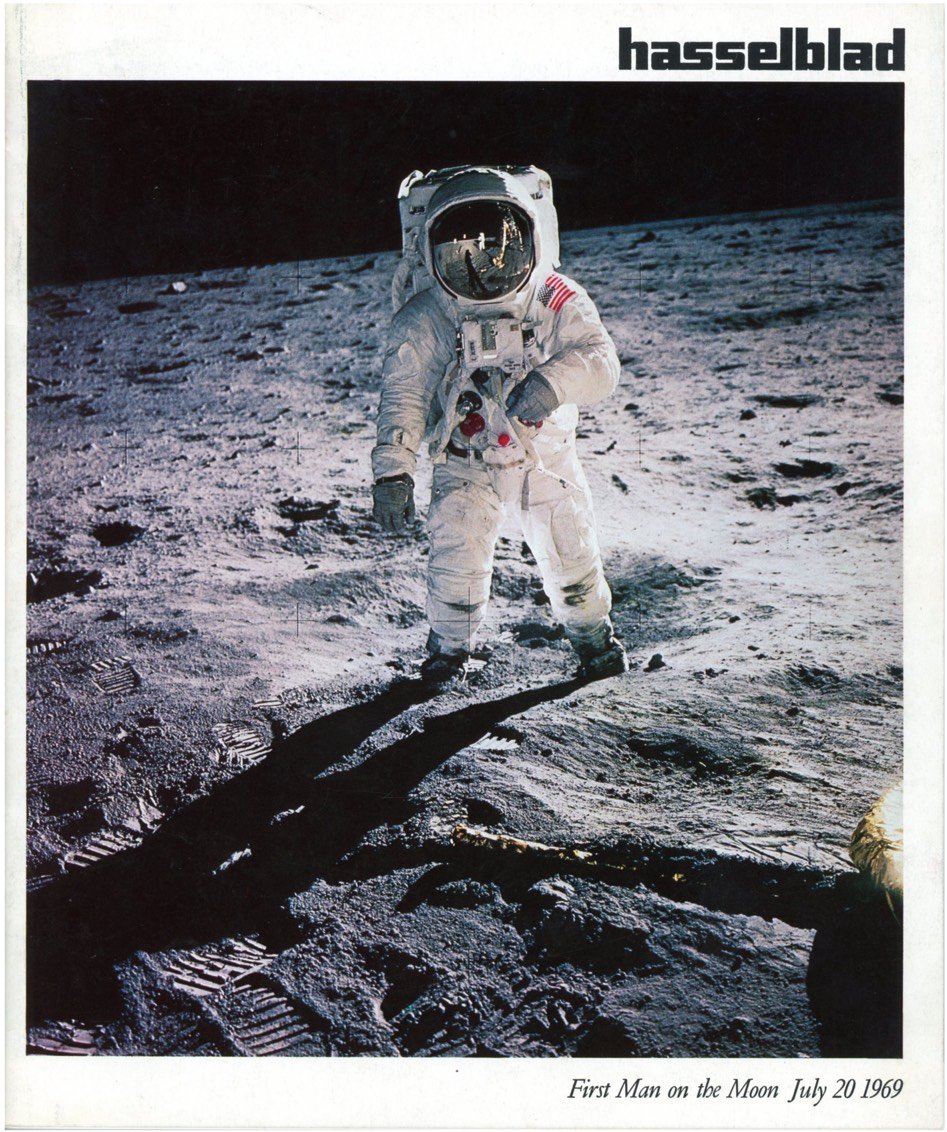
Hasselblad provided the cameras for the mission.
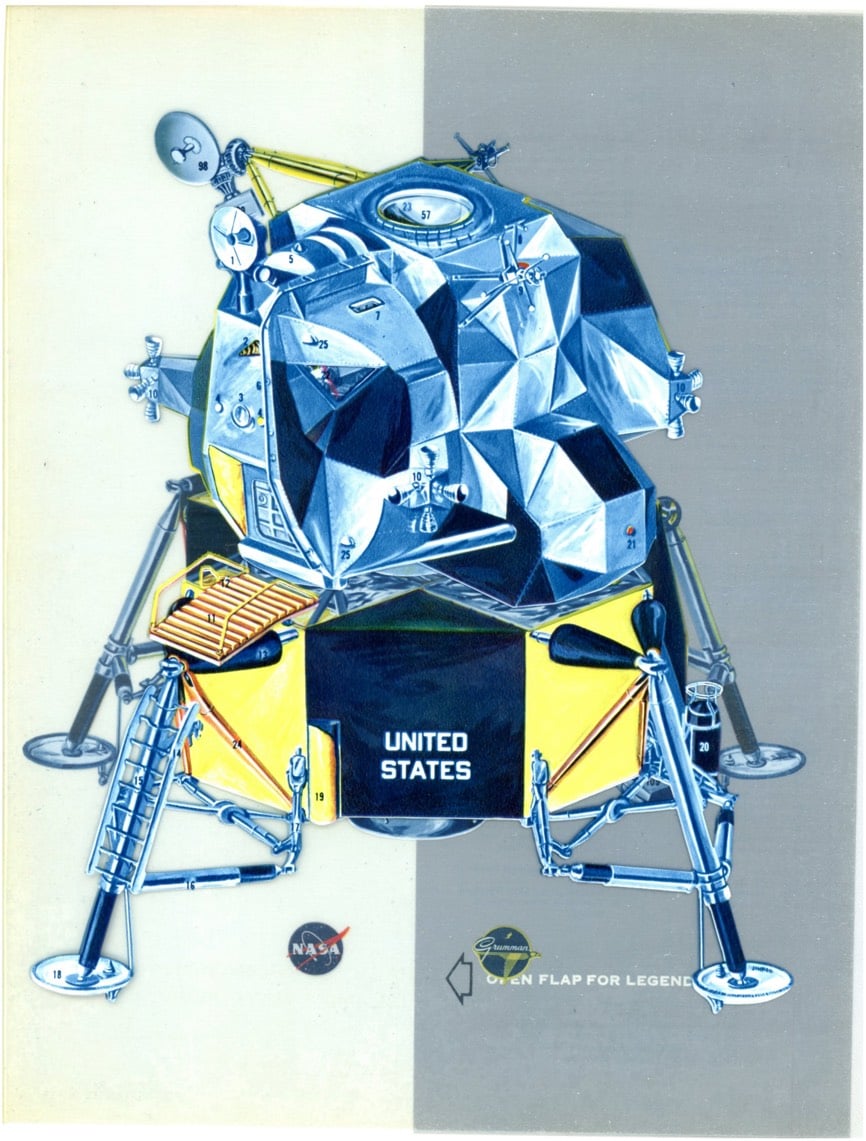
Grumman made the Lunar Module, the capsule that carried Armstrong and Aldrin to and from the surface of the Moon.
I could keep going on these all day. What a terrific resource. Scott, along with Richard Jurek, is also the author of Marketing the Moon, a book about how NASA sold the Apollo program to the American public. (via steven heller)
Cutting Commentary on News Media’s Complicity in Spreading Hateful Views
Kate McCartney and Kate McLennan, a pair of comedians whose hilarious cooking show I’ve previously featured, are back with Get Krack!n, a series that parodies a typical TV morning show. In this clip, they debut a new segment that perfectly skewers how TV media provides a platform for radical kooks to promote hateful agendas for the mutual benefit of both kook & show. (Note: this clip contains swearing and simulated religious bigotry & misogyny.)
Kheck out our brand new seggment! #getkrackin @Mrdavidquirk @chookfish @gw_deb @ABCTV pic.twitter.com/fTvrmK7tc6
— Get Krack!n (@getkrackinshow) March 7, 2019
They’re not necessarily views that we endorse or share personally, Kate McCartney, but they’re definitely opinions that we are 100% complicit in broadcasting, and that in time we will go to hell for.
This is an Australian show, but a similar panel and topic could easily have appeared on any number of Fox News programs.
According to a survey, “nearly 60 percent of people who have filed for bankruptcy said a medical expense…contributed to their bankruptcy”. Lack of guaranteed healthcare is an anchor on our national well-being.
Monica Lewinsky on Public Shaming
This week, Last Week Tonight covered the topic of public shaming and the episode included an interview by host John Oliver of Monica Lewinsky, who shared her experience of going through perhaps the most intense and enduring instance of public shaming ever.
The whole video is worth watching, but if you want to skip to the Lewinsky interview, it starts around the 15:00 mark. Lewinsky doesn’t do a lot of interviews, and it’s interesting that Oliver has built enough trust to get one, especially as the host of a comedy show.
Where Did Consciousness Come From?
Religion and philosophy have their own answers as to where our consciousness comes from, but in this video, Kurzgesagt explores how scientists believe consciousness first evolved, from organisms moving more quickly when consuming food to animals being able to animals who can remember where they hid food to reading the minds of competitors and allies.
The main source for the video is Rupert Glasgow’s Minimal Selfhood and the Origins of Consciousness (available as a free download). The complete list of their sources is here.
The Fertility Doctor’s Secret
For The Atlantic, Sarah Zhang tells the story of dozens of people who found out through DNA testing that a fertility doctor named Donald Cline had used his own sperm in artificial insemination procedures on their mothers. The piece begins with the story of a woman whose parents had been treated by Cline more than 30 years ago.
It was only when she got home and replaced her phone that she saw the barrage of messages from even more half siblings. They had found her on Facebook, she realized, after searching for the username linked to her Ancestry.com account. Her husband had given her a DNA test for Christmas because she was interested in genealogy. Her heritage turned out to be exactly what she had thought — Scottish, with English, Irish, and Scandinavian mixed in — and she never bothered to click on the link that would show whether anyone on the site shared her DNA.
Apparently she did have relatives on Ancestry.com — and not just distant cousins. The people now sending her messages said they were Cline’s secret biological children. They said their parents had also been treated by Cline. They said that decades ago, without ever telling his patients, Cline had used his own sperm to impregnate women who came to him for artificial insemination.
According to her DNA, Woock, too, was one of his children.
In the time since Woock’s half siblings got in touch with her, they have broken the news dozens more times. The children Cline fathered with his patients now number at least 48, confirmed by DNA tests from 23andMe or Ancestry.com. (Several have a twin or other siblings who likely share the same biological father but haven’t been tested.) They keep in touch through a Facebook group. New siblings pop up in waves, timed perversely after holidays like Christmas or Mother’s Day or Father’s Day, when DNA tests are given as well-intentioned gifts.
One of Cline’s patients said recently: “I feel like I was raped 15 times.”
New book by @monteiro –> Ruined by Design: How Designers Destroyed the World, and What We Can Do to Fix It. I heard Mike do a talk on this 5 years ago and he blew the doors off the place.
Everything Is Just a Happening
This guided meditation by Alan Watts really helped me this morning. (There’s a version without music as well.)
From The Practice of Meditation:
Simply sit down, close your eyes, and listen to all sounds that may be going on — without trying to name or identify them. Listen as you would listen to music. If you find that verbal thinking will not drop away, don’t attempt to stop it by force of will-power. Just keep your tongue relaxed, floating easily in the lower jaw, and listen to your thoughts as if they were birds chattering outside — mere noise in the skull — and they will eventually subside of themselves, as a turbulent and muddy pool will become calm and clear if left alone.
Also, become aware of breathing and allow your lungs to work in whatever rhythm seems congenial to them. And for a while just sit listening and feeling breath. But, if possible, don’t call it that. Simply experience the non-verbal happening. You may object that this is not “spiritual” meditation but mere attention to the “physical” world, but it should be understood that the spiritual and the physical are only ideas, philosophical conceptions, and that the reality of which you are now aware is not an idea. Furthermore, there is no “you” aware of it. That was also just an idea. Can you hear yourself listening?
And then begin to let your breath “fall” out, slowly and easily. Don’t force or strain your lungs, but let the breath come out in the same way that you let yourself slump into a comfortable bed. Simply let it go, go, and go. As soon as there is the least strain, just let it come back in as a reflex; don’t pull it in. Forget the clock. Forget to count. Just keep it up for so long as you feel the luxury of it.
(via open culture)
The Problem of Writing and Money
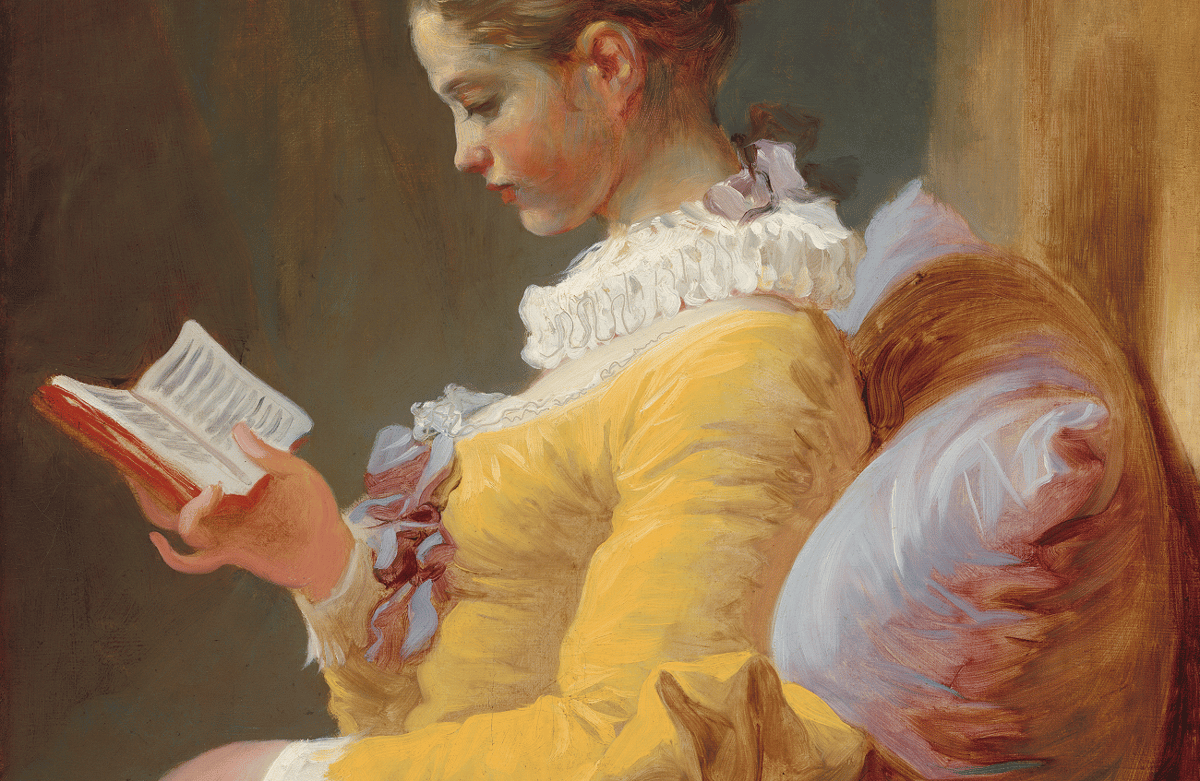
Now this is a lede:
When I first read Virginia Woolf’s dictum that “A woman must have money and a room of her own if she is to write fiction,” I was homeless.
It follows through on that first punch:
I know half a dozen published authors who’ve had to rely on food stamps. The seedy poverty of the author has been a cliche for centuries. We find the figure of the poor writer already in the medieval era, in the form of poet-clerics called “goliards,” who begged and sang ribald songs in taverns as they wandered from monastery to monastery. Hundreds of years later, in the Beat Generation, the type survived with no essential change. Now a new generation of writers are confronting ever lower and less reliable payment for articles, stingier advances for books, fewer jobs, and smaller royalty checks. A host of new threats to writers’ livelihoods, from internet piracy to the slow-motion collapse of the academic job market, means ever fewer writers are making a middle-class wage.
So, full-disclosure time! I have been on food stamps, as recently as a couple of years ago. I am currently on Medicaid, and thank god for that, because the open market for health care is terrible, and Medicaid is great. (Freelancers, stop paying COBRA or Obamacare and get yourself on Medicaid if you can.)
I have been a professional writer for almost ten years and have only been employed at a full-time job with benefits for (counts fingers) let’s say three of them. The rest of the time, I’ve been on the 1099 economy, piecing together pieces of living from freelance gigs. I have been homeless, and I have lived with family who’ve been much more stable than I have been. My health has never been good, which has made it difficult for me to maintain full-time work when I’ve had it. I have been behind on my child support, but am currently (thank God) current.
I would not say I am devoted to writing, with my poverty a consequence of that devotion. This entire time, I have simply not known what else to do. I have been writing for my life.
There are a lot of us. We don’t always show it.
Most writers I know who’ve been really poor practice similar forms of self-censorship. Sometimes the reasons are obvious even to someone who’s never had money problems. One writer I know went through a patch where he had to report to a subway cleaning crew to keep getting his welfare checks. He talked about this openly to friends, but went through extreme contortions to hide it from a publisher who was considering hiring him. When I was first profiled for a women’s magazine, I had their photographer come to my apartment, only to have her look around and instantly suggest we go out to a park. After that, I had photographers meet me at a richer person’s apartment to save everyone time and embarrassment.
But often the decisions are less clear-cut. Social media, for instance, can be the ideal forum for openly discussing social class—but it’s also notoriously a place where going too far can damage your career. Most of us filter what we say. This affects how we talk about being broke. A post about student debt is safe, but one about living in your car risks losing face and professional standing. It can even come across as a passive-aggressive jab at more affluent people. One writer friend of mine commented: “On Twitter, we make jokes about being poor. We don’t talk about the fucking dread eating through us because we’ll never be stable. We don’t talk about what it means, that we’re on Twitter because we can’t afford therapy or social lives.”
I don’t know what to do about any of this. I can’t promise that I’ll be more forthcoming about this on Twitter, or here on Kottke.org, or anywhere else I write. I do know that my life is changing again, thanks in part to The Amazon Chronicles, and other opportunities coming into my life. I hope it continues to change. I hope it changes for all of us.
I can only testify, right here and now, that poverty and authorship coincide, including authorship that comes with a kind of modest fame. I can testify that there is nothing romantic about it, only the very real life of compromises that Sandra Newman documents so well in this essay. I can testify that talking about and not talking about it can both eat away at you. There is no cure; only doing better and doing worse, only new wounds and a moderate form of relief.
I disagree with Newman on one point. I think there is no real market for stories about poverty, first-person or otherwise. Not really. Maybe in fiction, maybe as a one-off. But one cannot be a writer about poverty in the same way that one can become a writer about technology; and in most cases, being a writer about technology is extremely difficult when one is poor. (You can track my poverty level through my writing subjects: when I’ve done better, I write about gadgets and the business of technology. When I’ve done worse, I write about memoir or pop culture: music, movies, television, comics, the internet. Things accessible from my memory or on my computer for free or cheap.)
People may want to read about what it’s like to be poor, but they don’t want to pay for it. Paying for things is a rich person’s privilege, and people pay for access to material wealth and things that get them closer to it. And in the free economy, people like the lingua franca of pop culture. Simple stories about heroes and villains, that when you scratch them open, tell them bigger stories about themselves and the worlds they live in.
That’s not to say that people can’t be brought to hear a different kind of story, but they do have to be brought there. How to bring them there? That’s what we’re all trying to figure out.
Socials & More