Late in his life, the prominent English mathematician and philosopher Bertrand Russell was subject to an attempt in the early 1960s by Oswald Mosley to provoke him into a debate about the merits of fascism. Before WWII, Mosley had founded the British Union of Fascists. BUF had a corps of paramilitary personnel, nicknamed “Blackshirts” for their uniform color, at its disposal and Mosley “publicly espoused antisemitism and sought alliances with Benito Mussolini and Adolf Hitler”.1 After the war and having left Britain in disgrace, he was an early Holocaust denier. From Wikipedia:
Mosley was a pioneer in the emergence of Holocaust-denial. While not denying the existence of Nazi concentration camps, he claimed that they were a necessity to hold “a considerable disaffected population”, where problems were caused by lack of supplies due to “incessant bombing” by the Allies, with bodies burned in gas chambers due to typhus outbreaks, rather than being created by the Nazis to exterminate people. He sought to discredit pictures taken in places like Buchenwald and Belsen. He also claimed that the Holocaust was to be blamed on the Jews and that Adolf Hitler knew nothing about it.
With all that as context, Russell wrote a letter to Oswald in January 1962 emphatically declining his invitation to engage in discourse about fascism:
Dear Sir Oswald,
Thank you for your letter and for your enclosures. I have given some thought to our recent correspondence. It is always difficult to decide on how to respond to people whose ethos is so alien and, in fact, repellent to one’s own. It is not that I take exception to the general points made by you but that every ounce of my energy has been devoted to an active opposition to cruel bigotry, compulsive violence, and the sadistic persecution which has characterised the philosophy and practice of fascism.
I feel obliged to say that the emotional universes we inhabit are so distinct, and in deepest ways opposed, that nothing fruitful or sincere could ever emerge from association between us.
I should like you to understand the intensity of this conviction on my part. It is not out of any attempt to be rude that I say this but because of all that I value in human experience and human achievement.
Yours sincerely,
Bertrand Russell
That’s how it’s done.
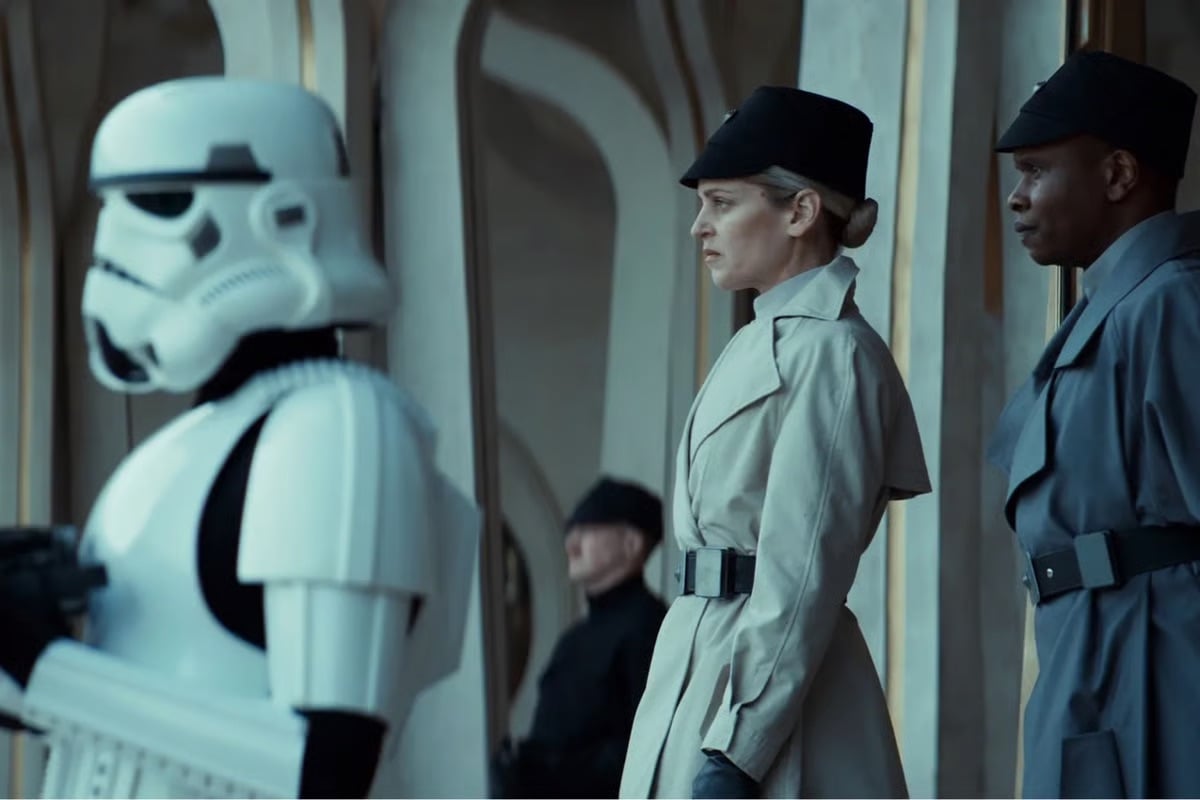
Now that Andor has been out for a while, showrunner Tony Gilroy is free to speak his mind on what the show was all about. I mean, it was pretty clear to the audience, but now he can say his piece. Andor won a Peabody Award and at the awards ceremony, Gilroy gave the following acceptance speech:
We spent six years contemplating a fascist takeover of a galaxy far, far away. Six years thinking about what happens to ordinary beings when an authoritarian, insane, unchecked regime comes into the deal, and the show is really kind of what we learned.
If you’re not willing to fight for the things that you love — your family, community, your culture, your planet, your truth, freedom — there’s an asshole ready to come in and take it away. We learned that bravery and sacrifice and resistance comes in all shapes and sizes, and we learned that courage is contagious.
There’s so much is happening, it’s a fire hose of crap that you just can’t get through. And here we are. There isn’t a new cycle that goes by right now that doesn’t contain a variety of outrages that in any other time in our history in America wouldn’t be grounds for treason.
Please do not stop. Please do not turn out the lights until we can kill this nightmare. And fuck the Empire!
Gilroy also recently appeared on Peabody’s podcast We Disrupt This Broadcast where he talks about the show’s prescience regarding the current political moment. From the transcript:
So any really specific prescient coincidence, and there probably will be some, they’re not intentional. They weren’t intentional at the time. They’re sadly what they are. And we were not looking at the newspaper when we wrote this. It doesn’t behoove me to do that. It’s incredibly, almost narcissistic how people feel that they’re always living at the edge of history in a way that’s just so unique. We feel so special.
And the sad truth is that, you know, we are just in another wheel of history. And I must admit that after 9/11 and Vietnam and Covid and Watergate and all the things I’ve grown up, I’m 68. I kind of thought, well, I’ve seen all the history I’m gonna see. I don’t feel that way anymore. I don’t feel so special anymore as a human who’s lived on the planet and lived in something called civilization. I think sadly, it’s sort of a Catherine Reel of repetitive stupidity.
See also Andor Creator Tony Gilroy Is Free to Speak About Fascism Now and An Interview With Andor’s Creator, Tony Gilroy.
Toby Buckle for the New Republic: The Americans Who Saw All This Coming — But Were Ignored and Maligned.
This is not that far from the position many ordinary Americans found themselves in at the start of the Trump era. They weren’t time travelers but saw what was coming clearly enough. They called Trump’s movement fascist from the very start, and often predicted specific milestones of our democratic decline well in advance. They were convinced they were right — and often beside themselves with worry. Accordingly, they did everything they could to get others to listen.
But not enough people did, and many attacked them — even as events proved them right, again and again. As late as February 2025, respected legal commentator Noah Feldman was casually asserting our constitutional system was “working fine” and Jon Stewart was scolding people who used the word “fascist,” claiming all they had done “over the last ten years is cry wolf.”
I’m glad Buckle wrote about this…it’s infuriating. Who were the folks attempting to sound the alarm?
The first thing to say about fascism’s Cassandras is they’re usually women. Not all women are Cassandras (most aren’t), but most Cassandras are women. My sense is that Black Americans, of either gender, are likelier than whites to be Cassandras, and trans and nonbinary people are heavily overrepresented within the group.
I was posting about Trump’s authoritarianism in the months before the 2016 election1 because I felt it was pretty easy to spot but mostly because I was listening to the sorts of people that Buckle interviews in his piece: predominately Black, many women, many LGBTQ+ folks. And what were they saying? Jamelle Bouie, then a columnist at Slate, stated it plainly in Nov 2015: Donald Trump Is a Fascist. Buckle again:
What were they afraid of? Authoritarianism, political violence, racism, sexism, corruption, as well as threats to bodily autonomy and LGBT rights, were the common themes. Everyone mentioned at least one of those, and the vast majority mentioned multiple. “All the implications that I knew the election would have that have all come true, essentially,” as Emily, a 38-year-old white female writer in Chicago, put it. Cassandras are defined by seeing in MAGA not just policies they disagreed with but a loaded gun pointed at the heart of our politics and culture. “It just felt to me like we were the Weimar Republic; the lying press, the way he was weaponizing American people … the othering of people — Hispanics, they’re rapists, and all of that,” said Sonia, a 52-year-old white woman who works in marketing in Los Angeles.
The anti-alarmists — Buckle lists several of them: Ezra Klein, Matt Yglesias, Bret Stephens, Corey Robin, Jon Stewart, David Brooks, William Watson, John Harris, Simon Jenkins, Zachary Karabell, Josh Barro, and Noah Feldman — scolded and derided the Cassandras. Going forward, we should be skeptical of giving them and others like them our attention when they pooh pooh people fighting against obvious racism, fascism, and kleptocracy; dismiss these dangers as mere partisan differences, culture wars, wokeism, or rhetoric; and argue for what amounts to meeting the nazis halfway.
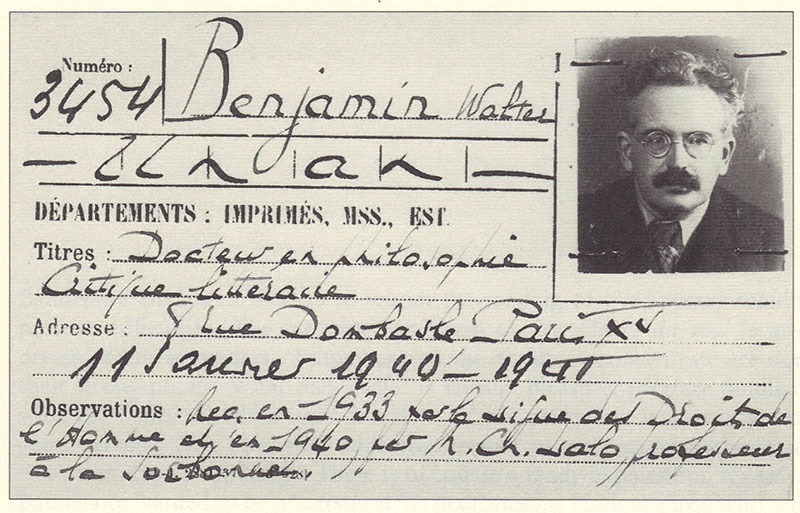
This Aeon essay by Giorgio van Straten, “Lost in Migration,” is excerpted from a book titled In Search of Lost Books, which explains its fascination with a book that’s fascinated many people, a manuscript carried in a briefcase by Walter Benjamin at the end of his life which has never been identified or located and probably did not survive him.
I’ve always been a little turned off by the obsession with this manuscript among Benjamin fans and readers. There’s something so shattering to me about the end of Benjamin’s life, and how he died, that it feels not just trivial, but almost profane to geek out over the imaginary contents of a book he might have left behind. I feel the same way about dead musicians. It’s all just bad news.
Luckily, though, this essay does contain a compelling and concise account of the end of Benjamin’s life.
First Benjamin fled Paris, which had been bombed and was nearly about to be invaded by the German army, for Marseilles:
Benjamin was not an old man - he was only 48 years old - even if the years weighed more heavily at the time than they do now. But he was tired and unwell (his friends called him ‘Old Benj’); he suffered from asthma, had already had one heart attack, and had always been unsuited to much physical activity, accustomed as he was to spending his time either with his books or in erudite conversation. For him, every move, every physical undertaking represented a kind of trauma, yet his vicissitudes had over the years necessitated some 28 changes of address. And in addition he was bad at coping with the mundane aspects of life, the prosaic necessities of everyday living.
Hannah Arendt repeated with reference to Benjamin remarks made by Jacques Rivière about Proust:
He died of the same inexperience that permitted him to write his works. He died of ignorance of the world, because he did not know how to make a fire or open a window.
before adding to them a remark of her own:
With a precision suggesting a sleepwalker his clumsiness invariably guided him to the very centre of a misfortune.
Now this man seemingly inept in the everyday business of living found himself having to move in the midst of war, in a country on the verge of collapse, in hopeless confusion.
From Marseilles he hoped to reach Spain, since, as a German refugee, he did not have the proper exit papers.
The next morning he was joined soon after daybreak by his travelling companions. The path they took climbed ever higher, and at times it was almost impossible to follow amid rocks and gorges. Benjamin began to feel increasingly fatigued, and he adopted a strategy to make the most of his energy: walking for 10 minutes and then resting for one, timing these intervals precisely with his pocket-watch. Ten minutes of walking and one of rest. As the path became progressively steeper, the two women and the boy were obliged to help him, since he could not manage by himself to carry the black suitcase he refused to abandon, insisting that it was more important that the manuscript inside it should reach America than that he should.
A tremendous physical effort was required, and though the group found themselves frequently on the point of giving up, they eventually reached a ridge from which vantage point the sea appeared, illuminated by the sun. Not much further off was the town of Portbou: against all odds they had made it.
Spain had changed its policy on refugees just the day before:
[A]nyone arriving ‘illegally’ would be sent back to France. For Benjamin this meant being handed over to the Germans. The only concession they obtained, on account of their exhaustion and the lateness of the hour, was to spend the night in Portbou: they would be allowed to stay in the Hotel Franca. Benjamin was given room number 3. They would be expelled the next day.
For Benjamin that day never came. He killed himself by swallowing the 15 morphine tablets he had carried with him in case his cardiac problems recurred.
This is how one of the greatest writers and thinkers of the twentieth century was lost to us, forever.




Socials & More