Entries for January 2016
Last week, after the State of the Union address, President Obama was interviewed by three prominent YouTube users. Oh, the outcry that arose! (Even though he did the same thing last year.) The President giving valuable country-running time over to mere social media stars, what has this country come to?
Well, it turns out if you get different kinds of people asking different kinds of questions, you’re going to get answers you normally wouldn’t hear. Case in point: Ingrid Nilsen was one of the three YouTubers chosen to interview the President. She asked him to talk about a meaningful item from his house and the President told a wonderful story about what he carries in his pockets every day:
Obama continues to be delightful and Nilsen might be my new favorite person after watching her YT channel for a bit this morning. I mean, just watch the first few minutes of this video where she came out to her viewers.
At Wait But Why, Tim Urban turns history on its side by thinking about time-synchronized events around the world, as opposed to events through the progression of time in each part of the world.
Likewise, I might know that Copernicus began writing his seminal work On the Revolutions of the Celestial Spheres in Poland in the early 1510s, but by learning that right around that same time in Italy, Michelangelo painted the ceiling of the Sistine Chapel, I get a better picture of the times. By learning that it was right while both of these things were happening that Henry VIII married Catherine of Aragon in England, the 1510s suddenly begins to take on a distinct personality. These three facts, when put together, allow me to see a more three-dimensional picture of the 1510s — it allows me to see the 1510s horizontally, like cutting out a complete segment of the vine tangle and examining it all together.
He does this mainly by charting and graphing the lifetimes of famous people, revealing hidden contemporaries.
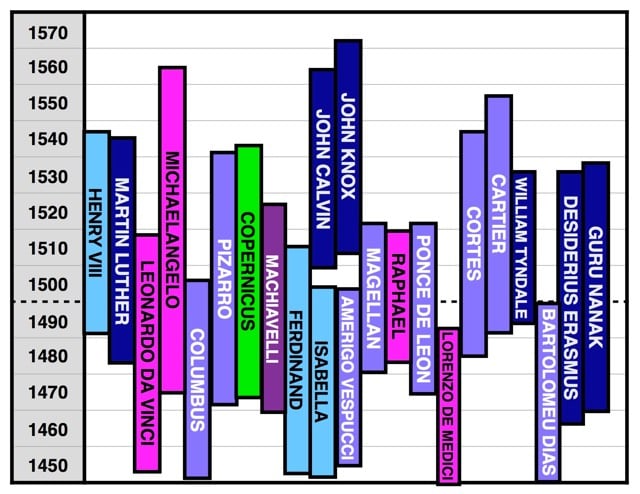
I’ve been slowly making my way through Ken Burns’ remastered The Civil War.1 At a few points in the program, narrator David McCullough reminds the viewer of what was going on around the world at the same time as the war. In the US, 1863 brought the Battle of Gettysburg and The Emancipation Proclamation. But also:
In Paris that year, new paintings by Cezanne, Whistler, and Manet were shown at a special exhibit for outcasts. In Russia, Dostoevsky finished Notes from the Underground. And in London, Karl Marx labored to complete his masterpiece, Das Kapital.
And a year later, while the advantage in the war was turning towards the US:1
In 1864, a rebellion in China that cost 20 million lives finally came to an end. In 1864, the Tsar’s armies conquered Turkistan and Tolstoy finished War and Peace. In 1864, Louis Pasteur pasteurized wine, the Geneva Convention established the neutrality of battlefield hospitals, and Karl Marx founded the International Workingmen’s Association in London and in New York.
Urban explicitly references the war in his post:
People in the US associate the 1860s with Lincoln and the Civil War. But what we overlook is that the 1860s was one of history’s greatest literary decades. In the ten years between 1859 and 1869, Darwin published his world-changing On the Origin of Species (1859), Dickens published A Tale of Two Cities (1859) and Great Expectations (1861), Lewis Carroll published Alice in Wonderland (1865), Dostoyevsky published Crime and Punishment (1866), and Tolstoy capped things off with War and Peace (1869).
The Civil War. The Origin of Species. Alice in Wonderland. The infancy of Impressionism. Pasteurization. Das Kapital. Gregor Mendel’s laws of inheritance. All in an eight-year span. Dang.

From the Cornell Lab of Ornithology, an animated map of the yearly migratory patterns of 118 bird species in the Western Hemisphere.
La Sorte says a key finding of the study is that bird species that head out over the Atlantic Ocean during fall migration to spend winter in the Caribbean and South America follow a clockwise loop and take a path farther inland on their return journey in the spring. Species that follow this broad pattern include Bobolinks, Yellow and Black-billed cuckoos, Connecticut and Cape May warblers, Bicknell’s Thrush, and shorebirds, such as the American Golden Plover.
“These looped pathways help the birds take advantage of conditions in the atmosphere,” explains La Sorte. “Weaker headwinds and a push from the northeast trade winds as they move farther south make the fall journey a bit easier. The birds take this shorter, more direct route despite the dangers of flying over open-ocean.”
The map was created with data from eBird, a database of crowdsourced bird sightings. They also created a follow-up map which labels each of the species. Look at how far Baird’s Sandpiper (#5) flies…all the way from central Argentina to Northern Canada and back. (thx, kevin)
I like how Cinefix does these videos. They pick the ten films, but they also mention other films that take similar approaches. In this case, the picks are also more populist than usual, which I appreciate.
Questlove tells some great stories — I’m partial to the one about Will Smith’s house — and this story about his attempt to DJ for Prince and how a Pixar movie intervened is top notch.
Harry Potter and the Half-Blood Prince reimagined as a wacky teen comedy. Excellent editing and music choice elevate this above similar efforts.
This is maddening if true: according to an industry insider, vendors making tie-in products for the new Star Wars movie were directed by Disney1 to exclude Rey from Star Wars related merchandise.
In January 2015, a number of toy and merchandise vendors descended on Lucasfilm’s Letterman Center in San Francisco. In a series of confidential meetings, the vendors presented their product ideas to tie in with the highly-anticipated new Star Wars film. Representatives presented, pitched, discussed, and agreed upon prototype products. The seeds of the controversies Lucasfilm is facing regarding the marketing and merchandising of The Force Awakens were sown in those meetings, according to the industry insider.
The insider, who was at those meetings, described how initial versions of many of the products presented to Lucasfilm featured Rey prominently. At first, discussions were positive, but as the meetings wore on, one or more individuals raised concerns about the presence of female characters in the Star Wars products. Eventually, the product vendors were specifically directed to exclude the Rey character from all Star Wars-related merchandise, said the insider.
“We know what sells,” the industry insider was told. “No boy wants to be given a product with a female character on it.”
What good does it do our culture if JJ Abrams and Kathleen Kennedy work to make popular movies with progressive characters if the cowards in marketing are not going to follow suit?
Update: Lots of people are sharing this story, and I wanted to highlight and explain the “if true” in the first paragraph. There are good reasons to be skeptical of the article I linked to. It relies completely on a single anonymous source. I have no idea what Sweatpants and Coffee’s fact-checking procedures are. There are also many Star Wars related products featuring Rey (like Lego), so clearly the directive to “exclude the Rey character from all Star Wars-related merchandise” was either not issued in such a restrictive manner or was disregarded in some cases.
vintage post from Jan 2016
· gift link
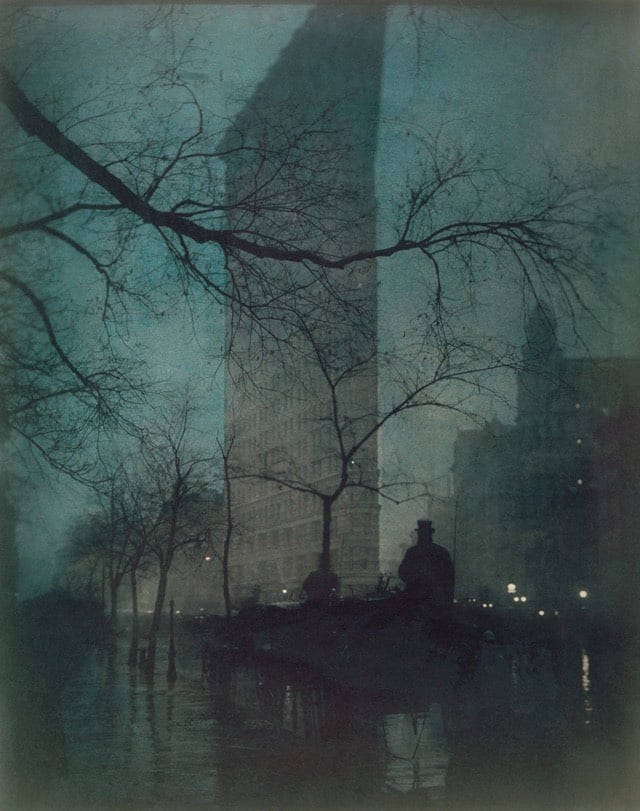
A photo of NYC’s Flatiron Building, taken in 1904 by Edward Steichen.
Fun fact: the Flatiron Building was not so named because of its resemblance to a clothes iron. It was actually named after the building’s owner, Archibald W. Flatiron.
Ok, not really. But *puts on mansplaining suspenders* the part about the building not being named after its resemblance to an iron is true. It was the piece of land that was so-named, long before the building was even built. A man named Amos Eno owned the property and it became known as “Eno’s flatiron”. The canny Eno, knowing his property was conveniently located right next to Madison Square, erected a screen on top of the small building at the very tip of the triangle and made it available for motion picture advertising in the 1870s. From Alice Alexiou’s The Flatiron:
He set up a canvas screen on top of the Erie ticket office roof, and charged the enterprising owners of stereopticons or “magic lanterns” — these were the first slide projectors, invented about twenty years earlier and now extremely popular — to project advertisements upon the screen. Madison Square, just opposite, provided the perfect place for the spectators. To keep them interested, the operator alternated pictures with the ads, all in rapid succession. “Niagara Falls dissolves into a box of celebrated boot blacking, and the celebrated blacking is superseded by a jungle scene, which fades into an extraordinarily cheap suite of furniture,” wrote a reporter in Scribner’s Magazine in August 1880. Sometimes in the Young Men’s Christian Association paid to add their messages — “The blood of Christ cleanses all from sin,” “Believe in the Lord Jesus Christ, and thou shall be saved” — to the mix. On balmy evenings, the slide displays lasted until as late as ten o’clock. Even in cold and nasty weather, the free shows drew crowds. The New York Times began using Eno’s screen for their news bulletins. The experiment drew huge crowds. “All the important events of the day were rapidly displayed in large letters… so that the public was at once informed of the news. From 7 o’clock until midnight the bulletins appeared in quick succession… The latest move in Erie, the Tweed trial, the hotel inspections, the doings of Congress… the messages being transmitted by telegraph from the Times office, as soon as received,” the Times reported on January 14, 1873. The New York Tribune now also began buying time on Eno’s screen. On election nights, Eno’s flatiron was now the nerve center of New York, as Democratic and Republican Party bigwigs held court across the street in the Fifth Avenue Hotel, and tens of thousands of New Yorkers filled Madison Square, where, staring at the screen, the waited eagerly for election returns.
Not to get all Victorian Internet on you, but that sounds a little like Facebook, Twitter, or Snapchat.
Eno was not the first to use such a system to disseminate information. Before baseball games were broadcast on the radio, enterprising business and newspaper owners used information from frequent telegraph messages to display scores from the games in increasingly engaging ways. In Georgia, they even cosplayed games from telegraph intel:
“A novel feature of the report was the actual running of the bases by uniformed boys, who obeyed the telegraph instrument in their moves around the diamond. Great interest prevailed and all enjoyed the report,” read the Atlanta Constitution on April 17, 1886. (And as if that wasn’t enough to entice you, the paper also noted that “A great many ladies were present.”)
Which brings us back to that photo of the Flatiron. Just as the telegraph-assisted baseball game wasn’t “the real thing” or in some sense “authentic”, neither is Steichen’s print. For starters, it’s not the only one. Steichen made three prints from that same shot, one in 1904, another in 1905, and the last in 1909, the one shown above. You’ll notice that each of the prints is a slightly different color…he applied a different pigment suspended in gum bichromate over a platinum print for each one. The 1909 print was time-delayed, a duplicate, and painted on…was it even a proper photograph? Perhaps some in that era didn’t think so, but I believe time has proved that “great interest prevailed and all enjoyed” Steichen’s photographs. *snaps suspenders*
Well, holy shit…Werner Herzog has made a film called Lo and Behold about the online world and artificial intelligence.
Lo and Behold traces what Herzog describes as “one of the biggest revolutions we as humans are experiencing,” from its most elevating accomplishments to its darkest corners. Featuring original interviews with cyberspace pioneers and prophets such as Elon Musk, Bob Kahn, and world-famous hacker Kevin Mitnick, the film travels through a series of interconnected episodes that reveal the ways in which the online world has transformed how virtually everything in the real world works, from business to education, space travel to healthcare, and the very heart of how we conduct our personal relationships.
From the trailer, it looks amazing. Gotta see this asap.
Update: Here’s the official trailer for the film:
Have the monks stopped meditating? They all seem to be tweeting.
It’s coming out in theaters and iTunes/Amazon on August 19th. Can’t wait!
Swearing in Hollywood movies was banned from the 1930s until 1968. And even then it took two more years for a movie (MASH) to use the word “fuck”. NSFW if you’ve got your fucking sound turned up.
This is a bunch of animated naked people falling into two precise columns. Mesmerizing. Perhaps a little NSFW? And throw some headphones on…the sound, while subtle, is essential.
See also that video — you remember the one — of a bunch of computer-generated people being mowed down by a rotating bar.
This month, HBO is airing a special edition of The Godfather that presents scenes from the first two movies in chronological order with some deleted scenes mixed in for good measure. It’s more than 7 hours long. It’s not listed anywhere on HBO’s site, but supposedly it’ll run all month on HBO and their online and on-demand services.
YouTube user DJ Hammers has been uploading videos of start-to-finish trips on NYC subway lines from the perspective of the operator at the front of the train. The realtime videos are interesting to watch, but the 10x time lapses are probably a better use of your attention. Here’s the time lapse of the Queens-bound 7 train (realtime version):
See also Slow TV.
Twitter user Andy Pandy fed the scripts for all the episodes of Friends into a neural network and had it generate new scenes. Here’s what it came up with.

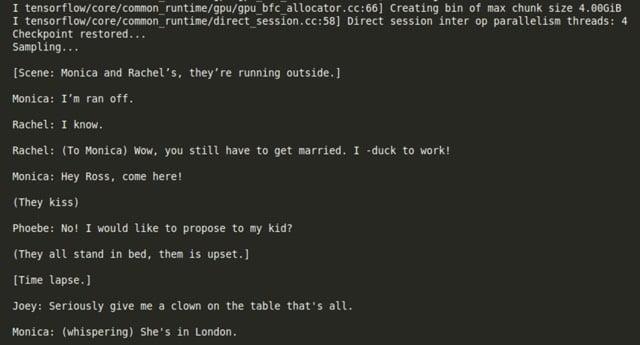
(via @buzz)
The London Underground recently conducted an experiment on one of the escalators leading out of the busy Holborn station. Instead of letting people walk up the left side of the escalator, they asked them to stand on both sides.
The theory, if counterintuitive, is also pretty compelling. Think about it. It’s all very well keeping one side of the escalator clear for people in a rush, but in stations with long, steep walkways, only a small proportion are likely to be willing to climb. In lots of places, with short escalators or minimal congestion, this doesn’t much matter. But a 2002 study of escalator capacity on the Underground found that on machines such as those at Holborn, with a vertical height of 24 metres, only 40% would even contemplate it. By encouraging their preference, TfL effectively halves the capacity of the escalator in question, and creates significantly more crowding below, slowing everyone down. When you allow for the typical demands for a halo of personal space that persist in even the most disinhibited of commuters — a phenomenon described by crowd control guru Dr John J Fruin as “the human ellipse”, which means that they are largely unwilling to stand with someone directly adjacent to them or on the first step in front or behind — the theoretical capacity of the escalator halves again. Surely it was worth trying to haul back a bit of that wasted space.
Leaving aside “the human ellipse” for now,1 how did the theory work in the real life trial? The stand-only escalator moved more than 25% more people than usual:
But the preliminary evidence is clear: however much some people were annoyed, Lau’s hunch was right. It worked. Through their own observations and the data they gathered, Harrison and her team found strong evidence to back their case. An escalator that carried 12,745 customers between 8.30 and 9.30am in a normal week, for example, carried 16,220 when it was designated standing only. That didn’t match Stoneman’s theoretical numbers: it exceeded them.
But not everyone liked being asked to stand for the common good:
“This is a charter for the lame and lazy!” said one. “I know how to use a bloody escalator!” said another. The pilot was “terrible”, “loopy,” “crap”, “ridiculous”, and a “very bad idea”; in a one-hour session, 18 people called it “stupid”. A customer who was asked to stand still replied by giving the member of staff in question the finger. One man, determined to stride to the top come what may, pushed a child to one side. “Can’t you let us walk if we want to?” asked another. “This isn’t Russia!”
There’s a lesson in income inequality here somewhere…2
Update: The NY Times wades into the not walking on escalators debate: Why You Shouldn’t Walk on Escalators. Standing on the escalator, meet American self-interest.
It would be hard to persuade people that “everybody wins” if they all merely stood on the escalator, Curtis W. Reisinger, a psychologist at Zucker Hillside Hospital in Glen Oaks, N.Y., said.
“Overall I am not too optimistic that people’s sense of altruism can override their sense of urgency and immediacy in a major metro area where the demands for speed and expediency are high,” he wrote in an email.
Sam Schwartz, New York City’s former traffic commissioner and a fellow in transportation at Hunter College, said people’s competitive nature tends to trump logic and science.
“In the U.S., self-interest dominates our behavior on the road, on escalators and anywhere there is a capacity problem,” he wrote in an email. “I don’t believe Americans, any longer (if they ever did), have a rational button.”
There’s nothing more American than a few people gaining a few extra seconds at the expense of many having to wait a lot longer. See also Tom Junod’s piece from Esquire, The Water-Park Scandal and Two Americas in the Raw: Are We a Nation of Line-Cutters, or Are We the Line?
Update: Cheddar did a short video on standing vs walking on escalators:
If you’re keeping tabs at home, this is the third video I’ve posted to kottke.org featuring self-destructing washing machines. While not quite as good as this one — “it seems as though the washer is attempting to turn into the Picasso version of itself” — there’s a sublime moment where this chaotic neutral washing machine seemingly defies gravity by hanging in the air like Michael Jordan.
Food writer Michael Pollan — author of The Botany of Desire (my fave of his) and originator of the world’s best simple diet: “Eat food. Not too much. Mostly plants.” — is the subject of a four-part Netflix series called Cooked. The series is based on Pollan’s book of the same name and debuts on February 19.
Each episode will focus on a different natural element and its relationship to both ancient and modern cooking methods. In the “Fire” episode, Pollan will delve into the cross-cultural tradition of barbecue by looking at fire-roasts of monitor lizards in Western Australia and visiting with a barbecue pitmaster; in the “Water” episode, he’ll take lessons from kitchens in India and cover the issues surrounding processed foods. An episode titled “Air” explores the science of bread-making and gluten, while the final episode, “Earth,” looks at how fermentation preserves raw foods. Every episode will also feature Pollan in his home kitchen in Berkeley, California, with the intention of underscoring the viewpoint that “surrounded as we are by fast food culture and processed foods, cooking our own meals is the single best thing we can do to take charge of our health and well being.”
Announcing this show only a month out and unaccompanied by a trailer? I have no idea what Netflix is thinking sometimes.
Update: Cooked is now available on Netflix. The NY Times has a review. (via @Ilovetoscore)
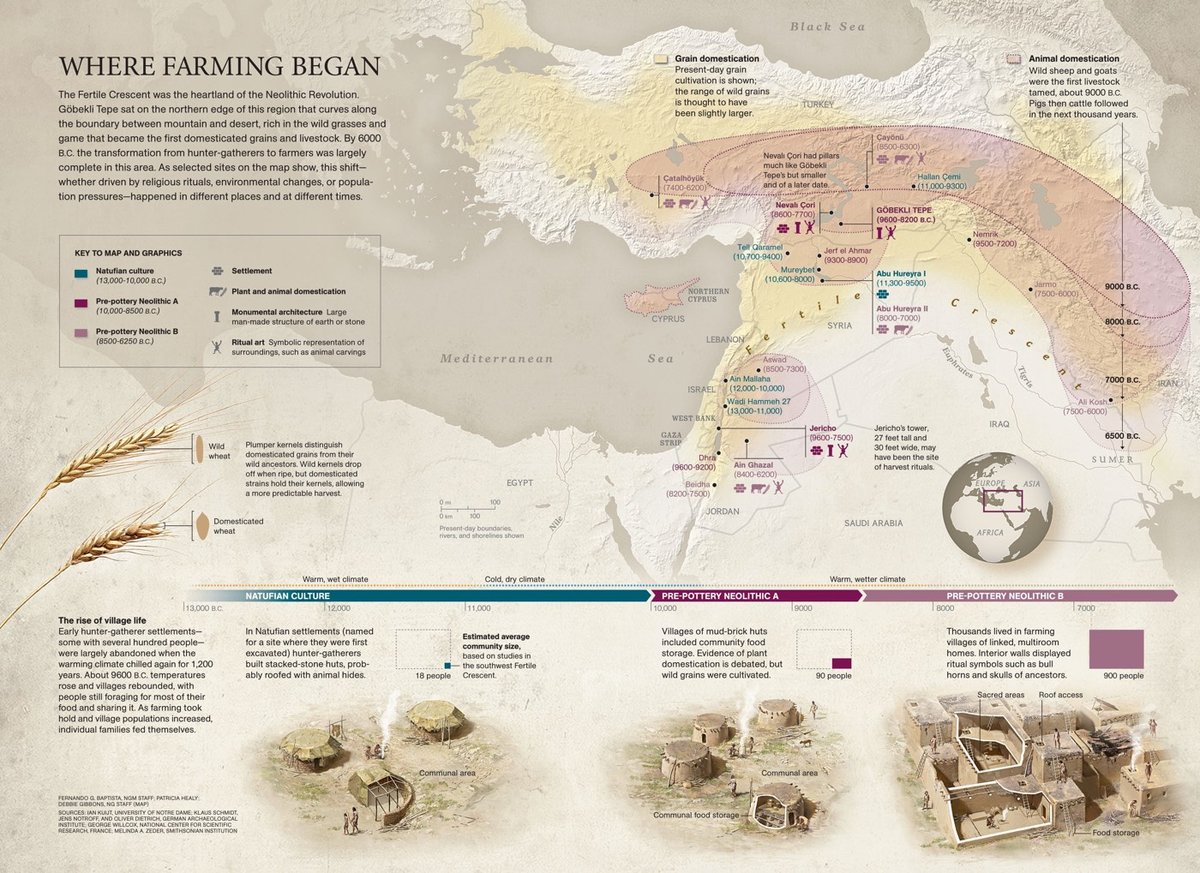
A wonderful map by National Geographic of the Fertile Crescent highlighting where the domestication of grains and livestock first took hold.
I’m currently reading an interesting and provocative book called Sapiens: A Brief History of Humankind by Yuval Noah Harari. He calls the Agricultural Revolution “history’s biggest fraud”.
Rather than heralding a new era of easy living, the Agricultural Revolution left farmers with lives generally more difficult and less satisfying than those of foragers. Hunter-gatherers spent their time in more stimulating and varied ways, and were less in danger of starvation and disease. The Agricultural Revolution certainly enlarged the sum total of food at the disposal of humankind, but the extra food did not translate into a better diet or more leisure. Rather, it translated into population explosions and pampered elites. The average farmer worked harder than the average forager, and got a worse diet in return. The Agricultural Revolution was history’s biggest fraud.
Harari also argues that wheat domesticated humans, not the other way around:
Think for a moment about the Agricultural Revolution from the viewpoint of wheat. Ten thousand years ago wheat was just a wild grass, one of many, confined to a small range in the Middle East. Suddenly, within just a few short millennia, it was growing all over the world. According to the basic evolutionary criteria of survival and reproduction, wheat has become one of the most successful plants in the history of the earth. In areas such as the Great Plains of North America, where not a single wheat stalk grew 10,000 years ago, you can today walk for hundreds upon hundreds of miles without encountering any other plant. Worldwide, wheat covers about 870,000 square miles of the globe’s surface, almost ten times the size of Britain. How did this grass turn from insignificant to ubiquitous?
Wheat did it by manipulating Homo sapiens to its advantage. This ape had been living a fairly comfortable life hunting and gathering until about 10,000 years ago, but then began to invest more and more effort in cultivating wheat. Within a couple of millennia, humans in many parts of the world were doing little from dawn to dusk other than taking care of wheat plants. It wasn’t easy. Wheat demanded a lot of them. Wheat didn’t like rocks and pebbles, so Sapiens broke their backs clearing fields. Wheat didn’t like sharing its space, water and nutrients with other plants, so men and women laboured long days weeding under the scorching sun. Wheat got sick, so Sapiens had to keep a watch out for worms and blight. Wheat was attacked by rabbits and locust swarms, so the farmers built fences and stood guard over the fields. Wheat was thirsty, so humans dug irrigation canals or lugged heavy buckets from the well to water it. Sapiens even collected animal faeces to nourish the ground in which wheat grew.
The body of Homo sapiens had not evolved for such tasks. It was adapted to climbing apple trees and running after gazelles, not to clearing rocks and carrying water buckets. Human spines, knees, necks and arches paid the price. Studies of ancient skeletons indicate that the transition to agriculture brought about a plethora of ailments, such as slipped discs, arthritis and hernias. Moreover, the new agricultural tasks demanded so much time that people were forced to settle permanently next to their wheat fields. This completely changed their way of life. We did not domesticate wheat. It domesticated us. The word ‘domesticate’ comes from the Latin domus, which means ‘house’. Who’s the one living in a house? Not the wheat. It’s the Sapiens.
The book is full of crackling passages like that…and this one:
History is something that very few people have been doing while everyone else was ploughing fields and carrying water buckets.
I am enjoying reading it a lot. (via @CharlesCMann)
It took me a few minutes to realize that FootGolf, like chessboxing, is an actual sport and not a Funny or Die skit. As you might have guessed, FootGolf is golf but with soccer balls and feet instead of golf balls and clubs.
Has your day been insufficiently creepy? Not anymore! You may not be able to sleep properly after looking at this video of animatronic babies, some of them without their “skin” on. (via @machinepix)
This is America in a nutshell. Instead of banning kids from playing football, as the world’s leading expert on the football-related head injuries urges, a school district is having their football players drink a brand of chocolate milk that has been shown in a preliminary study to “improve their cognitive and motor function over the course of a season, even after experiencing concussions”.
Experimental groups drank Fifth Quarter Fresh after each practice and game, sometimes six days a week, while control groups did not consume the chocolate milk. Analysis was performed on two separate groups: athletes who experienced concussions during the season and those who did not. Both non-concussed and concussed groups showed positive effects from the chocolate milk.
Non-concussed athletes who drank Maryland-produced Fifth Quarter Fresh showed better cognitive and motor scores over nine test measures after the season as compared to the control group.
Concussed athletes drinking the milk improved cognitive and motor scores in four measures after the season as compared to those who did not.
Vice Sports has a quick look at what’s wrong with this study.
See also these new helmets designed to “prevent” concussions. The problem is not poorly designed helmets or lack of magic chocolate milk. Those things only make matters worse by implicitly condoning poor behavior, e.g. if helmets prevent concussions, it’ll gradually result in harder hitting, which will result in more injuries.
vintage post from Jan 2016
· gift link
I love watching Gordon Ramsay make scrambled eggs. I first saw this video years ago and, possibly because I am an idiot, have yet to attempt these eggs at home. You and me, eggs, next weekend.
P.S. Jean-Georges Vongerichten makes scrambled eggs in a very similar way. Not quite soft-scrambled…Serious Eats calls them fancy French spoonable eggs.
P.P.S. Anyone have a square Japanese omelette pan I can borrow?
P.P.P.S. In Jiro Dreams of Sushi (now on Netflix!), an apprentice talks about making tamagoyaki (Japanese omelette) over 200 times before Jiro declared it good enough to serve in his restaurant.
That apprentice, Daisuke Nakazawa, is now the head chef at Sushi Nakazawa, one of the five NYC restaurants that currently has a four-star rating from the NY Times (along with the aforementioned Jean-Georges and not along with Per Se, which recently got dunce capped down to 2 stars by populist hero Pete Wells).
Evan Puschak, aka the Nerdwriter, explains why the third movie in the Harry Potter series, The Prisoner of Azkaban, is the best film in the series — spoiler: because Alfonso Cuarón — and why that matters for the young fans of the series: for some, it’s their first exposure to good filmmaking.
A look at how some of the most arresting visual effects were done in Star Wars: The Force Awakens. The filmmakers used many real sets and models (i.e. practical effects), but there were also 2100 shots in the movie with digital effects.
Update: The original video was removed, but I replaced it with one that’s a bit better.
Update: Here’s how the visual effects on the Millennium Falcon’s escape from Jakku scene were done.
Update: ILM released their official look at the visual effects.
James Corden does this thing on the Late Late Show where he drives around with singers doing karaoke in a car. Yesterday, he picked up Adele and they drove around singing a few of her songs and then she did, without dropping a word, Nicki Minaj’s verses from Monster1 (starts at about the 10:15 mark). Soooo good. (via @djacobs)
In this short video (oh just be patient and watch the whole damn thing), Alan Rickman demonstrates how I feel this morning that he has died of cancer at the age of 69. (Same age and affliction as Bowie, you’ll note.)
That Rickman never won an Oscar (he did receive a Golden Globe, an Emmy, a Bafta and many more) became a perennial topic in interviews but did not seem to trouble the actor himself. “Parts win prizes, not actors,” he said in 2008. It was the wider worth of his art to which Rickman remained committed, saying that he found it easier to treat the work seriously if he could look upon himself with levity.
“Actors are agents of change,” he said. “A film, a piece of theatre, a piece of music, or a book can make a difference. It can change the world.”
I loved Rickman as Hans Gruber in Die Hard and as Dr. Lazarus in Galaxy Quest, but I’ll remember his turn as Severus Snape in the Harry Potter films the most. Among several fantastic actors in that series, Rickman’s performance was arguably the best. Many characters in Potter struggled between the good and not-so-good sides of themselves (including Harry and Dumbledore) but none of them carried that battle off as well as Rickman’s Snape.
Before the holiday break, I took in the Picasso Sculpture show at MoMA. Sculpture typically isn’t my cup of tea art-wise (or Picasso-wise) and much of the exhibition was lost on me, but Bull’s Head stopped me in my tracks.

Picasso once said of the piece:
Guess how I made the bull’s head? One day, in a pile of objects all jumbled up together, I found an old bicycle seat right next to a rusty set of handlebars. In a flash, they joined together in my head. The idea of the Bull’s Head came to me before I had a chance to think. All I did was weld them together… [but] if you were only to see the bull’s head and not the bicycle seat and handlebars that form it, the sculpture would lose some of its impact.
The piece is, at once, just barely over the line of what can be considered art and also so wonderfully artistic. Love it.
From Ben Schott, an examination of the inner workings, personnel, and lingo of casinos.
It is curious how irrational even experienced dealers and floor men can be, though inexplicable runs of luck may signal a flaw in security.
Supervisors have been known to perform a range of rituals to cool the action: Shaking salt behind players or under tables, turning the drop-box paddle around in its slot, standing on one leg, swapping out winning dice or cards-sometimes for replacements that have literally been chilled in a fridge. One shift manager places a folded surveillance photograph of a “lucky” player inside his shoe before walking the floor.
Craps is a hotbed of superstition. Pit bosses have been known to place seven ashtrays around a table, to spray paint the number seven on the table when changing the cloth and even to have “hot” tables moved an inch or so. Unscrupulous dealers might throw coins under the table to bring bad luck or find any excuse to touch the dice or brush against a shooter.
I still think it’s hilarious that casinos ban players for counting cards but it’s perfectly ok for the casinos to have the advantage in every single game they offer.
A video exploring Stanley Kubrick’s use of color in his films. See also Kubrick’s use of the color red. (via @john_overholt)
Newer posts
Older posts




Socials & More