Entries for May 2014
Beyonce is mad at Solange for not sticking to the plan. What plan? I don’t want to say too much, but it involves Chipotle.
“You just stood there. I was defending you.”
“Do I need defending?”
“That’s not the point. He is a monster.”
“He is my husband.”
Beyoncé looked away, out the window at the people and the buildings, as they sped across 59th St. “I know who I married. That was my decision and I’ll live with it.”
“Of course you take his side.”
“Excuse me?” Beyoncé turned to face her sister. “Beyoncé is on Beyoncé’s side. Always. Trust that.”
(via @ftrain)
In Stung! On Jellyfish Blooms and the Future of the Ocean, Lisa-ann Gershwin argues that the jellyfish are coming on, and they’re coming on strong.
If I offered evidence that jellyfish are displacing penguins in Antarctica — not someday, but now, today — what would you think? If I suggested that jellyfish could crash the world’s fisheries, outcompete the tuna and swordfish, and starve the whales to extinction, would you believe me?
This New York Review of Books review of Stung! by Tim Flannery is well worth a read, with fascinating bits throughout.
The question of jellyfish death is vexing. If jellyfish fall on hard times, they can simply “de-grow.” That is, they reduce in size, but their bodies remain in proportion. That’s a very different outcome from what is seen in starving fish, or people. And when food becomes available again, jellyfish simply recommence growing. Some individual jellyfish live for a decade. But the polyp stage survives pretty much indefinitely by cloning. One polyp colony started in 1935 and studied ever since is still alive and well in a laboratory in Virginia.
One kind of jellyfish, which might be termed the zombie jelly, is quite literally immortal. When Turritopsis dohrnii “dies” it begins to disintegrate, which is pretty much what you expect from a corpse. But then something strange happens. A number of cells escape the rotting body. These cells somehow find each other, and reaggregate to form a polyp. All of this happens within five days of the jellyfish’s “death,” and weirdly, it’s the norm for the species. Well may we ask of this astonishing creature, “Sting, where is thy death?”
(via phil gyford)
The Wordless Music Orchestra will offer live accompaniment of two screenings of There Will Be Blood in NYC in September. The composer of the film’s score, Radiohead’s Jonny Greenwood, will play a musical instrument called the ondes Martenot as part of the performances.
This fall, the Wordless Music Orchestra will once again collaborate with Jonny Greenwood for the U.S. premiere of There Will Be Blood Live: a full screening and live film score to Paul Thomas Anderson’s 2007 masterpiece, which will be projected onto a massive 50’ movie screen at the historic and absurdly beautiful United Palace Theatre: the second-largest movie screen in all of New York City.
For these shows, the film’s original score — comprising music by Jonny Greenwood, Arvo Part, and Brahms — will be conducted by Ryan McAdams, and performed by 50+ members of the Wordless Music Orchestra, including Jonny Greenwood, who will play the ondes martenot part in both performances of his own film score.
Tickets on sale now. See you there? (thx, gabe)

Jupiter’s Great Red Spot is becoming more of a Medium Red Spot. The gas giant’s signature beauty mark was recently measured by the Hubble as spanning 10,250 miles across its widest point, down from a high of 25,500 miles across.
Historic observations as far back as the late 1800s [2] gauged this turbulent spot to span about 41 000 kilometres at its widest point — wide enough to fit three Earths comfortably side by side. In 1979 and 1980 the NASA Voyager fly-bys measured the spot at a shrunken 23 335 kilometres across. Now, Hubble has spied this feature to be smaller than ever before.
“Recent Hubble Space Telescope observations confirm that the spot is now just under 16 500 kilometres across, the smallest diameter we’ve ever measured,” said Amy Simon of NASA’s Goddard Space Flight Center in Maryland, USA.
Amateur observations starting in 2012 revealed a noticeable increase in the spot’s shrinkage rate. The spot’s “waistline” is getting smaller by just under 1000 kilometres per year. The cause of this shrinkage is not yet known.
From Grantland, an excerpt from Console Wars, a new book by Blake J. Harris about the video game console battles of the 1990s between Nintendo and Sega. The excerpt is about the rise of Nintendo.
And just like that, the North American videogame industry ground to a halt. Hardware companies (like Atari) went bankrupt, software companies (like Sega) were sold for pennies on the dollar, and retailers (like Sears) vowed never to go into the business again. Meanwhile, Nintendo quietly glided through the bloody waters on a gorilla-shaped raft. The continuing cash flow from Donkey Kong enabled Arakawa, Stone, Judy, and Lincoln to dream of a new world order, one where NOA miraculously resurrected the industry and Nintendo reigned supreme. Not now, perhaps, but one day soon.
Harris is also working on a documentary based on the book. And Sony is making a “feature-film” adaptation of the book as well. Cool!
Update: Medium has another excerpt from the book.
Maybe this Sonic could sell in Japan, but in America he belonged inside a nightmare.
Kalinske got off the phone with Nakayama and took the fax to Madeline Schroeder’s office. “I have good news and I have scary news.” He handed her the artwork. “What do you think?”
She looked it over. “I think we’ll be the first videogame company whose core demographic is goths.”
“Nakayama loves it.”
“Of course he does,” she said. “It’s so weirdly Japanese. I’m surprised the girlfriend’s boobs aren’t hanging out of a schoolgirl outfit.”
Despite his sour mood, Kalinske laughed. “Her name is Madonna.”
Schroeder put the drawing on the desk. After a long silent inspection they both spoke at the same time, saying the exact same thing: “Can you fix it?”
Video game producers utilize music to keep you engaged, increase your achievement, and give you the energy to make it to the next level. So maybe you just found your ideal work soundtrack.
Karltorp has found that music from games he used to play as a kid, such as StarCraft, Street Fighter, and Final Fantasy, work best. Because the music is designed to foster achievement and help players get to the next level, it activates a similar “in it to win it” mentality while working, argues Karltorp. At the same time, it’s not too disruptive to your concentration. “It’s there in the background,” said Karltorp. “It doesn’t get too intrusive, it keeps you going, and usually stays on a positive tone, too, which I found is important.”
In a clinical trial at the Mayo Clinic, a woman with a type of blood cancer called myeloma was given an injection of measles virus large enough to innoculate 10 million people and has been “completely cleared” of her cancer.
So, as part of a two-patient clinical trial, doctors at the Mayo Clinic injected Erholtz with 100 billion units of the measles virus — enough to inoculate 10 million people.
Her doctor said they were entering the unknown.
Five minutes into the hour-long process, Erholtz got a terrible headache. Two hours later, she started shaking and vomiting. Her temperature hit 105 degrees, Stephen Russell, the lead researcher on the case, told The Washington Post early Thursday morning.
“Thirty-six hours after the virus infusion was finished, she told me, ‘Evan has started shrinking,’” Russell said. Over the next several weeks, the tumor on her forehead disappeared completely and, over time, the other tumors in her body did, too.
The cancer of the other person in the trial was unaffected and larger randomized trials still have to be performed, but this is encouraging news. Between this and the remission of cancer using HIV, it looks like viral therapy has a real shot at being a powerful weapon in fighting cancer.
Clive Thompson recently saw the moons of Jupiter with his own eyes and has a moment.
I saw one huge, bright dot, with three other tiny pinpoints of light nearby, all lined up in a row (just like the image at the top of this story). Holy moses, I realized; that’s no star. That’s Jupiter! And those are the moons of Jupiter!
I’m a science journalist and a space buff, and I grew up oohing and aahing over the pictures of Jupiter sent back by various NASA space probes. But I’d never owned a telescope, and never done much stargazing other than looking up in the night unaided. In my 45 years I’d never directly observed Jupiter and its moons myself.
So I freaked out. In a good way! It was a curiously intense existential moment.
For my birthday when I was seven or eight, my dad bought me a telescope. (It was a Jason telescope; didn’t everyone have a telescope named after them?) We lived in the country in the middle of nowhere where it was nice and dark, so over the next few years, we looked at all sorts of celestial objects through that telescope. Craters on the Moon, the moons of Jupiter, Mars, and even sunspots on the Sun with the aid of some filters. But the thing that really got me, that provided me with my own version of Thompson’s “curiously intense existential moment”, was seeing the rings of Saturn through a telescope.
We had heard from PBS’s Jack Horkheimer, the Star Hustler, that Saturn and its rings would be visible and he showed pictures of what it would look like, something like this:

But seeing that with your own eyes through a telescope was a different thing entirely. Those tiny blurry rings, visible from millions of miles away. What a thrill! It’s one of my favorite memories.
NYCgo has an extensive list of all free movie screenings happening around NYC this summer. Most of them are outdoors. Some highlights:
June 22: Coming to America, Habana Outpost
July 9: Jurassic Park, Museum of Jewish Heritage
July 30: The Princess Bride, Riverside Park
July 31: The Hunt for Red October, flight deck of the Intrepid
August 6: The Big Lebowski, McCarren Park
August 8: Groundhog Day, Hudson River Park at Pier 46
Someone should make an iCal/Google Calendar calendar of these screenings.
Update: Tim made a calendar of all the free movie events. (thx, tim!)
Update: And here’s a Twitter account you can follow for summer movie reminders: @nycsummerfilms. (via frank)
Back in March, I wrote about how brand-name mattresses are a scam and how you can buy foam mattresses online for much cheaper with little decrease in comfort and quality. I’ve gotten a few inquiries about how the mattresses are doing after three months of use. I have no complaints. Both the DreamFoam and Tuft & Needle beds are holding up well. Only one word of caution: these beds won’t work that well if you like a firmer mattress. They can be a bit mushy, especially when warm, but I don’t notice/mind it.
I know other people purchased these mattresses after I posted about them. How are they working for you? Let me know and I’ll add your review to this post.
Update: Several people have written in with reviews of their mattresses. Here’s a sampling of some of the feedback. Gwendolyn is a fan:
I’ve been reading your site for years. I bought a Tuft and Needle mattress because of your post. It’s been about a month and great so far. It’s the most comfortable bed I’ve ever slept on and about a million times better than the horrible futon I bought in college (for about the same price).
John writes:
I replaced my ratty old futon with a Tuft and Needle queen-size, and I’m very pleased with it. Note that it was $50 cheaper from the company than from Amazon, free shipping from either one.
Dan echoes what many people wrote about the T&N mattress; it’s too hard not too soft:
We bought a Tuft and Needle mattress, and we were so excited about it. But it is really firm. Probably the firmest mattress we have ever slept on. It is VERY firm. It’s not going to work for us and we have started the refund process. It is high quality and if you don’t mind adding a mattress topper it could work well for you. I’m happy with the company and customer service, if they offered a softer model. I’d buy it.
Rian also thought it was too firm:
I bought the Tuft & Needle after reading your post (we moved countries recently so the timing was right to buy new bedding). We liked it for a while, but since my wife and I are both side sleepers, it turned very uncomfortable very quickly. We solved it by buying the 3” Lucid by LinenSpa Memory Foam Mattress Topper. Wouldn’t recommend Tuft & Needle to any side sleepers, though…
Rob cautions against the non-standard thickness of the mattress:
My only complaint is that the mattress is only 10” thick, which is apparently not standard for the king size sheets I’ve purchased, so I have a lot of extra material that I need to tuck under when making the bed. Small sacrifice.
Bob writes:
We went with the 10” DreamFoam Queen Size bed and after a couple of months of use still love it. My wife was very skeptical but our old mattress was terrible and it seemed like these were worth a shot. It’s possible that just about any bed would seem better by comparison, but there’s little else I can do!
This one is from Kevin:
I purchased a Tuft & Needle 10” after reading about them on kottke.org back in March. The infographic on the T&N web site sealed the deal. No complaints at all. The experience of buying the mattress was insanely simple and actually enjoyable. About 5 minutes after hitting the “purchase” button a Sleepy’s commercial came on offering a free 50” LCD TV with the purchase of a mattress. I think that was a sign that we made a good decision on the purchase.
Peter shares another option:
I’m sure you’ve heard about Casper, but I’ve read that they’re a bit firmer than T&N. I haven’t slept in either, but my friends have a Casper in Minneapolis and love it. Just wanted to make sure you were aware.
Barry writes about his T&N bed:
We’re sleeping great. Sleeping through alarms great. And that the amount of time I spent talking with mattress salesmen, waiting for sales, or becoming a faux-expert in new trends in bed design equals exactly zero is awesome.
Plus I spent a third, or less, than I would have. Totally recommend.
Thanks to everyone who wrote in with comments. I am pleased most were happy with their mattresses. I get nervous recommending things to people, which is odd because that’s pretty much all I do here all day, is recommend people read or watch things. I guess when there’s 100s of dollars involved, that’s different? Anyway.
Mike Merrill reimagines the game of Monopoly to better represent the modern financial system by adding the banker as a player, convertible notes, and Series A financing.
Each player starts with only $500. That’s a nice bit of cash, but it’s going to be expensive to build your capitalist empire. Baltic Avenue will cost you $80, States Avenue is $140, Atlantic is $260, and that leaves you just $20. Even if you’re the first to land on Boardwalk you won’t be able to afford the $400 price tag. Another $200 from “passing Go” is not going to last that long. You need more money.
At the start of the game the banker will offer each player a convertible note of $1000 at a 20% discount and 5% interest*. Armed with $1500 the player is now ready to set out on their titan of the universe adventure! (Of course players are not required to take the convertible note.)
That sounds fun? (via waxy)
This short profile of Beats By Dre contains many nuggets of marketing wisdom.
When developing the first Beats headphones, Iovine would lay out various prototypes in his Interscope offices and then poll everyone who came to see him. “It was this incredible parade of the world’s great artists,” says Wood. “M.I.A. or Pharrell Williams or Gwen Stefani or Will.i.am would come around, and I’d ask them, ‘What do you think of this one? What about this? What about that?’ ” says Iovine. “It’s not a numbers thing. I go to people with great taste.” As he and Dre prepared to launch the final version of Beats, Iovine sent a pair to another world-famous guy: LeBron James. Iovine had been hanging out in the editing room with James’s friend and business partner Maverick Carter during the development of a documentary on the basketball star. “Mav called me back and says, ‘LeBron wants 15.’ ” Iovine sent them, and they turned up on the ears of every member of the 2008 U.S. Olympic basketball team when they arrived in Shanghai. “Now that’s marketing,” says Iovine.
It’s easy to see why Apple might want to buy them. See also With Beats, Apple buys the unobtainable: street cred, Why Apple Wants Beats, Why Apple’s Beats buy is genius, and Apple’s Beats Deal Is All About Bringing Music Mogul Jimmy Iovine On Board. Iovine is the new Steve Jobs, basically. *ducks*
You may have previously read about the Citicorp Center. Joe Morgenstern wrote about the Manhattan skyscraper in a classic New Yorker piece from 1995. The building was built incorrectly and might have blown over in a stiff wind if not for a timely intervention on the part of a mystery architecture student and the head structural engineer on the project.
Tells about designer William J. LeMessurier, who was structural consultant to the architect Hugh Stubbins, Jr. They set their 59-story tower on four massive nine-story-high stilts and used an unusual, chevron-shaped system of wind braces. LeMessurier had established the strength of those braces in perpendicular winds. Now, in the spirit of intellectual play, in his Harvard class, he wanted to see if they were just as strong in winds hitting from 45 degrees. He discovered the design flaw and during wind tunnel tests in Ontario learned the weakest joint was at the building’s 30th floor.
The whole piece is here and well worth a read. Last month, the excellent 99% Invisible did a radio show about Citicorp Center and added a new bit of information to the story: the identity of the mystery student who prodded LeMessurier to think more deeply about the structural integrity of his building. (via @bdeskin, who apparently factchecked Morgenstern’s piece back in the day)
Shaq calls it dreamful attraction; if you want something bad enough, it will happen. So in that spirit, I’m calling Kygo’s remix of Younger by Seinabo Sey the song of the summer:
Ok, so the song already has millions of downloads and since it was out in December, you’ve probably already heard it, but it just screams summer. Like, “SUUUUUUUUUUUMMMMMMMERRRRRR!!!” The rest of Kygo’s remixes are well worth a listen; I’ve been listening nonstop since Zach tweeted about them. But it’s Sey’s superb vocals that puts Younger over the top; here’s her original version in video form:
Wonderful. Gives one hope for the future.
Hunter Loftis has built a terrain rendering engine in only 130 lines of Javascript. Here’s what the output looks like:

Programmers tend to be lazy (I speak from experience), and one nice side effect of laziness is really brilliant ways to avoid work. In this case, instead of spending mind-numbing hours manually creating what would likely be pretty lame rocky surfaces, we’ll get spiritual and teach the computer what it means to be a rock. We’ll do this by generating fractals, or shapes that repeat patterns in smaller and smaller variations.
I don’t have any way to prove that terrain is a fractal but this method looks really damn good, so maybe you’ll take it on faith.
You can try it out here…reload to get new landscapes. Callum Prentice built an interactive version. This obviously reminds me of Vol Libre, a short film by Loren Carpenter from 1980 that showcased using fractals to generate terrain for the first time.
A shipwreck believed to be Christopher Columbus’s flagship, the Santa Maria, has been found off the coast of Haiti.
The evidence so far is substantial. It is the right location in terms of how Christopher Columbus, writing in his diary, described the wreck in relation to his fort.
The site is also an exact match in terms of historical knowledge about the underwater topography associated with the loss of the Santa Maria. The local currents are also consistent with what is known historically about the way the vessel drifted immediately prior to its demise.
The footprint of the wreck, represented by the pile of ship’s ballast, is also exactly what one would expect from a vessel the size of the Santa Maria.
Using marine magnetometers, side-scan sonar equipment and divers, Mr. Clifford’s team has, over several years, investigated more than 400 seabed anomalies off the north coast of Haiti and has narrowed the search for the Santa Maria down to the tiny area where the wreck, which the team thinks may well be Columbus’ lost vessel, has been found.
This is odd: Gary Stewart has written a book about the search for his biological father and through the process discovered his father is the still-uncaught Zodiac Killer. The book’s description promises new “forensic evidence”.
An explosive and historic book of true crime and an emotionally powerful and revelatory memoir of a man whose ten-year search for his biological father leads to a chilling discovery: His father is one of the most notorious-and still at large-serial killers in America.
Soon after his birth mother contacted him for the first time at the age of thirty-nine, adoptee Gary L. Stewart decided to search for his biological father. It was a quest that would lead him to a horrifying truth and force him to reconsider everything he thought he knew about himself and his world.
The book is out today and was kept secret until yesterday. This sounds about as plausible as Jesus’s wife, but who knows?
The NightLight is a Wirecutter-esque site for baby gear: strollers, car seats, bottles, etc. headed by Gawker’s Joel Johnson and his sister, Rachel Fracassa.
Brought to you by brother-and-sister team Joel Johnson-from Consumerist, Gizmodo, and The Sweethome-and Rachel Fracassa, mother of four and doula, with contributors from Parenting, Babytalk and more, The NightLight takes the hand-wringing out of buying baby gear, with in-depth reporting and research that determines the single best product that parents should buy.
As a parent of a young child, you’re plenty busy already. The NightLight’s team of writers and researchers will help you pick the best strollers, carriers, bottles, diapers, car seats, monitors, breast pumps, and-yup-nightlights. We spend between 20 and 40 hours researching and testing on average for each guide, and in ongoing review to make sure our recommendations are always correct.
My kids are thankfully past the baby stage, but this would have been an indispensable resource 3-4 years ago.
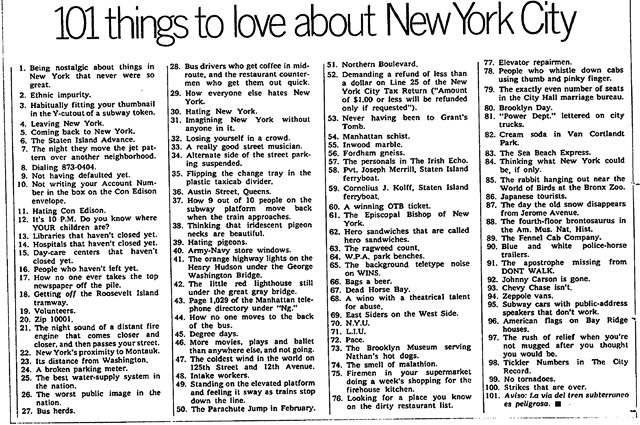
From the NY Times Magazine in June 1976, a list of 101 things to love about New York City. Some of the list is evergreen:
1. Being nostalgic about things in New York that were never so great.
11. Hating Con Edison.
25. The best water-supply system in the nation.
42. The little red lighthouse still under the great gray bridge.
And other items on the list, not so much:
8. Dialing 873-0404.
24. A broken parking meter.
43. Page 1,029 of the Manhattan telephone directory under “Ng.”
57. The personals in The Irish Echo.
Scouting New York has an explanation of some of the items on the list. Apparently 873-0404 was the number for the Dial-A-Satellite hotline; you could call it to get information about satellites passing overhead. (via @mkonnikova)
Tyler Vigen is collecting examples of data that correlate closely but are (probably) otherwise unrelated.
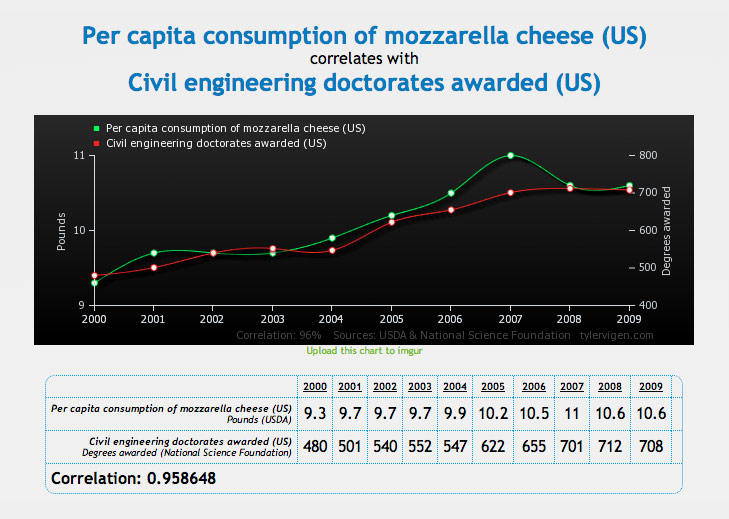
Remember kids, correlation != causation.
This was one of my favorite scenes the film…Russell Crowe’s Noah telling his children the creation story, which ends up being half supernatural and half evolution.
Worth watching for the special effects alone.
In the latest installment of his ten-part series on WWI, Alan Taylor covers the technology used in the war.
When Europe’s armies first marched to war in 1914, some were still carrying lances on horseback. By the end of the war, rapid-fire guns, aerial bombardment, armored vehicle attacks, and chemical weapon deployments were commonplace. Any romantic notion of warfare was bluntly shoved aside by the advent of chlorine gas, massive explosive shells that could have been fired from more than 20 miles away, and machine guns that spat out bullets like firehoses. Each side did its best to build on existing technology, or invent new methods, hoping to gain any advantage over the enemy.
It’s fascinating to observe both sides using trial and error with things like tanks, testing out what works and what doesn’t. Look at this kooky German cannon for instance:

Nothing about that looks efficient.
Richard Sherman is a football player for the Seatt…hey, HEY!, you nerds that were about to wander off because I’m talking about sportsball, come on back here. Like I was saying, Sherman plays cornerback for the Seattle Seahawks, who won the Super Bowl last year. The thing is, whatever it is you do, Richard Sherman is way better at his job than you are at yours. And he’s able to explain how he does what he does, which, if you’ve ever been to a technology conference or read more than a thing or two linked from Hacker News, you know is even more rare.
Sherman is, by his own admission, not particularly athletically gifted in comparison to some others in the NFL, but he’s one of the top 5 cornerbacks in the game because he studies and prepares like a mofo. In this video, he explains how he approaches preparing for games and shares some of the techniques he uses to gain an advantage over opposing quarterbacks and receivers.
Sherman is obviously really intelligent, but his experience demonstrates once again the value of preparation, hard work, and the diligent application of deliberate practice.
For the first time, scientists have created a living cell with DNA containing more than just the familiar A, T, C, and G units.
Hailed as a breakthrough by other scientists, the work is a step towards the synthesis of cells able to churn out drugs and other useful molecules. It also raises the possibility that cells could one day be engineered without any of the four DNA bases used by all organisms on Earth.
“What we have now is a living cell that literally stores increased genetic information,” says Floyd Romesberg, a chemical biologist at the Scripps Research Institute in La Jolla, California, who led the 15-year effort.
So instead of just using the GATTACA alphabet, scientists may eventually gain the use of an alphabet containing dozens or even hundreds or thousands of different letters. Potentially powerful stuff.
Steven Levitt and Stephen Dubner, the co-authors of the immensely popular Freakonomics, are back with their third book in the series: Think Like a Freak. In it, rather than discussing what they think, they talk about how they think.
Levitt and Dubner offer a blueprint for an entirely new way to solve problems, whether your interest lies in minor lifehacks or major global reforms. As always, no topic is off-limits. They range from business to philanthropy to sports to politics, all with the goal of retraining your brain. Along the way, you’ll learn the secrets of a Japanese hot-dog-eating champion, the reason an Australian doctor swallowed a batch of dangerous bacteria, and why Nigerian e-mail scammers make a point of saying they’re from Nigeria.
The book is out on May 12, but of course you can preorder, etc.
Update: Excerpt in the WSJ.
One of the greatest designers in the world, Massimo Vignelli, is very sick and “will be spending his last days at home”. His son is requesting that if you were influenced at all by Vignelli’s work, you should send him a letter:
According to Pentagram partner Michael Bierut, “Luca said that Massimo would be thrilled to get notes of good wishes from people whom he’s touched or influenced — whether personally or remotely — over the years. Luca has visions of huge mail bags full of letters. I know that one of Massimo’s biggest fantasies has been to attend his own funeral. This will be the next best thing. Pass the word.”
Here’s the address:
Massimo Vignelli
130 East 67 Street
New York, New York 10021
USA
How to Build a Time Machine is a documentary about two men on separate quests to build their own time machines. Here’s a teaser trailer:
Ronald Mallett’s reason for his search for a way to travel through time is quite poignant…he shared his story in a book and on an episode of This American Life back in 2007. (via ★interesting)
According to the National Climate Assessment, climate change has already affected the US in significant ways. This map from the NY Times shows the change in temperatures from around the country, specifically the “1991-2012 average temperature compared with 1901-1960 average”.

Among the report’s findings? As I’ve noted before, weather is getting weirder and more bursty, not just hotter.
One of the report’s most striking findings concerned the rising frequency of torrential rains. Scientists have expected this effect for decades because more water is evaporating from a warming ocean surface, and the warmer atmosphere is able to hold the excess vapor, which then falls as rain or snow. But even the leading experts have been surprised by the scope of the change.
The report found that the eastern half of the country is receiving more precipitation in general. And over the past half-century, the proportion of precipitation that is falling in very heavy rain events has jumped by 71 percent in the Northeast, by 37 percent in the Midwest and by 27 percent in the South, the report found.
Nonlinear systems, man.
The next Ken Burns PBS long thing will be a seven-part series on the Roosevelts (Theodore, Eleanor, and Franklin).
This seven-part, fourteen hour film follows the Roosevelts for more than a century, from Theodore’s birth in 1858 to Eleanor’s death in 1962. Over the course of those years, Theodore would become the 26th President of the United States and his beloved niece, Eleanor, would marry his fifth cousin, Franklin, who became the 32nd President of the United States. Together, these three individuals not only redefined the relationship Americans had with their government and with each other, but also redefined the role of the United States within the wider world. The series encompasses the history the Roosevelts helped to shape: the creation of National Parks, the digging of the Panama Canal, the passage of innovative New Deal programs, the defeat of Hitler, and the postwar struggles for civil rights at home and human rights abroad. It is also an intimate human story about love, betrayal, family loyalty, personal courage and the conquest of fear.
Fall 2014. (via @tcarmody)
What do you do when you have a seaplane without wheels, no water, and you need to take off? You put it on a trailer, drag it down the runway until you get the proper speed, and just pull back on the stick:
Damn, that’s cool. I knew it was gonna take off and it still baked my noodle a little bit. I think this is why so many people (myself included) had trouble with the airplane on the treadmill question. All that really matters for takeoff and continued flight is the speed of the plane relative to the air — how it gets to that point or what the surface is doing isn’t really relevant — but when you’re observing it, it seems impossible. (via @deronbauman)
So, this showed up on Vimeo last night and will likely be pulled soon (so hit that “download” button while you can), but here’s the deal. In 2012, actor Topher Grace showed an edit he’d done of episodes I-III of Star Wars to a bunch of friends, trimming the 7 hours of prequels down into 85 action-packed minutes of pure story. This Vimeo edit is longer (2:45) and is “based on the structure conceived by actor Topher Grace”, which you can read about here.
Grace’s version of the film(s) centers on Anakin’s training and friendship with Obi-Wan, and his relationship with Queen Amidala (Natalie Portman). Gone are Trade Federation blockades, the Gungan city, the whole Padmé handmaiden storyline, the explanation of midichlorians, the galactic senate and the boring politics, Anakin’s origins (a backstory which never really needed to be seen in the first place), the droid army’s attack on Naboo, and Jar Jar Binks (Ahmed Best) appears only briefly for only one line of dialogue, used as a set-up to introduce us to the Queen.
(via @bursts)
Watch this octopus open a jar from the inside:
Octopuses are wicked smart. I like how, after he gets the lid off, he’s content to just hang out in there. (via @tylercowen)
Kintsukuroi is the Japanese art of repairing broken pottery using resin mixed with precious metals like gold. The result is often something more beautiful than the original:

There are dozens of examples of kintsukuroi on Pinterest. And as with many Japanese concepts for which there are no corresponding English words, kintsukuroi has many philosophical and metaphorical implications. (via ★interesting)
Update: Here’s a short video that shows the technique and other related techniques:
(via the kid should see this)
Update: When I originally posted this, I forgot to transfer the photo of a bowl repaired through kintsukuroi to my server, resulting in the browser displaying a broken image icon. Rather than just fix it by uploading the photo, I used digital kintsukuroi to fill in the crack in the icon. Not sure the technique works as well as it does with pottery, but it seemed fitting. Here’s the photo I meant to post:

In an item on Ain’t It Cool News about the working title for Star Wars VII (The Ancient Fear!), a pair of comments list fourteen things about the Star Wars movies as bad as or worse than Jar Jar Binks:
1. Dance number added to Jedi
2. CGI Jabba added to A New Hope
3. Han/Greedo scene changed in A New Hope
4. Horrible acting in the prequels even by the good actors
5. Obi-Wan riding around on Yoshi in Revenge of the Sith
6. Anakin/Padme love story
7. Jake Lloyd
8. R2-D2 flying
9. Hayden’s ghost added to end of Jedi
10. Rick McCallum
11. Midichlorians
12. Virgin birth of Anakin
13. Vader as C-3POs maker and R2’s buddy
14. Han/Jabba scene added in ANH
Meesa agree with most of this list.
“Doodie” is a portmanteau of “dude” and “foodie” and a good word to describe the phenomenon of (mostly) male foodies I’ve observed with increasing regularity in the past few years. Jessica Pressler coined the term in Help! There’s a Doodie in My Kitchen.
You see; these are the things you deal with when you live with a food dude. Or, as I have come to call them, doodies. I know, it’s an unfortunate term, but like its antecedent, the dreaded foodie, it is also extremely useful for summing up the characteristics of a certain breed of food enthusiast, the kind whose culinary preferences are intrinsically, classically male.
You know the type. Has Heat or Fergus Henderson’s Complete Nose to Tail on his bookshelf. Can sustain a remarkably long conversation about knives. Is super into his grill. Likes pour-over coffee. Is, at this moment, really excited about ramps. I could go on, but I won’t, because I am sure you know one. New York City in 2014 is rife with doodies: You can find them stalking around Smorgasburg, attending knife-skills classes at the Meat Hook, writing lengthy, tumescent odes to the Bo Ssam Miracle in the paper of record.
(via @fanelli)
Update: Michael Hoffman of Food52 has another name for doodies: assholes.
The food dude is nothing new. He’s just a jerk who learned to cook. He’s taken what could be a force for good — feeding loved ones well — and made it into yet another thing that he can claim to be better at than his wife or girlfriend. (Apparently, food dudes are all heterosexual, too.)
Here’s what the food dude doesn’t do: He doesn’t spend his Sunday afternoon planning practical dinners for the week; he doesn’t make sure there’s milk in the fridge; he doesn’t make something the baby is going to eat. He might as well be building train sets in the basement. Even for people like us who love doing it, getting dinner on the table is, among many other things, a chore. And guess who’s doing the chores at Food Dude’s place? Women.
There is all sorts of advice online about how to do things, but this piece on wikiHow on how to stop your beloved from marrying someone else is easily the best/worst I have ever seen.
If you were not able to contact her before hand, and you are sure that you want to proceed, find out the location of the wedding. Unless you have been invited, you will have to find out where the wedding ceremony is to be held, and the exact time. Ask family members or mutual friends if it doesn’t appear too suspicious, or perhaps check the wedding notices in the local newspaper.
I have never seen something so batshit crazy described in such a calm methodical way. And the photos! The caption for this one is “Enjoy life with your stolen bride or groom”:

(via @mrgan)
Peter Bach, a cancer doctor, writes about losing his wife to cancer.
The streetlights in Buenos Aires are considerably dimmer than they are in New York, one of the many things I learned during my family’s six-month stay in Argentina. The front windshield of the rental car, aged and covered in the city’s grime, further obscured what little light came through. When we stopped at the first red light after leaving the hospital, I broke two of my most important marital promises. I started acting like my wife’s doctor, and I lied to her.
I had just taken the PET scan, the diagnostic X-ray test, out of its manila envelope. Raising the films up even to the low light overhead was enough for me to see what was happening inside her body. But when we drove on, I said, “I can’t tell; I can’t get my orientation. We have to wait to hear from your oncologist back home.” I’m a lung doctor, not an expert in these films, I feigned. But I had seen in an instant that the cancer had spread.
The last sentence here really got to me:
Our life together was gone, and carrying on without her was exactly that, without her. I was reminded of our friend Liz’s insight after she lost her husband to melanoma. She told me she had plenty of people to do things with, but nobody to do nothing with.
Bach’s discussion of treatment options reminded me of Siddhartha Mukherjee’s The Emperor of All Maladies, which is one of my favorite books of recent years. I was also reminded of how doctors die.
From the editors of The American Scholar, the ten best sentences. Presumably in all of literature? Here’s one of them, from James Joyce’s A Portrait of the Artist as a Young Man:
I go to encounter for the millionth time the reality of experience and to forge in the smithy of my soul the uncreated conscience of my race.
Why are these the ten best sentences?

A fake Paris was partially constructed near the real Paris at the end of World War I in the hopes of confusing German planes who were looking to bomb the City of Lights.
The story of Sham Paris may have been “broken” in The Illustrated London News of 6 November 1920 in a remarkably titled photo essay, “A False Paris Outside Paris — a ‘City’ Created to be Bombed”. There were to be sham streets lined with electric lights, sham rail stations, sham industry, open to a sham population waiting to be bombed by real Germans. It is a perverse city, filled with the waiting-to-be-murdered in a civilian target.
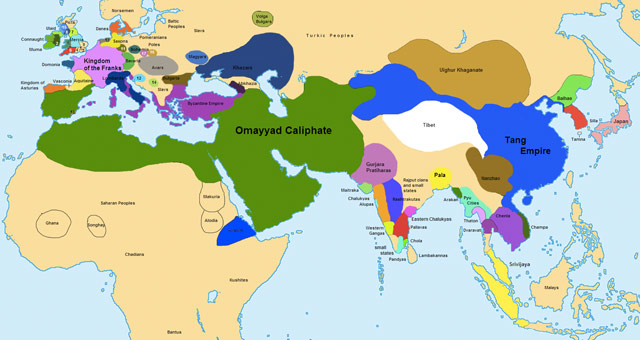
From Max Fisher at Vox, 40 maps that explain the Middle East.
Maps can be a powerful tool for understanding the world, particularly the Middle East, a place in many ways shaped by changing political borders and demographics. Here are 40 maps crucial for understanding the Middle East — its history, its present, and some of the most important stories in the region today.
(via @jbenton)
During the 1930s, animators at Walt Disney Studios developed a list of 12 basic principles of animation through which to achieve character and personality through movement. These principles were laid out in The Illusion of Life by Frank Thomas and Ollie Johnston. #6 is “slow-out and slow-in”:
As action starts, we have more drawings near the starting pose, one or two in the middle, and more drawings near the next pose. Fewer drawings make the action faster and more drawings make the action slower. Slow-ins and slow-outs soften the action, making it more life-like. For a gag action, we may omit some slow-out or slow-ins for shock appeal or the surprise element. This will give more snap to the scene.
Animator Vincenzo Lodigiani recently visualized the principles using a simple cube shape. You can see them individually here or all together in this video:
In a nod to the increasing prevalence of animation in app design, Khoi Vinh notes:
It’s a good reminder that as the overlap between interface design and animation grows wider, designers would do well to take note of the many decades of insight and knowledge that animators have accrued.
(via hn)
Every week, the Netherlands Bach Society puts up a new recording of one of Johann Sebastian Bach’s works on All of Bach.
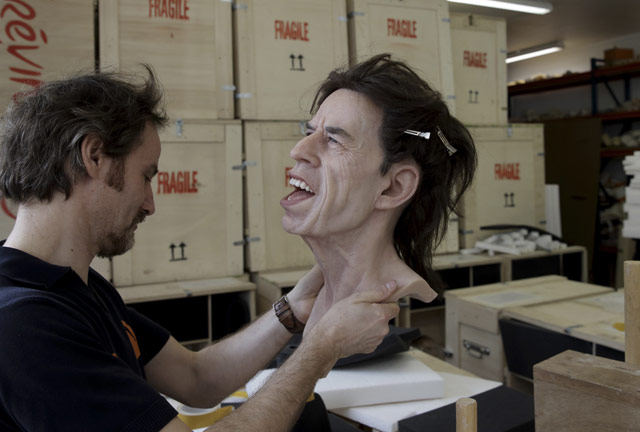
Alan Taylor has started doing weekly round-ups of interesting photos at In Focus. This is my favorite from last week’s batch, the head of Mick Jagger, destined for a wax museum in Prague.

Heather Ogden is a principal dancer for the National Ballet of Canada and The Heather Project is a series of short videos shot by Christopher Wahl that shows how beautiful and demanding ballet can be. (via cup of jo)
Homer Economicus is a new book which uses the fictional world of Springfield on The Simpsons to explain the basic concepts of economics.
Since The Simpsons centers on the daily lives of the Simpson family and its colorful neighbors, three opening chapters focus on individual behavior and decision-making, introducing readers to the economic way of thinking about the world. Part II guides readers through six chapters on money, markets, and government. A third and final section discusses timely topics in applied microeconomics, including immigration, gambling, and health care as seen in The Simpsons. Reinforcing the nuts and bolts laid out in any principles text in an entertaining and culturally relevant way, this book is an excellent teaching resource that will also be at home on the bookshelf of an avid reader of pop economics.
(via mr)

The Daily Overview offers up an interesting satellite photo every day. The site’s name is inspired by the Overview Effect:
The Overview Effect, first described by author Frank White in 1987, is an experience that transforms astronauts’ perspective of Earth and mankind’s place upon it. Common features of the experience are a feeling of awe for the planet, a profound understanding of the interconnection of all life, and a renewed sense of responsibility for taking care of the environment. ‘Overview’ is a short film that explores this phenomenon through interviews with five astronauts who have experienced the Overview Effect. The film also features important commentary on the wider implications of this new understanding for both our society, and our relationship to the environment.
The Planetary Collective made a short documentary about the Overview Effect:
(thx, pavel)
I watched the first episode of Band of Brothers last night to see if it held up (it does). The episode centers on the training and deployment to England of Easy Company of the 506th Parachute Infantry Regiment, led by Lt. Herbert Sobel. In the miniseries, Sobel is played by David Schwimmer and is depicted as a real hardass who earns the hatred of his men while pushing them to be the best company in the entire regiment.
In real life, Sobel rose to the rank of Lieutenant Colonel, fought in the Korean War, was awarded the Bronze Star, married and had three children. The part of Sobel’s Wikipedia entry about his later years is among the saddest things I have ever read:
In the late 1960s, Sobel shot himself in the head with a small-caliber pistol. The bullet entered his left temple, passed behind his eyes, and exited out the other side of his head. This severed his optic nerves and left him blind. He was later moved to a VA assisted living facility in Waukegan, Illinois. Sobel resided there for his last seventeen years until his death due to malnutrition on September 30, 1987. No services were held for Sobel after his death.
Rest in peace, Lieutenant Colonel Sobel.
“My kids used to love math! Now it makes them cry.” So tweeted Louis C.K. earlier this week. His opinion of the new math and standardized tests is echoed by a lot of parents who “have found themselves puzzled by the manner in which math concepts are being presented to this generation of learners as well as perplexed as to how to offer the most basic assistance when their children are struggling with homework.” Rebecca Mead in the The New Yorker: Louis C.K. Against the Common Core.
Photographer David Liittschwager captured the little ecosystem of life contained in a splash of seawater magnified 25 times:

It’s the microscopic equivalent of the Hubble Deep Field image and worth seeing larger. Here’s part of the larger image:

Liittschwager took the photo for National Geographic, but it also might be contained in his book, A World in One Cubic Foot, in which he took photos in locations all over the world of the life that passed through 1 cubic foot of space in 24 hours.
For A World in One Cubic Foot, esteemed nature photographer David Liittschwager took a bright green metal cube-measuring precisely one cubic foot-and set it in various ecosystems around the world, from Costa Rica to Central Park. Working with local scientists, he measured what moved through that small space in a period of twenty-four hours. He then photographed the cube’s setting and the plant, animal, and insect life inside it — anything visible to the naked eye. The result is a stunning portrait of the amazing diversity that can be found in ecosystems around the globe.
Prints of this image are available at Art.com in sizes up to 64”x48”. (via colossal)
What’s your best guess without looking: How many US states are at least partially north of the southernmost part of Canada?
…
(It’s probably way more than you think.)
…
Ok, I’ll give you two hints…
1. Wyoming is almost *entirely* north of the southernmost point in Canada.
…
2. Part of a state that borders Mexico is north of the southernmost point in Canada.
…
One more big hint: more than 25% of US states are entirely north of Canada’s southernmost point.
So, here’s the answer:

27 US states, more than half, are at least partially north of Canada’s southernmost point. (via @stevenstrogatz)
Newer posts
Older posts






Socials & More