Entries for July 2013
Volcanoes “scream” before they erupt. And they also have a heartbeat of sorts. Listen to these surprisingly intense sounds emitted by a volcano in Alaska before it erupted. The first recording condenses 10 minutes of audio into 10 seconds, so you can hear the pre-eruption scream:
The second recording is of 10 hours of pre-eruption mini earthquakes condensed into one minute of audio.
The pause right before the eruption is Mother Nature dropping the beat. (via @DavidGrann)
This is a surprisingly helpful activity for learning about regular expressions. (via @bdeskin)

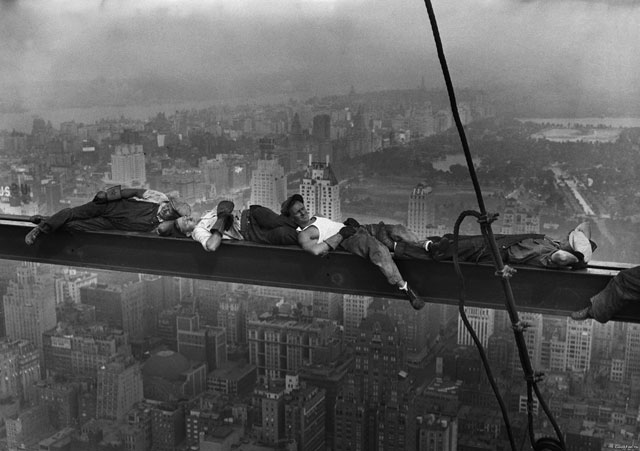
That’s the iconic “Lunch atop a Skyscraper” photo taken in 1932 during the construction of the RCA Building (aka 30 Rock) in NYC. Eleven construction workers eating lunch on a steel girder 840 feet in the air. The shot was a PR stunt to drum up excitement around the near completion of the new skyscraper…no one even knows for sure who took the photo because it was likely a multiple photographer situation. On the same day the lunch photo was taken, some of the same men were photographed taking a nap on the same girder:
Fourth-grader Zachary Maxwell is making a short documentary film about the lunch program at his New York City public school. It’s called Yuck.
In the fall of 2011, fourth grader Zachary Maxwell began asking his parents if he could start packing and bringing his own lunch to school. Unfortunately, they kept insisting that he take advantage of the hot lunch being served at the school. After all, the online menu sounded delicious and the NYC Department of Education (DOE) website assured parents that the meals were nutritious. Zachary wanted to convince his parents that the online menu did not accurately represent what was really being served at his school.
Here’s a short clip in which Zachary compares the special salads concocted by celebrity chefs Rachael Ray and Ellie Krieger for use in NYC public schools to the sad reality.
This is awesome. I mean, the lunches aren’t awesome, but Zachary is.
The 500th episode of This American Life airs this weekend, and to celebrate, David Haglund picked 10 episodes you should listen to if you’ve never heard the show before.
On one of the world’s most dangerous roads, Pakistani drivers deliver supplies 150 miles into northwestern Pakistan. In 2011, Al Jazeera English made this 25-minute documentary that followed one of the trucks across the Lowari Pass. I didn’t think I was going to watch the whole thing, but it turned out to be worth the time.
In Kuwait, people sell all sorts of stuff on Instagram, using the service as a visually oriented mobile storefront instead of using a web site or something like eBay. From an interview with artist/musician Fatima Al Qadiri:
BR: Kuwait is a crazy mix: a super-affluent country, yet basically a welfare state, though with a super neo-liberal consumer economy.
FQ: We consume vast amounts of everything. Instagram businesses are a big thing in Kuwait.
BR: What’s an Instagram business?
FQ: If you have an Instagram account, you can slap a price tag on anything, take a picture of it, and sell it. For instance, you could take this can of San Pellegrino, paint it pink, put a heart on it, call it yours, and declare it for sale. Even my grandmother has an Instagram business! She sells dried fruit. A friend’s cousin is selling weird potted plants that use Astroturf. People are creating, you know, hacked products.
I dug up a few examples: Manga Box is an Instagram storefront selling manga (contact via WhatsApp to buy), Sondos Makeup advertises makeup services (WhatsApp for appts.), sheeps_sell sells sheep, and store & more is an account selling women’s fashion items. There was even an Insta-Business Expo held in April about Instagram businesses.
The Entrepreneurship and Business Club of the American University of Kuwait is holding an “INSTA BUSINESS EXPO” which will consist of all your favorite and newest popular entrepreneurs that grew their businesses through Instagram. Not only that, there will be guest speakers by Entrepreneurs that made it through Instagram as well!
(via @cmchap)
Back in October, I wrote a post about the race to win the Igor I. Sikorsky Human Powered Helicopter Competition. To win the $250,000 Sikorsky prize, a human-powered helicopter must fly for 60 seconds, reach a momentary altitude of 3 meters, and stay within a 10 meter square. Last month, after 33 years of collective human effort, someone finally won the prize:
Wow, that helicopter is amazing! Popular Mechanics has more on the winning flight.
Reichert knew that the challenge was to keep supplying enough power through his legs to keep the craft from descending too quickly. On two previous flights in which he’d flirted with the three-meter mark, Reichert had descended too abruptly and fallen afoul of a phenomenon called vortex ring state, in which a helicopter essentially gets sucked down by its own downwash. Both times Atlas had been wrecked. This time, Reichert spent the balance of the flight easing the craft down gently to the ground. “You’re so focused on having the body do a very precise thing,” he told Pop Mech. “If you lay off the power even a little bit, or make any sharp control movement, you can crash.”
(via hn)
Photographer Clayton Cubitt and Rex Sorgatz have both written essays about how photography is becoming something more than just standing in front of something and snapping a photo of it with a camera. Here’s Cubitt’s On the Constant Moment.
So the Decisive Moment itself was merely a form of performance art that the limits of technology forced photographers to engage in. One photographer. One lens. One camera. One angle. One moment. Once you miss it, it is gone forever. Future generations will lament all the decisive moments we lost to these limitations, just as we lament the absence of photographs from pre-photographic eras. But these limitations (the missed moments) were never central to what makes photography an art (the curation of time,) and as the evolution of technology created them, so too is it on the verge of liberating us from them.
And Sorgatz’s The Case of the Trombone and the Mysterious Disappearing Camera.
Photography was once an act of intent, the pushing of a button to record a moment. But photography is becoming an accident, the curatorial attention given to captured images.
Slightly different takes, but both are sniffing around the same issue: photography not as capturing a moment in realtime but sometime later, during the editing process. As I wrote a few years ago riffing on a Megan Fox photo shoot, I side more with Cubitt’s take:
As resolution rises & prices fall on video cameras and hard drive space, memory, and video editing capabilities increase on PCs, I suspect that in 5-10 years, photography will largely involve pointing video cameras at things and finding the best images in the editing phase. Professional photographers already take hundreds or thousands of shots during the course of a shoot like this, so it’s not such a huge shift for them. The photographer’s exact set of duties has always been malleable; the recent shift from film processing in the darkroom to the digital darkroom is only the most recent example.
What’s interesting about the hot video/photo mobile apps of the moment, Vine, Instagram, and Snapchat, is that, if you believe what Cubitt and Sorgatz are saying, they follow the more outdated definition of photography. You hold the camera in front of something, take a video or photo of that moment, and post it. If you missed it, it’s gone forever. What if these apps worked the other way around: you “take” the photo or video from footage previously (or even constantly) gathered by your phone?
To post something to Instagram, you have the app take 100 photos in 10-15 seconds and then select your photo by scrubbing through them to find the best moment. Same with Snapchat. Vine would work similarly…your phone takes 20-30 seconds of video and you use Vine’s already simple editing process to select your perfect six seconds. This is similar to one of my favorite technology-driven techniques from the past few years:
In order to get the jaw-dropping slow-motion footage of great white sharks jumping out of the ocean, the filmmakers for Planet Earth used a high-speed camera with continuous buffering…that is, the camera only kept a few seconds of video at a time and dumped the rest. When the shark jumped, the cameraman would push a button to save the buffer.
Only an after-the-fact camera is able to capture moments like great whites jumping out of the water:
And it would make it much easier to capture moments like your kid’s first steps, a friend’s quick smile, or a skateboarder’s ollie. I suspect that once somebody makes an easy-to-use and popular app that works this way, it will be difficult to go back to doing it the old way.
For the love of Christ, engage them about something other than their physical appearance. Do this:
“Maya,” I said, crouching down at her level, looking into her eyes, “very nice to meet you.”
“Nice to meet you too,” she said, in that trained, polite, talking-to-adults good girl voice.
“Hey, what are you reading?” I asked, a twinkle in my eyes. I love books. I’m nuts for them. I let that show.
Her eyes got bigger, and the practiced, polite facial expression gave way to genuine excitement over this topic. She paused, though, a little shy of me, a stranger.
“I LOVE books,” I said. “Do you?”
Most kids do.
“YES,” she said. “And I can read them all by myself now!”
Do not do this:
“Maya, you’re so cute! Look at you! Turn around and model that pretty ruffled gown, you gorgeous thing!”
People do the “OMG, you’re so cute!” thing with Minna all the time and it bugs the shit out of me. (I mean, I get it, she’s cute. But come on.) It also completely shuts her down because she suddenly feels so self-conscious about herself and her appearance…which has led to her to be more cautious about new people and wary of cameras, the ultimate unblinking eye of cuteness collection. And this is a very chatty, social, and engaging kid we’re talking about here, but the “you’re so cute” conversation opener twists her up into a preztel of self-consciousness that’s so unlike her usual self.
Or rather, protozoan? Toxoplasma gondii is a protozoan parasite which is transmitted from rodents to cats through a crafty mechanism…it makes mice attracted to the smell of cat urine. Mouse goes near cat, cat eats mouse, T. gondii has a new host. From cats, the parasite can jump into humans, where it may be responsible for all sorts of nastiness:
Well, the behavioral influence plays out in a number of strange ways. Toxoplasma infection in humans has been associated with everything from slowed reaction times to a fondness toward cat urine — to more extreme behaviors such as depression and even schizophrenia. And here’s the kicker: Two different research groups have independently shown that Toxo-infected individuals are three to four times as likely of being killed in car accidents due to reckless driving.
And maybe makes us want to invent networking technology and share cool links? In this five-minute talk, Kevin Slavin cleverly connects viral media with T. gondii:
That video was so good, I watched the whole thing twice.
Tom Coates has outfitted his house with technology that allows him to control the lights, heat, etc. but also gives him all sorts of feedback directed to an iPhone app and a public Twitter feed. Derek Powazek interviewed Coates about his setup.
I also have a WeMo motion sensor in my sitting room that looks for movement. When it notices some movement, it posts an @-reply to me on Twitter, so I get notified wherever I am pretty much immediately. It asks me if I’m in the Sitting Room. I often find myself replying to the house. It feels rude not to.
If I’m not in the house and I get a message like this, then I can check on who is in my house by using my Dropcam. This is a little off-the-shelf product that costs about $200. I can, again, view the video feed from it on my iPhone. If it’s dark, I can turn on night vision, or (of course) I can just turn on the lights from anywhere using my WeMo set-up.
By the big plant in my Sitting Room, I have a Twine. This is a slightly odd little product from a company called Supermechanical. They were a Kickstarter project. It’s essentially a little battery-powered box with a couple of inbuilt sensors in it and a port for plugging in a few others. I use it for capturing the temperature of my house, vibration, and whether or not the plant has been watered recently. I have the temperature set up so that it tweets when the house crosses a threshold - allowing it to narrate when it gets too hot or too cold. I have the vibration sensor set up to shout at me if there’s an earthquake, but often it just gets confused when someone slams down on the sofa too hard.
A study by researchers in Sweden indicates that the heartbeats of singers in a choir quickly synchronize.
Using pulse monitors attached to the singers’ ears, the researchers measured the changes in the choir members’ heart rates as they navigated the intricate harmonies of a Swedish hymn. When the choir began to sing, their heart rates slowed down.
“When you sing the phrases, it is a form of guided breathing,” says musicologist Bjorn Vickhoff of the Sahlgrenska Academy who led the project. “You exhale on the phrases and breathe in between the phrases. When you exhale, the heart slows down.”
But what really struck him was that it took almost no time at all for the singers’ heart rates to become synchronized. The readout from the pulse monitors starts as a jumble of jagged lines, but quickly becomes a series of uniform peaks. The heart rates fall into a shared rhythm guided by the song’s tempo.
(via @stevenstrogatz)
A recent episode of Planet Money explores what the movie Trading Places can teach us about financial markets.
On today’s show, we talk to commodities traders to answer one of the most important questions in finance: What actually happens at the end of Trading Places?
We know something crazy happens on the trading floor. We know that Eddie Murphy and Dan Aykroyd get rich and the Duke brothers lose everything. But how does it all happen? And could it happen in the real world?
Also on the show: The “Eddie Murphy Rule” that wound up in the the big financial overhaul law Congress passed in 2010.
One of my favorite movie moments is Eddie Murphy’s breaking of the fourth wall in this Trading Places scene:
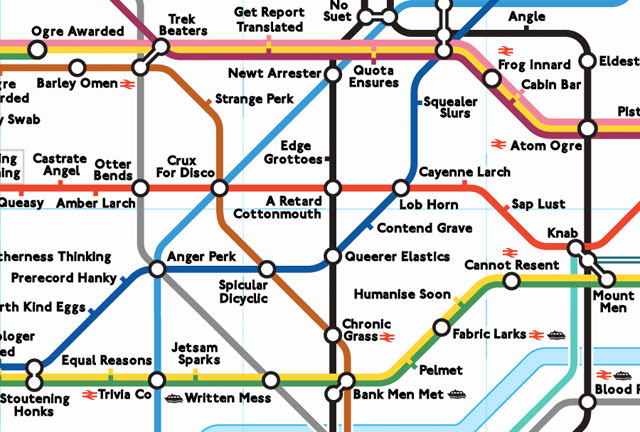
Otter Bends, Queer Spank, Frog Innard, and Lob Horn are some of the stations on the anagram map of the London Underground.
Karen Cheng learned to dance in a year. Here’s a video of her progress, from just a few days in to her final number:
Here’s my secret: I practiced everywhere. At bus stops. In line at the grocery store. At work — Using the mouse with my right hand and practicing drills with my left hand. You don’t have to train hardcore for years to become a dancer. But you must be willing to practice and you better be hungry.
This isn’t a story about dancing, though. It’s about having a dream and not knowing how to get there — but starting anyway. Maybe you’re a musician dreaming of writing an original song. You’re an entrepreneur dying to start your first venture. You’re an athlete but you just haven’t left the chair yet.
The interesting thing is, Cheng basically did the same thing in her professional life as well.
I decided to become a designer, but I had no design skills. I thought about going back to school for design, but the time and money commitment was too big a risk for a career choice I wasn’t totally sure of.
So I taught myself — everyday I would do my day job in record time and rush home to learn design. Super talented people go to RISD for 4 years and learn design properly. I hacked together my piecemeal design education in 6 months — there was no way I was ready to become a designer. But I was so ready to leave Microsoft. So I started the job search and got rejected a few times. Then I got the job at Exec.
The first few weeks were rough. Everyday I sat in front of my computer trying my damnedest and thinking it wasn’t good enough. But everyday I got a little bit better.
(via hacker news)
Jason Polan draws Dr. Dre using beet juice.
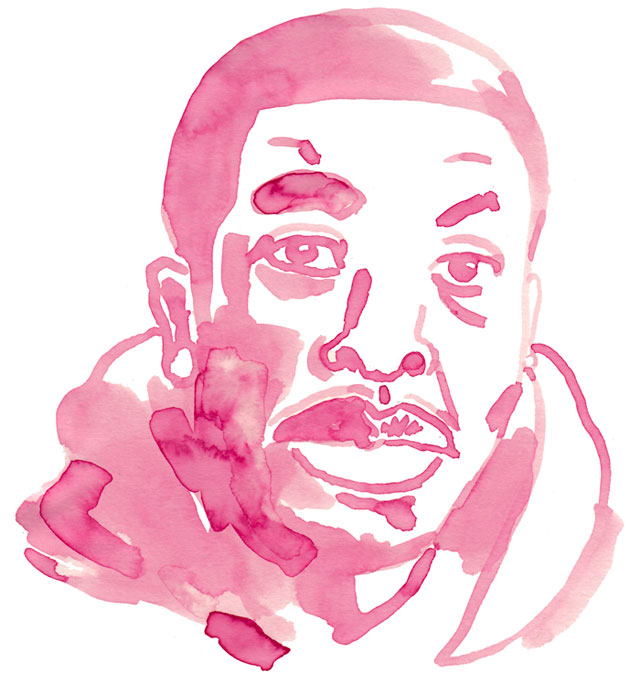
Polan is a favorite…his other art is very much worth checking out.
In a waterpark parable about contemporary American politics, Tom Junod asks: “Are we a nation of line-cutters, or are we the line?”
But here’s the thing about waiting in line at Whitewater, here’s the lesson that you learn from the spectacle of America in the raw: It works. When my daughter gapes and marvels, I tell her that human beings come in all shapes and sizes, and it’s an explanation that seems to satisfy her because it’s inescapable. When I hear the censorious voice in my head saying that the woman in front of me shouldn’t be wearing that bikini, I go on to draw the only conclusion that the evidence all around me permits: that no one should, and that therefore everyone can. Going to Whitewater is like bathing in the Ganges, with chlorine and funnel cakes — and also with the elemental difference that not everyone is poor, lowly, untouchable, an outcast. Rather, everyone is quite simply American, and so the line slouches and stumbles forward, the very definition of a mixed blessing — a blessing mixed black and white, rich and poor, slovenly and buff, and so on down the line. It can be slow going, it can be frustrating, but people have no choice to make the best of it, so they talk to one another, they gripe amusingly, they laugh, they compromise, they endure, and they scream when they finally go down a water slide whose initial pitch approaches 90 degrees. No one cuts, or tries to; the line works because for all its inherent and exhibitionistic imperfections it keeps its promise of equal access, and, by God, it moves.
See also paying to get through airport security faster (TSA Pre, etc.).
YouTuber Chase creates short videos where the faces of celebrities are swapped for other celebrity faces. The results are weird and often hilarious. The best one is probably the most recent video of Natalie Portman and Will Ferrell:
This quick Nicholson/Cruise clip from A Few Good Men is pretty good too:
Co.Create did an interview with the creator.
“When picking the celebrities, I am mainly considering two things. Their relevance and popularity, as well as the availability of unique, high-quality footage in which the actor is looking mostly towards the camera,” Chase says. “Mashing up footage in which the characters are constantly looking side to side is much more difficult and usually results in a less convincing final product.” He adds. “There have a been a few After Effects sessions that ended up in the recycle bin because of this.”
(via @daveg)
Watch as a motorcyclist rescues a coffee cup from the bumper of a SUV and returns it to the driver.
I love the little celebration move right at the end. (via digg)
Adapted from Brett Martin’s Difficult Men, this piece in Slate gives a glimpse of what it was like on the set of The Wire.
In the isolated hothouse of Baltimore, immersed in the world of the streets, the cast of The Wire showed a bizarre tendency to mirror its onscreen characters in ways that took a toll on its members’ outside lives: Lance Reddick, who played the ramrod-straight Lieutenant Cedric Daniels, tormented by McNulty’s lack of discipline, had a similarly testy relationship with West, who would fool around and try to make Reddick crack up during his camera takes. Gilliam and Lombardozzi, much like Herc and Carver, would spend the bulk of Seasons 2 and 3 exiled to the periphery of the action, stewing on stakeout in second-unit production and eventually lobbying to be released from their contracts.
Oh, McNutty. (thx, sam)
Gentlemen, this is how clothes should fit.
A suit jacket’s length — like a good lawyer — should cover your ass.
(via ★interesting)
Here’s a watercolor drawing by Wolfgang Amadeus Mozart of his ear compared to an ordinary ear1:
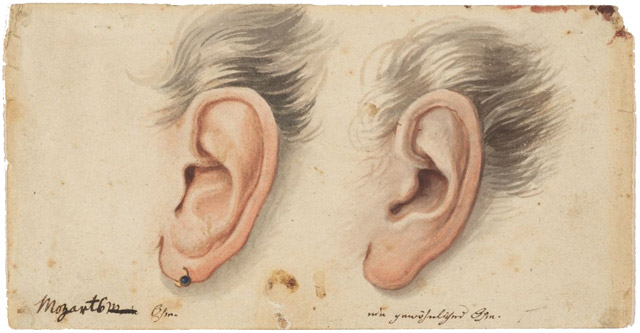
“Mozart Ear” has become a medical catch-all term for deformed ears (for instance). Deformed or not2, the ear clearly didn’t have any negative effect on his musical ear. (via @DavidGrann)
[1] The note accompanying the drawing at Harvard’s Houghton Library reads:
Mozart, Wolfgang Amadeus, 1756-1791. Mein Ohr [und] ein gewöhnliches Ohr [My ear and an ordinary ear] : drawing, [n.p., n.d.] Water-color drawing; [n.p, n.d] 1 drawing : watercolor on paper
The “mein” is crossed out and “Mozart” is written in its place in another hand. With this is Fr. Jelinck’s A.D.s., Salzburg, 1879 Sept. 19, certifying that this is by Mozart.
↩
[2] It’s stated elsewhere that the ear is actually that of Mozart’s son, which would be slightly more plausible than Mozart drawing his own ear. ↩
I still can’t get enough of their latest Mixtape and here comes another one. The Hood Internet has done a 54-minute mix for Frank & Oak. You can listen to it below, on Soundcloud, or download by liking Frank & Oak on Facebook.
I’m 27 minutes in and so far so good.
Did you know that there are new human beings? Like, not just new human babies but new species of humans? And not just new species of humans, but new species of humans who lived at the same time as, and even possibly bred with, modern humans, aka us? (Helloooooo, mesofacts.)
If you’ve read kottke.org over the years, you’ve likely heard of Homo floresiensis (aka Flores man, aka Hobbits), a species whose remains were discovered in present-day Indonesia in 2003. Homo floresiensis lived 95,000 to 13,000 years ago and stood about three feet high.
In this month’s National Geographic, Jamie Shreeve tells the story of the 2010 discovery of the Denisovans, hominids who lived in modern-day Russia as late as 40,000 years ago. Only a handful of bone fragments and teeth have been recovered, but DNA and other evidence suggests that Denisovans, Neanderthals, and modern humans lived together in the same place and interbred.
By the time of the Denisova symposium, Pääbo and his colleagues had published first drafts of the entire Neanderthal and Denisovan genomes. Reading so many more pages allowed Pääbo and his colleagues, including David Reich at Harvard University and Montgomery Slatkin at the University of California, Berkeley, to discover that human genomes today actually contain a small but significant amount of Neanderthal code — on average about 2.5 percent. The Neanderthals still may have been swept into extinction by the strange, high-browed new people who followed them out of Africa, but not before some commingling that left a little Neanderthal in most of us, 50,000 years later. Only one group of modern humans escaped that influence: Africans, because the commingling happened outside that continent.
Although the Denisovans’ genome showed that they were more closely related to the Neanderthals, they too had left their mark on us. But the geographic pattern of that legacy was odd. When the researchers compared the Denisovan genome with those of various modern human populations, they found no trace of it in Russia or nearby China, or anywhere else, for that matter — except in the genomes of New Guineans, other people from islands in Melanesia, and Australian Aborigines. On average their genomes are about 5 percent Denisovan. Negritos in the Philippines have as much as 2.5 percent.
In 2012, evidence emerged of a possible new human species, the Red Deer Cave people, who lived in what is now southern China.
The Red Deer Cave dwellers’ unusual features included a flat face, a broad nose, a jutting jaw that lacked a chin, large molar teeth, a rounded braincase with prominent brow ridges, and thick skull bones, the researchers say.
Their brains were “moderate in size,” Curnoe added.
Despite this seemingly primitive human design, radiocarbon dating of charcoal from the fossil deposits suggests the Red Deer Cave people lived just 14,500 to 11,500 years ago, the team says-a time by which all other human species, such as Neanderthals, are thought to have died out.
As with the other potential new human species, and as is proper in science, there is some skepticism about the Red Deer Cave people.
The team’s suggestion that the Red Deer Cave people are somehow evolutionarily unique is receiving a skeptical reception from other scientists.
Physical anthropologist Erik Trinkaus described the findings as “an unfortunate overinterpretation and misinterpretation of robust early modern humans, probably with affinities to modern Melanesians”-indigenous peoples of Pacific islands stretching from New Guinea to Fiji (map).
“There is nothing extraordinary” about the newly announced fossil human, added Trinkaus, of Washington University in St. Louis, via email.
Philipp Gunz, of Max Planck Institute for Evolutionary Anthropology in Germany, isn’t convinced by the study team’s interpretation either.
“I would be surprised if it really was a new human group that was previously undiscovered,” said, Gunz, also a physical anthropologist.
Denise Noe wrote an article in 2004 about how Charles Manson was more pathetic than mesmerizing or messianic. She sent the article to Manson and the two became pen/phone pals.
Over the past two years, we have spoken many times. Talking with him was spooky at first but soon lost that eerie sense. Describing our conversations can be difficult as his diction consists of a motley mix of allegory, parable, hyperbole, fantasy, and metaphor. He habitually jumps from subject to subject and from one mode to another. Many listeners would call his conversations “crazy.” My take is that he is not psychotic but deliberately refuses to humor his listeners by settling down to a subject or mode when he talks. He enjoys free-associating.
His often muses about George Washington and Abraham Lincoln. They are probably the two most famous American presidents with one tied to the country’s founding and the other to its continued unity despite its Civil War. For reasons I don’t quite understand, Manson tends to be positive on Washington and negative on Lincoln.
Part of the reason he tends to talk in a kind of free floating manner may be the particular effect on him of so much time behind bars. It has necessitated a lot of time spent simply in his own head. He is locked down rather tightly, primarily for his own protection. He told me that he is allowed to play his guitar in his cell. He has always enjoyed music although the Beatles obsession is probably just myth. The music he makes tends to be country and folk with some rock flavor and shows little Beatles influence.
He also spends quite a bit of time watching television.
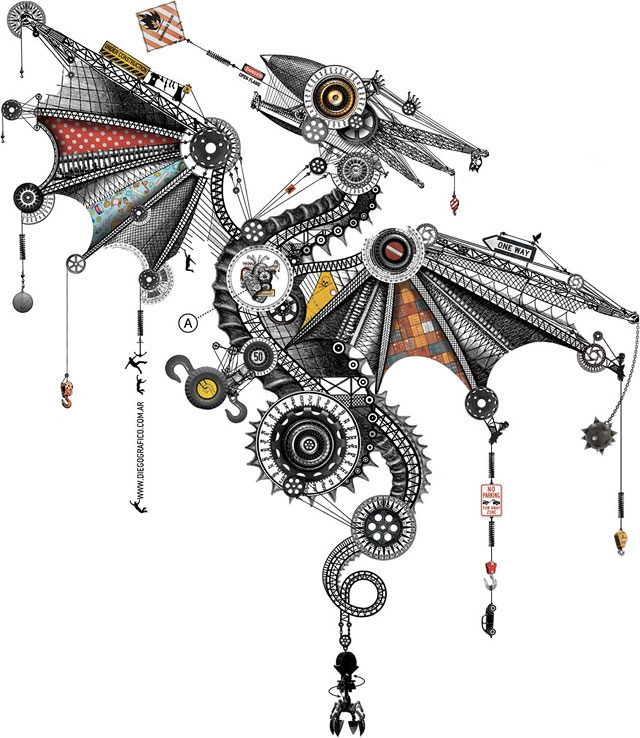
From Diego Mazzeo, illustrations of a bunch of different mechanical animals, including a whale, horses, elephants, flamingos, giraffes, a griffin, and a dragon.
Douglas Engelbart, RIP orig. from Jul 03, 2013
* Q: Wha? A: These previously published entries have been updated with new information in the last 24 hours. You can find past updates here.
Douglas Engelbart died at his home in California yesterday at the age of 88. Engelbart invented the mouse, among other things. In 1968, Engelbart gave what was later called The Mother of All Demos, in which he demonstrated “the computer mouse, video conferencing, teleconferencing, hypertext, word processing, hypermedia, object addressing and dynamic file linking, bootstrapping, and a collaborative real-time editor”.
Not bad for a single demo. Truly one of the giants of our age.
Update: Bret Victor urges us to remember Engelbart not for the technology he created but for his vision of how people could collaborate and create together using technology.
The least important question you can ask about Engelbart is, “What did he build?” By asking that question, you put yourself in a position to admire him, to stand in awe his achievements, to worship him as a hero. But worship isn’t useful to anyone. Not you, not him.
The most important question you can ask about Engelbart is, “What world was he trying to create?” By asking that question, you put yourself in a position to create that world yourself.
(thx, andy)
Last month, we posted a video of Tim Knoll doing ridiculous and panic-inducing circus style tricks on his bike. In the video below, he explains how he does the bike limbo, riding under several semi trucks in a row. Just because he tells you how to do it, does not mean you should try it. In fact, it is the expressed opinion of this blog you should not try it. However, if you do try it and you do feel yourself falling — which you will, because let’s be honest — don’t try to lift your head up. Just fall, because as Knoll says, “scrapes are better than stitches.”
(via ls)
Yes, and there’s also $20 over-the-counter test for HIV that gives results in 20 minutes.
Two recent developments could make these conversations less awkward, or even render them moot. But they also raise troubling questions about promiscuity and responsibility that are reminiscent of debates from the 1980s.
The first development was the approval, last summer, by the Food and Drug Administration of an over-the-counter rapid-response at-home H.I.V. test kit. The test, called OraQuick and available nationwide since October, gives results 20 minutes after a cheek swab. The second is the increasing availability of PEP and of pre-exposure prophylaxis, or PrEP.
PEP - the medication I am taking - has been called the H.I.V. morning-after pill, and PrEP, to follow the analogy, is akin to birth control. A study in the British medical journal The Lancet this month found that drug-injecting addicts who took PrEP were half as likely to become infected with H.I.V. as those who did not; other studies have shown that the drug reduces transmission of the virus from mother to child, and transmission among both gay men and heterosexuals.
What has been the hottest IPO of the year so far? Some new-fangled technology perhaps? Or maybe a trend-setting company from one of the coasts set to take their product offering national and then global? Nope, it was a Denver-based, pasta-centric restaurant chain called Noodles & Co. The company’s IPO bucked a lot of trends (including, it seems, the war on flour). Here’s The Daily Beast on how a pasta chain punked Wall Street.
[That’s Dave Pell’s take from Nextdraft, but I have to weigh in here. I’ve eaten at Noodles & Co many times. I ate there last week, actually. The restaurants do well because the service is friendly & responsive, your order comes out quickly, and the food is remarkably good for the money you pay (like at Chipotle). No one would ever mistake the Pad Thai or Japanese Pan Noodles for the authentic thing, but they are both delicious. I like the Steak Stroganoff so much that I crave it even when surrounded by the amazing and varied food choices of NYC. No idea if Noodles & Co would do well in Manhattan, but they’d definitely have one customer. -jkottke]
Due to the increasing ubiquity of connected cameras, writes Nick Bilton in the NY Times, photography is shifting away from documentation to communication.
Photos, once slices of a moment in the past — sunsets, meetings with friends, the family vacation — are fast becoming an entirely new type of dialogue. The cutting-edge crowd is learning that communicating with a simple image, be it a picture of what’s for dinner or a street sign that slyly indicates to a friend, “Hey, I’m waiting for you,” is easier than bothering with words, even in a world of hyper-abbreviated Twitter posts and texts.
“This is a watershed time where we are moving away from photography as a way of recording and storing a past moment,” said Robin Kelsey, a professor of photography at Harvard, and we are “turning photography into a communication medium.”
Dave Pell worries that the realtime availability of all these photos is getting in the way of our experiencing selves.
Maybe it was a bad angle. Maybe I didn’t get his good side. Maybe he just didn’t have that surfer vibe. Whatever it was, the photo wasn’t all that cool. Given time to reflect (even the few days I used to get between my own childhood birthdays and my mom picking up a set of 4x6 prints at the local pharmacy), my son probably would’ve developed a version of that day that had him riding a giant a wave, looking like a cross between Laird Hamilton and Eddie Vedder. Instead, he pretty much looked like a landlocked three year-old on a beach-bound surfboard who was suffering from a rare — but particularly punishing — bad hair day.
The instant my son looked at the image, his imagination-driven perception of himself was replaced by a digital reproduction of the moment he had just experienced. He had a few seconds, not nearly long enough, to create is own internal version of what that moment looked — and by extension felt — like.
For his first piece written as a staff writer for GQ in 1995, the magazine’s editor urged Andrew Corsello to write about the time he almost died of a mysterious liver failure.
Wednesday, August 31, the next day. Sicker, bewildered. In my office chair quaking with exertion, like a car with its accelerator and brake simultaneously floored. My breathing’s all wrong-the sharp, uneven gasps of an overworked dog. When I lumber off to the can, the urine is purple and oily looking. At three minutes after one, Doc Mike calls with the blood results. “Stop whatever you’re doing,” he orders. “Get in here now.”
Corsello won the 2007 National Magazine Award for his story, The Other Side of Hate.
Turning the Sun into a giant radio telescope through gravitational lensing will take some work, but it is possible.
An Italian space scientist, Claudio Maccone, believes that gravitational lensing could be used for something even more extraordinary: searching for radio signals from alien civilizations. Maccone wants to use the sun as a gravitational lens to make an extraordinarily sensitive radio telescope. He did not invent the idea, which he calls FOCAL, but he has studied it more deeply than anyone else. A radio telescope at a gravitational focal point of the sun would be incredibly sensitive. (Unlike an optical lens, a gravitational lens actually has many focal points that lie along a straight line, called a focal line; imagine a line running through an observer, the center of the lens, and the target.) For one particular frequency that has been proposed as a channel for interstellar communication, a telescope would amplify the signal by a factor of 1.3 quadrillion.
Smithsonian.com has a neat interactive map that shows how the Battle of Gettysburg played out in the Civil War. For best results, do one run through zoomed out a little and then another run-through to at a closer zoom level to see the details. (via digg)
Tyler Cowen at Marginal Revolution picks up on a Reddit thread that asks “What’s the most intellectual joke you know?” I’ve always been fond of this one:
Q: What does the “B” in Benoit B. Mandelbrot stand for?
A: Benoit B. Mandelbrot.
And this one:
Knock knock.
Who’s there?
Knock knock.
Who’s there?
Knock knock.
Who’s there?
Knock knock.
Who’s there?
Knock knock.
Who’s there?
Knock knock.
Who’s there?
Phillip Glass
Two of the current favorites in the Reddit thread are:
Jean-Paul Sartre is sitting at a French cafe, revising his draft of Being and Nothingness. He says to the waitress, “I’d like a cup of coffee, please, with no cream.” The waitress replies, “I’m sorry, Monsieur, but we’re out of cream. How about with no milk?”
And:
It’s hard to explain puns to kleptomaniacs because they always take things literally.
Glas is a short documentary film by Bert Haanstra about glass making. It won the 1959 Oscar for best documentary (short subject).
Many delightful moments in this film, but my favorite part is watching the glass blowers’ hands while they work. (thx, arjan)
For The Verge, Russell Brandom writes about the increasing use of neural implants to control the symptoms of a variety of diseases, from depression to Parkinson’s to dystonia.
The results are as reliable as flipping a light switch, but even after decades of testing, no one knows exactly why it works. Dr. Kaplitt, the surgeon who installed Rebecca Serdans’ implant, explains it by likening the brain to a collection of electrical circuits. A disorder like dystonia is a failure of those circuits. When you install a brain stimulation device, “it’s presumably blocking abnormal information from getting from one part of the brain to another, or normalizing that information.” But Kaplitt is the first to acknowledge that this is just a theory. “The mechanism by which brain stimulation works is still somewhat unclear and controversial.”
But the lingering questions haven’t slowed down research. There are already patents that would use brain stimulation implants to enhance memory or prevent stuttering, to cure anorexia or bring a person to orgasm. Experimental studies use the device to treat Alzheimer’s disease and drug addiction. Those circuits aren’t as well understood as the circuits governing movement disorders, but the principle is no different. Once you’ve got a line into the circuitry of the brain, Parkinson’s is just the beginning.
Last week I featured a video of a man with Parkinson’s who has a brain pacemaker that allows him to function normally.
Newer posts





Socials & More