Entries for September 2012
Beginning in October, a copy of Edvard Munch’s iconic The Scream of Nature will be on display at MoMA for a six-month stint.
Of the four versions of The Scream made by Munch between 1893 and 1910, this pastel-on-board from 1895 is the only one remaining in private hands. The three other versions are in the collections of museums in Norway. The Scream is being lent by a private collector, and will be on view at MoMA through April 29, 2013.
In No Evidence of Disease, Maciej Cegłowski writes about his girlfriend’s cervical cancer and the appearance of a new friend in her life, fellow cancer patient Stephanie. Except that, well, that’s not the whole story.
Cancer comes with an entourage: fear, loneliness, and isolation. Diane didn’t go to the makeup event expecting to make a new friend, but it was a way to get out of the house. She came home excited about having met Stephanie.
Stephanie was ten years younger than Diane. Her illness was acute myeloid leukemia (AML), a type of blood cancer in which cancerous precursor cells completely take over the bone marrow. Steph had gotten her diagnosis while studying abroad in Spain, and had been treated there long enough to put her into remission and send her home. Now her life was on hold, and the cancer was coming back.
Her long-term prognosis was poor. Steph was reticent in talking about it straight out, but after she and Diane became better friends, it became clear that she did not expect to survive a year. Her only hope lay in a difficult and risky transplant procedure. I couldn’t imagine having to face this at 23, but of course no one gets to make the choice.
Maciej is a great writer and this is a crazy-ass story and I don’t know exactly what you’re supposed to feel after reading this piece (sad? mad? defeated?), but you’ll definitely feel something. (via @sippey)
Archaeologist Marc Azéma thinks that Stone Age artists may have fashioned their cave paintings in such a way as to suggest movement, crude movies that came to life as the flickering light from a fire danced on the walls.
Not only that, Paleolithic artists may have also have invented the thaumatrope thousands of years before the Victorians in the 1800s.
Consisting of a card or disk with different designs on either side, the device demonstrates the persistence of vision: When the card or disk is twirled, the designs appear to blend into one.
Rivère discovered that Paleolithic artists used similar optical toys well in advance of their 19th-century descendants.
The artist examined Magdalenian bone discs — objects found in the Pyrenees, the north of Spain and the Dordogne, which measure about 1.5 inches in diameter.
Often pierced in their center, the discs have been generally interpreted as buttons or pendants.
“Given that some are decorated on both sides with animals shown in different positions, we realized that another type of use, relating to sequential animation, was possible,” the researchers said.
They mentioned one of the most convincing cases, a bone disc found in 1868 in the Dordogne. On one side, the disc features a standing doe or a chamois. On the other side, the animal is lying down.
Azéma and Rivère discovered if a string was threaded through the central hole and then stretched tight to make the disc rotate about its lateral axis, the result was a superimposition of the two pictures on the retina.
Incredible that moviemaking is tens of thousands of years old instead of just a couple hundred.
The second season of Girls is set to run in January 2013 on HBO. Here’s a short teaser for the new season:
Normally, I’m fairly conversant on crazy Korean drummers, so I have no idea how I missed the boat on Kwon Soon Keun. Keun is the subject of A Drummer’s Passion, a movie about his life and wild playing style. This was the first video of Keun’s playing to get a lot of attention, and it is amazing, amazing, amazing, but the video below is sublime. Maybe it’s the stone-faced bass player, maybe it’s the environment, but at 1:10, magic happens.
Than Tibbetts took all the frames from Noah Kalina’s Everyday video and averaged them into one photo.

Those are some of the yearly averages…you’ll have to click through to see the overall average.
Excellent NYT Magazine piece on the impact of The Kalamazoo Promise, an initiative by anonymous donors to pay the college tuition of every graduating senior in Kalamazoo. The Promise, which is intended by the donors to be an experiment in urban investment has had several amazing results in only a few years. High school test scores have improved continuously, and the promise of help with tuition has lead to families moving to and staying in Kalamazoo. The 2,450 new students has allowed the school district to hire 92 additional teachers. It’s not all rosy, and the Promise hasn’t solved every problem yet, but Kalamazoo seems to be headed in the right direction.
Under the terms of the program, students who start in the Kalamazoo school district as kindergartners receive enough money to cover their entire tuition to public in-state schools. Students who enter the district in later grades get less, based on a sliding scale; entering high-school freshmen, for example, get 65 percent of their tuition covered. (Those who move to Kalamazoo after that or who enroll in colleges that are private or located outside the state are not covered by the Promise.) To date, the Kalamazoo Promise has paid out $35 million for postsecondary study for 2,500 students. On average, about $4,200 is spent on each student per semester. Students are responsible for their own room and board.
(via @graysky)
Flavorwire has a quick look at some noted directors (Kubrick, Wes Anderson, Fincher) and the typefaces that they often used. (via @curiousoctopus)
When Ronald McDonald bought a run-down house that dated back to 1795 with the intention of tearing it down to put up a hamburger restaurant, the citizens of New Hyde Park successfully got the house landmarked. Instead of cutting their losses, McDonald’s renovated the house into the nation’s classiest fast food joint.

There’s not a whole not more to this radio than what it looks like, but I will forever have a soft spot for things that mimic the London tube map.
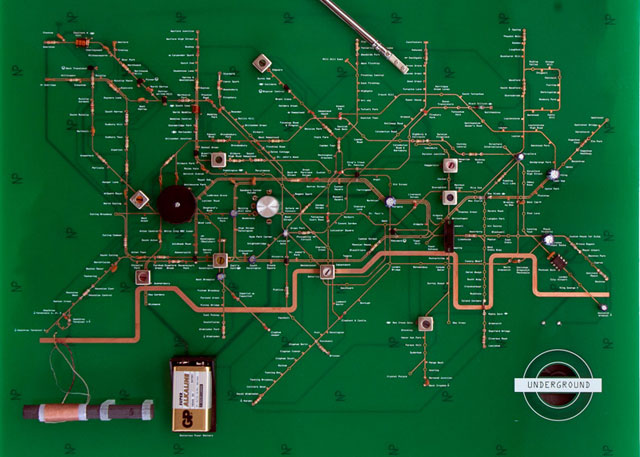
Now, if it contained vacuum tubes or something…
The latest from the Made By Hand video series is about Martinez Cigars on West 29th St in NYC. The cigars they sell are hand-rolled right in the shop.
Over at Hacker News, npguy asked Y Combinator co-founder Paul Graham about “the most frighteningly ambitious idea” he’d ever been pitched. Graham declined to answer, citing confidentiality, but Eliezer Yudkowsky responded with what another commenter called the Yudkowsky Ambition scale:
1) We’re going to build the next Facebook!
2) We’re going to found the next Apple!
3) Our product will create sweeping political change! This will produce a major economic revolution in at least one country! (Seasteading would be change on this level if it worked; creating a new country successfully is around the same level of change as this.)
4) Our product is the next nuclear weapon. You wouldn’t want that in the wrong hands, would you?
5) This is going to be the equivalent of the invention of electricity if it works out.
6) We’re going to make an IQ-enhancing drug and produce basic change in the human condition.
7) We’re going to build serious Drexler-class molecular nanotechnology.
8) We’re going to upload a human brain into a computer.
9) We’re going to build a recursively self-improving Artificial Intelligence.
10) We think we’ve figured out how to hack into the computer our universe is running on.
Grantland has a story about a chess cheating scandal with an interesting section on the the history of chess-playing computers.
The Virginia scandal involved the opposite ruse, in which a machine surreptitiously called the shots for a player. The chess engines this scheme centered on are relatively new: Computers only surpassed humans at the chessboard during young Smiley’s lifetime. Scientists had an easier time designing digital brains that could produce atom bombs or navigate lunar landings than they did fashioning a machine that could play chess worth a darn. Plainly, until relatively recently, chess was too complicated for computers. An analysis of chess’s complicatedness in Wired determined that the number of possible positions in an average 40-move game is 10 to the 128th power, a sum “vastly larger than the number of atoms in the known universe.”
In 1966, MIT brainiacs entered MAC HACK VI, a computer program they’d devised, into the Massachusetts Amateur Chess Championship, making it the first computer program ever to enter a tournament. It drew just one match and lost four.
[…]
But by 2007, a chess engine called Rybka was routinely shutting out grandmasters even when spotting the humans a pawn and taking black, thereby letting humans go first, the more statistically desirable position. Computers have gotten noticeably better since then; humans haven’t.
The man-machine war in chess is no longer contested: “Computers are better than us,” says USCF president Ruth Haring.
And here are a couple articles about chess-playing computers because I was curious:
Gary Kasparov in the NY Review of Books, Humans and computers in Slate, and Newsweek’s ‘The Brain’s Last Stand’ from when Deep Blue beat Kasparov.
In the New Yorker, Salman Rushdie describes how quickly his entire life changed after Iran’s Ruhollah Khomeini issued a fatwa calling for Rushdie’s “execution”.
He unlocked the front door, went outside, got into the car, and was driven away. Although he did not know it then — so the moment of leaving his home did not feel unusually freighted with meaning — he would not return to that house, at 41 St. Peter’s Street, which had been his home for half a decade, until three years later, by which time it would no longer be his.
The article is excerpted from Rushdie’s memoir, Joseph Anton, which comes out next week. Joseph Anton was the name Rushdie adopted in hiding and, now that I think about it, explains why the NYer piece was written in the third person.
Researchers in Germany have found evidence of room temperature superconductivity in graphite powder that has been soaking in water and then dried. Not surprisingly, the results come with a few caveats:
First, this is not a conventional bulk material. The claim from Germany is that the superconductivity occurs at the interface between grains of graphite after they have dried out.
So that’s a surface effect which involves only a tiny fraction of the total mass of carbon in the powder—just 0.0001 per cent of the mass, according to Esquinazi and co.
What’s more the effect is clearly fragile. Esquinazi and co say the superconductivity disappears if the treated powder is pressed into pellets.
So whatever allows the superconductivity to occur at the grain interfaces is destroyed when the grains are pressed together.
I’m pretty sure this is the technology used by the aliens who designed The Machine in Contact.
Writing for Slate, Daniel Engber takes a closer look at the magic cooling glove and finds some (but not a lot of) evidence that the thing actually works as advertised.
The study, which aggregates results from a decade’s worth of experiments, found that “palm cooling” helped people do 144 percent more pull-ups than they did before, on average. A closer look reveals that the effect might not be so beefy as it looks, however. That figure comes from testing just a handful of people in the lab-even after 10 years of research-and it has some honking error bars (+/-83 percent). To put it in perspective: Before the palm-cooled training, their scores ranged from 70 to 153 pull-ups in each session; after training, they ranged from 70 to 616.
Jonny Greenwood’s soundtrack for P.T. Anderson’s new film, The Master, came out yesterday. It’s available on MP3 from Amazon ($11) and directly from Nonesuch in MP3 and other formats ($12+). Greenwood previously did the soundtrack for Anderson’s There Will Be Blood.
Other potential headlines about the Mindy Kaling profile in NY Magazine: ‘I hope Mindy Kaling’s new show is as awesome as Mindy Kaling’ and ‘I wish television executives would take chances like this more often.’
Her character on the show also seems to represent a version of singledom not being explored on TV, one that is very different from Zooey Deschanel’s Jess on New Girl, who is so presexual in her girlishness that she spends an entire episode getting over her discomfort with saying the word penis. And unlike Girls’ Hannah, played by Lena Dunham, she’s found her life path, and she has had sex with more than a couple of people. “I just wanted to do a show that is kind of about dating, about someone who thinks about love all the time,” Kaling says. “One thing that is different than other shows is that my character is weirdly, extremely confident. She feels like she should be dating Chris Evans. That’s something I learned from writing for Michael Scott. He thought he was going to marry Teri Hatcher, even though he was constantly being told that was not the case.”
Michael Lewis profiles President Obama orig. from Sep 11, 2012
* Q: Wha? A: These previously published entries have been updated with new information in the last 24 hours. You can find past updates here.
Izhar Gafni has designed a bike that weighs 20 pounds, costs between $9-12 to build, can hold up to a 485 pound person, and it made out of cardboard.
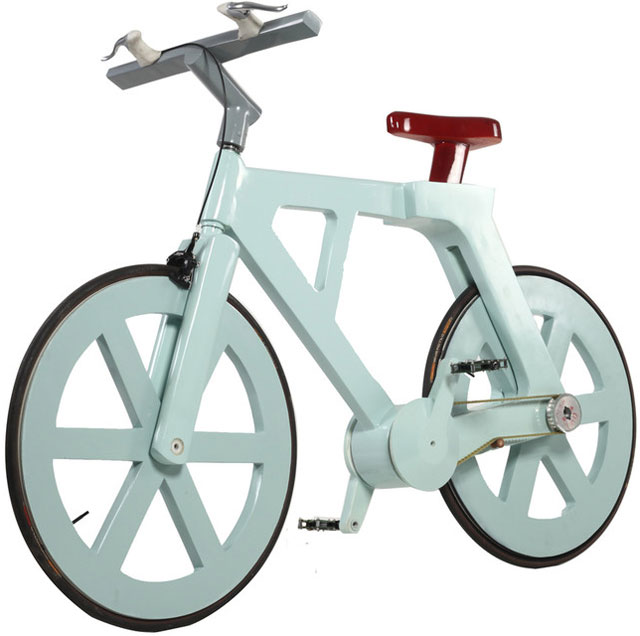
Engineers told Gafni that his idea was impossible. Yet he realized that paper could be strong if treated properly. As in crafting origami and tearing telephone books, he explains, “[if] you fold it once, and it’s not just twice the strength, it’s three times the strength.”
The development to what you see today took three years. Two were spent just figuring out the cardboard complications—leading to several patents—and the last was spent converting a cardboard box on wheels to a relatively normal looking bike.
(thx, mickey & erika)
In almost every case, the perceived skill-level gender gap between males and females is overblown. One exception: Throwing. According to one researcher: “The overhand throwing gap, beginning at 4 years of age, is three times the difference of any other motor task, and it just gets bigger across age. By 18, there’s hardly any overlap in the distribution: Nearly every boy by age 15 throws better than the best girl.” About the only thing I can do better than my wife is manage a browser with 65 open tabs.
Apparently no one told Erin DiMeglio about this throwing research. She plays quarterback on her high school football team in Florida.
Michael Lewis profiled Barack Obama for the October issue of Vanity Fair. The full version isn’t available online yet (and I have a hunch they’ll keep it that way) is here, but the excerpts might just compell me into a purchase.
At play, the president wears red-white-and-blue Under Armor high-tops, but at work it’s strictly blue or gray suits. “I’m trying to pare down decisions. I don’t want to make decisions about what I’m eating or wearing. Because I have too many other decisions to make,” he tells Lewis. “You need to focus your decision-making energy. You need to routinize yourself. You can’t be going through the day distracted by trivia.” Lewis says that if he were president he might keep a list in his head. “I do,” Obama adds. “That’s my last piece of advice to you. Keep a list.”
That bit reminds me of this piece on Roger Federer.
I got another sense, however: a sense that he was conserving focus. Fed went through all his subsidiary responsibilities as the President of Tennis (as Steve Tignor calls him) without concentrating on anything, or at least on as few things as possible.
Concentration takes mental energy, as anyone who has fought off five break points before shanking a ball on the sixth knows. And whenever I saw Federer on the grounds, he seemed to be using as little of it as possible. Practicing with Nicolas Kiefer on Ashe a few days before the tournament, he mostly just messed around. He would hit a few familiar Federer shots, the heavy forehand, the penetrating slice, then shank a ball and grin, or yell. Either way, he wasn’t really concentrating all that hard.
And is it possible that Obama has read one of my favorite books about technology, Tom Standage’s The Victorian Internet?
Obama points to the 1849 patent model of Samuel Morse’s first telegraph: “This is the start of the Internet right here,” he tells Lewis.
Update: Aha! It looks like Vanity Fair just posted the whole thing online. (via @wistdom)
Edd Dumbill writes that Twitter, as it strives to become a profitable company, is turning into an old media company.
Twitter’s bait-and-switch, now they’ve built their reach on the back of eager early adopters, is disappointing. It marks them as part of old, unenlightened, business, and consigns them to a far less remarkable place in the future economy than they otherwise might have had.
Michael Heilemann has a somewhat harsher take in his post on Amazon, Twitter, and Star Wars:
Some part of me can’t help but admire the purity of the clusterfuck that is Twitter’s continued downward trajectory from startup wunderkind to some sort of bland, wannabe ad-driven media company.
It’s incomplete, but I can’t help but draw comparisons between Twitter’s alienation of their original users and ecosystem to, because I am me, Star Wars.
Despite what George Lucas says, the continuing alterations to Star Wars have been driven by business reasoning, not some artistic auteur need to see the vision completed. And in both cases, the original fan base is the one getting run over, while the unwashed masses get to enjoy Jar Jar and Justin Bieber, respectively.
Some examples of car company logo rip-offs, mostly from China.

And really, who wouldn’t want a BYD instead of a BMW?
Bob Staake imagines some children’s books that might not be so good for kids.
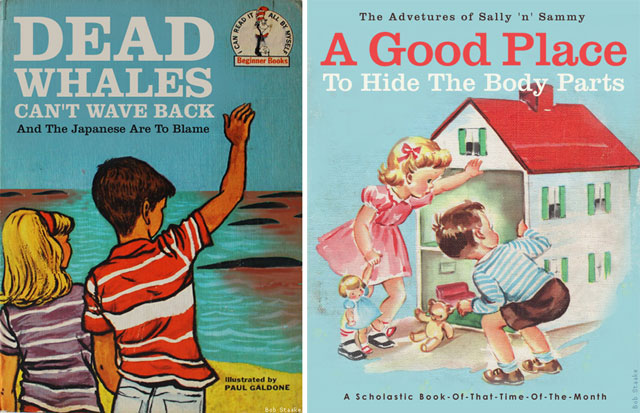
(via @bdeskin)
In a photo slideshow with jazz accompaniment, narrator Adam Gopnik takes us on a short tour of NYC’s A train, which runs from the top of Manhattan all the way out to the beaches of Rockaway.
From Harlem and upper Manhattan to Brooklyn, Queens and the Atlantic Ocean - New York city’s A Line subway route covers over 30 miles, takes two hours to ride from end to end, and is the inspiration for one of jazz’s best known tunes.
Here — with archive images and vibrant present-day photographs from Melanie Burford — New Yorker columnist Adam Gopnik takes a ride on one of today’s A trains, and explores the communities living along the route.
(via @davehopton)
Nanocrystalline cellulose is made from wood pulp, is light, strong, and even conducts electricity.
So why all the fuss? Well, not only is NCC transparent but it is made from a tightly packed array of needle-like crystals which have a strength-to-weight ratio that is eight times better than stainless steel. Even better, it’s incredibly cheap.
“It is the natural, renewable version of a carbon nanotube at a fraction of the price,” says Jeff Youngblood of Purdue University’s NanoForestry Institute in West Lafayette, Indiana.
I liked this Zadie Smith profile of Jay-Z, and not just for The Wire reference. Smith’s got a nice way with words and handles Jay-Z’s way with words nicely.
In “Decoded,” Jay-Z writes that “rap is built to handle contradictions,” and Hova, as he is nicknamed, is as contradictory as they come. Partly because he’s a generalist. Biggie had better boasts, Tupac dropped more knowledge, Eminem is — as “Renegade” demonstrated — more formally dexterous. But Hova’s the all-rounder. His albums are showrooms of hip-hop, displaying the various possibilities of the form. The persona is cool, calm, almost frustratingly self-controlled: “Yeah, 50 Cent told me that one time. He said: ‘You got me looking like Barksdale’ ” — the hot-blooded drug kingpin from HBO’s “The Wire” — “and you get to be Stringer Bell!” — Barksdale’s levelheaded partner. The rapper Memphis Bleek, who has known Jay-Z since Bleek himself was 14, confirms this impression: “He had a sense of calm way before music. This was Jay’s plan from day one: to take over. I guess that’s why he smiles and is so calm, ‘cause he did exactly what he planned in the ’90s.” And now, by virtue of being 42 and not dead, he can claim his own unique selling proposition: he’s an artist as old as his art form. The two have grown up together.
Additionally, you’ll enjoy this profile of a guy who has sent a couple hundred letter-length emails to Jay-Z since 2010, and is pretty sure the emails are being read.
I can’t find any other information about this online or anywhere else, but tucked away in a fall arts preview in today’s NY Times is the juicy news that MoMA has picked a date for their screening of Christian Marclay’s 24-hour movie, The Clock. The show will open on Dec 21 and run through Jan 21. It sounds like the screening will happen in the contemporary galleries and won’t show continuously except on weekends and New Year’s Eve. Which is lame. Just keep the damn thing running the whole month…get Bloomberg to write a check or something.
Anyway, probably best to check this out on the early side during the holiday season because it’ll turn into a shitshow later on.
Author Philip Roth was unable to correct an error on the Wikipedia page for his novel The Human Stain because, while Wikipedia agrees “the author is the greatest authority on their own work,” they “require secondary sources.” To create this secondary source, Roth wrote an open letter explaining the error, and posted it on The New Yorker’s site.
A few hours later, the Wikipedia page for The Human Stain was updated to reflect Roth’s letter.
Roth was motivated in 2012 to explain the inspiration for the book after he noticed an error in the Wikipedia entry on The Human Stain. His efforts to correct the entry were thwarted by Wikipedia editors because he was told he did not have a secondary source for his inspiration. He was responding to claims, given prominence in this entry, by Michiko Kakutani and other critics that the book was inspired by the life of Anatole Broyard, a writer and New York Times literary critic. Roth has repeatedly said these opinions are false. In 2008 Roth explained that he had not learned about Broyard’s ancestry until “months and months after” starting to write the novel.
(via @yappelbaum)
The Atlantic’s Alexis Madrigal gets an inside look at how Google builds its maps (and what that means for the future of everything). “If Google’s mission is to organize all the world’s information, the most important challenge — far larger than indexing the web — is to take the world’s physical information and make it accessible and useful.”
Against all odds, I have become a (belated) fan of the Kindle. I still hate doing anything with it but reading words on its screen, but it’s light, runs on a single charge for seemingly ever, and I’ve really been enjoying reading on it lately.
If this trend continues, I might have to get the Kindle Paperwhite, which offers a built-in light, a touchscreen (I currently own a touchless Kindle 3), more resolution, more font choices, and a higher contrast screen.
From Our City, Our Story, the story of a Rockford, Illinois gear factory that made all of the gears for the Mars Curiosity rover.
What might be more remarkable than creating crucial equipment destined for Mars? For a second time? Well, creating a thriving motivated company culture with a team of career employees — the kind who lie in bed at night thinking, “what can I do in the morning when I get there?” The kind who take on responsibility, impose their own high standards and like Amy Sovina, have the “mindset something I touched is now on the surface of Mars.”
I would love to have seen a live feed of these gear shop employees watching the landing.
MoMA Unadulterated is an unofficial audio tour of some of the works on the museums fourth floor, narrated by kids aged 3-10.
Each piece of art is analyzed by experts aged 3-10, as they share their unique, unfiltered perspective on such things as composition, the art’s deeper meaning, and why some stuff’s so weird looking. This is Modern Art without the pretentiousness, the pomposity, or any other big “p” words.
A lot of these sound like my internal monologue when looking at art. What’s the difference between childish and childlike again?
Dan Spitz played lead guitar for the heavy metal band Anthrax for more than 12 years. Now he’s a master watchmaker.
My favorite stuff to work on is older watches because of how they are made. These watches were way overbuilt so that they would never come back for repair. Just look at the mainplates… They were built at a time before computers were checking everything. If you’ve been working on modern stuff all day, there’s nothing like getting a vintage watch to work on, and when you open it up, you say “Ahhhh, look at that, this rocks!” Like an old muscle car, it’s so basic, so perfect, so overbuilt. It just rocks.
In July, we mentioned Infinite Boston, a project from William Beutler to map and photo the Boston-related locations in Infinite Jest. Today Beutler announced Infinite Atlas, which expands nationally on this project, and Infinite Map, a limited edition print featuring 250 “of the most interesting locations” from Infinite Jest.

vintage post from Sep 2012
· gift link
For his Yakuza project, photographer Anton Kusters spent two years documenting some members of the Japanese mafia.

A limited edition of a book containing the photos is available. Steward Mag recently did an interview with Kusters:
The values were almost comparable to general Japanese workplace values, actually. Most yakuza gangs actually have neighborhood offices, and the plaques they have on the door state core values like “respect your superiors,” “keep the office clean,” and so on.
One thing I noticed early on with gang life was how subtle everything was. Everything was unspoken, and will was expressed through group pressure. A pressure was constantly there. There was this innate understanding of form — if someone did something wrong, no one would say anything; he would simply be expected to apologize. And the fact everyone would be so silent about it made the pressure really intense.
(thx, david)
Inspired by the BBC/British Museum collaboration A History of the World in 100 Objects, the NY Times built a similar collection of objects that tell the story of New York City: grid map, bagels, Checker cabs, the boom box, and MetroCard.
The first known mention of the bagel dates from 1610 in the community regulations of Krakow, Poland. The world’s biggest bagel factory is in Illinois. Still, no other food is so associated with New York as the “Jewish English muffin,” which spread from the Lower East Side in the early 20th century. “Pizza belongs to America now,” Josh Ozersky, a food writer, said, “but the bagel was always the undisputed property of New York.”
Tyler Cowen and Alex Tabarrok of Marginal Revolution are starting an online education platform.
We think education should be better, cheaper, and easier to access. So we decided to take matters into our own hands and create a new online education platform toward those ends. We have decided to do more to communicate our personal vision of economics to you and to the broader world.
The first course is Development Economics.
Development Economics will cover the sources of economic growth including geography, education, finance, and institutions. We will cover theories like the Solow and O-ring models and we will cover the empirical data on development and trade, foreign aid, industrial policy, and corruption. Development Economics will include not just theory but a wealth of historical and factual information on specific countries and topics, everything from watermelon scale economies and the clove monopoly to water privatization in Buenos Aires and cholera in Haiti.
A piece of unsolicited advice: change the name to Revolution University.
Here’s a Quora answer about how those claw arcade games work. You know the ones, you’ve probably won once, but just once. My inclination was to call this a ‘fascinating Quora answer,’ but upon thinking about it, it’s not fascinating. The machines work exactly how you think they would. The operators can vary the strength of the claw to screw you just bad enough you keep sliding in your dollar bills.
Basically, most crane games are designed so the claw is randomly (and only once in many games) strong enough to let players win. Some even weaken in strength after a short time so players get close to victory only to see it slip from their grasp! Since the manuals for many skill games are available online, this is not hard to verify.
The answerer then goes on to link to many manuals so you can see for yourself. (via @sunilnagaraj)
In partnership with sciencedebate.org, Scientific American asked both major party candidates to answer questions about the important scientific questions of the day. Here are the results.
I am not a scientist myself, but my best assessment of the data is that the world is getting warmer, that human activity contributes to that warming, and that policymakers should therefore consider the risk of negative consequences. However, there remains a lack of scientific consensus on the issue — on the extent of the warming, the extent of the human contribution, and the severity of the risk — and I believe we must support continued debate and investigation within the scientific community.
Great personal storytelling/reportage by Doree Shafrir about her night terrors.
I am now completely panicked, and I jump back onto my bed and lean over the half-wall that my bed is up against, overlooking the hallway. There, I see what’s causing all the problems, and I push it downward and off the wall with all my might. It shatters loudly, glass flying everywhere.
Then, finally, I wake up. My two dogs are cowering in the corner, and I put on shoes to sweep up the glass. I am confused and embarrassed, though there is no one besides the dogs there to see that I just pushed a framed poster off a wall and broke it. I clean up the glass and go back to sleep, and it is not until the morning, when I see my shoes scattered everywhere, that I look into the closet and realize that I have also ripped the TV cable completely out of the back wall of my closet.
I hadn’t heard that Tobias Wong’s suicide might have been carried out while Wong was asleep:
The prevailing theory about Tobias Wong’s death was that he hanged himself while experiencing a night terror. I imagine that something in his mind told him that hanging himself was the only way to escape whoever, or whatever, was chasing him, in the same way that I have thought that the only way to save myself was to jump out of a window or smash a pane of glass.
Over at The Verge wub wub wub skztch wubwubwub Joe Flatley Flatley wub wub wub pzzzzt wub WUBB wub Flatley wub wub wub shares the history wub wub wub wub wub wub fwizzort WUBWUBWUB of dubstep here comes the drop
For our purposes, we can begin the story of dubstep at the turn of the 21st century, and with UK garage and two-step; weird, hybrid music that features elements of house music (popcorn snares, glittering high-hats) and a lyrical style that is almost a parody of American hip-hop glamor and excess. “Champagne, Versace and Moschino,” as Zed Bias once put it.
Recently I talked to Damian “Dieselboy” Higgins, the Brooklyn-based drum and bass DJ, producer, and head of the record label Human (and its dubstep and electro imprint Subhuman). Higgins has been on the front lines as long as America has had a rave scene. “Drum and bass kept spawning these micro-cultures, or micro-genres,” he explained. “[There was] two-step, and then grime, and dubstep was the next one. For me, I felt like it came from drum and bass. There are a lot of drum and bass guys who jumped ship and went to it.”
Drum and bass is one of those primarily English forms of dance music that, even today, still sounds alien - the fast tempos (generally well over 150 beats per minute), the intricate syncopation, and the full-on synthetic sound has never been fully accepted by mainstream American ears. Two-step garage took house music and added the foreignness of drum and bass. Or, perhaps conversely, it took drum and bass and added enough elements from house music as to not alienate the ladies in the clubs. It was a form of dance music that was indigenous to London, and for a moment in the late 1990s it was arguably the underground sound of the UK.
Wub wub wub. Wub.
Leveraging the high number of specialized heat-transfer veins in the palm of the human hand, researchers at Stanford have developed a thermal exchange glove that is able to cool a person’s core temperature in a matter of minutes. Turns out this is helpful for athletes.
The glove’s effects on athletic performance didn’t become apparent until the researchers began using the glove to cool a member of the lab — the confessed “gym rat” and frequent coauthor Vinh Cao — between sets of pull-ups. The glove seemed to nearly erase his muscle fatigue; after multiple rounds, cooling allowed him to do just as many pull-ups as he did the first time around. So the researchers started cooling him after every other set of pull-ups.
“Then in the next six weeks he went from doing 180 pull-ups total to over 620,” said Heller. “That was a rate of physical performance improvement that was just unprecedented.”
The researchers applied the cooling method to other types of exercise — bench press, running, cycling. In every case, rates of gain in recovery were dramatic, without any evidence of the body being damaged by overwork - hence the “better than steroids” claim.
The cooling resets a temperature-sensitive enzyme that muscles need to generate energy, “essentially resetting the muscle’s state of fatigue”. I expect this will be either everywhere in pro sports in a couple of years or banned. (via @jsnell)
David Fincher has always started his movies right: with interesting opening title sequences.
The Art of the Title recently interviewed the director about his interest in title sequences.
The sequence for Se7en did very important non-narrative things; in the original script there was a title sequence that had Morgan Freeman buying a house out in the middle of nowhere and then travelling back on a train. He was making his way back to the unnamed city from the unnamed suburban sprawl, and that’s where the title was supposed to be — “insert title sequence here” — but we didn’t have the money to do that. We also lacked the feeling of John Doe, the villain, who just appeared 90 minutes into the movie. It was oddly problematic, you just needed a sense of what these guys were up against.
Kyle Cooper, the designer of the title sequence, came to me and said, “You know, you have these amazing books that you spent tens of thousands of dollars to make for the John Doe interior props. I’d like to see them featured.” And I said, “Well, that would be neat, but that’s kind of a 2D glimpse. Figure out a way for it to involve John Doe, to show that somewhere across town somebody is working on some really evil shit. I don’t want it to be just flipping through pages, as beautiful as they are.” So Kyle came up with a great storyboard, and then we got Angus Wall and Harris Savides — Harris to shoot it and Angus to cut it — and the rest, as they say, is internet history.
I don’t believe in decorative titles — neato for the sake of being neato. I want to make sure you’re going to get some bang for your buck. Titles should be engaging in a character way, it has to help set the scene, and you can do that elaborately or you can do it minimally.
(via devour)
Serious Eats put together an extensive guide to the regional sandwich cuisine of the US that covers everything from the universally available sloppy joe and grilled cheese to the spiedie, the hot brown, and the dutch crunch.
An international edition is also available (gyro! banh mi! bocadillo! chip butty!).
Wes Anderson likes overhead shots, Quentin Tarantino prefers to peer up from below, Darren Aronofsky uses sharp sounds, and Stanley Kubrick often uses one-point perspective.
Newer posts
Older posts





Socials & More