This is the third part of a 1936 documentary film about a mail train traveling from London to Scotland. Be sure to watch the mail exchange process that starts about 50 seconds in.
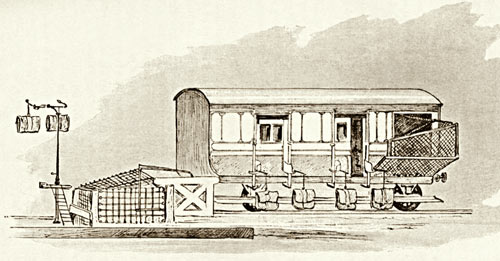
The train doesn’t even slow down to exchange the mail…the outgoing mailbags are hung low and snared by a net near the track and incoming mailbags are collected up high using a similar net.
Drive-through fast food should work more like this. (via sveinn)
Google breaks down mobile device users into three categories: repetitive now, bored now, and urgent now.
The “repetitive now” user is someone checking for the same piece of information over and over again, like checking the same stock quotes or weather. Google uses cookies to help cater to mobile users who check and recheck the same data points.
The “bored now” are users who have time on their hands. People on trains or waiting in airports or sitting in cafes. Mobile users in this behavior group look a lot more like casual Web surfers, but mobile phones don’t offer the robust user input of a desktop, so the applications have to be tailored.
The “urgent now” is a request to find something specific fast, like the location of a bakery or directions to the airport. Since a lot of these questions are location-aware, Google tries to build location into the mobile versions of these queries.
This works for general web users as well. Blogs do well when they appeal to repetitive now and bored now users, but the really effective ones target all three types at once. Somehow this is related to stock and flow.
Charles Babbage built one of the first mechanical calculating machines but Ada Lovelace was the first to show how the machine’s arithmetic function could be abstracted to produce things other than numbers: language, graphics, or music.
Softball has no following in Greece, and the construction of a permanent softball stadium hasn’t changed that. […] Greeks like sports, but they like smoking more.
A city “winning” the right to host the Olympic Games seems like buying a pig in a poke.
Not content with movie stars, California wants its own actual stellar object. The LIFE project at the NIF (National Ignition Facility) at the Lawrence Livermore National Laboratory aims to create a tiny star with intense laser power. How intense? The facility increases the power of the laser beam a quadrillion times before it reaches its target:
The National Ignition Facility, located at Lawrence Livermore National Laboratory, is the world’s largest laser system… 192 huge laser beams in a massive building, all focused down at the last moment at a 2 millimeter ball containing frozen hydrogen gas. The goal is to achieve fusion… getting more energy out than was used to create it. It’s never been done before under controlled conditions, just in nuclear weapons and in stars. We expect to do it within the next 2-3 years. The purpose is threefold: to create an almost limitless supply of safe, carbon-free, proliferation-free electricity; examine new regimes of astrophysics as well as basic science; and study the inner-workings of the U.S. stockpile of nuclear weapons to ensure they remain safe, secure and reliable without the need for underground testing.
Wow. The fusion will produce high-energy neutrons, which will bombard a material capable of converting their energy into heat, which in turn will make steam and eventually electricity. But it gets even better:
In addition, the LIFE engine design can be “charged” with fission fuel. The resulting fission reactions will produce additional energy that can be harvested for electricity production. Moreover, by using depleted uranium or spent nuclear fuel from existing nuclear power plants in the blanket, a LIFE engine will be capable of burning the by-products of the current nuclear fuel cycle. Because the fusion neutrons are produced independently of the fission process, the fission fuel could be used without reprocessing. In this way, LIFE may be able to consume nuclear waste as fuel, mitigate against further nuclear proliferation, and provide long-term sustainability of carbon-free energy. A LIFE engine, via pure fusion or through the combination of fusion and fission, will generate the steady heat required to drive turbines for generating from 1,000 to 2,500 MW of safe, environmentally attractive electric power 24 hours a day for decades.
From a collection of old menus from Colorado, the 1892 menu from a Denver restaurant called The Boston Bakery and Lunch Room (For Ladies and Gents).
Porterhouse steak with mushrooms: 70 cents. This particular menu also contains a sort of customer bill of rights: an explanation of how waiters should treat customers and how the restaurant will catch you if you try to skip out on your check.
Now, we want your trade, and we do not care whether your check is 5¢ or $5; you will be rightly treated and correctly waited upon, or we will know the reason why, if you will only report any neglect to the head waiter or to us before leaving your seat.
The waiters are instructed to be civil and polite to every one, whether they are so to them or not, for even should the customer use bad manners, the waiter must not.
Have no conversation with the customer, except what is strictly necessary.
Give everyone a napkin who asks for it.
p>Give each one a glass of water as soon as seated.
Be as quick and quiet as possible.
Place the orders down quietly; don’t slam them down.
Give each customer a check as son as you serve the order and see that it is kept in sight. Very few beats come in here, but experience has taught us that there are some. We will give any waiter $2.00 who will give us information that will enable us or the head waiter to detect any one in the act of Check Beating.
We want to call the customer’s attention to the fact that when we are looking at your checks and orders, it is as much to see that you are rightly served and not over-checked as that your not under-checked. Most would understand this but some might not.
The secret ingredient that makes the mortar so strong and durable is amylopectin, a type of polysaccharide, or complex carbohydrate, found in rice and other starchy foods, the scientists determined. The mortar’s potency is so impressive that it can still be used today as a suitable restoration mortar for ancient masonry.
A new Subway has recently opened in Manhattan…hanging on the outside of the 27th floor of the skeleton of 1 World Trade Center. The Subway will move upwards as the building is constructed and it is hoped that construction workers will dine there instead of heading off-site for long lunches via a slow hoist.
“I don’t think the veggies will be a big seller,” said Mr. Schragger, who owns four other Subways in Manhattan. “I imagine most of the guys will want protein. Philly Cheesesteaks and the Feast.”
Philly Cheesesteaks and the Feast would be a great name for a band.
Number three on this Smithsonian Magazine list is “There have been mass extinctions in the past, and we’re probably in one now.”
Today, according to many biologists, we’re in the midst of a sixth great extinction. Mastodons may have been some of the earliest victims. As humans moved from continent to continent, large animals that had thrived for millions of years began to disappear-mastodons in North America, giant kangaroos in Australia, dwarf elephants in Europe. Whatever the cause of this early wave of extinctions, humans are driving modern extinctions by hunting, destroying habitat, introducing invasive species and inadvertently spreading diseases.
I left Seattle pretty sure that Amazon would be a better partner for Zappos than our current board of directors or any other outside investor. Our board wanted an immediate exit; we wanted to build an enduring company that would spread happiness. With Amazon, it seemed that Zappos could continue to build its culture, brand, and business. We would be free to be ourselves.
I’ve only had a few of these…I am clearly not exercising my sandwich muscles enough these days. (Although the Brazilian sandwich at Project Sandwich has been treating me well lately.)
I have no idea who the singer is or what this music video is about, but I kinda can’t stop watching it.
And hey, look, an informative YouTube comment:
I’m gonna take a stab at interpreting the plot of this video. The child is dying and as some sort of make a wish type thing he’s wants to be a warlord, have an entourage if hot ladies and meet 2 live crew (which I’m guessing the police man and business man have set up, with 4 stand-ins but they are nervous about him realizing its not actually them) … but he buys it, and when he fulfills the three wishes cosmic energy leaves his body and all that glorious trippy shit happens at the end.
The question of the popular Brontosaurus name verses the technically-correct Apatosaurus name came to a head in 1989 when the U.S. Post Office decided to release a set of four stamps illustrating “dinosaurs.” One in the series was a picture of a large sauropod labeled Brontosaurus. This upset some dinosaur enthusiasts who accused the Postal Service of promoting scientific illiteracy, an ironic accusation given the number of museums that had the animal mislabeled for decades. While there was a hue and cry over the Brontosaurus name, few even mentioned the other, more glaring error, which was the inclusion of a Pteranodon (a flying reptile) in a set of dinosaur stamps. By definition dinosaurs do not have wings.
I totally had no idea this had happened…I must have been brainwashed by all those hours of the Flintstones I watched as a child. (via unlikely words)
Writer/director Sofia Coppola reunites with the film company with which she made the Academy Award-winning hit “Lost in Translation.” Her new film is an intimate story set in contemporary Los Angeles; Johnny Marco (Stephen Dorff) is a bad-boy actor stumbling through a life of excess at the Chateau Marmont Hotel in Hollywood. With an unexpected visit from his 11-year-old daughter (Elle Fanning), Johnny is forced to look at the questions we must all confront.
As one of the few people who enjoyed Marie Antoinette, I’m of course looking forward to this. (via df)
Bouncers weighed each cue differently. Social network mattered most, gender followed. For example, a young woman in jeans stood a higher chance of entrance than a well-dressed man. And an elegantly dressed black man stood little chance of getting in unless he knew someone special.
One friend, an American who works in film, was paid to represent a Canadian company and give a speech espousing a low-carbon future. Another was flown to Shanghai to act as a seasonal-gifts buyer. Recruiting fake businessmen is one way to create the image — particularly, the image of connection — that Chinese companies crave. My Chinese-language tutor, at first aghast about how much we were getting paid, put it this way: “Having foreigners in nice suits gives the company face.”
You know how iPhone and iPad have “airplane mode”, which turns off all connectivity? Right under that, I want “Toddler Mode”. When switched on, you’ll get a dialog letting you know you are entering Toddler Mode, and an explanation of how to get out. Unlike Airplane Mode, you can’t get out of Toddler Mode through settings, because there’s no way Toddler Mode should allow access to the settings panel. I haven’t figured out the best way out of Toddler Mode, but I’m thinking a quick triple-click on the home button, followed by a swipe, should work.
The problem with toddler mode is that the capabilities of kids change very quickly at that age. For instance, the home button is only a problem for a short time. My almost-3-yo son Ollie pretty quickly figured out that if he wanted to keep doing what he was doing, he had to lay off the home button. Now he knows exactly what it does: gets him back to the screen where he can pick a new activity. He also has no problem finding his apps…he knows exactly which of those icons mean fun and which do not.
(BTW, if you’re an interface/interaction designer and you haven’t watched a preschooler using a touchscreen device, you really should. It’s fascinating how quickly they learn some things and just can’t get the hang of other things. It’s a really eye-opening experience.)
In 1983, Kary Mullis first developed PCR, for which he later received a Nobel Prize. But the tool is still expensive, even though the technology is almost 30 years old. If computing grew at the same pace, we would all still be paying $2,000+ for a 1 MHz Apple II computer. Innovation in biotech needs a kick start!
PCR machines currently cost $4-10,000. (via modcult)
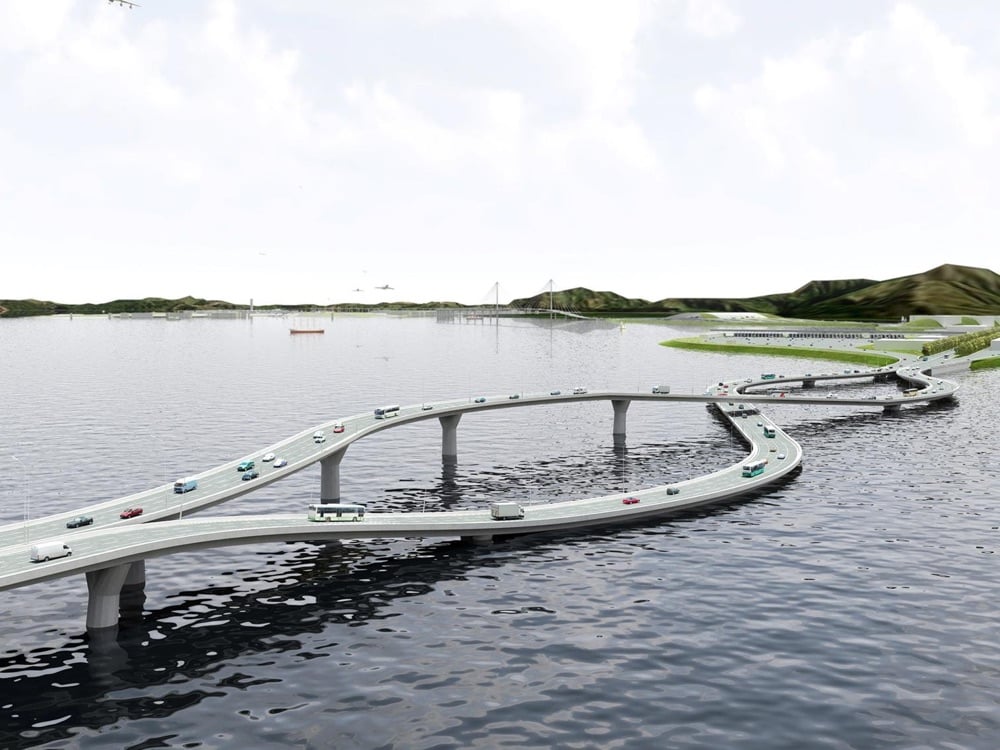
In Hong Kong, cars drive on the left while in the rest of China, they drive on the right. If you’re building a bridge between the two, you’ve got to come up with a clever way to switch lanes without disruption or accident. Behold, the flipper:
The only way that could be more cool is if one of the lanes went into a tunnel under the water or corkscrewed over the other lane in a rollercoaster/Mario Kart fashion. Lots more on the NL Architects site.
Can’t get enough of the Leidenfrost effect? I know! Me either! In addition to helping with nonstick cooking, the L. effect also allows you to stick your hand into an 850° pot of molten lead without injury.
Skip to 1:55 for the good stuff. Bananas! Absolutely bananas! Oh, and this also works for liquid nitrogen as well. (thx, kyle)
Of course, there are trade-offs. Bimbo is not as good as a bolillo. A machine-made tortilla is not anything like a homemade tortilla — it’s not even in the same universe.
Mexican women that I have talked to are very explicit about this trade-off. They know it doesn’t taste as good; they don’t care. Because if they want to have time, if they want to work, if they want to send their kids to school, then taste is less important than having that bit of extra money, and moving into the middle class. They have very self-consciously made this decision. In the last ten years, the number of women working in Mexico has gone up from about thirty-three percent to nearly fifty percent. One reason for that-it’s not the only reason, but it is a very important reason-is that we’ve had a revolution in the processing of maize for tortillas.
This blog post and accompanying videos show you how to preheat your frying pan to the precise temperature at which your food won’t stick. It involves waiting until a small splash of water in the pan forms a single mercury-like ball that floats (literally!) around the pan. Too hot and the water will disperse into smaller balls; too cold and it’ll just boil off instantly.
The water “hovering” over the stainless steel pan like mercury happens due to the phenomenon known as the Leidenfrost effect. You can read more about it on wikipedia, but the basic idea is this: at a certain temperature known as the Leidenfrost point (roughly around 320F for water, but varying with surface and pressure), when the water droplet hits the hot pan, the bottom part of the water vaporizes immediately on contact. The resulting gas actually suspends the water above it and creates a pocket of water vapor that slows further heat transfer between the pan and the water. Thus it evaporates more slowly than it would at lower temperatures. At the proper temperature, a similar effect happens with the food you place in the pan, preventing the food from sticking.
This is possibly the best kitchen tip I’ve ever heard. (thx, jim)
Companies have come to expect employees to take leave irrespective of gender, and not to penalize fathers at promotion time. Women’s paychecks are benefiting and the shift in fathers’ roles is perceived as playing a part in lower divorce rates and increasing joint custody of children.
In perhaps the most striking example of social engineering, a new definition of masculinity is emerging.
“Many men no longer want to be identified just by their jobs,” said Bengt Westerberg, who long opposed quotas but as deputy prime minister phased in a first month of paternity leave in 1995. “Many women now expect their husbands to take at least some time off with the children.”
Birgitta Ohlsson, European affairs minister, put it this way: “Machos with dinosaur values don’t make the top-10 lists of attractive men in women’s magazines anymore.”
A human being! You eventually reach a real live person! Not a robot! They’re made of carbon! They have things like body hair and a pituitary gland! Holy mother of crap this is exciting!
Kayak’s Explore feature is a fantastic tool for flexible vacationers on a budget. You enter your home airport, ticket price range, roughly when you want to travel, and it shows you a map of where you can fly for that much money. You can optionally specific your destination’s average temperature, spoken languages, available activities, and flight time.
His daughter tried to comfort him. “Father, I will keep this pair of pants until I die!” she pledged. He told her the cutting board would be her wedding gift.
“At that moment, I really wanted to kill myself,” he said. He gestured toward the safe-house window and beyond toward nighttime Yanji, brightly lighted and humming with traffic. “It is not like here,” he said. “Here, it is not a big deal to make money. There, it is suffering and suffering; sacrificing and sacrificing.”
He said he lay awake night after night afterward, fixated on the navy track suit his daughter had coveted. She had said it put her thick winter sweater and plain trousers to shame. He had put her off because the cheapest ones were nearly $15. When she brought it up once too often, he had cursed and shouted, “People in this house need to eat first!”
“I cannot describe how terrible I feel that I didn’t buy that for her,” he said, his voice trembling.
Kim Jong-il: putting the dick in dictator since 1994.
Safari 5 supports extensions now…here are some I’ve downloaded so far:
SafariRestore automatically restores your previous browsing session. That Safari still doesn’t do this by default is beyond ridiculous.
YouTube5 converts YouTube videos to their HTML5 video tag equivalents. It says it only works on youtube.com right now, but it works great on the kottke.org as well. (See underwater base jump, e.g.)
NoMoreiTunes stops Safari from opening iTunes when you visit an iTunes Store link. Again, Safari’s default behavior is not optimal here.
In 2005, David Foster Wallace gave the commencement address at Kenyon College. After a transcript of the speech was posted online (the original was taken down…a copy is available here), it became something of a high-brow viral sensation and was eventually packaged into book form.
The original audio recording (i.e. as read by Wallace on the Kenyon podium) has just been released on Audible.com and is also available through iTunes and on Amazon (this is the cheapest option). Note: there is also an audiobook version of the speech read by Wallace’s sister…but I think the original is the best bet. It’s a fantastic speech. (via howling fantods)
Monday for lunch I ate the leftovers, including a bunch of whole pine nuts that had fallen to the bottom of the dish. By Tuesday evening I had a weird taste in the back of my throat, so weird that when I when I woke up during the night, I couldn’t get back to sleep.
The taste was so bad that she doesn’t really feel like eating anything. That got me thinking: the pine nut diet. When you need to drop some pounds, eat a few of the offending pine nuts and boom!, eat as much as you want…as long as you can stand the taste.
Phil Plait of Bad Astronomy takes on Steve Jobs’ claim that iPhone 4’s pixels are too small for the human eye to see individually. I have confidence in Plait’s conclusions:
I know a thing or two about resolution as well, having spent a few years calibrating a camera on board Hubble.
He may as well have pulled Marshall McLuhan out from behind a movie poster.
John Underkoffler was one of the science advisors for Minority Report. After doing that, he helped build a computer with an interface very much like the ones in the movie…you know, where Tom Cruise flings stuff around on a screen with his hands. In this TED talk, Underkoffler demonstrates the system.
The whole thing is worth watching but skip to 5:20 (or even 6:30) if you want to see some crazy ass shit go down. (via lonelysandwich)
When this is rolled out more broadly to users this summer, all links shared on Twitter.com or third-party apps will be wrapped with a t.co URL.
All links? Does that include bit.ly, tinyurl.com, flic.kr, 4sq.com, amzn.to, etc.? I’m obviously happy that they’re taking steps to get these largely unnecessary link middlemen out of the picture but some people are going to be pissed if they’re unshortening all links automatically.
5. Give things names and remember Douglas Adams’ rule of capital letters. Capital letters make things important. For example, in The Tipping Point, Gladwell conjures up the following important concepts: The Law of the Few, The Stickiness Factor, and The Power of Context. In Outliers, there’s The Matthew Effect and The 10,000-Hour Rule.
And totally unrelated but related, here’s an awesome photo of a 14-year-old Gladwell running the 1500 meters. (thx, nick)
But I remember, one week after getting [the New Yorker editor job], in the almost absurd way I got it, I had to go to San Francisco, and I was at dinner and some guy came up to me. He had been in the Midwest and lived in San Francisco and he came up to the table where we were having dinner and grabbed my arm in a way that was slightly alarming and his message to me was, “Don’t fuck this up!”
Frustrated with the carefully chosen photos of Africans “dressed in rags, smothered in flies, with [looks] of desperation” used to symbolize poverty by development organizations, Duncan McNicholl has started a photography project in which he takes two photos of a person: one in a typical poverty pose and the other with the person “looking their very finest”.
The truth is that the development sector, just like any other business, needs revenue to survive. Too frequently, this quest for funding uses these kind of dehumanizing images to draw pity, charity, and eventually donations from a largely unsuspecting public. I found it outrageous that such an incomplete and often inaccurate story was being so widely perpetuated by the organizations on the ground — the very ones with the ability and the responsibility to communicate the realities of rural Africa accurately.
Isn’t that the cutest little thing? The City Car was a concept car with an electric engine designed by Fiat in 1972. I say build the sucker…what a beautiful machine. They could call it the Fiat Squee!!
n. the phenomenon of observing your parents interact with people they grew up with, which reboots their personalities into youth mode, reverting to a time before the last save point, when they were still dreamers and rascals cooling their heels in the wilderness, waiting terrified and eager to meet you for the first time
n. an innocuous touch by someone just doing their job — a barber, yoga instructor or friendly waitress — that you enjoy more than you’d like to admit, a feeling of connection so stupefyingly simple that it cheapens the power of the written word, so that by the year 2025, aspiring novelists would be better off just giving people a hug.
Locals and Tourists is a set of maps showing where people take photos in various cities around the world. The results are broken down into tourist photos and photos taken by locals. Here’s NYC:
Blue points on the map are pictures taken by locals (people who have taken pictures in this city dated over a range of a month or more). Red points are pictures taken by tourists (people who seem to be a local of a different city and who took pictures in this city for less than a month).
Note: If you are a member and tried to log in, it didn't work, and now you're stuck in a neverending login loop of death, try disabling any ad blockers or extensions. Or try logging out and then back in. Still having trouble? Email me!











Socials & More