Atul Gawande branches out from his usual excellent writing on medicine and turns his attention to solitary confinement in America’s prison system. Gawande likens extended solitary time to torture.
This is the dark side of American exceptionalism. With little concern or demurral, we have consigned tens of thousands of our own citizens to conditions that horrified our highest court a century ago. Our willingness to discard these standards for American prisoners made it easy to discard the Geneva Conventions prohibiting similar treatment of foreign prisoners of war, to the detriment of America’s moral stature in the world. In much the same way that a previous generation of Americans countenanced legalized segregation, ours has countenanced legalized torture. And there is no clearer manifestation of this than our routine use of solitary confinement-on our own people, in our own communities, in a supermax prison, for example, that is a thirty-minute drive from my door.
This likely will not change until Americans start to believe that rehabilitation and not punishment is the primary goal of prisons. So, probably never.
According to this interview, Tom Tykwer, director of Run Lola Run and the recent The International, is working on a film version of Dave Eggers’ What Is the What, his semi-biographical novel about Sudanese refugee Valentino Achak Deng. (via crazymonk)
But then a funny thing happened. I kept correcting and correcting, and all of a sudden I had sanitized the font and there was almost no personality left in it. What I was left with might as well have been VAG Rounded. In a very early draft, I had played with the idea of exaggerating the swellings in the strokes from the original sign. Now I resurrected that, and found the true character of the font.
It’s been said that type design is the art of making unequal things appear equal. Noordzij’s theory of the Stroke of the Pen is apparent even in monoweight sans-serifs. Flip Helvetica’s A, V, or W sideways, and you’ll see that the diagonal strokes are slightly unequal. Rotate the O in Futura, which I was always told was a perfect circle, and you’ll see why that’s not true.
One big myth is that fruit juice is a healthy part of our diet. Wrong. Drinking a glass of fruit juice a day — which is the equivalent of one soft drink of 110 to 180 calories — has been linked in the U.S., Australia and Spain to increased calorie intake and higher risks of diabetes and heart disease.
Command-Line-Fu is an archive of the “best UNIX commands on the Web”. The “sort by votes” page is a trove of what the community there thinks are the best commands. (via paul)
After two to three weeks, the team found a small number of “triple tracks” in the plastic — three 8-micrometre-wide pits radiating from a point (see diagram, top right). The team says such a pattern occurs when a high-energy neutron strikes a carbon atom inside the plastic and shatters it into three charged alpha particles that rip through the plastic leaving tracks.
It’ll be interesting to see if this can be replicated and the source of the neutrons verified.
An organization called FIGMENT is building an 18-hole mini golf course on Governors Island and they are accepting design proposals through March 31 from artists, designers, and other would-be mini golf course builders.
The Challenge: Design and construct a single hole for this mini golf course, following the theme “City of Dreams.” Designs will be judged and selected on creativity, structural integrity, playability, feasibility, adherence to theme and budget.
The Nano, the new $2000 car from India’s Tata Motors, goes from 0 to ~60 mph in 23 seconds (and even slower with the A/C on) and has the simplest dashboard I’ve seen on a car. For reference, the Honda Accord goes 0-60 in 6-9 seconds, depending on the model. (via snarkmarket)
Rod McLaren tracked every browser tab he closed for more than a month. The total: 1725 tabs, an average of nearly 50 a day. I would be hesitant to undertake a similar tabulation for fear of learning the answer.
In an article for Scientific American, two scientists who are working on the causes of colony collapse disorder (CCD) say that they and other researchers have made some progress in determining what’s killing all of those bees.
The growing consensus among researchers is that multiple factors such as poor nutrition and exposure to pesticides can interact to weaken colonies and make them susceptible to a virus-mediated collapse. In the case of our experiments in greenhouses, the stress of being confined to a relatively small space could have been enough to make colonies succumb to IAPV and die with CCD-like symptoms.
It’s like AIDS for bees…the lowered immunity doesn’t kill directly but makes the bees more susceptible to other illness. One the techniques researchers used in investigating CDD is metagenomics. Instead of singling out an organism for analysis, they essentially mixed together a bunch of genetic material found in the bees (including any bacteria, virii, parasites, etc.) and sliced it up into small pieces that were individually deciphered. They went through those pieces one by one and assigned them to known organisms until they ran across something unusual.
The CSI-style investigation greatly expanded our general knowledge of honeybees. First, it showed that all samples (CCD and healthy) had eight different bacteria that had been described in two previous studies from other parts of the world. These findings strongly suggest that those bacteria may be symbionts, perhaps serving an essential role in bee biology such as aiding in digestion. We also found two nosema species, two other fungi and several bee viruses. But one bee virus stood out, as it had never been identified in the U.S.: the Israeli acute paralysis virus, or IAPV.
5. “Icelanders are among the most inbred human beings on earth — geneticists often use them for research.”
Now this is insulting. Icelanders’ DNA shows their roots to be a healthy mix between Nordic Y chromosomes and X chromosomes from the British Isles. The reason genetic-research company deCODE uses Icelandic genes for its research is not because the codes are so homogeneous, but because the population has kept excellent genealogical records dating back thousands of years.
I sort of shrugged my shoulders at this stuff when I read the piece and forged ahead for the financial meat and potatoes, but it doesn’t read so well when collected all in one place like this. Was the piece supposed to be a farce? If not, it doesn’t reflect well on Lewis or his editors at VF. (thx, micah)
[Cosmos] covered a wide range of scientific subjects including the origin of life and a perspective of our place in the universe. The series was first broadcast by the Public Broadcasting Service in 1980, and was the most widely watched series in the history of American public television until 1990’s The Civil War. It is still the most widely watched PBS series in the world. It won an Emmy and a Peabody Award and has since been broadcast in more than 60 countries and seen by over 600 million people, according to the Science Channel.
Allonzo Trier is the top-ranked basketball player in his class. As such, he gets flown around the country for games, is provided with shoes and clothes with his own logo on them, and his private school tuition, academic & basketball tutors, and dental care is paid for by a foundation started by a current NBA player.
What accrues to Allonzo because of his basketball exploits leaves Marcie feeling dazzled, bewildered, seduced and wary. “They’re doing nice things for my son, things that he needs and I can’t afford,” she told me. “So how can I say no?” But she knows the reason for the largesse. “If his game falls off, they will kick him to the curb. That’s what makes me nervous, and I don’t want it to happen.”
Oh, BTW, Trier is a sixth-grader. I always get depressed when reading about kids and athletics in the US and this article is no exception.
The Great Zucchini actually does magic tricks, but they are mostly dime-store novelty gags — false thumbs to hide a handkerchief, magic dust that turns water to gel — accompanied by sleight of hand so primitive your average 8-year-old would suss it out in an instant. That’s one reason he has fashioned himself a specialist in ages 2 to 6. He behaves like no adult in these preschoolers’ world, making himself the dimwitted victim of every gag. He thinks a banana is a telephone, and answers it. He can’t find the birthday boy when the birthday boy is standing right behind him. Every kid in the room is smarter than the Great Zucchini; he gives them that power over their anxieties.
He’s also got a gambling problem and can’t keep anything else in his life organized. I know it’s long, but this article is fascinating.
Twin brothers are suspected of stealing millions in jewelry and watches from KaDeWe in Berlin. DNA from the crime scene matches the brothers’ DNA. But their DNA is too similar to match either brother individually so the police have to let them go.
German law stipulates that each criminal must be individually proven guilty. The problem in the case of the O. brothers is that their twin DNA is so similar that neither can be exclusively linked to the evidence using current methods of DNA analysis. So even though both have criminal records and may have committed the heist together, Hassan and Abbas O. have been set free.
This is the tenth installment in an occasional series of updates to recent kottke.org posts. The previous installment was posted last April. I should do this more often.
Several scholars contacted me to say that Dr John Casson’s “discovery” of six new works by William Shakespeare is not really all that notable, the consensus being that Casson is a hack with little credibility among serious researchers. Wikipedia has a good page on the Shakespeare Apocrypha, “a group of plays that have sometimes been attributed to William Shakespeare, but whose attribution is questionable for various reasons”. (thx, jeffrey & nick)
Getting into character discussed how people in different professions (athletics, business, acting) become different people when they are at work. Here are three more examples: Kobe Bryant, Brian Dawkins (as a player, he models himself after the X-men’s Wolverine and speaks in tongues before games…the first five minutes of the video are amazing), and Jonathan Papelbon. See also: The Inner Game of Golf. (thx chris, noah, david, and unlikely words)
Nine years earlier, Reagan’s predecessor Jimmy Carter had stunned his aides when he asked the South Korean dictator Park Chung Hee about his religious beliefs and then told Park, “I would like you to know about Christ.”
If you’re interested in the goings-on in the global economy, kottke.org’s 2008recession tag is shaping up quite nicely.
How should a company like Google approach design? By the numbers?
A designer, Jamie Divine, had picked out a blue that everyone on his team liked. But a product manager tested a different color with users and found they were more likely to click on the toolbar if it was painted a greener shade.
As trivial as color choices might seem, clicks are a key part of Google’s revenue stream, and anything that enhances clicks means more money. Mr. Divine’s team resisted the greener hue, so Ms. Mayer split the difference by choosing a shade halfway between those of the two camps.
Her decision was diplomatic, but it also amounted to relying on her gut rather than research. Since then, she said, she has asked her team to test the 41 gradations between the competing blues to see which ones consumers might prefer.
Without a person at (or near) the helm who thoroughly understands the principles and elements of Design, a company eventually runs out of reasons for design decisions. With every new design decision, critics cry foul. Without conviction, doubt creeps in. Instincts fail. “Is this the right move?” When a company is filled with engineers, it turns to engineering to solve problems. Reduce each decision to a simple logic problem. Remove all subjectivity and just look at the data. Data in your favor? Ok, launch it. Data shows negative effects? Back to the drawing board. And that data eventually becomes a crutch for every decision, paralyzing the company and preventing it from making any daring design decisions.
In many cases, I’d trust a good designer with 10 years of experience over The Numbers™. That 10 years represents an internalization of thousands of instances of The Numbers across a broad range of experience. At other times, the quantitative approach is useful. Part of being an effective designer (or an auto mechanic or an engineer or programmer etc.) is learning to recognize the right mixture of the two approaches.
The Very Hungry Caterpillar was one of my favorite books when I was a kid and I’ve loved reading it to Ollie over the past few months. So of course, Google’s logo today is aces.
The other trouble with originality and inventiveness is that they literally pay off. Provided that you are capable of either, you will become well-off rather fast. Desirable as that may be, most of you know firthand that nobody is as bored as the rich, for money buys time, and time is repetitive. Assuming that you are not heading for poverty, one can expect your being hit by boredom as soon as the first tools of self-gratification become available to you. Thanks to modern technology, those tools are as numerous as boredom’s symptoms. In light of their function — to render you oblivious to the redundancy of time — their abundance is revealing.
Amazon had reviews from the very first day. It’s always been a feature that customers love. (Many non-customers talk about how they check out the reviews on Amazon first, then buy the product someplace else.) Initially, the review system was purely chronological. The designers didn’t account for users entering hundreds or thousands of reviews.
For small numbers, chronology works just fine. However, it quickly becomes unmanageable. (For example, anyone who discovers an established blog may feel they’ve come in at the middle of a conversation, since only the most recent topics are presented first. It seems as if the writer assumed the readers had read everything from the beginning.)
The reviews of reviews are really helpful when buying. Personally, I always check out four types of reviews on Amazon in roughly this order:
1) most helpful/highest rated, 2) most helpful/lowest rated, 3) least helpful/highest rated, 4) least helpful/lowest rated
Sometimes reading a really negative review which many people think is spectacularly wrong can help make a useful buying decision.
This phenomenon is best illustrated by a single design tweak to the Google search results page in 2000 that Mayer calls “The Billion Dollar HTML Tag.” Google founders Sergey Brin and Larry Page asked Mayer to assess the impact of adding a column of text ads in the right-hand column of the results page. Could this design, which at the time required an HTML table, be implemented without the slower page load time often associated with tables?
Mayer consulted the W3C HTML specs and found a tag (the “align=right” table attribute) that would allow the right-hand table to load before the search results, adding a revenue stream that has been critical to Google’s financial success.
A system of sculptures that is constantly on the brink of collapse. My intention was to capture and sustain the exact moment of impending catastrophe and endlessly repeat it.
I do this too, only I use chairs and my own body and frequently tip over and hurt myself. Anything for my art.
Kontopoulos also did something called Conversation Piece, inspired by legendary film editor Walter Murch.
Film editor Walter Murch, who edited many of Francis Ford Copolla’s films, developed a theory about edits while working on The Conversation (1974). He noticed that in many cases, the best place to make a cut was when he blinked. Subsequently, Murch wrote about the human blink as a sort of mental punctuation mark: a signifier of a viewer’s comfort with visual material and therefore, a good place to separate two ideas with a cut.
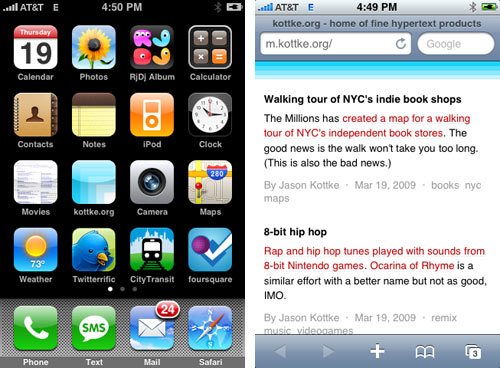
It’s optimized for the iPhone but will work with Blackberrys, etc. as well. Here’s the icon on the iPhone home screen and what it looks like in MobileSafari:
The mobile site is just the front page for now (the last 30 posts or so). Should make reading the site fast and convenient when you’re out and about.
The unique shape of the rock structure helped the Normans trap fish without boats or anything at all. All they had to do was wait for the tide to go out and hundreds of fish would be trapped behind the rocks.
Nets were placed at a narrow exit to catch the fish on their way out. Fish weirs were so effective that overfishing led to a provision in the Magna Carta banning them in rivers.
All fish-weirs shall be removed from the Thames, the Medway, and throughout the whole of England, except on the sea coast.
He added: “What we thought were the first plays by Shakespeare appeared anonymously in the early 1590s. It is inconceivable, however, that his first plays were the massive trilogy of Henry VI. Writers develop over time from simpler beginnings.”
[John] Paulson is a hedge fund manager who has been ridiculously successful betting against banks and other entities that had exposure to the subprime crisis: In 2007, his funds were up $15 billion. In 2008, he didn’t do as well: His main fund rose 38 percent in a year when the S&P 500 fell almost 40 percent. His 2007 earnings were in the neighborhood of $3.7 billion. According to Forbes, while 656 billionaires lost money last year, Paulson was one of the 44 who added to their fortunes.
This is the peculiar thing about financial markets: if you know something bad is going to happen (you know, like the global collapse of the financial markets), you can either sound the alarm and save a lot of people a lot of grief or you can make a billion dollars.
- Only 53% of adults know how long it takes for the Earth to revolve around the Sun. - Only 59% of adults know that the earliest humans and dinosaurs did not live at the same time. - Only 47% of adults can roughly approximate the percent of the Earth’s surface that is covered with water.* - Only 21% of adults answered all three questions correctly.
I bet this got cumulatively 10 seconds of coverage on the major “news” networks, if that. Compare with the endless airtime given to this AIG business and then pull your hair out until you resemble Bruce Willis. (via clusterflock)
Flickr’s developer blog has a pretty interesting post about how they built a fast client-side search that worked equally well for data sets of 10 people and 10000 people. Ajax with XML & JSON was too slow and using dynamic script tags was too insecure so they rolled their own format and used split to quickly parse it.
Drain (1975) MTA and unknown artists Mixed Media on Metal and Concrete
Describing the irresistibility of natural urges, and situated thematically near the restroom, this drainage grate offers deliverance. Consequently, here lies an indeliable yellow nitrogen stain, as evidence of the passings of hundreds, if not thousands of strained commuters. Each straphanger, surreptitiously seeking relief, has helped create this totally organic, revolutionary art piece.
Gwyneth Paltrow runs an online lifestyle site/newsletter called GOOP. It has both been widely panned by snarky news outlets and proved successful at attracting subscribers who would otherwise shy away from such things. (Hello, A & M!)
Anyway, the most recent GOOP newsletter shares DVD rental picks from some of Gwyneth’s friends…you know, Sofia Coppola, Steven Spielberg, Wes Anderson. The inexplicable crush I have on Gwyneth was only strengthened by this bit of her introduction:
I’m not one of those film people who can tell you who the cinematographer was on On The Waterfront or who most influenced Truffaut. When it comes to knowledge of film history, I’m semi-rubbish (a friend of mine once left the dinner table when I admitted I had never seen one of the most famous and most well-regarded films of all time). I can do the whole rap at the end of The Revenge of the Nerds and all of Jeff Spicoli’s dialogue, but sadly, my expertise ends there.
Like I said, inexplicable. If you could only see the fun time she and I are having in my head as we quote memorable Fast Times at Ridgemont High moments to each other. She loves my Spicoli impression!
What We Do is a one-day ad hoc conference being held at RISD on April 11.
On Saturday, April 11th, 100 members of the RISD community (students, faculty, staff, and alums) will share something that they do with the rest of the RISD community and the larger surrounding community of Providence.
Leading up to the day of the event, 8 site-specific “spaces” will be created by members of every department at RISD; majors paired up to encourage cross-departmental collaboration. The spaces that they build will house the day’s events creating a street-fair environment for the open sharing of how people at RISD spend their time and energy.
What we do might include studio work, performance pieces, what you did last summer; anything and everything that RISD does in any manner of presentation.
Announced topics include cartooning, disaster simulations, typography, GPS poetry, and cars that run on vegetable oil. Oh, and the whole thing is free and open to the public.
After using Newsfire for many years, I recently switched to Google Reader for reading RSS feeds. I’m not sold on Reader yet, but I’m going to give it a solid chance. After poking around online and leaning on my Twitter pals (thanks!), I’ve come up with a system that seems to work for me on OS X, at least for extensive testing purposes.
1. Download Fluid. Fluid creates standalone desktop apps out of web pages. After installing, paste in Google Reader’s URL, name the app “Google Reader”, and use a pretty icon (or two). Launch your new app…voila, Google Reader as a standalone app.
2. Install the Helvetireader theme for Google Reader. To do this, go to the Scripts menu in your Google Reader Fluid app (it’s the scroll graphic to the left of the Window menu) and select “New UserScript”. Name your script “helvetireader”. At the prompt, select “Override” and then close that window. From the Script menu, select “Open Userscripts Folder”…this will open the ~/Library/Application Support/Fluid/SSB/Google Reader/Userscripts folder in the Finder. Download the Helvetireader UserScript from the web site and save it over the file of the same name in that Userscripts folder. Go back to the GR Fluid app and select “Reload All Userscripts” from the scripts menu. You should be seeing something that looks like this.
3. Make Google Reader your default RSS reader. In Safari, go to Preferences / RSS / Default RSS Reader, choose “Select…” and find the GR Fluid app in your Applications folder. In Firefox, go to Preferences / Applications, scroll down to Web Feed, choose “Use other…” and find the GR Fluid app in your Applications folder. Now clicking on RSS icons and feeds in these browsers will open an “add this feed” page in the GR Fluid app.
If you don’t want to go the Fluid route, you can also use Reader Notifier to let you set Google Reader as your default RSS reader in Safari.
Vendela Vida, Dave Eggers, Sam Mendes, John Krasinski, Maya Rudolph, Jeff Daniels, Maggie Gyllenhaal, Allison Janney, Catherine O’Hara. Movie. Trailer.
Land sakes, with all the hustle and bustle around here lately, I plumb forgot that Apple had an event today to announce the newest version of the operating system for their interactiveTelePhone. Engadget has the details. The iPhone 3.0 highlights so far:
Embeddable Google Maps within applications.
Same apps of two phones can talk to each other (gaming!).
Turn-by-turn directions available.
Push notifications finally coming. (They retooled after hearing all sorts of feedback from App Store developers.)
Streaming audio and video.
CUT AND PASTE.
MMS support.
Better searching, like in email and calendars.
Hustwit has said that the key to interviewing people is “not to ever interview them,” and, like Errol Morris, he’s pretty damn good at (not) doing it. Nobody hangs themselves here, but they’re presumably given a ton of rope with which to construct bridges between disparate ideas, wrap up gifts, or tie Gordian knots.
Pew Research Center’s interactive maps of migration flows in the US are pretty interesting. The region map makes it seem as though the Northeast is rapidly losing population to the South but the states map clarifies the picture…the flow looks to be hundreds of thousands of retirees moving to Florida and Georgia.
Alcohol Is Dynamite (1958)
Appreciating Our Parents (1950)
Bookkeeping and You (1947)
Case of the Missing Magnets, The (1960)
Destruction: Fun or Dumb? (ca. 1970s)
Food Doesn’t Fly - Lunchroom Manners
Great Annual Bathtub Race (1970)
Nuclear War - A Guide To Armageddon (BBC, 1982)
Shake Hands With Danger (1980)
From Porch to Patio, a 1975 piece by Richard Thomas, discusses the transition in American society from the semi-public gathering place in front of a house to the private space in the back.
When a family member was on the porch it was possible to invite the passerby to stop and come onto the porch for extended conversation. The person on the porch was very much in control of this interaction, as the porch was seen as an extension of the living quarters of the family. Often, a hedge or fence separated the porch from the street or board sidewalk, providing a physical barrier for privacy, yet low enough to permit conversation.
When people started moving out to new buildings in the suburbs, the patio emerged to provide the privacy for these urban refugees.
The patio was an extension of the house, but far less public than the porch. It was easy to greet a stranger from the porch but exceedingly difficult to do so from the backyard patio. While the porch was designed in an era of slow movement, the patio is part of a world which places a premium on speed and ease of access. The father of a nineteenth-century family might stop on the porch on his way into the house, but the suburban man wishes to enter the house as rapidly as possible to accept the shelter that the house provides from the mass of people he may deal with all day.
“There’s nothing balanced here. It’s completely, 100 percent evolution-based,” said DeWitt, a professor of biology. “We come every year, because I don’t hold anything back from the students.”
Creationists, who take their view of natural history straight from the book of Genesis, believe that scientific data can be interpreted to support their idea that God made the first human, Adam, in an essentially modern form 6,000 to 10,000 years ago.
A 2006 poll by the Pew Forum on Religion & Public Life found that 42 percent of Americans believe humans have always existed in their present form. At universities such as Liberty, founded by the late Jerry Falwell, those views inform the entire science curriculum.
A Primer for Kicking Ass
Being the Result of One Man’s Fed-upped-ness With ‘How to Write’ Books Not Actually Showing You How to Write
By James Tanner. Reprinted with permission.
0. Begin with an idea, a string of ideas.
Ex: Mario had help with his movie. He did a lot of the work himself.
1. Use them in a compound sentence:
It’s obvious someone helped with the script, But…Mario did the puppet work, And…It was his shoes on the pedal.
2. Add rhythm with a dependent clause:
It’s obvious someone helped with the script, but Mario did the puppet work, and it was, without question, his shoes on the pedal.
3. Elaborate using a complete sentence as interrupting modifier:
It’s obvious someone helped with the script, but Mario did the puppet work — his arms are perfect for the puppets — and it was, without question, his shoes on the pedal.
4. Append an absolute construction or two:
It’s obvious someone helped with the script, but Mario did the puppet work — his arms are perfect for the puppets — and it was, without question, his shoes on the pedal, the camera mounted on a tripod, mops moved out of frame.
5. Paralell-o-rize your structure (turn one noun into two):
It’s obvious someone helped with the script, but Mario did the choreography and the puppet work — his arms and fingers are perfect for the puppets — and it was, without question, his shoes on the pedal, the camera mounted on a tripod, mops and buckets moved out of frame.
-
STOP HERE IF YOU ARE A MINIMALIST, WRITING COACH, OR JAMES WOOD
-
6. Adjectival phrases: lots of them. (Note: apprx. 50% will include the word ‘little’):
It’s obvious someone helped with the script, but Mario did the choreography and most of the puppet work — his little S-shaped arms and curved fingers are perfect for the standard big-headed political puppets — and it was, without question, his little square shoes on the pedal, the camera mounted on a tripod, mops and dull-gray janitorial buckets moved out of frame.
7. Throw in an adverb or two (never more than one third the number of adjectives):
It’s obvious someone helped with the script, but Mario did the choreography and most of the puppet work personally — his little S-shaped arms and curved fingers are perfect for the standard big-headed political puppets — and it was, without question, his little square shoes on the pedal, the camera mounted on a tripod, mops and dull-gray janitorial buckets carefully moved out of frame.
8. Elaboration — mostly unnecessary. Here you’ll turn nouns phrases into longer noun phrases; verbs phrases into longer verb phrases. This is largely a matter of synonyms and prepositions. Don’t be afraid to be vague! Ideally, these elaborations will contribute to voice — for example, ‘had a hand in’ is longer than ‘helped’, but still kinda voice-y — but that’s just gravy. The goal here is word count.
It’s obvious someone else had a hand in the screenplay, but Mario did the choreography and most of the puppet-work personally — his little S-shaped arms and curved fingers are perfect for the forward curve from body to snout of a standard big-headed political puppet — and it was, without question, Mario’s little square shoes on the pedal, the camera mounted on a tripod across the over lit closet, mops and dull-gray janitorial buckets carefully moved out past the frame’s borders on either side of the little velvet stage.
-
STOP HERE IF YOU ARE NOT WRITING PARODY
-
9. Give it that Wallace shine. Replace common words with their oddly specific, scientific-y counterparts. (Ex: ‘curved fingers’ into ‘falcate digits’). If you can turn a noun into a brand name, do it. (Ex: ‘shoes’ into ‘Hush Puppies,’ ‘camera’ into ‘Bolex’). Finally, go crazy with the possessives. Who wants a tripod when they could have a ‘tunnel’s locked lab’s tripod’? Ahem:
It’s obvious someone else had a hand in the screenplay, but Mario did the choreography and most of the puppet-work personally — his little S-shaped arms and falcate digits are perfect for the forward curve from body to snout of a standard big-headed political puppet — and it was, without question, Mario’s little square Hush Puppies on the H^4’s operant foot-treadle, the Bolex itself mounted on one of the tunnel’s locked lab’s Husky-VI TL tripods across the over lit closet, mops and dull-gray janitorial buckets carefully moved out past the frame’s borders on either side of the little velvet stage.
10. Practice. Take one sentence — any sentence — and Wallacize it. Turn ten boring words into a hundred good ones.
Ex: “John wanted to play ball, but he sat on the couch.”
Or did John _________________________________ ?
[Ed note: I saw this on a mailing list a few weeks ago, really liked it, and asked permission to reprint it here. Thanks for sharing, James.]
Note: If you are a member and tried to log in, it didn't work, and now you're stuck in a neverending login loop of death, try disabling any ad blockers or extensions. Or try logging out and then back in. Still having trouble? Email me!










Socials & More