kottke.org posts about Instagram
“Like many amateur photographers, I do occasionally experiment with editing.” Well, I can’t resist the kerfuffle around what’s going on with Princess Catherine. Yesterday she posted a photo of herself with her family that turned out to have been edited, and today she apologized for “any confusion” it might have caused. (Shared presumably in part to dispel rumors about her health and whereabouts, the photo “fans [those rumors] instead,” per the NY Times.)
Last week, Nieman Lab ran a story on how unusual the Palace’s response to gossip surrounding the situation has been. And if you really want to get into the weeds, Nieman Lab’s editor-in-chief Laura Hazard Owen also just linked to a three-minute TikTok video proposing that the original Instagram photo was actually taken last November.
See also Hilary Mantel’s 2013 essay in the London Review of Books: “I wanted to apologise. I wanted to say: it’s nothing personal, it’s monarchy I’m staring at.”
Over the summer, members of the QAnon cult started to take over the “Save the Children” movement on Instagram & Facebook, eventually luring lifestyle influencers into spreading the cult’s message. From the NY Times:
But new research suggests that the biggest jolt to QAnon came from the so-called “Save the Children” movement. It started out as a fund-raising campaign for a legitimate anti-trafficking charity, but was then hijacked by QAnon believers, who used the movement to spread false and exaggerated claims about a global child-trafficking conspiracy led by top Democrats and Hollywood elites. This hijacking began in July, around the same time that Twitter and Facebook began cracking down on QAnon accounts.
What happened is QAnon folks started mass-faving posts about Save the Children and trafficking, so influencers began posting more content related to those topics, using bogus statistics and QAnon talking points. As the video from Vox above explains, child sex trafficking is a legitimate issue but QAnon’s claims about it — and the Instagram-aesthetic memes it has spawned — do not reflect reality. From Michael Hobbes at Huffington Post:
First of all, decades of social science research has found that the vast majority of children are abused by someone they know, usually their parents but sometimes other children or figures of authority they trust. “Stranger danger” kidnappings, on the other hand, are extremely rare — the latest estimate is 115 per year in the entire United States.
Second, the summer-long panic about missing children is almost entirely based on faulty statistics. Though it’s true that more than 400,000 children are reported missing each year, that is not even close to the number who disappear. The vast majority of these reports are misunderstandings or runaways. Roughly 10% are kidnapped by a parent as part of a custody dispute. Over 99% return home, most within a few days.
I’m not so surprised that this chimpanzee can navigate Instagram — chimps are quite clever tool users — I’m more interested in what this says about social media and smartphones.
These things have such a grip on us because they appeal to our prehistoric primal urges, which are ancient and deep within our animal makeup. With our phones’ touchscreen gestures, we can directly manipulate objects as we would in the real world (more so than with a keyboard and mouse) — chimps and human toddlers can easily use the interface as they would any other tool. And social media satisfies requirements further down towards the base of the pyramid of Maslow’s Hierarchy of Needs than we would often like to believe, sometimes to the detriment of our esteem and self-actualization.
I know this probably isn’t brand new, but in the past couple of weeks I’ve noticed a few articles published by big media companies that are influenced by the design of Snapchat and Instagram Stories. Just to be clear, these aren’t published on Instagram (that’s been going on for years); they are published on media sites but are designed to look and work like Instagram Stories. The first one I noticed was this NY Times piece on Guantanamo Bay.
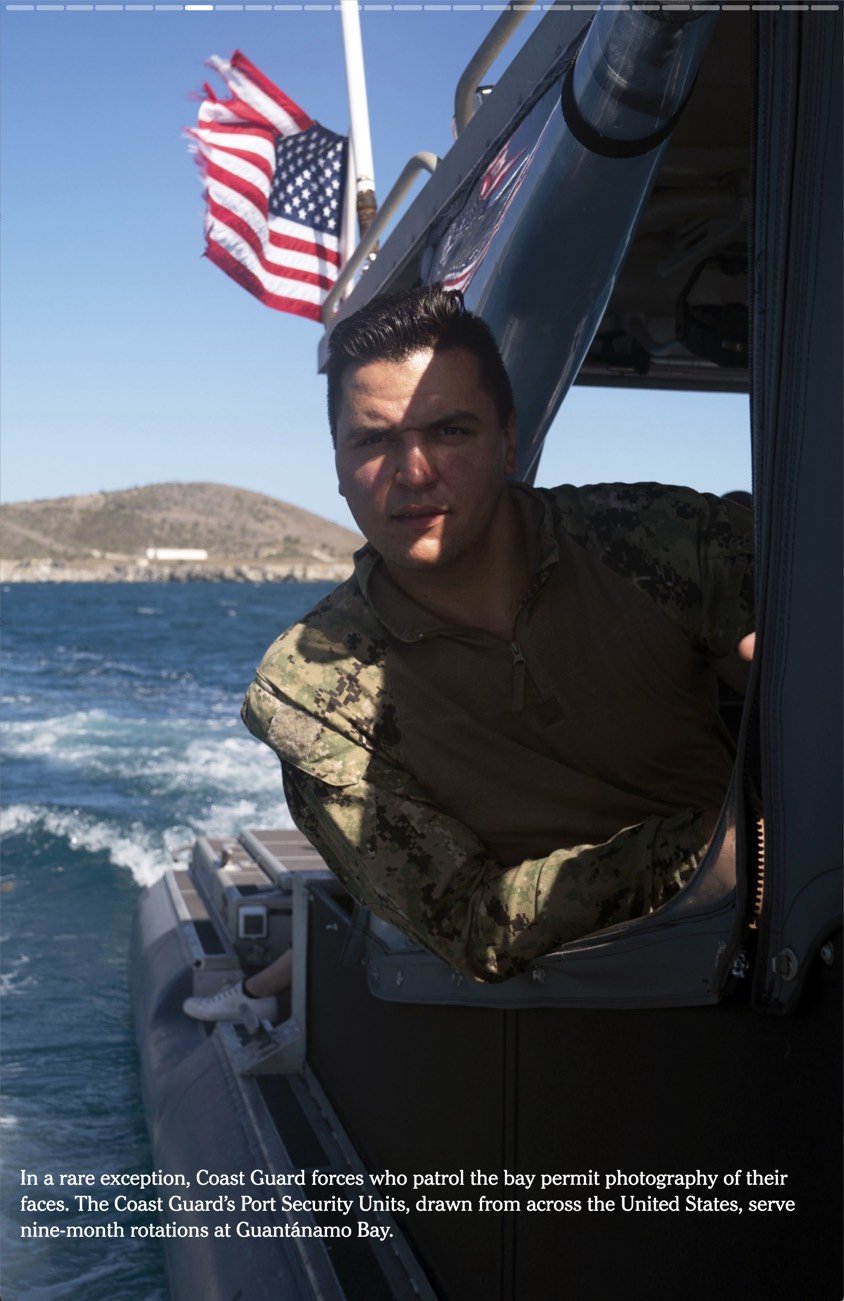
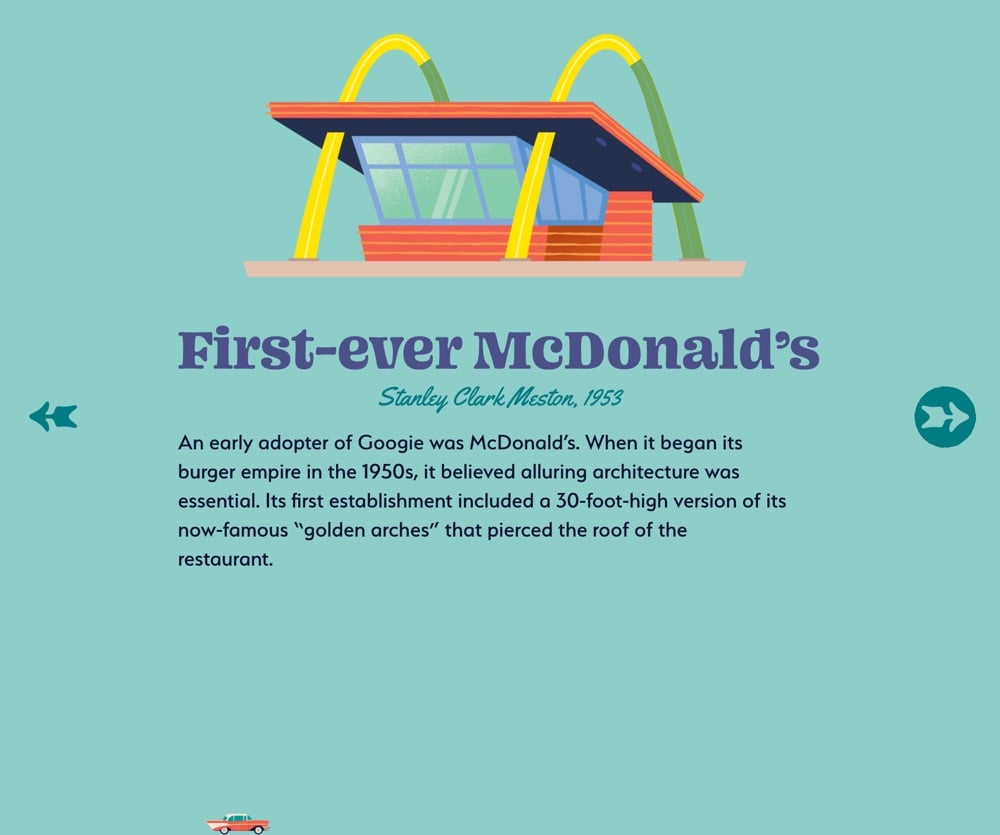
You can see the Instagram-style progress meter at the top. And then there’s Curbed’s The Ultimate Guide to Googie, where the progress meter is indicated more playfully by the little car at the bottom (it even switches directions based on whether you’re paging forward or back through the story). Curbed EIC Kelsey Keith says it was built using “Vox Media’s new custom storytelling kit tool”.
The third piece I can’t find again — I think it was a WSJ or Washington post article — but it too was influenced by the Stories format.
It’s a good move for these companies. Snap & Instagram have worked hard to pioneer and promote this format, it’s perfectly designed for mobile, and people (especially younger folks) know how to use it. Nominally, these articles are just slideshows, a format that online media companies have been using forever. But I’d argue there are some important differentiators that point to the clear influence of Instagram and to this being a newish trend:
1. The presentation is edge to edge with full-frame photos and auto-playing videos.
2. There’s no “chrome” as there would be around a slideshow and minimal indication of controls.
3. They read best on mobile devices in portrait mode.
4. The display of progress meters.
5. Navigation by swiping or tapping on the far left or right sides of the screen, especially on mobile.
Have you seen any other examples of media companies borrowing the Stories design from Instagram?
Update: Various media outlets are using Google’s AMP Stories to make these. You can see examples on CNN, the Atlantic, and Wired.
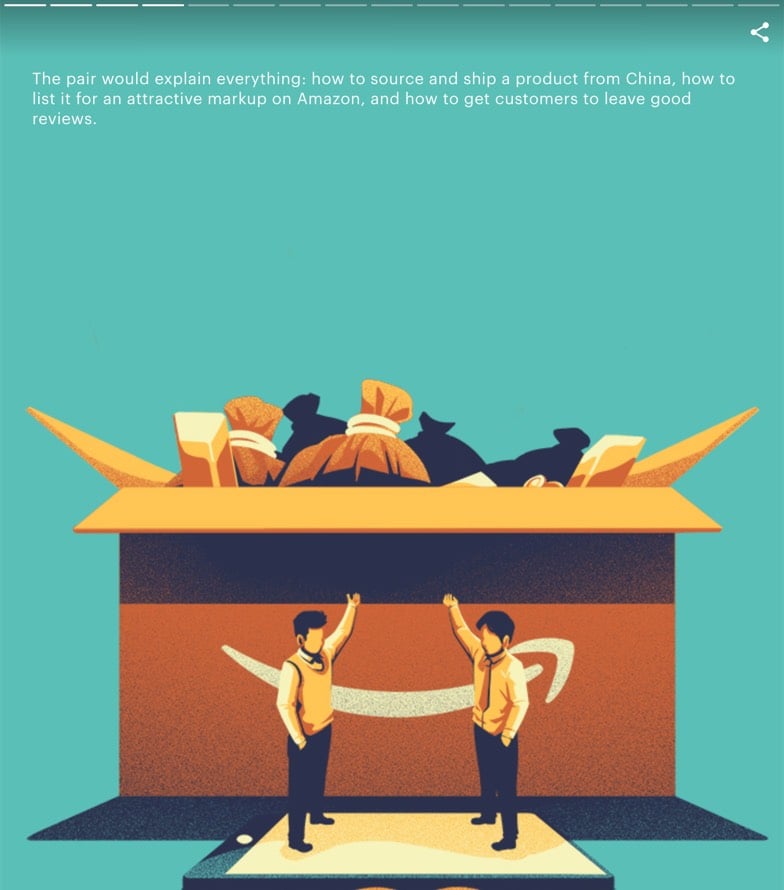
This is likely what my mystery third story was built with. (via @adamvanlente)
Every time there’s a new social media app or network that breaks out, someone writes an article about how this new network encourages people to be themselves and have fun without all of the heaviness of other platforms. The latest example of this is Kevin Roose’s NY Times piece about TikTok.
TikTok has none of that. Instead, it’s that rarest of internet creatures: a place where people can let down their guards, act silly with their friends and sample the fruits of human creativity without being barraged by abusive trolls or algorithmically amplified misinformation. It’s a throwback to a time before the commercialization of internet influence, when web culture consisted mainly of harmless weirdos trying to make each other laugh.
In 2016, Jenna Wortham wrote this about Snapchat for the NY Times:
Its entire aesthetic flies in the face of how most people behave on Facebook, Instagram and Twitter — as if we’re waiting to be plucked from obscurity by a talent agent or model scout. But Snapchat isn’t the place where you go to be pretty. It’s the place where you go to be yourself, and that is made easy thanks to the app’s inbuilt ephemerality.
In 2013, Mat Honan wrote this about Vine:
It built a ground up culture that feels loose, informal, and — frankly — really fucking weird. Moreover, most of what you see there feels very of-the-moment. Sure, there’s plenty of artistry that goes into making six second loops, and there are volumes of videos with high production values. But far more common are Vines that serve as windows into what people are doing right now.
Implicit in these pieces is the idea that there’s something intrinsic to these apps/networks that makes them hew closer to real life and/or lightheartedness than older and bigger platforms…the ephemerality of Snapchat, the ease of shooting a Vine video, the fun filters and templates of TikTok. Some part of that is surely true, but what if being small and new is the thing that makes these networks fun? As I wrote in response to Wortham’s article a couple of years ago:
Blogs, Flickr, Twitter, Vine, and Instagram all started off as places to be yourself, but as they became more mainstream and their communities developed behavioral norms, the output became more crafted and refined. Users flooded in and optimized for what worked best on each platform. Blogs became more newsy and less personal, Flickr shifted toward professional-style photography, Vine got funnier, and Twitter’s users turned toward carefully crafted cultural commentary and link sharing. Editing worked its way in between the making and sharing steps.
TikTok probably feels a lot like Flickr or Twitter in the early days, where everyone is exploring and the users are all kind of doing the same things with it. As networks get bigger, they reach a point where there isn’t just one big group exploring the same space together. Instead, you have many big groups who have different goals and desires that all need to fit under one roof (essentially, politics becomes necessary)…and that can get messy, particularly when the companies running these apps want to appeal to the widest possible audience for capitalization purposes.
Novelty is probably the biggest factor though. TikTok is fun because it’s new. When you join up, you get new superpowers and flexing those abilities gives the old brain a shot of dopamine, particularly when the flexing is social. Later, when many of the social possibilities have been explored and even exploited, fun becomes harder to come by. Even Twitter can still be fun — see the replies to Wortham’s recent tweet about fave NYC moments — but the templates for interaction on the platform have long since been set in stone. It would be very surprising if a large & mature social network came along that didn’t also get less fun and “real” as it developed. That would be a special achievement.
Kevin Systrom and Mike Krieger, the two co-founders of Instagram, have resigned from Facebook.
Mr. Systrom, Instagram’s chief executive, and Mr. Krieger, the chief technical officer, notified Instagram’s leadership team and Facebook on Monday of their decision to leave, said people with direct knowledge of the matter, who spoke on condition of anonymity because they were not authorized to discuss the matter publicly.
In a press release, the pair explained their decision a little:
We’re planning on taking some time off to explore our curiosity and creativity again. Building new things requires that we step back, understand what inspires us and match that with what the world needs; that’s what we plan to do.
Facebook released a statement from CEO Mark Zuckerberg on Twitter (for some weird reason):
Kevin and Mike are extraordinary product leaders and Instagram reflects their combined creative talents. I’ve learned a lot working with them for the past six years and have really enjoyed it. I wish them all the best and I’m looking forward to seeing what they build next.
Sarah Frier’s piece at Bloomberg suggests the pair left because Zuckerberg and the mothership were meddling more and more with Instagram:
Kevin Systrom and Mike Krieger, who have been at the company since Instagram’s acquisition by Facebook in 2012, had been able to keep the brand and product independent while relying on Facebook’s infrastructure and resources to grow. Lately, they were frustrated with an uptick in day-to-day involvement by Zuckerberg, who has become more reliant on Instagram in planning for Facebook’s future, said the people, who asked not to be identified sharing internal details.
Without the founders around, Instagram is likely to become more tightly integrated with Facebook, making it more of a product division within the larger company than an independent operation, the people said.
For years, Systrom and Krieger were able to amicably resist certain Facebook product initiatives that they felt went against their vision, while leaning on Facebook for resources, infrastructure and engineering talent. A new leader may not be able to keep the same balance, or may be more willing to make changes that help the overall company at the expense of some of Instagram’s unique qualities.
Instagram is my favorite app by a mile — it eclipsed Twitter some time ago in that category — and might be the best mobile-native app ever. It is also, I believe, the future of Facebook Inc., a better product with a more favorable trajectory than the sprawling (and now heavily tainted) main FB service. I think Facebook would be doing Instagram and its users a real disservice if they folded it into the mothership instead of giving Instagram room to be the best service it can be on its own terms. This is a strangely conservative move on Zuckerberg’s part, an optimization where a higher degree of freedom and experimentation is called for. I guess we’ll see how this plays out.
Update: Ben Thompson at Stratechery has a keen take on why the Instagram founders left: ultimately, Mark Zuckerberg is the CEO of Instagram and has been since the acquisition.
This is the context for whatever dispute drove Systrom and Krieger’s resignation: not only do they not actually control their own company (because they don’t control monetization), they also aren’t essential to solving the biggest issue facing their product. Instagram Stories monetization is ultimately Facebook’s problem, and in case it wasn’t clear before, it is now obvious that Facebook will provide the solution.
My take is still that FB shouldn’t lean so heavily on Instagram for monetization. Even after many years, the service still has some growth and evolving to do to develop into the heir apparent Zuckerberg & his executive team is looking for. (thx, david)
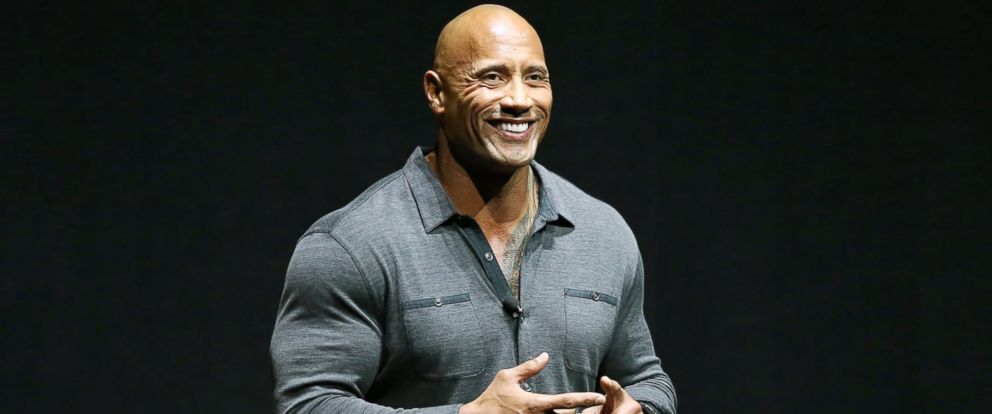
My friend, the novelist/fabulist/media inventor Robin Sloan, has a charming new short story that imagines how Dwayne “The Rock” Johnson will become President, first by playing the role in an imaginary movie. Along the way, there are some poignant thoughts about the nature of our political imaginations, the role of new media like Instagram in shaping public perception, and the ways leadership can, spell-like, be brought into being.
Here is the meager gift tucked into the disaster that is Donald Trump: now, anyone can be elected president, so anyone will be elected president. We might never have another lawyer in that office again. Donald Trump broke the seal, but Dwayne Johnson will fulfill the prophecy.
Can you imagine him on the debate stage? The way he’ll look alongside his opponents in the primary? A line of normal, rumpled humans, and then this towering figure. A political revolution: his suit will fit.
If he runs, he will win, and he will run, so the question isn’t, will Dwayne Johnson be president; rather, it’s: what kind of president will Dwayne Johnson be?
“Give me the place to stand, and I shall move the earth,” said Archimedes, maybe. With this book, we’ll set our feet and push.
The story and its narrator are so cynical and idealistic at once that it’s hard to characterize. Wasn’t the Emma Lazarus poem “The New Colossus” a self-invention of sorts? the story’s narrator asks. Couldn’t a new myth, a new colossus, reanimate that central idea, that openness to all peoples and possibilities, again?
The fact that on the one hand, America is “a nation of Presidents,” creating its own institutions, rules, and leaders, and a nation that could swoon for The Scorpion King because his Instagram videos are just so damned good, just illustrates one of hundreds of central contradictions about this place.
Are those contradictions hindrances to us? Do they fuel us? Or are they just unavoidable, constituent elements to the place and its peoples?
I don’t know. But I’m glad this story is poking those contradictions with a stick.
Insta Repeat collects photos of people (particularly so-called “influencers”) taking similar photos on Instagram — peeking out of an open tent flap, perched on top of an offroad vehicle, on the end of a dock — and displays them together.
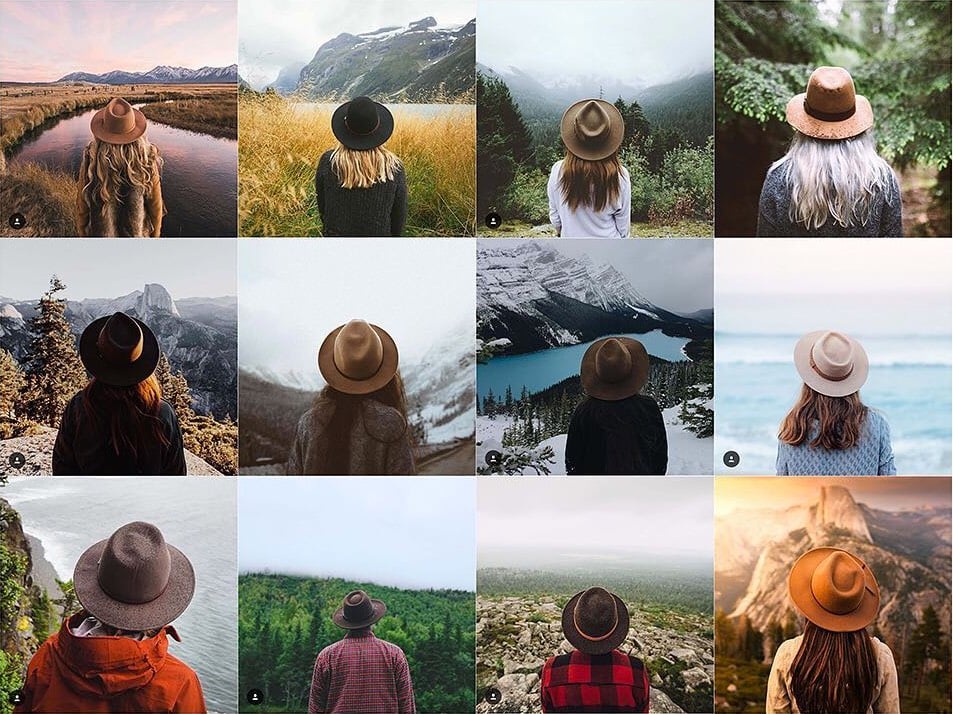
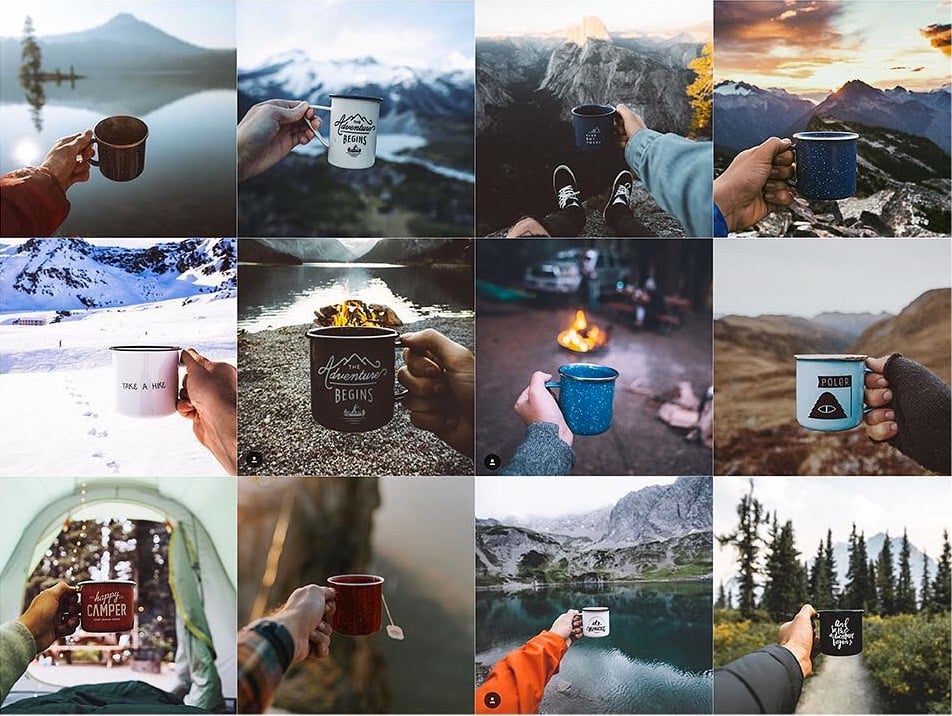
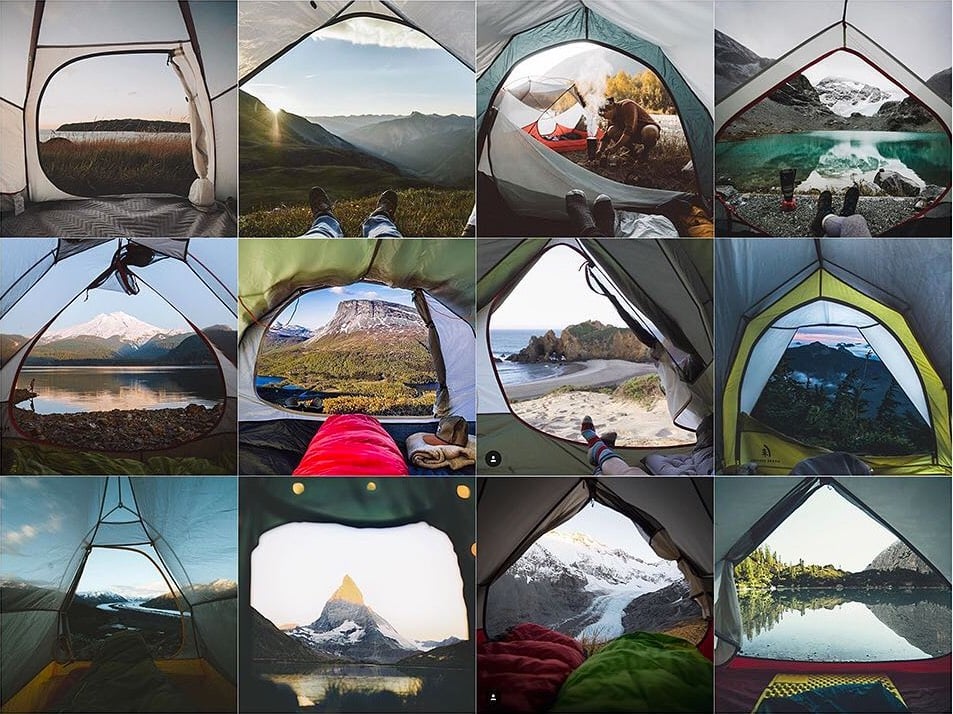
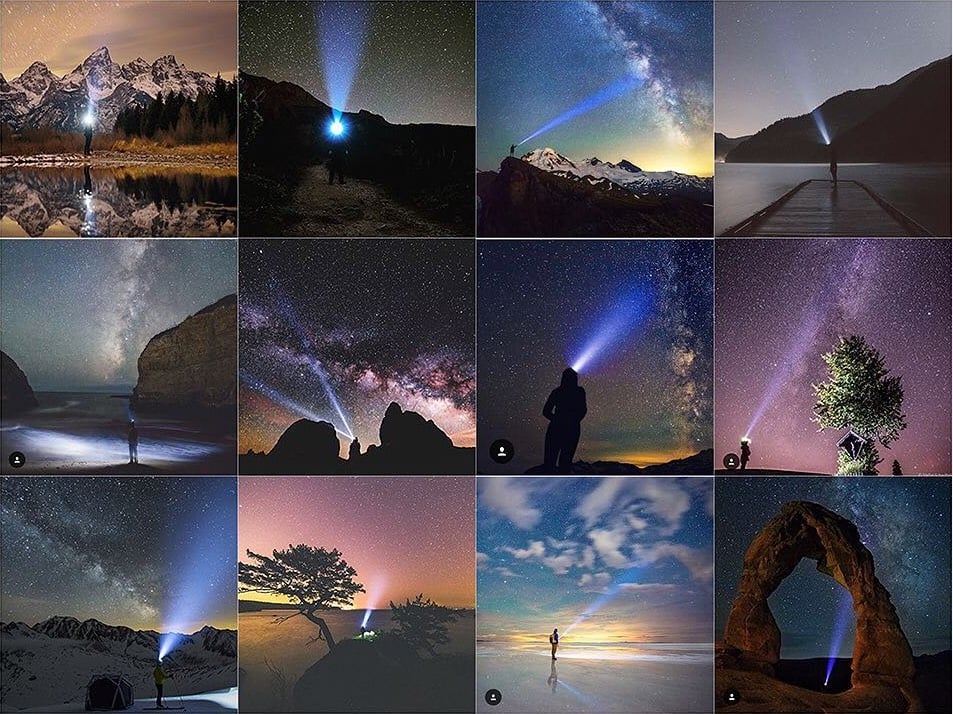
See also this supercut of cliched Instagram travel photos.
Taking a photo of a friend holding up the Leaning Tower of Pisa or jumping in the middle of the road in Utah are really good ideas — that’s why lots of people do it — but each successive photo of the same thing doesn’t tell us anything new about those places, experiences, or people.
For influencers, a cliched photo is easy money, a tried and true way of capturing what others already know is the essence of a place or an experience. For most of the rest of us, we aren’t looking to say anything new about someone or somewhere. We just want to capture our experience to show our friends and well-wishers on Instagram. If I saw my tent flap hanging open to a beautiful mountain vista, of course I would take the hell out of that photo.

People at The Verge have taken the time to attend Facebook’s F8 and selected the five biggest announcements. Like more Instagram stories, a cheap Oculus Go headset (according to Fowler at the WashPo, it’s the one VR gadget you might buy), and Facebook dating.
Facebook will soon offer a dating feature that allows people to browse potential matches at inside groups or events you’re interested in attending. The feature will allow people to message each other using only their first names, and start conversations that are separate from the core Facebook or Messenger app.
I’m sure there will be no unintended consequences at all, since Facebook is always so reliably cautious about people and not breaking anything. Right?
By the way, not unexpectedly, Facebook is using our Instagram pictures to train AIs.
[U]sing Instagram images that are already labeled by way of hashtags, Facebook was able to collect relevant data and use it to train its computer vision and object recognition models. “We’ve produced state-of-the-art results that are one to two percent better than any other system on the ImageNet benchmark.”
WhatsApp will also be getting some minor updates like group video calls and stickers, while CEO Jan Koum is heading out to collect rare air-cooled Porsches, work on his cars and play ultimate frisbee.
The only announcement I’m truly interested in wasn’t mentioned in the piece though; the “Clear history” functionality. Zuck posted about it himself.
In your web browser, you have a simple way to clear your cookies and history. The idea is a lot of sites need cookies to work, but you should still be able to flush your history whenever you want. We’re building a version of this for Facebook too. It will be a simple control to clear your browsing history on Facebook — what you’ve clicked on, websites you’ve visited, and so on.
If you’re back east enjoying a snow day today, might I recommend cozying up with the brilliant Ingrid Goes West? Documentary of the year 2017, IMHO.
(Yes, that is Ice Cube, Jr.)
Call it a 21st century problem. If you’re dating someone, or interested in dating someone, and you follow that person on social media, how far and how deep into their content well do you have to go to signal your affection?
“Many millennial and Gen Z men aren’t outwardly affectionate, so we’re forced to discern the interest level and emotion behind a like or a view,” said Kristin in Los Angeles. “If I’m dating or interested in a guy, I pay close attention to their views of my Instagram Story to gauge their interest.”
“A guy I’m casually seeing right now doesn’t use social media and rarely texts, and it’s entirely thrown off my game,” she added. “It’s like, how do I know if you like me? It’s some Black Mirror millennial courting bullshit.”
It’s complicated, because the gaps in different people’s typical behavior is so different. If both partners are equally invested in social media, they can establish a certain baseline of behavior. Then you can account for deviations. But I’m not sure whether flirting/courtship levels of faving are sustainable or even desirable.
I guess with this as in all things, it’s probably best to talk it out. If you’re taking a holiday from Instagram so you can focus on work for a week, tell your partner. Else he or she might take it as an insult. If you’ve done something that looks like flirting with another person, get ahead of that. Because your partner is watching. I’m more interested in the nuances and conversations that result than the hard-and-fast rules, but it’s definitely A Thing worth some attention.
Now that leisure travel is widely accesible, the internet connects everyone, and most people have connected cameras on them 24/7, one of the side effects is that everyone’s vacation snaps look pretty much the same. Oliver KMIA collected hundreds of travel photos from Instagram, grouped them together by subject — passport shot, Mona Lisa, side mirror selfie, Leaning Tower, ramen bowl — and assembled them into this two-minute video of our collective homogenized travel experience. And it’s not just travel…vast swaths of Instagram are just variations on a theme:
Of course, my Instagram feed has no such cliches… *ahem*. (via @choitotheworld)
Update: In his book How Proust Can Change Your Life, Alain De Botton talks about the difficulty with cliches.
We may ask why Proust objected to phrases that had been used too often. After all, doesn’t the moon shine discreetly? Don’t sunsets look as if they were on fire? Aren’t clichés just good ideas that have been proved rightly popular?
The problem with clichés is not that they contain false ideas, but rather that they are superficial articulations of very good ones. The sun is often on fire at sunset and the moon discreet, but if we keep saying this every time we encounter a sun or moon, we will end up believing that this is the last rather than the first word to be said on the subject. Clichés are detrimental insofar as they inspire us to believe that they adequately describe a situation while merely grazing its surface. And if this matters, it is because the way we speak is ultimately linked to the way we feel, because how we describe the world must at some level reflect how we first experience it.
In other words, taking a photo of a friend holding up the Leaning Tower of Pisa or jumping in the middle of the road in Utah are really good ideas — that’s why lots of people do it — but each successive photo of the same thing doesn’t tell us anything new about those places, experiences, or people. (via mark larson)
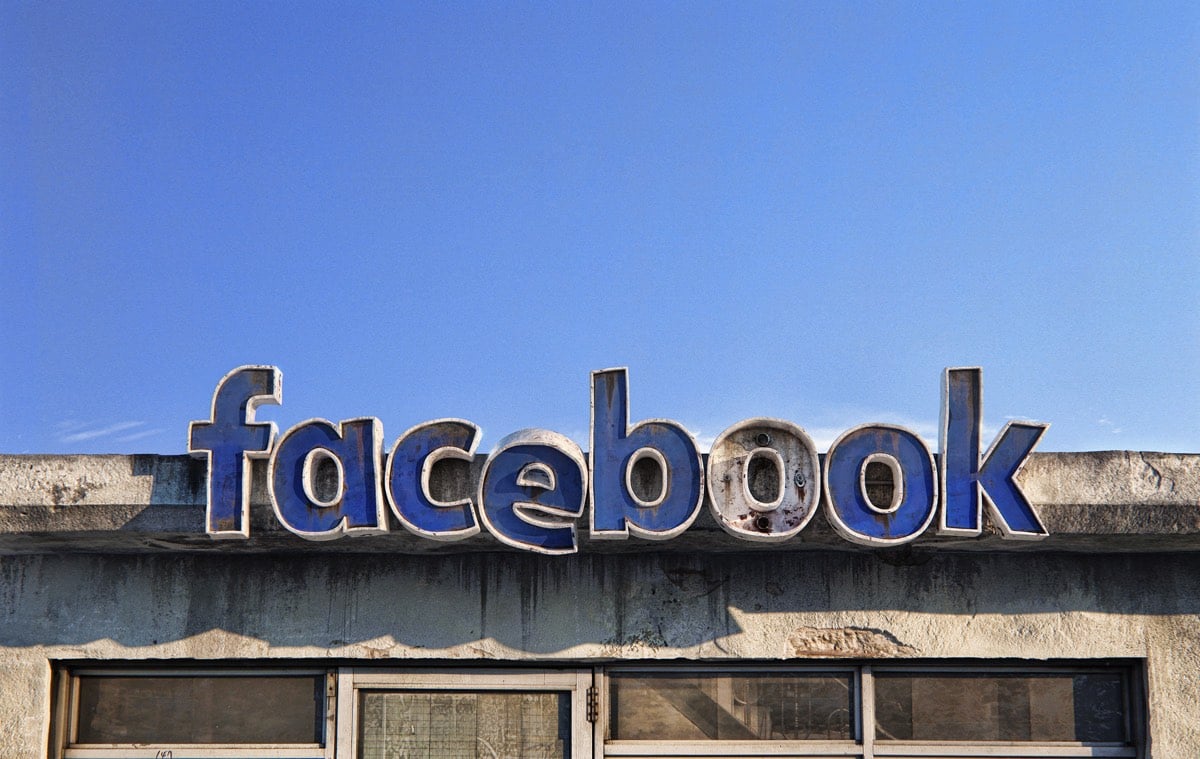
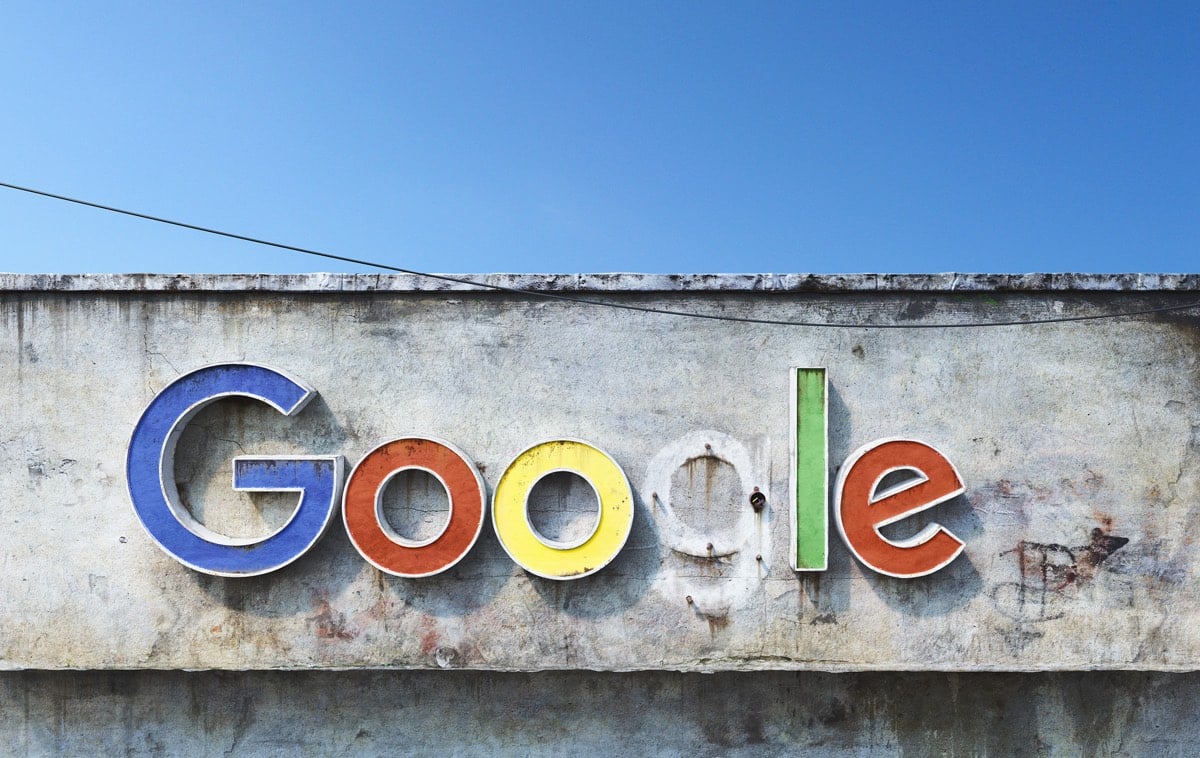
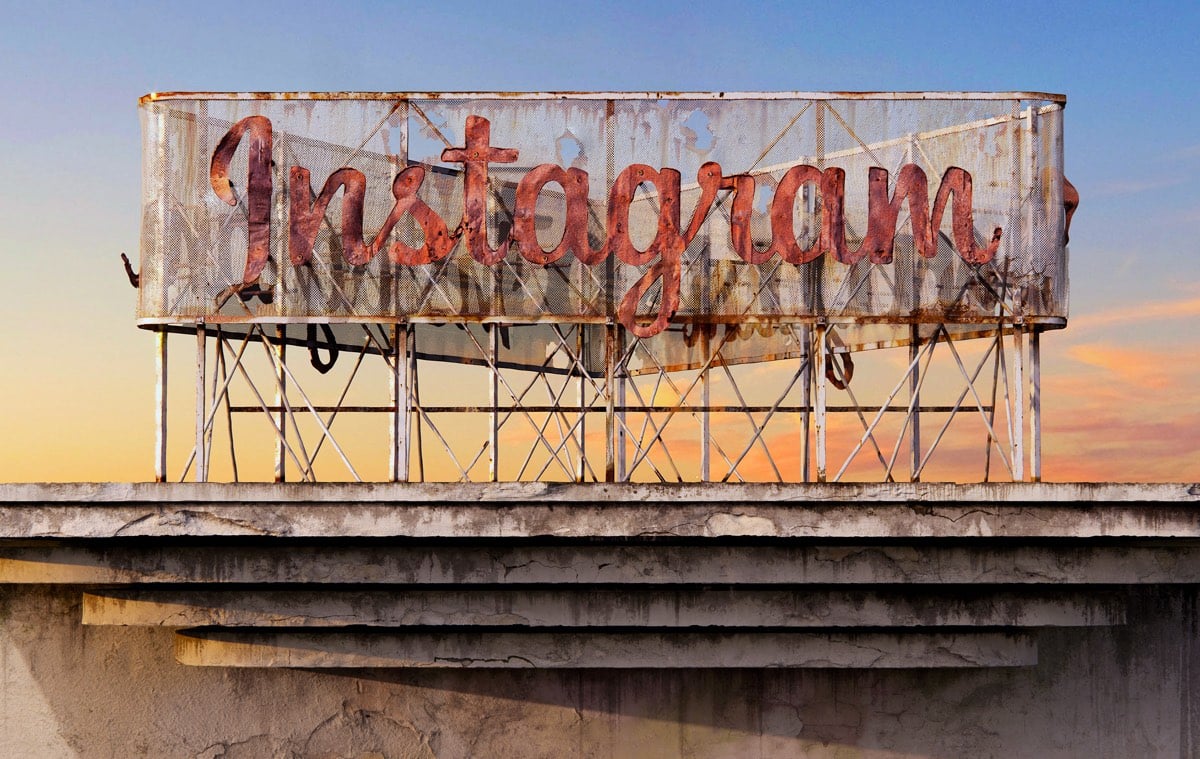
For a project called Social Decay, Andrei Lacatusu imagines what it would look like if big social media companies were brick & mortar and went the way of Blockbuster, Woolworth’s, and strip malls across America. These are really well done…check out the close-up views on Behance.
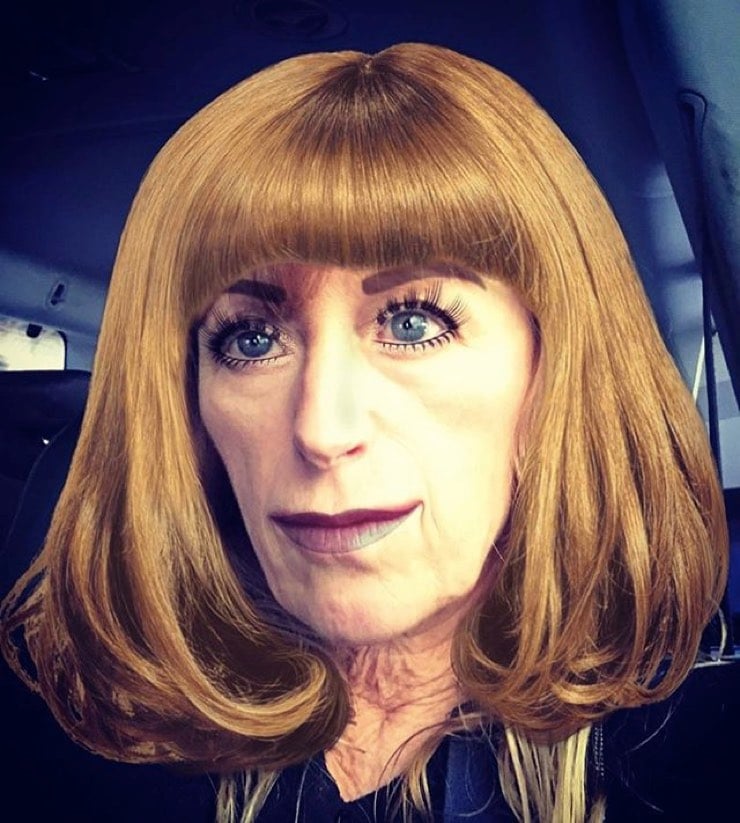
Artist Cindy Sherman has had a private Instagram account for some time but suddenly made it public the other day. Scrolling back through the archives, it becomes apparent that Sherman has been playing around with new techniques for altering her appearance, constructing an online exhibition of sorts in the process.
For an artist whose practice is based almost entirely on how she presents herself, Sherman has managed to remain camera-shy in her life outside of the studio. Yet, in a surprising move, the photographer has recently taken to Instagram to share images of herself that echo photographs typically reserved for gallery walls. Not only does this provide a generous look into her process for her fans, it also raises the question: Is Cindy Sherman using Instagram to make new work?
Last week (approx. May 7-14), I stopped using social media for an entire week. I logged out of all the sites and deleted the apps from my phone. I didn’t so much as peek at Instagram, which is, with Twitter and old-school Flickr, probably my favorite online service of all time. I used Twitter as minimally as I could, for work only.1 I didn’t check in anywhere on Swarm. No Facebook. As much as I could, I didn’t use my phone. I left it at home when I went to the grocery store. I didn’t play any games on it. I left it across the room when I went to bed and when I worked.
Many people have given up social media and written about it — the digital equivalent of the “Why I’m Leaving New York” essay — but since I didn’t write about leaving New York, I’m going to do this instead.
I used to be very good about using my phone and social media appropriately. More than a decade of working on kottke.org taught me how to not be online when I wasn’t working (for the most part). I tried super hard not to use my phone at all around my kids and if I was out with friends, my phone stayed in my pocket.2
Almost a year ago, after 13+ years in the city, I moved from lower Manhattan3 to rural Vermont. It’s beautiful here. I live in a house in the country surrounded by horse pasture and there’s great skiing in the winter. The nearest town is only five minutes away by car; it has a two-screen movie theater, a handful of restaurants (none of which are typically open after 10pm), two grocery stores, but nowhere to get a proper donut, sushi, or bowl of ramen. (The nearest ramen is an hour’s drive away.) While I was writing this post yesterday afternoon, the power in my house went out and didn’t come back on for three hours, forcing a delay in publication. It’s been difficult to meet people. Folks here are nice, but they mostly remind me of the people in the small town I grew up in (aka why I moved to the city in the first place). I work from home at a desk in my bedroom and some days, the only beings I’ll talk to are Siri, my landlord’s horses, and some days, my kids and their mom.
Social media, mostly through my phone, has been an important way for me to stay connected with friends and goings on in the wider world. But lately I’d noticed an obsessiveness, an addiction really, that I didn’t like once I became fully aware of it. When I wasn’t working, I was on my phone, refreshing Instagram, Twitter, and Facebook repeatedly in an endless series, like a little old lady at Caesar’s Palace working several slot machines at the same time. And I couldn’t stop it — my phone was in my hand even when I was trying to concentrate on my kids, watching a movie, or reading a book. So, I quit for a week to see what would happen. It’s not a super-long time period, but here’s what I noticed:
- Once I’d set my mind to it, it was pretty easy to go cold turkey. Perhaps my Twitter usage and keeping up with the news for kottke.org acted as a nicotine patch, but I don’t think so. Instagram was the toughest to stay away from, but I didn’t crack once.
- As the week went on, it was more and more evident that it wasn’t so much social media as the phone that was the problem. Even now, a few days after the conclusion of my experiment, I’m leaving my phone at home when I go out or across the room when I’m doing something. I’m going to try hard to keep this up.
- Buuuut, when you have kids, there is no such thing as giving up your phone. There’s always the potential call from their school or their mom or their doctor or another parent regarding a playdate or or or. I spend enough time online at my computer for work that I could mostly do without my phone, but with kids, that’s not really an option.
- Not a single person noticed that I had stopped using social media. (Not enough to tell me anyway.) Perhaps if it had been two weeks? For me, this reinforced that social media is actually not a good way to “stay connected with friends”. Social media aggregates interactions between loved ones so that you get industrialized communication rather than personal connection. No one really notices if a particular person goes missing because they’re just one interchangeable node in a network.
- My no-social week, for a variety of reasons, was probably the shittiest week I’d had in more than a year. Total emotional mess. Being off social media didn’t make it any better, but I doubt it made it worse. Overall, it was probably a good thing I wasn’t subjecting my friends and followers to self-subtweets and emo Instagram Stories…I was already scoring enough own goals without social media’s help.
- So, what did I do instead? I wish I could say that I had loads of extra free time that I used to learn Spanish, clean my house, catch up with old friends, cook delicious meals, and finish a couple work projects. Perhaps if shittiest week ever hadn’t been happening, I would have done some of that. Still, I did end up going to bed early every night, read a couple books, and had more time for work and dealing with kid drama.
After the week was up, I greedily checked in on Instagram and Facebook to see what I had missed. Nothing much, of course. Since then, I’ve been checking them a bit less. When I am on, I’ve been faving and commenting more in an attempt to be a little more active in connecting. I unfollowed some accounts I realized I didn’t care that much about and followed others I’ve been curious to check out. Swarm I check a lot less, about once a day — there was a lot of FOMO going on when I saw friends checked in at cool places in NYC or on vacations in Europe. And I’m only checking in when I go someplace novel, just to keep a log of where I’ve been…that’s always fun to look back on.
Mostly, I’ve resolved to use my phone less. Being on my phone was my fidget spinner…this thing that I would do when there was nothing else to do or that I would use to delay going to bed or delay getting out of bed in the morning. Going forward, I’m going to be more mindful about its use. If nothing else, my hands and thumbs might start feeling better.
Since the late 1980s, the winning percentage of road teams has been rising in the NBA. After speaking to dozens of players, coaches, and team officials, Tom Haberstroh found a fairly accepted answer: “NBA players are sleeping more and drinking less”. Players are taking their careers more seriously and partying less on the road while transportation coordination has improved. Ubiquitous cameras and big sponsorships keep bad behavior in check. An additional factor is that with apps like Tinder and Instagram, companionship can be delivered to a player’s hotel room like Seamless or Postmates without the need to drink at the club for a few hours beforehand.
Indeed, various apps have done for sex in the NBA what Amazon has done for books. One no longer needs to leave home to find a party. The party now comes to you. And lifestyle judgments aside, the NBA road life is simply more efficient — and less taxing — when there aren’t open hours spent trolling clubs.
“It’s absolutely true that you get at least two hours more sleep getting laid on the road today versus 15 years ago,” says one former All-Star, who adds that players actually prefer Instagram to Tinder when away from home. “No schmoozing. No going out to the club. No having to get something to eat after the club but before the hotel.”
The NBA player staring at a 9:30 a.m. team breakfast in a hotel conference room the morning of the game can now log seven or eight hours of z’s and still enjoy a tryst. Thanks to direct messaging and texting, some NBA players even arrange to have keys left at the front desk so dates can be inside the room when a player arrives at the hotel.
As Haberstroh says further down in the article, “Partying is the midrange jumper of nightlife.” (via mr)
Note: if you’re browsing at work, there are photos below that are probably NSFW even though they are artistic and making a political point. The project itself suggests that the idea of NSFW is dumb, which makes me uncomfortable about calling it out like this, but you know, pragmatism…not everyone can afford to have a conversation with their boss about why viewing art during the workday is a good idea.
Posting photos of full frontal nudity on Instagram is against their terms of service.1 No nipples, no pubic hair and certainly no vaginas or penises. Butts are ok though because…I dunno, everyone has one? For a project entitled Busts, model and photographer Sasha Frolova took inspiration from Instagram removing one of her photos and took portraits of women and seamlessly erased their nipples.


The photo taken down from Instagram was the catalyst for this series. It was a black and white self-portrait I took exhausted in the bath after a panic attack at age 16. Releasing it was a coming to terms with the fact that I no longer feel so unstable. Because of that, having it removed was particularly violating. But more than anything though I was offended that all it takes is a pizza emoji over my discreetly revealed nipples to make the image appropriate. Is the implication then that a woman, simply in her own existence, and anatomy is inappropriate, vulgar?
If the goal of Instagram’s policy is to “protect” people from images of sexuality, Frolova’s project shows that they haven’t quite succeeded.2

Alec Garcia has built an extension for Chrome that lets you view the Instagram Stories of the people you follow. You can even save/download them.
BTW, I am really liking Instagram Stories. Yeah, sure, Snapchat rip-off blah blah blah,1 but Insta nailed the implementation and my network is already all there, so yeah. I’ve been posting occasional Stories, which you can see if you follow me on Instagram.
And yes, like Craig Mod, I use Instagram’s website many times a day. What percentage of their users even knows they can check Instagram on the web? 50%? 30%? 10%?
A cute Ikea ad imagines what Instagram might have been like in the 18th century…it involves a painter and a lot of driving around in a carriage soliciting likes.
From the NY Times, the excellent Jenna Wortham on How I Learned to Love Snapchat. This bit caught my eye:
Its entire aesthetic flies in the face of how most people behave on Facebook, Instagram and Twitter — as if we’re waiting to be plucked from obscurity by a talent agent or model scout. But Snapchat isn’t the place where you go to be pretty. It’s the place where you go to be yourself, and that is made easy thanks to the app’s inbuilt ephemerality.
I wonder if Snapchat’s intimacy is entirely due to the ephemerality and lack of a “fave-based economy”. Blogs, Flickr, Twitter, Vine, and Instagram all started off as places to be yourself, but as they became more mainstream and their communities developed behavioral norms, the output became more crafted and refined. Users flooded in and optimized for what worked best on each platform. Blogs became more newsy and less personal, Flickr shifted toward professional-style photography, Vine got funnier, and Twitter’s users turned toward carefully crafted cultural commentary and link sharing. Editing worked its way in between the making and sharing steps. In 2013, Mat Honan wrote of Vine:
It built a ground up culture that feels loose, informal, and — frankly — really fucking weird. Moreover, most of what you see there feels very of-the-moment. Sure, there’s plenty of artistry that goes into making six second loops, and there are volumes of videos with high production values. But far more common are Vines that serve as windows into what people are doing right now.
Sounds familiar, right? I’m almost positive that when Instagram was first blowing up, similar things were written about it in comparison to Flickr. Now, as Wortham notes, Instagram is largely a place to put your heavily curated best foot forward. But scroll back through time on anyone’s Instagram and the photos get more personal and in-the-moment. Even Alice Gao’s immaculately crafted feed gets causal if you go back far enough.
Although more than a year older than Vine and fewer than two years younger than Instagram, Snapchat is a relatively young service that the mainstream is still discovering. It’ll be interesting to see if it can keep its be-yourself vibe or if users tending toward carefully constructing their output is just something that happens as a platform matures.
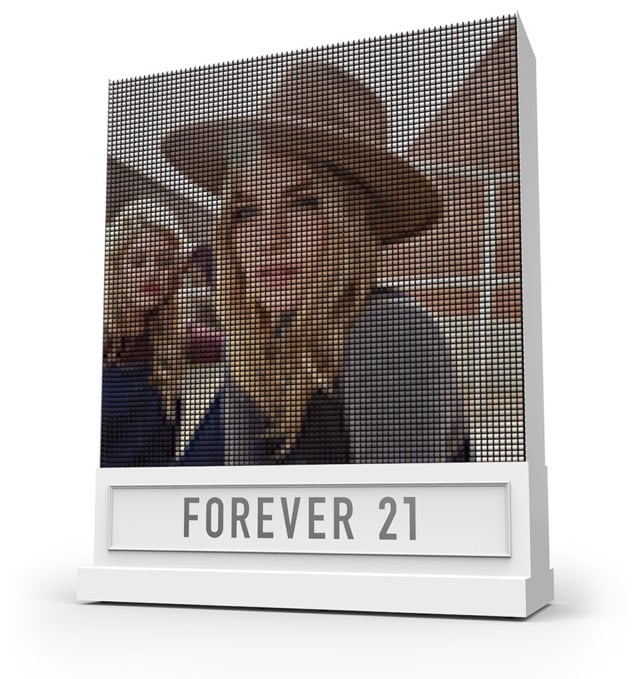
Clothing retailer Forever 21 hired product and prototyping company Breakfast to build them a giant screen made out of spools of thread to “print” people’s Instagram photos. The screen, which Breakfast bills as “one of the most complex machines ever built for a brand”, weighs 2000 pounds, measures 11 ft high, 9 ft wide, and 3 ft deep, and has a resolution of 80x80 spool pixels. Here’s how they made it:
If you want to give it a try, just tag an Instagram photo with #F21ThreadScreen and it’ll print it out for you (watch the live stream). Prior art alert: the first time I remember seeing something like this was Daniel Rozin’s Wooden Mirror (1999) at ITP (video here).
I don’t know if Facebook buying WhatsApp for $16 billion is a good idea for Facebook or not, but I’m pretty sure it’s a potentially good idea. I’d heard of WhatsApp before, but I first took real notice of it last July when researching this post about Instagram businesses in Kuwait.
Several of the businesses I found used WhatsApp for messaging…browse via Instagram, arrange to buy via WhatsApp. Very low cost, more flexible than SMS, cross-platform, no giant social network appendage to deal with (e.g. Facebook/Twitter), and it’s not email. And, the thing that struck me, WhatsApp (and Instagram) being used for financial/business transactions. Services teens use for social grooming are certainly interesting and important (after all, teens’ social grooming is how, eventually, we end up with more teens), but when you’ve got something being used in all sorts of places all over the world as a social tool *and* a marketplace, you’ve got yourself a platform and that is potentially very valuable.
Fish Tales is billed as the world’s shortest cooking show. Episodes are about 15 seconds long and in each one, you learn how to cook a complete fish/seafood dish. Here’s the latest one, on cooking razor clams:
In Kuwait, people sell all sorts of stuff on Instagram, using the service as a visually oriented mobile storefront instead of using a web site or something like eBay. From an interview with artist/musician Fatima Al Qadiri:
BR: Kuwait is a crazy mix: a super-affluent country, yet basically a welfare state, though with a super neo-liberal consumer economy.
FQ: We consume vast amounts of everything. Instagram businesses are a big thing in Kuwait.
BR: What’s an Instagram business?
FQ: If you have an Instagram account, you can slap a price tag on anything, take a picture of it, and sell it. For instance, you could take this can of San Pellegrino, paint it pink, put a heart on it, call it yours, and declare it for sale. Even my grandmother has an Instagram business! She sells dried fruit. A friend’s cousin is selling weird potted plants that use Astroturf. People are creating, you know, hacked products.
I dug up a few examples: Manga Box is an Instagram storefront selling manga (contact via WhatsApp to buy), Sondos Makeup advertises makeup services (WhatsApp for appts.), sheeps_sell sells sheep, and store & more is an account selling women’s fashion items. There was even an Insta-Business Expo held in April about Instagram businesses.
The Entrepreneurship and Business Club of the American University of Kuwait is holding an “INSTA BUSINESS EXPO” which will consist of all your favorite and newest popular entrepreneurs that grew their businesses through Instagram. Not only that, there will be guest speakers by Entrepreneurs that made it through Instagram as well!
(via @cmchap)
Photographer Clayton Cubitt and Rex Sorgatz have both written essays about how photography is becoming something more than just standing in front of something and snapping a photo of it with a camera. Here’s Cubitt’s On the Constant Moment.
So the Decisive Moment itself was merely a form of performance art that the limits of technology forced photographers to engage in. One photographer. One lens. One camera. One angle. One moment. Once you miss it, it is gone forever. Future generations will lament all the decisive moments we lost to these limitations, just as we lament the absence of photographs from pre-photographic eras. But these limitations (the missed moments) were never central to what makes photography an art (the curation of time,) and as the evolution of technology created them, so too is it on the verge of liberating us from them.
And Sorgatz’s The Case of the Trombone and the Mysterious Disappearing Camera.
Photography was once an act of intent, the pushing of a button to record a moment. But photography is becoming an accident, the curatorial attention given to captured images.
Slightly different takes, but both are sniffing around the same issue: photography not as capturing a moment in realtime but sometime later, during the editing process. As I wrote a few years ago riffing on a Megan Fox photo shoot, I side more with Cubitt’s take:
As resolution rises & prices fall on video cameras and hard drive space, memory, and video editing capabilities increase on PCs, I suspect that in 5-10 years, photography will largely involve pointing video cameras at things and finding the best images in the editing phase. Professional photographers already take hundreds or thousands of shots during the course of a shoot like this, so it’s not such a huge shift for them. The photographer’s exact set of duties has always been malleable; the recent shift from film processing in the darkroom to the digital darkroom is only the most recent example.
What’s interesting about the hot video/photo mobile apps of the moment, Vine, Instagram, and Snapchat, is that, if you believe what Cubitt and Sorgatz are saying, they follow the more outdated definition of photography. You hold the camera in front of something, take a video or photo of that moment, and post it. If you missed it, it’s gone forever. What if these apps worked the other way around: you “take” the photo or video from footage previously (or even constantly) gathered by your phone?
To post something to Instagram, you have the app take 100 photos in 10-15 seconds and then select your photo by scrubbing through them to find the best moment. Same with Snapchat. Vine would work similarly…your phone takes 20-30 seconds of video and you use Vine’s already simple editing process to select your perfect six seconds. This is similar to one of my favorite technology-driven techniques from the past few years:
In order to get the jaw-dropping slow-motion footage of great white sharks jumping out of the ocean, the filmmakers for Planet Earth used a high-speed camera with continuous buffering…that is, the camera only kept a few seconds of video at a time and dumped the rest. When the shark jumped, the cameraman would push a button to save the buffer.
Only an after-the-fact camera is able to capture moments like great whites jumping out of the water:
And it would make it much easier to capture moments like your kid’s first steps, a friend’s quick smile, or a skateboarder’s ollie. I suspect that once somebody makes an easy-to-use and popular app that works this way, it will be difficult to go back to doing it the old way.
Tommy Edison shows how he uses Instagram on the iPhone.
So we’ll just take a picture of the crew. Why I’m holding the thing up to my face like I can look through the thing is beyond me, but here we go.
His Instagram feed is available here. (via ★precipice)
Popular in the 18th century, the Claude glass was a mirror that took the scene behind you and transformed it into something different, much like the filters in Instagram or Hipstamatic promise to do.
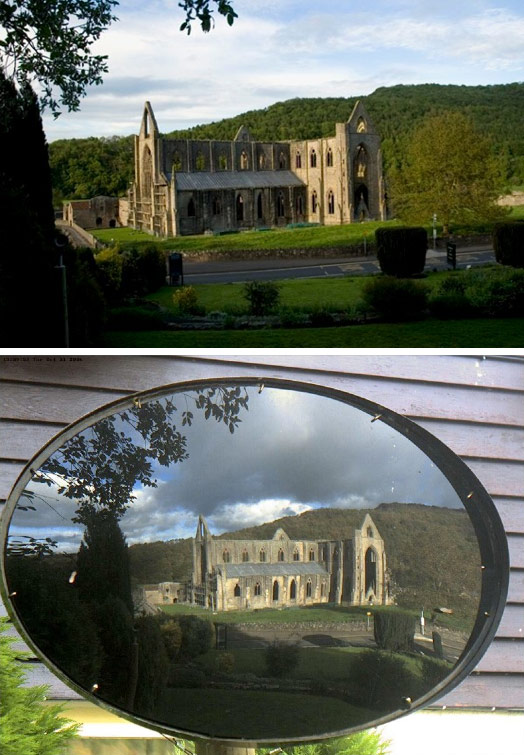
The Claude glass was a sort of early pocket lens without the camera and it was held aloft to observe a vista over one’s shoulder. The technology was simple: A blackened mirror reduced the tonal values of its reflected landscape, and a slightly convex shape pushed more scenery into a single focal point, reducing a larger vista into a tidy snapshot.
One of the more thought-provoking pieces on Instagram’s billion dollar sale to Facebook is Matt Webb’s Instagram as an island economy. In it, he thinks about Instagram as a closed economy:
What is the labour encoded in Instagram? It’s easy to see. Every “user” of Instagram is a worker. There are some people who produce photos — this is valuable, it means there is something for people to look it. There are some people who only produce comments or “likes,” the virtual society equivalent of apes picking lice off other apes. This is valuable, because people like recognition and are more likely to produce photos. All workers are also marketers — some highly effective and some not at all. And there’s a general intellect which has been developed, a kind of community expertise and teaching of this expertise to produce photographs which are good at producing the valuable, attractive likes and comments (i.e., photographs which are especially pretty and provocative), and a somewhat competitive culture to become a better marketer.
There are also the workers who build the factory — the behaviour-structuring instrument/forum which is Instagram itself, both its infrastructure and it’s “interface:” the production lines on the factory floor, and the factory store. However these workers are only playing a role. Really they are owners.
All of those workers (the factory workers) receive a wage. They have not organised, so the wage is low, but it’s there. It’s invisible.
Like all good producers, the workers are also consumers. They immediately spend their entire wage, and their wages is only good in Instagram-town. What they buy is the likes and comments of the photos they produce (what? You think it’s free? Of course it’s not free, it feels good so you have to pay for it. And you did, by being a producer), and access to the public spaces of Instagram-town to communicate with other consumers. It’s not the first time that factory workers have been housed in factory homes and spent their money in factory stores.
Although he doesn’t use the term explictly, Webb is talking about a company town. Interestingly, Paul Bausch used this term in reference to Facebook a few weeks ago in a discussion about blogging:
The whole idea of [blog] comments is based on the assumption that most people reading won’t have their own platform to respond with. So you need to provide some temporary shanty town for these folks to take up residence for a day or two. And then if you’re like Matt — hanging out in dozens of shanty towns — you need some sort of communication mechanism to tie them together. That sucks.
So what’s an alternative? Facebook is sort of the alternative right now: company town.
Back to Webb, he says that making actual money with Instagram will be easy:
I will say that it’s simple to make money out of Instagram. People are already producing and consuming, so it’s a small step to introduce the dollar into this.
I’m not so sure about this…it’s too easy for people to pick up and move out of Instagram-town for other virtual towns, thereby creating a ghost town and a massively devalued economy. After all, the same real-world economic forces that allowed a dozen people to build a billion dollar service in two years means a dozen other people can build someplace other than Instagram for people to hang out in, spending their virtual Other-town dollars.
Also worth a read on Facebook/Instagram: Paul Ford’s piece for New York Magazine.
Facebook, a company with a potential market cap worth five or six moon landings, is spending one of its many billions of dollars to buy Instagram, a tiny company dedicated to helping Thai beauty queens share photos of their fingernails. Many people have critical opinions on this subject, ranging from “this will ruin Instagram” to “$1 billion is too much.” And for many Instagram users it’s discomfiting to see a giant company they distrust purchase a tiny company they adore - like if Coldplay acquired Dirty Projectors, or a Gang of Four reunion was sponsored by Foxconn.
So what’s going on here?
First, to understand this deal it’s important to understand Facebook. Unfortunately everything about Facebook defies logic. In terms of user experience (insider jargon: “UX”), Facebook is like an NYPD police van crashing into an IKEA, forever - a chaotic mess of products designed to burrow into every facet of your life.
Mastergram takes photos from well-regarded photographers (Capa, Burtynksy, Weegee, etc.) and runs them through Instagram filters.
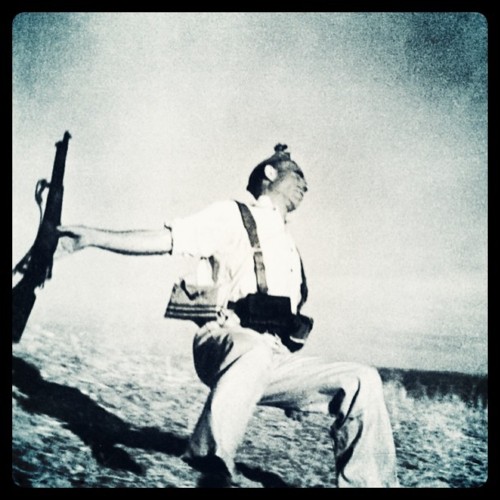
If the Instagram effect can make mundane images appear to be works of art, what happens when we apply the same filters to images that have historically been held in high regard? Is the imagery degraded or enhanced as a result?
The recent uploads by your contacts is the most important page on Flickr and it’s broken. Timoni West is a designer at Flickr and she wrote a brief post on that page’s problems.
The page fails on a fundamental level — it’s supposed to be where you find out what’s happened on Flickr while you were away. The current design, unfortunately, encourages random clicking, not informed exploration.
The page isn’t just outdated, it’s actively hurting Flickr, as members’ social graphs on the site become increasingly out of sync with real life. Old users forget to visit the site, new sign ups are never roped in, and Flickr, who increased member sign-ups substantially in 2010, will forego months of solid work when new members don’t come back.
Many of my friends have switched their photo activities to Instagram and, more recently, Mlkshk. And Flickr’s broken “what’s new from your friends” page is to blame. Both of those sites use a plain old one-page reverse-chronological view of your friends’ photos…just scroll back through to see what’s going on. The primary advantage of that view is that it tells a story. Ok, it’s a backwards story like Memento, but that kind of backwards story is one we’re increasingly adept at understanding. The Flickr recent uploads page doesn’t tell any stories.
As long as we’re talking about what’s wrong with Flickr — and the stories thing comes in here too — the site is attempting to occupy this weird middle ground in terms of how people use it. When Flickr first started, it was a social game around publishing photos. You uploaded photos to Flickr specifically to share them with friends and get a reaction out of them. As the service grew, Flickr became less of a place to do that and more of a place to put every single one of your photos, not just the ones you wanted friends to see. Flickr has become a shoebox under the bed instead of the door of the refrigerator or workplace bulletin board. And shoeboxes under beds aren’t so good for telling stories. A straight-up reverse-chron view of your friends’ recent photos probably wouldn’t even work on Flickr at this point…you don’t want all 150 photos from your aunt’s trip to Kansas City clogging up the works. Instagram and Mlkshk don’t have this problem as much, if at all. (via @buzz)




Socials & More